Key Takeaways
Perth is one of the safest major Australian cities, but its isolation and scarce rental stock create two scam clusters: (1) transport — airport taxi overcharge and artificial Uber surges on Kings Perth Hwy routes; and (2) rental — a very hot sharehouse market makes Facebook Marketplace fake-listing fraud endemic. Traveler reports describe a current pattern where Uber drivers create artificial surge prices by refusing rides until the fare ticks up.
⚡ Quick Safety Tips
- At Perth Airport T1/T2 use Uber or DiDi from the rideshare bay — taxis have been reported at 3–5× legitimate fares.
- Never send a deposit on a Perth rental or sharehouse before an in-person viewing — Facebook Marketplace fakes are documented weekly on traveler reports.
- Buy Rottnest Island ferry + bike + accommodation packages direct from rottnestisland.com or official ferry operators (Rottnest Express, Sealink).
- At Fremantle Markets, pay by card only for anything over $20 — stall overcharging and 'system error' receipts are an issue.
- Northbridge nightlife is generally safe but keep phones off tables and pay round-by-round to avoid tab inflation.
- Use Transperth SmartRider or contactless on all public transport — Perth Airport train opens May 2026 providing a tourist-proof airport transfer.
Jump to a Scam
- High Perth Airport Taxi & Uber 'Fake Surge' Overcharge
- High Perth Facebook / Gumtree Fake Rental Scam
- Medium Rottnest Island Ferry & 'Day Tour' Upsell
- Low Fremantle Markets & 'Cappuccino Strip' Overcharge
- High Perth Backpacker Hostel Prepay Scam
- Medium Northbridge Nightlife Tab Inflation & Card Skim
The 6 Scams
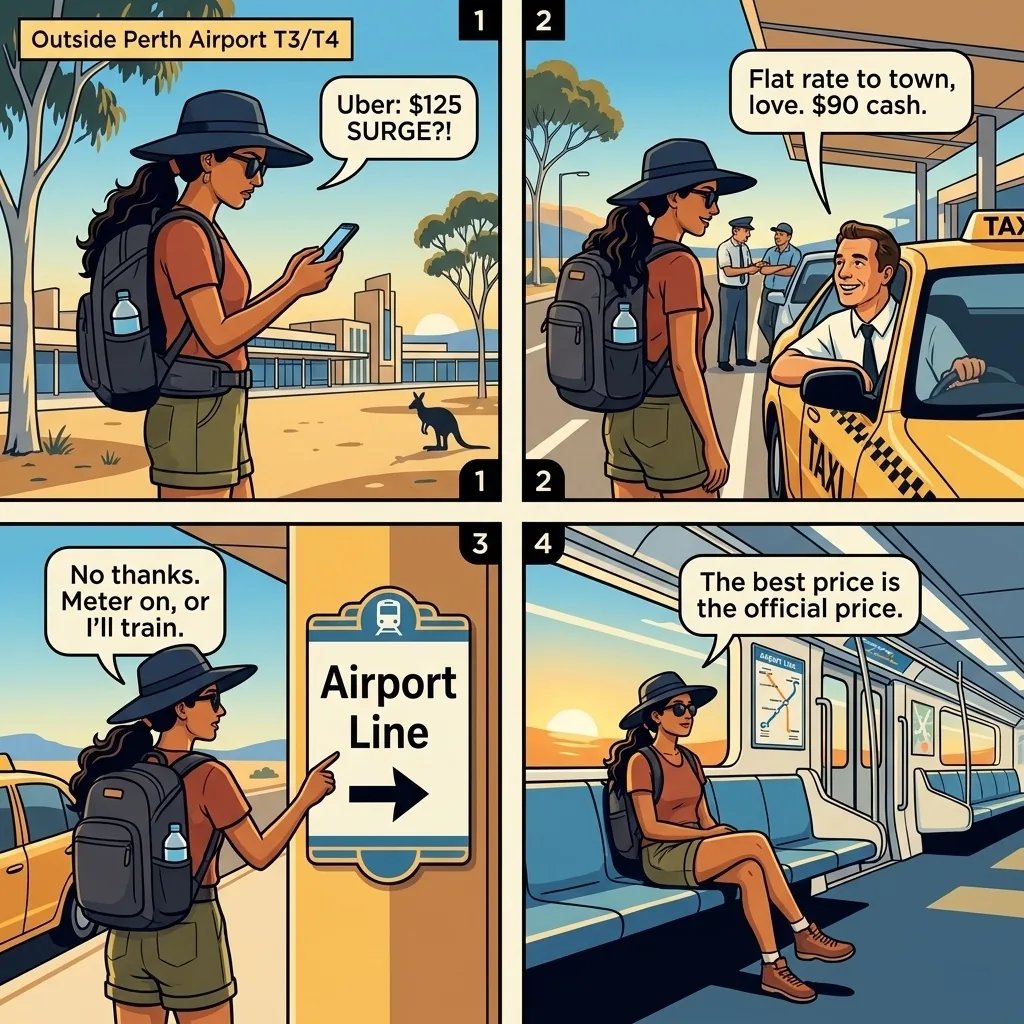
At Perth Airport, the Uber app quotes a $125 "surge" fare for a trip that should be $35. Frustrated, you switch to a taxi at the rank, where the driver offers a flat $90 cash fare — for a ride the meter would have clocked at $52.
You land at Perth Airport at 6am, exhausted. The Uber app quotes you an eye-watering $125 for a trip to Northbridge that should cost around $35, flagging it as 3.5x surge pricing. At the taxi rank, a driver waves you over, claims his meter is “slow tonight,” and offers a flat $90 cash fare. The catch is that the actual metered fare, including the airport's $5 surcharge, would be about $52. This happens most often during the 4am–6am and 5pm–7pm windows, when fly-in-fly-out mining traffic thins the pool of available drivers, who then coordinate to keep prices artificially high.
If one app is surging, check another like DiDi before you commit — both have designated pickup bays at all terminals. Often, just waiting ten minutes is enough for the surge to reset as drivers see potential fares walking away. Standard rideshare trips from the airport to the CBD should run $35–$55, with metered taxis costing about the same plus the surcharge. Anything quoted over $80 is a signal to find a different ride. Since late 2022, the simplest fix is the airport's own rail link, which connects Terminals 3 and 4 to the city for under $5.
The Western Australian Department of Transport requires taxi meters to be used for all rank and hail trips. Drivers at the T1 international rank exploit a loophole for pre-booked journeys — where a fare can be agreed upon beforehand — by making verbal cash offers to unsuspecting arrivals. This behavior is a known issue, with traveler forums documenting the same play running daily. The official metered rate is calculated by distance and time, not a driver's whim. Insist the driver uses the meter or book a ride on a designated app — its upfront pricing is your binding contract.
Red Flags
- Uber quote 2–4× above normal ($35–55) without weather or event cause
- Multiple drivers cancel in succession — artificial scarcity setup
- Taxi driver quotes a 'flat rate' above $80 for a CBD trip
- Driver refuses to run the meter or covers the display
- 'Card machine broken' demand for cash
How to Avoid
- Take the Perth Airport train to CBD (<$5, every 15 min) as the tourist-proof option.
- Use Uber or DiDi from the rideshare bay — typical CBD fare is $35–$55.
- Compare Uber, DiDi and Bolt before ordering — one is usually normally priced.
- Wait 10 minutes and retry if surges are extreme — they reset.
- Insist on meter and card tap for any taxi — screenshot the receipt.
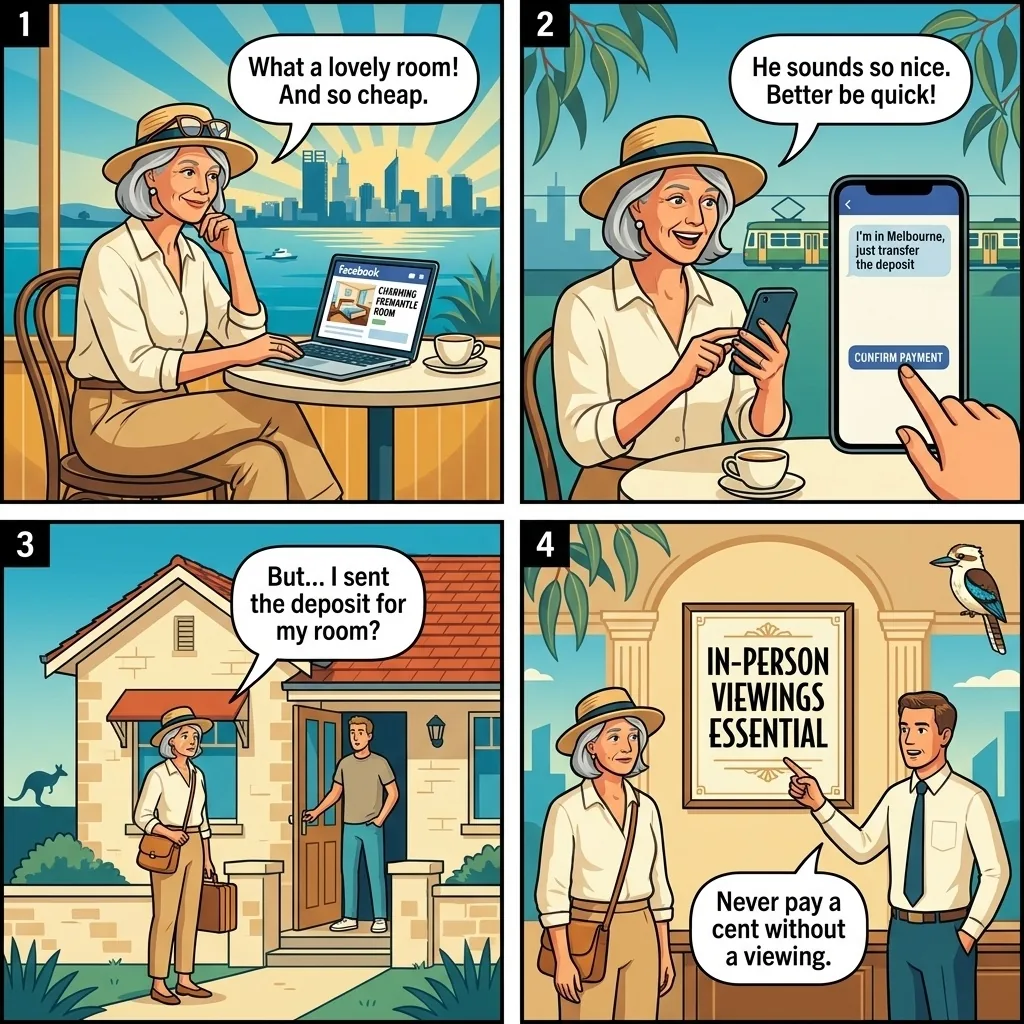
You find a Fremantle share-room listed on Facebook Marketplace for $200/week — great photos, a friendly 'landlord' who says he's currently in Melbourne and needs a bank-transfer deposit of $400 to hold the room. You send it. When you arrive in Fremantle, the address is a family home, and the Facebook account has vanished.
The listing appears on Facebook Marketplace or Gumtree: a share-room in a desirable suburb like Fremantle or Subiaco for just $200 a week. The photos look great, and the 'landlord' is friendly and responsive over messaging. They explain they're currently away for work — in Melbourne or Singapore — but are keen to lock in a good tenant. All they need is a bank transfer of $400 to $800 to hold the room for you.
Once the 'holding deposit' is sent, the trap closes. The friendly landlord vanishes, deleting the social media profile and the listing. Arriving at the address, you discover it's a private family home whose residents have no idea about any rental. The scammers, who lift photos from legitimate real estate sites, specifically target backpackers and new arrivals on Working Holiday Visas, who may not have an Australian bank account to dispute the transfer through.
This scam exploits a legal loophole. WA's Department of Mines, Industry Regulation and Safety (DMIRS) confirms that any security bond must be lodged with the state's Bond Administrator and cannot exceed four weeks' rent. By calling the payment a 'holding deposit' — a term with no legal standing — operators bypass these protections entirely. The tactic is so common that many long-term Perth renters now refuse to use Facebook for their housing search , favoring sites like flatmates.com.au. If a landlord refuses to let you walk through the door before the deposit hits their account, the door doesn't exist — report the listing to ScamWatch at scamwatch.gov.au and WA Police on 131 444.
Red Flags
- 'Landlord' insists on bank transfer or crypto before an in-person viewing
- Listing price is 30–50% below comparable Perth suburb stock
- Communication exclusively via Facebook Messenger with a <6-month-old profile
- 'Landlord is overseas / in another state' and can't meet but a 'friend' could — classic bait
- Listing photos reverse image-search to real estate sites or other cities
How to Avoid
- Never pay any deposit before an in-person viewing and key handover.
- Use airbnb.com / booking.com only for short stays, via the app or a bookmarked URL.
- For sharehouses use flatmates.com.au and inspect in person before paying.
- Reverse image-search photos in Google Images before any financial commitment.
- Report scams to ScamWatch at scamwatch.gov.au and WA Police on 131 444.
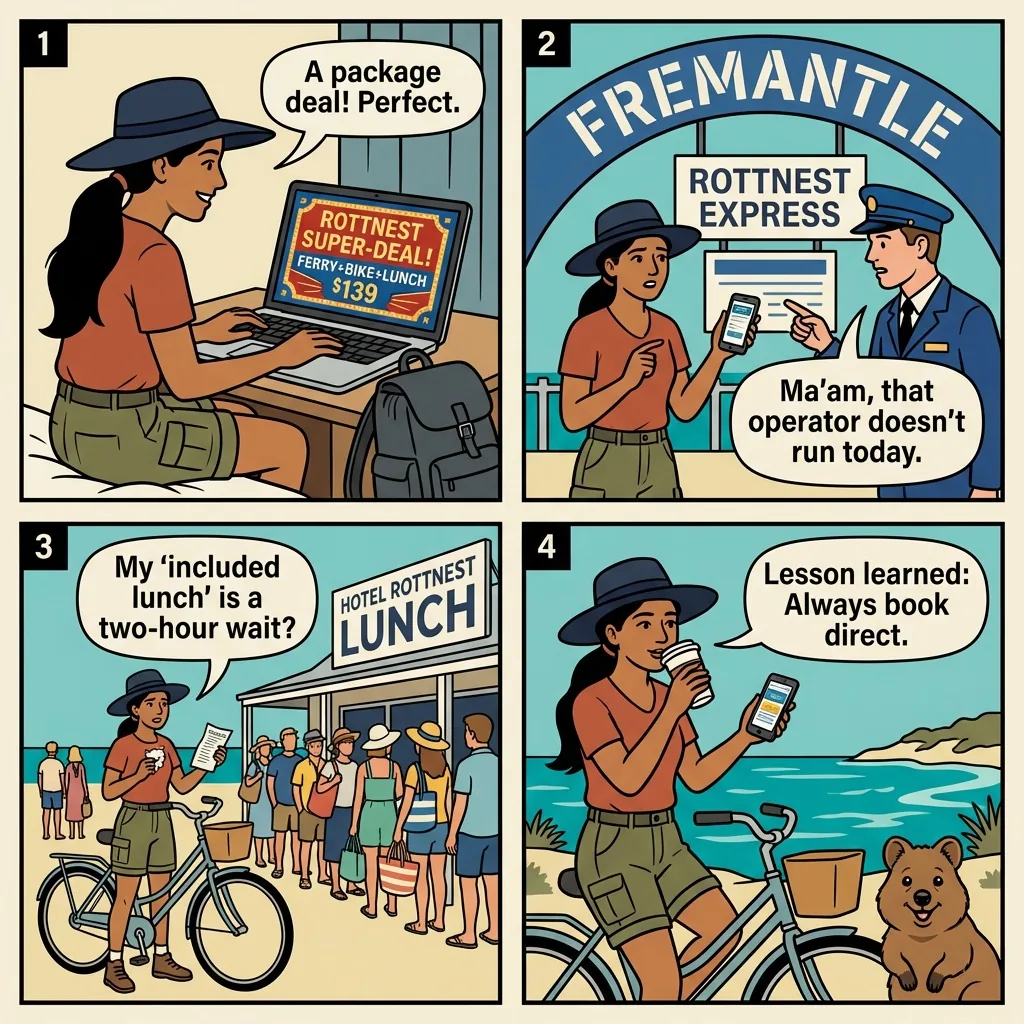
An online ad for a Rottnest Island 'day trip' offers a ferry, bike, and lunch package for $139. At the Fremantle terminal, you discover the ferry runs on a limited schedule, the bike is basic with no helmet, and the 'lunch' is a worthless voucher.
A search for 'Rottnest Island day trip' surfaces an aggressive booking site offering a 'ferry + bike + lunch' package for just $139 — a steal, considering the island's notoriously high costs. A standard visit can easily run double that, with a $50+ admission fee, a $50–$90 ferry ticket, and $30+ for bike hire. Locals are quick to point out the island has been priced for capacity, not backpackers, for years (a frequent topic in traveler forums), making the all-in-one deal seem like the only affordable way to go.
The trap closes when you arrive at the Fremantle B Shed or Barrack Street jetty. You discover the ferry portion is with a budget operator that only runs on odd-numbered weekdays, which don't match your dates. The included bike is a single-speed clunker without a helmet, and the 'lunch' is a restrictive voucher for a single dish at a Hotel Rottnest counter, where the queue can stretch to 90 minutes at peak times. By the time you've paid for upgrades or found alternatives, you've burned half the daylight and spent more than the official rate.
This model relies on obscuring the final cost and operator details until after you've paid. While the Australian Competition & Consumer Commission (ACCC) enforces consumer laws against such misleading claims, these third-party sites persist. The best defense is to book directly with the two established ferry operators, Rottnest Express and Sealink Rottnest Island, and pay the Rottnest Island Authority admission fee separately on its official site. Using a credit card provides chargeback leverage if any part of a third-party deal isn't delivered. Book ferry, admission, and bike hire as separate items on the official operator and Rottnest Island Authority websites.
Red Flags
- Aggressive discount site offers 'ferry + bike + lunch' for 20–30% below direct booking
- Operator isn't Rottnest Express, Sealink Rottnest Island, or a ferry-owner partnership
- Ferry dates are 'flexible' but not specified at booking
- 'Lunch voucher' doesn't name a specific restaurant or meal
- No confirmation email with ticket-holder name and specific boat departure
How to Avoid
- Book directly with Rottnest Express (rottnestexpress.com.au) or Sealink (sealinkrottnest.com.au).
- Buy the Rottnest Island Authority admission separately at rottnestisland.com.
- Rent bikes on-island at Pedal & Flipper — $30/day with helmet.
- Pay by credit card for chargeback protection.
- Read TripAdvisor reviews of the exact ferry operator from the last 6 months.
Like what you're reading? Get a full Perth itinerary with safety tips built in.
Browse travel-safety books →
At a stall in Fremantle Markets, you pick out a $25 mass-produced boomerang, but the cashier rings it up as an $89 authentic Indigenous piece. You tap-to-pay without checking the itemized bill, only discovering the overcharge after you've left the market.
The scene is classic Fremantle: you're wandering the weekend markets or grabbing a seat on the bustling 'Cappuccino Strip'. Inside the market, stalls are piled high with tourist-friendly boomerangs, didgeridoos, and t-shirts. On the street, the sun is out and an open-air table at a cafe seems like the perfect spot. The trap is set with seemingly harmless convenience — a pile of souvenirs to be paid for with a single tap, or a menu you don't see before you sit down. Authentic Indigenous art is genuinely expensive, and the price gap between a mass-produced souvenir and a certified piece is where the overcharge scam lives.
At the register, your pile of goods comes to $245. You tap your card without checking the itemization. Only later do you see the $25 wooden boomerang was rung up at $89, the price for an authentic, artist-made piece. For multi-item purchases, the total is often compressed into one lump sum nobody questions. On the Cappuccino Strip, the trap closes when the bill arrives with an outdoor seating surcharge that was only printed on the menu inside. Locals know the area is rife with these small-scale cons, with traveler reports documenting the pattern of over-priced pubs and flexible market pricing.
This behavior exploits tourist ignorance of the strict rules governing the sale of Indigenous art. The Indigenous Art Code and the ACCC's rules on misleading conduct are clear, but market stalls selling mass-produced items for over $50 are banking on you not knowing the difference. Legitimate galleries in Fremantle's West End, like Japingka, are signatories to the code and will provide a Certificate of Authenticity detailing the artist's story and the work's meaning. Don't buy Indigenous art at a generic stall if the operator can't provide certification from a body like the Aboriginal Art Association. Only buy Indigenous art from a dedicated gallery that is a signatory to the Indigenous Art Code—their membership is your guarantee of authenticity.
Red Flags
- Stall won't provide itemized receipt — just a single tap-total
- 'Indigenous art' at under-market prices without provenance or certification
- Menu prices posted inside only, with outdoor-seat surcharges undisclosed
- Card reader 'rebooting' multiple times during a single purchase
- Rounded-up totals on multi-item purchases ($45 → $48 'includes GST')
How to Avoid
- Always request itemized receipts — count the items on the receipt match what you bought.
- Buy Indigenous art only from certified galleries (Japingka, Fremantle Arts Center).
- Check menu prices before sitting outside at Cappuccino Strip cafes.
- Pay by card tap and screenshot receipts immediately.
- Challenge rounded totals politely — most operators correct errors when asked.
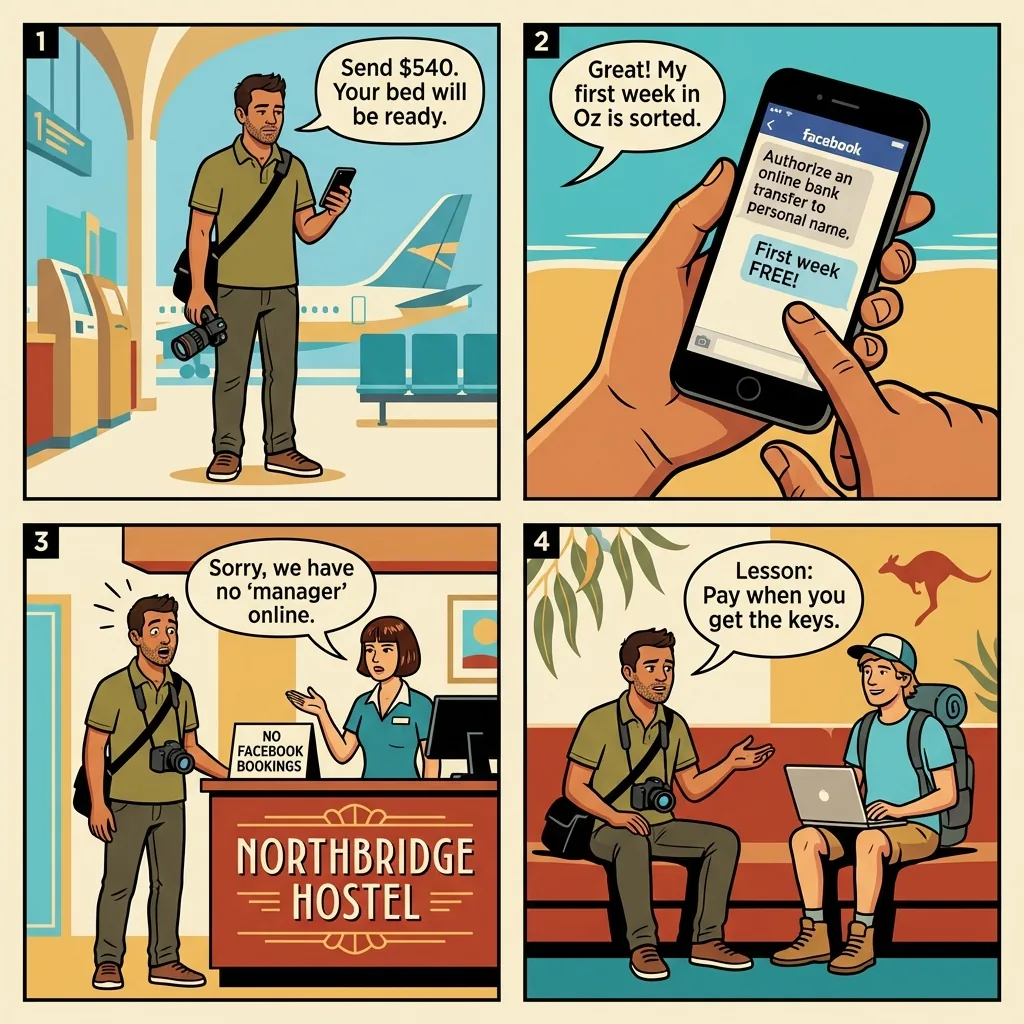
A 'manager' in a Facebook backpacker group offers a Northbridge hostel bed for $180/week, with the first week free if you prepay four weeks by bank transfer. You send the $540, but the manager vanishes and the hostel has no record of your booking.
You've just landed in Perth on a Working Holiday Visa, scrolling through a backpacker group on Facebook. An ad catches your eye: a 'manager' is offering a bed in a Northbridge hostel for just $180/week. The deal gets better — pay four weeks upfront by bank transfer and get the first week free. The pitch is designed for new arrivals who are jet-lagged, don't have an Australian bank account to dispute a charge, and are desperate to get settled without the hassle of a formal lease. It's a common play, with numerous traveler reports documenting nearly identical stories.
You calculate the savings and send the $540 — three weeks' rent — to the bank account provided. The 'manager,' who was so responsive before, suddenly goes silent. When you show up at the hostel address, luggage in hand, the front desk staff gives you a sympathetic but firm look: they've never heard of the manager, there's no bed reserved in your name, and your money is gone. Because you used a direct bank transfer, there's no platform protection or way to reverse the payment.
This isn't just a backpacker problem; it's a city-wide rental scam. WA ScamNet, the state's consumer protection agency, issues regular warnings about fake rental listings on Gumtree and Facebook Marketplace that demand upfront payments for properties that don't exist. These scams flourish when the rental market is tight, and the average loss reported in 2023 was over $2,000. For legitimate short-term stays, book only through verified platforms like HostelWorld or Booking.com, which offer protection. For longer-term sharehouses, always inspect the property in person and meet the current flatmates before paying anything. Book your first three nights in Perth through HostelWorld or Booking.com before you arrive — this gives you a secure address and time to inspect long-term options in person without pressure.
Red Flags
- 'Hostel manager' requires bank transfer before check-in
- Communication only via Facebook/WhatsApp with a <12-month-old profile
- Listing price significantly below Perth hostel dorm rates ($28–40/night)
- 'Special deal' that requires 2–4 weeks prepayment
- 'Manager' can't name the hostel's reception staff or current operating hours
How to Avoid
- Book hostels only via HostelWorld, Booking.com, or directly at reception.
- Never pay more than one night's stay before check-in — not even a deposit.
- Cross-check any Facebook post in the Perth Working Holiday group before paying.
- Keep a copy of your bank-transfer reference number — needed for WA Police reports.
- If scammed, file a police report at police.wa.gov.au and ScamWatch.
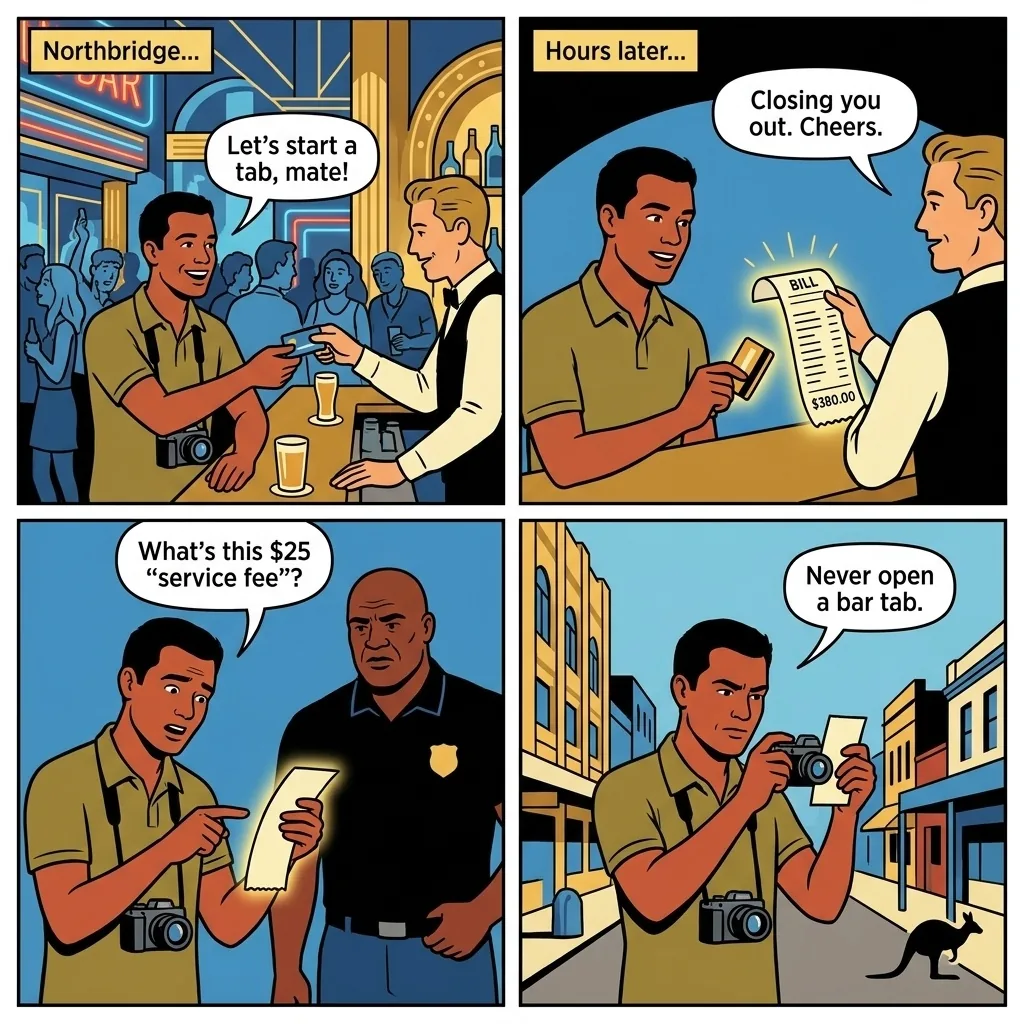
You open a tab at a busy Northbridge club and end the night with a $380 bill. It's inflated with 'accidental' double-taps on the card reader and a hidden $25 service charge — and security is watching closely as you review the receipt.
Traveler reports on Northbridge are a long catalogue of patience-tested late nights: this is where WA's nightclub licensing is deliberately concentrated, so the same tab-inflation playbook running in Fortitude Valley and Cavill Avenue runs here too. The specifically Perth variants are mechanical: card readers that "system error" and ring up the same round twice, tab items for drinks nobody ordered showing up at 2am, and undisclosed event-night cover charges quietly rolled into the final bill while security hovers a step behind you.
Your defense is identical to any Australian nightlife district. Never open a tab; pay round-by-round with card tap. Keep your card in your wallet and only tap personally — never hand it over. Scrutinize every receipt before signing. If a tab is unavoidable for a group purchase, appoint one trusted person to hold it and photograph each drink receipt as it comes back. If the bill is wrong, ask for the venue manager, photograph the itemized total, and dispute the charge with your bank the next business day — Australian card networks side with the cardholder when the venue can't produce signed receipts for every line item.
Consumer Protection WA documents a consistent pattern of nightlife complaints from the William Street and James Street precinct, particularly around unauthorized transactions and non-itemized bills. Under Australian Consumer Law, venues must display all surcharges and service fees clearly before the point of sale; adding them silently to a final tab is illegal. Pay for each round separately using your phone or watch's tap-to-pay function — this keeps your physical card out of sight and creates a clear, timestamped digital receipt for every single transaction.
Red Flags
- Bartender wants to hold your card 'to keep the tab open'
- Card reader taps multiple times in succession on a single purchase
- Bill has undisclosed 'service charge' or 'event fee' at the end
- Security stands uncomfortably close while you review the bill
- Items on the receipt that nobody in the group remembers ordering
How to Avoid
- Never open a tab — pay round-by-round with card tap.
- Keep your card in your wallet; tap personally, never hand over.
- Photograph every bar receipt so totals are verifiable at the end of the night.
- Challenge bills calmly — request the venue manager and itemization.
- Chargeback disputed charges next business day with your bank.
🆘 What to Do If You Get Scammed
📋 File a Police Report
Go to the nearest Western Australia Police station. Call 000 (emergency) or 131 444 (non-emergency). Get an official crime report — you'll need this for insurance claims. You can also report online at police.wa.gov.au.
💳 Cancel Your Cards
Call your bank immediately. Most have 24/7 numbers on the back of the card (keep a photo saved separately). Block any suspicious transactions before the thieves use your details.
🛂 Lost Passport?
Contact your nearest embassy or consulate. The US Consulate General in Perth is at Level 6, 16 St Georges Terrace, Perth WA 6000 (+61 8-9202-1224). The UK High Commission is in Canberra (+61 2-6270-6666). Report scams to Consumer Protection WA or ScamWatch at scamwatch.gov.au.
📱 Track Your Device
If your phone was stolen, use Find My (iPhone) or Find My Device (Android) from another device. Don't confront thieves yourself — share the location with police instead.