Key Takeaways
Alice Springs is the gateway to Uluru, Kata Tjuta and the Red Centre — and the scam mix reflects that. The dominant risks are (1) mislabeled 'Aboriginal art' (Alice is Australia's biggest fake-Aboriginal-art market), (2) cloned Uluru Sounds of Silence or Field of Light booking sites, (3) rental car damage claims after outback self-drives where unsealed roads void insurance, and (4) backpacker hostel prepayment scams. Uluru itself is a sacred site managed jointly by Anangu traditional owners and Parks Australia — all entry is regulated and legitimate.
⚡ Quick Safety Tips
- Buy Aboriginal art ONLY from galleries displaying the Indigenous Art Code — Alice has the highest concentration of fake-art vendors in Australia.
- Book Sounds of Silence, Field of Light and all Uluru-Kata Tjuta experiences ONLY at ayersrockresort.com.au or parksaustralia.gov.au.
- Pay for Uluru-Kata Tjuta National Park admission at parksaustralia.gov.au — $38/adult/3-day pass, no agent needed.
- If you drive from Alice Springs to Uluru (450 km), confirm your rental contract explicitly allows the Stuart Highway — and avoid ALL unsealed detours.
- Never pre-pay an Alice hostel or Yulara accommodation to a Facebook seller — use booking platforms with escrow.
- At Uluru climb is closed since 2019 — any operator claiming to offer 'climb experiences' is lying.
Jump to a Scam
- High Fake Aboriginal Art Gallery & 'Genuine Artist' Mislabelling
- Medium Cloned Uluru 'Sounds of Silence' & 'Field of Light' Booking Site
- High Alice Springs Rental Car Outback Damage Claim
- Medium Alice Springs Airport Taxi Short-Run Overcharge
- High Alice Springs Backpacker Hostel & Uluru Accommodation Prepay Scam
- Medium Fake Uluru 'Experience Combo Pass' Ticket Fraud
The 6 Scams
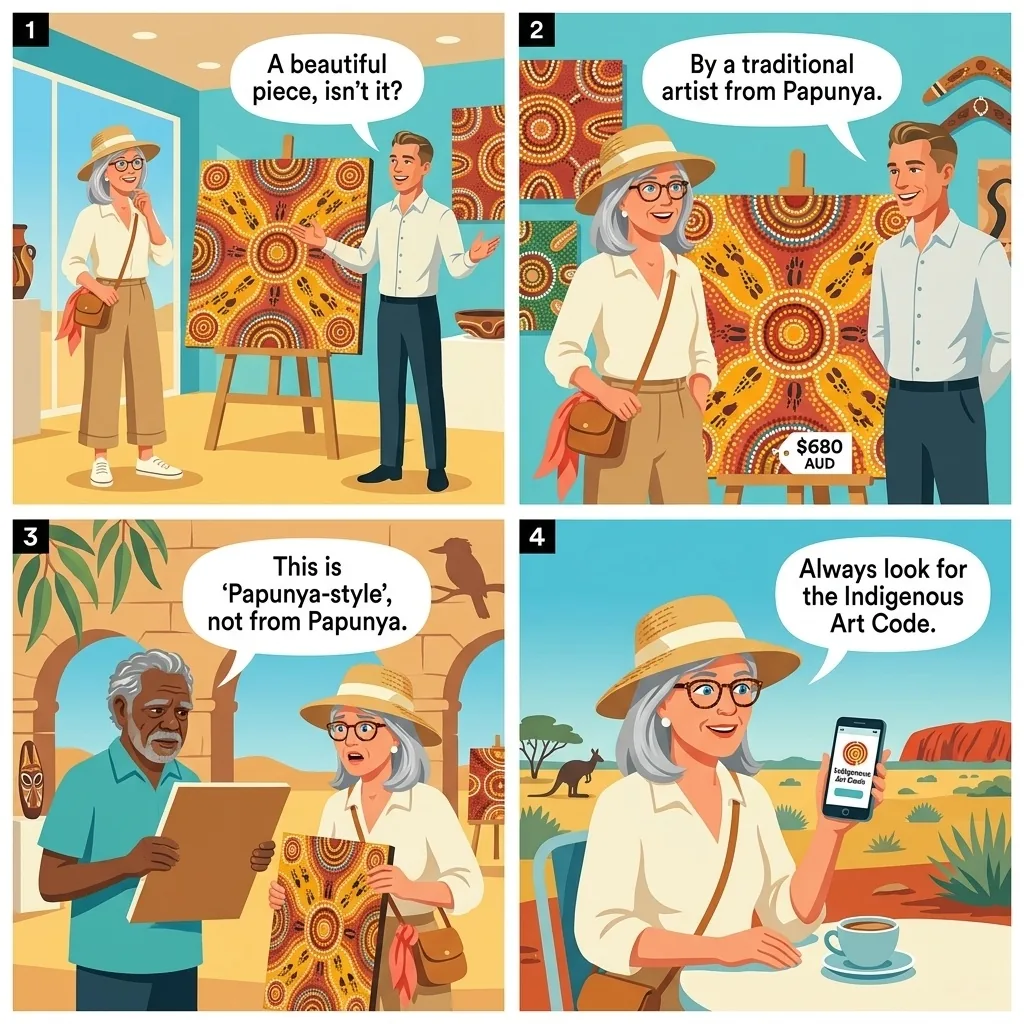
In Alice Springs galleries along Todd Mall, mass-produced dot paintings from overseas workshops are sold as authentic Aboriginal work for $400–$1,500 per piece — vendors name a community ('Papunya') or style ('Desert dot') but cannot produce artist provenance paperwork or an Indigenous Art Code membership listing.
Alice Springs is Australia's largest Aboriginal art market, and Todd Mall is lined with dozens of galleries ranging from community-controlled cooperatives to shopfronts selling mass-produced reproductions. Tourists arrive expecting that the geographic setting guarantees authenticity — the dot-painting aesthetic, the word 'Aboriginal' on the sign, the premium price — without a quick way to distinguish a genuine community artist from a commercial forger.
Vendors use community place-names like 'Papunya,' 'Western Desert,' or 'Arnhem Land' as style labels rather than provenance markers. An artist name may appear on the wall card but cannot be verified against any public registry. Pieces stack identically across shelves at the same price — a pattern consistent with batch production rather than individual artistic work — and the gallery is absent from the Indigenous Art Code member register at indigenousartcode.org.
The Indigenous Art Code was created specifically because geographic proximity and art-world aesthetics are not sufficient proof of origin. Buy only from galleries displaying the Indigenous Art Code membership logo, and ask for the artist's full name, community of origin, and written provenance paperwork on any piece over $200 — every legitimate Code gallery has this on file, and failure to produce it is a clean reason to walk out.
Red Flags
- Gallery can't provide the artist's community of origin or provenance paperwork
- Mass-stacked paintings of the same style and size at identical prices
- 'Papunya-style' or 'Desert dot painting style' branding without a named artist
- Gallery not displayed on the Indigenous Art Code member register
- Prices at 30–50% below comparable ArtPrice Australia records for a 'named' artist
How to Avoid
- Buy only from Indigenous Art Code signatories (list at indigenousartcode.org).
- Verified Alice sources: Papunya Tula Artists, Mbantua Gallery, Araluen, Keringke.
- Ask for artist name, community and provenance paperwork on any piece over $200.
- Cross-check artists at NATSIAA and ArtPrice Australia.
- Pay by card for chargeback leverage if the piece isn't as described.
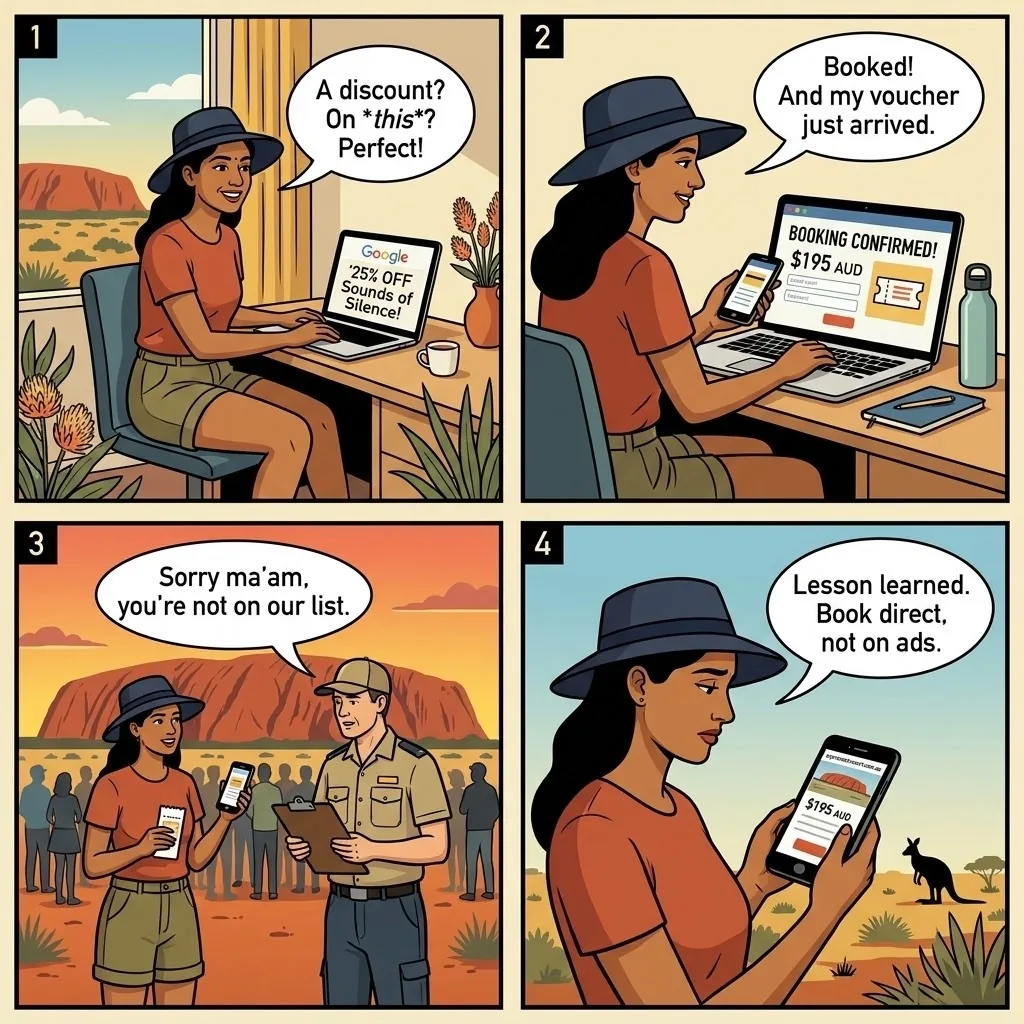
Cloned booking sites mirroring the Ayers Rock Resort look run Google Ads targeting 'Uluru Sounds of Silence' and 'Field of Light' at 20–30% below official prices, collect full payment, and deliver either worthless PDF vouchers or nothing — Sounds of Silence and Field of Light have no authorized third-party resellers.
Sounds of Silence ($275+ per person) and Field of Light ($55+ per person) are proprietary experiences operated exclusively by Ayers Rock Resort at Yulara. Parks Australia sells the three-day national park pass ($38/adult) at its own portal. Neither has authorized a discount aggregator or combo reseller to sell on their behalf — a structural fact that most tourists don't know before searching.
Fake booking sites run Google Ads on the experience names, clone the ayersrockresort.com.au visual design, and quote prices 20–30% below the official rate. After payment — almost always by credit card to reduce suspicion — the buyer receives a PDF voucher with a QR code that either doesn't scan at the resort or scans to a generic page. By the time travelers arrive at Yulara for the event, the site's customer support line is an overseas number or already disconnected.
There are no exceptions to the channel rule for these experiences. Book all Uluru experiences directly at ayersrockresort.com.au and National Park admission at parksaustralia.gov.au — any third-party site claiming to bundle, discount, or aggregate these is unauthorized regardless of how legitimate it looks.
Red Flags
- Site domain isn't ayersrockresort.com.au or a named Indigenous Tourism NT operator
- Price is 20–30% below the Ayers Rock Resort rate for Sounds of Silence ($275+) or Field of Light ($55+)
- Payment required by bank transfer or PayPal F&F
- Voucher PDF doesn't have Ayers Rock Resort branding
- Contact phone is an overseas number or disconnected
How to Avoid
- Book Sounds of Silence, Field of Light, Uluru Camel Tours at ayersrockresort.com.au.
- Pay National Park admission at parksaustralia.gov.au ($38/adult/3-day).
- Use Viator or GetYourGuide if you prefer an aggregator — they vet operators.
- Read TripAdvisor reviews from the past 6 months.
- Pay by credit card for chargeback protection.
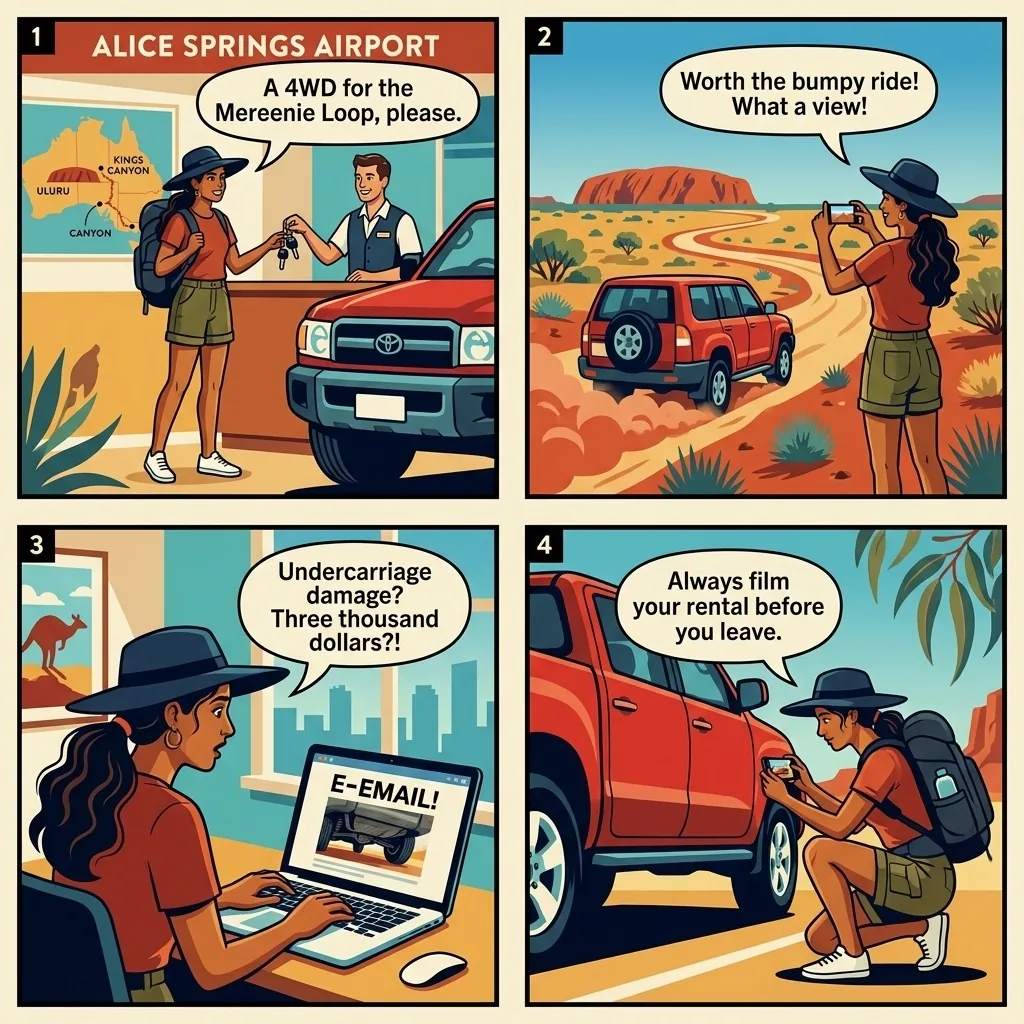
Tourists who rent a 4WD in Alice Springs and take any unsealed road detour — Mereenie Loop, Finke Desert, Kings Canyon access track — return their car to find insurance voided by a contract clause, then receive a $2,000–$5,000 'undercarriage damage' invoice weeks later with undated generic photos.
Alice Springs is the gateway to the Northern Territory's vast unsealed road network — Mereenie Loop to Kings Canyon, the Finke Desert Race route, the Oodnadatta Track, the Tanami Road. Most standard rental contracts explicitly void all insurance coverage the moment you leave sealed roads. GPS trackers installed in the vehicles log every gravel detour, making it straightforward for operators to identify exactly which clause to invoke and when.
The damage claim arrives two to four weeks after drop-off, citing 'undercarriage' or 'chassis' damage that is impossible for the renter to have inspected at handover. Photos are undated or generic — the same undercarriage scratches appear across multiple customers' invoices on Google Maps review threads. The invoice total is calibrated to fall just within the amount a traveler might settle rather than dispute internationally.
The damage evidence is hard to contest after the fact, so the defense is documentary. Film every panel, the undercarriage, and the odometer in a single unedited continuous video at both pickup and drop-off, and get a written list of which specific NT roads your insurance covers before leaving the depot — if you plan to drive the Mereenie Loop, either confirm in writing that it is covered or rent from a specialist outback operator (Britz, Apollo, or Outback Australia 4WD Hire) with appropriate coverage.
Red Flags
- Contract voids insurance on 'all unsealed roads' without itemisation
- GPS tracker visible in vehicle — increases post-rental damage claim plausibility
- Key-drop box drop-off with no signed no-damage receipt
- Post-rental invoice cites 'undercarriage' or 'chassis' damage with generic photos
- Rental company has repeated Google Maps review complaints about phantom charges
How to Avoid
- Itemise covered roads in writing — don't accept 'all unsealed is void'.
- Rent from Britz, Apollo or specialist outback operators for true off-sealed travel.
- Film the car in detail at pickup AND drop-off.
- Use a credit card with primary CDW coverage.
- Dispute phantom charges via chargeback + Consumer Affairs NT.
Like what you're reading? Get a full Alice Springs itinerary with safety tips built in.
Browse travel-safety books →
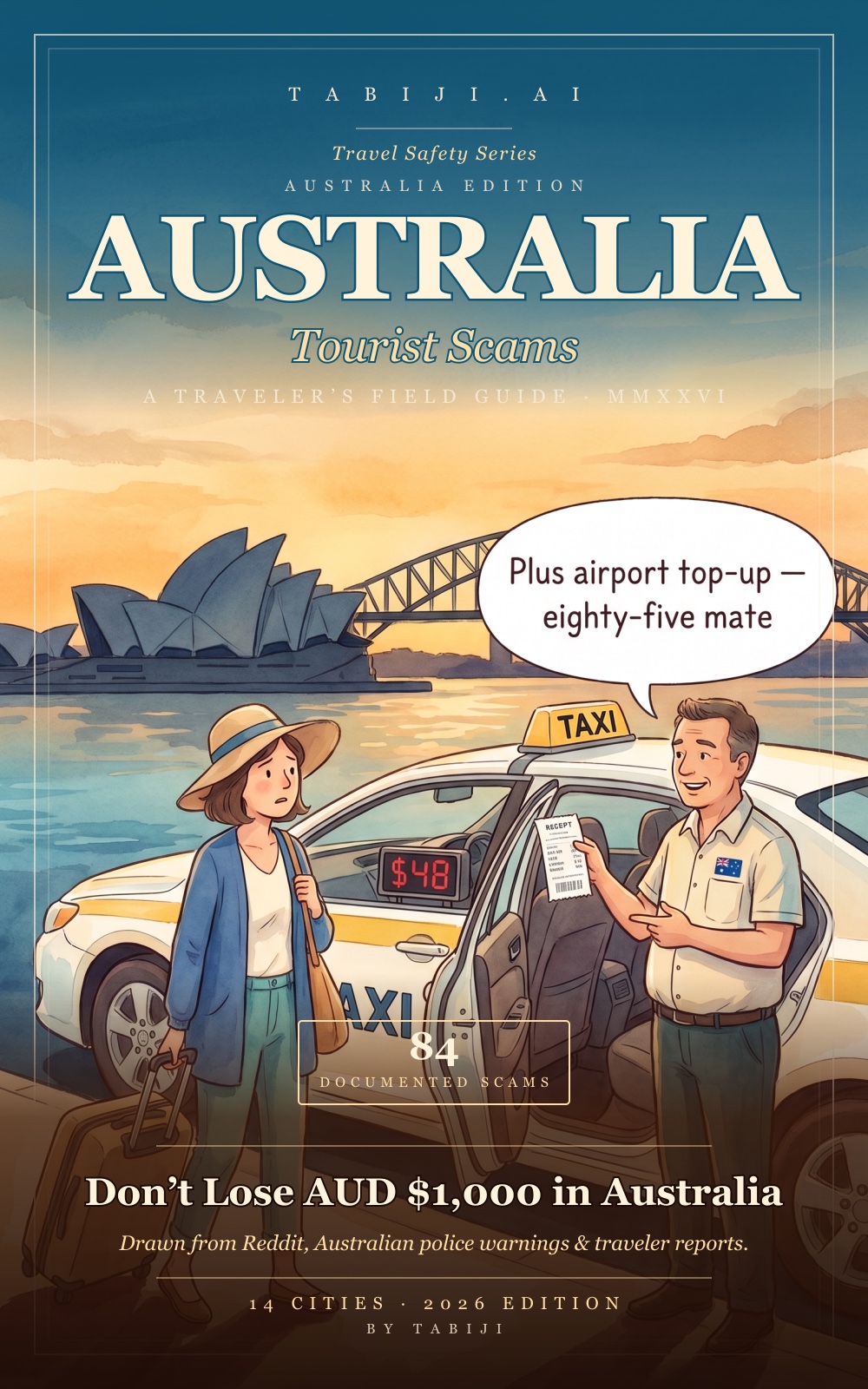
Taxis at Alice Springs Airport (ASP) quote flat rates of $55–$70 for the 15-km CBD run — roughly 40–70% above the metered fare — exploiting the absence of meaningful Uber coverage in Alice Springs to eliminate any price comparison at the curb.
Alice Springs Airport sits 15 km south of Todd Mall. Unlike Brisbane, Sydney, or Melbourne, Alice has minimal rideshare coverage: Uber availability is sporadic and often unavailable at night, leaving most arrivals dependent on the official taxi rank. Drivers know there is no alternative to compare against, which is what makes the flat-rate quote — framed confidently as 'the standard airport price' — so effective.
The quoted flat rate of $55–$70 compares to a metered fare of $35–$42 for the same trip under the Northern Territory taxi fare schedule. Drivers add pressure by quoting the flat rate before you load your bags, making it socially awkward to negotiate after loading. Late-night arrivals are the highest-risk window, when the shuttle services have stopped running and there is no crowd of other travelers to reality-check the price with.
The shuttle bypasses the problem entirely. Pre-book the Airport Transfers Alice Springs shuttle ($25 one-way) or arrange hotel pickup before arriving; if you must take a taxi, insist on the meter before loading bags, pay by card on the in-car terminal, and photograph the taxi plate number as you approach the vehicle.
Red Flags
- Driver quotes a flat rate above $45 for the 15-km CBD run
- 'Card machine is broken' cash-only demand
- 'Night surcharge' with no in-cab signage
- Meter increments faster than legal pulses
- Circuitous route via North Alice or Larapinta Drive
How to Avoid
- Use Airport Transfers Alice Springs shuttle ($25 one-way).
- Arrange hotel airport pickup for late arrivals.
- Insist on meter and pay by card on the in-car terminal.
- Photograph taxi plate before the ride.
- Report bad drivers to Transport NT.
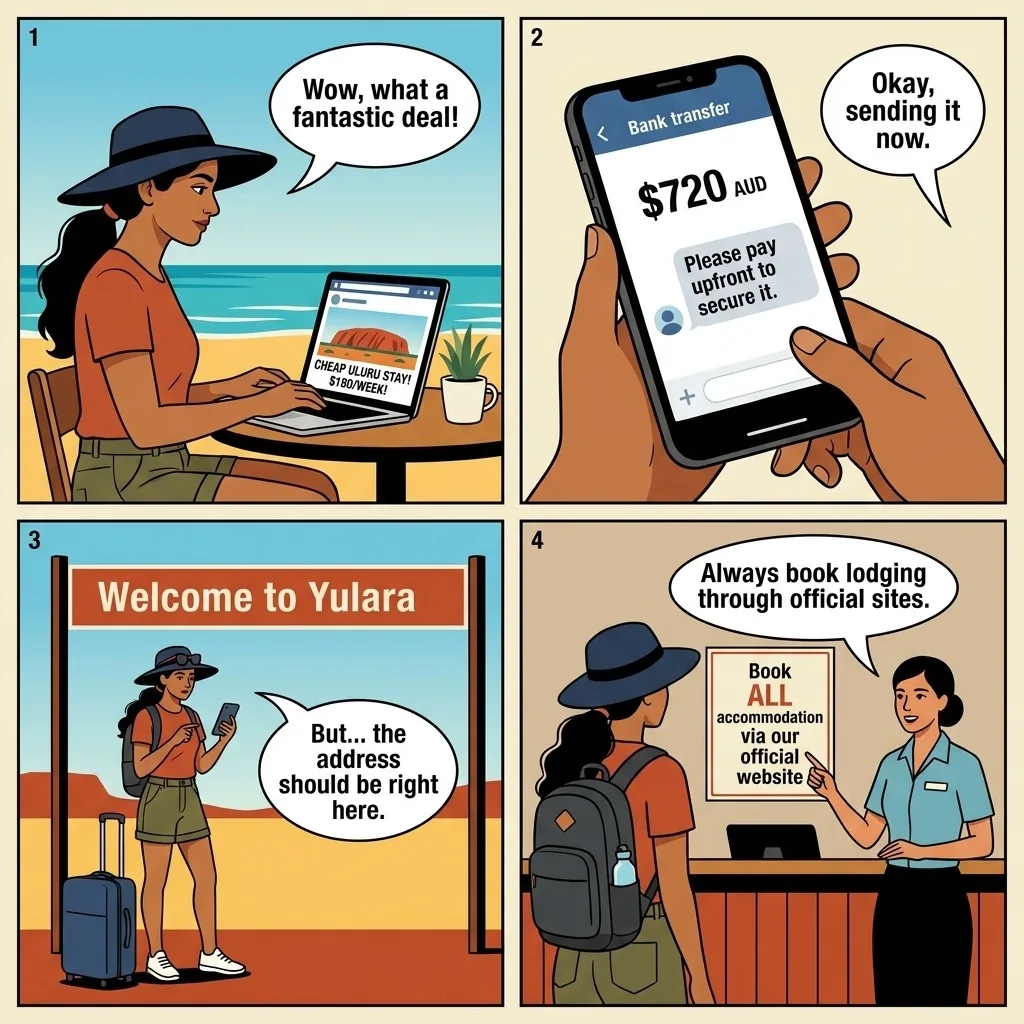
Facebook backpacker groups and Instagram DMs advertise 'cheap Yulara hostel alternatives' at $120–$180/week with Uluru shuttle included — no such accommodation exists, payment is required by unrecoverable bank transfer, and the money disappears before the travel date.
Yulara is the only settlement permitted within Uluru-Kata Tjuta National Park, and its entire accommodation stock is run by a single operator: Ayers Rock Resort. The cheapest legitimate options — Outback Pioneer Lodge dorm rooms from $80/night and Ayers Rock Campground from $45/night — are booked exclusively at ayersrockresort.com.au. There is no independent hostel, no backpacker alternative, and no shuttle-included weekly rental. The scam exploits the sticker shock of official Yulara rates by presenting an impossibly attractive alternative.
Listings appear on Facebook Australia Backpackers groups and WhatsApp travel threads, using photos lifted from legitimate hostel sites. The seller is always 'going home early' or 'got a job and can't stay' — a pretext for requesting upfront payment by bank transfer or Wise before you can verify anything. By the time you arrive at Yulara, the contact number is disconnected and the money is gone.
The monopoly structure is the protection: if accommodation is not on ayersrockresort.com.au, it does not exist at Uluru. Book all Yulara accommodation only at ayersrockresort.com.au or through the official Booking.com listing, and never pay for accommodation by bank transfer — no legitimate Australian accommodation provider requires direct upfront wire payment.
Red Flags
- 'Yulara hostel alternative' or 'cheap Uluru accommodation' outside Ayers Rock Resort
- Payment required by bank transfer or Wise
- Listing on Facebook or Gumtree without a corresponding Booking.com entry
- Price impossibly low vs established Yulara rates ($250+ for anything other than camping)
- Emails from 'booking.com' with non-booking.com sender domains
How to Avoid
- Book Yulara/Uluru at ayersrockresort.com.au or booking.com via the official app.
- Alice Springs hostels via HostelWorld or Booking.com.
- Camping at Ayers Rock Campground (cheapest legitimate Uluru option).
- Never bank-transfer for accommodation.
- Report fake listings to booking.com and Facebook Marketplace.
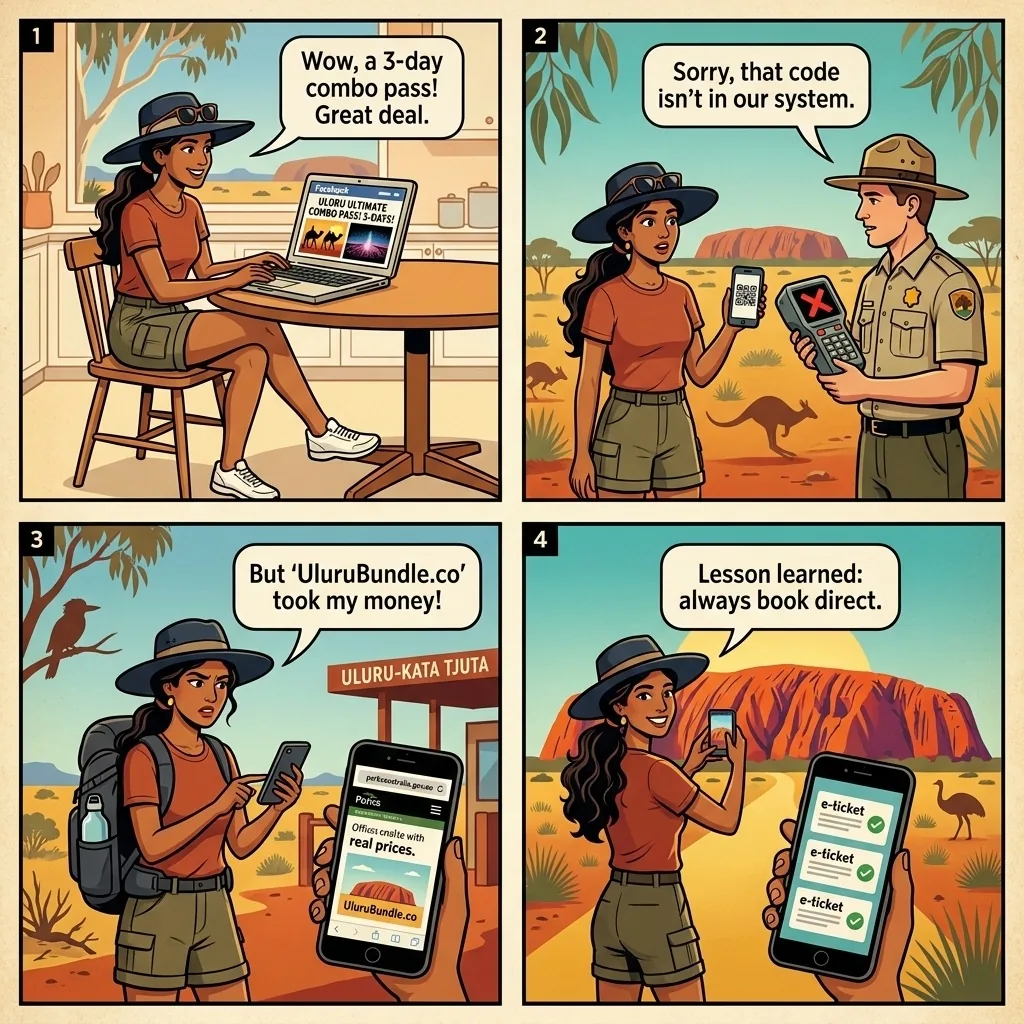
Facebook and Instagram ads for 'Ultimate Uluru 3-day combo passes' bundling National Park entry, Field of Light, Sounds of Silence, and camel rides for $200–$300 deliver QR codes that don't scan at the park gate — no authorized aggregator resells these individual-operator experiences as a bundle.
Uluru-Kata Tjuta National Park admission ($38/adult, 3-day pass) is sold exclusively by Parks Australia at parksaustralia.gov.au. Sounds of Silence and Field of Light are sold exclusively by Ayers Rock Resort at ayersrockresort.com.au. Uluru Camel Tours, Maruku Arts dot-painting workshops, and Anangu cultural walks are each booked through their own dedicated operators. None of these has authorized a third-party aggregator to bundle or discount them together — the 'combo pass' category simply does not exist in the official supply chain.
Fraudulent ads clone the visual style of the official sites and price the bundle at 20–30% below what the individual components cost if bought directly at source. The PDF voucher contains a QR code that either fails to scan at the park gate or resolves to a generic page with no booking record. Staff at both the Parks Australia entrance booth and the resort have no record of the purchase under the buyer's name.
Every component has exactly one legitimate purchase point. Buy National Park admission at parksaustralia.gov.au, Sounds of Silence and Field of Light at ayersrockresort.com.au, and each Indigenous-led experience directly through its own operator — any site that bundles these together is unauthorized regardless of how polished it looks.
Red Flags
- Combo site claims to bundle Park admission + named experiences at 20%+ discount
- Site domain isn't parksaustralia.gov.au or ayersrockresort.com.au
- Facebook or Instagram ad leading to a non-.com.au domain
- Payment required by bank transfer
- No Australian office address or phone number listed
How to Avoid
- Park admission at parksaustralia.gov.au only ($38/3-day adult).
- Experience bookings at ayersrockresort.com.au for all resort-run experiences.
- Indigenous-led experiences direct with Maruku Arts or Anangu Tours.
- Pay by credit card for chargeback protection.
- Ignore Facebook/Instagram discount ads for Uluru tickets.
🆘 What to Do If You Get Scammed
📋 File a Police Report
Go to the nearest Northern Territory Police station. Call 000 (emergency) or 131 444 (non-emergency). Get an official crime report — you'll need this for insurance claims. You can also report online at pfes.nt.gov.au.
💳 Cancel Your Cards
Call your bank immediately. Most have 24/7 numbers on the back of the card (keep a photo saved separately). Block any suspicious transactions before the thieves use your details.
🛂 Lost Passport?
Contact your nearest embassy or consulate. The closest US Consulate is in Sydney: MLC Centre, Level 10, 19-29 Martin Place, Sydney NSW 2000 (+61 2-9373-9200). The UK High Commission is in Canberra (+61 2-6270-6666). Report scams to Consumer Affairs NT or ScamWatch at scamwatch.gov.au.
📱 Track Your Device
If your phone was stolen, use Find My (iPhone) or Find My Device (Android) from another device. Don't confront thieves yourself — share the location with police instead.