Key Takeaways
Adelaide is physically one of the safest state capitals in Australia, but three financial scam clusters hit tourists hard: (1) taxi and DiDi/Uber overcharging on short CBD routes — Reddit threads regularly call airport taxis 'a scam' — (2) fake Barossa / McLaren Vale wine tour bookings from cloned sites, and (3) short-stay rental fraud on Facebook Marketplace. International students attending Adelaide colleges also face dedicated visa/education scams worth knowing about for anyone traveling long-term.
⚡ Quick Safety Tips
- At Adelaide Airport use Uber or DiDi from the rideshare pickup zone — taxis have been charging inflated short-run fares documented across traveler reports.
- Check every DiDi receipt for 'driver canceled mid-trip' phantom charges — Reddit threads document the pattern.
- Book Barossa, Clare and McLaren Vale wine tours only with operators on the South Australian Tourism Commission register.
- Never pay a rental deposit before in-person viewing — Reddit threads document current fake-Airbnb invoice scams.
- Use Adelaide Metro's Metrocard or contactless on trams and buses — never pay 'transport officers' directly.
- International students should verify any 'visa consultant' against the MARA register at mara.gov.au before paying.
Jump to a Scam
- High Adelaide Airport-to-Rundle Mall Taxi Top-Up
- Medium DiDi / Uber 'Cancel Mid-Trip' Charge Scam
- Medium Fake Barossa / McLaren Vale Wine Tour Booking
- High Adelaide Fake Rental / Facebook Airbnb Invoice Scam
- High Adelaide MARA-Spoof Migration Agent Visa Trap
- Low Fake 'SA Tourism Voucher' / Booking Voucher Scam
The 6 Scams
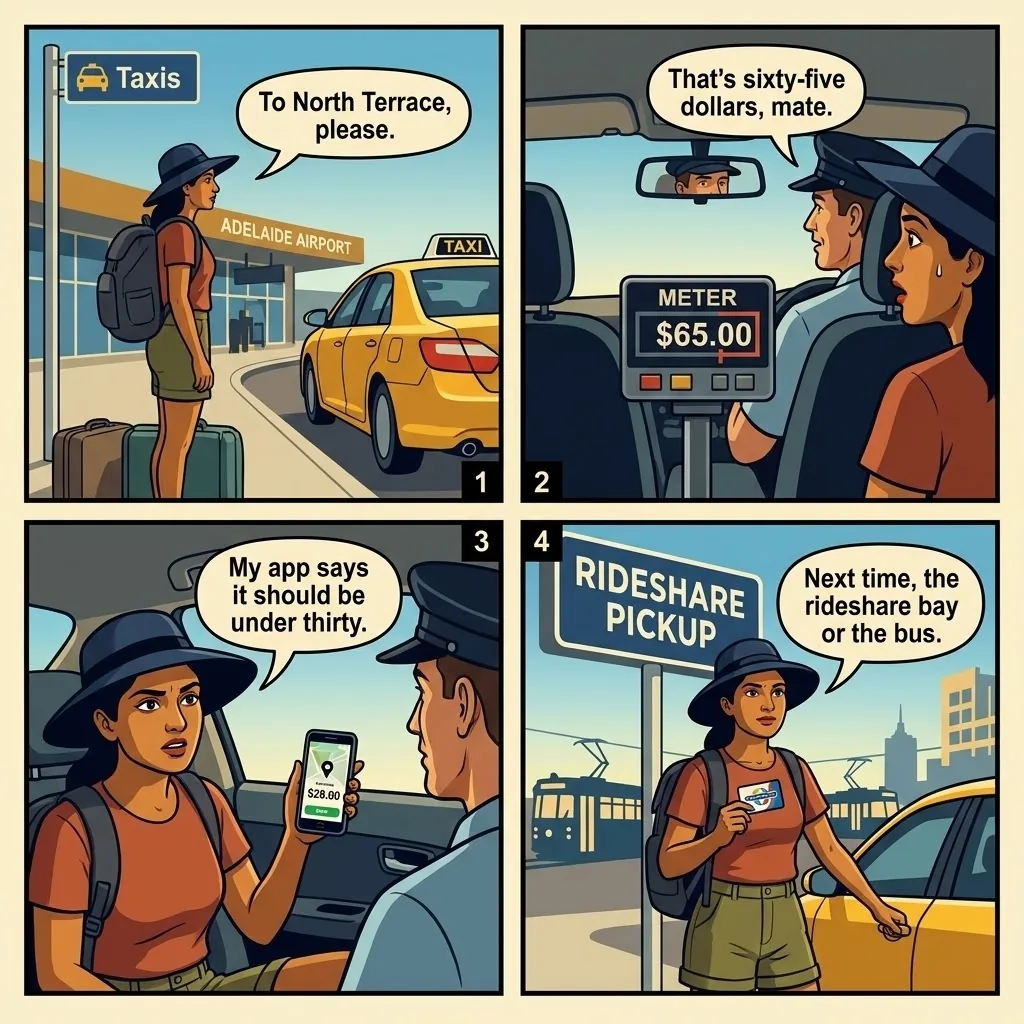
Adelaide taxi drivers, especially at the airport, stack fuel surcharges, airport fees, and tampered meters to turn a $28 Uber-equivalent journey into a $65 or $99 bill — a pattern so common that traveler boards run threads titled 'Is taxi in Adelaide a scam now.'
Adelaide Airport sits 7 km from the CBD — a short enough journey that the gap between legitimate and inflated fares is immediately obvious. The licensed taxi queue at the international terminal operates without a fixed-fare structure, leaving fare calculation to a meter system that scam drivers manipulate two ways: stacking optional surcharges (airport fee, late-night rate, fuel levy) or running the meter in $0.40 increments rather than the legal $0.35 maximum.
You watch the meter click through $45, $50, $60, and arrive at the hotel to be asked $65 or more for a journey that Uber prices at $25–$30. The driver points to a printed surcharge card in the back seat — airport fee $3.30, fuel levy $1.50, late-night rate applied — each item technically real but stacked beyond what legitimately applies. Some drivers use meter devices set to a faster increment, visible only if you watch closely from the start.
The surcharge-stacking problem disappears when you remove the licensed taxi from the equation. Use Uber or DiDi from the dedicated rideshare bay at Adelaide Airport — typical CBD fare $25–$40 with a fixed price before you book. Alternatively, Adelaide Metro JetExpress buses (J1, J2, J7) run from the airport to the CBD for $5.40 and are the tourist-proof option. If you take a taxi, photograph the driver ID before moving and watch the meter display from the first kilometer.
Red Flags
- Meter clicks up faster than the legal rate of $0.35 or smaller increments
- 'Fuel surcharge' or 'airport surcharge' not displayed inside the cab
- 'Card reader is broken' cash-only demand
- Flat rate quoted above $55 for a CBD run from ADL
- Driver takes circuitous route via West Terrace or Port Road
How to Avoid
- Use Uber or DiDi from Adelaide Airport rideshare pickup — fare $25–$40 to CBD.
- Take JetExpress bus (J1/J2) to CBD — $5.40 with Metrocard.
- Pay by card on the in-car terminal and screenshot the receipt.
- Photograph taxi plate before the ride.
- Report overcharging via adelaidemetro.com.au.
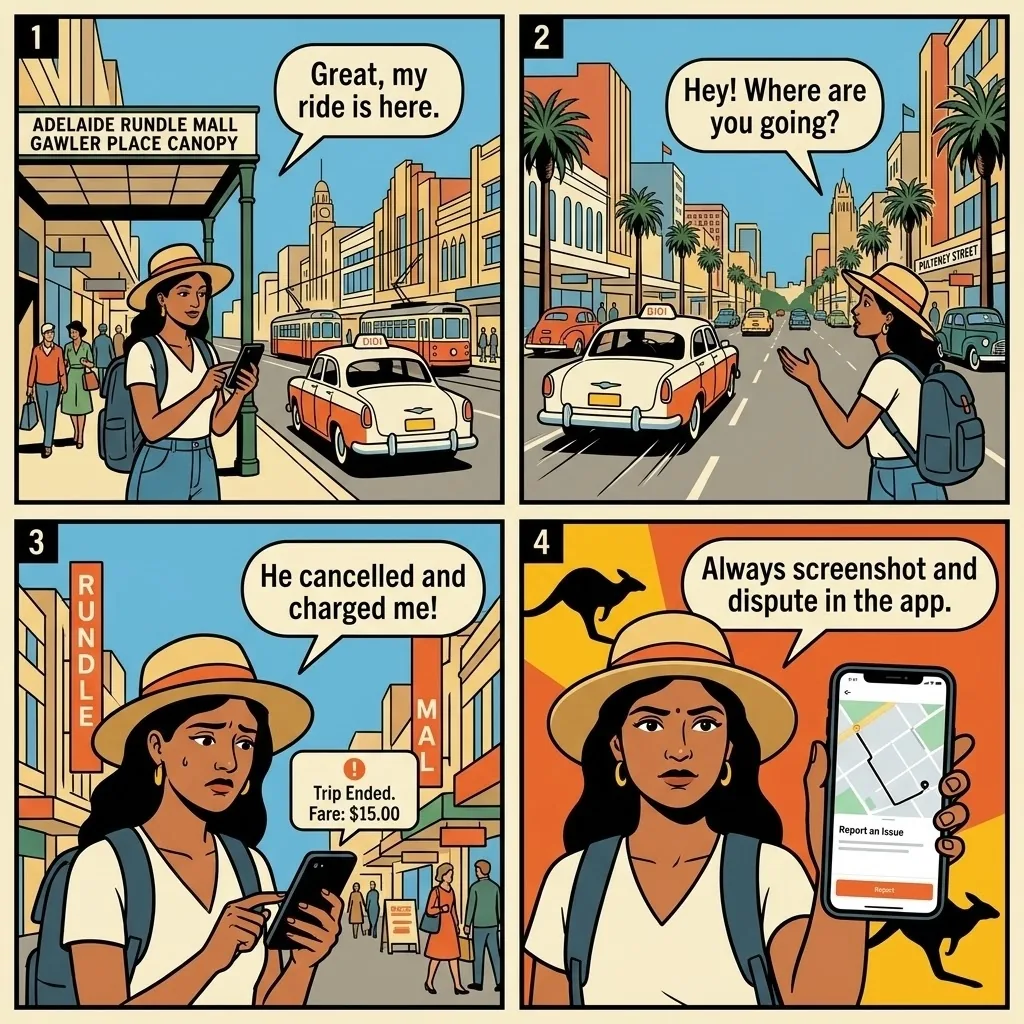
In Adelaide's CBD, rideshare drivers accept a booking, drive 100 meters, and end the trip in the app — charging the passenger a cancellation or part-trip fee of $12–$20 while the driver collects a payout and immediately takes another booking.
DiDi and Uber bookings in the Adelaide CBD, particularly around Rundle Mall and Hindley Street, have produced a recurring pattern: a driver accepts the booking, pulls up near the designated spot, waits briefly, then moves the car a short distance and ends the ride in the app before the passenger has boarded.
The platform's cancellation and part-trip fee structures exist to compensate drivers for genuinely interrupted journeys — the scam exploits these by simulating a completed partial pickup. The passenger's account is debited $12–$20, the driver collects the payout, and the app marks the ride as completed. A secondary variant: the driver claims an app issue and asks for cash payment directly, then drives off once paid.
Platform dispute works when you act the moment it happens. Screenshot the ride details as soon as a driver ends a trip you did not take, then submit an in-app refund request citing the trip-end discrepancy; Uber typically resolves these within 48 hours. If the platform stalls, escalate via a credit card chargeback. In the CBD, Uber has been more reliable than DiDi for this particular pattern.
Red Flags
- Driver sits at pickup spot then 'moves' the car 100–500m and ends the trip
- Receipt shows a fare disproportionate to the trip distance (e.g. $15 for 100m)
- Driver claims 'app issue' and wants cash or direct bank payment
- Multiple cancel-charges on your account from different drivers
- Driver calls asking you to 'cancel for me' so they get a cancellation fee
How to Avoid
- Never cancel at the driver's request — they're seeking a cancellation fee.
- Screenshot the in-app map the moment you realize the ride is being ended early.
- Request an in-app refund with the screenshot attached.
- Chargeback on your credit card if the platform denies the refund.
- Prefer Uber over DiDi in Adelaide for cleaner customer service.

Fake wine tour operators running polished Google Ads sites offer full-day Barossa or McLaren Vale tours for $79–$120, require bank transfer to avoid 'card fees,' and then fail to appear on tour day — the operator exists only as a website.
The Barossa Valley and McLaren Vale are among South Australia's major tourist draws, and the search landscape for 'Barossa wine tour from Adelaide' is crowded with legitimate operators and with cloned sites that run Google Ads campaigns to outrank them. Fake sites use professional photography, plausible itineraries, and prices just below the market rate to appear indistinguishable from real operators.
The tell is the payment instruction: the site requests bank transfer to 'avoid card fees,' or PayPal Friends & Family to 'simplify processing.' On tour day, no vehicle arrives. The phone number listed disconnects or rings out, and the booking confirmation email produces no response. Credit card payment would have enabled a chargeback; bank transfer makes recovery almost impossible.
Legitimate wine tour operators have Adelaide offices, ABNs registered at abn.business.gov.au, and accept credit card payment with a receipt. Book with verified operators — Groovy Grape Tours, Taste the Barossa, or Barossa Daimler — and pay by credit card for chargeback protection. Never pay by bank transfer or PayPal Friends & Family for a tour, regardless of how convincing the site looks.
Red Flags
- Price is 30–40% below comparable Barossa full-day tours with lunch
- Operator asks for bank transfer or PayPal F&F to 'avoid card fees'
- Website has no physical Adelaide office address or ABN
- Confirmation email doesn't name specific wineries on the itinerary
- Google ad leads to a site with.com.co domain (not.com.au)
How to Avoid
- Book with Groovy Grape, Taste the Barossa, Barossa Daimler or Adelaide Wine Tours.
- Verify ABN at abn.business.gov.au.
- Pay by credit card for chargeback protection.
- Read 50 most recent TripAdvisor reviews — fake operators have clumped review dates.
- Confirm exact winery names in the itinerary before paying.
Like what you're reading? Get a full Adelaide itinerary with safety tips built in.
Browse travel-safety books →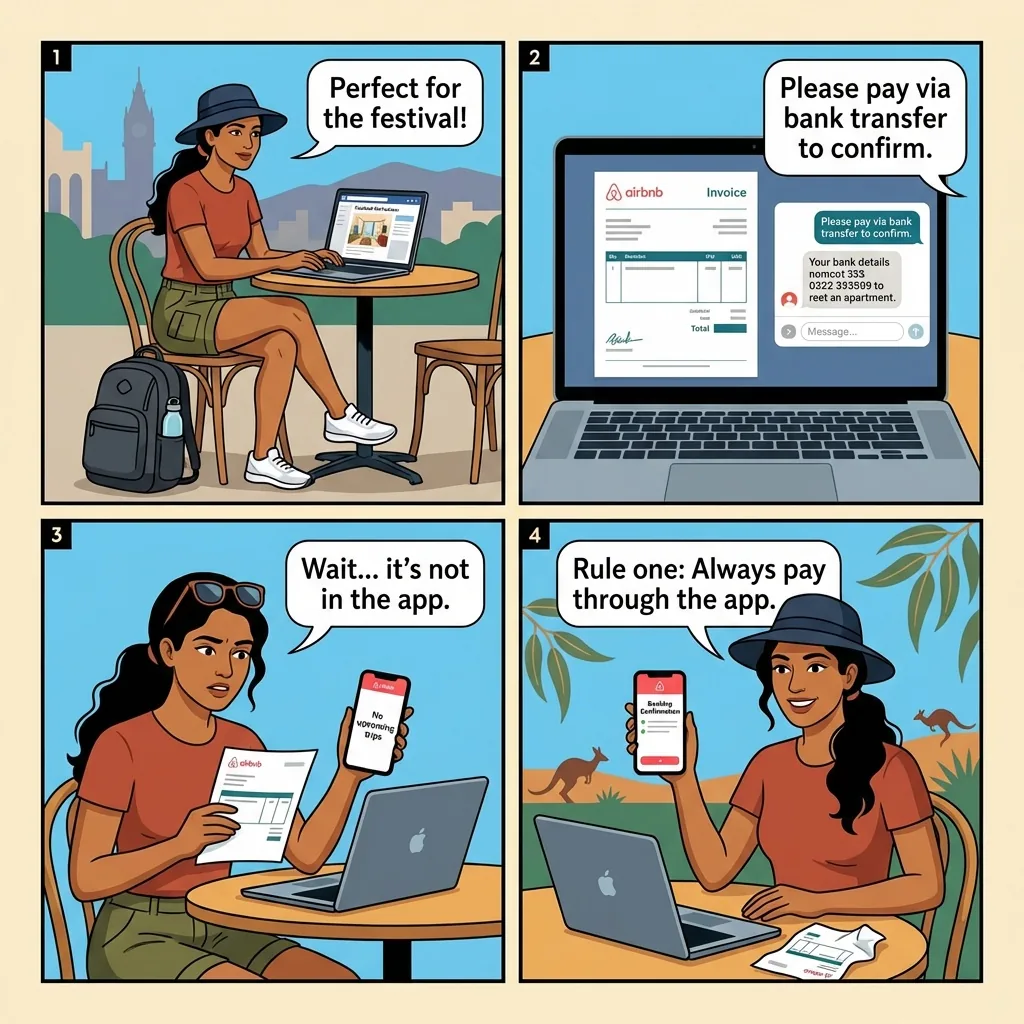
On Facebook Marketplace, scammers posing as Adelaide hosts send convincing Airbnb-branded invoice PDFs for short stays, request bank transfer for 'payment,' and disappear after the money arrives — Airbnb has no record of the booking because none was ever made.
Adelaide's short-stay rental market has a visible presence on Facebook Marketplace, where listings for North Adelaide and Glenelg properties at below-platform rates attract visitors trying to avoid Airbnb service fees. Scammers harvest genuine property photos from Airbnb or real estate listings and create Marketplace listings indistinguishable from legitimate private host offers.
After initial contact, the scammer sends a PDF invoice designed to mimic official Airbnb branding — the same fonts, colors, and booking-confirmation format — and instructs the victim to bank-transfer the full amount to confirm the reservation. Once payment arrives, the host stops responding. Airbnb's records show no booking under the victim's name, because the transaction never passed through Airbnb's system.
A genuine Airbnb booking is confirmed exclusively in the Airbnb app — an invoice PDF arriving by email is never how the platform works. Book directly through the Airbnb app and never pay for a short stay by bank transfer, regardless of how professional the invoice looks. If you have already transferred money, call your bank within 24 hours to request a payment recall before the funds clear.
Red Flags
- 'Airbnb invoice' received as PDF via email rather than inside the Airbnb app
- Host requests bank transfer, Wise, or crypto instead of in-app payment
- Listing is on Facebook Marketplace or Gumtree with photos that look too professional
- Price is 30–50% below comparable Adelaide short-stays
- Host refuses a 1-minute video call to show the property live
How to Avoid
- Book only through the Airbnb or Booking.com app — never from an email link.
- A real Airbnb payment runs entirely in-app; external invoices are always fake.
- Never pay by bank transfer outside the platform.
- Reverse image-search listing photos in Google Images.
- Report scam listings to Airbnb and Facebook Marketplace immediately.

In Adelaide's international student community, fraudulent migration agents advertise on social media, collect $8,000–$13,000 upfront for visa pathways or PR sponsorship via unaccredited colleges, and disappear once paid — leaving students enrolled in fake courses with no visa and no money.
Adelaide has a large international student population, particularly from South and Southeast Asia, and fraudulent migration agents target newcomers through social media advertising and community referrals. They offer PR sponsorship, post-study work visa pathways, or guaranteed university placements at fees of $8,000–$13,000 paid upfront — a price point that feels credible given the actual cost of legitimate migration services.
The agent collects payment in cash or bank transfer, provides documents that appear official, and enrols the student in a college that is either unregistered with CRICOS or running fraudulent admissions. The visa application either fails or was never submitted. Refund requests are met with delays and eventually silence, and cash payments leave no chargeback path.
Both the agent and the institution can be verified against public government registers before any money changes hands. Only use MARA-registered migration agents (searchable at mara.gov.au) and only enrol in CRICOS-registered institutions (cricos.education.gov.au). Pay by card or bank transfer to a registered ABN with a written receipt, never in cash. Any promise of guaranteed PR is a lie — no legitimate agent can guarantee government visa decisions.
Red Flags
- Agent promises 'guaranteed PR' or '100% visa approval' impossible
- Payment requested in cash with no receipt
- Institution isn't on the CRICOS register (cricos.education.gov.au)
- Agent has no MARA Migration Agents Registration Authority number
- Recruitment is via WeChat, WhatsApp, or Facebook without a physical Adelaide office
How to Avoid
- Use only MARA-registered agents — check mara.gov.au public register.
- Enrol only in CRICOS-registered institutions — verify at cricos.education.gov.au.
- Pay by card or bank transfer with receipt — never cash.
- Verify agent's ABN at abn.business.gov.au.
- Report suspected fraud to the Department of Home Affairs at immi.gov.au.
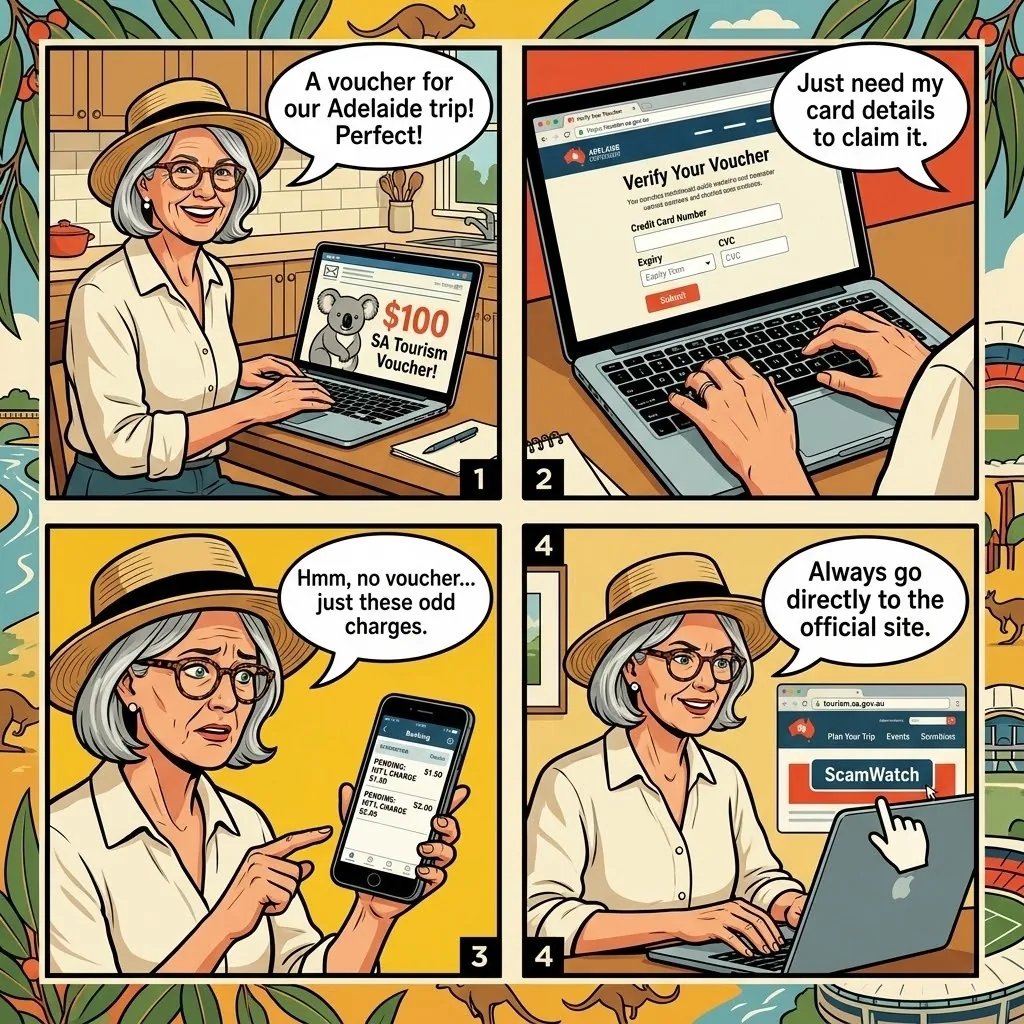
Unsolicited emails and social posts offering '$100 South Australian Tourism Commission vouchers' link to cloned government-branded sites that request card details to 'verify eligibility' — the voucher never arrives and small test transactions begin appearing on the card.
South Australia's Tourism Commission ran legitimate promotional voucher programs during the 2020–2022 tourism recovery period, and scammers have exploited that brand recognition since. Fake voucher emails and Facebook posts mimic the government's visual identity closely enough that recipients who are aware of the real programs may not question their legitimacy.
The link in the email or post leads to a site that replicates the southaustralia.com design, asks for name, email, and credit card details to 'verify your eligibility' or 'activate the voucher,' and submits the card data to a skimming operation. The voucher email does not arrive. Within days, small test transactions — typically $1–$9 — appear on the card as the skimmer confirms it is live before larger charges follow.
Any legitimate SA government voucher promotion is announced on southaustralia.com and tourism.sa.gov.au — not in unsolicited emails. Never click a voucher link in an unsolicited email or social post; go directly to tourism.sa.gov.au to verify any promotion exists before entering any details. If you have already entered card details on a suspicious site, call your bank immediately to freeze the card and report the attempt to ScamWatch at scamwatch.gov.au.
Red Flags
- Unsolicited email or SMS claiming an SA government tourism voucher
- Link goes to a site that isn't southaustralia.com or tourism.sa.gov.au
- Voucher 'verification' requires your card details
- Urgency — 'voucher expires in 24 hours'
- Sender domain is similar to but not exactly an SA government domain
How to Avoid
- Verify any voucher program directly at southaustralia.com or tourism.sa.gov.au.
- Never click voucher links in unsolicited emails.
- Book hotels via Booking.com, Stayz, or calling hotels directly.
- If you've entered card details into a suspect site, reissue your card.
- Report phishing to ScamWatch at scamwatch.gov.au.
🆘 What to Do If You Get Scammed
📋 File a Police Report
Go to the nearest South Australia Police station. Call 000 (emergency) or 131 444 (non-emergency). Get an official crime report — you'll need this for insurance claims. You can also report online at police.sa.gov.au.
💳 Cancel Your Cards
Call your bank immediately. Most have 24/7 numbers on the back of the card (keep a photo saved separately). Block any suspicious transactions before the thieves use your details.
🛂 Lost Passport?
Contact your nearest embassy or consulate. The closest US Consulate is in Melbourne: 553 St Kilda Road, Melbourne VIC 3004 (+61 3-9526-5900). The UK High Commission is in Canberra (+61 2-6270-6666). Report scams to Consumer and Business Services SA or ScamWatch at scamwatch.gov.au.
📱 Track Your Device
If your phone was stolen, use Find My (iPhone) or Find My Device (Android) from another device. Don't confront thieves yourself — share the location with police instead.