Key Takeaways
The sharpest money risks in Melbourne are (1) fake-taxi and DiDi/Uber bait scams at Melbourne Airport, where drivers intercept tourists in the baggage hall; (2) phantom rental-car damage claims billed after you return the car (the SIXT Australia scam is a standout on traveler reports); and (3) fake QR-code 'parking ticket' stickers placed on windshields in CBD carparks. Violent crime against tourists is very rare — the losses are almost all financial.
⚡ Quick Safety Tips
- At Melbourne Airport (Tullamarine), ignore anyone who approaches you inside the terminal offering a 'taxi' or 'Uber' — the legitimate taxi rank and rideshare bays are signposted outside.
- Photograph and video every panel of a rental car at pickup AND drop-off — the SIXT damage scam has cost traveler reporters up to $6,500.
- Never scan a QR code sticker on a parking meter or windshield 'ticket' — real City of Melbourne tickets have a CoM barcode and phone number, not a QR code.
- Book short-stay rentals only via Airbnb or Booking.com directly — traveler threads document $3,000+ losses to off-platform bank-transfer fakes.
- Keep phones and wallets out of back pockets on crowded trams (routes 70, 75, 96 at Flinders Street and Federation Square).
- Check the bill at CBD clubs line-by-line — card-surcharge tricks and 'system error' overcharges show up weekly on traveler reports.
Jump to a Scam
- High Melbourne Airport Fake Taxi / DiDi Bait Scam
- High SIXT / Budget Phantom Rental-Car Damage Claim
- Medium Fake QR-Code Parking Ticket Sticker Scam
- High The Docklands / CBD Airbnb Bank-Transfer Trap
- Low Flinders Street / CBD Tram Pickpocket & Tab Bait
- Medium Great Ocean Road 'Day Tour' Fake Booking Scam
The 6 Scams
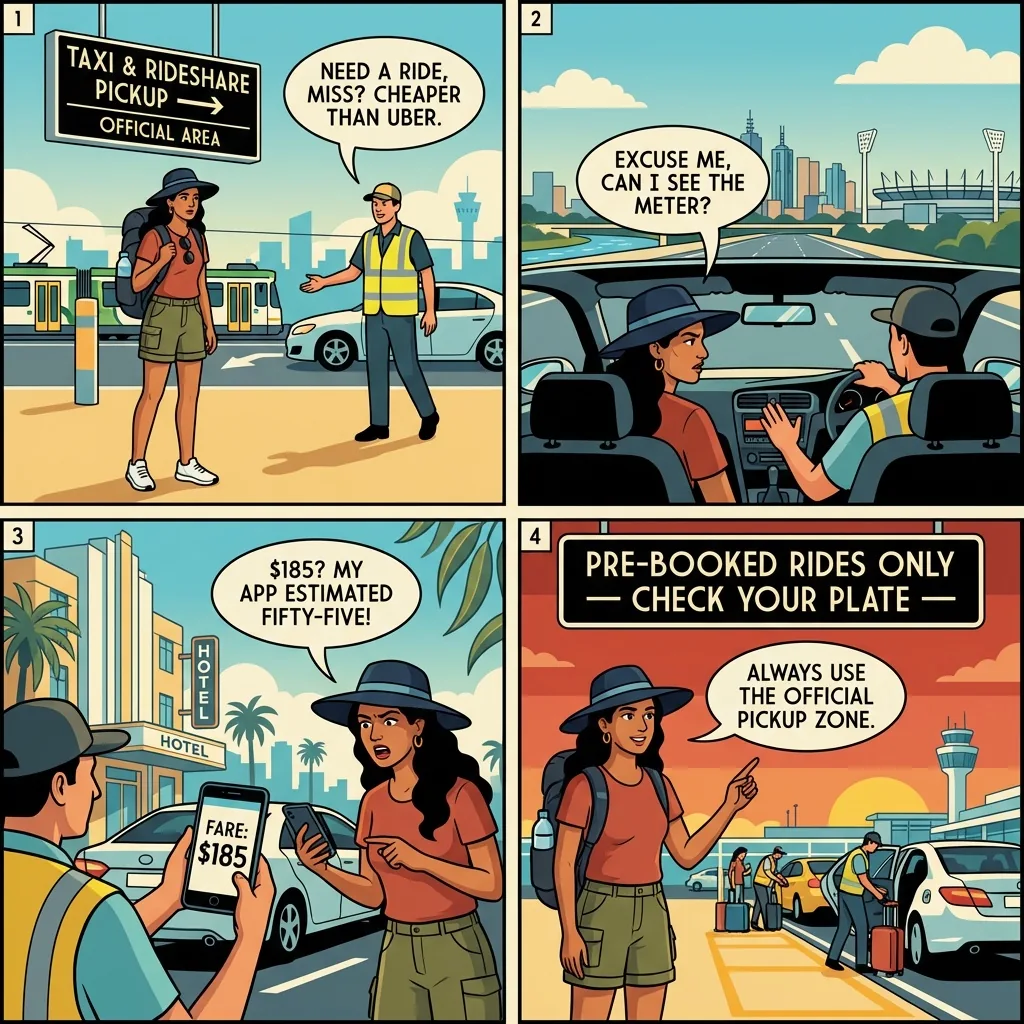
A man in a high-vis vest meets you at Tullamarine baggage claim offering "cheaper than Uber" and walks you to an unmarked sedan in the short-term carpark — forty minutes later, with no visible meter, he demands $185 for a ride Uber would have priced at $55.
The play is a constant at Melbourne's Tullamarine Airport: a man in a high-vis vest approaches you at baggage claim, offering a ride that's "cheaper than Uber." He'll coax a tired traveler off a legitimate $55 rideshare and into an unmarked sedan waiting in the short-term carpark. The pattern is so persistent that Melbourne Airport has installed signs in the arrivals hall warning travelers not to accept rides from anyone who approaches them inside the terminal.
Forty minutes later, you're in the CBD, but there's no visible meter — or the driver has covered it with a clipboard. The demand is suddenly $185. In another version of the scam, a driver charges $99 for a fifteen-minute trip; when the passenger asks to see the meter, the fare has already ticked over $27 in the first five minutes. A legitimate metered fare from Tullamarine to the CBD runs $60–$80 depending on the time of day; anything over $100 is a tell.
Commercial Passenger Vehicles Victoria (CPVV) regulations explicitly forbid drivers from touting for fares inside airport terminals. All legitimate pre-booked rides must be met at the designated pickup zones outside T1/T2/T3 for Uber and DiDi, or T4 for OLA. Unbooked taxis must be taken from the official supervised ranks. Touts operating inside the arrivals hall (sometimes with fake rideshare credentials, a trick documented on Reddit) are unlicensed and illegal. Only enter a vehicle from the designated ground transport hubs outside the terminals after booking through an official app.
Red Flags
- Anyone inside the terminal (baggage claim, arrivals hall) offering transport — always illegal
- Driver covering the meter with a card, clipboard or bag
- Unmarked sedan without taxi livery, or a DiDi/Uber driver who won't verify the ride code in-app
- No receipt offered, or receipt written on a blank paper rather than printed
- Fare demanded is 1.5–3× the Uber in-app estimate
How to Avoid
- Ignore all in-terminal transport offers — walk outside to the signposted ranks and rideshare bays.
- Verify driver photo and license plate in the Uber/DiDi/Bolt app before entering the car.
- Take SkyBus ($22, runs every 10 min to Southern Cross Station) if in any doubt.
- Make the driver uncover the meter before pulling away — 'turn the meter on' is your first words.
- Pay with card on the in-car terminal for chargeback protection — never hand cash to an unmarked driver.

Two weeks after dropping your rental at Melbourne Airport, your card is hit with a $1,040 charge for a "scratch near the rear wheel" you never caused. The company sends a vague photo as proof and stonewalls your protest by citing their terms and conditions.
The scene at the Melbourne Airport rental counter is often rushed. Staff at SIXT — the most-reported operator — might wave off your questions about pre-existing scratches with a casual "don't worry, it's all logged" as they hurry you into the car. You take the keys, assuming everything is documented, and start your trip. The same pattern is reported at lower volumes with Budget, Thrifty, and Hertz, but traveler accounts from 2024–2026 identify SIXT as the standout offender.
Weeks after you've returned the car, the trap springs. An unexpected charge hits your credit card — perhaps $1,040 for a scratch near the rear wheel or even a staggering $6,500 for alleged underbody damage. When you protest, the company emails a generic photo that could have been taken anytime and defends the charge with a fine-print T&Cs clause. Your attempts to dispute it are often met with a one-line "refer to T&Cs" reply.
This phantom damage model relies on travelers lacking proof to fight back. Consumer Affairs Victoria guidelines state that companies cannot charge for damage unless they can prove the renter caused it, and the Australian Competition and Consumer Commission (ACCC) has previously acted against rental companies for unfair contract terms. Complaints on forums like Reddit show that the fee is consistently reversed once travelers push back with video evidence. Film every panel, the roof, and the undercarriage before leaving the Melbourne Airport lot and again upon return — this video evidence is your primary defense in any subsequent dispute or credit card chargeback.
Red Flags
- Rental agent rushes you through pickup and dismisses pre-existing damage documentation
- Damage panel diagram signed at pickup shows only a few visible marks but ignores actual scratches
- Return is 'contactless' drop keys in a box — with no signed no-damage receipt
- Charge appears 7–30 days after drop-off with photos that could be from any angle/time
- Invoice cites 'underbody damage' or 'scratch under 3cm' with no proof of when it occurred
How to Avoid
- Film the entire car on video at both pickup AND drop-off — all sides, underneath, interior, dashboard.
- Insist on a signed no-damage receipt at drop-off with the desk agent present — photograph it.
- Pay with a credit card that provides primary CDW insurance (Amex Platinum, Chase Sapphire, Capital One Venture X).
- Decline rental-desk CDW upsells if your card covers it — keep the rental cost transparent.
- If hit with a phantom charge, file a chargeback immediately and complain to Consumer Affairs Victoria.
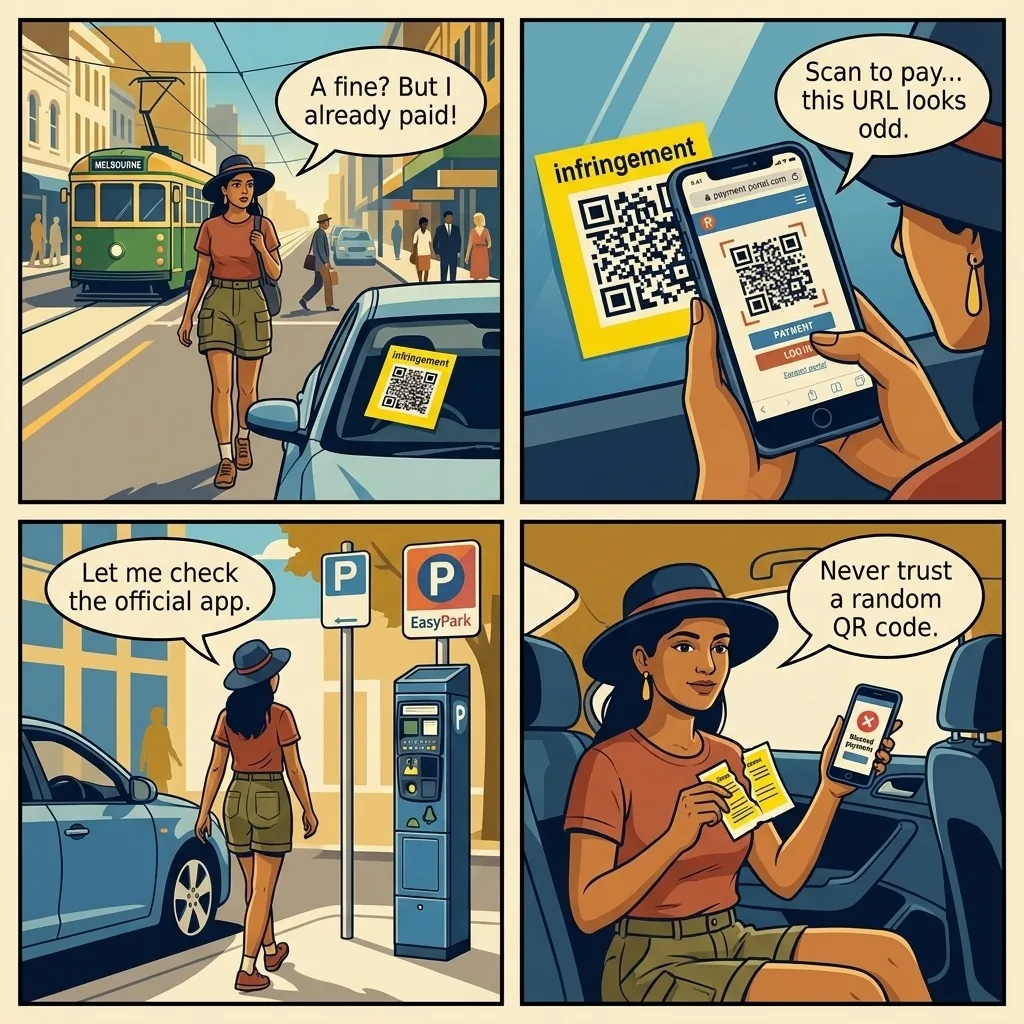
A yellow "City of Melbourne" sticker on your windshield tells you to scan a QR code and pay an $89 fine. The payment site is a clone designed to steal your card details, which scammers then use to drain your bank account a week later.
Fake QR-code parking tickets exploded across Victoria in 2024 and Reddit still documents new sightings most weeks. Drivers post side-by-side photos of fake stickers placed on cars in the CBD and inner suburbs — the counterfeits carry a council logo, a barcode and roughly the right typography, close enough to a real infringement notice to fool anyone in a hurry. A second variant uses fake QR stickers pasted directly over the real PayStay code on parking meters. Either way the outcome is the same: your card data lands on a clone site, the scammers run small test purchases to confirm it works, then drain the account.
The fix is simple: never trust a QR code on a parking meter or a windshield. Real City of Melbourne fines come on a numbered infringement notice and are paid at melbourne.vic.gov.au/parkingfines — a URL you type by hand. Real meter payment runs through the PayStay or CellOPark app, downloaded from your phone's app store, never via a sticker on the meter itself. If you've already scanned a suspicious code and entered your card, call your bank now and have the card frozen and reissued — the test charges start small and fast.
The Australian Competition and Consumer Commission's Scamwatch service reports that QR code scams are a fast-growing category of phishing attack, designed to harvest credit card details. City of Melbourne parking inspectors never issue on-the-spot fines with QR codes for immediate payment; official infringement notices direct you to a government URL that you type in manually. The stickers are often placed in high-traffic tourist areas like Federation Square or near the Queen Victoria Market. Download the official PayStay or EasyPark app directly from the Apple App Store or Google Play and set up payment details before you arrive — never scan a physical sticker on a meter or a ticket on your windshield.
Red Flags
- A QR code is the primary method on a 'parking ticket' on your windshield
- The 'ticket' demands payment within 24 hours with a threatened 25%+ penalty
- The logo looks close to but not exactly like the City of Melbourne emblem
- Parking meter has a QR code sticker that looks pasted-over or peeling
- The payment page asks for your CVV plus your billing address in a single form
How to Avoid
- Never scan a QR code on a parking ticket or meter — type melbourne.vic.gov.au manually.
- Pay for parking only through the PayStay or CellOPark app downloaded from your app store.
- If you find a 'ticket', verify it by calling City of Melbourne (03 9658 9658) before paying.
- Photograph any suspicious sticker and report to City of Melbourne rangers for removal.
- If you've entered card details into a suspicious page, call your bank immediately and reissue.
Like what you're reading? Get a full Melbourne itinerary with safety tips built in.
Browse travel-safety books →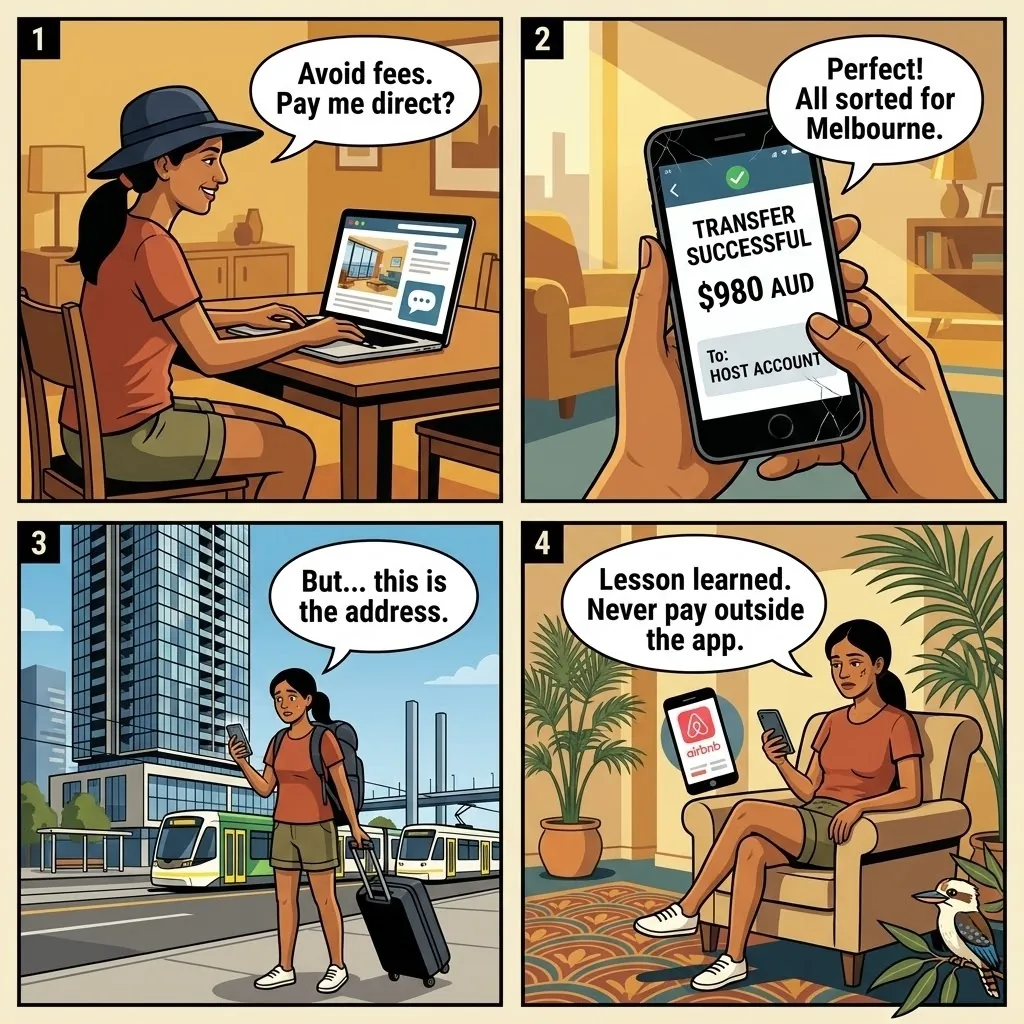
A host with a Docklands harbor-view apartment asks you to bypass Airbnb with a bank transfer to "avoid fees." You send $980 for the week, then arrive to find the address is fake, the phone number is disconnected, and your money is gone.
The bait is a high-floor Docklands or Southbank apartment with Yarra River views, listed on Airbnb or Booking.com at a rate just low enough to create urgency. To build the convincing post, scammers lift photos and property details directly from old real-estate marketing pages, a tactic that has become so common that ABC News reported an escalation in these fake listings in August 2024. The scam particularly targets new-to-Melbourne residents and working-holiday travelers desperate for short-term housing in a tight rental market.
Once you inquire, the 'host' immediately pushes to communicate outside the platform, complaining that the app's fees are a ripoff. They'll ask for payment via a direct bank transfer to 'save you both money'. This is the moment the trap closes. One Canadian traveler lost AUD $3,266 to this exact playbook (a story documented on Reddit), sending the funds and arriving at Tullamarine airport only to find the host's number disconnected and the address belonging to a confused resident whose home was never for rent.
Consumer Affairs Victoria and the ACCC's Scamwatch service track this as a persistent rental scam, costing Australians over $2.7 million in 2023 alone. Your defense is to stay on the platform, reverse image-search the listing's photos, and ask for a 60-second live video call from inside the apartment — a real host will comply, while a scammer will make excuses or disappear. Book only through the Airbnb or Booking.com platform where your payment is held in escrow until 24 hours after check-in — any host pushing for a bank transfer to 'save on fees' is running a well-documented scam.
Red Flags
- Host asks for bank transfer, Zelle, Wise, Western Union or crypto instead of in-platform payment
- Host explains the platform fees are 'inflated' so please pay direct
- Listing price is 30–50% below comparable CBD/Docklands/St Kilda listings same week
- Host refuses a 1-minute video call to show the apartment in real time
- Listing photos reverse image-search to a real-estate site or different city
How to Avoid
- Book only through airbnb.com or booking.com via the app or a bookmarked URL.
- Never pay by bank transfer, wire or crypto — legitimate platforms always escrow.
- Reverse image-search the listing photos in Google Images before paying.
- Check the listing has reviews from multiple guests in the past 12 months.
- Ask for a live video call tour of the property — refusal is a hard no.
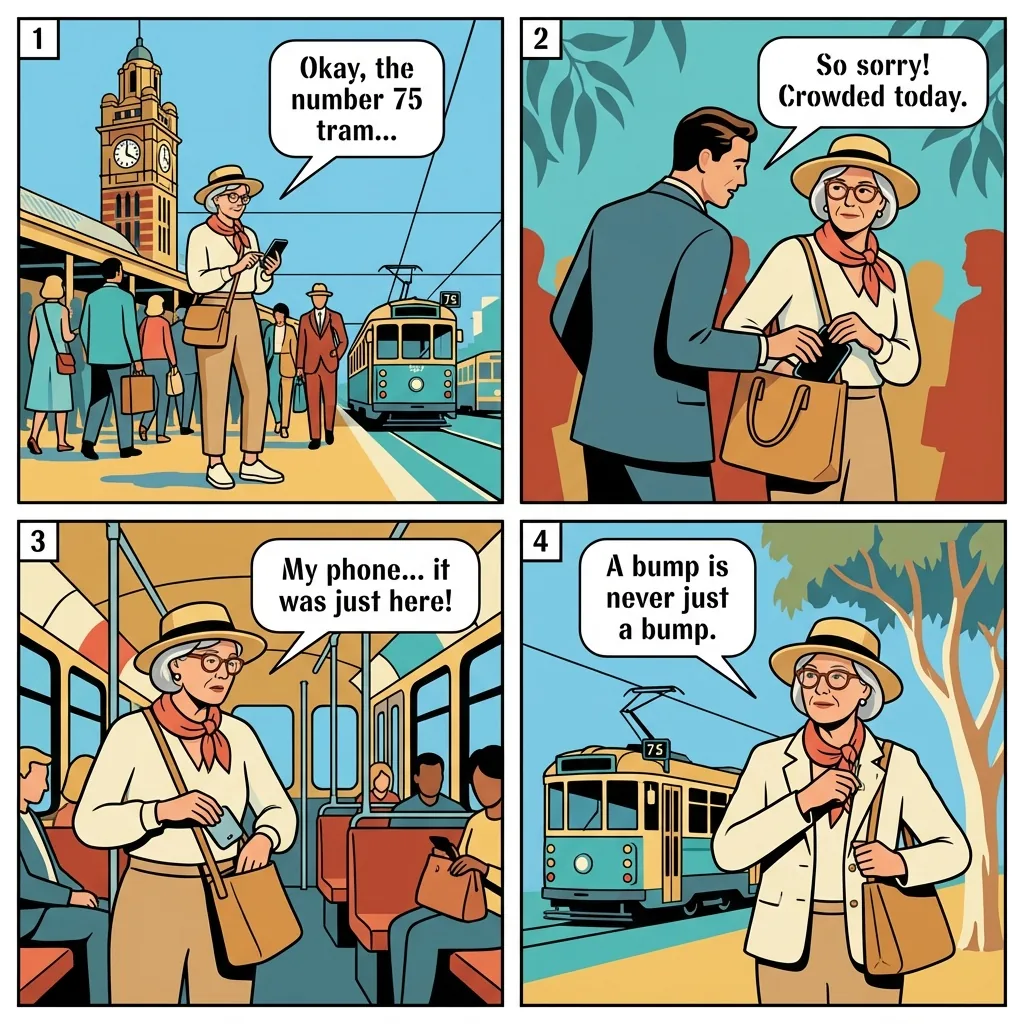
You're in the rush-hour crowd at Flinders Street Station, phone out checking the next tram, when someone bumps your shoulder, apologizes, and moves on — three minutes later you reach for the phone again and it's gone from your back pocket. You never felt the lift.
While Melbourne has lower pickpocket rates than major European cities, the primary hotspot is the crush of commuters and tourists around Flinders Street Station and Federation Square. On the crowded 70, 75, and 96 trams that service the area, a sudden bump or jostle is rarely an accident. Teams use this manufactured contact to gauge your awareness and locate valuables, setting up the lift in the next pulse of the crowd. The stretch of Elizabeth Street near the Flinders intersection is particularly notorious after dark.
The lift itself is professional and fast; you rarely feel a hand slip into a back pocket or an open bag. A companion scam plays out in CBD rooftop bars and on the free City Circle tram, where a credit card machine 'fails' and is tapped multiple times. You might also find an extra round of drinks you never ordered or a mysterious 5% 'system error' surcharge on your final bill — an error that, curiously, never works in the customer's favor.
The behavior is a documented pattern. Victoria Police data from 2023 shows theft from a person rose 15% year-on-year, with the Melbourne 3000 postcode logging the most offenses statewide. The most common targets are phones left on cafe tables or lifted from back pockets in crowds at major interchanges like Southern Cross and Flinders Street Station, a trend frequently discussed by locals (on forums like Reddit). Keep your phone in a zipped front pocket, never the back, and scrutinize every bar bill line by line before you sign — any barrier that requires two hands to open defeats the opportunistic lift.
Red Flags
- A stranger bumps or brushes you on a platform or tram then apologizes and moves on
- Unusually crowded group presses against you at the Flinders Street Station pinch point
- Rooftop bar 'system error' adds an extra round or 5%+ card surcharge to your tab
- Card reader appears to 'fail' multiple times before the first tap goes through
- Bill presented face-down so you sign without reading — then surcharges appear
How to Avoid
- Keep phone and wallet in a zipped front pocket, not a back pocket — obvious but chronically ignored.
- Carry a slim crossbody bag across your chest, not a backpack on your back, on trams 70/75/96.
- Scrutinize every bar bill before signing — dispute any extra items or surcharges immediately.
- Tap your own card — never hand it to the staff to 'process' at the till.
- Use contactless or Myki for trams so your phone doesn't come out in crowded zones.
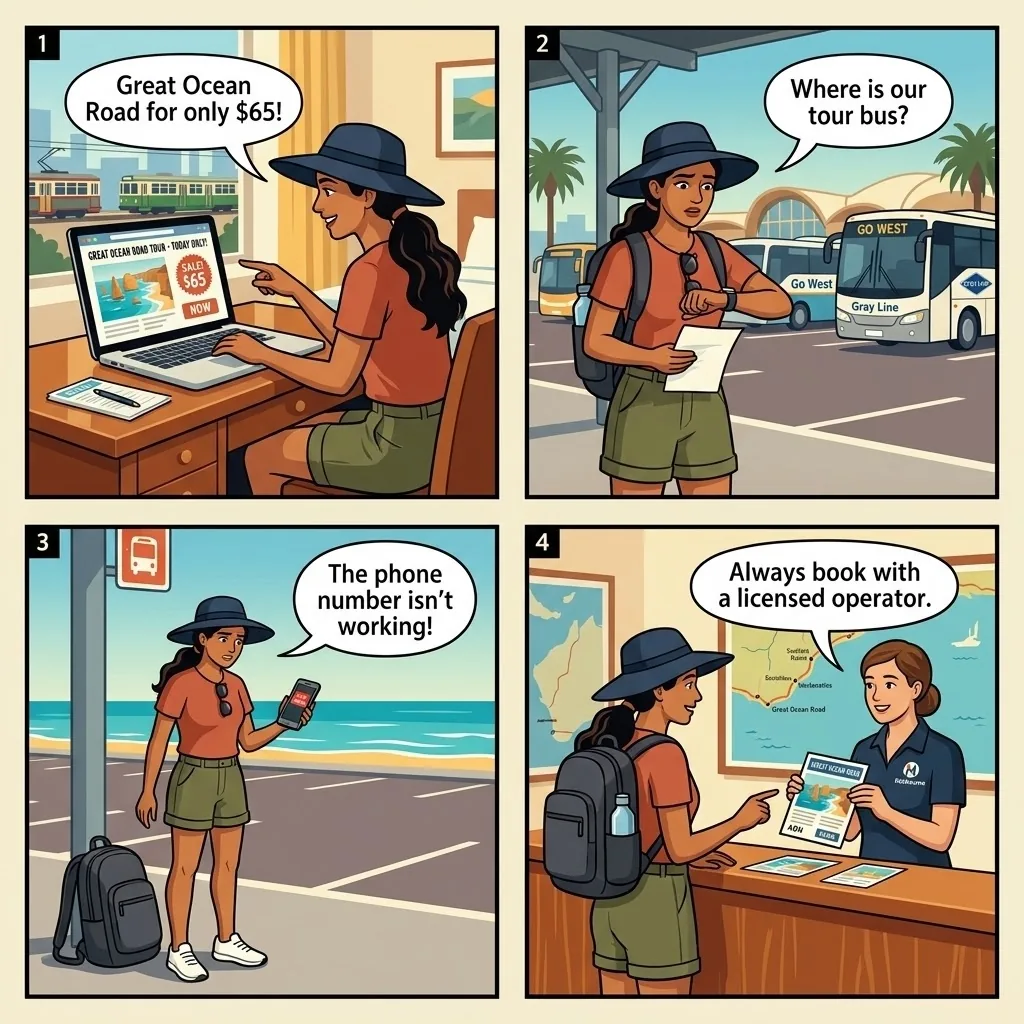
A professional-looking website sells a Great Ocean Road day tour for $65 with hotel pickup. You book and get a confirmation, but on the morning of the tour, the bus never arrives. The phone number is disconnected and the company doesn't exist, leaving you stranded.
The ads appear on Google and Facebook, targeting visitors searching for day trips to the Great Ocean Road, Phillip Island, or the Yarra Valley. The websites look professional, the itineraries match those of major operators, and the price is an unbeatable $65 per person — a 20–40% discount compared to legitimate companies like Gray Line or Go West Tours. You book, pay, and receive a slick confirmation PDF for your pickup at Southern Cross Station.
On the morning of the tour, you're waiting at the bus terminal, but your bus never arrives. The operator's phone number goes to a dead line. A quick search reveals the company has no physical office and no connection to any registered Victorian tour operator. The money is gone, and so is your day trip. Consumer Affairs Victoria and ScamWatch have flagged multiple versions of this scam, including one from an operator named "Holiday Great Ocean Road" that cloned a real company's branding to process payments for tours it never ran.
This ghost-bus model thrives by mimicking the pickup locations and itineraries of established companies that use the Southern Cross Station bus hub. Online discussions (including on Reddit) document identical scams playing out after a visitor clicks a compelling social media ad. Before booking, check for the official Tourism Australia 'tick' logo on the operator's site and verify their Australian Business Number (ABN) is active. Never pay for a Victorian day tour by bank transfer or PayPal 'friends and family' — pay by credit card so that when the bus doesn't show up, you can dispute the charge the same morning.
Red Flags
- Tour operator doesn't have a Melbourne office address or Australian Business Number (ABN)
- Price is 20–40% below Gray Line, Go West, or Autopia for the same itinerary
- Google ad leads to a site with misspellings, amateurish design, or a non-.com.au domain
- Operator asks for bank transfer or PayPal 'friends and family' instead of card payment
- No cancellation policy or phone number on the confirmation
How to Avoid
- Book through Gray Line, Go West, Autopia Tours, Bunyip Tours, or a verified Viator/GetYourGuide listing.
- Verify the operator's ABN at abn.business.gov.au — legitimate tours are ABN-registered.
- Pay only by credit card for chargeback protection — never bank transfer or PayPal F&F.
- Read TripAdvisor reviews from the last 6 months specifically — a gap suggests a new/fake listing.
- If no bus arrives, call the operator's landline first, then dispute the charge with your bank.
🆘 What to Do If You Get Scammed
📋 File a Police Report
Go to the nearest Victoria Police station. Call 000 (emergency) or 131 444 (non-emergency). Get an official crime report — you'll need this for insurance claims. You can also report online at police.vic.gov.au.
💳 Cancel Your Cards
Call your bank immediately. Most have 24/7 numbers on the back of the card (keep a photo saved separately). Block any suspicious transactions before the thieves use your details.
🛂 Lost Passport?
Contact your nearest embassy or consulate. The US Consulate General in Melbourne is at 553 St Kilda Road, Melbourne VIC 3004 (+61 3-9526-5900). The UK Consulate-General is at Level 17, 90 Collins Street (+61 3-9652-1600). Report scams to Consumer Affairs Victoria at consumer.vic.gov.au or ScamWatch at scamwatch.gov.au.
📱 Track Your Device
If your phone was stolen, use Find My (iPhone) or Find My Device (Android) from another device. Don't confront thieves yourself — share the location with police instead.