
Key Takeaways
- The #1 reported scam is the TBS White-Toyota Meter-Tariff Switch.
- 2 of 6 scams are rated high risk.
- Use app-based ride services (Uber, Bolt) or official metered taxis instead of unmarked vehicles.
- Never accept unsolicited offers from strangers near tourist sites in Tbilisi.
⚡ Quick Safety Tips
- Keep phones and valuables in secure pockets when in crowded areas.
- Use only licensed taxis or app-based ride services.
- Book tours and tickets through verified operators with online reviews.
- Keep a copy of your passport separate from the original.
Jump to a Scam
The 6 Scams
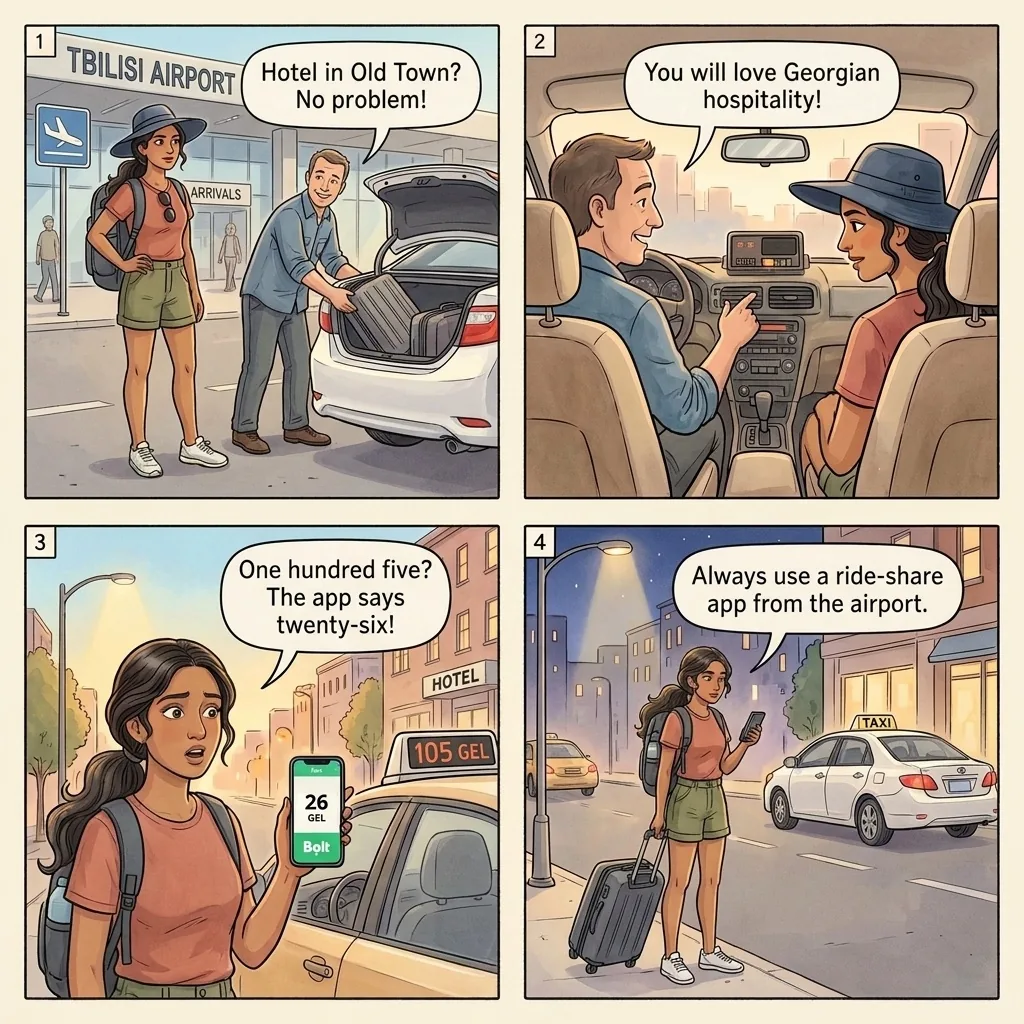
A white Toyota at Tbilisi Airport quietly drives you to the Old Town and the meter reads 105 GEL — a Bolt ride for the same trip is 26 GEL, and the 'meter' was programmed to a tourist tariff that switches with one button-press.
You exit Tbilisi Airport and approach one of the white Toyota taxis waiting outside. The driver doesn't mention a price — he just loads your bags and starts driving. When you arrive at your hotel in the Old Town, the meter shows 105 GEL. A Bolt ride for the same trip costs 26 GEL. The meter wasn't broken — it was programmed to a higher tariff.
Turkish-style taxi meters used across Georgia can store multiple tariff rates, and switching between them requires only a button press. The driver activates the tourist tariff once you're seated, and the higher rate compounds across the 17 km airport-to-center trip — a four-times multiplier on the Bolt-equivalent fare with no obvious tell on the meter display.
This is one of the most extensively documented scams in Tbilisi. TripAdvisor's 'Scammed by a taxi at Tbilisi airport' and 'Airport Taxi Scam' threads have accumulated years of complaints. One poster describes a driver who initially asked for 100 GEL, 'negotiated' down to 60, then charged 105 on arrival. Wander-Lush warns directly: 'Never use an independent taxi waiting outside Tbilisi airport, no matter what the driver is telling you. It's going to be very expensive in the best case and can get really dangerous in the worst case.'
Tbilisi Expat's taxi guide confirms the technical mechanic: 'Meters can easily be manipulated — you can program different tariffs into it, and activate any one of them with a click.' The legitimate metered base fare is 1 GEL opening plus a per-km rate that lands a TBS-to-center trip at 25–35 GEL. Anything reading above 40 GEL on arrival is the tourist tariff, not a malfunction.
The defensive move is unanimous across every source: download Bolt before landing — a Bolt ride from TBS to the center is 20–30 GEL quoted in advance. Alternatively, take Bus 37 to the city center for 0.50 GEL, or have your hotel arrange airport pickup at a fixed 30–40 GEL. For overcharge complaints, the Georgian tourist police are reachable via 112 (24-hour) and the Georgian National Tourism Administration line is +995-32-243-6999.
Red Flags
- The driver does not discuss the fare before starting the trip
- The meter shows a starting fare higher than the standard 1 GEL opening charge
- The fare climbs noticeably fast relative to the distance traveled
- The driver approaches you inside the terminal rather than waiting at the official rank
- The quoted or metered fare exceeds 40 GEL for the airport-to-center trip
How to Avoid
- Download and use Bolt before landing — the fare from TBS to the city center is 20-30 GEL, quoted in advance.
- Alternatively, take the airport bus (Bus 37) for 0.50 GEL to the city center.
- If you must take a taxi, agree on the exact fare in writing before getting in — 30-35 GEL is fair.
- Never get into a taxi that doesn't have a visible, functioning meter or a pre-agreed fare.
- Ask your hotel to arrange airport pickup at a fixed price, which is typically 30-40 GEL.
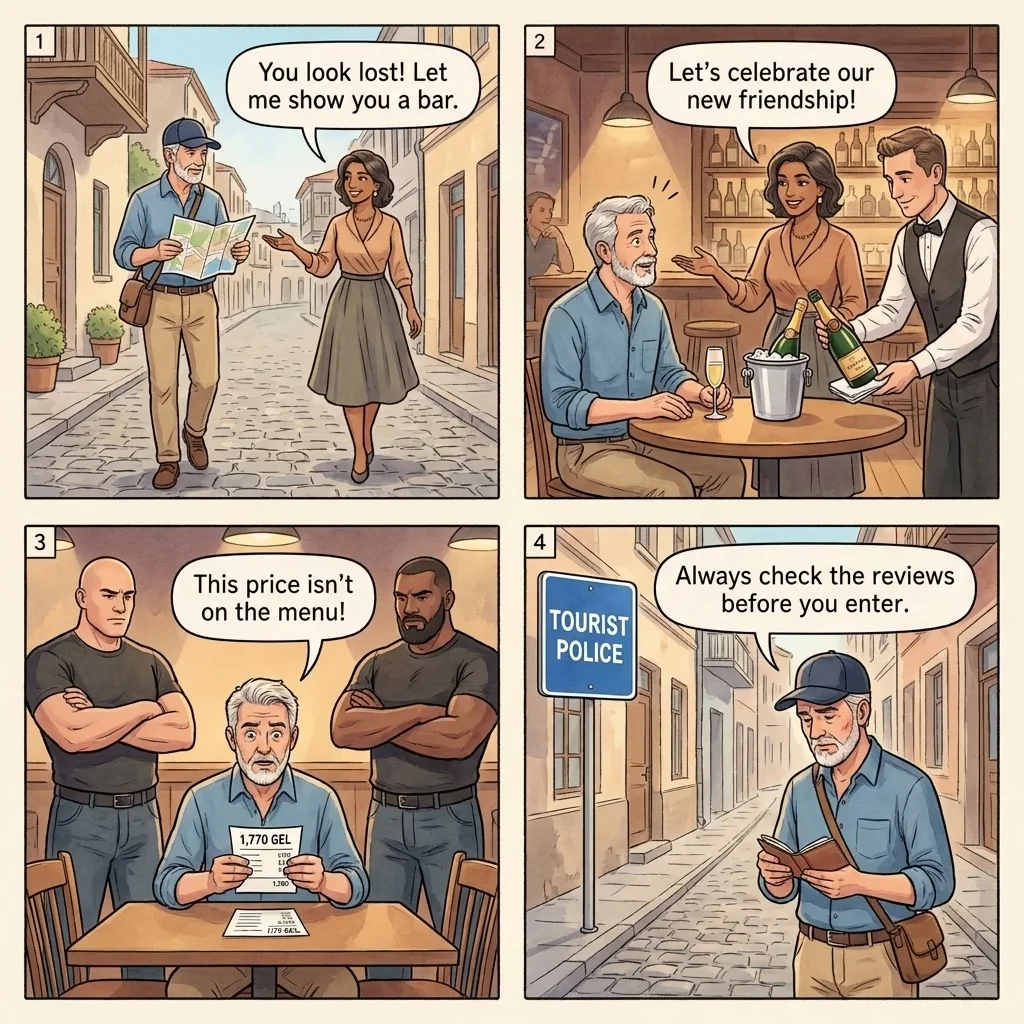
An attractive English-speaking stranger from a dating app invites you to a 'great local bar' on Ioane Shavteli, orders 1,200 GEL champagne off-menu, and bouncers enforce a cash-only 1,770 GEL bill — a 14-person ring was convicted for the exact play in 2019, and copycats keep operating.
You match with someone on a dating app or are approached on the street by an attractive, English-speaking person who invites you for drinks at a 'great local bar.' The venue looks normal — dim lighting, music, a bartender. Your companion orders champagne and cocktails. The bill arrives: 1,770 GEL (about $650). The menu showed nothing over 50 GEL, but the champagne your companion ordered costs 1,200 GEL.
Staff insist on cash only. When you resist, bouncers appear and psychological pressure intensifies until you pay. The 'companion' usually disappears during the bill dispute, taking a cut of the eventual cash payment. The cash-only enforcement is intentional: it removes any chargeback path your card issuer might offer afterward.
This is Tbilisi's most notorious tourist scam — a dedicated documentation site at tbilisiscam.home.blog catalogs it. TripAdvisor threads 'Scammed in International cafe/Club in Tbilisi' and 'Nightclub nightmare in Tbilisi, be aware' have years of victim posts. In 2019, OC Media reported that Tbilisi City Court found 14 people guilty of operating the scam across two clubs (Kalakuri and Royal), with convictions including the owner. The scheme used 'promo girls' contacting tourists through social media to arrange meetups at scam venues.
SAFE Club and Royal Club Restaurant both carry TripAdvisor reviews from victims; Royal Club earned a review titled 'SCAM CAFE/BEWARE.' While the 2019 convictions disrupted some operations, the scheme continues at different venues with the same pattern: attractive stranger → suggested venue → expensive off-menu orders on your tab → cash-only enforcement when the bill arrives.
The defensive move is to never let someone you just met choose the venue — always pick your own bar from a list with TripAdvisor reviews and Google ratings. Be immediately suspicious if a dating-app match wants to meet at a specific bar rather than a well-known restaurant. Check menu prices before ordering anything. If the bill is outrageous, call the police on 112 rather than paying under duress; the 2019 convictions show authorities take this seriously. Avoid Ioane Shavteli Street venues you haven't researched in advance.
Red Flags
- Someone you just met (in person or on dating apps) suggests a specific bar or club
- The venue is on a quiet side street with no visible price list or reviews
- Your companion orders champagne, cocktails, or premium drinks without discussing cost
- The venue insists on cash-only payment — legitimate bars accept cards
- Bouncers or large staff members become visible when you question the bill
How to Avoid
- Never let someone you just met choose the venue — always pick your own bar from a list with TripAdvisor reviews.
- Check menu prices before ordering anything and confirm the cost of each item.
- Be immediately suspicious if someone from a dating app wants to meet at a specific bar rather than a well-known restaurant.
- If the bill is outrageous, call the police (112) rather than paying under duress — the 2019 convictions show authorities take this seriously.
- Avoid bars on Ioane Shavteli Street that you haven't specifically researched in advance.
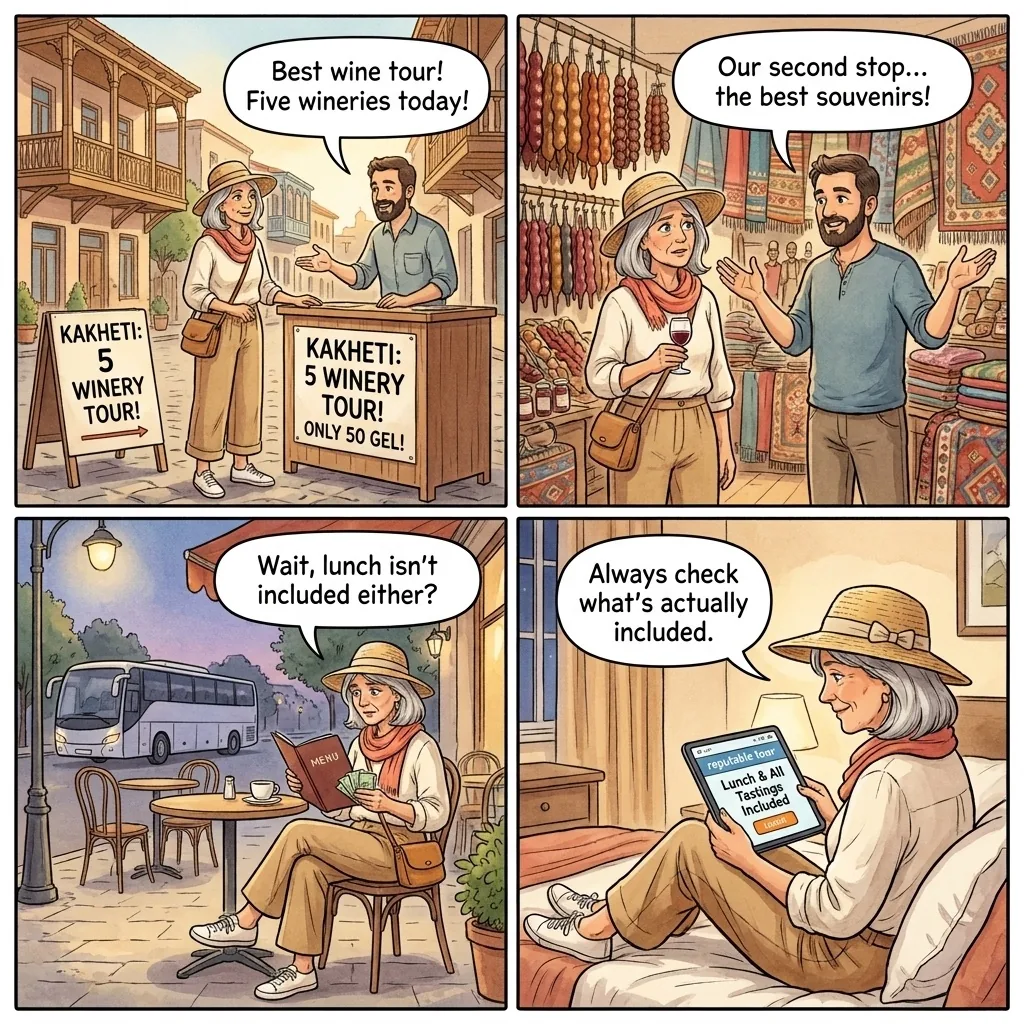
A Tbilisi street agency sells a '5-winery Kakheti tour' for 50 GEL — the trip is one winery, four souvenir shops, no lunch, no real guide, and after the 'extras' you've paid more than a legitimate operator would charge for the real thing.
You book a 'full-day Kakheti wine tour' from a Tbilisi street agency for 50 GEL per person, excited to explore Georgia's famous wine country. The tour bus picks you up, drives to Kakheti, and stops at one winery where you taste one small glass of wine. Lunch isn't included despite being implied. The 'five-winery tour' turns out to be one winery and four souvenir shops where the guide collects commissions on whatever you buy.
Back in Tbilisi, you've paid 50 GEL for the tour, 40 GEL for lunch you had to buy yourself, and 30 GEL for 'extras' that weren't disclosed up front — 120 GEL total, which is more than what a quality full-service tour would have cost in the first place. The bait pricing is the entire trick: the headline number gets you on the bus, the rest of the cost compounds on the road where you can't change operators.
The Wander-Lush travel blog's Kakheti wine-tour guide warns: 'Don't assume food or even wine is included in the quoted price because it's often not.' They document tours where 'a wine tasting could just mean one small glass of wine' and 'budget tours don't usually include food.' One tourist reported paying 85 GEL for 5 wines 'the most expensive of which was 40 GEL,' getting no real tour. The Traveling Jezebel blog adds that some Kakheti tour guides are 'glorified translators' with no actual wine knowledge.
The shop-stop pattern is a separate revenue stream layered on top of the tour fee. Each souvenir shop pays the guide a 10–20% commission on tourist purchases, so a 'five-winery tour' with four shop-stops makes more money for the operator than a real five-winery tour would. The wine knowledge is sacrificed because it doesn't drive the kickback economics.
The defensive move is to book through operators with hundreds of TripAdvisor or GetYourGuide reviews — Eat This Tours, Gourmet Georgia, and Taste Georgia all have transparent pricing and verified itineraries. Confirm in writing what's included: number of winery visits, number of tastings per winery, lunch, transport. Expect to pay 80–120 GEL per person for a quality full-day tour. For complaints, the Georgian National Tourism Administration line is +995-32-243-6999 and licensed operators must be registered with them.
Red Flags
- The tour price is significantly below 80 GEL per person, suggesting corners will be cut
- The operator cannot provide a clear written itinerary listing which wineries you'll visit
- Food and lunch are described as 'available' rather than 'included'
- The booking is through a street flyer or kiosk rather than an established operator with online reviews
- The operator describes 'five stops' without specifying that some are shops rather than wineries
How to Avoid
- Book through operators with hundreds of TripAdvisor or GetYourGuide reviews (Eat This Tours, Gourmet Georgia, Taste Georgia).
- Confirm in writing what's included: number of winery visits, number of tastings per winery, lunch, transport.
- Expect to pay 80-120 GEL per person for a quality full-day tour — lower prices mean lower quality.
- Ask whether the guide is knowledgeable about wine or just a driver who speaks English.
- Consider hiring a private driver (100-150 GEL per day) and visiting wineries independently, which offers more control.
Like what you're reading? Get a full Tbilisi itinerary with safety tips built in.
Browse travel-safety books →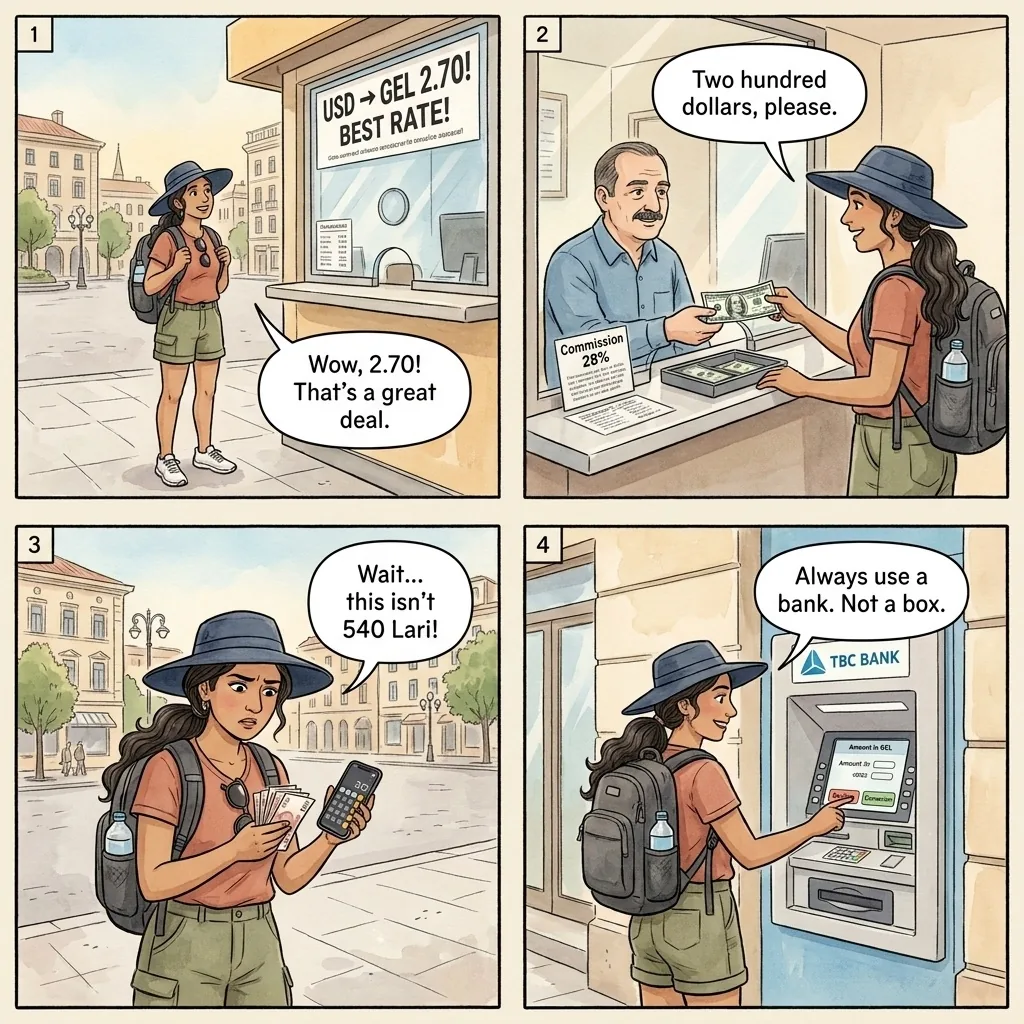
A Liberty Square exchange office advertises 2.70 GEL per USD — better than the bank rate of 2.65 — but a 28% commission is buried in the fine print, your effective rate is 2.16, and you lose $40 on a $200 exchange you thought was a good deal.
You walk into a currency exchange near Liberty Square that advertises 2.70 GEL per USD on the window sign — better than the bank rate of 2.65. You hand over $200 and receive 540 GEL. The transaction feels straightforward; the cashier counts quickly and slides the lari across the counter.
But when you check the receipt (if you got one), there's a 28% commission buried in the fine print. Your effective rate was 2.16 GEL per dollar, not 2.70. You lost about $40 on the trade — the headline rate was a sticker, the real rate was hidden behind a charge that no Georgian regulation requires the office to disclose verbally.
ATMs present a parallel trap. The machine offers to convert your withdrawal to your home currency at a 'guaranteed rate.' This Dynamic Currency Conversion (DCC) applies a markup of 5–8% on every transaction, with the markup paid to the ATM operator rather than the legitimate interbank rate. Always decline DCC and let your home bank handle the currency conversion at the standard interchange rate.
Backpack Moments' Georgia money guide warns: 'Some companies have commission fees as high as 28%. Before you exchange currency in Georgia, make sure that company does not have any commission fee.' Escape with Annual Leave's Tbilisi money-exchange guide flags that tourist-area exchanges near Liberty Square often have the worst rates despite advertising attractive headline numbers. The Georgian Travel Guide adds: 'You should avoid exchanging money in tourist-heavy areas where scams are more common.'
The defensive move is to ask 'is there a commission?' before exchanging any money — the best offices charge zero commission and post that fact on the window. Use exchange offices on Pushkin Street or Aghmashenebeli Avenue away from tourist landmarks. At ATMs, always decline DCC. Withdraw from TBC Bank or Bank of Georgia ATMs inside branches for the best security and the genuine interbank rate. The Georgian National Bank consumer-protection line is +995-32-240-6406.
Red Flags
- The advertised rate is significantly better than what banks offer — the gap is hidden in commission
- No commission rate is displayed alongside the exchange rate
- The office is located directly at a tourist landmark, train station, or airport
- The cashier counts quickly and discourages you from verifying before leaving
- An ATM offers to convert your withdrawal to your home currency at a 'guaranteed rate'
How to Avoid
- Ask 'is there a commission?' before exchanging any money — the best offices charge zero commission.
- Use exchange offices on Pushkin Street or Aghmashenebeli Avenue away from tourist landmarks.
- At ATMs, always decline Dynamic Currency Conversion (DCC) and let your home bank handle the exchange.
- Withdraw from TBC Bank or Bank of Georgia ATMs inside branches for the best security.
- Exchange only small amounts at airports or hotels and get the rest at city exchange offices.
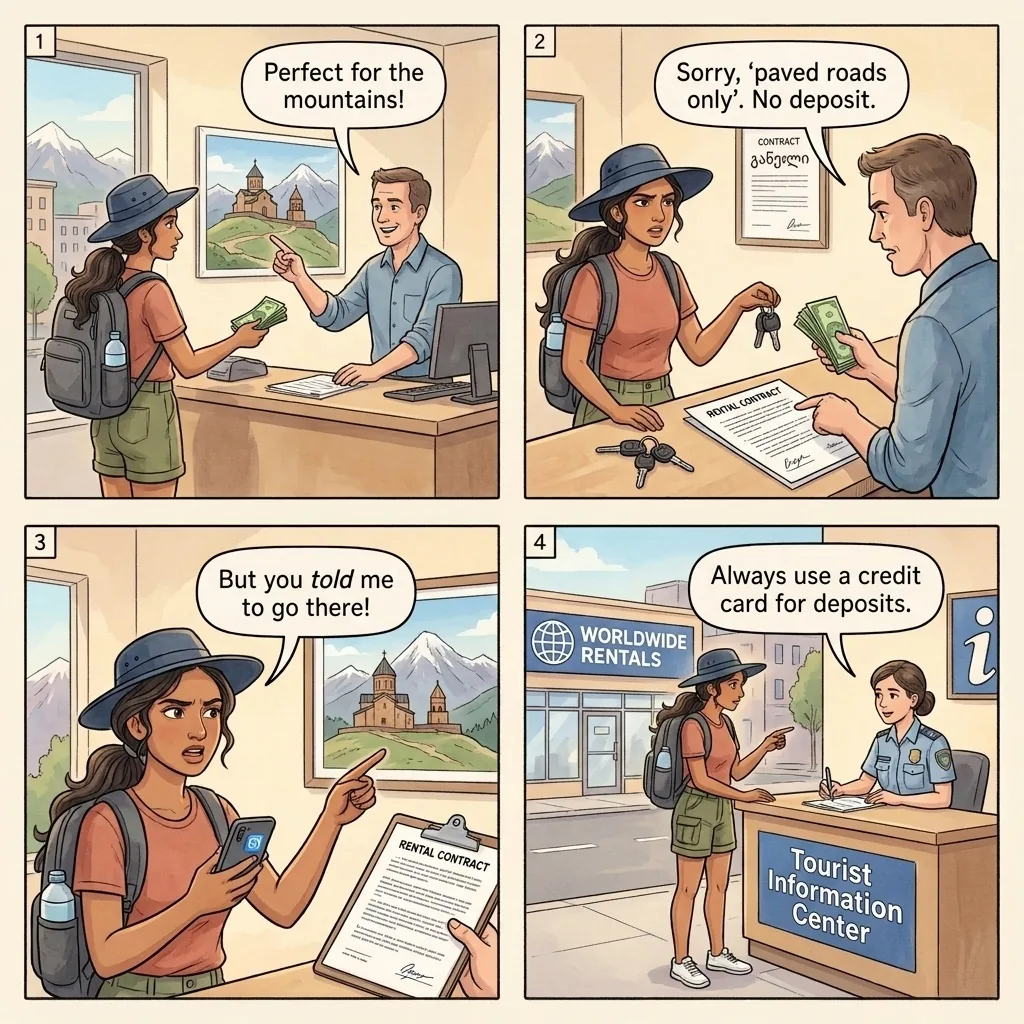
You rent from a local Tbilisi company, pay $100 cash deposit, drive Kazbegi and return the car undamaged — they refuse the deposit citing 'unapproved roads' buried in a Georgian-language contract you couldn't read, and travelers report the same play repeats with Mimino Rent Car and others.
You rent a car from a local Tbilisi company and put down a $100 cash deposit. The rental goes smoothly — you drive the Georgian Military Highway, explore Kazbegi, and return the car in the same condition you received it. The company then refuses to return your deposit, claiming you drove on 'unapproved roads' that were 'poorly described in the contract.'
The contract is written in Georgian with a brief English summary that left out the road restrictions. The clause apparently limited the car to paved roads only — but the company knew when you booked that you were planning a mountain trip. The mismatch between the verbal pitch ('great for Kazbegi') and the contract restriction ('paved roads only') is the entire mechanic; the deposit funds the operator's profit.
This pattern is documented on TripAdvisor's Tbilisi forum, where travelers report local companies like Mimino Rent Car taking cash deposits that were not returned, 'with the company citing reasons like not traveling on approved roads that were poorly described in the contract.' Reviewers note that 'these companies appeared to always find reasons for confiscating deposits, and this was believed to be common practice in Georgia.'
Road Is Calling's Georgia rental guide adds a second hazard: one tourist who scratched a rental car in an underground lot was required by the rental company to call Georgian police, who charged them with 'causing a serious traffic incident and property damage' for a parking scratch — a $400 fine for a $50 paint repair. The police-involvement variant turns a small dispute into a record that complicates exit through immigration.
The defensive move is to rent only from international companies (Europcar, Hertz, Avis) with standardized contracts and dispute processes, or from well-reviewed locals like Local Rent that offer no-deposit options. Pay deposits by credit-card hold rather than cash so a chargeback path stays open. Photograph the entire car at pickup and return, including all existing damage. Read the full contract carefully — get a Georgian-speaking hotel-staff or friend to translate restrictions before signing. Purchase full CDW/Super-CDW insurance to cap liability regardless of the deposit.
Red Flags
- The company requires a cash deposit rather than a credit card hold
- The contract is only in Georgian with a brief, vague English summary
- Road restrictions in the contract are vaguely worded or seem designed to be violated unknowingly
- No thorough vehicle condition report is completed at pickup with photos
- The company has mixed reviews with multiple complaints about deposit disputes
How to Avoid
- Rent from international companies (Europcar, Hertz) or well-reviewed locals (Local Rent) that offer no-deposit options.
- Photograph the entire car at pickup and return, including all existing damage.
- Read the full contract carefully — get a Georgian friend or your hotel to translate restrictions.
- Pay deposits by credit card rather than cash so you can dispute if the deposit is unfairly withheld.
- Purchase full CDW/Super CDW insurance to limit your liability regardless of the deposit.
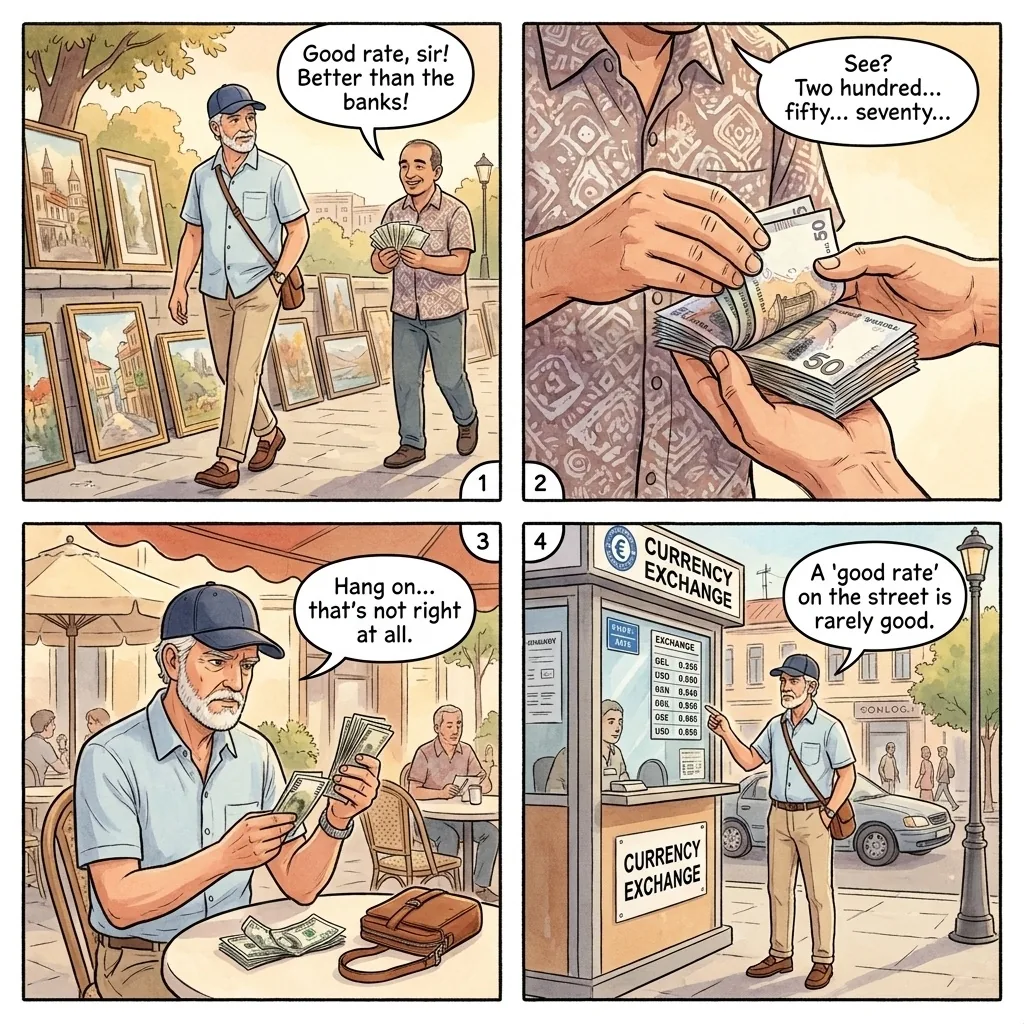
A man near the Dry Bridge Market offers a noticeably better-than-office rate, counts the lari slowly and carefully in front of you, and palms 50 GEL on a $100 exchange — a sleight-of-hand technique you don't catch because you can't yet identify Georgian lari denominations by sight.
A man near the Dry Bridge Market approaches and offers to exchange your dollars or euros at a rate noticeably better than exchange offices. You agree to change $100. He counts the lari slowly and carefully, showing you each note. Satisfied, you take the stack. Back at your hotel, you recount: you're 50 GEL short. During the count, he palmed several notes using a technique so smooth you didn't notice.
The technique relies on the better-than-market rate drawing you in, combined with practiced sleight-of-hand that exploits the fact you're unfamiliar with Georgian lari denominations and bill design. The 'careful' count is theater — the palm move happens between notes when your eye is tracking the next one being placed down. By the time you've taken the stack, the missing bills are already pocketed.
Tourist Scams Co's Tbilisi page warns about 'local money exchangers offering to exchange GEL for foreign coins at a very good rate' as a documented scam. My Geo Trip's currency guide adds: 'Be cautious of street vendors or unofficial exchange services that may offer seemingly attractive rates.' The pattern is identical across the Dry Bridge perimeter, Rustaveli Avenue near the parliament, and the area around Central Train Station — wherever foot traffic includes tourists carrying foreign cash.
A second variant adds a 'commission' demand at the end of the count, after you've already received the stack — a 5–10 GEL surcharge that wasn't mentioned upfront, designed to extract one more bill before you walk away. Both variants vanish the moment you say 'I'll go to a registered office instead' — there is no legitimate reason a street exchanger needs the trade more than a fixed-rate office on Aghmashenebeli Avenue does.
The defensive rule is simple: never exchange money on the street. Georgia has hundreds of licensed exchange offices (many open 24 hours) offering competitive rates at zero commission. The best are on Pushkin Street and Aghmashenebeli Avenue. Always count your money at the counter of an exchange office before leaving. Learn the basic Georgian lari denominations (1, 2, 5, 10, 20, 50, 100, 200) before arriving so you can spot a short stack in seconds. Police line: 112.
Red Flags
- A stranger on the street offers currency exchange at rates better than exchange offices
- They count money very quickly or use distracting conversation during the count
- The exchange happens while walking or in a doorway rather than at a fixed location with a receipt
- They become agitated or try to rush you if you attempt to recount
- The person has no fixed stall, shop, or business registration visible
How to Avoid
- Never exchange money with street vendors — always use licensed exchange offices or bank ATMs.
- If offered a street exchange, simply say 'no thanks' and walk to the nearest exchange office.
- Always count your money at the counter of an exchange office before leaving.
- Learn the basic Georgian lari denominations (1, 2, 5, 10, 20, 50, 100, 200) before arriving.
- The best exchange offices are on Pushkin Street and Aghmashenebeli Avenue, open 24 hours.
🆘 What to Do If You Get Scammed
📋 File a Police Report
Go to the nearest Georgian Police (Patrol Police) station. Call 112 (Emergency) or 022-241-106 (Police). Get an official crime report — you'll need this for insurance claims. You can also report online at police.ge.
💳 Cancel Your Cards
Call your bank immediately. Most have 24/7 numbers on the back of the card (keep a photo saved separately). Block any suspicious transactions before the thieves use your details.
🛂 Lost Passport?
Contact the US Embassy in Tbilisi at 11 George Balanchine Street. For emergencies: +995 32-227-7000.
📱 Track Your Device
If your phone was stolen, use Find My (iPhone) or Find My Device (Android) from another device. Don't confront thieves yourself — share the location with police instead.
Frequently Asked Questions
You just read 6 scams in Tbilisi. The full Travel Safety Series has 780+ more across 20+ countries.
Tokyo's Kabukichō ¥130,000 bar trap. Rome's gladiator photo extortion. Paris's gold-ring trick. Bali's ATM skimmer scams. Bangkok's grand-palace closure ruse. Every documented scam across 20+ destinations — with the exact scripts, red flags, and local-language phrases that shut each one down. Drawn from Reddit traveler reports, embassy advisories, and consumer-protection cases.
- 780+ documented scams across Tokyo, Rome, Paris, Bali, Bangkok, Rio & 100+ more cities
- 20+ countries covered, with country-by-country phrase cards for every destination
- Updated annually — buy once, re-download future editions free
- All titles $4.99 each on Amazon Kindle