
Key Takeaways
- The #1 reported scam is the Fake Toledo Cathedral, Alcázar & Synagogue Combo-Ticket Websites.
- 1 of 6 scams are rated high risk.
- Use app-based ride services (Uber, Bolt) or official metered taxis instead of unmarked vehicles.
- Never accept unsolicited offers from strangers near tourist sites in Toledo.
⚡ Quick Safety Tips
- Buy the Pulsera Turística wristband (€12 for 7 monuments) at any participating site on arrival — or book Cathedral only at catedralprimada.es and Alcázar at ejercito.defensa.gob.es; flags the ticket-overcharge ecosystem.
- At Toledo Train Station, use Cabify or Uber (€5–€7 to Plaza de Zocodover) — the station taxi rank routinely quotes €10–€15 'fixed prices.'
- For damascene knives or swords as gifts, visit Mariano Zamorano (Calle Ciudad 19) or Simón Cortés (Paseo de San Cristobal) warns the Calle del Comercio tourist shops sell decorative replicas, not genuine forged damascene.
- Keep crossbody bag in front in narrow Judería alleys and Plaza de Zocodover during 10 AM / 2 PM tour-group transitions notes Toledo distraction pickpockets specifically target 'relaxed' day-trippers.
- Walk two streets off Plaza de Zocodover for lunch — Alfileritos 24, Bar Ludeña, and El Trebol have honest €13–€16 Menú del Día.
Jump to a Scam
- High Fake Toledo Cathedral, Alcázar & Synagogue Combo-Ticket Websites
- Medium 'Authentic Damascene' Knife & Sword Counterfeit Shops
- Medium Toledo Old Town Distraction Pickpockets
- Medium 'Free Walking Tour' Guilt-Trip Tip Demands
- Medium Plaza de Zocodover Tourist-Menu Restaurant Overcharge
- Medium Toledo Train Station Taxi Overcharge & Route Skimming
The 6 Scams

Toledo's official 'Pulsera Turística' wristband at €12 covers 7 monuments (Cathedral, Alcázar, both synagogues, plus 3 more), and direct admissions are €12 Catedral Primada, €5 Alcázar, €3–€4 each synagogue — but clone sites mimicking catedralprimada.es and Patrimonio Nacional charge €30–€45 for tickets that should cost €12 and send PDFs that may not scan at the gate; book at the monuments directly or through the licensed reseller Tiqets only.
Toledo is a one-day Madrid satellite — AVE trains run every hour from Atocha (33 minutes), the whole old town is walkable in a day, and nearly every visitor buys a combo ticket covering the Cathedral (Catedral Primada), the Alcázar de Toledo (now the Museo del Ejército), and one or both of the historic synagogues (Sinagoga del Tránsito and Sinagoga Santa María la Blanca). That combo-ticket market is the single most common Toledo scam vector: clone sites that mimic the official Catedral Primada and Patrimonio Nacional booking pages, charge €30–€45 for the same access that costs €12 direct, and send PDF confirmations that occasionally fail to scan at the gate. The canonical legitimate pricing (2024–2025) is €12 Catedral Primada with audio guide included, €5 Alcázar/Museo del Ejército, €3 Sinagoga del Tránsito, €4 Sinagoga Santa María la Blanca, and €12 for the official Pulsera Turística wristband covering all 7 participating monuments.
The trap menu has three mechanics. Clone sites that copy the visual identity of catedralprimada.es or patrimonionacional.es and rank above the genuine sites in Google search results, selling the same Cathedral or Alcázar tickets at €30–€45 for a €12 product, with PDFs that may or may not scan at the gate depending on how recently the clone was registered. Bundled 'Toledo Combo' tickets at €40–€60 that wrap the Pulsera Turística (€12 direct) with a 'guide' or 'audio download' for what amounts to pure markup. Tiqets is a licensed reseller for the Alcázar specifically and is genuinely OK to use, but most of the other listings on Tiqets and GetYourGuide for Toledo are bundled markups rather than direct ticketing. The Cathedral-specific community confusion is that there's a small free chapel section vs the paid main-Cathedral walk — travelers who didn't know the paid section existed sometimes flag the legitimate €12 fee as a 'scam' on Reddit threads, which is itself part of the messaging environment that resellers exploit.
For older travelers on a Madrid day-trip to Toledo, the defense is the official €12 Pulsera Turística bought on arrival at any participating monument. Buy the Pulsera Turística wristband at €12 from any of the 7 participating monuments on arrival in Toledo (the simplest defense covering all major sites with one purchase) — or buy individual tickets direct at catedralprimada.es (€12 Cathedral with audio guide) and at the Alcázar/Museo del Ejército ticket window (€5) — and refuse every clone site charging €30–€45 for a €12 Cathedral ticket, every 'Toledo Combo' bundle at €40–€60 that wraps the €12 Pulsera Turística with a marketing guide, and every PDF confirmation from a non-official URL that may fail to scan at the gate. Tiqets at tiqets.com is a licensed reseller for the Alcázar specifically and is genuinely fine to use — but verify the booking confirmation arrives from tiqets.com rather than a copycat domain. AVE trains from Madrid Atocha to Toledo run every hour at €13–€26 each way; Spanish Tarjeta Dorada (age 60+) drops fares 25–40%.
Red Flags
- URL is not catedralprimada.es, ejercito.defensa.gob.es, or the official Toledo tourism site (toledomonumental.com)
- Combo-ticket price is above €35 when the official Pulsera Turística is €12
- Site uses English-language urgency language ('only 3 tickets left today') that the official sites never use
- Payment confirmation lacks the Toledo Catedral Primada or Patrimonio Nacional logo
- Listed 'combo' includes unofficial venues (tapas tour, dance show) alongside the monuments
How to Avoid
- Buy the Pulsera Turística wristband (€12, covers 7 monuments) at any of the participating sites on arrival.
- Book Cathedral tickets only at catedralprimada.es and Alcázar tickets only at ejercito.defensa.gob.es.
- For online pre-booking, use Tiqets or GetYourGuide — both are licensed resellers with buyer protection.
- Avoid Google ads for 'Toledo tickets' which routinely lead to clone sites.
- If pre-paid tickets fail at the gate, file a chargeback with your credit card company and buy new tickets on-site.

Toledo old-town tourist shops on Calle del Comercio and the path from Plaza de Zocodover to the Cathedral sell €40–€90 'Toledo damascene' decorative replicas — mass-produced in the Toledo industrial zone or imported with 'mystery metals often including lead' and rarely heat-treated, marked with 'Toledo, España' engravings that imply craft pedigree they don't have; genuine damascene from Mariano Zamorano (Calle Ciudad) or Simón Cortés (Paseo de San Cristobal) starts at €120 for folding knives and reaches €500+ for swords.
Toledo's historic reputation as Europe's sword-making capital stretches back to Roman times, and real Toledo damascene steel is still produced by a handful of traditional workshops — Mariano Zamorano on Calle Ciudad and Simón Cortés on Paseo de San Cristobal are the named legitimate operators. These workshops are small, mostly mail-order, and their prices reflect the craft: a genuine Toledo damascene folding knife starts around €120 and a full sword can reach €500+. The old-town tourist shops that line the path from Plaza de Zocodover to the Cathedral market an entirely different product — decorative replica knives, swords, and fantasy 'medieval' blades mass-produced in the Toledo industrial zone or imported from China, then marked with 'Toledo, España' engravings that imply a craft pedigree the items don't have.
Long-time community guidance is consistent: Toledo is now better known for decorative replicas than genuine damascene, and you'll hardly find any real damascene outside the few named workshops. The community shorthand is that if the shop is on the main tourist street and sells Conan the Barbarian replicas alongside supposedly-damascene knives, the 'authentic' claims are pure marketing. The materials concern is real — community-flagged warnings note that mass-produced 'damascus' replicas use mystery metals (sometimes including lead) and are rarely heat-treated, making them decorative-only items that won't hold an edge or pass a metallurgical test. The €40–€90 price point on Calle del Comercio is the standard tourist-shop range for these replicas, marked up against a €5–€20 manufacturing cost. The workshops at Mariano Zamorano and Simón Cortés sit a few streets off the tourist path and operate on appointment-style visits with named provenance and verifiable craft history.
For older travelers buying gifts in Toledo, the defense is to know which product you're buying and pay accordingly. For a genuine Toledo damascene piece, visit a named workshop (Mariano Zamorano on Calle Ciudad or Simón Cortés on Paseo de San Cristobal) and pay workshop prices — €120+ for a folding knife, €500+ for a full sword — with verifiable provenance and craft history; for a decorative souvenir, accept that the €40–€90 blade from a Calle del Comercio tourist shop is a mass-produced replica (pretty, legal to bring home in checked luggage, but not what the 'Toledo damascene' marketing claims) and refuse every shop that mixes 'Toledo damascene' marketing with Conan the Barbarian fantasy replicas as a non-craft retailer. Check checked-luggage rules for swords on your return airline (most allow swords in checked bags only with proper packaging; UK and US customs sometimes require declaration). The tourist-shop replicas have lead in the alloy in some 2025 documented cases — store away from food contact and don't sharpen for cutting use. Real damascene pieces from the named workshops carry authentication paperwork; tourist-shop replicas don't.
Red Flags
- Shop is on a tourist street with English signage, window displays of 'medieval,' 'Game of Thrones,' or fantasy swords
- 'Damascus' or 'damascene' blades priced under €100 — genuine handmade damascene work starts much higher
- Staff claim 'hand-forged' for items clearly identical to hundreds on display
- Country-of-origin stamps reveal outsourced manufacturing (e.g. 'Pakistan,' 'Oklahoma') on blades claimed Spanish
- Pressure to buy quickly ('last one in stock,' 'special discount for you')
How to Avoid
- For genuine Toledo damascene, visit named workshops: Mariano Zamorano (Calle Ciudad 19) or Simón Cortés (Paseo de San Cristobal).
- Accept that sub-€100 'damascene' blades are decorative replicas, not handmade craft — pay accordingly.
- Check blades for country-of-origin stamps and stated metal composition before buying.
- For checked-luggage rules, confirm the blade length your home country permits before purchase.
- Genuine damascene has a flowing water-ripple pattern forged into the steel, not an etched or laminated surface pattern.

Toledo's old-town choke points (Plaza de Zocodover during tour-group transitions at 10 AM and 2 PM, the Judería's narrow Calle Reyes Católicos en route to the synagogues, the steep climb from the train station up to Zocodover where tourists pause for breath and reach for phones) concentrate opportunistic pickpockets — Toledo doesn't have Barcelona-level organized crews but the medieval-town complacency factor is real, and the same crossbody-bag-in-front Madrid defense applies.
Toledo doesn't have Barcelona-level organized pickpocket rings, but its narrow medieval old town funnels thousands of day-trippers through a small footprint every afternoon, and opportunistic thieves work that crowd. The old town's geography concentrates pedestrians at three reliable choke points: Plaza de Zocodover during tour-group transitions (typically 10 AM when the first AVE arrivals unload and 2 PM when the second wave hits), the Judería's narrow Calle Reyes Católicos on the way to the Sinagoga del Tránsito and Sinagoga Santa María la Blanca, and the steep climb from the train station up to Zocodover where tired tourists pause for breath and reach for phones — exactly the moment of distraction that opportunistic crews work.
The mechanic is consistent with the Spain-wide pattern flagged in Madrid and Barcelona, scaled down to Toledo's smaller crowd density. The 2025 Spain-wide defensive rule applies twice over in Toledo's narrow streets where bumping is physically unavoidable: don't put valuables in a backpack on your back, keep wallet and passport in a front pocket. The relaxed-tourist framing matters most: visitors typically arrive in Toledo just after Madrid where they've been warned about pickpockets, arrive in a 'medieval fairytale town' that doesn't feel like Madrid's threat-level, and let their guard down exactly in the hour the first tour buses unload at Plaza de Zocodover. The crew profile is opportunistic individuals working the choke points rather than coordinated 3–5 person teams — but a single skilled lift in a narrow street is enough to lose a phone or a wallet, and recovery rates are essentially zero.
For older travelers arriving by AVE from Madrid or on a cruise-arranged Toledo day tour, the defense is to apply the Madrid posture in Toledo without relaxing for the smaller-town setting. Wear a zipped crossbody bag in front through Plaza de Zocodover, the Judería's Calle Reyes Católicos, and the climb from the train station — keep your phone in a zipped inner pocket between uses (never in a back pocket or open backpack pouch), split valuables so €20 and one card sit in a zipped front pocket while passport and backup card stay locked in a hotel safe or with a traveling companion, and don't relax the Madrid pickpocket posture just because the town is smaller and the architecture friendlier. The choke points peak at 10 AM and 2 PM with tour-group arrivals — visiting before 10 or between noon and 2 PM gives lower crowd density. The Escalera Mecánica (outdoor covered escalator) between Paseo de Recaredo and the Alcázar is free and accessible — a more comfortable alternative to the steep climb up from the station that also avoids the highest-density pickpocket window. If you're hit with a lift, file a denuncia at Policía Nacional Toledo within 48 hours for the insurance and chargeback paperwork.
Red Flags
- Plaza de Zocodover during tour-group transitions (10 AM, 2 PM) with crowds converging on a small plaza
- Narrow Judería streets (Calle Reyes Católicos, Calle de los Judíos) where bumping is unavoidable
- The train-station-to-Zocodover climb where tourists pause for breath and reach into bags
- A stranger asks for photo help or directions while their companion approaches from your blind side
- Someone brushes against you in the Cathedral square on a busy afternoon
How to Avoid
- Wear a zipped crossbody bag in front at all times in the Toledo old town.
- Do not put wallet, phone, or passport in back pockets or outer backpack compartments — both are openly vulnerable in Toledo's narrow streets.
- Keep one hand on your bag during any pause — at a viewpoint, at a cafe terrace, on the Zocodover climb.
- If someone bumps into you, immediately check all pockets and bag compartments before walking on.
- Report thefts to Policía Nacional (Comisaría de Toledo, Calle Peñas de la Cruz, +34 925 284 000) within 48 hours for the denuncia required for insurance.
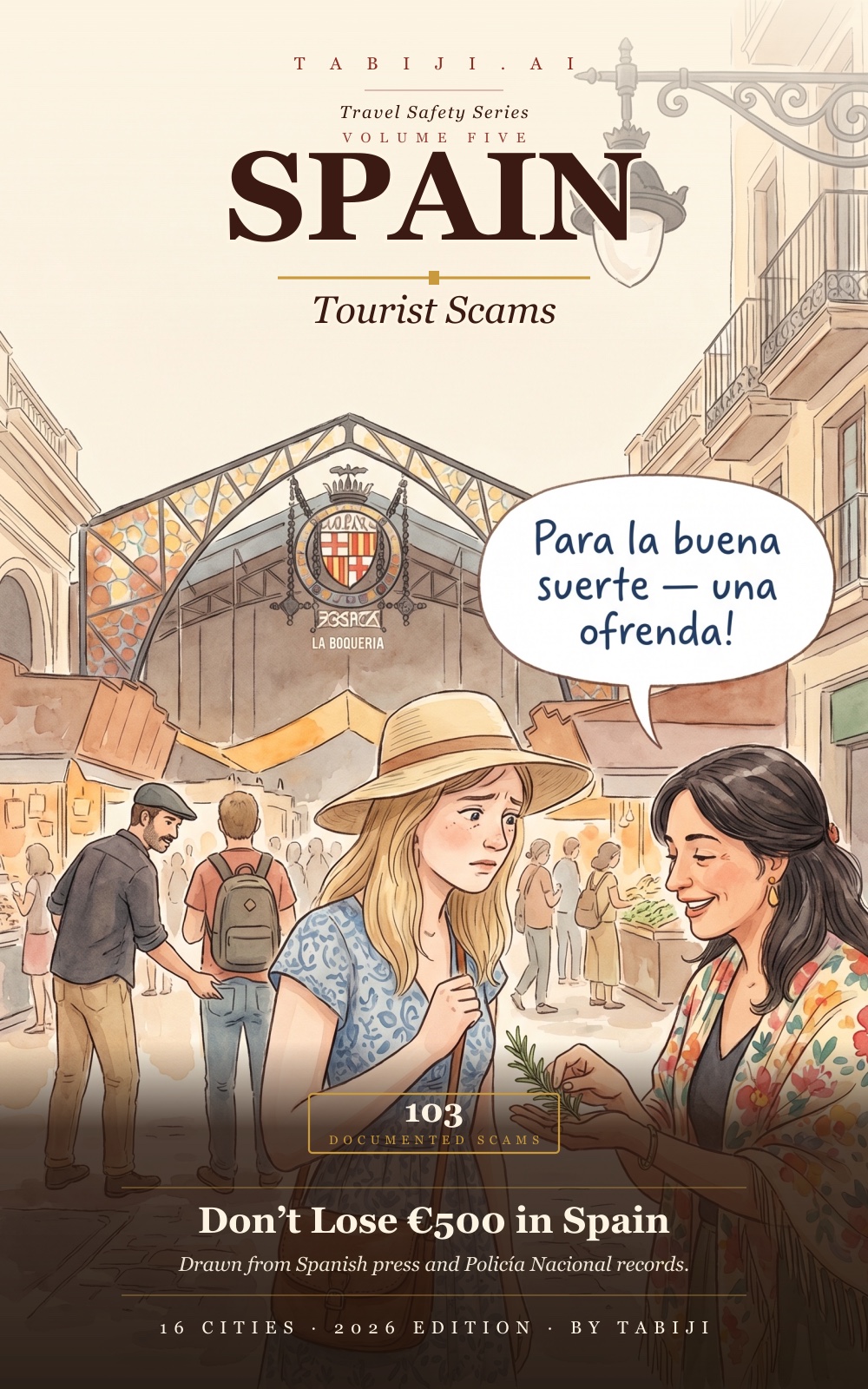

Toledo 'tip-based' walking tours end with a high-pressure €10–€20-per-person cash demand framed as 'whatever you think it was worth' — the guide spends 90 minutes building rapport then produces a cash envelope and stares until you pay — and the downstream commission scam steers you into damascene knife shops with inflated prices, tourist-menu restaurants kicking back 10%, and 'authentic flamenco' venues at 3× the real rate; book paid Tiqets/GetYourGuide tours with fixed pricing or use a Rick Steves self-guided audio instead.
Toledo's tourist-strip walking-tour ecosystem runs the standard Spain-wide 'free tip-based' pattern that's been documented across Madrid, Barcelona, and Seville: a guide advertises a 'free' walking tour that ends with a high-pressure cash ask of €10–€20 per person, framed as 'whatever you think it was worth.' The pressure is the actual scam — the guide spends 90 minutes building rapport, delivers the rehearsed 'it's completely up to you what you feel it was worth' speech at the end, produces a cash envelope, and stares at you until you pay. Travelers consistently describe the mechanic as 'guilted into giving the guide at least €10' even when the content quality was good. The information itself is often legitimate, which makes the social-pressure dynamic harder to refuse.
The mechanic has two layers. The first is the tip-pressure itself, which extracts €10–€20 per person from a 'free' product that travelers wouldn't have paid €15 for upfront. The second is the downstream commission funnel — the guide spends the 90 minutes of rapport-building working route stops at venues that pay 10–30% commissions: a damascene knife shop with inflated prices (€80 replicas where the workshop equivalent is €120 with verified provenance), a tourist-menu restaurant near Plaza de Zocodover that kicks back 10% on every meal, or an 'authentic flamenco' venue charging 3× the real Madrid rate. The full 'train-scam' variant documented across Europe has the guide's real business as the commission funnel rather than the tip — every recommended stop pays the guide, and travelers leave thinking they got an 'insider' experience when they actually walked a commission route. The Rick Steves community recommendation for Toledo specifically is consistent: a paper guide with a map (or a downloaded Rick Steves audio tour at €5–€20) does the same informational job at zero social pressure and zero commission funnel.
For older travelers wanting a Toledo tour, the defense is to book paid guided tours with fixed pricing or use a self-guided audio. Book paid guided tours through Tiqets, GetYourGuide, or the Toledo tourism office at fixed prices upfront (€15–€30 per person for a 90-minute walk with a Blue Badge or qualified guide) — or buy the €12 Pulsera Turística and pair it with a Rick Steves self-guided audio tour on your phone for zero social pressure — and refuse every 'free tip-based' walking tour that ends with a cash-envelope ask, every guide who steers you into a damascene knife shop or tourist-menu restaurant during the route as a commission funnel, and every 'authentic flamenco' venue at 3× Madrid prices recommended by a tour guide. If you do take a tip-based tour and the route includes a 'recommended' shop or restaurant stop, decline to enter and continue the walk yourself — the guide has no authority to require shop visits, and refusing the commission stop exposes the funnel without confrontation. The €10 tip itself isn't the actual cost; the downstream commissions on a single damascene shop visit can run €40–€100 over fair-price purchases at the named workshops.
Red Flags
- Tour advertised as 'free' or 'tip-based' with tour-start promoted at Plaza de Zocodover or near the Cathedral
- Guide builds unusually warm rapport early in the tour — a social-pressure setup
- Tour includes 'recommended' shops, restaurants, or flamenco venues as stops
- Guide produces a tip envelope or hat at the end and stares at each tourist until they contribute
- Recommended 'authentic' venues match names flagged on traveler reports as overcharging or scam operators
How to Avoid
- Book a paid guided tour with a fixed upfront price via Tiqets or GetYourGuide instead of a 'free' tour.
- Use a Rick Steves audio guide on your phone for a self-guided tour — genuinely free and no social pressure.
- If you join a free tour, decide your tip amount before the end and leave promptly — don't linger for upsell pitches.
- Ignore guide 'recommendations' for shops or restaurants; cross-check on traveler reports or traveler reports.
- Never give cash directly to a tour guide outside the advertised tip window.
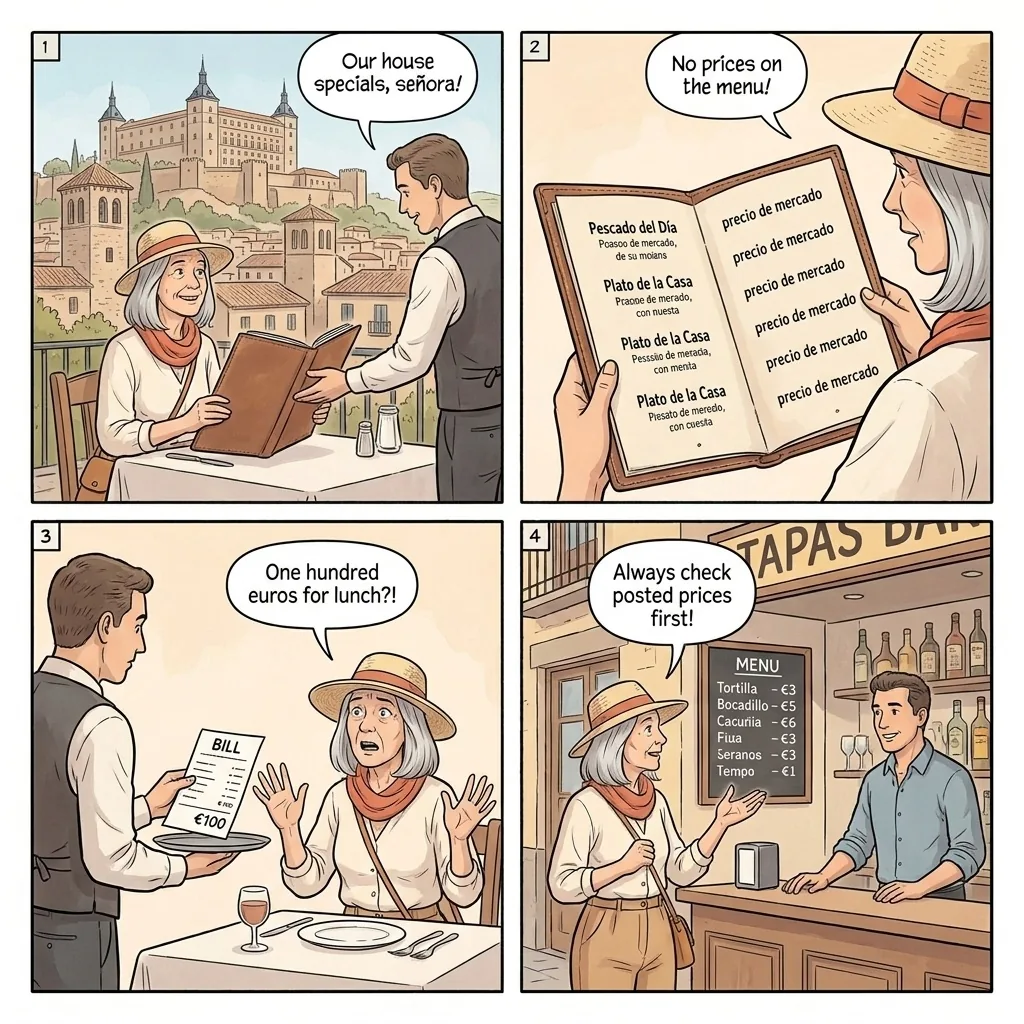
Toledo's Plaza de Zocodover restaurants pad bills with €18–€25 'Menú del Día' that's actually a lower-quality Menú Turístico, unlisted cover charges, €4 'complimentary' bread baskets, terrace supplements not mentioned at seating, and substitute ingredients at premium prices (frozen cod 'fresh,' industrial gazpacho 'homemade') — walk two streets off Zocodover to Calle Núñez de Arce, Calle Hombre de Palo, or Plaza Mayor for a real €13–€16 Menú del Día at Alfileritos 24, Bar Ludeña, or El Trebol.
Toledo's entire old town is compressed around Plaza de Zocodover, and tour groups unload at the same three hours every day (10 AM, 12 PM, 2 PM). The restaurants ringing the plaza and extending toward the Cathedral know their customers eat there once and never return — the perfect conditions for 'tourist-menu' bill-padding. Long-time Spain community guidance treats Toledo as Madrid's satellite rather than a destination with its own restaurant culture, so the right framing is: don't expect the locals' food scene to be at Plaza de Zocodover, where the eight or ten plaza-facing restaurants are calibrated for once-only tourist customers.
The trap menu has six recurring mechanics. €18–€25 'Menú del Día' marketing on plaza-facing menus that's actually a lower-quality Menú Turístico (different prep, smaller portions, frozen ingredients) at 30–40% premium over a real €13–€16 locals' Menú del Día. Unlisted cover charges of €2–€4 per person that appear on the bill without disclosure on the menu. 'Complimentary' bread baskets that turn out to cost €4 per basket, with the 'cortesía' framing as a deliberate misrepresentation under Spanish consumer law. Terrace supplements (€3–€5 per person) not mentioned at seating but applied to outdoor tables with plaza views. Substitute-ingredient premium pricing: frozen cod served as 'fresh,' industrial gazpacho served as 'homemade,' microwaved paella served as 'a la valenciana.' Credit-card surcharges of 5% added at payment without prior disclosure on the menu. The cumulative effect on a two-person Plaza de Zocodover lunch can move a €40 expectation to €70+ via the stack. The locals' alternative is a few streets off the plaza in any direction.
For older travelers on a Toledo day-trip, the defense is to walk two streets off Plaza de Zocodover before sitting down to eat. Walk at least two streets off Plaza de Zocodover before sitting down for a meal — Calle Núñez de Arce, Calle Hombre de Palo, and the alleys near Plaza Mayor (Ayuntamiento) have restaurants where local office workers and Toledo residents eat with posted Spanish menus, a proper Menú del Día at €13–€16, and no terrace supplements; refuse every Plaza de Zocodover-facing 'Menú del Día €18–€25,' every unlisted cover charge, every €4 'complimentary' bread basket that arrives at the table without confirmation, and every undisclosed terrace supplement or credit-card surcharge. Community-recommended Toledo restaurants with consistent good reviews: Alfileritos 24 (modern Castilian, €18–€30 mains, posted menu), Bar Ludeña (traditional tapas, €8–€16 small plates, locals' venue), Restaurante Adolfo (upscale but honest, €30–€60 per person), El Trebol (casual locals' lunch). Confirm the menu at the door matches the menu at the table before sitting (Spanish law requires consistency), refuse welcome bread and olives that arrive without confirmation of free status, and check the bill line by line at payment time disputing any non-ordered items. PROCON Castilla-La Mancha handles Toledo restaurant disputes if a manager refuses to correct an abusive bill.
Red Flags
- Menu is only in English with photos of every dish — no chalkboard Spanish specials
- Staff outside actively recruiting passing tourists into the restaurant
- 'Menú del Día' advertised at €18+ when the local residential rate is €13–€16
- Bread, olives, or water appear on the table without being ordered
- Bill includes terrace supplement, cover charge, or service charge not mentioned at ordering
How to Avoid
- Walk at least two streets off Plaza de Zocodover before choosing a restaurant.
- Order the Menú del Día at honest-priced restaurants (€13–€16): Alfileritos 24, Bar Ludeña, El Trebol are community-recommended.
- Order in Spanish or at least point to Spanish menu items — this signals you are not a soft tourist target.
- Check drink prices on the menu before ordering; above €3 for a caña/vino tinto is tourist pricing.
- Refuse any bread, olives, or water not explicitly ordered and request an itemised bill before paying.
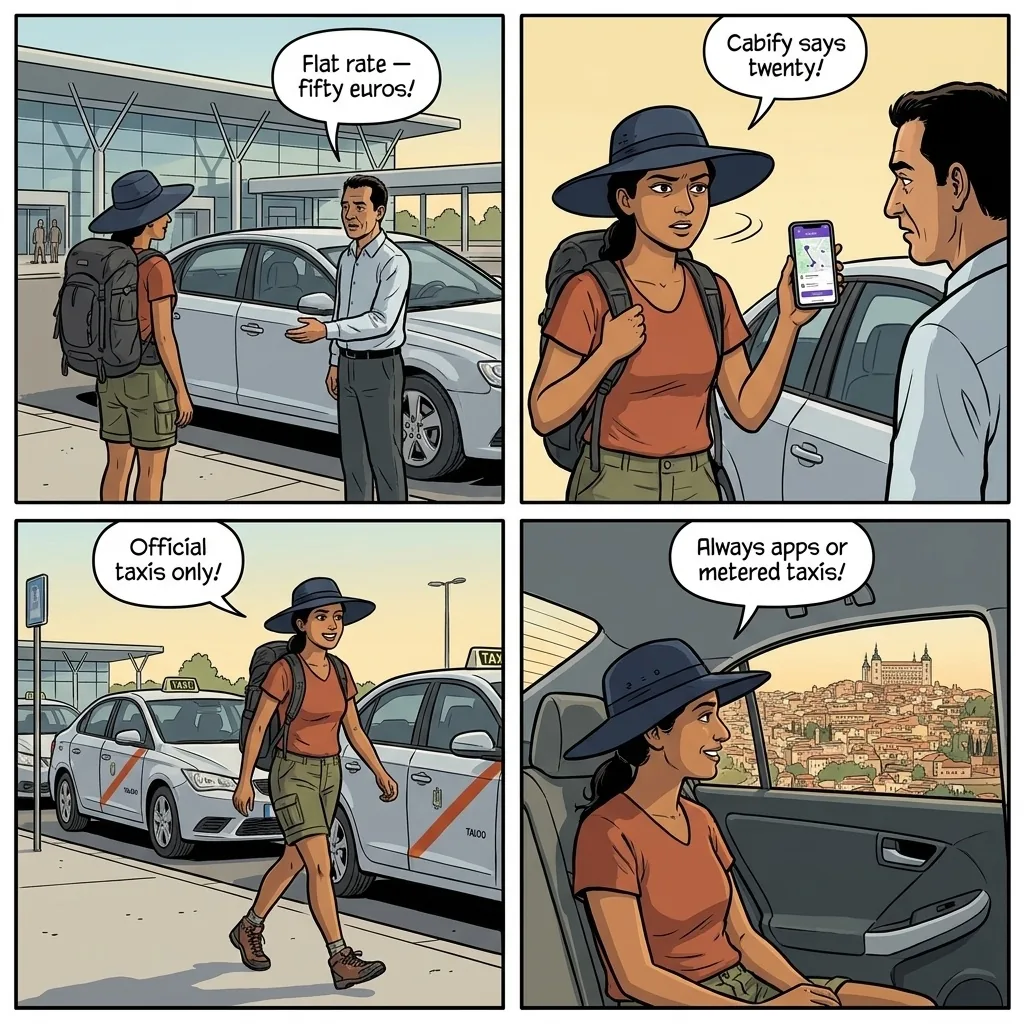
Toledo Station to Plaza de Zocodover is a 15-minute scenic-but-steep walk up over the Alcántara bridge — but most day-trip arrivals take a taxi where the metered fare is €5–€7 and unofficial 'listos' on peak tour weekends quote 'fixed prices' of €10–€15, refuse the meter, or take extended routes adding €5; Cabify and Uber both operate in Toledo with app-regulated fares, and the free outdoor Escalera Mecánica between Paseo de Recaredo and the Alcázar is the accessible walking alternative.
Toledo's AVE train station sits on the lower riverbank below the historic old town, connected by a dramatic but steep 15-minute walk up over the Alcántara bridge. Long-time community guidance frames the walk as scenic and manageable for most able-bodied travelers, with a taxi as optional rather than necessary — but most day-trip arrivals with luggage or mobility concerns default to the taxi rank, and that rank is the choke point where overcharging happens. The legitimate metered fare is €5–€7 from Toledo Station to Plaza de Zocodover. Unofficial operators and 'listos' (touts) on peak tour weekends quote 'fixed prices' of €10–€15, refuse to run the meter, or take extended routes that add €5 to a metered fare.
The trap menu has three mechanics. The fixed-price refusal — drivers at the station rank quote €10–€15 'fixed' to Plaza de Zocodover and refuse the meter, knowing day-trippers with luggage are unlikely to walk back into the station to find another driver. The extended-route padding — drivers run the meter but take a route that adds 5–8 minutes via the longer riverbank road, taking a €5 fare to €10. The 'listo' tout variant — unofficial drivers approach arriving travelers inside the station concourse with 'taxi to the centre?' offers, then quote inflated fixed rates against the licensed metered rank waiting outside. Cabify and Uber both operate in Toledo with app-regulated fares and digital receipts, making them the strongest defense for travelers who want a fixed app-regulated price. The free outdoor Escalera Mecánica (covered escalator) between Paseo de Recaredo and the Alcázar is the accessible walking alternative for travelers without heavy luggage who want to skip the taxi entirely.
For older travelers arriving at Toledo Station, the defense is to use Cabify/Uber, walk via the Escalera Mecánica, or insist on the metered rank. Use Cabify or Uber for a €5–€7 app-regulated ride from Toledo Station to Plaza de Zocodover (digital receipt, fixed fare, no meter dispute) — or if taking the station taxi rank, request the driver run the meter before boarding and photograph the taxi number plate as you enter — and if walking, take the free outdoor Escalera Mecánica covered escalator between Paseo de Recaredo and the Alcázar as the accessible alternative; refuse every 'fixed price €10–€15' quote at the station rank, every meter-refusal, every extended-route padding via the longer riverbank road, and every unofficial 'listo' tout offering 'taxi to the centre' inside the station concourse. The walk over the Alcántara bridge is scenic and 15 minutes for travelers without heavy luggage — manageable for most able-bodied visitors and free. For travelers with luggage, leave bags at the Toledo Station luggage office (€3–€5 per bag for the day) and walk up unencumbered, then collect on return — significantly cheaper and more flexible than carrying bags into the centre. If a driver refuses the meter at the station rank, walk to the next licensed taxi in the queue or open the Cabify app — the metered fare is regulated and the driver knows it.
Red Flags
- Driver quotes a 'fixed price' of €10–€15 for the station-to-center ride when the meter rate is €5–€7
- Driver refuses to run the meter 'because it's close'
- Route takes you across the Alcántara bridge and back around instead of the direct Paseo de la Rosa–Cuesta de la Vega approach
- No receipt offered on arrival
- App pickup shows your starting location moving away from the station to inflate the metered distance
How to Avoid
- Use Cabify or Uber at Toledo Station — app-regulated fare, digital receipt, starting-location screenshot.
- If using a licensed taxi, confirm the meter is on before boarding and the driver is registered.
- For no-luggage travelers, the 15-minute walk up Cuesta de la Vega is scenic and free.
- Use the free outdoor Escalera Mecánica at Paseo de Recaredo as a covered escalator-assisted route to the Alcázar.
- Photograph the driver's taxi plate number from the rear windscreen on entering — useful if you need to file a complaint.
🆘 What to Do If You Get Scammed
📋 File a Police Report
Go to the nearest Policía Nacional or Guardia Civil station. Call 091 (Policía Nacional) or 112 (emergency). Get an official crime report — you'll need this for insurance claims. You can also report online at policia.es.
💳 Cancel Your Cards
Call your bank immediately. Most have 24/7 numbers on the back of the card (keep a photo saved separately). Block any suspicious transactions before the thieves use your details.
🛂 Lost Passport?
Contact your nearest embassy or consulate. The US Embassy is at Calle de Serrano, 75, 28006 Madrid. For emergencies: +34 91 587-2200.
📱 Track Your Device
If your phone was stolen, use Find My (iPhone) or Find My Device (Android) from another device. Don't confront thieves yourself — share the location with police instead.
Frequently Asked Questions
You just read 6 scams in Toledo. The book has 97 more across 16 Spanish destinations.
Barcelona's La Rambla rosemary-sprig clavel circuit. Madrid's Puerta del Sol three-card trile. Seville's Plaza de España palm-reading gambit. Granada's Alhambra skip-the-line reseller industry. Ibiza and Mallorca scooter deposit-hold cycle. Every documented Spain scam — with the exact scripts, red flags, and Spanish phrases that shut each one down. Drawn from El País, La Vanguardia, ABC, El Mundo, and Policía Nacional and Mossos d'Esquadra records.
- 103 documented scams across Barcelona, Madrid, Seville, Granada & 12 more cities and islands
- A Spanish exit-phrase card you can screenshot to your phone
- Updated annually — buy once, re-download future editions free
- Readable in one flight — $4.99 on Amazon Kindle