
Key Takeaways
- The #1 reported scam is the Ruins 'Conservation Fee' Gate Trap.
- 4 of 6 scams are rated high risk.
- Use app-based ride services (Uber, DiDi) instead of street taxis — avoid unmarked vehicles, especially at night.
- Never accept unsolicited offers from strangers near tourist sites in Tulum.
⚡ Quick Safety Tips
- At Tulum ruins, pay ONLY MX$100 INAH entry at the official window; official/local reports document 2025 'conservation fee MX$500' and 'mandatory guide MX$600' touts; NO extras are legitimate.
- In Beach Zone, eat in DOWNTOWN TULUM for authentic food at 1/3 Beach Road prices — reputable Charly's Vegan Tacos, Antojitos La Chiapaneca, El Tacoqueto on Av. Tulum/Satélite.
- Book cenotes via Google 4.7+ operators (Jugo Cenote, Mex-On, Yuchitur) at MX$1,500–MX$2,500 per person — refuse 'private cenote access MX$3,500' and 'Mayan shaman' upsells.
- For TQO airport departure, pay Visitax ONLY via visitax.gob.mx before trip — Ignore every 'tax agent' or 'processing fee' kiosk.
- On Highway 307, drive conservatively and carry all documents + copies — Quintana Roo rental-car checkpoint extortion documented in; never pay cash on spot, ask for badge + written ticket.
Jump to a Scam
The 6 Scams

Tulum Archaeological Zone is Mexico's most-visited Caribbean-coast Mayan ruins and hosts a 2025 "conservation fee" and "mandatory guide" scam ecosystem at the gate.
is a 2025 adjacent anchor.
Legitimate costs: Tulum ruins entry is MX$100 (INAH federal). No additional "conservation fee" exists. Optional licensed guides charge MX$800–MX$1,200 per group of 4–8 people, not per person. Parking at the official lot is MX$150. The 2025 scams: (a) "ecological conservation fee MX$500 per person" demanded at the gate by touts in uniforms (fake); (b) "mandatory Mayan guide MX$600 per person" at the entrance (no guide is required, and self-guided maps are free); (c) ticket-seller imposters 200m before the gate selling a "combined ticket MX$800" (no combo exists); (d) "parking fee MX$500" at unofficial lots (real price MX$150); (e) "cenote + ruins combo MX$2,000 per person" bundled with a commission-stop lunch; (f) "photo package MX$400" upsell at the Castillo viewpoint; (g) "mandatory donation to Mayan community MX$200" post-visit.
For travelers: (1) buy Tulum ruins entry at the official INAH ticket window — MX$100 per foreigner, with no additional fees; (2) park only at the official lot for MX$150 with a government-issued receipt, and ignore unofficial touts directing you elsewhere; (3) no guide is mandatory — self-guide with the free INAH map, or hire an optional licensed guide at MX$800–MX$1,200 per group (verify the license badge with photo and number); (4) refuse every "conservation fee", "Mayan community donation", and "photo package" demand; (5) arrive at 8 AM opening, because by 10 AM tour buses flood the site; (6) wear comfortable walking shoes, a hat, and sun protection — the site is exposed and hot, often 35°C+ in summer; (7) for swimming at the adjacent beach, walk down from the ruins; beach access is MX$50 if taken via the site; (8) has specific tout-location warnings worth memorizing. Threads on Reddit and Reddit document the same pattern across multiple seasons.
Red Flags
- "Ecological conservation fee MX$500 per person" demanded at the gate
- "Mandatory Mayan guide MX$600 per person" pitched at the entrance
- Ticket-seller imposters 200m before the gate selling a "combo MX$800"
- "Parking fee MX$500" charged at an unofficial lot
- "Mandatory Mayan community donation MX$200" demanded post-visit
How to Avoid
- Pay only MX$100 at the official INAH ticket window.
- Park at the official lot for MX$150 with a government receipt.
- Skip the guide or hire a licensed one at MX$800–MX$1,200 per group.
- Refuse every "conservation fee", "donation", and "photo package" demand.
- Arrive at 8 AM opening before the tour-bus flood.
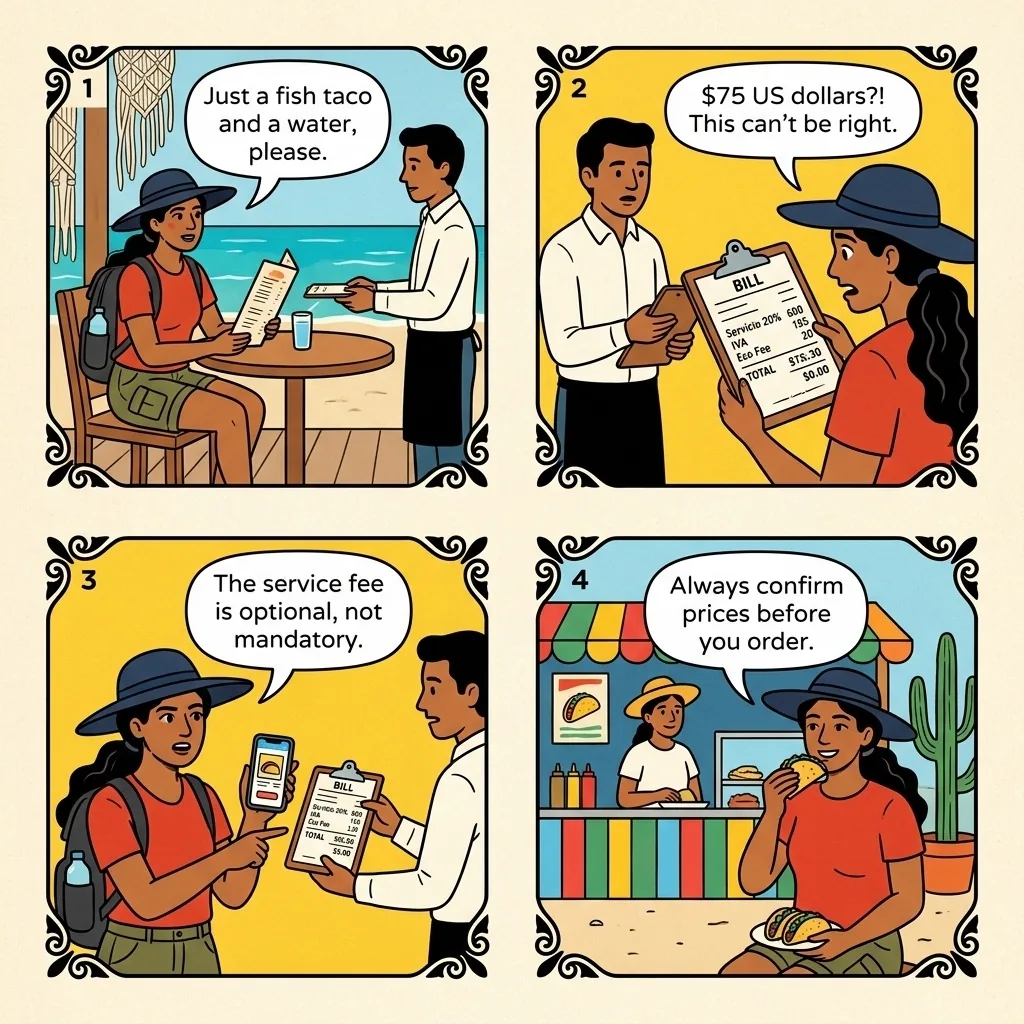
Tulum's Zona Hotelera (Beach Zone, 6 km south of Downtown Tulum) hosts one of Mexico's most notorious restaurant-bill padding and beach-club upcharge ecosystems.
Traveler reports document the pattern.
The 2025 scams: (a) Beach Road restaurants with USD-only menus at 2–3x Mexico norms (US$18 for breakfast, US$35+ for mains); (b) "service charge 18%" pre-added alongside a tip line (a double-tipping trap); (c) credit-card surcharge of 10–18% added unannounced; (d) "environmental fee MX$150 per person" surcharge at some beach restaurants (fake); (e) beach club "entry minimum US$50 per person food/drink" plus "VIP bed US$200" that turns out to be an uncovered wooden platform; (f) "bottle minimum US$300+" at trendy beach clubs like Papaya Playa and Nomade, where one bottle of mid-shelf tequila runs US$400; (g) "photo package US$100" upsells from Beach Road nightclubs; (h) "cash only" smaller restaurants with a "no receipt" policy (chargeback-proof); (i) bill switcheroo where the itemized receipt does not match the card charge.
For travelers: (1) eat in Downtown Tulum rather than the Beach Zone — restaurants on Av. Tulum and Av. Satélite have authentic Yucatec food at roughly one-third of Beach Zone prices, with reputable options including Charly's Vegan Tacos, Antojitos La Chiapaneca, and El Tacoqueto; (2) if you do go to the Beach Zone, budget US$60–US$100 per person for a meal regardless of any "deals"; (3) inspect the bill line by line and refuse "environmental fee" surcharges, "service charge + tip" double-dipping, and 10–18% card surcharges; (4) at beach clubs, confirm the minimum spend and any "VIP" charge before sitting, and photograph the menu; (5) refuse any "bottle minimum" and order drinks individually off the menu; (6) USD menus usually pad the exchange by 10–15%, so ask for the bill in pesos; (7); (8) bring a calculator and verify totals; (9) pay with credit card (for chargeback leverage) rather than cash where possible.
Red Flags
- Beach Road restaurants with USD-only menus at 2–3x Mexico norms
- "Service charge 18%" pre-added alongside a tip line (double-tipping)
- "Credit-card processing fee 10–18%" added unannounced
- "Environmental fee MX$150 per person" surcharge at the table
- Beach club "VIP bed US$200" that turns out to be a plain wooden platform
How to Avoid
- Eat in Downtown Tulum (Av. Tulum or Av. Satélite) for a third of Beach Zone prices.
- Try Charly's Vegan Tacos, Antojitos La Chiapaneca, or El Tacoqueto.
- Inspect the bill and refuse double-tipping or card surcharges above 3%.
- Confirm any beach-club minimum and VIP charge before sitting down.
- Request the bill in pesos, not USD (which pads 10–15% on exchange).
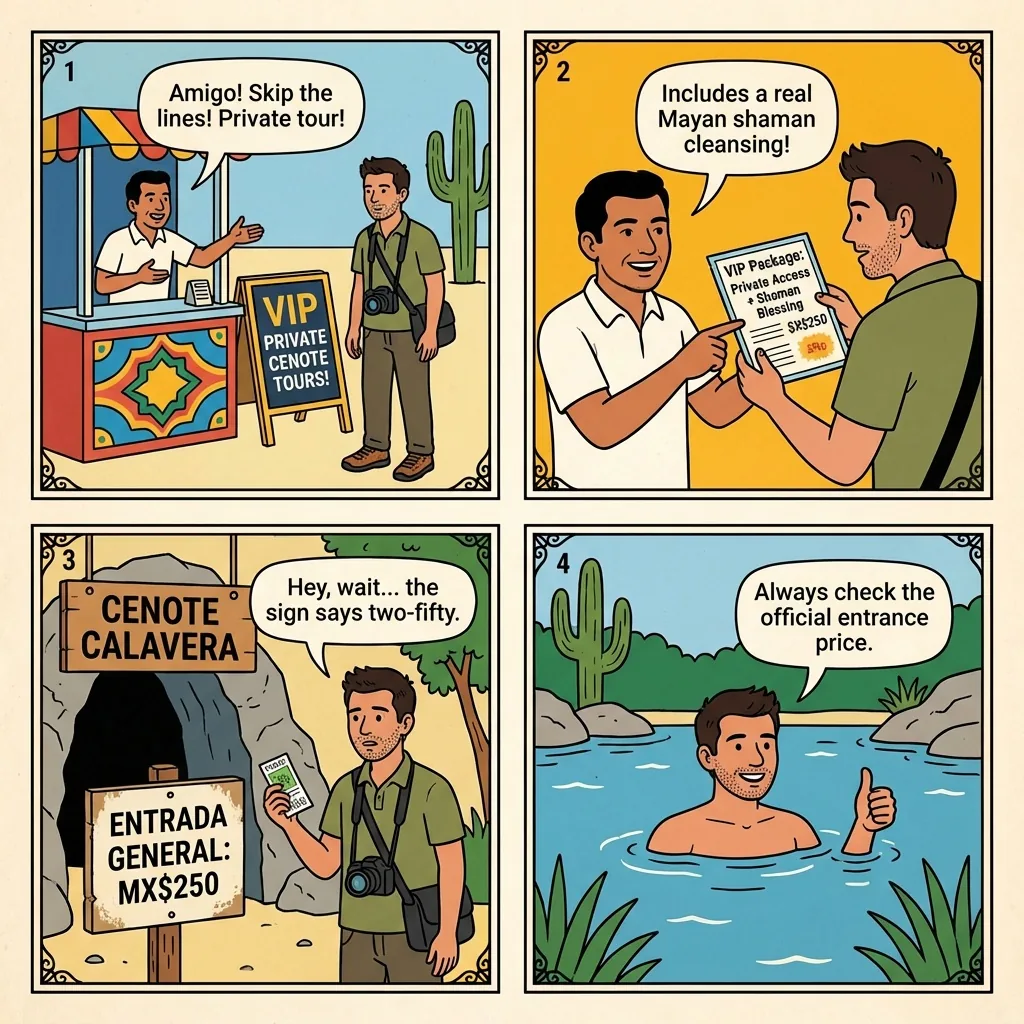
Tulum is surrounded by world-class cenotes (Dos Ojos, Gran Cenote, Cenote Calavera, Casa Cenote), and the tour ecosystem hosts a 2025 unlicensed-operator and entry-fee overcharge pattern.
surfaces in searches for the Tulum cenote tour scam.
Legitimate costs: Gran Cenote entry is MX$500, Cenote Dos Ojos MX$350, Cenote Calavera MX$250, Cenote Cristal MX$250, and Casa Cenote MX$150. A reputable small-group tour (3–4 cenotes, plus transport and lunch) runs MX$1,500–MX$2,500 per person. The 2025 scams: (a) Downtown Tulum tour booths selling "private cenote access MX$3,500 per person" when public entry is MX$250–MX$500; (b) "VIP guide + underwater photo package" bundle at MX$5,000 (photos rarely delivered); (c) fake "mandatory Mayan shaman cleansing MX$800" at cenote entry; (d) unlicensed tour operators running without life jackets, insurance, or SEMARNAT permits; (e) "exclusive Dos Ojos underwater cave dive MX$8,000" for non-certified visitors (cave diving requires full cave certification, so this is either fraud or genuinely dangerous); (f) a "commission restaurant" inserted into the tour route; (g) "life-jacket rental MX$200" at cenotes where jackets are included in entry; (h) rental-car drivers directed to a "better cenote" by a hotel concierge (which is a commission shop).
For travelers: (1) drive yourself (rental car or Uber day-hire) to cenote entries — Dos Ojos MX$350, Gran Cenote MX$500, Cenote Calavera MX$250 — and pay at the official ticket window; (2) book guided tours only via Google 4.7+ operators such as Jugo Cenote Experiences, Mex-On Adventures, or Yuchitur, at MX$1,500–MX$2,500 per person for a 3-cenote day; (3) refuse every "private cenote access", "Mayan shaman", and "VIP guide package" upsell; (4) at Dos Ojos, accept only open-water snorkel, not a cave dive, unless you are fully cave-certified with your own instructor; (5) bring biodegradable sunscreen only — chemical sunscreens damage cenote ecosystems, and some sites require a rinse-off; (6) travelers with mobility concerns will find Casa Cenote (easy shore entry) and Cenote Cristal (walkway and platform) the most accessible; (7) avoid Gran Cenote between 11 AM and 3 PM when tour buses flood in; (8) two or three cenotes in one day is plenty — four or more is exhausting.
Red Flags
- "Private cenote access MX$3,500 per person" pitched from a downtown booth
- "VIP guide + underwater photo MX$5,000" bundle
- "Mandatory Mayan shaman cleansing MX$800" at cenote entry
- "Exclusive Dos Ojos cave dive MX$8,000" offered to non-certified visitors
- "Life-jacket rental MX$200" at cenotes where jackets are already included
How to Avoid
- Pay at official cenote windows (Dos Ojos MX$350, Gran Cenote MX$500).
- Book tours via Jugo Cenote, Mex-On, or Yuchitur (Google 4.7+).
- Refuse any "private access", "shaman", or "VIP package" upsell.
- Skip cave dives unless fully cave-certified with your own instructor.
- Bring biodegradable sunscreen and cap the day at 2–3 cenotes.
Like what you're reading? Get a full Tulum itinerary with safety tips built in.
Browse travel-safety books →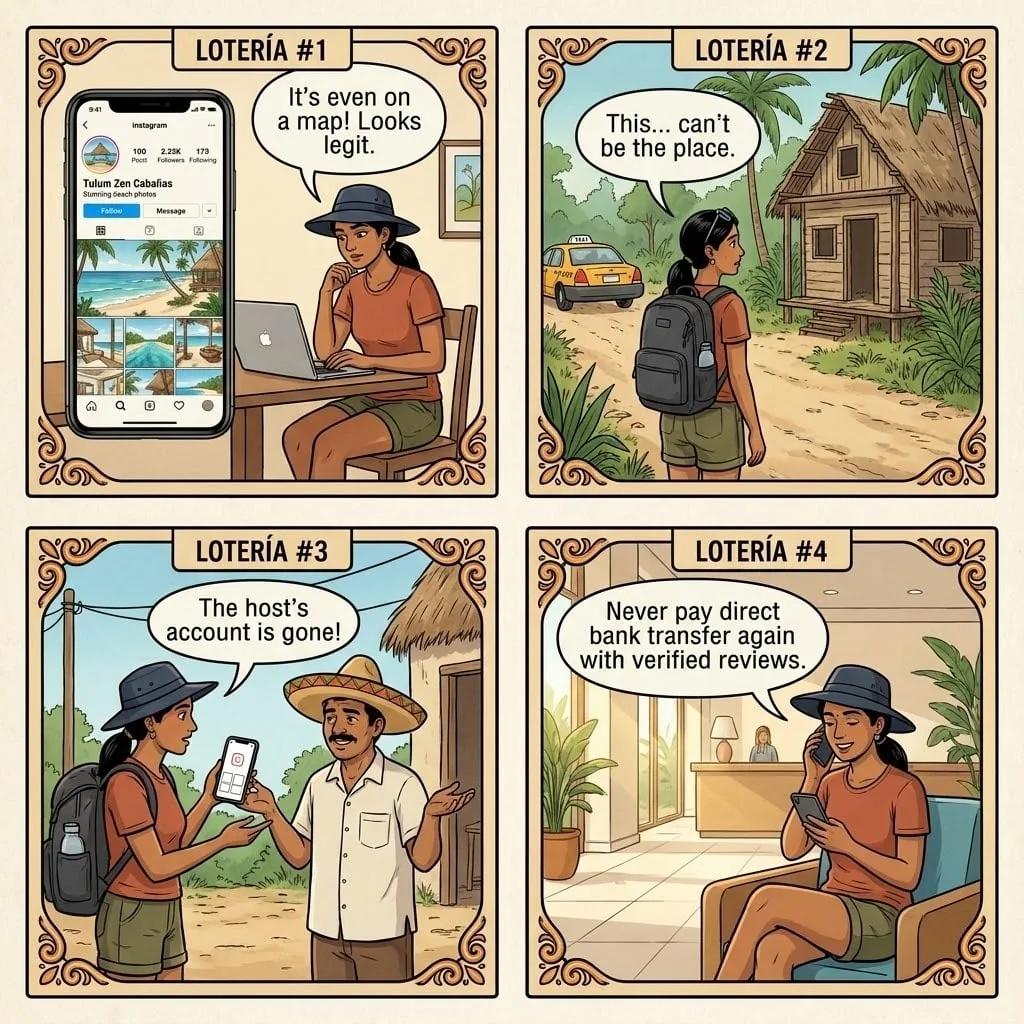
Tulum's rapid eco-luxury boom from 2020–2025 has outpaced legitimate accommodation supply, creating a fake-listing and price-gouging ecosystem around the Beach Zone.
Traveler reports.
The 2025 scams: (a) fake Airbnb "eco-luxury jungle cabaña" listings using stolen photos, where the property either does not exist or is 200m inland rather than "beachfront"; (b) Instagram DM and WhatsApp "exclusive private villa rental" at US$400/night requiring full upfront payment via bank transfer; (c) Facebook "Tulum Luxury Villas" groups with fake profiles, following the same pattern as Seminyak Bali villa scams; (d) confirmed-booking cancellations during high season (Dec–Mar, July–Aug) with re-listing at 3–5x the rate; (e) on-arrival bait-and-switch to inferior properties; (f) "cleaning deposit US$150" paid in cash that never returns; (g) "no electricity, bio-toilet only" surprises pitched as "eco-authentic" when they are really just power failures; (h) "mandatory gratuity 15–20%" added at beach-road "managed" cabañas and pocketed by middlemen.
For travelers: (1) book Tulum accommodations only via platform-protected channels such as Booking.com, Hotels.com, or Expedia, or direct from verified hotel websites (Be Tulum, Papaya Playa Project, Nomade, La Zebra), all with Booking.com 4.7+ ratings; (2) avoid Instagram DM, WhatsApp-only, Facebook group, and small-time "villa manager" listings; (3) never bank-transfer to private sellers — use platform secure payment only; (4) for peak season (Dec–Mar, July–Aug), book 4–6 months ahead on Booking.com with free cancellation; (5) avoid Airbnb for peak-season Tulum, since the cancellation pattern is well documented; (6) confirm beach access in writing, because "beachfront" and "2-minute walk to beach" are very different, and some eco-cabañas are 200–500m inland; (7) confirm power, AC, and Wi-Fi status in writing, because some "eco" properties run on generator power for only 3 hours a night; (8) prefer actual hotels over "cabaña" concepts; (9) budget: Tulum Beach Zone runs US$300–US$1,500+ per night in peak season, while Downtown Tulum is US$60–US$200 for far better value.
Red Flags
- Airbnb "eco-luxury jungle cabaña" using stolen Maldives or Bora Bora photos
- Instagram DM "exclusive villa US$400 full upfront" via bank transfer
- "Mandatory cleaning deposit US$150" in cash that never returns
- "Mandatory gratuity 15–20%" added by a managed-cabaña middleman
- "Eco-authentic" description hiding a no-power or bio-toilet reality
How to Avoid
- Book only via Booking.com, Hotels.com, or Expedia for platform protection.
- Avoid Instagram DM, WhatsApp-only, and Facebook group listings.
- Never bank-transfer to private sellers.
- Confirm beach access, power, AC, and Wi-Fi status in writing.
- Prefer Downtown Tulum (US$60–US$200) over Beach Zone (US$300+).
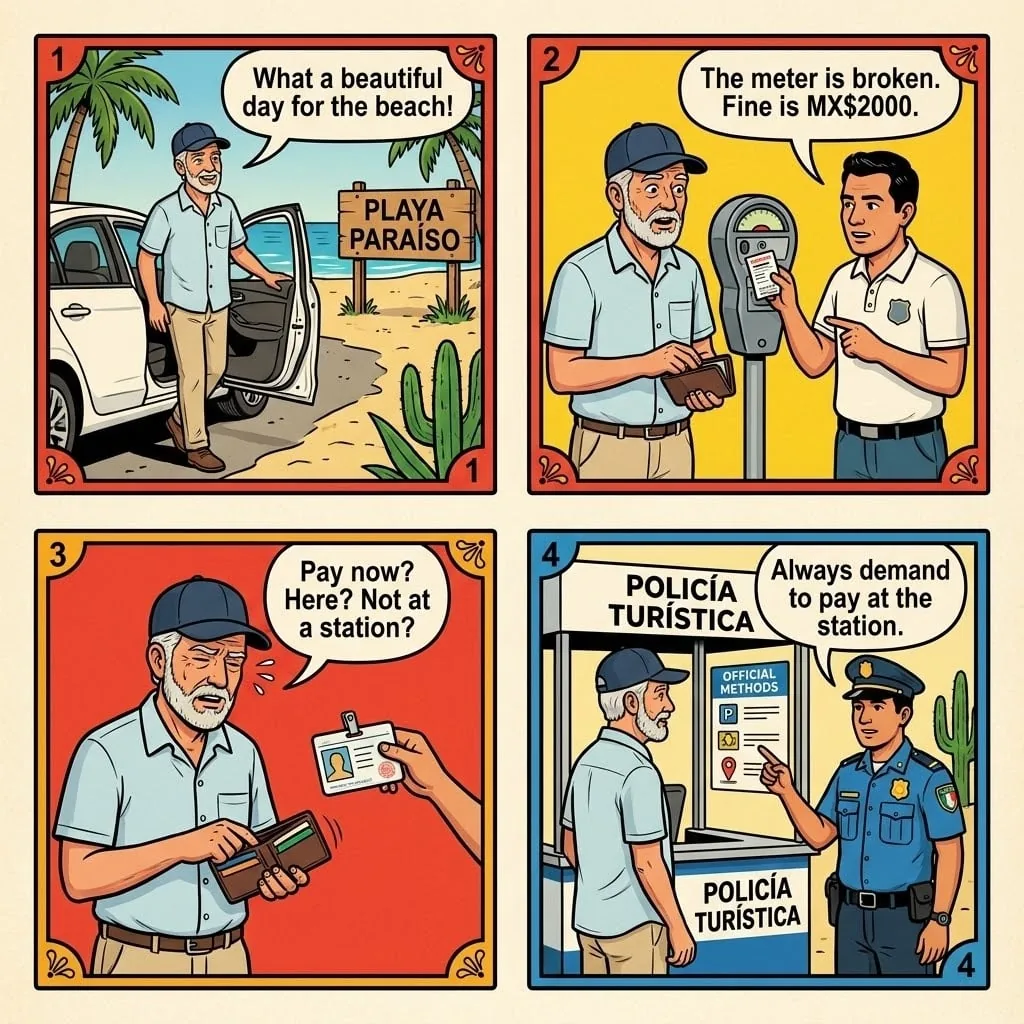
Tulum Beach Road has a documented 2025 parking-enforcement and rental-car break-in ecosystem that mirrors the Playa del Carmen highway-checkpoint pattern.
The 2025 scams: (a) a "parking enforcement officer" (fake or real municipal) on Beach Road "finding" infractions and demanding MX$1,500–MX$5,000 in cash; (b) a "boot removal fee" of MX$2,000 at parking-restricted zones where your car has been "booted" for "wrong parking"; (c) rental-car window smash-and-grab at unguarded beach parking (Sian Ka'an approach, Ruins Beach) while the driver is in the water; (d) a "parking attendant" demanding an MX$100–MX$200 cash deposit to "watch your car" and then not actually watching; (e) rental-car theft via GPS tracker when the car is left unattended on Beach Road; (f) "car damage during parking" fraud at return (the same pattern as the Isla and Holbox golf-cart scams); (g) a "broken meter fee" ticket on the windshield demanding MX$500 in cash to pay at a "nearby" kiosk (fraud).
For travelers: (1) use Uber or taxi for Beach Zone visits and avoid taking a rental car if possible, because Tulum Beach Road has limited legitimate parking and unattended rental cars are theft targets; (2) if you do drive, park only at a hotel valet (free for hotel guests) or at a pay-to-park lot with a receipt; (3) never leave anything visible in the rental car — bags, phones, and cameras should be in the trunk or with you; (4) if "parking enforcement" approaches, ask for a badge and officer number and a written ticket, not cash; (5) refuse "boot removal fee" and "broken meter" windshield tickets demanding cash — legitimate tickets are paid at the treasury office with a written stub; (6) for Sian Ka'an (a one-hour drive), park at the designated Muyil entry point with ranger station, not at informal roadside pullouts; (7) rental-car theft requires a police denuncia at Ministerio Público Tulum (+52 984 871 2109) within 24 hours for the insurance claim; (8) carry sufficient rental insurance, including Mexican third-party liability and comprehensive coverage; (9) has specific location warnings.
Red Flags
- "Parking enforcement officer" finding infractions along Beach Road
- "Boot removal fee MX$2,000" charged for "wrong parking"
- "Broken meter fee" windshield ticket demanding MX$500 in cash
- "Parking attendant" demanding an MX$100–MX$200 deposit to "watch" the car
- Unattended rental car parked at a Sian Ka'an roadside pullout
How to Avoid
- Take Uber or taxi for Beach Zone visits and skip rental-car parking.
- Use hotel valet or a pay-to-park lot with a receipt when driving.
- Never leave bags, phones, or cameras visible in the rental car.
- Refuse "boot fee" and "broken meter" cash demands on windshields.
- Report theft at Tulum Ministerio Público (+52 984 871 2109) within 24 hours.
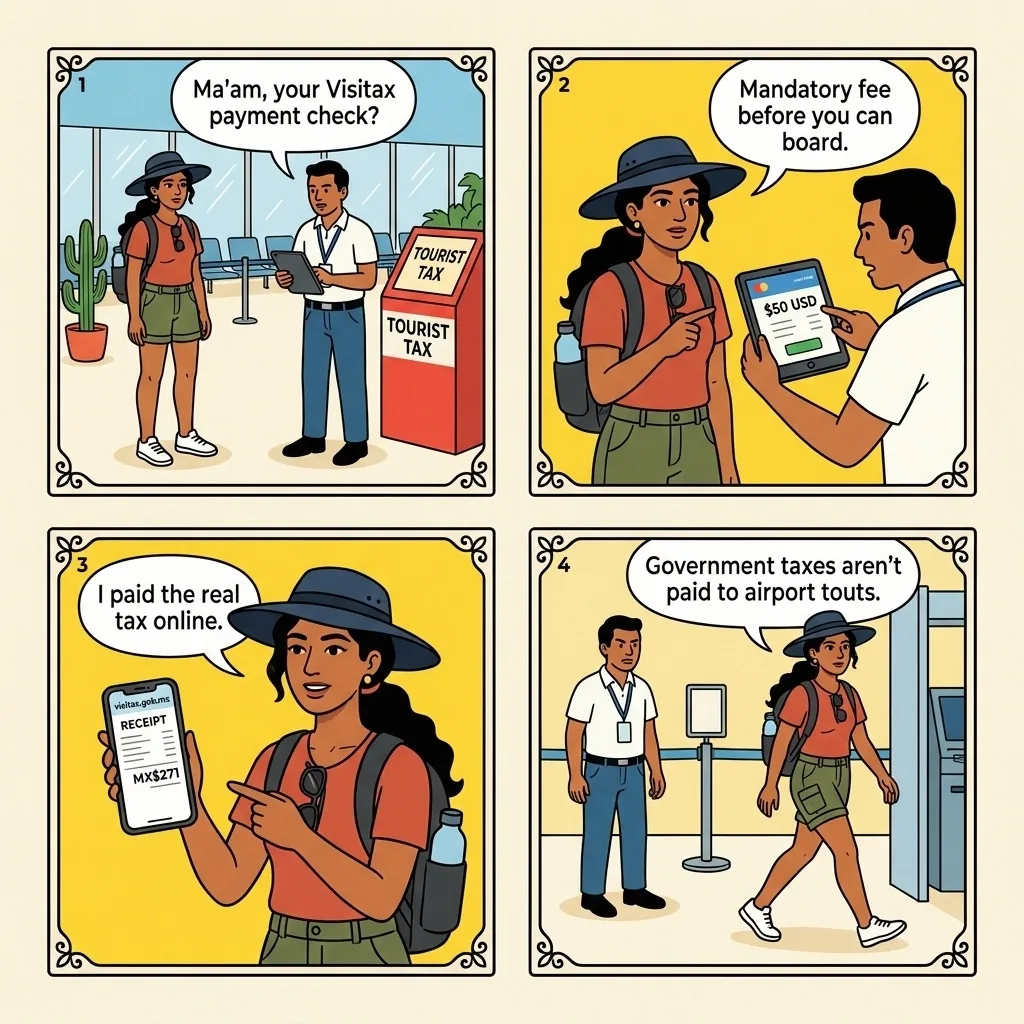
Tulum opened a new international airport (TQO) in December 2023 and now hosts a 2025 departure-scam ecosystem that mirrors Cancún's Visitax fraud.
T PAY BULLSHIT EXIT-TAX!" covers the regional fraud.
The 2025 scams: (a) a "Visitax verification agent" at TQO departure demanding US$30–US$60 per person "before you can board" — the real Visitax is MX$271 paid online via visitax.gob.mx; (b) a "tourism tax processing fee" tablet-based phishing setup that clones credit cards; (c) a "luggage inspection fee" of MX$200–MX$500 per bag demanded unofficially; (d) "mandatory passport re-stamping fee US$15" — no such fee exists; (e) WhatsApp phishing texts claiming "your Tulum departure tax is unpaid"; (f) "skip the line US$25" upsell at immigration (no skip-line service exists); (g) fake "FMM return form fee" — the tourist-card return is free.
For travelers: (1) pay Visitax only via visitax.gob.mx (the official Quintana Roo government portal) before your trip, and save the PDF confirmation to your phone — MX$271 per person ages 4+; (2) ignore every TQO "tax agent" or "processing fee" approach, because the government does not collect tax at the airport; (3) the only legitimate airport fees are ticket-price-inclusive airport taxes (shown on your boarding pass) and Visitax (paid online pre-trip); (4) never hand your credit card to any airport "tax payment" kiosk or tablet; (5) refuse every "luggage inspection", "passport re-stamping", and "FMM fee" demand — none is legitimate; (6) if pressured, show your visitax.gob.mx PDF and walk to the airline counter; (7) WhatsApp and SMS "unpaid tax" texts are phishing, so ignore them and do not click the links; (8) has specific TQO-airport warnings; (9) the US Embassy 24-hour line is +52 55 8526 2561 if things escalate.
Red Flags
- "Visitax verification agent" at TQO demanding US$30–US$60 per person
- Tablet-based "tourism tax processing" requested at departure
- "Luggage inspection fee" of MX$200–MX$500 demanded unofficially
- "Mandatory passport re-stamping fee US$15" demanded at the counter
- WhatsApp or SMS text claiming "your Tulum departure tax is unpaid"
How to Avoid
- Pay Visitax only via visitax.gob.mx before the trip (MX$271 per person).
- Save the PDF confirmation on your phone and show it if challenged.
- Ignore every TQO airport "tax agent" approach.
- Never hand your card to any airport "tax" kiosk or tablet.
- Refuse "luggage", "passport", or "FMM" fee demands — none exist.
🆘 What to Do If You Get Scammed
📋 File a Police Report
Go to the nearest Mexican Police (Policía) station. Call 911. Get an official crime report — you'll need this for insurance claims. You can also report online at gob.mx.
💳 Cancel Your Cards
Call your bank immediately. Most have 24/7 numbers on the back of the card (keep a photo saved separately). Block any suspicious transactions before the thieves use your details.
🛂 Lost Passport?
Contact your nearest embassy or consulate. The US Embassy is at Paseo de la Reforma 305, Cuauhtémoc, 06500 Mexico City. For emergencies: +52 55-5080-2000.
📱 Track Your Device
If your phone was stolen, use Find My (iPhone) or Find My Device (Android) from another device. Don't confront thieves yourself — share the location with police instead.
Frequently Asked Questions
You just read 6 scams in Tulum. The full Travel Safety Series has 780+ more across 20+ countries.
Tokyo's Kabukichō ¥130,000 bar trap. Rome's gladiator photo extortion. Paris's gold-ring trick. Bali's ATM skimmer scams. Bangkok's grand-palace closure ruse. Every documented scam across 20+ destinations — with the exact scripts, red flags, and local-language phrases that shut each one down. Drawn from Reddit traveler reports, embassy advisories, and consumer-protection cases.
- 780+ documented scams across Tokyo, Rome, Paris, Bali, Bangkok, Rio & 100+ more cities
- 20+ countries covered, with country-by-country phrase cards for every destination
- Updated annually — buy once, re-download future editions free
- All titles $4.99 each on Amazon Kindle