
Key Takeaways
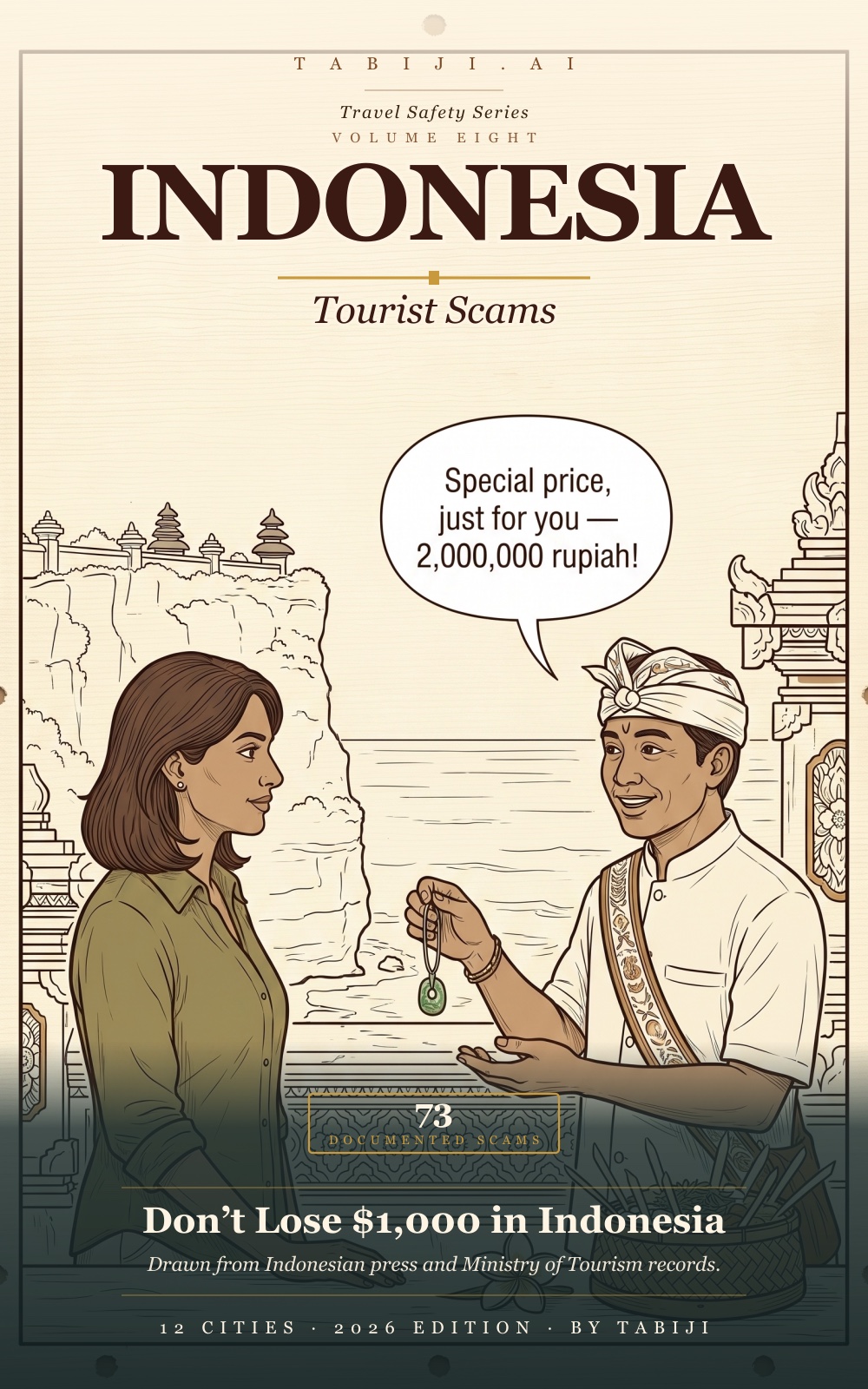
- The #1 reported scam is the Ubud Sacred Monkey Forest Theft & Aggressive Monkeys.
- 2 of 6 scams are rated high risk.
- Use official taxi ranks or local ride apps where available — always confirm the fare before departure.
- Never accept unsolicited offers from strangers near tourist sites in Ubud.
⚡ Quick Safety Tips
- At the Sacred Monkey Forest, leave ALL valuables (sunglasses, earrings, smartphones, passport) in your hotel safe; the monkeys are trained to trade stolen items back for food via staff commission.
- Avoid any 'Kopi Luwak coffee plantation' tour documents civet caging is near-universal; buy certified wild-sourced beans from Seniman Coffee Studio or skip entirely.
- Research yoga retreats on and traveler reports before booking; avoid any 'spiritual healing' or 'one-on-one clearing session' upcharges ($200–$2,000).
- Book Grab/Gojek for rides — Ubud has an entrenched 'taxi mafia'; meet your driver 100–200m AWAY from restaurant clusters on Jalan Monkey Forest to avoid forced pickup transfers.
- At Tegallalang Rice Terraces, refuse any 'mandatory guide' (none is required); pay ONLY the 25,000 IDR entry fee at the official booth documents 'path maintenance' scams at 50K–200K IDR.
Jump to a Scam
- High Ubud Sacred Monkey Forest Theft & Aggressive Monkeys
- Medium Kopi Luwak 'Coffee Plantation' Animal-Cruelty Tour & Fake Product
- Medium Fake-Guru Yoga Retreat & 'Spiritual Healing' Scam
- High Ubud Taxi Mafia & Anti-Grab Blockade
- Medium Ubud Pushy Massage & 'Extended Service' Upcharge Pressure
- Medium Tegallalang Rice Terrace 'Mandatory Guide' & Photo-Spot Fees
The 6 Scams

Ubud's Sacred Monkey Forest runs a documented pickpocket-by-primate scheme where trained long-tailed macaques target tourists with visible valuables (sunglasses, hats, phones, bags with passports) and a 'guide' appears within 60 seconds to 'negotiate' retrieval for 100–500K IDR plus a bag of peanuts — bites carry rabies risk requiring 5-dose post-exposure shots costing $500–$2,000, and the legitimate entrance fee is 80,000 IDR adults at the official ticket booth only.
Ubud's Sacred Monkey Forest Sanctuary is a documented pickpocket-by-primate ecosystem with a secondary human-scam layer that operates around the official sanctuary perimeter. The trained long-tailed macaques target tourists with visible valuables — sunglasses, hats, phones, and specifically bags containing passports — and a 'guide' appears moments after to offer 'negotiated' retrieval for a 100–500K IDR fee plus a bag of peanuts that the monkey trades the item for. The sanctuary officially denies that handlers train the monkeys for this, but consistent traveler reports across multiple years document the same pattern with the same handler-and-monkey pairings.
The trap menu has five recurring patterns. Stage one is the targeted theft: a monkey grabs sunglasses, a hat, a phone, or a wallet from a tourist with visible items, often after watching the tourist for several minutes from a tree. Stage two is the handler appearance: within 30–60 seconds, a 'guide' appears offering retrieval. The negotiation runs by item value — 50–100K IDR for sunglasses or a hat, 300–500K IDR for phone or wallet retrieval. Stage three is the bite-or-scratch escalation: aggressive monkeys clamp onto tourists' legs or arms (especially children), with bites carrying real rabies risk that requires the 5-dose post-exposure series at BIMC Hospital Ubud at $500–$2,000. Stage four is the passport-theft worst case: a monkey takes a bag containing a passport, the handler 'retrieves' the bag but the passport is missing, requiring embassy replacement at $150+ plus replacement-visa processing time and a delayed return flight. Stage five is the secondary direct human scam: 'tickets' sold by individuals near the entrance at inflated prices that don't actually scan at the official gate, when the legitimate 2025 rate is 80,000 IDR adults and 60,000 IDR children at the official ticket booth.
For older travelers visiting the Monkey Forest, the defense is to remove every visible valuable before entering and never engage with monkeys directly. Remove all valuables before entering — no sunglasses (worn or hair-clipped), no hats, no visible jewelry, no loose phone in pockets, no passport in any accessible bag — keep bags zipped and worn across the chest with one hand covering the zip, never feed monkeys (illegal and dangerous), never make direct eye contact (primate challenge that triggers attacks), and never try to retrieve a stolen item yourself: back away calmly and let the item go rather than escalating to a bite-risk confrontation. If you're bitten or scratched, go immediately to BIMC Hospital Ubud (+62 361 2300 150) for the rabies post-exposure series — every hour of delay matters and the protocol requires 5 doses over 28 days. Pay the entrance fee only at the official ticket booth (80,000 IDR adults, 60,000 IDR children at 2025 rates), never to individuals on the approach road. If a monkey takes your bag and a 'handler' offers retrieval, refuse the negotiation and report immediately to the sanctuary office at the entrance — the official path bypasses the handler-and-monkey commission scheme.
Red Flags
- Monkey suddenly approaches holding eye contact
- Monkey follows you specifically (trained to target tourists)
- 'Guide' appears immediately after a monkey takes an item
- Sunglasses, hat, hair clip, or visible phone on body
- Small child brought into the forest (primary target)
How to Avoid
- Remove ALL valuables before entering (no sunglasses, hats, jewelry, loose phones).
- Keep bags zipped across chest with one hand covering.
- Don't feed monkeys; Don't make direct eye contact.
- If an item is stolen, back away — do not try to retrieve.
- If bitten/scratched, go IMMEDIATELY to BIMC Hospital Ubud (+62 361 2300 150) for rabies series.

Ubud-area 'Kopi Luwak coffee plantation' tours are a documented animal-cruelty-plus-tourist-trap ecosystem where caged civet cats are force-fed coffee beans (despite 'wild-foraged' marketing), 8–12 coffee tastings end with pressure to buy 200–500K IDR bags of fake luwak coffee that's actually flavored robusta — visit Seniman Coffee Studio, Kopi Kultur, or Anomali Coffee for genuine ethically-sourced Indonesian specialty at 35K–80K IDR per cup instead.
Ubud-area 'Kopi Luwak coffee plantation' tours are a documented animal-cruelty-plus-tourist-trap ecosystem that runs as the standard mid-tour stop on full-day Bali excursion packages. The kopi luwak product itself is a real specialty coffee in which civet cats consume coffee cherries and pass partially-digested beans, with the legitimate wild-foraged version selling at $50–$100 USD per 50g at licensed premium producers like Kopi Jawa Dua. The tourist-plantation version is something different: civets are kept in small cages and force-fed coffee beans, the 'wild-foraged' marketing is false, and the coffee sold to tourists is typically regular robusta with artificial flavoring rather than actual luwak coffee. Traveler community guidance is consistent: avoid the plantation-stop visits, both for the animal welfare issues and for the sales-funnel mechanics.
The trap menu has five recurring mechanics. The bundled tour stop: full-day Bali excursion packages include a 'free coffee plantation visit' with operator kickback that turns the route into a sales-funnel detour. The single-civet 'demonstration' shows one caged animal while claiming wild-foraged product, with the cage pre-positioned for photo-friendly visibility. The 8–12 coffee tasting flight ends with pressure to buy 200–500K IDR bags of kopi luwak — typically flavored robusta, not actual luwak coffee. The coconut-coffee and chocolate-coffee upsells at 150K+ IDR per bag round out the sales push. The 'organic farm' framing extends the route through additional commission-paying stops (a vanilla farm, a cocoa farm, a 'traditional Balinese kitchen' with a 200K IDR lunch). Genuine ethically-sourced Indonesian specialty coffee is available at named Ubud roasters (Seniman Coffee Studio on Jalan Sriwedari is award-winning, Kopi Kultur has multiple Ubud locations, Anomali Coffee runs Ubud and Seminyak shops) at 35K–80K IDR per cup or 150K–250K IDR per bag of beans — comparable quality to the tourist-plantation prices without the animal-welfare or fake-product concerns.
For older travelers visiting Ubud, the defense is to skip every 'free coffee plantation' tour stop and buy specialty coffee at named ethical roasters. Skip all 'free coffee plantation' stops on Bali tour packages — these are pure sales funnels with caged animals — and for genuine ethically-sourced Indonesian specialty coffee, visit Seniman Coffee Studio on Jalan Sriwedari (award-winning specialty roaster), Kopi Kultur (multiple Ubud locations), or Anomali Coffee (Ubud and Seminyak shops) at 35K–80K IDR per cup or 150K–250K IDR per bag of beans; refuse every 'kopi luwak' offered at a tour-stop plantation as either fake (flavored robusta) or sourced from caged force-fed civets, every 200–500K IDR plantation-shop bag of luwak coffee, and every 'coconut coffee' or 'chocolate coffee' upsell at 150K+ IDR. Genuine wild-foraged kopi luwak with certification is a premium product rarely found in tourist plantations — if you specifically want to try it, buy at a licensed specialty roaster with verifiable provenance rather than at a tour-stop plantation. Decline 'coffee tasting' sessions at plantation stops entirely; the tasting itself is the sales-pressure setup. If your tour package includes a plantation stop, request to skip it (most operators will accept this) or use the time to walk back to the bus rather than entering the demonstration room.
Red Flags
- Tour package includes 'free coffee plantation visit' in Tegallalang or Kintamani area
- Caged luwak animal displayed as 'free range' or 'wild forager'
- 'Coffee tasting' of 8–12 varieties with escalating sales pressure
- Kopi Luwak bag priced 200–500K IDR (legitimate is $50–$100 USD for 50g at licensed producers)
- 'Coconut coffee' or 'chocolate coffee' upsells
How to Avoid
- SKIP all 'free coffee plantation' stops on tour packages — pure sales funnels with caged animals.
- For genuine Indonesian specialty coffee: Seniman Coffee Studio, Kopi Kultur, Anomali Coffee (Ubud).
- Expected specialty coffee price: 35–80K IDR cup, 150–250K bag of beans.
- Genuine wild kopi luwak is premium ($50–$100/50g at licensed producers only).
- DECLINE 'coffee tasting' sessions at plantation stops.

Ubud's spiritual-tourism economy hosts a documented fake-guru/fake-healer scam ecosystem with $200–$1,000 'energy clearing' sessions, $500–$3,000 unlicensed ayahuasca ceremonies, $2,000–$5,000 '7-day transformation retreats' with escalating upsells, and Australian-expat 'gurus' operating illegally as healers with no medical training — the legitimate Ubud wellness industry (Yoga Barn, Radiantly Alive, Intuitive Flow, Ubud Yoga House) is fine; the scam is the satellite private-healer marketplace around it.
Ubud has positioned itself as Bali's wellness capital since the early 2000s, and the legitimate yoga and wellness industry there is genuinely worthwhile — established studios like Yoga Barn (theyogabarn.com), Radiantly Alive, Intuitive Flow, and Ubud Yoga House operate with clear commercial licensing, transparent pricing (150–200K IDR drop-in, around $10–$13 USD), and qualified instructors. The scam ecosystem operates in the satellite 'private healer' and 'retreat' marketplace around the legitimate studios — unlicensed foreigners (often Australian expats) operating as 'spiritual healers' with no medical or psychological training, charging premium rates to mental-health-vulnerable visitors who came to Bali seeking transformation. It's technically illegal for foreigners to operate as spiritual healers in Indonesia, but the industry operates outside meaningful regulation.
The trap menu has five recurring mechanics. 'Spiritual healer' sessions charge $200–$1,000 per session for 'energy clearing,' 'past-life regression,' or 'aura cleansing,' typically delivered by a foreigner with no verifiable credentials or licensure. 'Ayahuasca ceremony' retreats at $500–$3,000 per weekend run with unlicensed facilitators, no medical screening, and serious psychiatric risk for participants with undisclosed mental-health conditions — Ayahuasca is a controlled substance in Indonesia and the ceremonies operate illegally. '7-day transformation retreat' packages at $2,000–$5,000 use escalating upsells for 'private sessions' that compound on the base price, with mental-health-vulnerable participants particularly susceptible to upsell pressure during emotionally-loaded retreat moments. The 'Australian-expat-guru' scenario has foreigners running multi-week courses without any medical, psychological, or formal spiritual-tradition training. Victims are often targeted for additional sessions via emotional-dependency mechanisms — a participant who cried during a session gets a follow-up call offering 'extended care' for another $500–$1,000.
For older travelers visiting Ubud for wellness, the defense is to book only at established studios with clear commercial licensing and refuse private-healer or transformation-retreat upsells. Book yoga and wellness classes only at established studios with clear commercial licensing — Yoga Barn (theyogabarn.com), Radiantly Alive, Intuitive Flow, Ubud Yoga House — at the typical 150–200K IDR drop-in or 800K–1.5M weekly pass rate; avoid private 'healer' sessions booked through hotel concierges or Instagram 'spiritual coaches' without verifiable medical or licensed-traditional credentials, refuse 'ayahuasca' or 'plant medicine' ceremonies in Bali (unlicensed, unsafe, and illegal), and refuse transformation-retreat packages at $2,000+ as high-pressure upsell operations targeting mental-health-vulnerable participants. For genuine spa and wellness experiences, use named hotel spas with posted prices: Four Seasons Sayan, COMO Shambhala, Hanging Gardens Ubud — premium pricing but transparent, licensed, and with trained staff. The legitimate Ubud yoga industry is excellent value for travelers wanting practice and instruction; the scam is in the satellite marketplace selling personal transformation at the price of psychiatric care without the qualifications. If you're considering a multi-day retreat, verify the lead facilitator's credentials independently before paying any deposit, and never pay 100% upfront for any retreat regardless of the marketing.
Red Flags
- 'Private healer' booked through hotel concierge without verifiable credentials
- 'Spiritual healer' charging $200–$1000 per session
- 'Ayahuasca' or 'plant medicine' ceremony offering (illegal in Indonesia)
- '7-day transformation retreat' at $2000+ with escalating session upsells
- Foreign (non-Indonesian) operator claiming to be a 'healer' or 'guru'
How to Avoid
- Book ONLY at established studios: Yoga Barn, Radiantly Alive, Intuitive Flow, Ubud Yoga House.
- Typical rate: 150–200K IDR drop-in class; 800K–1.5M weekly.
- Avoid 'private healer' sessions booked through concierges or Instagram.
- Don't participate in 'ayahuasca' or 'plant medicine' ceremonies (illegal).
- For spa/wellness, use named hotel spas (Four Seasons Sayan, COMO Shambhala, Hanging Gardens Ubud).

Ubud has Indonesia's most-documented 'taxi mafia' where local private drivers physically block Grab and Gojek pickups in the center, the apps show 'no drivers available,' rank drivers at hotels quote 'fixed prices' 3–5× the Grab rate, and tourists are forced to walk 500m–1km to 'safe zones' (Starbucks Ubud, Warung Biah Biah, Ubud Market car park) for app pickups — Blue Bird Bali (dark-blue vehicles, '690 9000') is the national licensed metered alternative.
Ubud has Indonesia's most-documented 'taxi mafia' situation where local private drivers physically block Grab and Gojek drivers from picking up passengers in the central tourist zones. The pattern has operated for years and predates the rise of ride-hail apps — local drivers protecting livelihoods through territorial control of the central pickup zones — but the enforcement is consistently aggressive, with documented physical intimidation of app drivers including blocking, verbal threats, and occasional attacks on the drivers themselves rather than the passengers. The result is that travelers in Ubud center often find Grab and Gojek apps showing 'no drivers available' even when drivers are physically nearby but unwilling to enter the controlled zone.
The trap menu has five recurring patterns. The app-blocking variant: Grab and Gojek apps show 'no drivers available' in central Ubud because nearby drivers won't enter the controlled zone. The 'fixed price' rank variant: taxi-mafia drivers at hotel ranks and the main intersections quote 'fixed prices' 3–5× the Grab rate (an Ubud center to Tegallalang ride that's 80–120K IDR on Grab gets quoted at 300–500K). The physical-blocking variant: if a Grab driver is nearby and accepts a ride, local taxi drivers physically block them from picking up the passenger, sometimes attacking the driver — and the passenger waits while the dispute resolves. The 'safe zone' walk-out: travelers learn to walk 500m–1km to a designated app-friendly pickup point (Starbucks Ubud on Jalan Raya, Warung Biah Biah, or the Ubud Market car park) where the territorial enforcement doesn't apply. The hotel-arranged transfer at 2–3× Grab: hotels offer 'transfer service' at fixed prices that route around the mafia situation but still mark up against the app rate. Blue Bird Bali (the national licensed metered taxi) operates in Ubud at metered fares — dark-blue vehicles with '690 9000' phone number — and is the safest non-app option.
For older travelers in Ubud, the defense is to walk to designated safe pickup zones for app rides or use Blue Bird Bali at metered rates. Pre-book Grab or Gojek outside Ubud center by walking to designated safe pickup zones — Starbucks Ubud on Jalan Raya, Warung Biah Biah, or the Ubud Market car park — where the taxi-mafia territorial enforcement doesn't reach; or call Blue Bird Bali (the national licensed metered taxi, dark-blue vehicles, +62 361 690 9000) for a safe metered alternative; refuse every taxi-mafia 'fixed price' quote at 3–5× the Grab rate from hotel ranks and main intersections, every hotel-arranged transfer at 2–3× the app rate without good reason, and accept that Ubud center Grab pickups will require the safe-zone walk regardless of how close drivers appear in the app. For day trips (Tegallalang, Tanah Lot, Uluwatu), pre-book a private driver for the full day at 600K–800K IDR (~$40–$55 USD) through a licensed operator (your hotel can recommend a specific named driver) rather than trying to use app rides between sites. For Ubud-DPS airport transfers, book through your hotel at the fixed 300–400K IDR rate rather than trying Grab from Ubud center at 1 AM. Walking is the right answer for short Ubud-center distances — the town is compact and pedestrian-friendly during daylight.
Red Flags
- Grab/Gojek app shows 'no drivers available' in Ubud center (forced blockade)
- Taxi-mafia driver at hotel rank quoting 300K+ IDR for a 2–5 km trip
- Driver physically blocking a Grab driver from picking you up
- Hotel concierge pushing 'partner' transfer at 2–3x Grab rate
- Local driver following your phone-booked Grab driver aggressively
How to Avoid
- Pre-book Grab/Gojek from outside Ubud center — designated safe zones: Starbucks Ubud, Warung Biah Biah, Ubud Market car park.
- For day trips, pre-book a private driver for full day at 600–800K IDR (~$40–$55 USD) via licensed operator.
- Use Blue Bird Bali metered taxi (dark blue, phone 690 9000) — safe, metered, licensed.
- Walk where possible — Ubud center is compact and walkable.
- For Ubud-DPS airport, book through hotel at fixed 300–400K IDR.
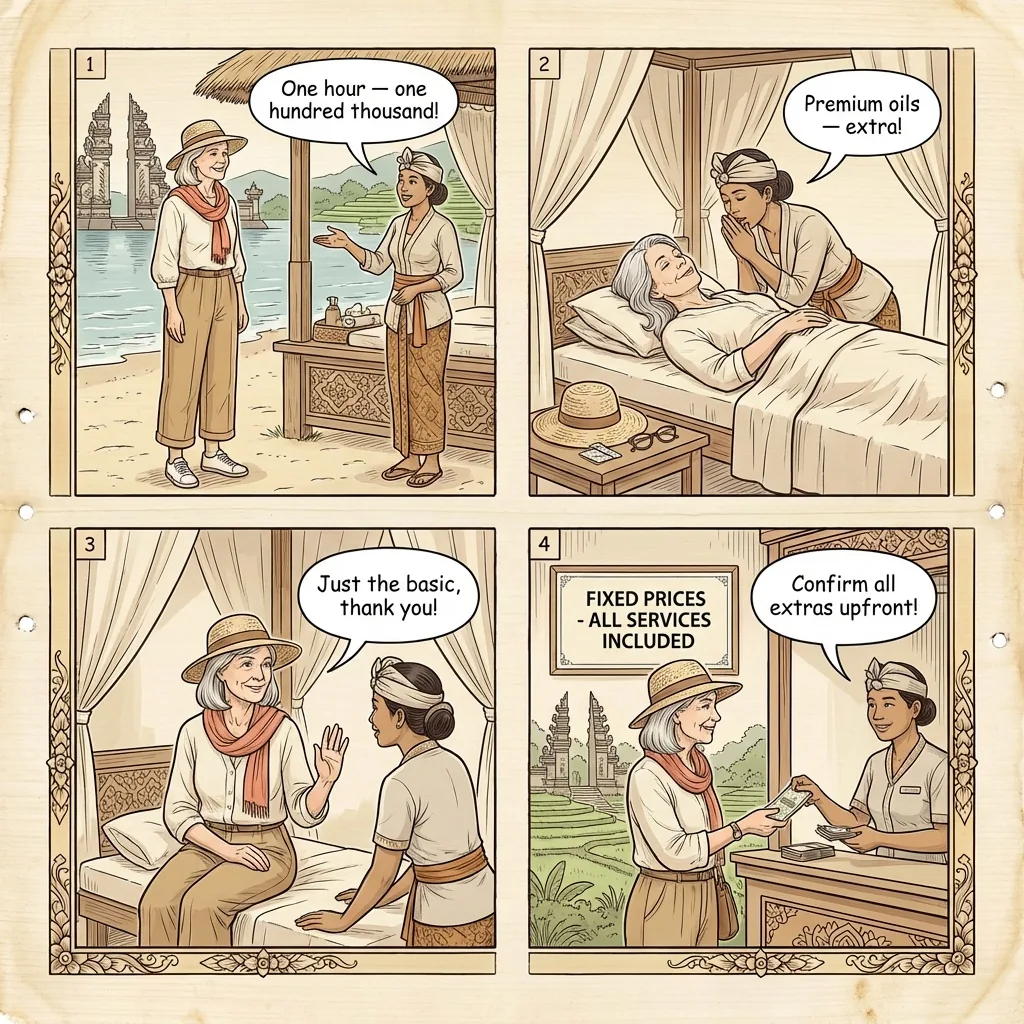
Ubud's street-side massage shops on Jalan Hanoman and Jalan Monkey Forest advertise '60-minute massage 100K IDR' and pivot mid-session to 150K 'oil upgrade,' 200–300K 'extended time,' 200–500K 'herbal compress' or 'cupping' upsells with tip pressure at end where staff expect 100–200K minimum or refuse to unlock the treatment-room door — a documented card-skim-while-in-treatment variant runs on cards left in treatment-room lockers, with RFID-blocking wallets the defense.
Ubud's massage economy splits cleanly between named reputable spas with posted prices (Karsa Spa, Bodyworks, Kush Ayurvedic Spa, the Spa at Four Seasons Sayan as the premium-tier option) and a documented 2025 upsell-and-pressure-sales scene at the street-side massage shops along Jalan Hanoman and Jalan Monkey Forest. The reputable spas charge 200–400K IDR for a 60-minute massage and 800K–1.5M for premium hotel spa treatments with transparent menus and no upsell pressure. The street-side shops advertise '60-minute massage 100K IDR' as the lure and turn the session itself into a continuous upsell-pressure environment — community guidance is consistent that 'the massage is never worth it afterwards' because the pressure context overwhelms any relaxation benefit.
The trap menu has six recurring mechanics. The headline-rate-and-upsell: '60-minute massage 100K IDR' on a street-side sign followed by mid-session upsells. The 'oil upgrade' at 150K IDR offered partway into the treatment, framed as a quality-of-experience question. The 'extended time' offer at 200–300K mid-session for 20 extra minutes. The 'herbal compress' or 'cupping' add-on at 200–500K. The end-of-session tip pressure: staff expect 100–200K IDR minimum and sometimes refuse to unlock the treatment-room door until payment is resolved. The card-skim-while-in-treatment variant is the most damaging — some spa operations clone cards remotely via RFID skimmers while cards are in wallets in treatment-room lockers or chairs, with fraud charges appearing days later (one documented account: 'I get Fraud alert on my cards. I paid cash. My cards were in my wallet within reach while I was getting a massage'). The cumulative effect on a 100K IDR 'starting price' can reach 1–2M IDR plus card-cloning damage — orders of magnitude above what a 200–400K reputable-spa booking would cost.
For older travelers booking massage in Ubud, the defense is to use only named reputable spas and never leave cards in treatment-room lockers. Book only at named reputable spas with posted prices — Karsa Spa, Bodyworks, Kush Ayurvedic Spa, or the premium Spa at Four Seasons Sayan — at the legitimate 200–400K IDR (60-minute massage at reputable Ubud spa) or 800K–1.5M (premium hotel spa) range, refuse every street-side '60-minute massage 100K IDR' offer on Jalan Hanoman or Jalan Monkey Forest as a continuous upsell-pressure environment, refuse every mid-session 'oil upgrade,' 'extended time,' 'herbal compress,' or 'cupping' upsell with a firm 'tidak, terima kasih,' and never leave cards in treatment-room lockers since RFID-skim-while-in-treatment is documented. Take only the cash you need for payment into the treatment room; use an RFID-blocking wallet or leave cards in the hotel safe entirely. The reputable end-of-massage tip is 20–50K IDR after 60 minutes — never accept tip pressure above this and never accept staff refusing to unlock the door until payment. If a venue blocks your exit, call your hotel reception (which can dispatch staff) or the Bali Tourist Police at +62 361 784 5988 (Kuta) or +62 361 224 111 (central). Spa-card cloning fraud often appears 24–72 hours after the treatment, so monitor card statements for the week after any Ubud spa visit.
Red Flags
- Street-side massage shop advertising '100K/hour' with no posted upgrade menu
- 'Oil upgrade' or 'extended time' offered mid-session at 150–300K
- Tip pressure of 100–200K+ at end with staff blocking exit
- Card-skim risk at spa with cards in treatment-room locker or chair
- Hotel-doorstep massage solicitation (often unlicensed, inflated pricing)
How to Avoid
- Book at named reputable spas: Karsa Spa, Bodyworks, Kush Ayurvedic Spa, Four Seasons Sayan.
- Expected: 200–400K IDR 60-min massage at reputable spa; 800K–1.5M premium hotel spa.
- Refuse mid-session upsells firmly ('non, terima kasih').
- Don't leave cards/cash in treatment-room lockers — take only payment amount.
- Reasonable tip: 20–50K IDR after 60-min massage.
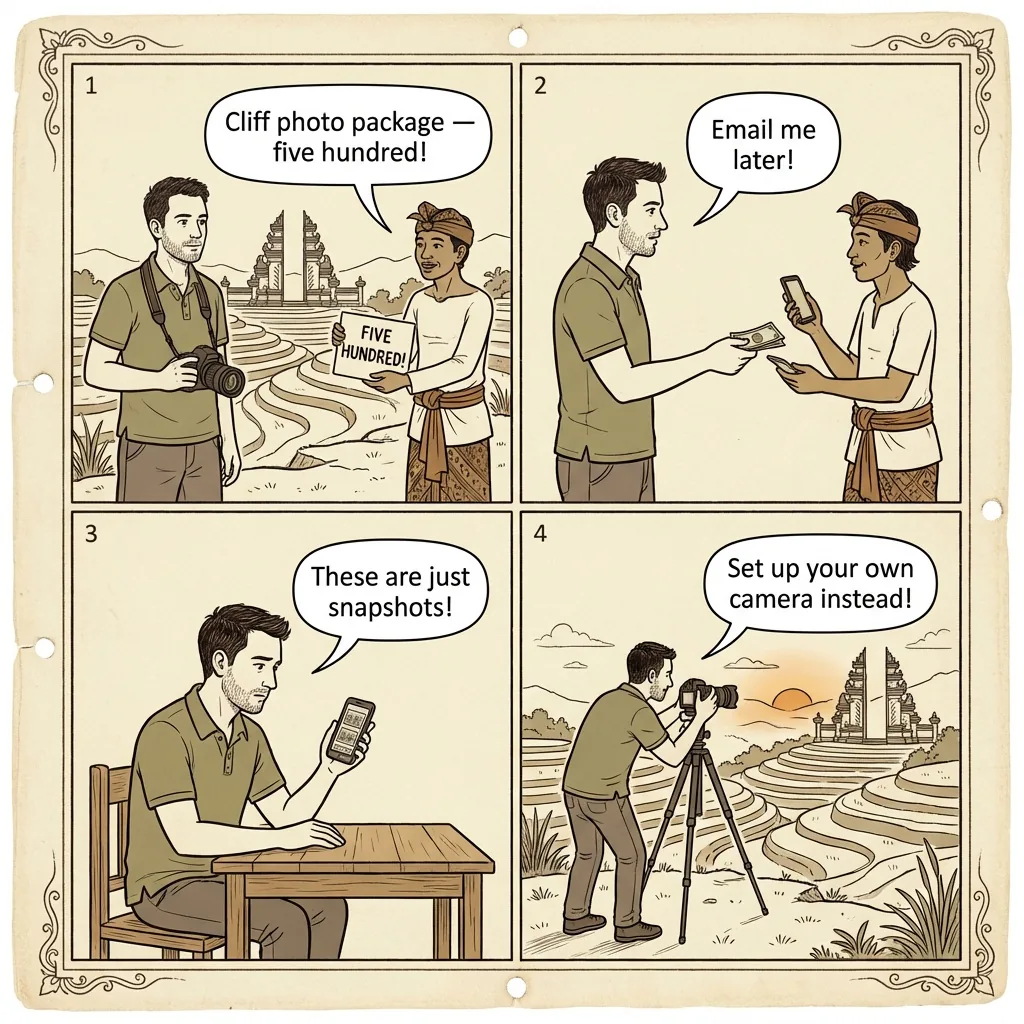
Ubud's iconic Tegallalang Rice Terrace has an official 15K IDR entrance plus 5K IDR parking at the main ticket booth — but multiple unofficial 'parking attendants' demand 20–50K IDR at access points, 'entrance fee collectors' charge 10–30K IDR at secondary entrances, 'mandatory local guides' demand 100–200K IDR, and 'Bali Swing' operators charge $35–$50 for 30-second photo rides; Jatiluwih Rice Terrace at 40K IDR (UNESCO World Heritage, less commercial) is the cleaner alternative.
Tegallalang Rice Terrace is Ubud's iconic Instagram-spotlight rice-paddy landscape 30 minutes north of town, with an official entrance fee structure that's small and clearly published: 15,000 IDR per person at the main ticket booth near the large Tegallalang signboard, plus 5,000 IDR for parking at the main designated car park. The trap layers around that legitimate fee with multiple unofficial collection points along the access road, mandatory-guide pressure at the terrace entrances, and 'photo-op swing' operators charging $35–$50 for what should be free scenic viewpoints. The less-commercialised alternative is Jatiluwih Rice Terrace 1 hour northwest of Ubud — a UNESCO World Heritage site at 40K IDR official entrance with substantially less tourist-trap layering.
The trap menu has five recurring mechanics. 'Parking attendants' demand 20–50K IDR at multiple points along the terrace approach road, separate from and well beyond the official 5K parking fee at the main car park. 'Entrance fee collectors' at various unofficial access points charge 10–30K IDR (above the official 15K single-entry rate at the main ticket booth). 'Mandatory local guides' at the terrace entrances demand 100–200K IDR for a guided walk tourists can do themselves on the marked paths — no guide is required anywhere on the terrace. 'Scenic viewpoint fees' at the famous Instagram bamboo swings and photo-op spots charge 100–500K IDR per photo for views that are visible free from the public path. 'Bali Swing' operators charging $35–$50 for a 30-second photo ride at the Tegallalang viewpoint deliver an inflated photo-tourism experience that's the standard tourist-trap markup. Traveler reports specifically flag mandatory guides as part of the 2025 Tegallalang tourist-trap pattern, with anything above the official 15K plus 5K parking rate as scam-tier charging.
For older travelers visiting Tegallalang or Jatiluwih, the defense is to pay only at the official ticket booth and refuse every other charge along the road. Pay the entrance only at the main official Tegallalang ticket booth near the large signboard (15,000 IDR per person), park at the main designated car park (5,000 IDR), refuse every 'parking attendant' demand at 20–50K along the terrace road as unofficial collection, refuse every 'entrance fee collector' at secondary access points charging 10–30K above the official rate, refuse every 'mandatory local guide' demand at 100–200K (the terrace is walkable on marked paths without a guide), and skip every 'Bali Swing' photo-op operator at $35–$50 since the same scenic viewpoints are visible free from the public path. For a less-scammed alternative, visit Jatiluwih Rice Terrace 1 hour northwest of Ubud — a UNESCO World Heritage site at 40K IDR official entrance with substantially less commercial overlay. Visit early morning (7–9 AM) for quieter conditions and more authentic experience; peak 10 AM–2 PM concentrates the scammer activity at every access point. Take your own photos at the free public viewpoints rather than paying the swing operators.
Red Flags
- 'Parking attendant' demanding 20–50K IDR at multiple road points
- Non-official 'entrance collector' charging 10–30K IDR at secondary access points
- 'Mandatory guide' demanded at 100–200K IDR
- 'Scenic viewpoint fee' 100–500K IDR for photo-op spots
- 'Bali Swing' operators charging $35–$50 per 30-second ride
How to Avoid
- Pay entrance ONLY at main official ticket booth: 15K IDR + 5K parking.
- Refuse 'mandatory guide' demands — terrace is walkable without guide.
- SKIP 'Bali Swing' photo-ops — expensive tourist traps; take free viewpoint photos.
- Alternative: Jatiluwih Rice Terrace (UNESCO, less commercial) at 40K IDR.
- Visit 7–9 AM (quieter) rather than 10 AM–2 PM peak.
🆘 What to Do If You Get Scammed
📋 File a Police Report
Go to the nearest Indonesian National Police (Polri) station. Call 110 (Police) or 112 (Emergency). Get an official crime report — you'll need this for insurance claims. You can also report online at polri.go.id.
💳 Cancel Your Cards
Call your bank immediately. Most have 24/7 numbers on the back of the card (keep a photo saved separately). Block any suspicious transactions before the thieves use your details.
🛂 Lost Passport?
Contact your nearest embassy or consulate. The US Embassy in Jakarta is at Jl. Merdeka Selatan No. 3-5, Jakarta 10110. For emergencies: +62 21-5083-1000.
📱 Track Your Device
If your phone was stolen, use Find My (iPhone) or Find My Device (Android) from another device. Don't confront thieves yourself — share the location with police instead.
Frequently Asked Questions
You just read 6 scams in Ubud. The book has 67 more across 12 Indonesian destinations.
Bali's Ngurah Rai Airport fake-Grab circuit. Jakarta's Blok M honeypot-bar 7-million-rupiah extortion. Yogyakarta's Malioboro batik kickback. The Mount Bromo jeep cartel. Ijen Crater's mandatory-guide shakedown. Every documented Indonesia scam — with the exact scripts, red flags, and Bahasa Indonesia phrases that shut each one down. Drawn from Jakarta Post, Tempo, Kompas, Bali Post, and Ministry of Tourism records.
- 73 documented scams across Bali, Jakarta, Yogyakarta & 9 more cities and regions
- A Bahasa Indonesia exit-phrase card you can screenshot to your phone
- Updated annually — buy once, re-download future editions free
- Readable in one flight — $4.99 on Amazon Kindle