
Key Takeaways
- The #1 reported scam is the Valparaíso Cruise-Day Ascensor Surcharge.
- Most scams in Valparaíso are low-to-medium risk.
- Use app-based ride services (Uber, DiDi) instead of street taxis — avoid unmarked vehicles, especially at night.
- Never accept unsolicited offers from strangers near tourist sites in Valparaíso.
⚡ Quick Safety Tips
- Keep phones and valuables in secure pockets when in crowded areas.
- Use only licensed taxis or app-based ride services.
- Book tours and tickets through verified operators with online reviews.
- Keep a copy of your passport separate from the original.
Jump to a Scam
The 2 Scams
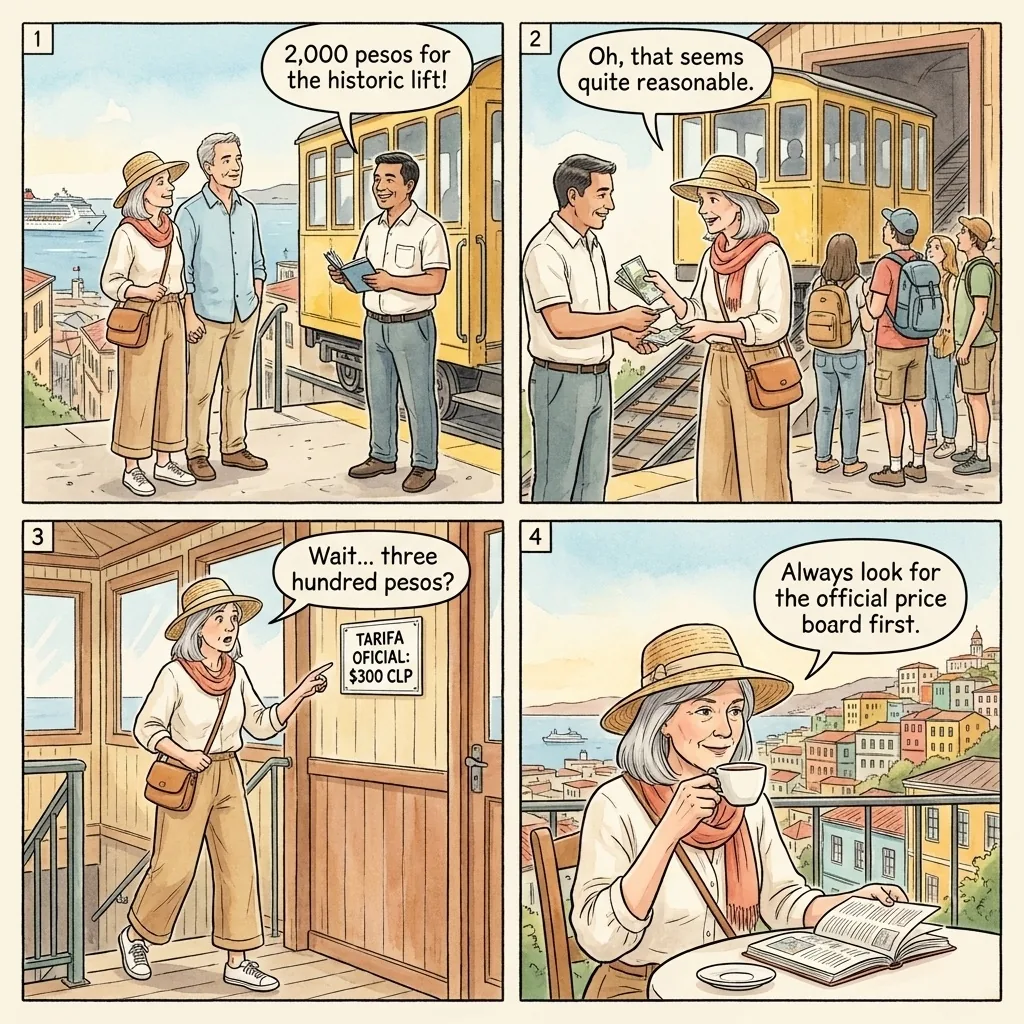
It's a Wednesday in February, your cruise ship has just docked at Muelle Prat for the day, and you walk up the cobblestone approach toward Plaza Sotomayor planning to ride the historic Ascensor Concepción up to Cerro Alegre.
A man at the lower station — clean shirt, sometimes a hand-stamped ticket book — quotes you 2,000 CLP per person to ride. You pay because the price feels reasonable for a 'historic funicular' and because the queue behind you would make a question awkward. The ride lasts ninety seconds. At the top there is no posted price, no ticket office, just the wooden cabin and the view over the harbour.
The published Valparaíso ascensor fares are 100–300 CLP one-way for the municipally-operated lifts (Concepción, Artillería, El Peral, Polanco, Reina Victoria) — about $0.10–0.30 USD. The 2,000 CLP you just paid is a 7–20× markup applied specifically on cruise-ship days at the funiculars closest to Muelle Prat. The man at the bottom of the lift is sometimes a freelancer pocketing the difference, sometimes the legitimate operator running a 'tourist price' on top of the official fare. As travelers report across Reddit, the TripAdvisor Valparaíso forum, the Lonely Planet South America thorntree, and local consumer-protection complaints to SERNAC, the cruise-day surcharge is one of the most-reported Valparaíso friction points.
The pattern is consistent. The surcharge does not appear on weekdays without a cruise in port. It does not appear at the ascensores furthest from the harbour (Polanco, Reina Victoria). It does appear specifically at Concepción, Artillería, and El Peral on cruise days, when several thousand visitors arrive over a few hours and the operator can run a tourist-only fare without the local pushback that would shut it down on a normal day. The dollar damage on a single trip is small ($1–2), but multiplied across two adults and four ascensor rides on a port day, it becomes a $15–20 invisible tax that is entirely avoidable.
The municipally-restored ascensores were declared part of UNESCO's World Heritage protection of historic Valparaíso in 2003, and Chile's Ministry of Public Works has spent the past two decades restoring the wooden cabins and steel cables to their early-20th-century specifications. The fare board at each lower station is therefore not just a price list — it is the official municipal tariff posted by the operating concession. Any quote that diverges from that board is, by definition, a freelancer surcharge. A photograph of the board on your phone gives you the receipt you need to refuse the markup.
Look at the posted fare board at the lower station of every Valparaíso ascensor before you pay — official municipal fares are 100–300 CLP one-way. If a 'ticket seller' quotes 2,000 CLP, ask to see the official fare card, point to the posted board, and offer the correct fare. Have exact change ready. If you arrive on a cruise day, prefer Ascensor Polanco or Reina Victoria, which sit further from Muelle Prat and rarely run the surcharge. Walking up the cerros on foot via Paseo Atkinson or Calle Templeman is also free, gentle, and lined with the murals you came for. Disputes can be reported to 133 (Carabineros de Chile) or 131 (ambulance); the U.S. Embassy in Santiago is at +56 2 2330 3000.
Red Flags
- Price quoted is significantly above the posted fare
- Operator at the ascensor entrance asks for cash before you board
- Happens primarily when cruise ships are in port
How to Avoid
- Check the posted fare before paying — it should be 100-300 CLP.
- Exact change avoids any negotiation.
- The Ascensor Concepción and Artillería are the most reliable with posted prices.
- Walk the cerros if you're unsure — the views are better on foot anyway.
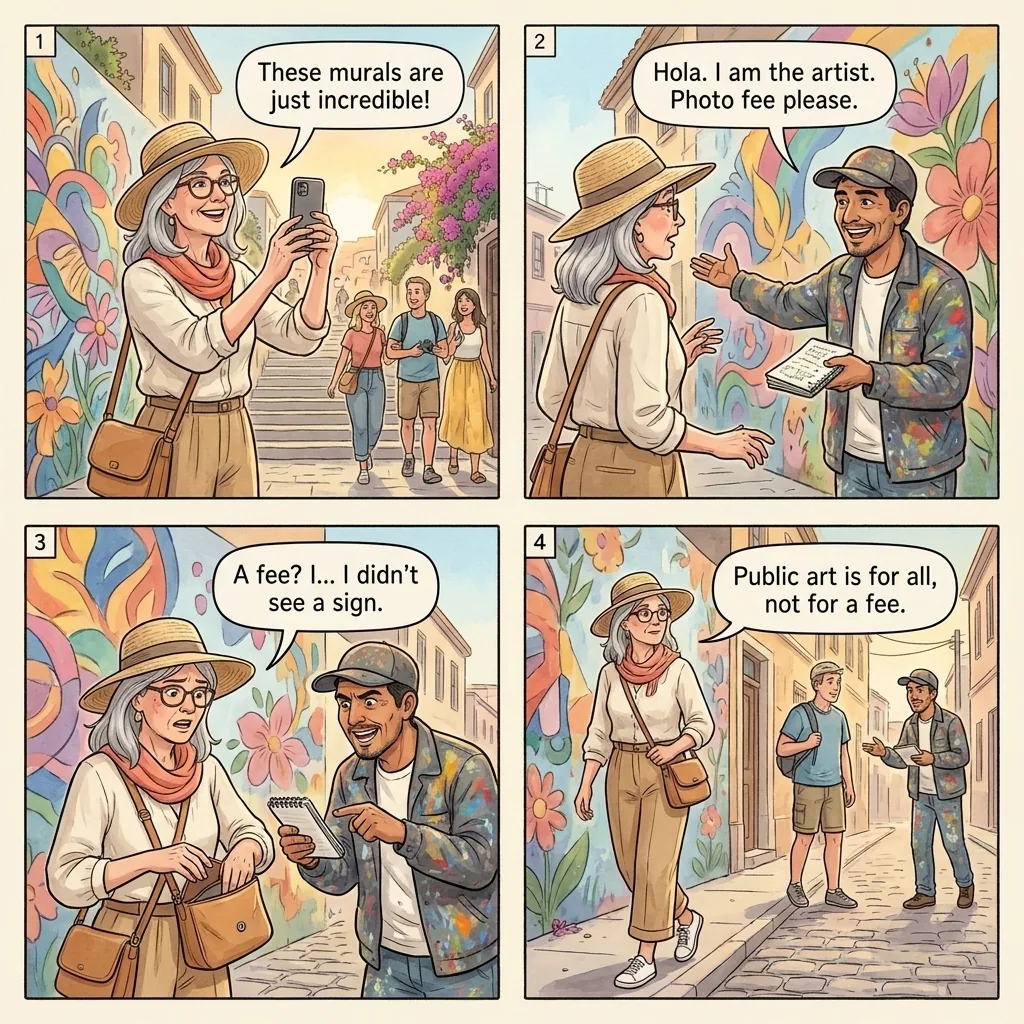
It's a bright afternoon on Cerro Alegre, you've just photographed one of the famous Inti or Charquipunk murals on a stairway wall, and a man in a paint-splattered jacket steps out from a doorway and explains in friendly Spanish that he is the artist who painted it.
He says he 'lives just there' on the cerro and that his standard photo fee is 5,000 CLP per visitor. The figure feels both arbitrary and oddly specific — small enough to seem possible, large enough to be inconvenient. Sometimes he produces a battered notebook of 'previous tippers' to underline that this is what people normally pay. Sometimes he points to other tourists down the street as if to indicate they paid too.
He did not paint the mural. The well-known Valparaíso muralists — Inti, Charquipunk, La Robot de Madera, Mono González — work on commission, sign their pieces, and do not station themselves on the cerro to charge passersby. The Open Sky Museum (Museo a Cielo Abierto) along Pasaje Bavestrello is a free public art installation funded by the Universidad Católica de Valparaíso in the 1990s. The Cerro Alegre and Cerro Concepción murals are public art on public walls, free to photograph, with no fee structure of any kind. As travelers report across Reddit, the TripAdvisor Valparaíso forum, and the Lonely Planet South America thorntree, the photo-fee shakedown is concentrated on the highest-traffic mural corridors during cruise-ship and weekend hours.
The mechanism is opportunistic rather than organised — different individuals on different days work the same stairways, and a confident decline almost always ends the encounter. The aggressive variant involves a small group following a tourist for several blocks, escalating tone but never escalating to physical confrontation. The polished variant involves an apparent 'guide' who offers a 'tour' of the murals, leads you through five minutes of context, then pivots to a fee at the end of an unsolicited service.
The legitimate Valparaíso mural ecosystem is well-documented. The Open Sky Museum at Pasaje Bavestrello holds twenty commissioned works from named Chilean artists installed in 1992. The newer murals across Cerro Alegre and Cerro Concepción are the work of the city's well-known street-art collective, with credits accessible via the Valparaíso municipal tourism office and the Fundación Itaú catalogue. None of these artists charge passersby on the cerros. Tourists who want to support working muralists can buy prints and zines at Galería Bahia Utopica or Crisol on Almirante Montt, where a portion of sales funds active local artists directly.
Street art on public walls is free to photograph anywhere in Valparaíso. If someone claims to be the artist and asks for a fee, you can decline with a firm 'no, gracias' and keep walking — the encounter ends ninety percent of the time. If they persist, ask for the artist's name and search it on your phone in front of them: the real Valparaíso muralists have public Instagram accounts and Wikipedia entries. Join one of the free Cerro Alegre and Cerro Concepción walking tours that depart from Plaza Sotomayor for legitimate context on who painted what. Do not pay anyone who 'happens to be the artist' on the street. If a fee demand turns aggressive or follows you, dial 133 (Carabineros de Chile); the U.S. Embassy in Santiago is at +56 2 2330 3000.
Red Flags
- Someone claims to be the artist of a famous public mural
- Demands payment for photos of public street art
- Becomes aggressive or loud if you refuse
How to Avoid
- Street art in public spaces is free to photograph — you don't owe anyone.
- If someone claims to be the artist, ask their name and look it up later.
- A confident 'no, gracias' and continuing to walk is sufficient.
- Join a free walking tour for context on who actually created the murals.
🆘 What to Do If You Get Scammed
📋 File a Police Report
Go to the nearest Carabineros de Chile station. Call 133 (Police) or 131 (ambulance). Get an official crime report (constancia or denuncia) — you'll need this for insurance claims. The Valparaíso Tourist Police (PDI) post is at Plaza Sotomayor.
💳 Cancel Your Cards
Call your bank immediately. Most have 24/7 numbers on the back of the card (keep a photo saved separately). Block any suspicious transactions before the thieves use your details.
🛂 Lost Passport?
Contact your nearest embassy or consulate. The U.S. Embassy in Santiago is at Av. Andrés Bello 2800, Las Condes. For emergencies: +56 2 2330 3000.
📱 Track Your Device
If your phone was stolen, use Find My (iPhone) or Find My Device (Android) from another device. Don't confront thieves yourself — share the location with police instead.
Frequently Asked Questions
You just read 2 scams in Valparaiso. The full Travel Safety Series has 780+ more across 20+ countries.
Tokyo's Kabukichō ¥130,000 bar trap. Rome's gladiator photo extortion. Paris's gold-ring trick. Bali's ATM skimmer scams. Bangkok's grand-palace closure ruse. Every documented scam across 20+ destinations — with the exact scripts, red flags, and local-language phrases that shut each one down. Drawn from Reddit traveler reports, embassy advisories, and consumer-protection cases.
- 780+ documented scams across Tokyo, Rome, Paris, Bali, Bangkok, Rio & 100+ more cities
- 20+ countries covered, with country-by-country phrase cards for every destination
- Updated annually — buy once, re-download future editions free
- All titles $4.99 each on Amazon Kindle