
Key Takeaways
- Vienna logs roughly 5,300 pickpocket cases a year; the 1st district alone saw 1,290 in 2024 per meinbezirk — the U1 between Stephansplatz and Reumannplatz is the hottest corridor.
- The fake-police scam (officers demanding to "check" wallets and PINs) has cost Austrian victims around 22 million euros — four convicted in Vienna's regional criminal court in March 2025 per wien.ORF.
- Vienna Airport taxi rank quotes 50–70 euros off-meter, but prebooked fixed-price is 33–39 euros and the S7 train is 4.40 euros — hailing curbside at the rank is the most expensive option.
- Apartment-rental fraud is a weekly pattern — Austria's Federal Criminal Police log about 30 Vienna cases a week; a serial fraudster was arrested in December 2025 with 110,000 euros in damages (wien.ORF).
- Costumed "Mozart" ticket sellers on Stephansplatz are licensed (MA 36, 18 vendors in three zones per Falter's 2020 investigation) but the concerts are usually student ensembles, not palace performances.
⚡ Quick Safety Tips
- Between Vienna Airport (VIE) and the city, take the S7 (4.40 euros) or prebook a fixed-price taxi at taxi40100.at (33–39 euros) — a Vienna day pass does not cover the airport zone and ÖBB conductors ticket 105 euros on the spot.
- On the U1 and U3, keep your bag across your body and one hand on the zipper when the door chime sounds; Stephansplatz escalators are a documented hotspot.
- Never hand your wallet or PIN to anyone in plain clothes — real Vienna police wear blue "POLIZEI" uniforms and will escort you to the nearest Polizeiinspektion if a check is genuinely needed.
- Buy classical concert tickets at wiener-staatsoper.at, musikverein.at, or konzerthaus.at — ignore costumed sellers outside the Staatsoper.
- Save 133 (Austrian police), 112 (EU emergency, multilingual), and Sperrnotruf 116 116 (24-hour bank card blocking) before you arrive.
Jump to a Scam
- Medium Fake Mozart Ticket Sellers
- High Pickpockets on the U1 & Stephansplatz Escalators
- Medium Vienna Airport Taxi Fixed-Price Shakedown
- High Fake Police 'ID Check' PIN Extraction
- High Fake Apartment & Airbnb Listings
- Low Kärntner Strasse Restaurant Cover-Charge Creep
- Medium Airport-Train Zone Trap & the 105-Euro Fine
- Medium Distraction Theft: Flower, Bracelet, Petition, 'Munich Ticket'
The 8 Scams
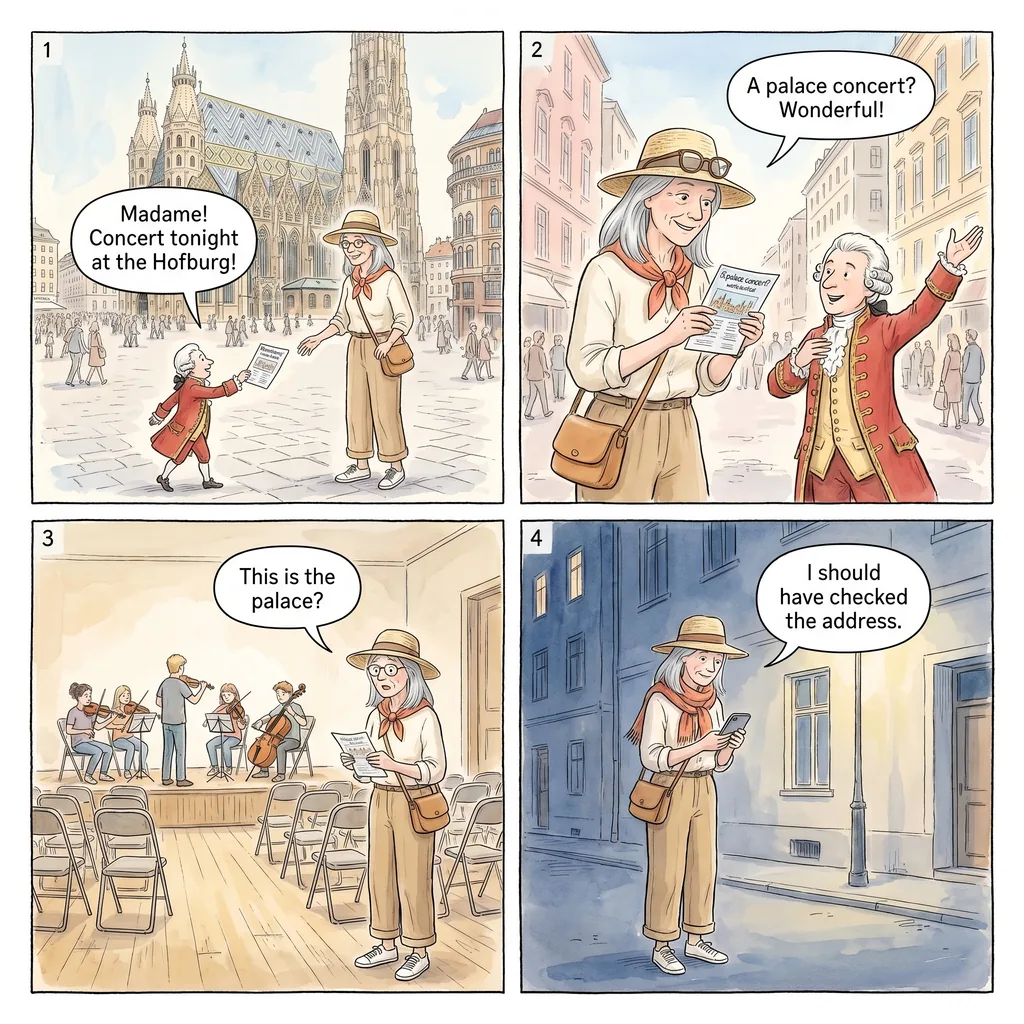
Costumed "Mozarts" in powdered wigs and red frock coats sell tickets to grand-sounding concerts that turn out to be student orchestras in a rented hall, nothing like the venue implied by the costume.
You step out of Stephansdom into the late-afternoon light on Stephansplatz and a man in a red coat and white wig is already moving toward you with a laminated flyer. He speaks good English, calls himself "Mozart," and says he has a few seats left for a concert tonight at the Hofburg. The price is 55 to 85 euros depending on the category. What he does not quite say — and what a dozen travelers have posted about afterwards on traveler reports — is that the concert is usually not at the Hofburg at all. A 2024 traveler threads titled "Got scammed by the fake Mozarts" describes paying for what was sold as a Hofburg performance and being redirected to a much smaller venue with a student ensemble; the commenters under it ("the 'concert' itself is the scam") confirm it is a pattern, not an isolated bad night. Austrian weekly Falter investigated the vendors back in January 2020 and found the city of Vienna responded by requiring every street seller to register with MA 36, pay 150 euros a month, and capping the trade at eighteen licensed vendors in three zones — a regulation which, six years on, locals on Reddit still complain is barely enforced.
The mechanic is a costume and a bait-and-switch. The "Mozarts" are commission salespeople for a handful of tourist-facing orchestras — Der Standard's 2024 report on a pay dispute inside this world ("Gagenstreit in der lukrativen Welt der Touristenklassik") names the Wiener Mozart Orchester as the most commercially successful — and they are paid per ticket sold, not per happy customer. The costume implies a Baroque palace concert; the venue is often a rented function hall where a rotating cast of conservatory students plays an abridged, hits-of-Mozart program. Die Presse's TripAdvisor survey ("Ärger mit Wiens falschen Mozarts") found complaints of "brazen rip-off" and "total joke" next to positive reviews, which is the tell: the product varies wildly because the orchestra does. The pitch targets anyone who has just finished their first loop of the Ringstrasse — tired, culturally primed, unclear how classical-music ticketing actually works in Vienna.
If you want live classical music in Vienna, buy directly from the venue. Wiener Staatsoper, Musikverein, Konzerthaus, Volksoper, and the Hofburg's own Wiener Hofburg Orchester all sell online with clear seat maps and English checkout. Musikverein standing-room tickets go for 6–10 euros at the door, 80 minutes before the concert starts. If you still want a costumed concert with a glass of sparkling wine afterwards, that is a legitimate product — just book it online from the venue, not from a man on Stephansplatz. Vienna's Tourist-Info at Albertinaplatz 1 (daily 9:00–19:00) will tell you the night's official programs. If you have already paid and feel deceived, Austria's consumer protection agency VKI (Verein für Konsumenteninformation) accepts complaints at 0800 201 211.
Red Flags
- Seller is in costume (powdered wig, red or gold 18th-century coat) on Stephansplatz, Graben, or at the Staatsoper corner
- Venue is described vaguely — "at the Hofburg," "in a palace" — without a specific hall name or address
- Price category list looks printed but no seat map is shown
- You are told seats are "limited tonight" and you must decide on the spot
- Payment is card-tap on a handheld terminal with no itemized receipt, or cash only
How to Avoid
- Buy direct from wiener-staatsoper.at, musikverein.at, konzerthaus.at, volksoper.at, or hofburgorchester.at — all in English.
- If you want a costumed concert, pick an established house's own product and search the exact company name online first.
- Check the venue address on Google Maps before paying: "Hofburg" covers several halls — legitimate concerts name the specific one (Festsaal, Redoutensaal).
- Ask at Tourist-Info Albertinaplatz what is actually playing tonight — free, 60 seconds of your walk.
- If it feels like a hard sell and you cannot leave without committing, that is the answer.
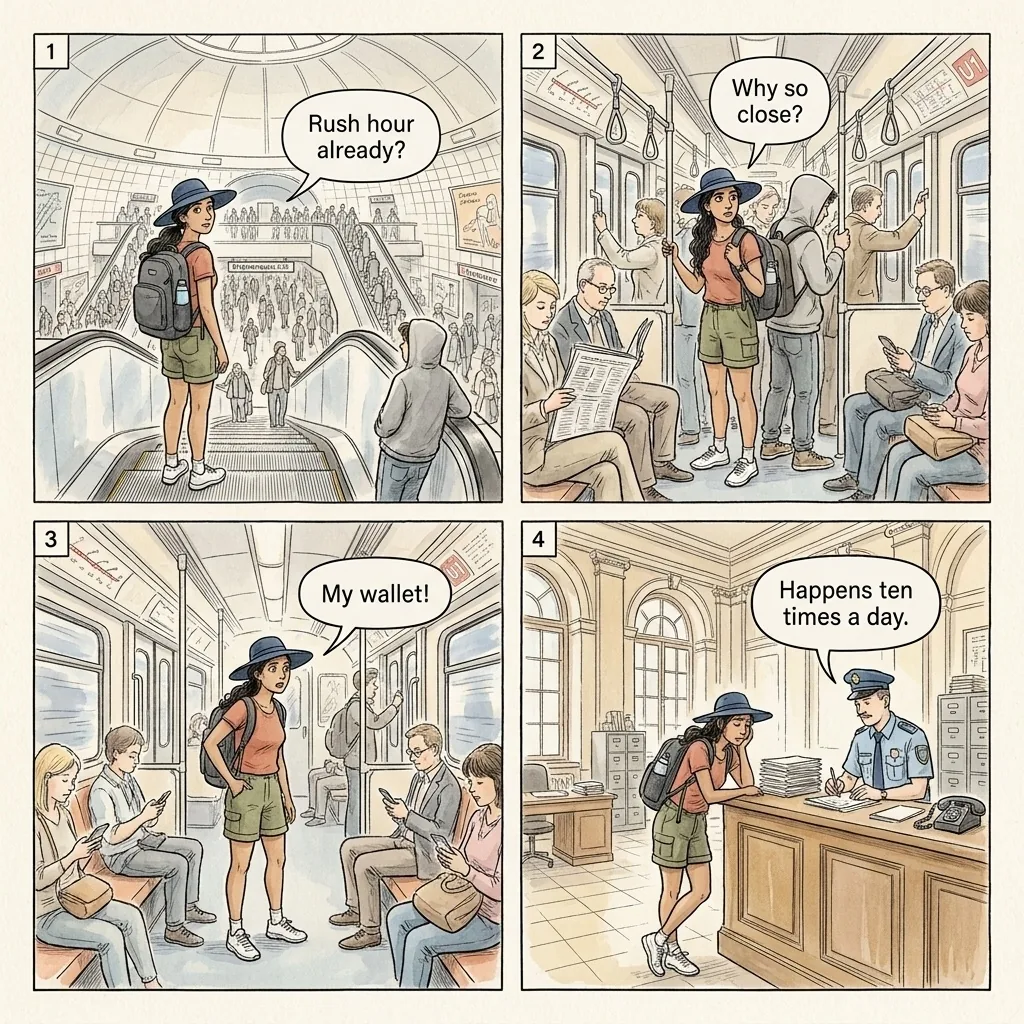
Vienna records roughly 5,300 pickpocket cases a year, and more than half of Austria's pickpocketing happens in the capital — concentrated on the U1 line and the 1st-district tourist triangle.
The July 2025 arrest that made the pattern legible came out of Hauptbahnhof police station: two Chilean nationals, ages 52 and 69, had worked the U1 line between Stephansplatz and Reumannplatz since early June, hitting the train between 12–1 PM and 7–8 PM — the lunch crowd and the dinner-hour commute.ORF.at reported at least ten documented incidents; Die Kriminalisten, the Austrian police magazine that profiled the case, put the documented damage at "over 8,000 euros" and noted the pair sometimes used victims' bank cards to withdraw cash after the theft. They were caught when officers stationed themselves in pairs at U1 stations and watched the duo board at Karlsplatz heading toward Leopoldau, intercepting them at Schwedenplatz. An older man on U1 who had his wallet lifted was the complaint that opened the file. For scale: meinbezirk reported Vienna's 1st district alone logged 1,290 pickpocket cases in 2024, up from 1,160 in 2023, and the Austrian Federal Criminal Police flag Mariahilfer Strasse, Stephansplatz, and Naschmarkt as the national hotspots.
The mechanic is crowding and misdirection. On the U1, the move usually happens in the four-second window when the doors chime and everyone shuffles — a pair of thieves will bracket you, one ahead, one behind, a third sometimes asking you for directions or shoving a clipboard at you. The Stephansplatz escalator climbing up from the U-Bahn is a known hit point because backpacks ride at waist height for the thief behind you. At Naschmarkt on Saturdays the crowd is dense enough that a hand into an open tote is invisible; on Mariahilfer Strasse the move is often a teenage girl or boy asking you to sign a petition while their partner works the outside of your bag. A widely-cited 2025 exxpress report ("Influencerin fasste Mädchen-Duo bei Diebstahl am Stephansplatz") recounts a local influencer physically catching two girls lifting from tourists on the Stephansplatz escalators. The girls in such stings are frequently minors who are released the same day — which is why police describe the problem as persistent rather than solvable.
The protection is structural, not situational. Carry your phone in a zipped front pocket, not a back pocket; wear a bag across your body, zipper side against your chest; in the U-Bahn keep one hand on the bag once you hear the door chime. Contactless bank cards should live inside a signal-blocking sleeve. If your wallet is taken, call your bank to freeze cards first (Sperrnotruf 116 116, a 24-hour Austrian blocking line), then report at the nearest police station — in the 1st district that is Polizeiinspektion Deutschmeisterplatz or Polizeiinspektion Goethegasse (the Goethegasse station handled the Innere Stadt pickpocket arrests vienna.at reported on in 2023). Austria's general police line is 133, EU emergency is 112. For a full theft report in English, the US Embassy on Boltzmanngasse 16 (+43 1-31339-0) helps American citizens with emergency document replacement; UK travelers go through the British Embassy on Jauresgasse 12.
Red Flags
- A stranger offers an unusually friendly shove toward the U-Bahn doors just as they are closing
- A clipboard, petition ("deaf-mute" or "children's charity"), or paper map is pushed into your personal space on Mariahilfer Strasse
- A group of teenagers forms a rough circle around you on the Stephansplatz escalator
- Someone bumps you from behind at the top or bottom of the escalator, then apologizes with a hand on your arm
- A vendor at Naschmarkt leans across to hand you something while another person stands very close behind you
How to Avoid
- Use a front-zipped pocket for phone and a crossbody bag for wallet; keep your hand on the zipper on crowded U1 / U3 trains.
- When the U-Bahn door chime sounds, assume your zone of awareness just shrank and glance down at your bag.
- Decline all petitions, flyers, and "just take this for free" handovers on Graben and Mariahilfer Strasse — accepting frees one of your hands.
- Keep only one card and a small cash amount in a day wallet; leave the rest in the hotel safe.
- On the Stephansplatz escalators, wear your backpack on your front — locals do it, you will not look out of place.
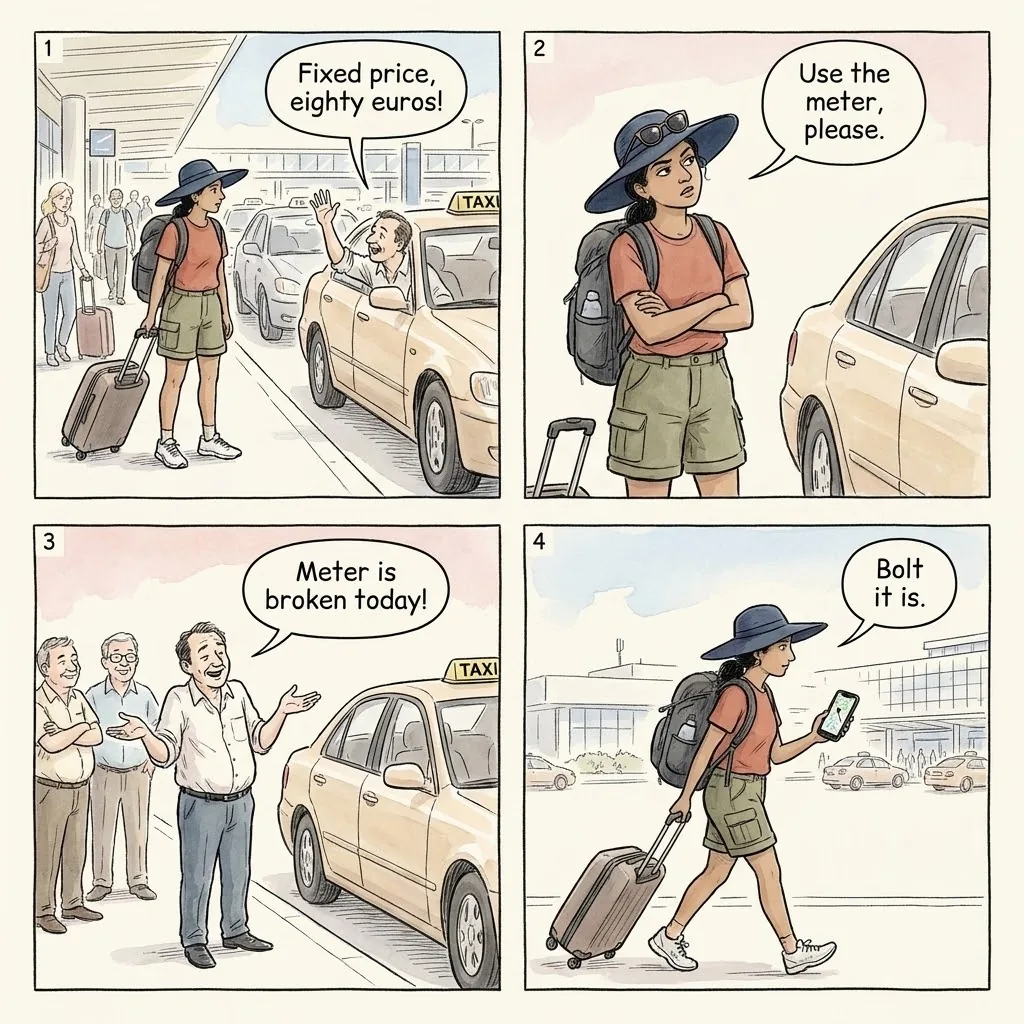
Drivers at the VIE arrivals rank quote off-meter "fixed" fares of 50–70 euros for a ride into town — both a rip-off and, for curbside hails inside city limits, technically illegal under Vienna's taxi ordinance.
The baseline to anchor against: the train from Vienna Airport to the city center costs 4.40 euros on the ÖBB S7 (about 27 minutes to Wien Mitte); the City Airport Train (CAT) costs 15 euros one way and goes to the same Wien Mitte station about seven minutes faster. A prebooked airport-transfer taxi is 33–39 euros flat to the 1st district. The scam is what happens if you walk out of arrivals and join the curbside taxi queue cold.at's December 2024 undercover piece ("Verboten: Wucher-Preise vor Wiener Taxi-Hotspots") filmed drivers quoting 30 euros for a 1.8-kilometer inner-city ride at the Innere Stadt stand — a price explicitly illegal under Vienna's taxi regulations, which state that rides starting at a Standplatz inside city limits must be billed by the meter only. At the airport the trick takes two shapes: an off-meter "fixed price" of 55–70 euros for the run into Vienna (versus the legitimate prebooked 33–39), or a running meter that has been manipulated — a documented issue Der Standard covered in 2024 when the Austrian Financial Crimes Office raided a Viennese taxi family and seized luxury cars, watches, and 60,000 euros in cash.
The mechanic is a staged negotiation. You are jet-lagged, you have luggage, and the driver at the front of the rank says "meter does not work here, fixed price to Stephansplatz is 55." If you push back he will lower it theatrically to 45, which is still double the legitimate rate. Uber operates at VIE at around 35–40 euros; Bolt is similar; the 40100 radio-taxi app quotes a fixed prebooked price that is binding. A Reddit thread from traveler reports titled "Airport Taxi charged me 56€?" has a top answer that reads simply: "In arrivals there are transfer-driver companies that charge a fixed rate up front. Take those next time, the ones outside are a ripoff." The Viennese taxi guild itself (Wiener Taxi-Innung, wko.at) has publicly backed the city's 2024 crackdown on rogue operators, saying illegal rides and manipulated meters "distort the industry."
The defense is never hailing curbside at the airport. Book a prebooked fixed-price taxi before you land (taxi40100.at, flughafentaxi-wien-fixpreis.at, or taxiradar.at — all quote 33–39 euros to the 1st district), take the S7 (not CAT unless you specifically want to pay triple for seven minutes), or open Uber / Bolt in the airport lobby before you step outside. If you do end up in a rank taxi and the meter is "broken," get out. If the driver refuses to let you out, call 133 and stay calm — Austrian drivers will usually fold at the mention of the Taxi-Innung (guild) because they can lose their concession. To report a bad ride after the fact, use taxifeedback.at (the Chamber of Commerce channel) with the license plate and the stand name.
Red Flags
- Driver says "meter is broken" or "only fixed price today" as soon as you sit down
- The car is at a Vienna taxi stand (Standplatz) but the quote is a flat number, not a metered starting fare
- License plate does not start with "W" and end in "TX" (Vienna taxi plates are W-xxxxxTX)
- Driver refuses card payment — Viennese taxis have been required to accept cards since 2019
- At VIE, a driver approaches you inside the terminal before you reach the official rank
How to Avoid
- Pre-book a fixed-price airport transfer online (Taxi 40100 app, flughafentaxi-wien-fixpreis.at) — binding at 33–39 euros.
- Take the S7 S-Bahn for 4.40 euros to Wien Mitte (buy "Einzel + Außenzone 100" or the airport through-ticket at the platform machine).
- Insist on the meter inside city limits — meter-only is the law at Vienna Standplätze.
- Pay by card in the car; always get a receipt with the plate number.
- If you must hail at a rank, take a picture of the plate before you load luggage.
Like what you're reading? Get a full Vienna itinerary with safety tips built in.
Browse travel-safety books →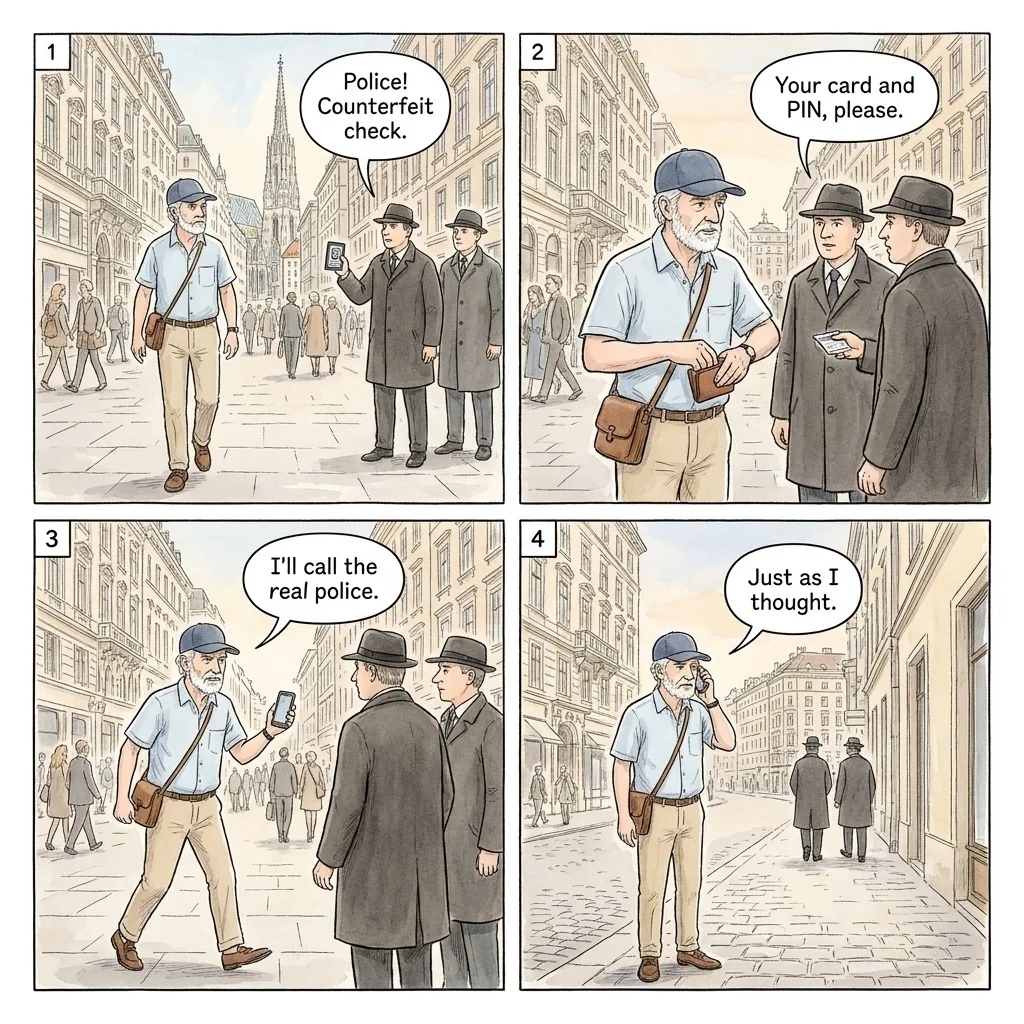
Men in plain clothes flash a fake police badge, claim counterfeit currency is circulating, and ask to "check" your wallet and PIN — a scheme Der Standard documented against Egyptian and Japanese tourists in the Innere Stadt.
Der Standard's Innenstadt case file is the clearest tourist-facing version: three men in civilian clothes approached Egyptian and Japanese tourists in Vienna's 1st district, flashed what they called "criminal police" identification, and demanded to inspect the victims' wallets and extract PIN codes for their bank and credit cards. The cover story is usually that counterfeit banknotes are circulating in the area and the "officers" need to verify your cash. The in-person Innere Stadt version is rarer than the telephone variant — in which callers spoof real Austrian numbers and pose as Kriminalpolizei to walk elderly victims into handing over life savings — but both run on the same script.ORF.at reported in March 2025 that four men were convicted at Vienna's regional criminal court of running the phone version from late 2023 to early 2024; their ring targeted ten elderly women, one of whom lost 1.2 million euros across five separate pickups, and the Austrian public prosecutor put the network's total damage at around 22 million euros. The convicted ringleader received three years and nine months.
The mechanic is the badge flash plus the credentialed-authority freeze response. A genuine Austrian police officer on patrol in the Innere Stadt wears the blue Bundespolizei uniform with "POLIZEI" on the vest; plain-clothes officers do exist (Kriminalpolizei, patrolling the same Goethegasse area that Polizeiinspektion Goethegasse works) but will not ask you for a PIN code under any circumstance, will not accept you handing them cash or cards, and will not conduct a wallet inspection on the sidewalk. The tell in the tourist version is always the financial demand: a real officer asking to see ID for a legitimate reason will escort you to the nearest police station or book the check on the street, not ask you to unlock your banking app. The Austrian Ministry of the Interior (BMI) and Wiener Polizei have put the "Falsche Polizisten" scam on public warning boards every Christmas season since 2022 — profil.at reported the Vienna call center behind it was raided in 2023 after approximately 23 million euros in estimated Austrian damage.
The script on the street is short: you say, in English or any language, "I will call the real police now," and you dial 133 (Austrian Police) or 112 (EU emergency, multilingual dispatch). Real Austrian officers will come; fake ones will vanish the second you reach for your phone. Do not hand your wallet to anyone in plain clothes on the street, ever. If you are pushed past that first move and a "badge" has already been shown, walk into any open shop — a Billa, a Spar, a café on Kärntner Strasse — and ask the staff to call police. Vienna's Tourist-Info Albertinaplatz 1 (daily 9:00–19:00) will let you sit and call from their desk. If you have already shown a PIN, call your bank within minutes and freeze the card; Austrian banks' 24-hour blocking line (Sperrnotruf) is 116 116. The US Embassy on Boltzmanngasse 16 (+43 1-31339-0) helps American citizens file emergency reports.
Red Flags
- Plain-clothes stranger claims to be police and asks about counterfeit bills in the area
- The "officer" asks to see your wallet, bank card, or PIN for any reason
- He flashes a laminated card briefly and puts it away before you can read it
- He is alone or in a pair of two, with no marked vehicle nearby
- He tells you not to call 133 because "it will take too long"
How to Avoid
- Real Vienna police on Kärntner Strasse wear blue uniforms with "POLIZEI" — anyone else you can politely ignore.
- Never, under any circumstance, hand your wallet or PIN to someone on the street — real police will not ask.
- If pressed, say loudly "I will call 133 right now" and start dialing; fraudsters leave.
- Carry only one card and a small cash amount for the day; leave passport and second card in the hotel safe.
- If a badge is shown, ask to walk with them to the nearest Polizeiinspektion — refusal confirms the scam.
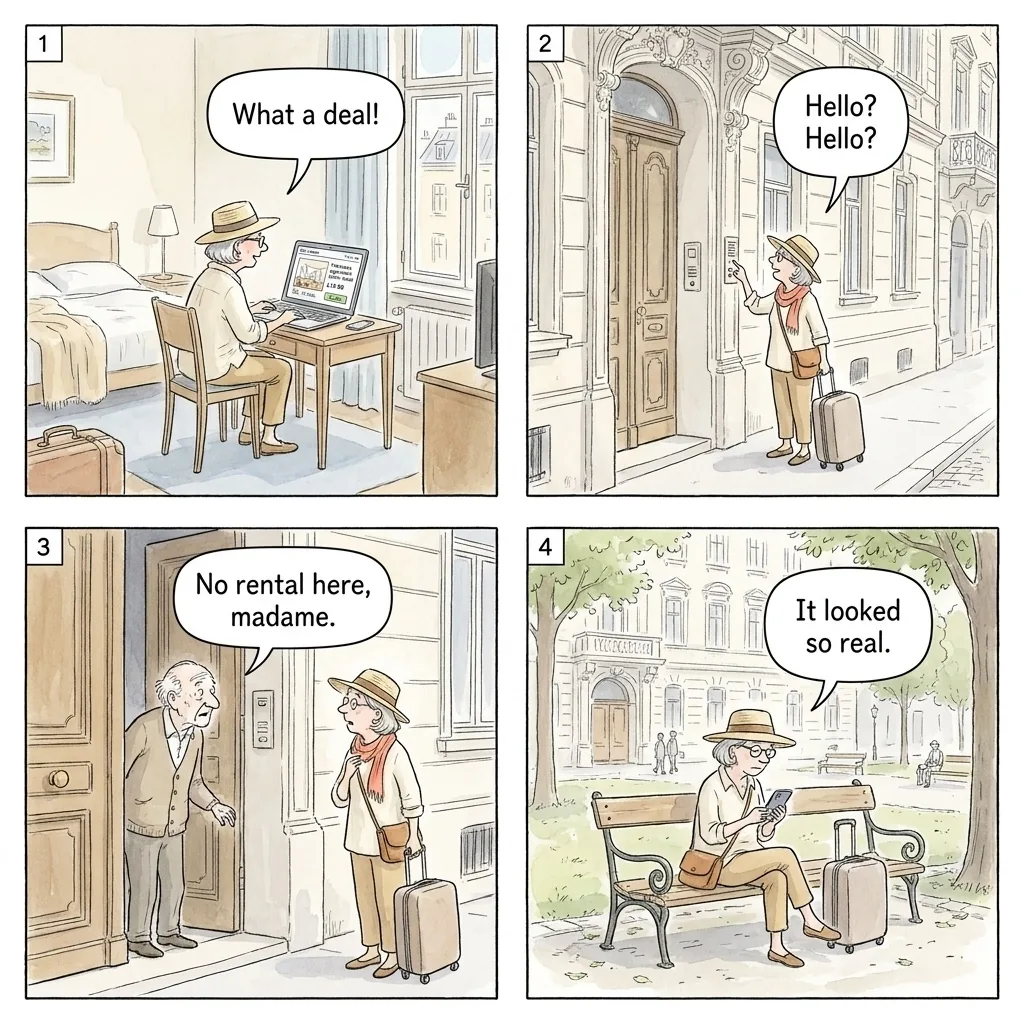
Fraudsters post cheap Vienna flats with stolen photos, run staged viewings in apartments they do not own, and ask for deposits and "key delivery" transfers that disappear — a pattern Austria's Federal Criminal Police say produces about 30 Vienna cases a week.
Austrian English-language news outlet The Local reported in November 2024 that Vienna was logging about thirty fake-apartment cases a week, most using stolen property photos pulled from legitimate platforms. Reinhard Nosofsky, head of Vienna's fraud investigation unit, told The Local flatly: "The flats don't actually exist. They simply use photos from the internet." In February 2024 the Wiener Polizei escalated the warning — The Local's follow-up ("Vienna Police warns of new scam with fake apartments").ORF.at added the concrete arrest in December 2025: a 37-year-old Turkish man had run 23 cases worth 110,000 euros in 2024–25, on top of 27 cases worth 50,000 euros in 2023. He posed as an architecture student, used stolen floor plans from a housing cooperative, collected cash and transfers under the alias "Johannes Berg," and preyed primarily on the Serbian-Vienna community because word-of-mouth trust had already done the hard work of vetting him. Separately, Kurier reported in 2024 that scammers had begun renting short-term Airbnbs in Vienna and relisting them as long-term apartments on other platforms, collecting deposits before the real owners even knew.
The mechanic has two main forms. The first is the remote scam: a too-cheap listing (a 48-square-meter flat at 602 euros a month including utilities, in the real 2024 case The Local used as its lead), a "landlord" who is supposedly in Ireland or Spain and needs you to wire a deposit via a link that looks like Airbnb but is a cloned domain. No keys, no address, no flat. The second is the staged viewing: the fraudster has the physical keys to a furnished unit (sometimes a short-term rental he is actually in) and walks you through it, then presents a contract over WhatsApp with a deposit and a "Vermittlungsprovision" (agent fee). You pay, the contact line goes dead, and the real owner arrives on the agreed move-in day having never heard of you. Both rely on Vienna's housing pressure — low vacancy, high rents, and a lot of desperate movers and tourists.
The defenses are administrative. Before you transfer a single euro, verify ownership in Austria's national land register (Grundbuch), searchable online at justizonline.gv.at — it will show the actual registered owner of any Vienna property. Reverse-image-search the listing photos with Google Lens or TinEye; if they appear on multiple real-estate sites across different countries, the listing is stolen. Refuse any landlord who will not meet you in person at the property; refuse any deposit request routed through a free email (hotmail, gmx, protonmail). On Airbnb specifically, never accept a link to pay outside the platform — Airbnb's booking protection only covers on-platform payments, and the Austrian police warning specifically flags "off-platform payment requests" as the key scam signal. If you have lost money, report to the Vienna Landeskriminalamt via the Landespolizeidirektion Wien switchboard +43 1-31310 and, if you are not Austrian, also to your embassy. Austria's consumer protection agency at 0800 201 211 logs these cases.
Red Flags
- Rent is 30–50% below the Vienna market rate for the district
- Landlord "is abroad" and cannot meet in person before payment
- Payment link looks like Airbnb / Booking.com but the URL is slightly different (airbnb-secure-pay.com, booking-transfers.net)
- Contract arrives over WhatsApp; email is from a free provider (gmx, hotmail, protonmail)
- Viewing appointment is rushed ("I have five other interested") and keys are collected before any paperwork
How to Avoid
- Verify ownership in Austria's Grundbuch (justizonline.gv.at) — free lookup of registered owner.
- Reverse-image-search listing photos with Google Lens; if they appear on other countries' sites, walk away.
- Never pay outside Airbnb / Booking.com — on-platform payment is the only thing covered by their protection.
- Meet the landlord at the property, in person, before any deposit; ask to see Austrian ID.
- Use Vienna's Arbeiterkammer (wien.arbeiterkammer.at) and VKI consumer helpline (0800 201 211) if anything feels off.
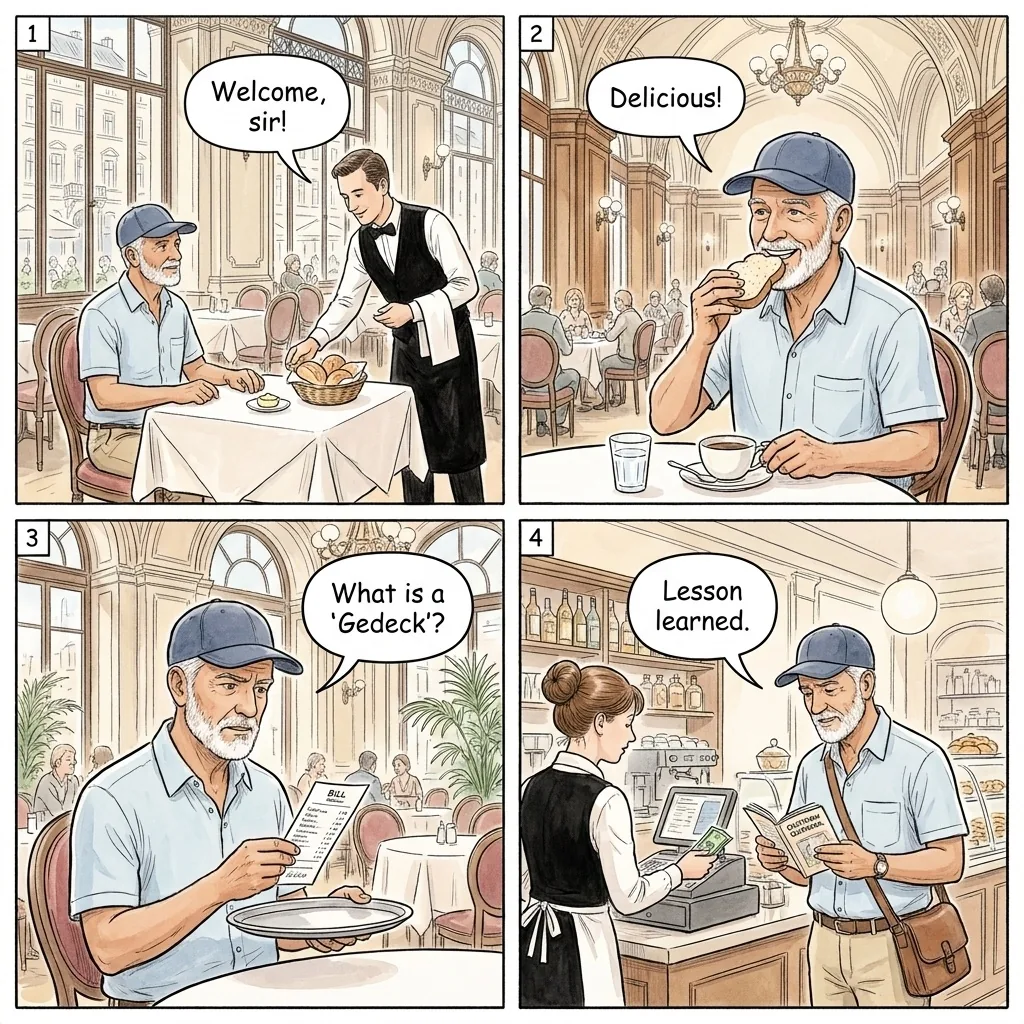
Restaurants in the 1st-district tourist ring slip a "Besteckgebühr" (cutlery fee), "Gedeck" (cover charge), or "coperto" onto your bill — usually 3–8 euros a person, legal in Austria but rarely used outside tourist zones, and almost never disclosed in English before you order.
One TripAdvisor review of Ristorante Al Caminetto da Mario on Krugerstrasse 4, a block off Kärntner Strasse, captures the move: the guest orders dinner, enjoys it, asks for the bill, and finds a line item labeled "Besteckgebühr" — literally "cutlery fee." Another review of the same restaurant flags a 5-euro "coperto" for a table setting that was never agreed to. The 1000things magazine guide to "the five worst TripAdvisor restaurants in Vienna" and Meinbezirk's Favoriten report ("Wien ist schön, aber Abzocke nicht") both describe the same pattern in the 1st district: a 3.50-euro coffee suddenly costs 5 euros, a glass of wine is 9.40, a green side salad 7.30, and the line item labeled "Gedeck" adds 4–6 euros a person for "bread and table setting" whether you touched the bread or not. Die Presse's investigative TV-style exposé "Achtung Abzocke" chased a Kärntner-Strasse restaurant specifically on this, and a 2018 traveler threads titled "Achtung Abzocke TV-Team stellt Wiener Abzock-Wirt zur Rede" still gets fresh comments because the same restaurants are still operating.
The mechanic is legal-but-sharp. Under Austrian gastronomy custom a menu price is a menu price, and any additional flat-fee "Gedeck" or "Couvert" must be printed on the menu to be enforceable. In the tourist ring on Kärntner Strasse the fees are there — in 8-point type, on page one of a twelve-page menu, often only in the German version. Locals on traveler reports flag the same few streets every year: Kärntner Strasse, Graben, Stephansplatz, Petersplatz, and the stretch of Rotenturmstrasse closest to Stephansdom. Move two blocks into the side streets (Habsburgergasse, Spiegelgasse, Weihburggasse) and the markup evaporates. A related variant is "dynamic currency conversion" at the card terminal: the waiter hands you the terminal, it offers to charge in dollars or pounds at an inflated rate (usually 3–5% worse than the bank rate), and if you tap "yes" you have effectively tipped the payment processor. Always pay in euros.
The defenses cost nothing. Read the menu from the bottom before you order — every Gedeck, Couvert, or Besteckgebühr must be printed somewhere, and if it isn't you are not obligated to pay it. When the card terminal asks "pay in EUR or USD," always pick EUR. Ask for the bill itemized ("Rechnung bitte, aufgeschlüsselt") before you tip. If a fee you were never informed of appears, politely ask for it to be removed; Austrian staff will usually concede because they are legally on thin ice. If they refuse, pay the base, note the amount and receipt, and file with the Arbeiterkammer Wien consumer service (+43 1 501 65 0) or VKI at 0800 201 211. For a tourist-safe dinner in the 1st district, go to a Beisl — the traditional working-class tavern — one or two streets back from Kärntner Strasse.
Red Flags
- Menu is twelve pages long with photos of every dish, handed to you the moment you sit down
- Waiter brings bread you did not order — expect a "Gedeck" or "Couvert" line on the bill
- English menu has different prices from the German menu on the same table
- Card terminal asks "pay in USD / GBP or EUR" (dynamic currency conversion)
- No price is visible on the wine-by-the-glass list
How to Avoid
- Eat one or two streets off Kärntner Strasse — Habsburgergasse, Weihburggasse, Spiegelgasse are fairly priced.
- Check the bottom of the menu for "Gedeck," "Couvert," or "Besteckgebühr" lines before ordering.
- Always pay in euros on the card terminal, never the "home currency" conversion.
- Ask for the itemized bill ("aufgeschlüsselt") and verify line items against what you ordered.
- Save VKI (0800 201 211) and Arbeiterkammer Wien (+43 1 501 65 0) in your phone before dinner.
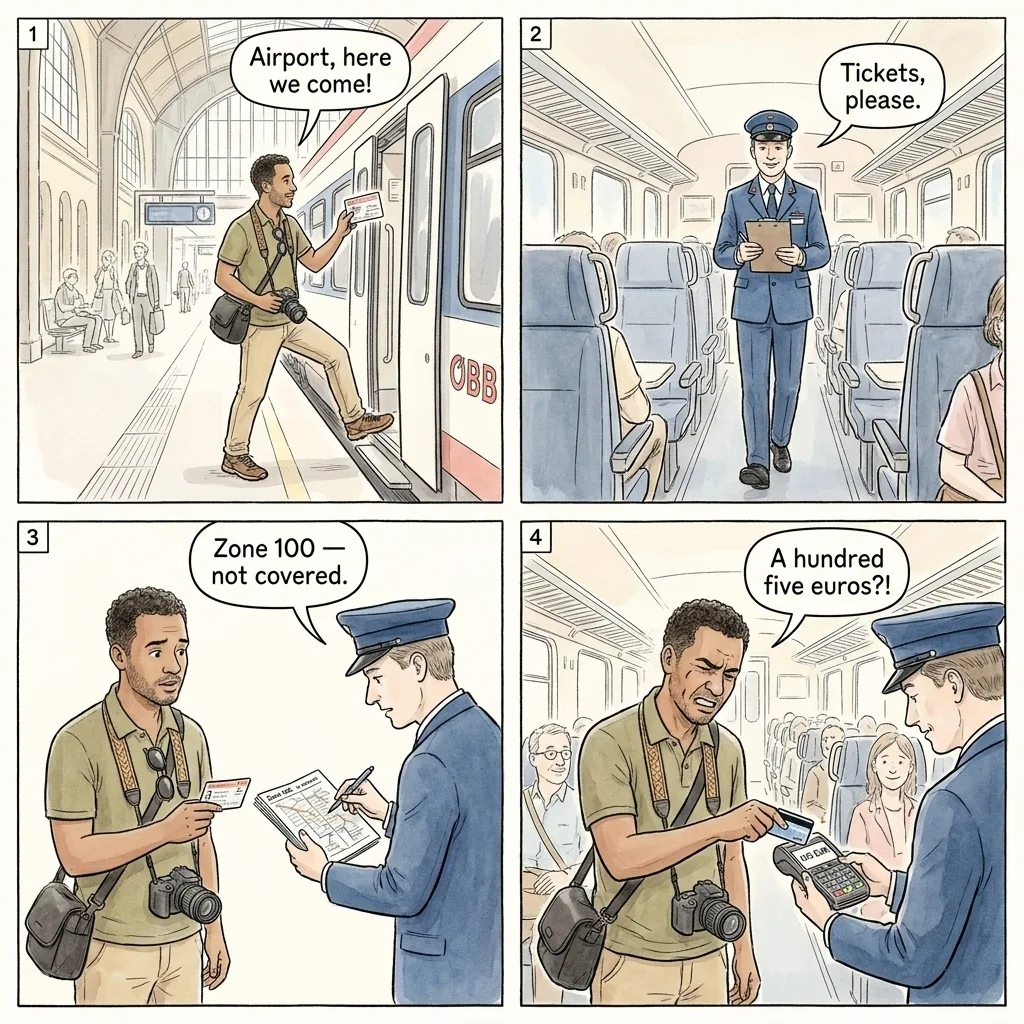
The airport sits in VOR tariff Zone 100 (outside Vienna's core), so a Wiener Linien 24-hour pass does not cover the airport train — and an ÖBB conductor will ticket you 105 euros on the spot even if you thought you had a valid ticket.
A widely-linked traveler report titled "I was charged a 105eu fine in the ÖBB train the minute I sat down" captures the ground truth: the traveler had bought a Vienna public-transport ticket, boarded the S7 at Flughafen Wien thinking it was covered, and was ticketed the moment the conductor walked through. The top-voted reply, which the thread has returned to every quarter since 2020, is blunt: "I agree that it's a scam to put the airport station just one stop outside the core zone. Happens to a lot of people, nothing you can do." Technically it is not a scam in the criminal sense — the ticket rules are posted, in German, in the ÖBB app — but operationally it is a tax on tourists who cannot read Austrian transit zone maps at 6 AM. The airport is in the VOR tariff Zone 100, which means a Wiener Linien Einzelfahrschein (3.20 euros single) or the Vienna City Card does not get you from VIE to Wien Mitte. You need either a separate zone supplement (an "Außenzone 100" ticket around 2.60 euros, combined total 5.80 euros), or a through-ticket from VIE to Vienna at 4.40 euros on the S7 (15 euros on the CAT).
The mechanic catches two kinds of traveler. The first is the arriving tourist with a Vienna City Card from the hotel who assumes it covers the airport — it does not. The second is the leaving tourist who has a 72-hour Wiener Linien pass valid inside the city, hops on the S7 at Wien Mitte for the airport, and gets ticketed in the three minutes between Rennweg and Flughafen Wien. In both cases the ÖBB conductor's penalty is 105 euros, payable on the train by card. There is no negotiation; the rule is enforced even on travelers who show a real ticket for the Vienna zone. A corollary is the Westbahn–ÖBB station trap: if you buy the wrong carrier's ticket for the same Vienna–Salzburg route, it is not valid on the other carrier's train — a traveler threads ("Austria surcharge Westbahn") is full of people who learned that the hard way.
The defense is one rule: when going to or from Vienna Airport, buy an airport-specific ticket, not a Vienna day pass. The S7 ticket costs 4.40 euros at any ÖBB vending machine (all English-enabled). On the Wiener Linien vending machine at a U-Bahn stop, buy "Einzel Wien + Außenzone 100" for 5.80 euros. On the ÖBB Scotty and Wiener Linien WienMobil apps, search for your destination as "Flughafen Wien" and the app auto-applies the zone supplement. The CAT (City Airport Train) at 15 euros has no zone trap — its ticket is a through-ticket. If you have been ticketed, you can pay on the train and, if you believe the ticket was misrepresented, write to ÖBB customer service within 14 days at [email protected]. Wiener Linien info for zone questions is +43 1 7909 100.
Red Flags
- You are on a train to or from Flughafen Wien with only a Wiener Linien ticket or Vienna City Card
- A conductor in ÖBB uniform enters the car within two minutes of departure
- Your app shows "valid until 22:00" but the destination is Flughafen Wien
- The ticket machine at the airport station is labeled "ÖBB," not "Wiener Linien" — and you bought a Wiener Linien ticket
- No one else in your carriage has the same ticket type you do
How to Avoid
- To/from the airport, always buy an "S7 to Flughafen Wien" ticket (4.40 euros) or the CAT ticket (15 euros).
- If you already have a Vienna day pass, buy the "Außenzone 100" supplement (2.60 euros) separately.
- Use the ÖBB Scotty app or Wiener Linien WienMobil app and let it calculate the right ticket by destination.
- Validate your ticket before you board (blue machines at the platform entrance) — unvalidated counts as "unticketed."
- If ticketed, pay with card on the train; never hand cash to anyone claiming to be a controller without seeing the ÖBB badge.
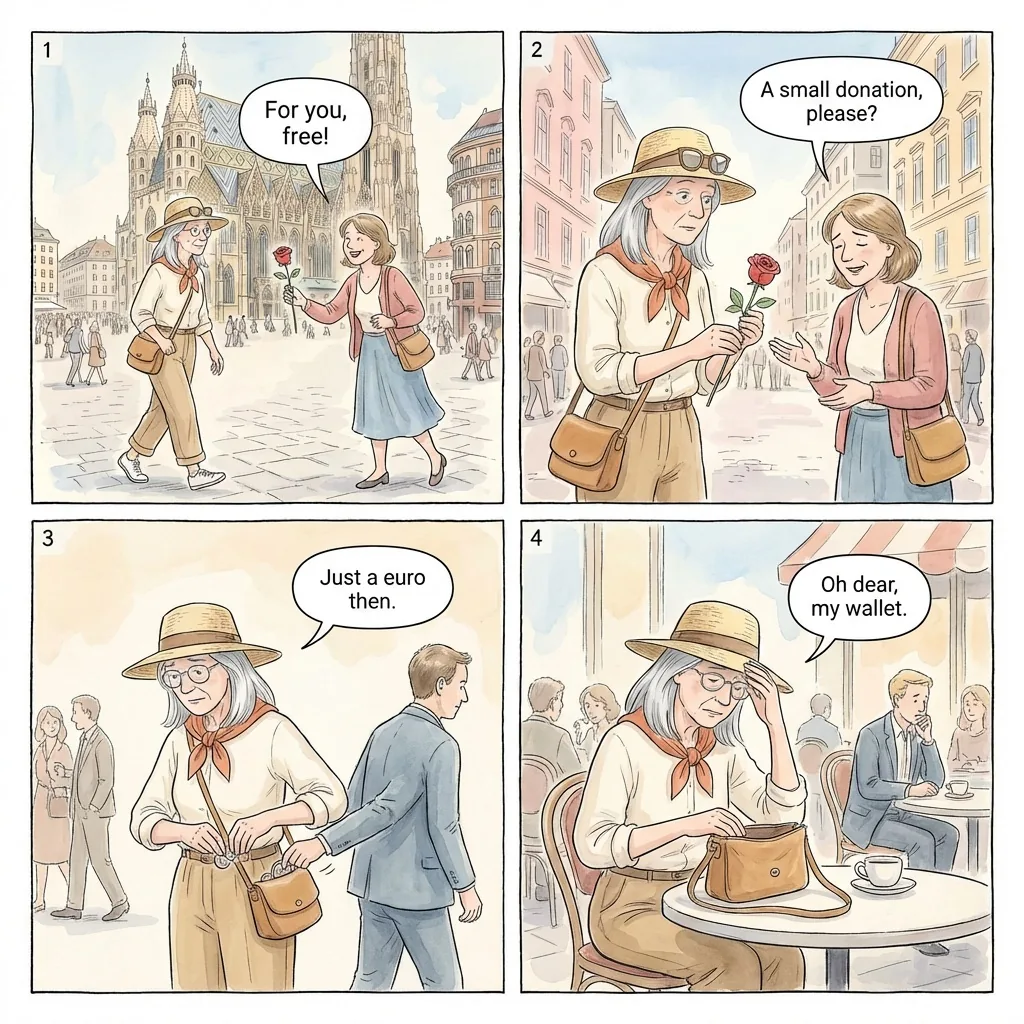
A rotating cast of distraction plays — a "free" flower pressed into your hand, a bracelet tied on your wrist, a petition on a clipboard, a traveler who needs exactly 47 euros for a Munich ticket — all use the same mechanic: occupy your hands or your conscience while a partner works your pockets.
The traveler report "Flower scam in Vienna?" from November 2024 describes the simplest version: two men on Stephansplatz handing flowers to tourists "for free," then pestering for "donations" and following the tourist until the flower was paid for or returned. It is low-stakes on its own — at worst you lose 5 or 10 euros — but the same pattern scales up. In front of the Staatsoper, a friendly stranger will ask "where are you from?" and while you are answering, a bracelet of colored string is being tied around your wrist; then comes the 20-euro demand. A traveler threads titled "Dealing with scammers in Vienna?" breaks down the Hauptbahnhof version: a stranger approaches with a story ("couple needs money to get back to Munich," or children and a bank-app payment screen), shows you a convincing fake banking confirmation, and either asks for cash you will never see again or uses the screen-tilt moment to phish your contactless card. A separate traveler report "I got approached by a scammer at Hbf" confirms it is still active on the Hauptbahnhof concourse in 2025: "It's usually 'I desperately need € so I can buy my ticket to [random destination], because [fake reason].'"
The mechanic sits at the intersection of shame and crowd cover. A flower or a bracelet is physically in your hand before you can refuse, so refusing becomes confrontation — and the scammer counts on Anglo-European tourists' politeness to avoid confrontation. The Munich-ticket story targets your empathy; the "Cross scam" (which a 2015 traveler threads flagged when it first hit Vienna) works the same way with a religious prop. In crowded zones like Stephansplatz at 5 PM or Hauptbahnhof arrivals, a second person often stands near enough to work a bag while you are negotiating with the first. The Austrian theft-statistics panel (5,286 annual pickpocket cases nationwide) lists Stephansplatz as one of the top three hotspots precisely because the distraction pattern runs on a loop from open to close. A traveler reports commenter who lived in Vienna put the mechanic plainly: "The actual scam is as simple as 'do you have money for food/tickets?', and counting on the other person's social conditioning to fork over some."
The defense is practiced refusal. If someone tries to place an object in your hand, keep both hands at your sides or in your pockets and say a flat "no" in any language — the scammer will disengage in under ten seconds because he cannot monetize conversation. If a bracelet is already tied, cut it off and drop it on the ground; you owe nothing for something you did not consent to. If someone shows you a "banking app" for a desperate ticket story, the answer is always "no cash, but I will walk with you to the nearest Polizei (133) and we can ask them." The scammer leaves. If you feel a bag has been worked during any of this, stop and check before you move — pickpockets rely on the victim walking away before the theft is noticed. For formal reports, the 1st-district police station is Polizeiinspektion Deutschmeisterplatz; the general police line is 133, and the Austrian Tourismuspolizei operates within the Bundespolizei Wien. US citizens can reach the embassy at +43 1-31339-0 for emergency document replacement after theft.
Red Flags
- Someone tries to put an object — flower, bracelet, printed map — into your hand "for free"
- A stranger on Stephansplatz or in front of the Staatsoper asks "where are you from?" as the first thing
- On the Hauptbahnhof concourse, someone shows you a phone with a banking confirmation and asks for cash
- A petition on a clipboard is pushed across your body while a second person stands close behind
- The "desperate" person has a rehearsed story and a specific Euro amount they "need"
How to Avoid
- Keep both hands in pockets or at sides when walking through Stephansplatz, Graben, or Hauptbahnhof.
- If something is put in your hand, drop it — you owe nothing for an unsolicited object.
- Decline all petitions and flyers in the tourist ring; accepting frees a hand.
- Counter the Munich-ticket story with "I will walk to the police with you" — scammers leave.
- If you carry cash, split it: a small day-wallet in a zipped front pocket, the rest in the hotel safe.
🆘 What to Do If You Get Scammed
📋 File a Police Report
Go to the nearest Bundespolizei (Austrian Federal Police) station — in the 1st district that is Polizeiinspektion Deutschmeisterplatz or Polizeiinspektion Goethegasse. Call 133 (Police) or 112 (EU Emergency, multilingual). Get the official Anzeige (crime report) reference number — your travel insurance will require it. You can also report non-urgent matters online at polizei.gv.at.
💳 Cancel Your Cards
Austria's 24-hour bank card blocking line (Sperrnotruf) is 116 116. Call your home bank immediately as well — most have 24/7 numbers on the back of the card (keep a photo saved separately). Block suspicious transactions before thieves use your details.
🛂 Lost Passport?
Contact your embassy. The US Embassy in Vienna is at Boltzmanngasse 16, 1090 Vienna (+43 1-31339-0). The British Embassy is at Jauresgasse 12, 1030 Vienna. Canadians: Laurenzerberg 2, 1010 Vienna. Bring your police Anzeige reference number to the appointment.
📱 Track Your Device
If your phone was stolen, use Find My (iPhone) or Find My Device (Android) from another device. Do not confront thieves yourself — share the location with police on 133 instead. For consumer disputes (restaurant, taxi, apartment), VKI is 0800 201 211 and Arbeiterkammer Wien is +43 1 501 65 0.
Sources & further reading
Every scam here is cross-checked against official government advisories, police bulletins, and established reporting. Confirm current details with the primary sources below before you travel.
-
U.S. Department of State — Austria International Travel Information
Government advisory
“Beware of pickpockets on public transportation and in bus or train stations.”
-
UK Foreign, Commonwealth & Development Office (GOV.UK) — Safety and security - Austria travel advice
Government advisory
“Crime levels are generally low.”
-
The Local Austria — Six tourist scams to be aware of in Austria
News report
“One scam reported in Vienna involves people dressed as police officers with fake identification approaching tourists and asking for their ID.”
Frequently Asked Questions
You just read 8 scams in Vienna. The full Travel Safety Series has 780+ more across 20+ countries.
Tokyo's Kabukichō ¥130,000 bar trap. Rome's gladiator photo extortion. Paris's gold-ring trick. Bali's ATM skimmer scams. Bangkok's grand-palace closure ruse. Every documented scam across 20+ destinations — with the exact scripts, red flags, and local-language phrases that shut each one down. Drawn from Reddit traveler reports, embassy advisories, and consumer-protection cases.
- 780+ documented scams across Tokyo, Rome, Paris, Bali, Bangkok, Rio & 100+ more cities
- 20+ countries covered, with country-by-country phrase cards for every destination
- Updated annually — buy once, re-download future editions free
- All titles $4.99 each on Amazon Kindle