
Key Takeaways
- The #1 reported scam is the Zvartnots Airport Unlicensed-Taxi Shakedown.
- 2 of 5 scams are rated high risk.
- Use app-based ride services (Uber, Bolt) or official metered taxis instead of unmarked vehicles.
- Never accept unsolicited offers from strangers near tourist sites in Yerevan.
⚡ Quick Safety Tips
- Keep phones and valuables in secure pockets when in crowded areas.
- Use only licensed taxis or app-based ride services.
- Book tours and tickets through verified operators with online reviews.
- Keep a copy of your passport separate from the original.
Jump to a Scam
The 5 Scams
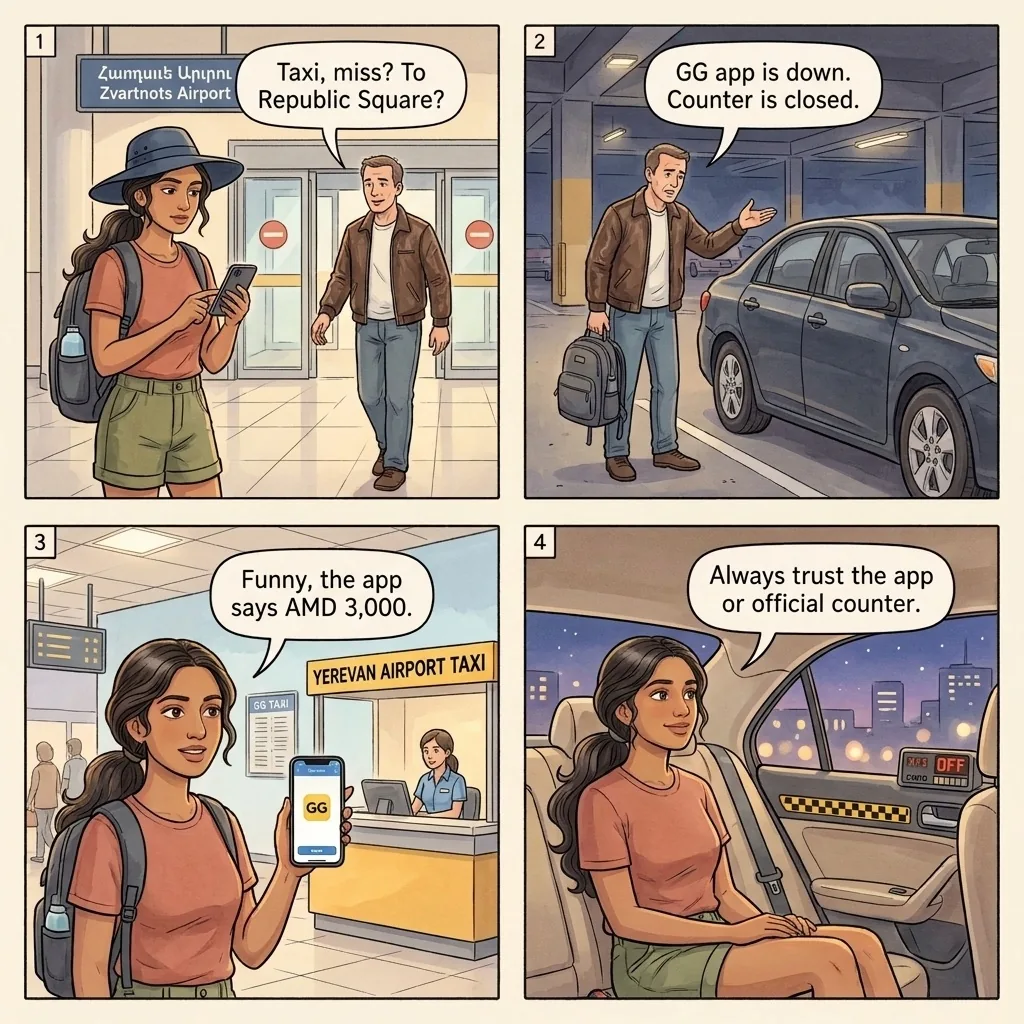
It's an evening flight into Yerevan, you've cleared customs at Zvartnots Airport with a small backpack and a hotel address near Republic Square, and a driver in a leather jacket waves you over from the parking lot just outside the arrivals hall.
He says he can do Republic Square for AMD 12,000 — about USD $30, 'fixed price.' He tells you the airport Wi-Fi is down, that the GG Taxi app 'doesn't work this late,' and that the official taxi counter inside the terminal is closed. None of those statements are true. He picks up your backpack and walks you toward an unmarked sedan with no taxi roof-light or company markings. Twenty-five minutes later you're at your hotel and you've paid roughly four times the legitimate fare.
The legitimate Zvartnots-to-central-Yerevan taxi fare on the GG Taxi app (Armenia's dominant rideshare) is AMD 2,500–4,000 — about USD $6–10. The same trip via Yandex Go runs similar. The official Zvartnots taxi counter inside the terminal posts a fixed-rate of AMD 3,000–5,000 to the city centre depending on time of day. The AMD 12,000 you've been charged is 3–4× the legitimate rate. As travelers report across Reddit, the TripAdvisor Yerevan forum, the Lonely Planet Caucasus thorntree, and the U.K. Foreign Office Armenia travel advice, the unlicensed-taxi shakedown at Zvartnots is the most-reported Yerevan tourist friction.
The mechanism is structural and consistent. The unlicensed operators cluster the arrivals-hall parking and the corridor between baggage claim and the official taxi counter. They intercept tourists before they reach either the counter or a Wi-Fi-connected app booking. The 'app doesn't work' framing is the load-bearing piece; once the customer believes the app is unavailable, the inflated 'fixed price' becomes the only option. The U.K. Foreign Office advisory specifically names this pattern.
The defence is structural. The Zvartnots terminal has free Wi-Fi at the arrivals area; the GG Taxi and Yandex Go apps both work at the airport at all hours; the official airport taxi counter inside the terminal is open 24/7 with posted fixed rates. None of these requires accepting an off-counter tout. Walking past the parking-lot drivers and going directly to the counter or booking through an app removes the entire interaction.
Book a Zvartnots-to-Yerevan taxi via the GG Taxi app or Yandex Go (both work at the airport, fare displayed in advance, drivers rated) — these are Armenia's dominant rideshares and run at AMD 2,500–4,000 to the city centre. If apps aren't working, use the official Zvartnots taxi counter inside the terminal (open 24/7, posted fixed rates of AMD 3,000–5,000 to central Yerevan). Decline kerbside drivers who quote AMD 8,000+ and claim the 'app doesn't work' — that is the entire mechanism. Pay by card where possible for chargeback options. Carry small AMD bills (AMD 500, 1,000) so you can pay only the agreed amount on metered taxis. Emergency: 102 (Police) or 911 (general); the U.S. Embassy in Yerevan is at +374 10 464 700.
Red Flags
- Driver approaches you aggressively inside the terminal
- Claims rideshare apps don't operate at the airport
- Refuses to use a meter or show a fixed-rate card
- Vehicle has no visible taxi company markings or license
How to Avoid
- Download the GG Taxi or Yandex Taxi app before landing.
- Walk past the arrivals hall to get away from unlicensed touts.
- A fair airport-to-center fare is 2,500-4,000 AMD via app.
- If you must take a street taxi, agree on the price before getting in.
- Carry small AMD bills so you don't need change from a driver.
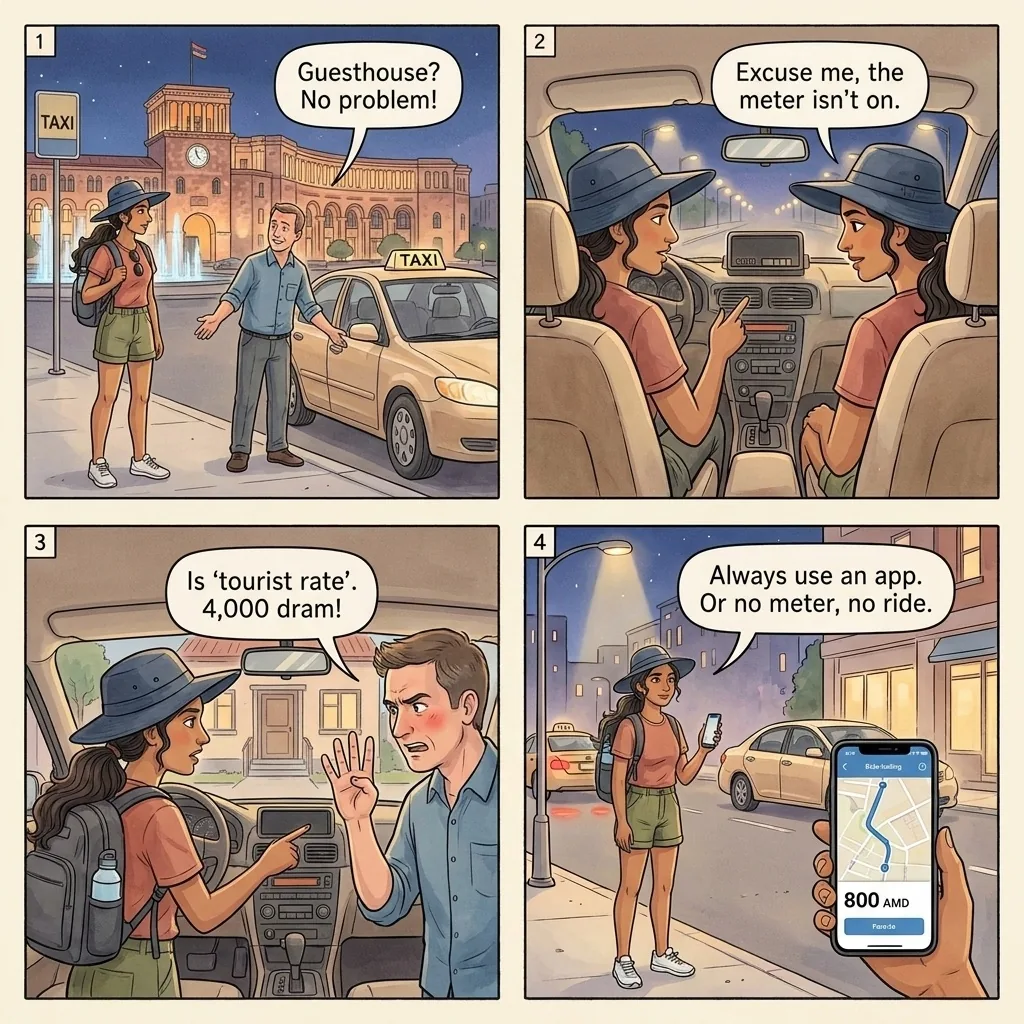
It's a Saturday evening, you've just had dinner at a Republic Square restaurant, and you flag a taxi from the rank near the Marriott to take you back to your guesthouse on Pushkin Street — a fifteen-minute ride.
The driver smiles, agrees to the destination, and pulls into traffic. The meter is not running. He doesn't quote a price. You assume he'll start the meter at the next light. Twelve minutes later you're at your guesthouse and he asks for AMD 4,000 — about USD $10. The legitimate metered fare for the same trip is AMD 600–900, about USD $1.50–2. If you argue, he claims AMD 4,000 is 'the tourist rate' and stays parked at your kerb until you pay.
The Republic Square meter-dodge works on a structural information gap. Yerevan taxis are extraordinarily cheap by international standards — most central-Yerevan trips cost AMD 400–1,000 on the meter (USD $1–2.50). Tourists don't know this baseline; they assume that an AMD 4,000 fare 'sounds reasonable' compared to taxi prices in their home cities. Drivers exploit the ignorance specifically at the late-night kerbs around Republic Square, the Cascade, and the Opera House. As travelers report across Reddit, the TripAdvisor Yerevan forum, and the Lonely Planet Caucasus thorntree, the meter-dodge is the second-most-reported Yerevan friction after the airport shakedown.
The mechanism is identical across operators. Driver agrees to destination without naming a price. Driver does not turn on the meter when the cab leaves the kerb. Driver names a flat fare on arrival that is 4–8× the metered rate. The variant with route-detour adds another fifteen percent to the ride time and the inflated fare. The variant with 'no-change' refuses to break large bills, forcing the customer to pay the rounded-up sum.
The defence is structural. Use GG Taxi or Yandex Go (Armenia's two dominant rideshare apps) for all in-city rides — fares are app-displayed and fixed, drivers are rated, no negotiation. If you must take a street taxi, insist verbally that the meter (հաշվիչ — hashvich) be turned on before the car moves; if the driver refuses, get out before the wheels turn. Anchor against the metered baseline (AMD 400–1,000 for most central trips) so the inflated 'tourist rate' feels obviously wrong. Carry small AMD notes so you can pay only the meter total without depending on the driver's change.
Book all in-city Yerevan taxis via the GG Taxi or Yandex Go app — fares are fixed in-app, drivers are rated, and there is no meter-dodge mechanic. If you must take a street taxi, insist on the meter (hashvich) before the car moves; refuse 'flat-rate' framings. The legitimate metered fare for most central-Yerevan rides is AMD 400–1,000 (USD $1–2.50); anything quoted above AMD 1,500 for a 10-minute trip is the dodge. Carry small AMD notes; refuse to overpay because the driver claims 'no change.' Photograph the licence plate of any cab you take and keep the photo until after the ride. Emergency: 102 (Police); the U.S. Embassy in Yerevan is at +374 10 464 700.
Red Flags
- Driver doesn't turn on the meter when you get in
- No price discussion before the trip begins
- Takes a suspiciously long route through side streets
- Quotes a flat fare that's 3-5 times the metered rate
How to Avoid
- Always insist the meter is running before the car moves.
- Use GG Taxi or Yandex Go for fixed, transparent pricing.
- Know that most in-city rides cost 400-1,000 AMD on the meter.
- Screenshot your route on Google Maps to catch detours.
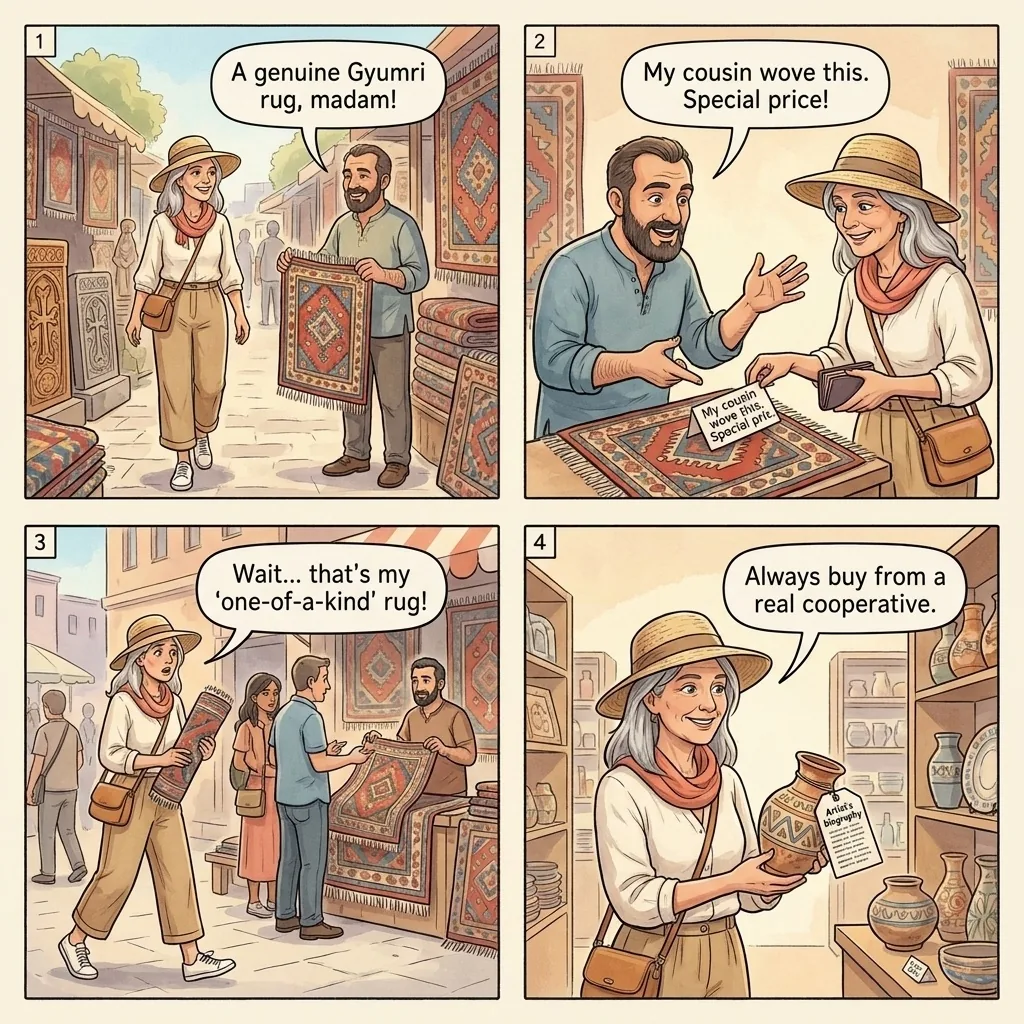
It's a sunny Saturday at the Vernissage open-air flea market, you've been browsing carpets and khachkar (Armenian cross-stone) carvings for an hour, and a vendor is now showing you a small rug he swears was hand-woven by artisans in Gyumri — $200, 'authentic Armenian.'
The rug looks plausible. The vendor's story is detailed: his cousin's workshop in Gyumri, three months of weaving, traditional Armenian motifs from the Lori region. He produces a handwritten tag in Armenian that nominally validates the provenance. You hesitate at the $200 ask, he counter-offers $140, and you walk away with what you believe is a meaningful piece of Armenian craft heritage.
A meaningful fraction of the 'handmade Armenian crafts' at Vernissage are not handmade in Armenia. The same rug, the same khachkar carving, the same hand-painted ceramic plate appears at three or four different vendors at the market — a strong signal that the supply chain is centralised, factory-produced imports from China, Turkey, or Iran, marked up 4–5× for tourist buyers. As travelers report across Reddit, the TripAdvisor Yerevan forum, and the Lonely Planet Caucasus thorntree, identifying which Vernissage vendors are selling genuine Armenian-made goods versus repackaged imports requires either local knowledge, careful inspection of artisan markings, or buying from registered cooperatives that publish the maker chain.
The Armenian craft sector is real and significant — Gyumri does have working carpet weavers, the Tatev Monastery region produces genuine khachkar miniatures, the village of Sardarapat hosts the Folk Arts Hypermarket which sells direct from artisans. The fraction of Vernissage stalls selling these genuine products versus mass-imported substitutes is rough — perhaps 30–40% genuine, 60–70% repackaged imports. The price you pay for the same kind of rug at a registered cooperative versus at a Vernissage import-stall differs by a factor of 2–3, with the cooperative typically being cheaper because it skips the middleman markup.
The structural giveaways are visible at the stall. Identical items appearing at multiple Vernissage stalls (same rug, same ceramic) — a single weaver does not produce identical pieces in volume. No artisan markings, no cooperative paperwork, no provenance tag in Armenian and English. Aggressive bargaining-down on a 'handmade' piece (a real artisan won't drop $200 to $140 in five minutes for a three-month weaving). Vendor discourages comparing prices at neighbouring stalls.
For genuine Armenian crafts, buy from registered artisan cooperatives — the Folk Arts Hypermarket at Sardarapat, the Megerian Carpet showroom on Tigran Mets Avenue, the GUM Market crafts section, or the Erebuni Museum gift shop. These document the artisan's name and pay the maker directly. At Vernissage, treat all 'handmade' claims with skepticism: cross-check whether the same item appears at multiple stalls (a sign of import sourcing), inspect for artisan markings or cooperative paperwork, refuse aggressive 'handmade' framings on items priced for fast bargaining-down. If you do buy at Vernissage, anchor your offer at 30–40% of the quoted price and cap your spend at the import-equivalent rate. Emergency: 102 (Police).
Red Flags
- Vendor claims everything is handmade with no proof
- Price is dramatically higher than what locals would pay
- Identical items appear at multiple stalls — a sign of factory sourcing
- Vendor discourages you from comparing prices elsewhere
- No artisan markings, certificates, or provenance details
How to Avoid
- Bring an Armenian friend or ask your hotel for vendor recommendations.
- Haggle aggressively — starting at 30-40% of the quoted price is expected.
- Buy directly from verified artisan cooperatives instead.
- Compare prices at multiple stalls before committing.
- For authentic goods, visit the GUM Market or Erebuni Museum shop.
Like what you're reading? Get a full Yerevan itinerary with safety tips built in.
Browse travel-safety books →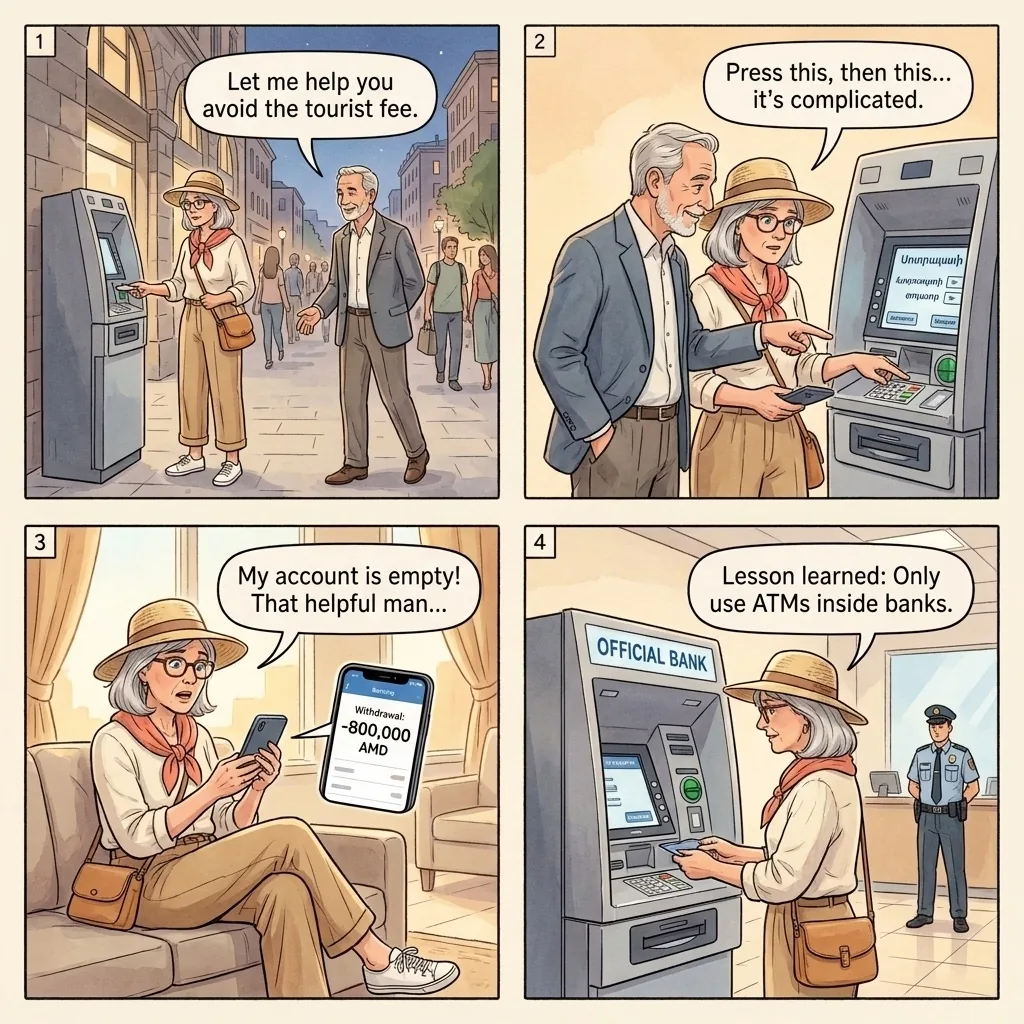
It's an evening on Northern Avenue, you're at a standalone ATM withdrawing AMD 50,000 for the next two days, and a friendly older man steps up next to you and offers to 'help you avoid the foreign-card service fee' the machine is about to charge.
He says the machine has a hidden 'tourist surcharge' that you can dodge by selecting a specific menu sequence — Armenian language, then a particular fee-decline screen, then back to English. While he's walking you through the menu, he's standing close enough to read your PIN and is operating a small handheld skimmer in his coat pocket that clones the card data as the machine reads your chip. Three days later, after you've left Armenia, AMD 800,000 in unauthorised withdrawals appears on your bank statement.
The Northern Avenue ATM-skimmer 'helper' is one of the highest-dollar tourist scams in Yerevan. The mechanism combines two attacks: the shoulder-surf to capture your PIN, and the handheld skimmer to clone the card data via the chip-and-PIN read. The combination yields a working clone of your card with the PIN attached, which the operators then use at compromised ATMs in Armenia or elsewhere in the region within 24–72 hours. As travelers report across Reddit, the TripAdvisor Yerevan forum, the Lonely Planet Caucasus thorntree, and Armenia Banking Association consumer alerts, this is the highest-stakes Yerevan friction.
The targeting is deliberate. The standalone ATMs along Northern Avenue and around tourist sites lack the bank-branch CCTV that would deter the attack. The 'helper' framing — offering to navigate a complex multi-language ATM menu — is a calibrated reason to stand close enough for the shoulder-surf and the clone. The 'service fee dodge' premise is fictional but plausible to a tourist who hasn't seen Armenian-language ATM menus before.
The structural defences are concrete. Use ATMs only inside bank branches during business hours, where CCTV deters the attack and bank staff can intervene. The major Armenian banks — Ameriabank, Ardshinbank, Ineco-bank, ACBA — all have central-Yerevan branches with indoor ATMs. Cover the keypad fully with your free hand when entering your PIN. Decline all unsolicited 'help' at ATMs without exception — there is no legitimate ATM-helper category in Armenia. Inspect the card slot for looseness or unusual bulk before inserting (an ATM-mounted skimmer is a different attack vector with the same defence). Enable real-time transaction notifications on your banking app so you see fraudulent withdrawals immediately. Decline Dynamic Currency Conversion (DCC) at any ATM — it adds an embedded 5–10% spread.
Use ATMs ONLY inside bank branches during business hours — Ameriabank, Ardshinbank, Inecobank, ACBA all have central-Yerevan locations with indoor ATMs. Avoid all standalone street ATMs along Northern Avenue, around Republic Square, and near tourist sites. Cover the keypad fully when entering your PIN. Decline ALL unsolicited 'help' at ATMs no matter how plausible — there is no legitimate ATM-helper category in Armenia. Inspect the card slot for looseness before inserting. Enable real-time transaction notifications on your banking app. Decline Dynamic Currency Conversion. If unauthorised withdrawals appear, dispute with your bank within 60 days for chargeback under most card-issuer policies. Emergency: 102 (Police); the U.S. Embassy in Yerevan is at +374 10 464 700.
Red Flags
- A stranger offers unsolicited help at an ATM
- The ATM is standalone and not attached to a bank branch
- The card slot feels loose, bulky, or different from normal
- Someone stands unusually close while you type your PIN
How to Avoid
- Only use ATMs inside bank branches like Ameriabank or Ardshinbank.
- Cover the keypad with your hand when entering your PIN.
- Decline all help from strangers at ATMs — no exceptions.
- Never accept Dynamic Currency Conversion (DCC) at ATMs — it adds hidden fees.
- Enable transaction notifications on your banking app.
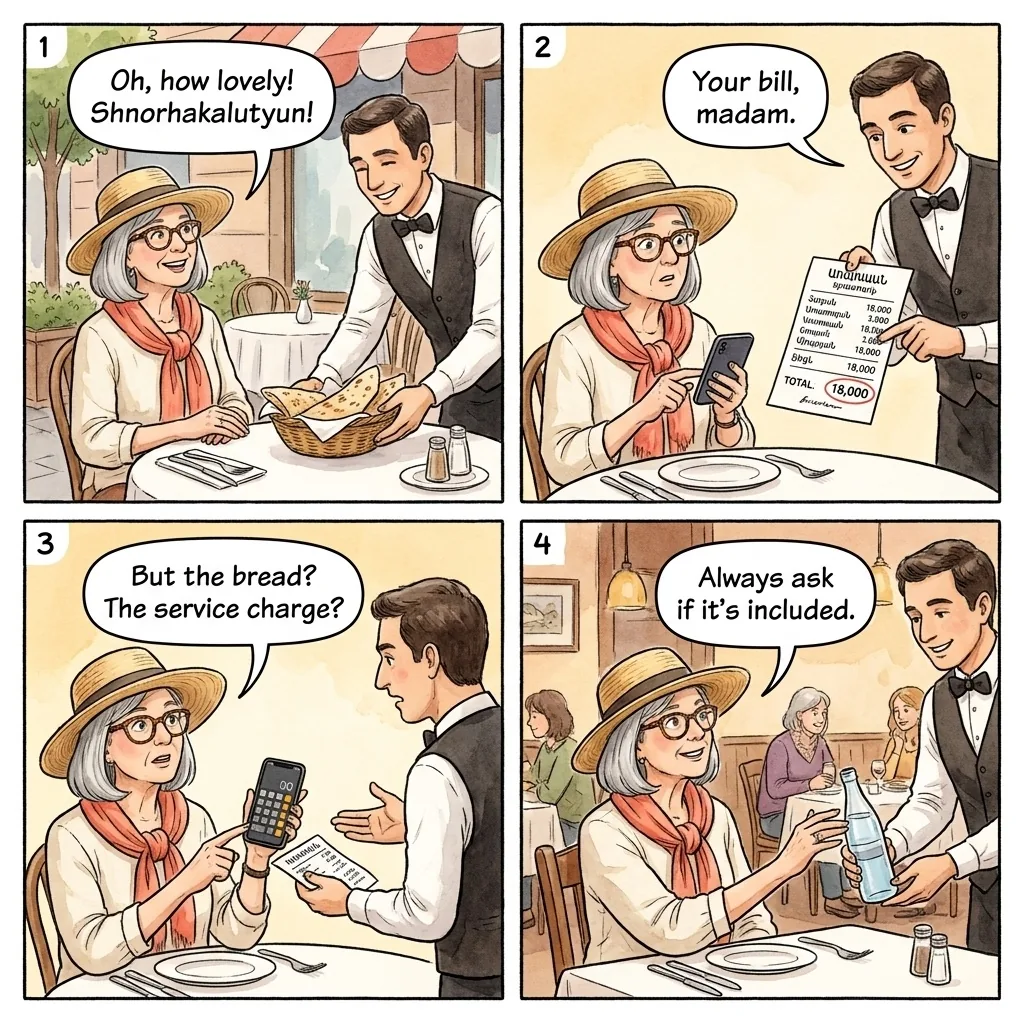
It's a Saturday evening at a sidewalk restaurant on Northern Avenue, you've enjoyed a long meal — kebab, lavash, two glasses of Armenian Areni wine, what felt like a complimentary plate of bread and pickles — and the bill arrives in Armenian script that you can't read.
The total is AMD 18,000 — about USD $45 — when you mentally tracked the meal at AMD 12,000. Hidden in the bill are a 10% 'service charge' that wasn't mentioned on the menu, AMD 1,500 for the bread basket that was placed on the table without being ordered, two AMD 3,000 'complimentary' glasses of Armenian brandy that turned out not to be complimentary, and a small 'cover charge' on top.
The Northern Avenue restaurant bill-pad is a low-grade but consistently-encountered Yerevan friction. The mechanism uses three structural failures: a menu in Armenian-and-English with prices listed only in Armenian, unrequested 'complimentary' items placed on the table that turn out to be billed, and a final bill written in Armenian script that the customer can't easily verify. The pad lands the bill 30–50% above the menu-listed total. As travelers report across Reddit, the TripAdvisor Yerevan forum, the Lonely Planet Caucasus thorntree, and the Armenia Tourism Committee's published consumer guidance, this pattern clusters at the high-foot-traffic Northern Avenue and Republic Square restaurants and is rare at neighbourhood places off the tourist strip.
The legitimate pricing for a sit-down dinner in Yerevan is meaningfully cheaper than the tourist-strip rates. A two-course meal with wine at a neighbourhood restaurant in Kentron, Arabkir, or Achapnyak runs AMD 8,000–14,000 (USD $20–35). The same meal at a Northern Avenue tourist restaurant runs AMD 15,000–25,000 (USD $38–63), with a meaningful fraction of the gap attributable to the bill-pad mechanic rather than higher legitimate cost.
The structural defences are concrete. Ask for the menu with prices in Armenian dram before ordering — many tourist-strip menus list prices in USD or EUR which obscures the actual AMD total. Photograph the menu so you have a reference. Refuse unrequested bread, water, brandy, or other 'complimentary' items placed on the table — send them back before consuming, otherwise they appear on the bill. Ask explicitly whether a service charge is added before paying. Use Google Translate's camera feature on Armenian-script bills to verify line items. Eat where locals eat: small neighbourhood places off the tourist strip rarely run the pad.
At any Yerevan restaurant on Northern Avenue, around Republic Square, or near the Cascade, ask for the menu with prices in Armenian dram before ordering and photograph it. Refuse unrequested 'complimentary' items (bread, brandy, pickles) placed on the table — send them back before eating any of it. Ask explicitly whether a service charge is added on top of menu prices. Use Google Translate's camera feature to verify Armenian-script bill line items. Eat at neighbourhood restaurants in Kentron, Arabkir, or Achapnyak rather than the tourist strip — the price difference is meaningful and the bill-pad mechanic is rare. Pay by card for chargeback options on disputed bills. Emergency: 102 (Police); Armenia Tourism Committee complaint line: +374 11 542 303.
Red Flags
- Menu prices are vague or missing entirely
- 'Complimentary' items that show up on the final bill
- Bill is handwritten or only in Armenian with no English translation
- Service charge added without being mentioned on the menu
- Bread and water appear on the bill despite being presented as free
How to Avoid
- Ask for a menu with prices and photograph it before ordering.
- Clarify if bread, water, and service charges are included.
- Request an itemized bill and check it line by line before paying.
- Eat where locals eat — one block off the main squares.
- Use Google Translate's camera feature on Armenian-only bills.
🆘 What to Do If You Get Scammed
📋 File a Police Report
Go to the nearest Armenian Police station. Call 102 (Police) or 103 (Ambulance). Get an official crime report — you'll need this for insurance claims. You can also report online at police.am.
💳 Cancel Your Cards
Call your bank immediately. Most have 24/7 numbers on the back of the card (keep a photo saved separately). Block any suspicious transactions before the thieves use your details.
🛂 Lost Passport?
Contact the US Embassy in Yerevan at 1 American Avenue, Yerevan 0082. For emergencies: +374 10-464-700.
📱 Track Your Device
If your phone was stolen, use Find My (iPhone) or Find My Device (Android) from another device. Don't confront thieves yourself — share the location with police instead.
Frequently Asked Questions
You just read 5 scams in Yerevan. The full Travel Safety Series has 780+ more across 20+ countries.
Tokyo's Kabukichō ¥130,000 bar trap. Rome's gladiator photo extortion. Paris's gold-ring trick. Bali's ATM skimmer scams. Bangkok's grand-palace closure ruse. Every documented scam across 20+ destinations — with the exact scripts, red flags, and local-language phrases that shut each one down. Drawn from Reddit traveler reports, embassy advisories, and consumer-protection cases.
- 780+ documented scams across Tokyo, Rome, Paris, Bali, Bangkok, Rio & 100+ more cities
- 20+ countries covered, with country-by-country phrase cards for every destination
- Updated annually — buy once, re-download future editions free
- All titles $4.99 each on Amazon Kindle