
Key Takeaways
- The #1 reported scam is the Stone Town Ferry-Porter Bag Walk-Off.
- 1 of 6 scams are rated high risk.
- Use app-based ride services (Uber, Bolt) instead of unmarked taxis — always confirm the fare before departure.
- Never accept unsolicited offers from strangers near tourist sites in Zanzibar.
⚡ Quick Safety Tips
- Keep phones and valuables in secure pockets when in crowded areas.
- Use only licensed taxis or app-based ride services.
- Book tours and tickets through verified operators with online reviews.
- Keep a copy of your passport separate from the original.
Jump to a Scam
The 6 Scams
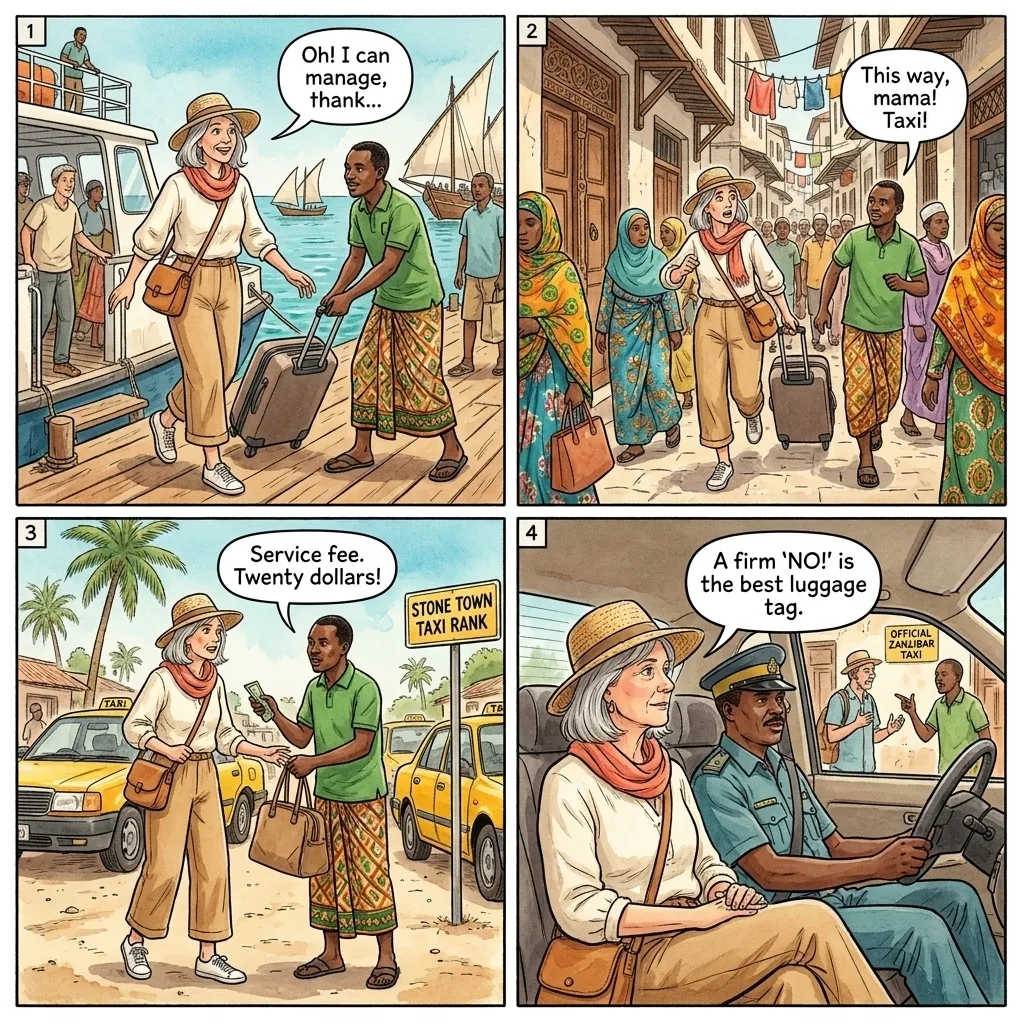
The Dar es Salaam ferry docks at Stone Town and men grab your luggage without asking, walk it 20m to the taxi rank, then demand $10–$20 for a 'service' you never requested — refuse and the bag becomes leverage. The terminal chaos is the entire mechanic.
The ferry from Dar es Salaam docks at Stone Town and before you've even found your sea legs, men are reaching for your luggage. They don't ask — they simply take hold of your bag and start walking. You scramble to keep up. They carry your bag twenty metres to the taxi rank and then demand $10 or $20 for a 'service' you never requested. If you don't pay, some travelers report the bag being held as leverage.
One traveler described the exact scenario: 'Surprise surprise when we got to the ferry terminal there was local men offering to carry big bags and speed you through as a service — you had to pay them after.' The chaos of the ferry terminal is deliberate — the combination of a crowd, heat, disorientation, and the sudden loss of control of your luggage creates a compliance loop where saying 'no' feels harder than just paying.
The grab-and-walk technique is calibrated: it happens so fast that by the time you've registered what's happening, the porter is already 5–10m ahead with your bag, and chasing him to take it back creates a public scene. Most tourists choose to just pay rather than confront, which is exactly what the system depends on.
Once you're through the terminal and at the legitimate taxi rank, the situation normalises. The terminal chaos is the entire window for the scam — outside the gates, normal boda-boda drivers and ZATI-registered taxis operate at fair fixed prices. Book your taxi in advance through your accommodation, or use the fixed-price ZATI desk inside the terminal building.
The defensive move is to keep both hands on your bags the moment the ferry docks and say 'no, thank you' loudly to anyone who touches your luggage — make brief, direct eye contact (hesitation reads as invitation to continue). Book a hotel pickup in advance with a name-sign meeting at the gate. If a porter situation occurs, agree a price before any movement happens. Police: 112 (general emergency) / 113 (police). Tourist Police Tanzania: +255 22 211-1601.
Red Flags
- Men reach for your bag without asking the moment you disembark
- They move quickly and confidently as if the service has been agreed
- They speak rapidly and direct you away from the main crowds
- No price is discussed before the service begins
- The bag is held at distance while payment is demanded
How to Avoid
- Keep both hands on your bags the moment the ferry docks and throughout disembarkation.
- Say 'no, thank you' loudly and immediately to anyone who touches your luggage.
- Book a hotel pickup in advance — your hotel driver will meet you with a name sign.
- Arrange taxi through the official ZATI desk inside the terminal building.
- If a porter situation occurs, agree a price before any movement happens.
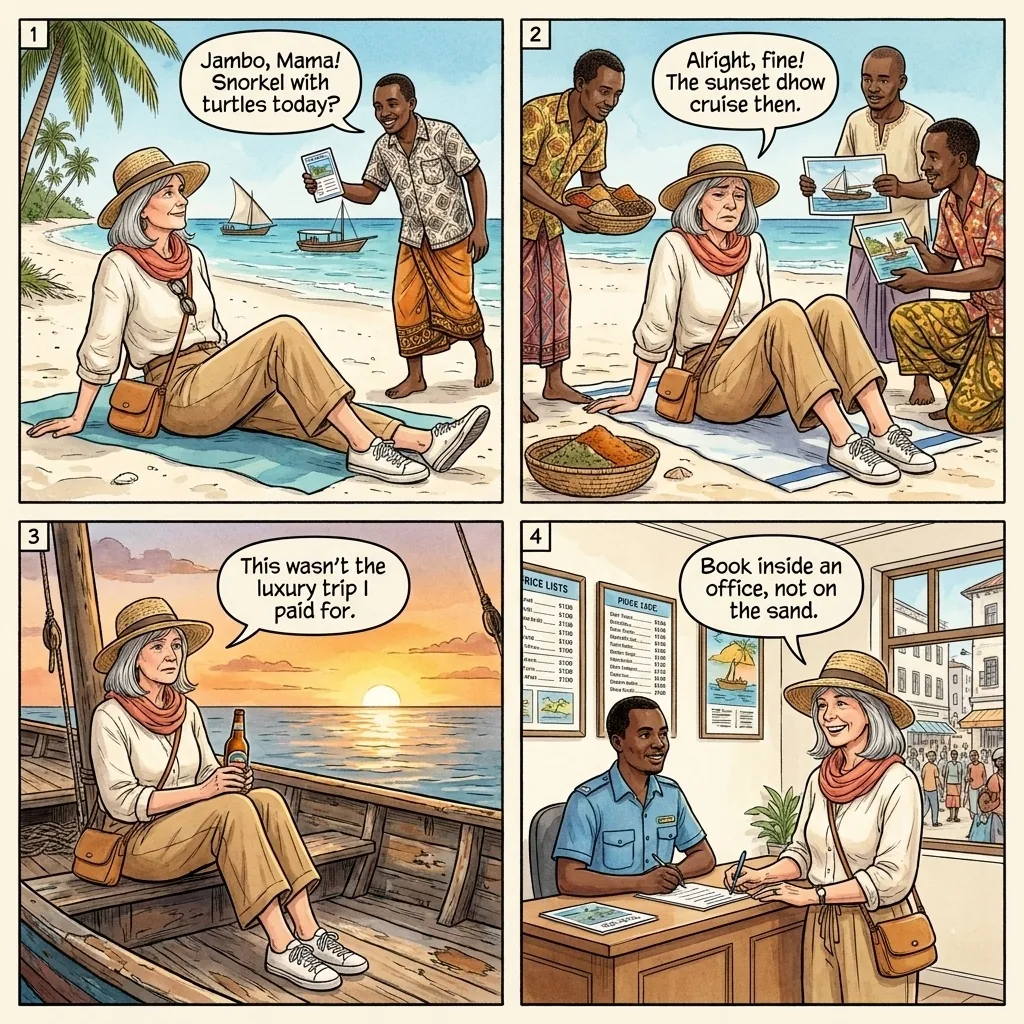
Settle on Nungwi sand and the first papasi (Swahili for beach hustler) arrives within minutes — spice tours, snorkel trips, dhow cruises, hair braiding, quad bikes, all at 2–3× legit rates. Say no to one and another takes his place in five minutes; the 'sea turtle' snorkel turns out to be a mediocre reef, the 'sunset dhow' is warm Kilimanjaro on an old vessel.
You've found your perfect stretch of white sand on Nungwi beach, towel laid out, the Indian Ocean glittering. Within minutes, the first papasi arrives. Papasi — the Swahili slang for beach hustlers — are a constant presence on Zanzibar's tourist beaches. Spice tours, snorkelling trips, dhow cruises, quad bikes, hair braiding — they cycle through the full tourism menu with relentless positivity. Say no to one and another takes his place five minutes later.
This is less a scam and more an exhausting gauntlet, but it does shade into fraud. Tours sold on the beach are routinely overpriced (two to three times legitimate operator rates), poorly executed, or simply don't match what was described. The 'snorkelling spot' that was meant to have sea turtles turns out to be a mediocre reef. The dhow 'sunset cruise' involves an old vessel and warm Kilimanjaro beer.
The bait-and-switch on quality is hard to dispute after the fact: by the time you've discovered the snorkel spot has no turtles, you're 30 minutes offshore on a boat you didn't choose, paid for, and there's no path back to a refund. The papasi who sold you the trip is back on the beach selling the same trip to someone else.
Zanzibar has a registered system for tour operators — ask for a ZATI or TTB (Tanzania Tourism Board) registration. Better still, book activities through your hotel or guesthouse, which has accountability to its guests. The beach hustle culture is genuinely embedded in Zanzibar's economy and most papasi are not dangerous — just persistent.
The defensive move is to book all beach activities through your hotel or guesthouse (vetted operators) and ask for a ZATI or TTB registration number before paying any beach operator. Learn 'sitaki, asante' — 'I don't want, thank you' — papasi respect Swahili refusals more than English. Agree full details in writing before any payment: duration, location, equipment included. If you do want a tour, the first price is never the real one. Tourist Police Tanzania: +255 22 211-1601.
Red Flags
- The tour is offered by someone wandering the beach rather than from a visible business
- The price drops dramatically the moment you express hesitation
- There is no written itinerary or confirmation of what's included
- They ask for full payment upfront in cash before any paperwork
- The described activity location or quality seems vague or inconsistent
How to Avoid
- Book all beach activities through your hotel or guesthouse — they use vetted operators.
- Ask for ZATI or TTB registration number before paying anything to a beach operator.
- Learn 'sitaki, asante' — 'I don't want, thank you' — papasi respect Swahili refusals more.
- Agree full details in writing before any payment: duration, location, equipment included.
- If you want the tour, always negotiate — the first price is never the real one.
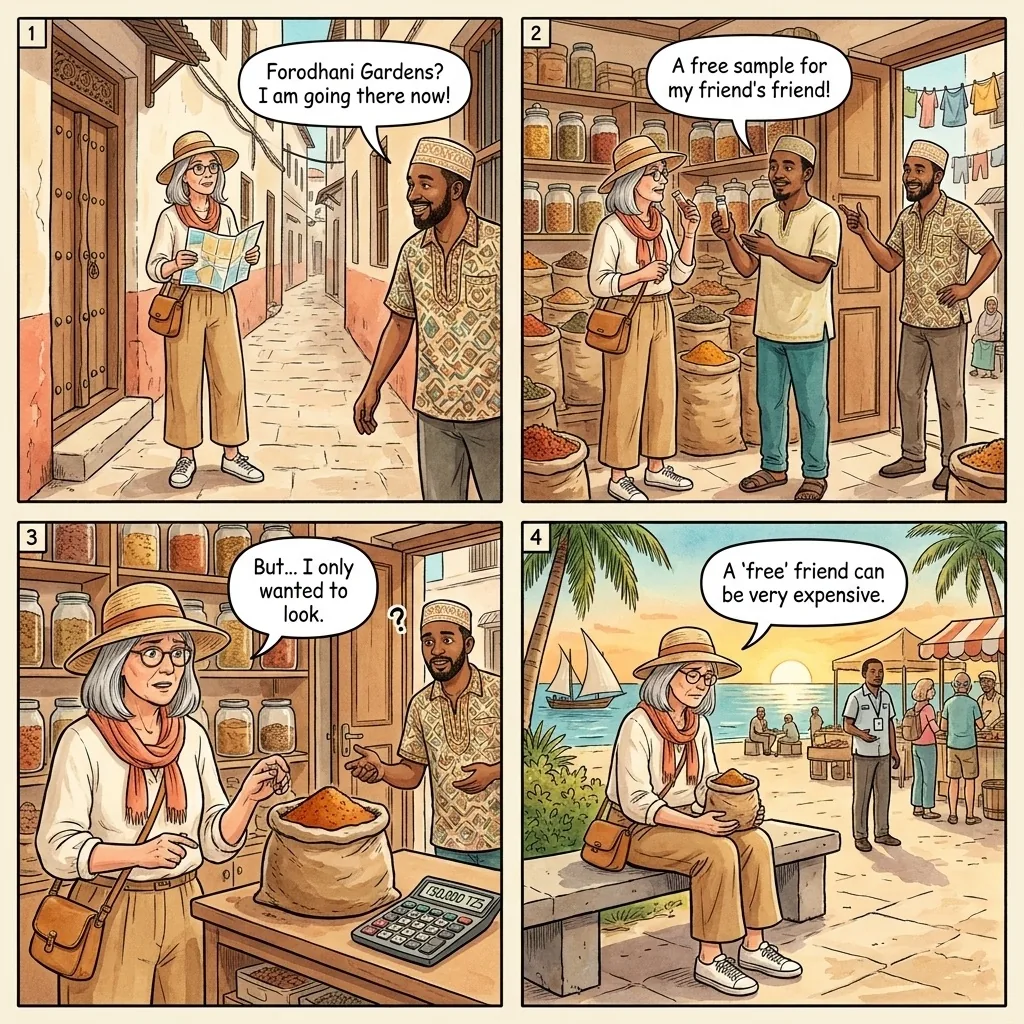
A 'friendly local' near Forodhani Gardens walks you 20 minutes through Stone Town's medina-like alleys, points out landmarks, and 'happens to know' a spice merchant — the merchant offers free samples while your guide waits outside for his 20–40% commission on the $60 of spices you somehow agreed to buy.
Stone Town's medina-like network of alleys is genuinely easy to get lost in, which makes you receptive when a friendly local offers to walk you toward Forodhani Gardens. He's not a guide, he insists — just a local who likes meeting travelers. You walk together for twenty minutes, he points out the old Arab fort, a spice merchant he knows. The merchant offers you free samples, shows you dozens of spices and essential oils. It's fascinating.
By the time you realize the social debt has compounded silently, you've bought $60 of spices you didn't plan to buy, the guide is waiting outside for his commission, and you're not entirely sure how you got here. The 'free samples' are calibrated to make refusal feel rude — by the time you've tasted three or four oils, walking out empty-handed feels confrontational in a way that walking into a department store and leaving doesn't.
This is a well-documented variant of the 'friendly local' commission tour operating in medina cities from Fez to Stone Town. The guide earns 20–40% of your purchase from every shop he brings you to. The 'friendship' is real in a transactional sense — he's genuinely pleasant — but the endpoint was always the spice merchant. Multiple Tanzania trip reports mention being pleasantly but firmly walked into spice and souvenir shops this way.
The counter test is simple: if someone offers to show you around Stone Town unprompted, acknowledge that you'd be happy to pay for an official guided walk. Legitimate guides accept this and give you a clear price. Commission-based unofficial guides deflect or insist they just 'want to be friendly.' That deflection tells you everything about who's actually paying for the walk.
The defensive move is to offer to pay for official guiding upfront — legitimate guides accept and quote a clear price; commission touts resist. Book Stone Town walking tours through your hotel or the local tourism office. If you enter a shop with a guide, you are under no obligation to purchase. Say 'I'm just looking' and exit any shop you feel pressured in. Download offline Google Maps before arrival to navigate without 'help.' Tourist Police: +255 22 211-1601.
Red Flags
- A stranger proactively offers to walk you around Stone Town 'just as friends'
- They steer the walk toward specific shops rather than prominent tourist landmarks
- The shopkeeper greets your guide by name and immediately starts a sales pitch
- You feel social obligation building to buy something before any prices appear
- Your guide waits patiently outside while you browse — a classic commission sign
How to Avoid
- Offer to pay for official guiding upfront — legitimate guides accept, commission touts resist.
- Book Stone Town walking tours through your hotel or the local tourism office.
- If you enter a shop with a guide, you are under no obligation to purchase anything.
- Simply say 'I'm just looking' and exit any shop you feel pressured in.
- Download offline maps of Stone Town before arrival — you can navigate without assistance.
Like what you're reading? Get a full Zanzibar itinerary with safety tips built in.
Browse travel-safety books →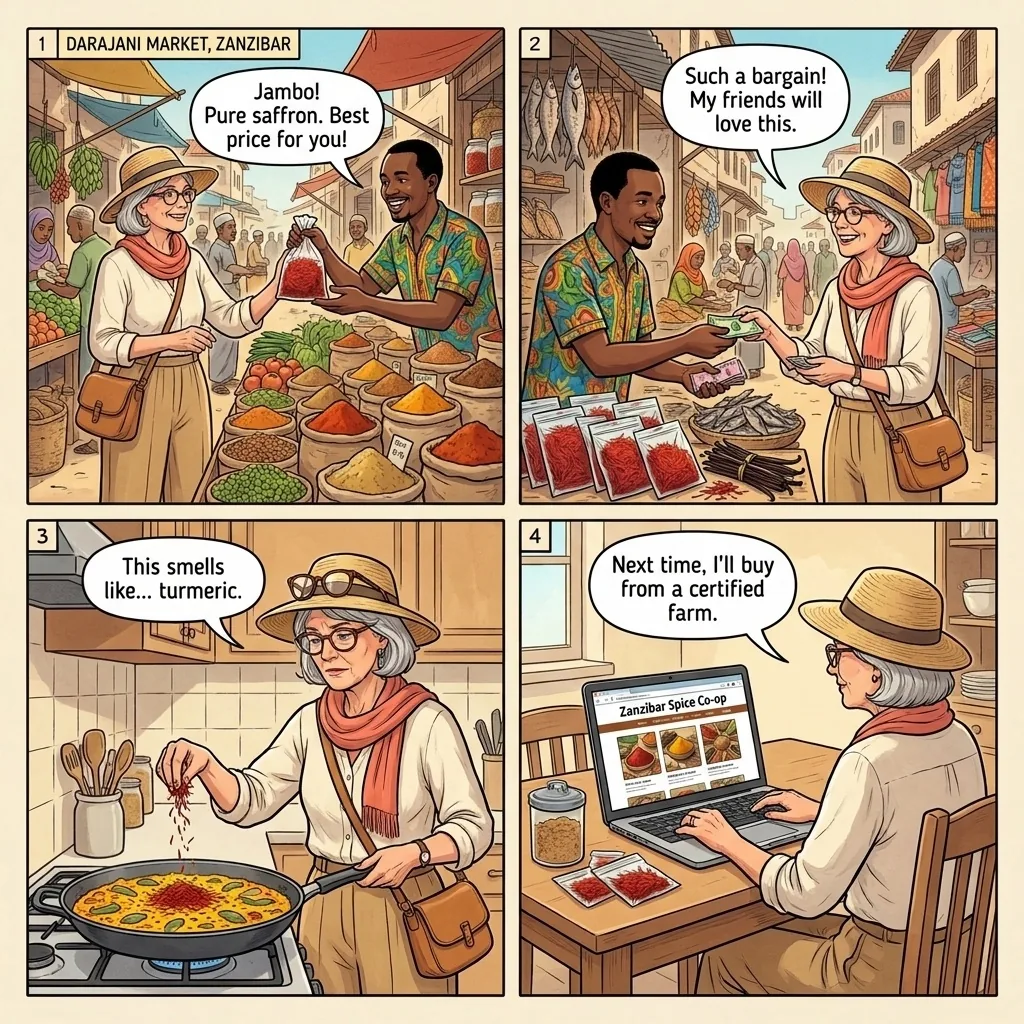
A Darajani 'saffron' purchase turns out to be safflower or turmeric six weeks later. Vanilla extract has no smell, clove oil is heavily diluted. Adulterated spices are a documented East African market problem and Zanzibar tourists pay premium prices for what cost the seller almost nothing.
You came to the Spice Island for the spices, and you're taking some home. The saffron is beautiful, deeply colored, reasonably priced — a fraction of what it costs back home. The vanilla pods are fat and fragrant. The cloves smell genuine. Six weeks later, the 'saffron' you've been adding to rice turns out to be safflower or turmeric — not saffron at all. The vanilla extract you made smells of nothing. You paid premium prices for something that cost the seller almost nothing.
Adulterated spices are a documented problem in tourist markets throughout East Africa's spice trade. The issue is particularly prevalent with saffron (the most expensive spice globally, commonly counterfeited with safflower), vanilla (imitation flavouring sold as real pods), and supposedly 'authentic' Zanzibar clove oil that has been heavily diluted with cheaper carrier oils.
Travelers on multiple forums report disappointment with market purchases that didn't survive the journey home. The 'reasonable' price is the structural tell: real saffron from any source costs $5–$10/gram at the global wholesale rate, so a Darajani vendor offering 'pure saffron' at a fraction of that price is almost certainly selling safflower (which costs cents per gram). Real vanilla pods cost similarly: $3–$8 per pod genuine, vs $0.10 per pod imitation.
The visual tells matter. Real vanilla pods are oily, genuinely black, and pliable — counterfeit ones are dry and brown. Real saffron threads are deep red at the top and orange at the base — if they're uniformly orange, or the spice is sold pre-ground in unlabelled bags, the adulteration risk is high. Sellers who can't tell you the specific farm or region for their cloves are flags too.
The defensive move is to book a spice farm tour through your hotel — these include supervised purchases from vetted sellers and guides who know which products are genuine. Smell everything before buying — real spices have an immediate, strong, specific aroma. Buy from the Zanzibar government-accredited ZSTC (Spice Trading Corporation) where possible. Purchase small amounts from multiple vendors and compare quality before bulk buying. Tourist Police: +255 22 211-1601.
Red Flags
- Saffron is priced suspiciously cheaply compared to global saffron rates
- Vanilla pods are dry, brittle, or brown rather than oily and dark
- Spice powder is pre-ground and packed in unlabelled bags with no origin information
- The seller cannot tell you the specific farm or region their cloves come from
- Prices drop dramatically when you pick up the most premium items
How to Avoid
- Book a spice farm tour through your hotel — includes supervised purchases from vetted sellers.
- Smell everything before buying — real spices have an immediate, strong, specific aroma.
- Learn what authentic saffron looks like: red threads, not orange, never pre-ground.
- Buy from the Zanzibar government-accredited ZSTC (spice trading corporation) if possible.
- Purchase small amounts from multiple vendors and compare quality before bulk buying.
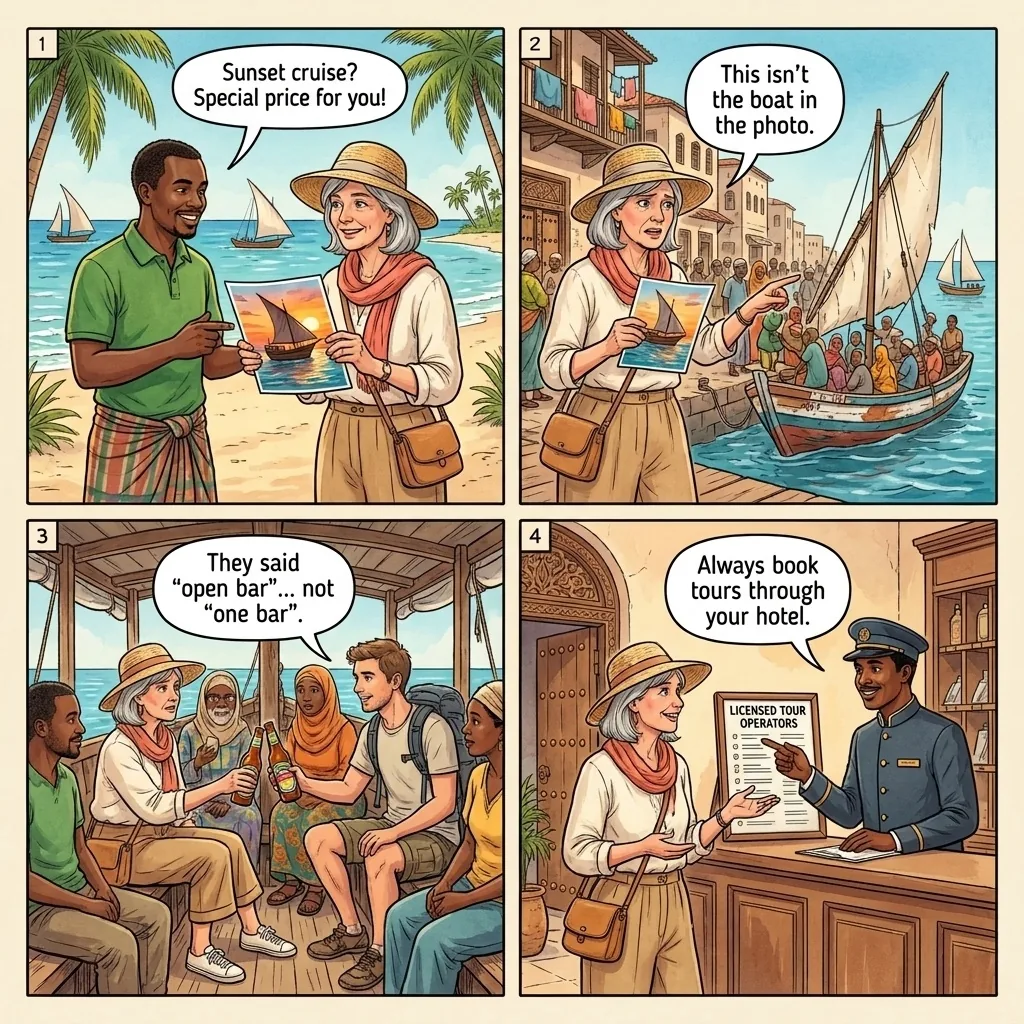
A $30 dhow sunset cruise advertises a beautiful wooden dhow gliding across a blazing Indian Ocean sunset — the day-of vessel is weathered, peeling paint, small outboard motor, 18 people on a 10-person boat, three warm Kilimanjaros shared, 45 minutes circling the harbour. Promo photos were stolen from a real operator.
The advertisement promises a traditional wooden dhow gliding across a blazing Indian Ocean sunset, drinks in hand, a handful of beautiful people laughing on deck. The price is $30 per person. You book and pay. On the day, you're collected and driven to a weathered dhow with peeling paint and a small outboard motor. There are eighteen people on a vessel that comfortably holds ten. The 'open bar' is three warm bottles of Kilimanjaro shared among everyone. The 'sunset' consists of motoring slowly around the harbour for forty-five minutes.
Dhow cruise bait-and-switch is a Zanzibar travel complaint that appears repeatedly in TripAdvisor reviews and traveler forums. The promotional photos used are often stolen from reputable operators' websites, and the operator you're actually booked with has no relationship to those images. The pre-payment in cash is the trick — once you've paid, your only choices are to board the actual boat or eat the loss.
Budget cruise pricing is a particular red flag — legitimate sunset dhow cruises with the experience advertised typically run $60–$100 per person. The $30 'deal' isn't a deal: it reflects the real cost of an old vessel, no bar, and 18 passengers crammed into a 10-person space. The economics don't allow the photographed experience at that price; the photos are advertising, not product.
The 'WhatsApp-only' contact is the second flag. Legitimate Zanzibar operators have physical offices in Stone Town or at Port Denarau-equivalent marinas, and they're happy to show you the vessel before you book. Operators who only contact via WhatsApp, accept only mobile-money or cash, and have no fixed address are operating in the same fly-by-night space as the fake liveaboards in the Maldives.
The defensive move is to book dhow experiences only through your hotel or through ZATI-registered operators with physical offices you can visit in person before paying. Ask to see the actual vessel you'll be on. Check the operator's ZATI registration number against the official registry. Read TripAdvisor reviews specifically mentioning the vessel condition. Budget realistically — $60+ per person for an authentic experience. Tourist Police: +255 22 211-1601.
Red Flags
- Promotional photos do not match the vessel you're shown on the day
- The price is significantly below similar offerings from hotel-booked operators
- Contact is only via WhatsApp — no physical office or visible business registration
- Full cash payment is required days in advance with no refund policy
- The number of confirmed passengers keeps growing past what seems comfortable
How to Avoid
- Book only through your hotel or physically visit the operator's office before paying.
- Ask to see the actual vessel you'll be on before confirming any booking.
- Check the operator's ZATI registration number against the official registry.
- Read TripAdvisor and Google reviews specifically mentioning the vessel condition.
- Budget a realistic amount — authentic dhow sunset experiences cost $60+ per person.
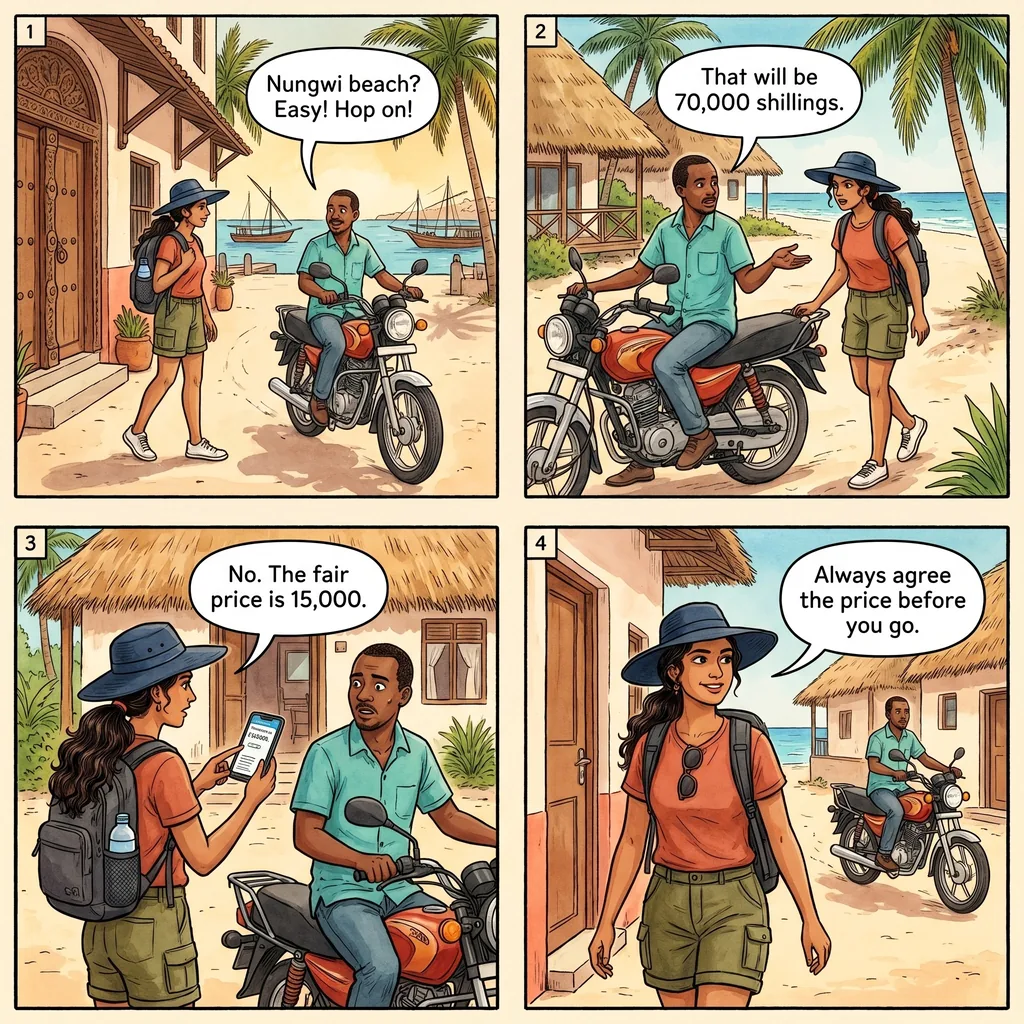
A boda-boda (motorcycle taxi) ride from Stone Town to Nungwi without a pre-agreed price ends with the driver quoting 5× the fair rate (10,000–15,000 TSH). You're 50 km from anywhere with your luggage on the back of a stranger's bike — the secondary risk is being routed past commission shops.
Getting between Stone Town and your beachfront guesthouse by boda-boda (motorcycle taxi) is convenient, cheap, and entirely normal on Zanzibar. The problem starts when you don't agree a price before mounting. The driver begins the journey, you relax, and thirty minutes later you're delivered to your destination and quoted five times the reasonable fare. You're a long way from anywhere with your luggage strapped to the back of a stranger's motorcycle. The power dynamics are not subtle.
Zanzibar boda-boda fares are entirely negotiated — there are no meters, no fixed tariffs, no official rate cards for tourists. Every experienced traveler to Zanzibar emphasises negotiating the price before sitting down. The fair rate from Stone Town to Nungwi (roughly 50km) is approximately 10,000–15,000 Tanzanian shillings. Drivers routinely quote foreign tourists three to five times this figure when asked post-journey.
The 'no price agreed' trap is the entire mechanic: the driver has the cash leverage at the destination, you have no leverage with luggage on his bike. Refusing to pay risks a confrontation; paying establishes that the route is profitable for him to repeat. The drivers who quote post-journey know exactly what they're doing — drivers who quote upfront are operating honestly.
A secondary risk is being taken on an unnecessarily long route past specific shops where the driver has commission agreements. If your journey seems to be taking longer than expected or heading through unfamiliar areas, stop the driver and check your map. The detour adds 10–15 minutes and a chance for one more shop pitch to a captive passenger.
The defensive move is to always negotiate and agree the exact price before sitting on the motorcycle, and ask your hotel for a contact number for a reliable boda-boda driver they know personally. If the route seems off or longer than expected, stop the driver and check your map. Trusted hotel-recommended drivers don't need the post-journey quote because their reputation depends on referrals. Tourist Police Tanzania: +255 22 211-1601. Police: 112.
Red Flags
- The driver won't discuss price before you mount the motorcycle
- They agree to go 'cheap' without specifying what cheap means
- The route seems longer than your map suggests it should be
- You pass multiple shops where the driver waves or stops briefly
- The quoted price after arrival is dramatically higher than you expected
How to Avoid
- Always negotiate and agree the exact price before sitting on the motorcycle.
- Ask your hotel staff what a fair rate is for your specific journey before leaving.
- Use Google Maps to verify the route is direct — object if major detours appear.
- Get the driver's phone number before setting off as accountability measure.
- Pay in exact change when possible — 'no change' claims are a common additional charge.
🆘 What to Do If You Get Scammed
📋 File a Police Report
Go to the nearest Tanzania Police Force station. Call 112 or 114 (Police). Get an official crime report — you'll need this for insurance claims. You can also report online at polisi.go.tz.
💳 Cancel Your Cards
Call your bank immediately. Most have 24/7 numbers on the back of the card (keep a photo saved separately). Block any suspicious transactions before the thieves use your details.
🛂 Lost Passport?
Contact your nearest embassy or consulate. The US Embassy in Dar es Salaam is at 686 Old Bagamoyo Road, Msasani, Dar es Salaam. For emergencies: +255 22-229-4000.
📱 Track Your Device
If your phone was stolen, use Find My (iPhone) or Find My Device (Android) from another device. Don't confront thieves yourself — share the location with police instead.
Frequently Asked Questions
You just read 6 scams in Zanzibar. The full Travel Safety Series has 780+ more across 20+ countries.
Tokyo's Kabukichō ¥130,000 bar trap. Rome's gladiator photo extortion. Paris's gold-ring trick. Bali's ATM skimmer scams. Bangkok's grand-palace closure ruse. Every documented scam across 20+ destinations — with the exact scripts, red flags, and local-language phrases that shut each one down. Drawn from Reddit traveler reports, embassy advisories, and consumer-protection cases.
- 780+ documented scams across Tokyo, Rome, Paris, Bali, Bangkok, Rio & 100+ more cities
- 20+ countries covered, with country-by-country phrase cards for every destination
- Updated annually — buy once, re-download future editions free
- All titles $4.99 each on Amazon Kindle