
Key Takeaways
- The #1 reported scam is the Battambang Bamboo Train Tourist-Trap Circuit.
- 2 of 6 scams are rated high risk.
- Use official taxi ranks or local ride apps where available — always confirm the fare before departure.
- Never accept unsolicited offers from strangers near tourist sites in Battambang.
⚡ Quick Safety Tips
- Keep phones and valuables in secure pockets when in crowded areas.
- Use only licensed taxis or app-based ride services.
- Book tours and tickets through verified operators with online reviews.
- Keep a copy of your passport separate from the original.
Jump to a Scam
The 6 Scams
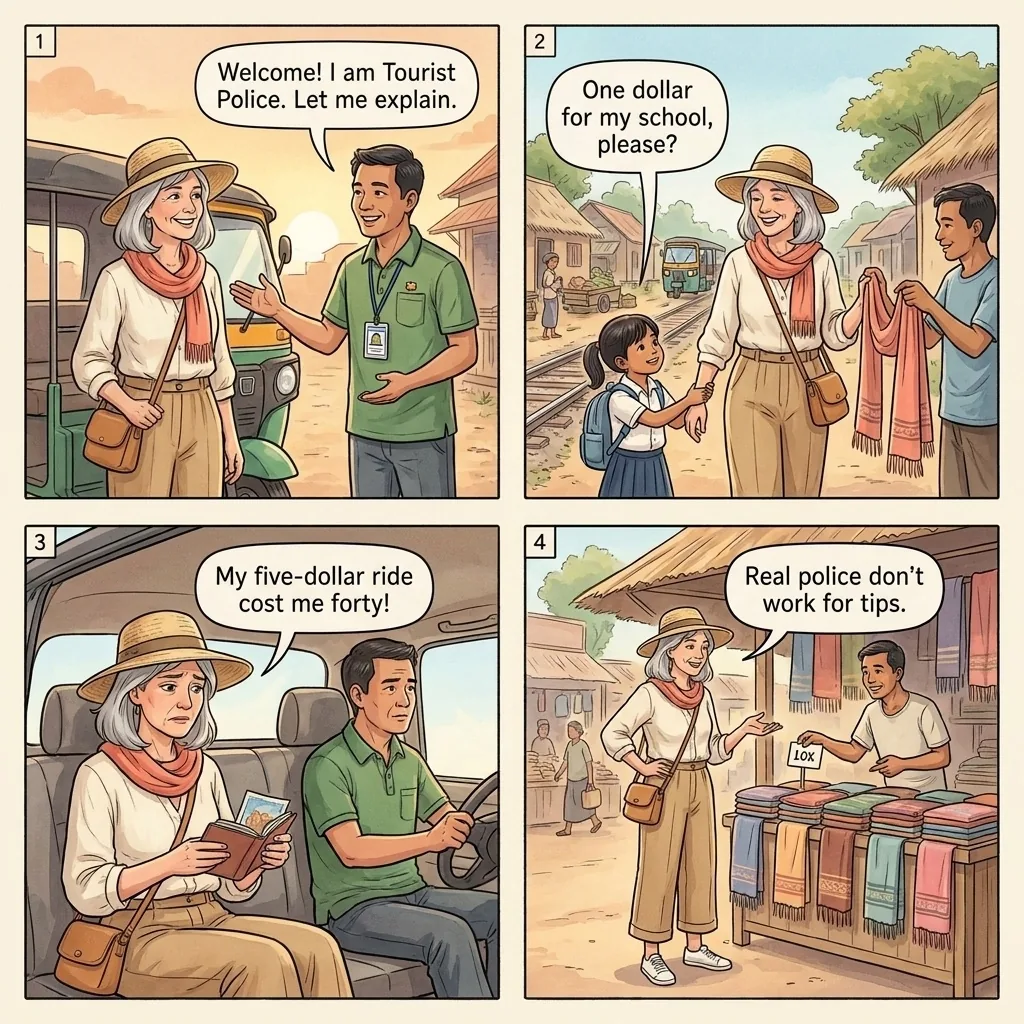
It's a Wednesday afternoon, you've hired a tuk-tuk for $8 round-trip to the famous Battambang Bamboo Train (norry), and as you arrive at the ticket booth, a man in a uniform-ish polo introduces himself as a 'tourist police officer.'
He gives you a friendly five-minute history lesson on the bamboo-train tradition, walks you to the ticket counter where you pay $5 per person for the ride, and at the end suggests a 'tip' of $2. The 15-minute ride on a motorised bamboo platform is deafeningly loud, the route runs through monotonous rice fields with zero scenery, and at the endpoint village a swarm of vendors descends with overpriced scarves, T-shirts, and trinkets while small children demand 'school money' tips of $1–2 each. Your tuk-tuk driver waits patiently. The whole operation — tuk-tuk fee, 'guide tip,' ride ticket, vendor pressure, child-tip pressure — sums to $35–50 for what was advertised as a $5 ride.
The Battambang Bamboo Train tourist-trap circuit is documented across Reddit, the TripAdvisor Battambang forum, the Lonely Planet Cambodia thorntree, and Cambodian Tourism Board guidance. The 'tourist police officer' is not a real officer — Cambodia has a real Tourist Police force, but they wear documented uniforms with name badges and don't operate as guides at attraction sites. The 'voluntary tips' for both the guide and the children are calibrated social-pressure mechanics. The scarves and T-shirts at the endpoint sell at three to five times the legitimate Psar Nat market rate.
The mechanism is structural rather than fraudulent — the bamboo train ride itself is real, the operators are real, the village is real. But the layered cost structure (tuk-tuk + 'guide' + tickets + vendor pressure + child-tip pressure) extracts meaningfully more than the advertised price. The 15-minute scenic ride is also significantly less impressive than the marketing materials suggest — most travelers report mild disappointment.
The legitimate Battambang Bamboo Train experience exists at the new Banan site (the original site closed in 2017 for railway-modernisation reasons; the new tourism-only site opened nearby). The all-in cost should be approximately $5 ticket + $5–8 tuk-tuk round-trip from town + small voluntary tip ($1) for the bamboo-train operator. Setting expectations at this level — including budgeting for the vendor strip — gives a more honest picture. The Battambang Bat Caves at Phnom Sampeau and the Wat Banan temple ruins are arguably more interesting day-trip alternatives at similar cost.
Set the Battambang Bamboo Train budget at $15–20 all-in (round-trip tuk-tuk + ticket + small operator tip) and budget mentally for the $10–15 layered extras (fake-officer tip, vendor pressure, child tips). Negotiate the tuk-tuk fare in advance — $6–8 round-trip is fair. Decline the 'tourist police officer' guide tip; real Tourist Police don't operate as guides at attraction sites. Carry small US bills ($1, $5) for the legitimate ticket and a token tip; refuse aggressive vendor pricing at the endpoint. Consider skipping the bamboo train entirely and visiting the Phnom Sampeau bat caves or Wat Banan temple ruins instead — both are arguably better experiences at similar cost. Emergency: 117 (Cambodian Police) or 119 (Ambulance); the U.S. Embassy in Phnom Penh is at +855 23 728 000.
Red Flags
- Tuk-tuk driver quotes an inflated fare for the 'special trip'
- 'Tourist police' officer acts as an unofficial guide demanding tips
- Vendors at the endpoint are extremely aggressive
- Children are used to guilt tourists into paying more
- The ride is far shorter and less scenic than advertised
How to Avoid
- Negotiate tuk-tuk fare in advance — 4,000-6,000 riel round trip is fair.
- Set expectations low — the ride is brief and noisy.
- Bring small bills to avoid overpaying vendors.
- Politely but firmly decline aggressive sellers with a smile.
- Consider skipping it entirely — the Battambang bat caves are a better experience.
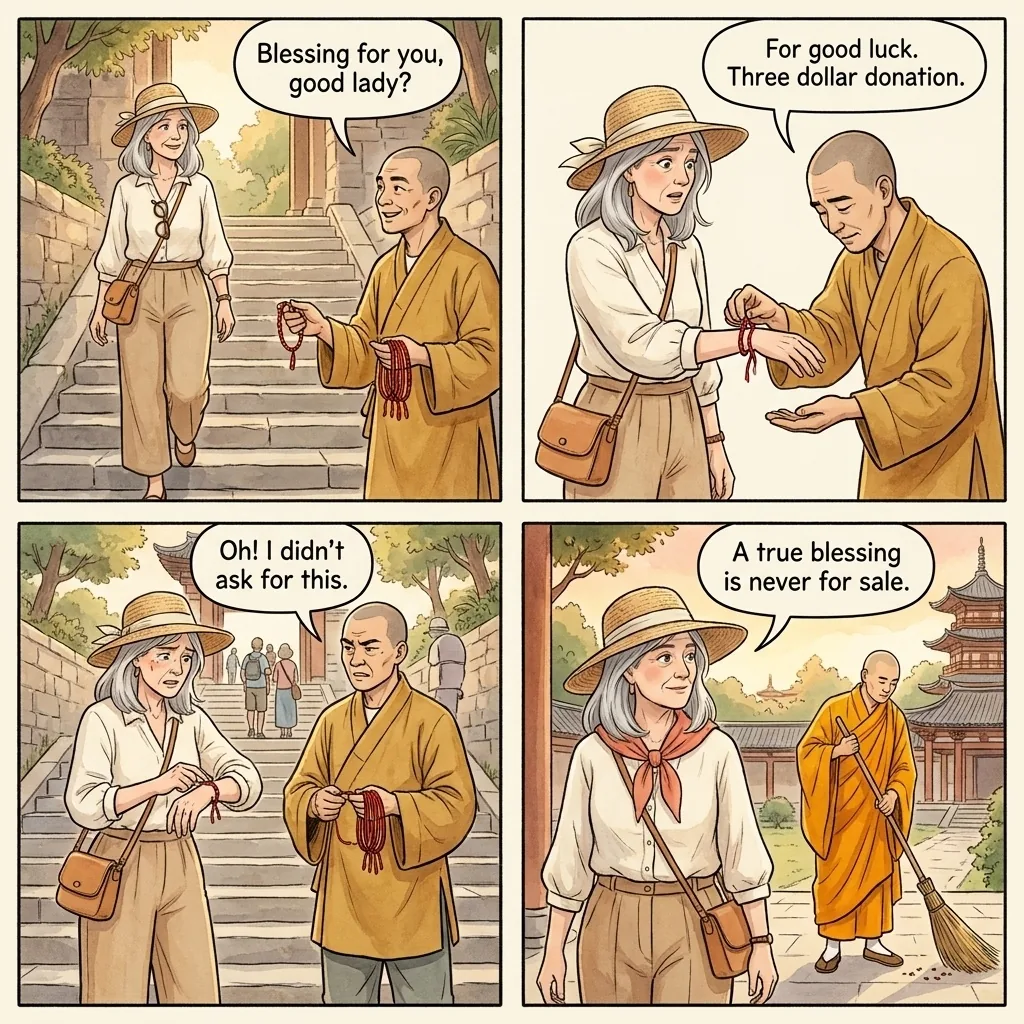
It's late afternoon at Phnom Sampeau, you're climbing the steep steps toward the Killing Cave memorial and the bat-cave viewpoint, and a man in mustard-coloured robes approaches you with a string of red bracelets and a small stick of incense.
Before you can react, he's tied a bracelet around your wrist, murmured a brief 'blessing' in Khmer, and gestured for a $3 donation. The transaction has happened in fifteen seconds; the bracelet is now on your wrist; you're being asked to pay for something you didn't request. When you try to remove the bracelet and decline, the 'monk' becomes visibly agitated, voice raising, sometimes followed by another 'monk' nearby who joins the demand.
Real Theravada monks in Cambodia wear saffron orange robes (sometimes deep red-maroon for the most senior monks), never directly handle money, and would never approach tourists to sell blessings. The 'monks' in mustard or brown robes at Phnom Sampeau, Wat Banan, and Battambang's central pagodas are not real monks — they are middle-aged men (sometimes wearing pants under the robes, which is a clear giveaway) running a calibrated guilt-and-blessing transaction targeting tourists at the Buddhist temple circuit. As travelers report across Reddit, the TripAdvisor Battambang forum, the Lonely Planet Cambodia thorntree, and Cambodian Buddhist authority statements, the fake-monk blessing scam is one of the most-encountered Battambang temple-circuit frictions.
The dollar damage per encounter is small ($2–5), but the operators run dozens of tourists per day across the temple circuit. The Cambodian Sangha (the official Buddhist monastic body) has weighed in repeatedly: real monks rely on alms, donate-to-temple-not-to-monk donations, and never solicit individual transactions from foreign visitors. The fake-monk pattern also exists in Phnom Penh, Siem Reap, and at the Angkor temples — same script, different location.
The structural defences are clear. Decline the bracelet-and-blessing approach with a polite firm 'no, dhanyabad' and continued walking — the social-pressure mechanic only works if you stay in the encounter. Do not let the 'monk' tie anything on your wrist; keep your hands at your sides. If a bracelet is already tied on, remove it and hand it back; the 'monk' has no enforcement leverage if you refuse to pay and walk away. If you genuinely want to support Cambodian Buddhism, drop riel into the official temple donation box (clearly marked at every legitimate pagoda), where 100% of the donation goes to the temple rather than to the operator.
Decline the bracelet-and-blessing approach at Phnom Sampeau, Wat Banan, and Battambang central pagodas — real Cambodian monks wear saffron orange (or deep red-maroon for senior monks), don't handle money directly, and don't solicit individual transactions from tourists. Keep your hands at your sides; do NOT let anyone tie a bracelet on your wrist. If a bracelet is already tied on, remove it and hand it back; the operator has no enforcement leverage if you refuse to pay. If you want to support Cambodian Buddhism, drop small riel notes into the official temple donation box at the pagoda entrance — clearly marked, with 100% going to the temple. The fake-monk pattern runs across Phnom Penh, Siem Reap, and Angkor too — same defence everywhere. Emergency: 117 (Cambodian Police).
Red Flags
- Monk wears brown or mustard robes instead of traditional saffron orange
- Approaches you directly and initiates physical contact
- Offers bracelets or trinkets before asking for payment
- Handles cash directly — real monks use donation boxes
- Often middle-aged, sometimes wearing pants under robes
How to Avoid
- Politely decline and keep walking — a firm 'no thank you' works.
- Don't accept bracelets or items placed on your wrist.
- Real monks never solicit money — donate at official temple donation boxes.
- Learn to recognize authentic Theravada monk attire (saffron orange, no pants).
- Report fake monks to temple management or local authorities.
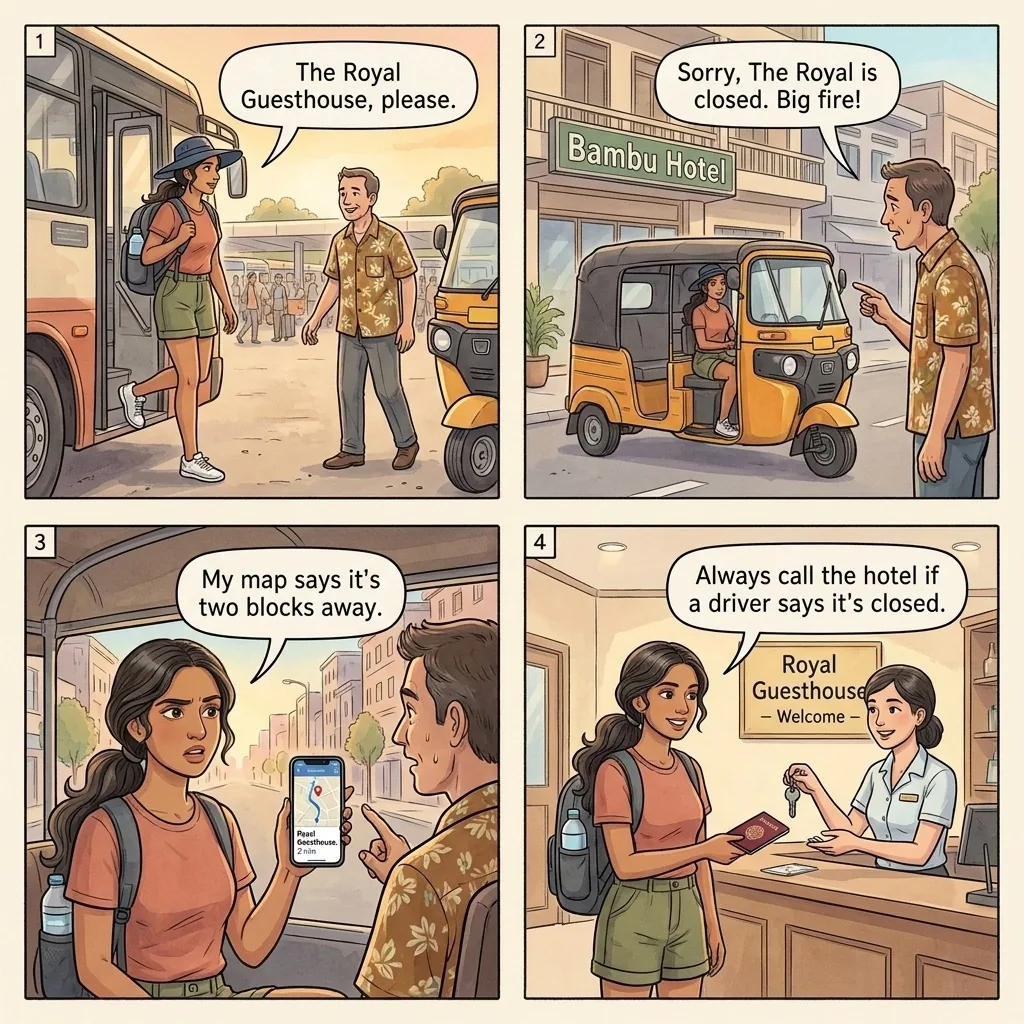
You arrive at the Battambang bus station after the seven-hour ride from Phnom Penh, you've pre-booked a riverside guesthouse called The Royal at $20/night, and a tuk-tuk driver outside the terminal offers to take you there for 2,000 riel (about $0.50).
The price is fair, you climb in, and four minutes later he stops outside a different guesthouse called Bambu Hotel. He says The Royal 'closed last month' or 'is completely full' or 'had a fire' — the framing varies. He encourages you to check in at Bambu instead. Bambu pays him a $3–6 per-tourist-per-night kickback for the redirect, and the room itself runs $25/night versus the $20 you'd booked at The Royal.
The Battambang tuk-tuk hotel-hijack is documented across Reddit, the TripAdvisor Battambang forum, and Lonely Planet Cambodia thorntree reports. The mechanism uses three structural failures: the bus companies sometimes share passenger names and hotel bookings with the drivers (so the driver knows where you're trying to go before you tell him), the 'your hotel is closed' framing exploits the tourist's lack of local information, and the alternative-hotel commission economy gives the driver a strong incentive to redirect even at the cost of customer goodwill.
If you insist on your original hotel, the response varies by driver. The friendlier ones reluctantly drive you. The less-friendly ones drop you blocks away and refuse to continue, forcing you to walk with luggage or hire another tuk-tuk. The aggressive minority claim a higher fare ('it's farther than I thought') and demand additional payment to complete the trip.
The structural defences are concrete. Save your guesthouse's address, phone number, and Google Maps location offline before arriving in Battambang. Call your hotel directly when you arrive at the bus station to confirm the booking before paying any tuk-tuk driver. Insist firmly on your destination; if the driver claims your hotel is closed, ask him to call them on speakerphone. Use Google Maps on your phone to verify the driver's route and call out detours. If the driver refuses to take you to your real destination, get out and hire another tuk-tuk — the kickback economy operates everywhere, but most drivers will deliver to the booked location if pressed.
Save your guesthouse's address, phone number, and Google Maps location offline BEFORE arriving in Battambang. Call your hotel directly when you arrive at the bus station to confirm your booking before paying any tuk-tuk driver — most legitimate guesthouses respond within a minute and dispel the 'closed/full' framing immediately. Insist firmly on your booked destination. Use Google Maps to verify the driver's route in real time; call out detours. If the driver refuses to take you to your real destination, get out and hire another tuk-tuk — the kickback economy is widespread but most drivers will deliver to the booked location when pressed. Pre-book your guesthouse's airport-or-bus-station pickup if available; many Battambang accommodations include free transfers. Emergency: 117 (Cambodian Police).
Red Flags
- Driver claims your booked hotel is closed, full, or 'moved'
- Drives you to a different guesthouse without your consent
- Pretends to call your hotel and reports it's unavailable
- Becomes aggressive or drops you far from your destination when you insist
- Multiple drivers compete for you at the bus station
How to Avoid
- Have your hotel's address and phone number saved offline.
- Call your hotel directly to confirm availability before trusting the driver.
- Insist firmly on your destination — threaten to get another tuk-tuk.
- Book a hotel pickup in advance through the guesthouse.
- Use Google Maps on your phone to verify the driver's route.
Like what you're reading? Get a full Battambang itinerary with safety tips built in.
Browse travel-safety books →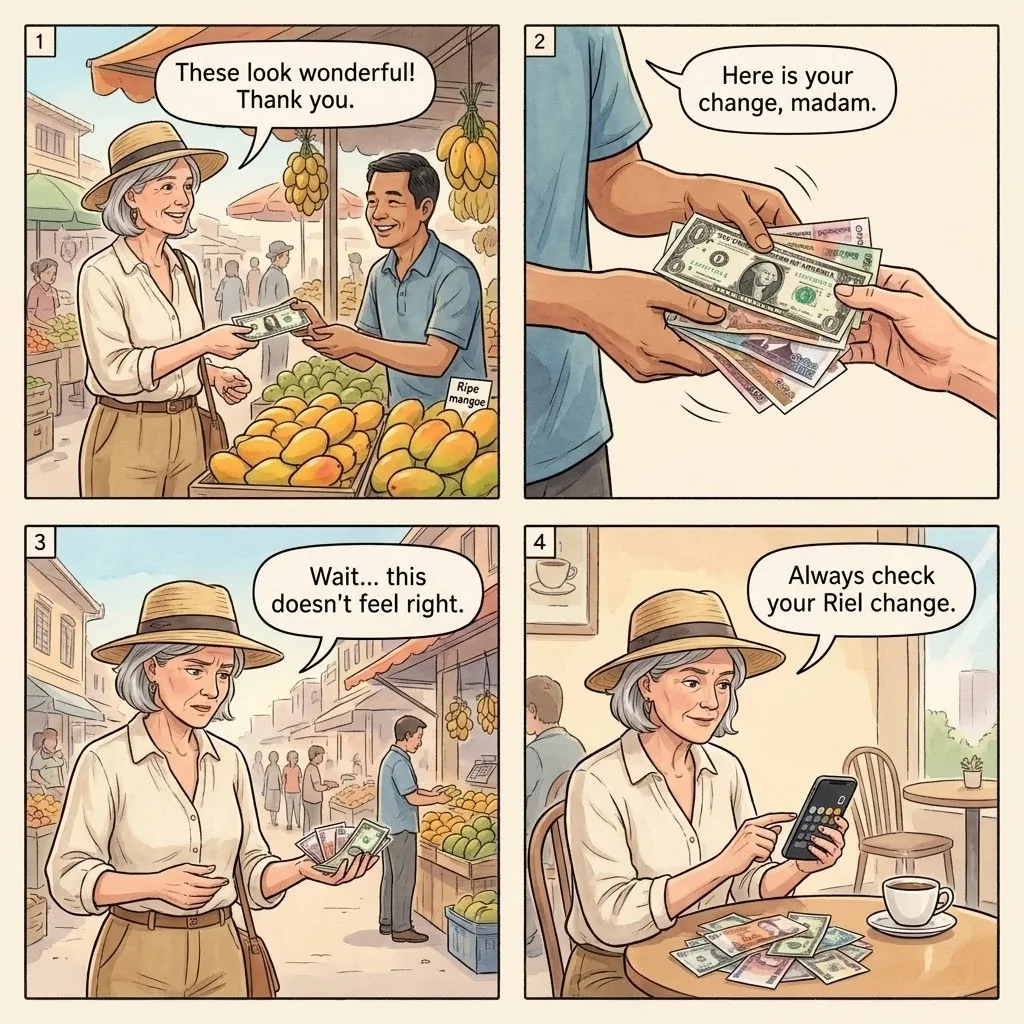
It's a Tuesday morning at Psar Nat central market in Battambang, you buy a kilogram of mangoes for $2, hand over a $5 bill, and wait for $3 in change.
The vendor smiles, counts quickly, and hands you back a small mix of currencies: a $1 USD bill, a 2,000-riel note, and a 4,000-riel note. The math seems okay until you actually do it: $1 + 2,000 riel + 4,000 riel = $1 + $1.50 = $2.50. You're short by $0.50. The vendor has used the dual-currency Cambodian system — where USD and riel circulate side by side at roughly 4,100 riel per dollar — to short the change. In the chaos of two currencies, different denominations, and a quick verbal exchange, you pocket the change without doing the math.
The Battambang dollar-riel change confusion is documented across Reddit, the TripAdvisor Battambang forum, and the Lonely Planet Cambodia thorntree. Cambodia's dual-currency system is real and widely used — USD circulates as the de facto large-denomination currency, riel as the small-change currency, with most prices quoted in USD and most change given in mixed currencies. The legitimate exchange rate is approximately 4,100 riel per $1 (verify on xe.com before traveling); some vendors short the math by 200–800 riel per transaction (about $0.05–$0.20), and the cumulative damage across a week of meals and shopping can reach $20–40.
The variant scams add layers. The 'worn USD' variant returns dollar bills that are torn, faded, or pre-2009 series — these are routinely rejected by other Cambodian vendors and effectively useless. The 'broken denomination' variant returns large riel notes (10,000 or 20,000 riel) instead of smaller notes the customer might prefer, making subsequent transactions awkward. The 'short-counting' variant counts quickly and hands the customer the stack with the vendor watching for the customer to pocket it without verification.
The structural defences are concrete. Know the current riel-to-USD rate (approximately 4,100 riel per $1; verify on a currency-converter app before travel). Count change carefully and do the math on the spot — vendors who don't want to be caught short-changing will return the correct amount when they see you counting. Carry small USD bills ($1, $2, $5) so you minimise the change-giving step entirely. Refuse damaged or pre-2009 dollar bills in change; they'll be useless at other Cambodian vendors. For larger purchases ($20+), pay in mixed currency rather than handing over a $50 — it's harder to short-change a buyer who hands the exact USD denomination.
Know the riel-to-USD rate (~4,100 riel per $1) and verify on a currency-converter app before travel. Count change carefully and do the math on the spot at every Battambang market and restaurant — vendors short-change quickly and hope you don't verify. Carry small USD bills ($1, $2, $5) to minimise the change-giving interaction entirely. Refuse damaged, torn, or pre-2009 USD bills returned in change — they're routinely rejected by other vendors. For larger purchases, pay in exact USD denominations rather than handing over a $50 and waiting for a chaotic mixed-currency change. Use a currency-converter app for quick mental verification. Emergency: 117 (Cambodian Police).
Red Flags
- Change given in a mix of dollars and riel to confuse the math
- Vendor counts quickly and pushes you to move along
- Worn or damaged US dollar bills included in your change
- Exchange rate used is worse than the standard 4,000 riel per $1
- Vendor claims they don't have smaller dollar bills to make correct change
How to Avoid
- Know the current riel-to-dollar rate (approximately 4,100 riel = $1).
- Count your change immediately and do the math before walking away.
- Carry small US dollar bills ($1s and $5s) to minimize change issues.
- Refuse damaged dollar bills in your change — they'll be rejected elsewhere.
- Use a currency converter app on your phone for quick calculations.
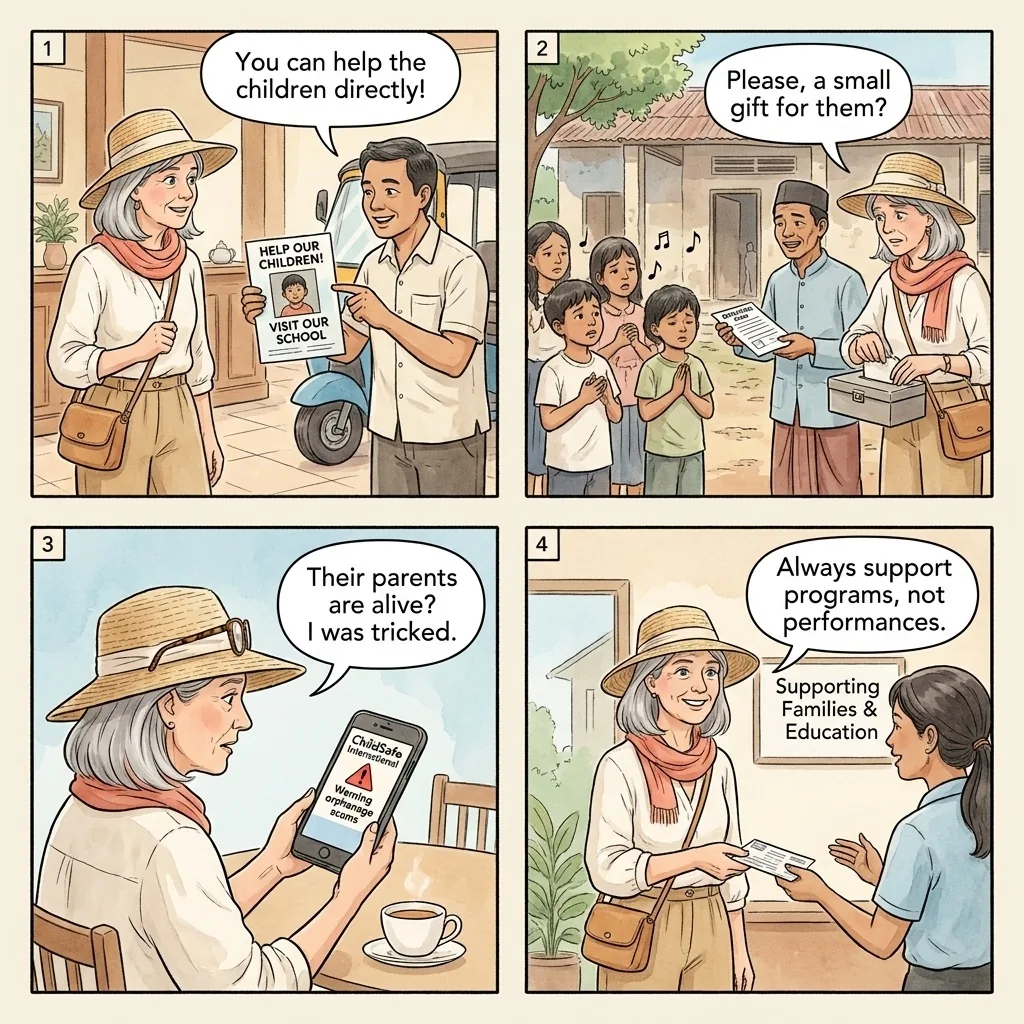
A flyer at your guesthouse invites you to visit a 'local orphanage' — bring school supplies and donations to support disadvantaged Cambodian children — and a tuk-tuk driver offers to take you for $10 round-trip.
The visit is moving. The children sing memorised songs in English, perform short dances, and beg for the tourists' attention. The orphanage manager presents you with a 'sponsorship form' and a donation request of $20–50 in cash. The children's faces are sad, the building is run-down, and the cash feels meaningful. You leave having donated $40 and feeling you've done something good.
UNICEF, Save the Children, and ChildSafe International have weighed in repeatedly: the majority of children in Cambodian 'orphanages' are not orphans. They have living parents, often in poverty, who were persuaded to send their children to the orphanage with promises of education and material support. Many of these institutions are deliberately maintained in poor condition to maximise tourist sympathy and donation flow. The donations rarely fund the children's welfare — they fund the operator. As travelers report across Reddit, the TripAdvisor Battambang forum, the UNICEF Cambodia consumer materials, and the ChildSafe International advisories, this is one of the most damaging scams in Cambodia, with Battambang specifically cited in orphanage-trafficking investigations.
The harm extends beyond the financial fraud. Children in these institutions experience meaningful developmental damage: rotating exposure to strangers, lack of stable family attachment, the institutionalisation of children who would be better served by family-based support. The Cambodian government has been moving to close orphanage-tourism operations and reunite children with families since 2017, but the practice persists in the lower-tier orphanages that target the tourist circuit.
The structural defence is straightforward: do not visit orphanages as a tourist in Cambodia, full stop. The visit itself — regardless of intent — funds the demand-side of the orphanage-tourism economy. If you genuinely want to support Cambodian children in poverty, donate to vetted long-term programmes that work on family reunification rather than institutionalisation. Friends International, Phare Performing Social Enterprise, the Cambodian Children's Fund, and ChildSafe International all run programmes with documented financial transparency and family-preservation focus. The ChildSafe app on your phone provides a hotline (012 311 112) to report suspicious orphanage-tourism promotions.
Do NOT visit orphanages as a tourist in Cambodia — the visit itself, regardless of donation intent, funds the demand-side of the orphanage-tourism economy and contributes to child harm. Decline guesthouse flyers and tuk-tuk-driver recommendations for orphanage visits with a polite firm 'no, thank you.' If you genuinely want to support Cambodian children in poverty, donate to vetted long-term programmes that work on family reunification, not institutionalisation: Friends International (mithsamlanh.org), Phare Performing Social Enterprise, Cambodian Children's Fund, and ChildSafe International. Use the ChildSafe hotline (012 311 112) to report suspicious orphanage-tourism promotions you encounter. Emergency: 117 (Cambodian Police); ChildSafe hotline: +855 12 311 112.
Red Flags
- Promoted through guesthouse flyers or tuk-tuk drivers
- Children perform rehearsed songs and dances for visitors
- Cash donations are requested on-site with no financial transparency
- Facility conditions seem deliberately poor despite receiving regular donations
- Visitors are allowed to interact closely with children without background checks
How to Avoid
- Never visit orphanages as a tourist — it fuels demand for child exploitation.
- Support established NGOs like Friends International or Phare instead.
- Donate to organizations that work on family reunification, not institutionalization.
- Report suspicious orphanage tourism promotions to ChildSafe at 012 311 112.
- If you want to help children, volunteer through vetted long-term programs.
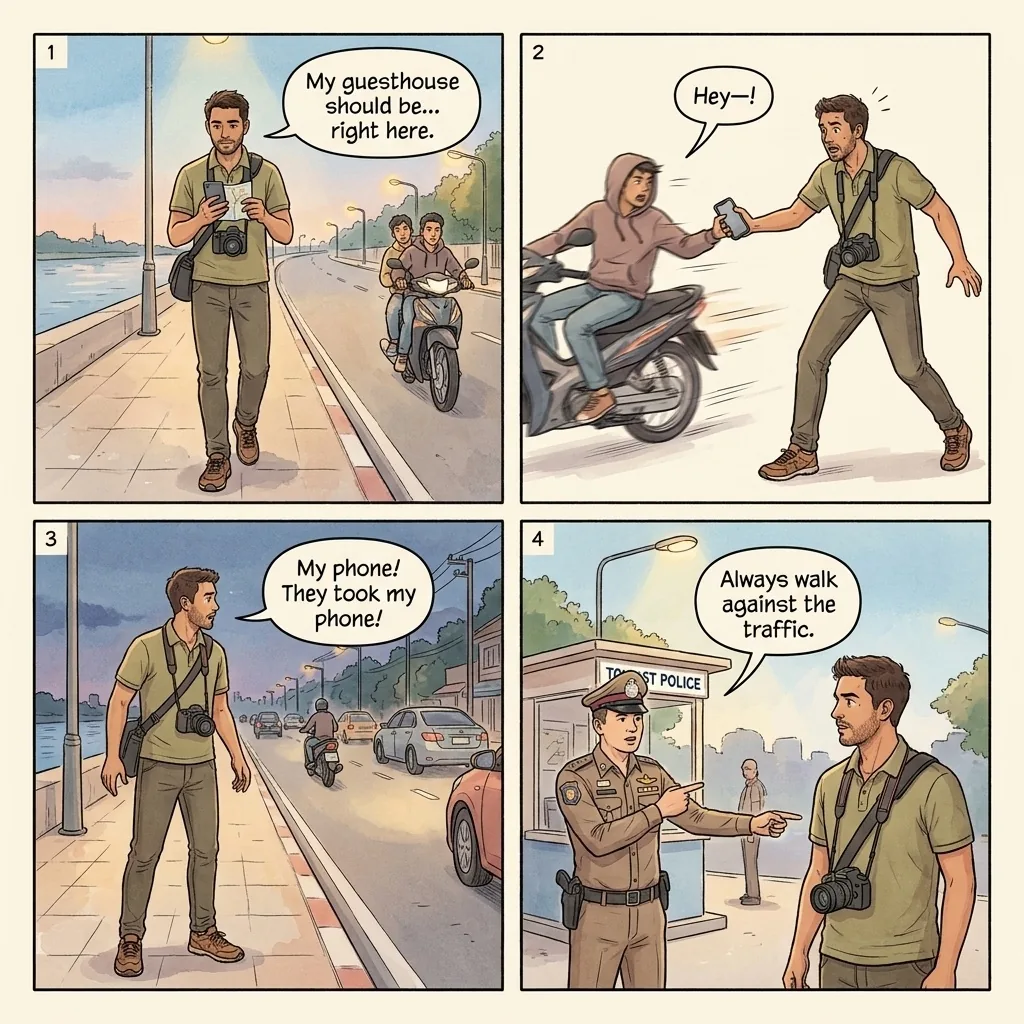
It's an early evening on Battambang's riverside promenade, you're walking back to your guesthouse along Street 1 with your phone in hand checking Google Maps, and a motorbike with two riders zips past on the road side and the passenger reaches across in one swift motion to snatch the phone from your hand.
By the time you've registered what happened, the bike is fifty metres away and accelerating into traffic. The lift took less than three seconds. The passenger and the driver coordinated the snatch as they passed; the passenger was watching for the right target — phone visible, walker on the road side, no other walkers within easy witness distance. The same script also runs against crossbody bags worn on the road-facing shoulder, against camera-on-strap-around-neck setups, and against handbags carried casually at hip-height.
The Battambang riverside motorbike bag-snatch is documented across Reddit, the TripAdvisor Battambang forum, the Lonely Planet Cambodia thorntree, and Cambodian Tourist Police consumer alerts. It is the most common crime affecting tourists in Cambodian cities (Phnom Penh, Siem Reap, Battambang), and Battambang's quieter riverside stretches between the Sangker River bridges are the highest-frequency location in the city because there are fewer pedestrian witnesses than in central markets.
The financial damage varies — a smartphone snatch is $400–1,000 in replacement cost plus the ongoing risk of cloned-card or banking-app exploitation; a crossbody-bag lift can include passport, cards, and cash for cumulative damage of $1,000+. Recovery is rare: the rider team is on the bike in seconds, license plates are often covered or stolen, and the goods enter resale chains within hours.
The structural defences are concrete. Wear bags on your building-facing shoulder, not the road-facing shoulder; wear a crossbody bag with the strap diagonal across your chest, tucked under your arm, on the building side. Don't walk with your phone in your hand on Battambang streets — use it stationary inside a shop or restaurant, then put it away before walking. Stay alert on quiet riverside roads in the evening; if you see a motorbike with two riders slowing down or making U-turns near you, change direction or step into a shop. Keep valuables in your guesthouse safe and carry only what you need for the day.
Wear bags on the BUILDING-FACING shoulder, not the road-facing shoulder, on Battambang streets; wear a crossbody bag diagonal across your chest, tucked under your arm, on the building side. Don't walk with your phone in your hand on Battambang streets — use it stationary inside a shop or restaurant, then put it away before walking. Stay alert on quiet riverside roads in the early evening; if you see a motorbike with two riders slowing or making U-turns near you, change direction or step into a shop. Keep passport, spare cards, and bulk cash in your guesthouse safe; carry only what you need for the day. If a snatch happens, do not chase the bike — the ride safety risk outweighs the recovery odds. Emergency: 117 (Cambodian Police), 119 (ambulance); the U.S. Embassy in Phnom Penh is at +855 23 728 000.
Red Flags
- Motorbike with two riders slowing down near pedestrians
- Riders circling the same block or making U-turns near you
- Being on a quiet road with your phone or camera visible
- Bag worn on the road-facing shoulder
How to Avoid
- Wear bags on the building side, not the road side.
- Don't walk with your phone in your hand — use it only when stationary.
- Stay alert on quiet riverside roads in the evening.
- Use a cross-body bag with the strap across your chest, tucked under your arm.
- Keep valuables in your hotel safe and carry only what you need.
🆘 What to Do If You Get Scammed
📋 File a Police Report
Go to the nearest Cambodian Tourist Police station. Call 117 (Police) or 119 (Emergency). Get an official crime report — you'll need this for insurance claims. You can also report online at tourismcambodia.com.
💳 Cancel Your Cards
Call your bank immediately. Most have 24/7 numbers on the back of the card (keep a photo saved separately). Block any suspicious transactions before the thieves use your details.
🛂 Lost Passport?
Contact your nearest embassy or consulate. The US Embassy in Phnom Penh is at #1, Street 96, Sangkat Wat Phnom, Khan Daun Penh. For emergencies: +855 23-728-000.
📱 Track Your Device
If your phone was stolen, use Find My (iPhone) or Find My Device (Android) from another device. Don't confront thieves yourself — share the location with police instead.
Frequently Asked Questions
You just read 6 scams in Battambang. The full Travel Safety Series has 780+ more across 20+ countries.
Tokyo's Kabukichō ¥130,000 bar trap. Rome's gladiator photo extortion. Paris's gold-ring trick. Bali's ATM skimmer scams. Bangkok's grand-palace closure ruse. Every documented scam across 20+ destinations — with the exact scripts, red flags, and local-language phrases that shut each one down. Drawn from Reddit traveler reports, embassy advisories, and consumer-protection cases.
- 780+ documented scams across Tokyo, Rome, Paris, Bali, Bangkok, Rio & 100+ more cities
- 20+ countries covered, with country-by-country phrase cards for every destination
- Updated annually — buy once, re-download future editions free
- All titles $4.99 each on Amazon Kindle