
Key Takeaways
- The #1 reported scam is the Phnom Penh Tuk-Tuk $5 Day-Tour Commission Loop.
- 4 of 6 scams are rated high risk.
- Use official taxi ranks or local ride apps where available — always confirm the fare before departure.
- Never accept unsolicited offers from strangers near tourist sites in Phnom Penh.
⚡ Quick Safety Tips
- Use the PassApp or Grab app for tuk-tuks and taxis — street tuk-tuk drivers near the Royal Palace overcharge tourists by 3-5x.
- Never accept tours to 'shooting ranges' outside the city from tuk-tuk drivers — these operations are unlicensed and occasionally dangerous.
- Keep bags on your lap in tuk-tuks, not on the seat — motorbike bag snatches from moving tuk-tuks are common along the riverside.
- At the Russian Market and Central Market, bargain to 40-50% of the first quoted price — initial tourist prices are always dramatically inflated.
Jump to a Scam
- Medium The Phnom Penh Tuk-Tuk $5 Day-Tour Commission Loop
- Medium The Mekong Riverfront Fake-Monk Blessing
- High The Phnom Penh 'Helpful Local' Casino Card Setup
- High The Cambodia evisa.gov.kh Lookalike Site
- High The Phnom Penh Orphanage Voluntourism Donation
- High The Phnom Penh Motorbike Passport-Hostage Damage
The 6 Scams
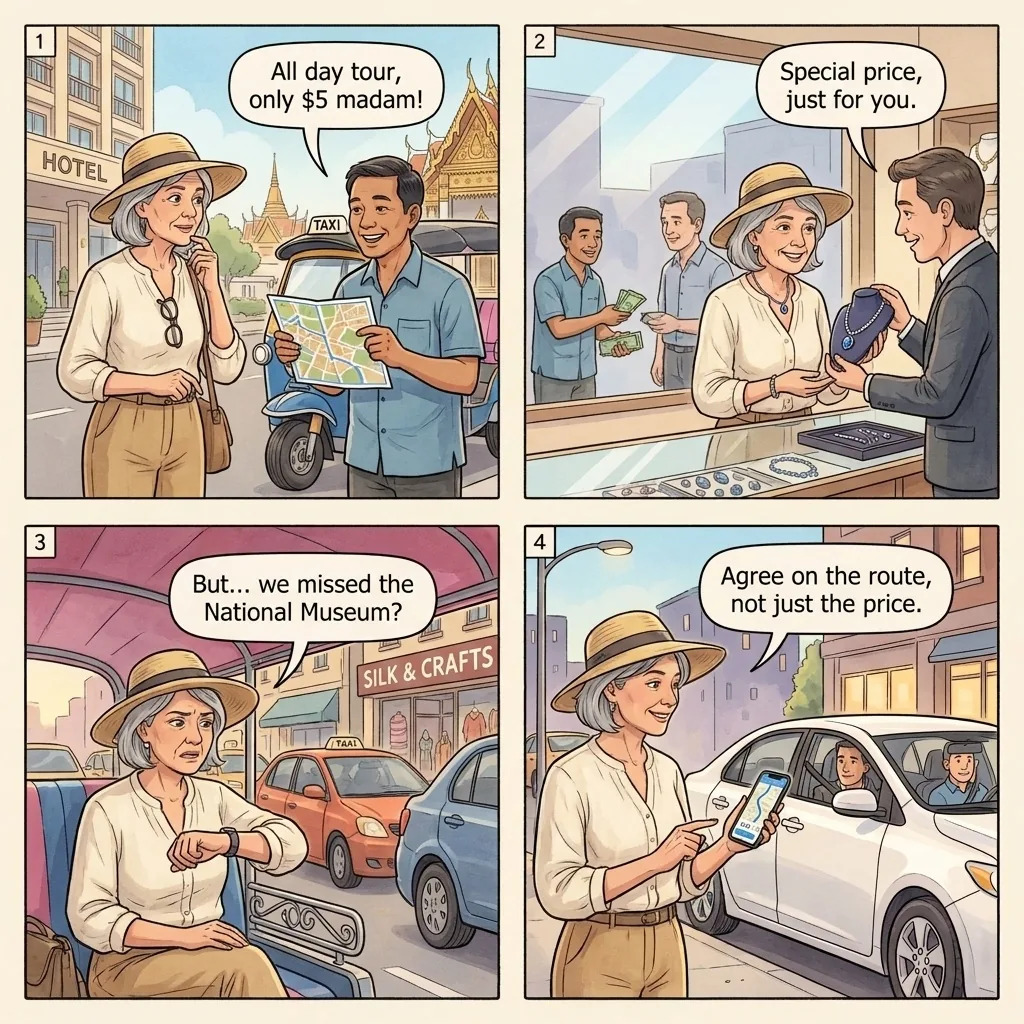
You step out of your hotel near Wat Phnom for the first time, and a tuk-tuk driver leaning against his ride waves you over with a wide smile and a laminated map of the city.
He has it all on the card — Royal Palace, Silver Pagoda, the National Museum, Tuol Sleng (S-21), the Russian Market, lunch stop, sunset cruise — and he quotes you $5 for the whole day. The standard rate for a full-day tuk-tuk in Phnom Penh runs $15–25 depending on distance, so $5 is a quarter of normal. You think you have found a bargain. He grins, pats the bench, and you climb in.
The morning starts well enough. He drops you at the Royal Palace, waits patiently while you tour the Silver Pagoda, and then — instead of the National Museum next door, three minutes' walk away — he announces a 'beautiful gem shop' he 'just wants you to see' on the way. You go inside to be polite. Twenty minutes later you emerge having declined a sapphire pendant. Then comes a 'silk tailor' on the way to S-21, then a 'spice market,' then a 'recommended' restaurant for lunch where his friend works the door.
By 3 p.m. you have seen the Royal Palace, S-21, and four shops you did not ask about. The Russian Market and the National Museum are gone, the sunset cruise is rushed, and the day you wanted to spend understanding Phnom Penh has dissolved into a slow-motion commission run. Your driver's $5 fee is real — he is making it back five times over by collecting $2–5 per delivered tourist at each shop, plus a percentage of any sale.
The commission-shop loop is the most consistently reported low-grade Phnom Penh tourist scam, documented across Reddit, the long-running Lonely Planet Cambodia thread, and most travel blogs. The mechanic is universal: an absurdly low quoted day rate ($5–10 versus the $15–25 norm) signals that the driver is paid by shops, not by you. Hotel-vetted drivers and Grab/PassApp tuk-tuks charge market rates and have no shop network behind them.
Negotiate a fair full-day rate ($15–25 USD) and tell the driver explicitly: 'No shopping stops, no commission stores, just sightseeing.' Use the PassApp or Grab apps for individual rides where the meter and the route are tracked, and ignore any tuk-tuk quoting day rates below $10. Plan your itinerary in writing on your phone, hand it to the driver, and refuse detours to gem shops, silk tailors, or 'recommended' restaurants you did not ask for. If a driver insists on commission stops, end the tour, refuse to pay for the unrequested stops, and book a Grab back to your hotel.
Red Flags
- Driver offers day tours at suspiciously low prices
- Route includes unexpected 'interesting' shops
- Driver insists you 'just look' at stores you didn't ask about
How to Avoid
- Negotiate a fair rate ($10-20/day) and specify that no commission stops are included.
- Use Grab (Southeast Asia's Uber) for metered, transparent pricing.
- Plan your own itinerary and show the driver specifically where you want to go.
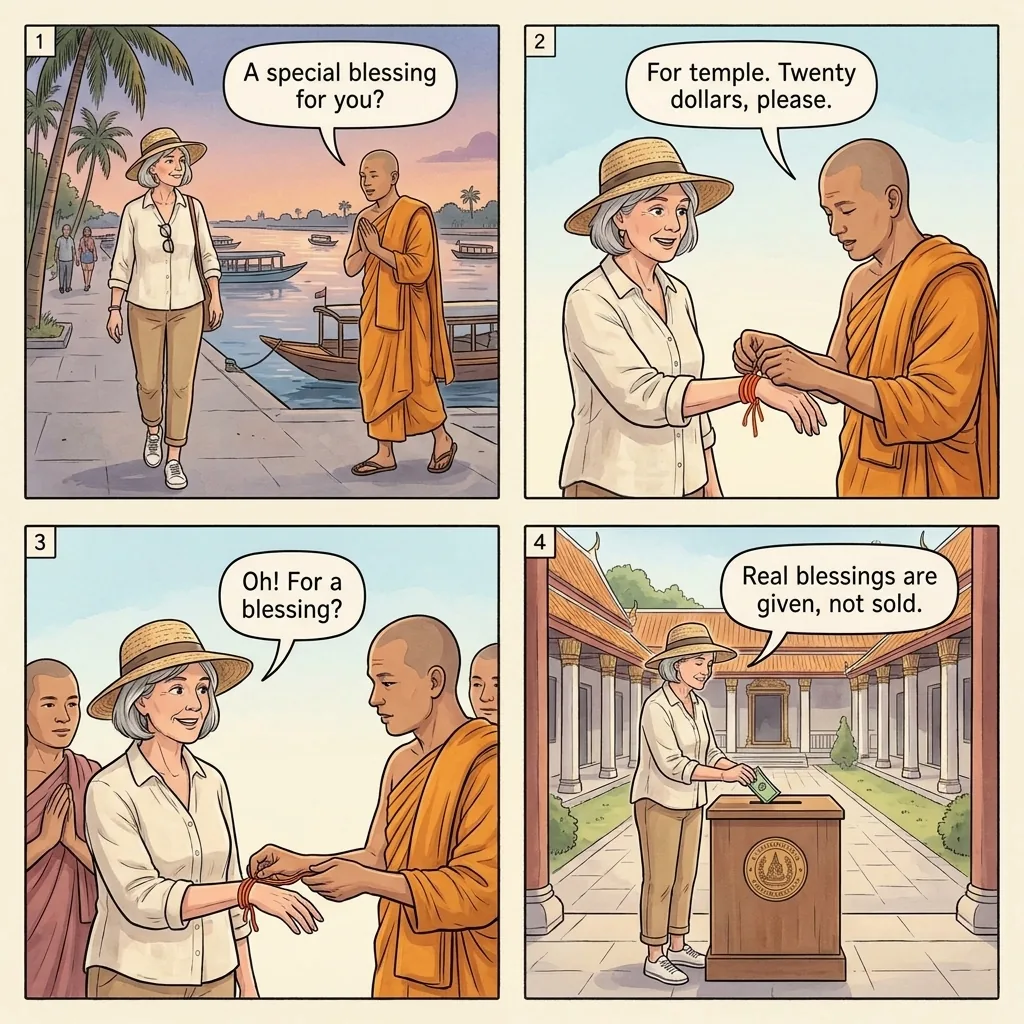
You are walking the Sisowath Quay riverfront promenade at dusk, watching the boats on the Tonlé Sap, when a saffron-robed figure steps softly into your path with his hands already raised in a blessing.
Before you have processed what is happening, he has gently clasped your wrist, looped a thin orange string around it, and started chanting in low Pali. The robe looks correct — saffron, draped across the right shoulder — and his head is shaved. Other tourists nearby slow down to watch. You assume this is a genuine spiritual interaction at a famously Buddhist riverfront, and you feel honored to be chosen.
The chant ends. He smiles. Then his hand turns palm-up, and he asks for a donation — twenty dollars, often, sometimes more, and the request is firm rather than suggested. If you hesitate, two or three other 'monks' a few meters down the promenade drift closer. The pressure is mild but unmistakable. Most travelers hand over $5–20 cash to disengage with grace, and only later realize what just happened.
Real Buddhist monks in Cambodia do not approach foreigners on the street to perform unsolicited blessings, and the Sangha rules explicitly prohibit monks from handling cash directly. Genuine monastic interactions take place at a wat (temple), where you remove shoes, sit at a respectful distance, and offer alms in the morning by placing food in the begging bowl — never with a hand-to-hand cash transaction. The Phnom Penh fake-monk pattern has been documented for over a decade, with formal warnings from the Cambodian Sangha Council, and Reddit, TripAdvisor's Phnom Penh forum, and most guidebooks all flag the riverfront scam by name.
The economics tell the story. The orange string costs about ten cents at any market, the chant takes thirty seconds, and the operation runs along the same stretch of Sisowath Quay every evening. Some operators rotate between the riverfront and the steps near the Royal Palace; others work in pairs, with a 'translator' standing nearby to help close reluctant tourists. The same scam runs in Bangkok, Yangon, and Vientiane, and the visual cue — a robed figure approaching first rather than a tourist approaching a temple — is the consistent giveaway.
Real monks do not approach tourists on the street to sell or bless — full stop. If a robed figure walks toward you on Sisowath Quay or near the Royal Palace, decline by pressing your palms together at chest level, give a small bow, and keep walking without breaking stride. If a string is already on your wrist, you can remove it the moment you are out of sight; you owe nothing for an unsolicited blessing. If you genuinely want to support a temple, visit Wat Ounalom or Wat Phnom and place a donation in the labeled box at the entrance, never in a stranger's hand.
Red Flags
- Robed figure approaches you proactively rather than you approaching a temple
- Blessing performed without consent in a non-temple setting
- Donation demanded rather than suggested, with visible pressure
How to Avoid
- Real monks do not approach tourists on the street to sell or bless.
- Politely decline by pressing palms together and moving on.
- If you want to make a genuine donation, do so at a legitimate temple.
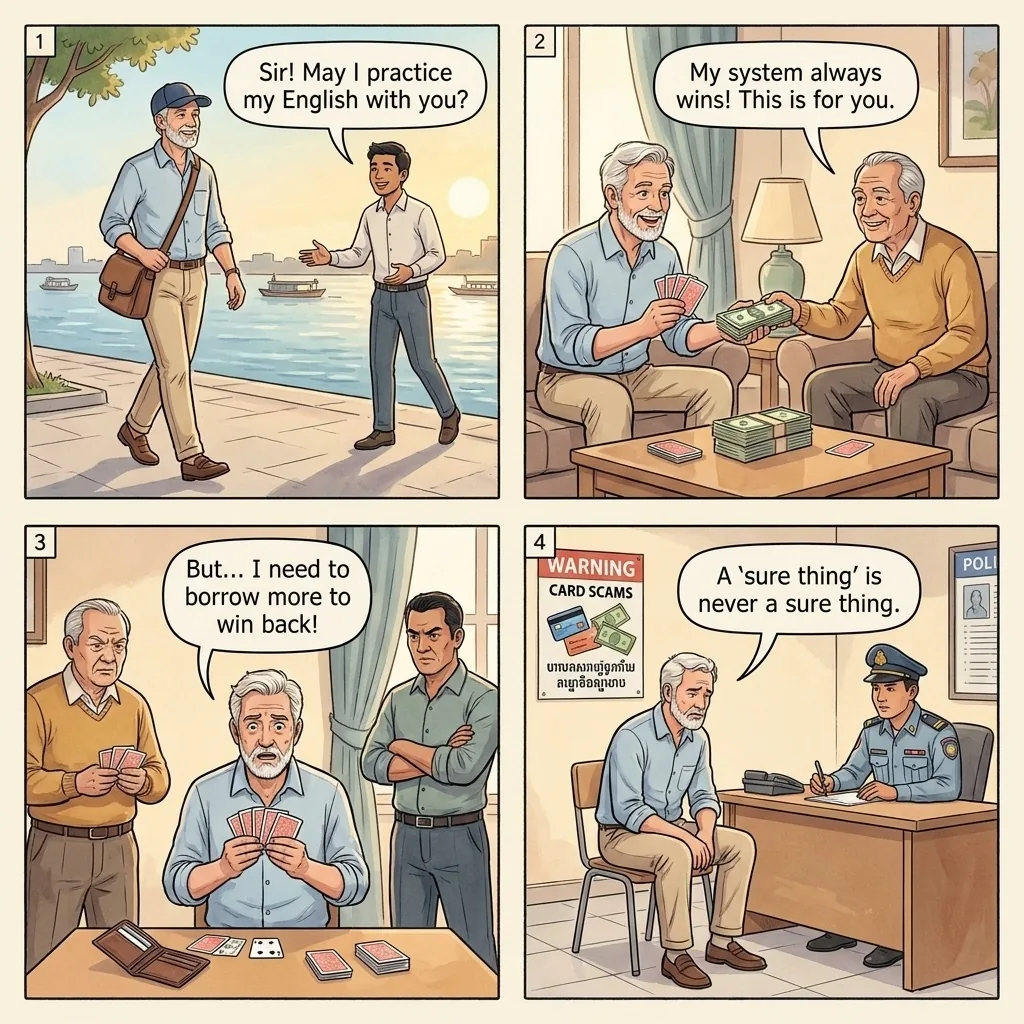
A friendly young Cambodian falls into step beside you on the riverfront on your second afternoon in Phnom Penh, mentions he is an English teacher, and asks if you would mind chatting for a few minutes so he can practice his accent.
His English is already fluent. The conversation drifts to your hometown, his sister who hopes to study in Australia, the weather, the food. After fifteen minutes he mentions casually that his uncle is a very wealthy businessman with an unusual problem: a casino owner has invited him to a private card game tonight, but the rules require an English-speaking 'foreign partner' to count cards on his behalf, and he has been struggling to find one. Would you, perhaps, be willing to come and meet him? Just for a chat, no obligation.
You agree out of curiosity. He takes you to a comfortable house in a quiet residential street. The 'uncle' is charming, well-dressed, and explains the deal: he has a 'system' for winning a specific card game (often a variant of three-card Brag or 21), but he cannot play directly because of his standing in the community. He shows you the system in two practice rounds and you win both — easily, dramatically. He hands you several hundred dollars in 'practice winnings' to take home as a gesture of goodwill.
The hook is the practice winnings. You feel competent, you trust the system, you are now invested in the relationship. The real game, an hour later, requires you to put up your own money — $5,000, $10,000, sometimes more — to 'demonstrate good faith' to the casino owner. The cards are dealt, the system flips against you in the deciding hand, and you lose everything. The 'uncle,' the casino owner, the dealer, the supposed nephew on the street, are all part of the same operation, and the practice rounds were rigged to feel real.
The Phnom Penh card-game scam is the most consistently reported high-loss tourist scam in Cambodia, and the U.S. Embassy in Phnom Penh has issued warnings about it for years. Reddit and TripAdvisor's Cambodia forum carry first-person accounts running from $3,000 up to $40,000 per loss. The pattern is regional — variants run in Manila, Bangkok, and Ho Chi Minh — and the opener is consistent: a flattering personal connection ('my sister wants to study in your country'), a wealthy relative with an unusual proposition, and a private location.
Treat any stranger in Phnom Penh who claims to be an 'English teacher,' an 'aspiring student,' or a 'helpful local' as a potential card-game setup — the opener is the scam. Never follow a new acquaintance to a private home, an apartment, or a 'family member's house,' however mundane the invitation. Decline any conversation about gambling, card systems, or 'foreign partner' opportunities, and walk back to a public area immediately if it is mentioned. If you have already lost money, dial 117 for police and call the U.S. Embassy in Phnom Penh at +855 23 728 000 (or your country's equivalent) — quick reporting sometimes recovers funds.
Red Flags
- Friendly stranger who 'just happened to meet you' and quickly becomes your new best friend
- Elaborate family story to establish credibility and trust
- Proposition involves making money with minimal effort
How to Avoid
- Never follow strangers to private homes or unfamiliar venues, no matter how friendly they seem.
- Any gambling setup where foreigners are guaranteed to win is a scam.
- The 'helpful local' setup is one of the most sophisticated scams in Southeast Asia — trust your instincts.
Like what you're reading? Get a full Phnom Penh itinerary with safety tips built in.
Browse travel-safety books →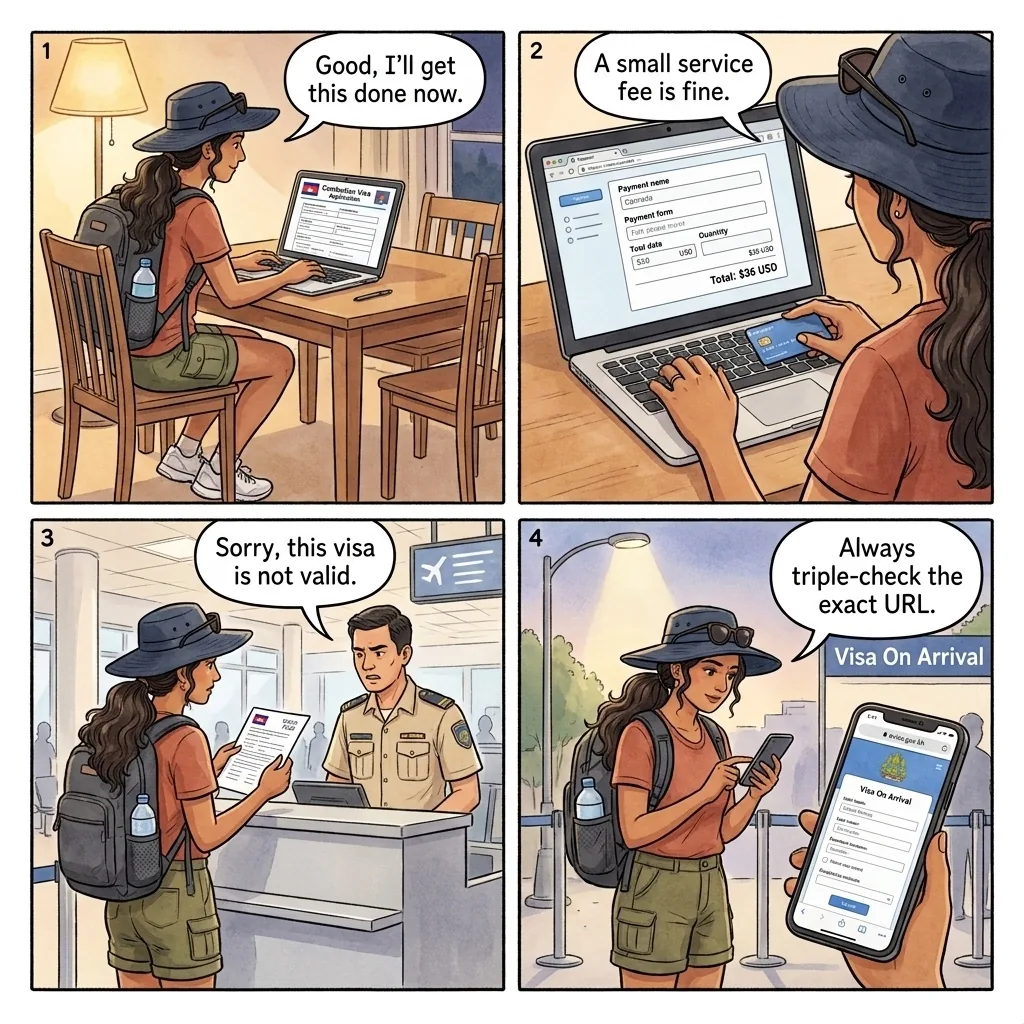
You search Google for 'Cambodia e-visa' the night before your flight, click the first result that has a Cambodian flag and a 'gov' in the URL, and start filling in the visa form on what looks like the official Ministry of Foreign Affairs page.
The form asks for your full passport details, a passport scan upload, your photo, your travel dates, and your hotel address. The fee at checkout is $36 — close enough to the official $30 that you assume the difference is a 'service charge' or currency conversion. You pay by credit card, the page returns a confirmation number, and a PDF arrives by email a few hours later that looks like an official Cambodian e-visa with all the right stamps and serial numbers.
You arrive at Phnom Penh International with the printed PDF. The immigration officer scans it, frowns, scans it again, and tells you the document is not in the Ministry's system. The site you used was a lookalike — a third-party aggregator that takes your money, files an actual visa application on your behalf at the official site (sometimes), and pockets the difference, or in worse cases generates a fake PDF and disappears with both your fee and your full passport scan. Either way, you now need to apply for a real visa on arrival and pay $30 again.
The Cambodia evisa lookalike pattern is the most common pre-arrival scam targeting Phnom Penh visitors, and it is well-documented by the Cambodian Ministry of Foreign Affairs, the U.S. State Department, and TripAdvisor's Cambodia forum. The scam survives because Google's paid search results consistently surface aggregator sites above the actual government domain, and the lookalikes have refined their UX to feel official — flag, fonts, formal language, even a fake 'verify' button. Some aggregators are technically legal middlemen who charge a marked-up fee for filing your real application; others are pure fraud.
The data side is the bigger long-term cost. Even when the visa eventually works, you have just handed full passport details and a high-resolution scan to an unknown third party — feedstock for identity fraud, fake-document creation, and downstream phishing. The official Cambodian e-visa portal is exactly evisa.gov.kh and nothing else; the fee is exactly $36 ($30 visa + $6 processing) and is paid only by credit card on the .gov.kh domain.
Type evisa.gov.kh directly into your browser — never click a Google result for 'Cambodia visa,' as the top sponsored ads are almost always aggregators or lookalikes. The official fee is exactly $36 (visa $30 + processing $6) for tourist e-visa, and the only payment method is credit card on the .gov.kh domain. Bookmark the URL before your trip, take a screenshot of the official confirmation, and never upload a passport scan to a non-.gov.kh URL. If you have already paid a lookalike, dispute the charge with your card issuer immediately and assume your passport details may be compromised — monitor for fraud and consider notifying your home country's identity-theft service.
Red Flags
- Website URL is not evisa.gov.kh (the only official Cambodian e-visa site)
- Visa fee is different from the official $36 (Tourist) or $42 (Business)
- Website requests payment by wire transfer or cryptocurrency
- 'Sponsored' label appears next to the search result on Google
- The site asks you to upload a passport scan to a non-.gov.kh URL
How to Avoid
- Only use evisa.gov.kh for Cambodian e-visa — bookmark this before your trip.
- Ignore all paid search ads for 'Cambodia visa' — scroll to the official .gov.kh domain.
- Alternatively, visas on arrival are available at major ports of entry.
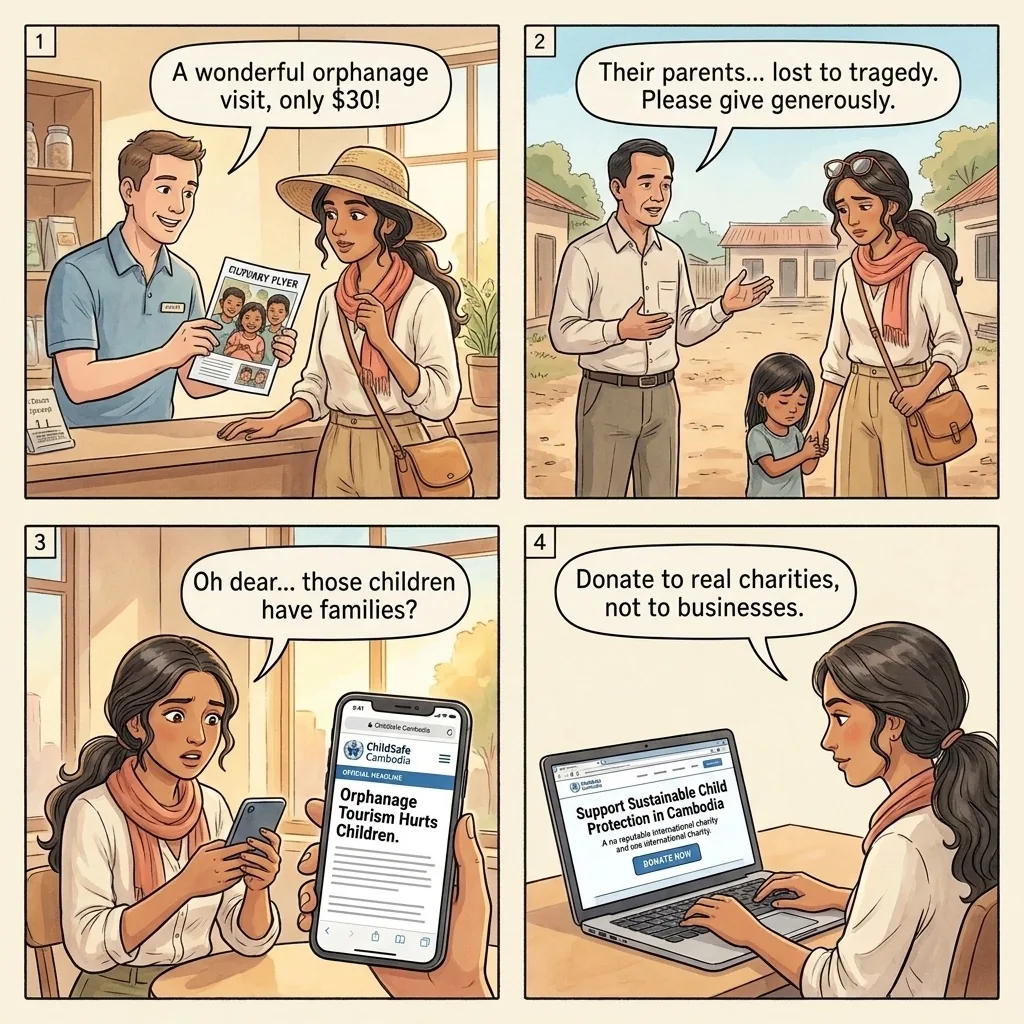
A friendly receptionist at your hostel hands you a glossy flyer for a 'half-day orphanage visit' on the outskirts of Phnom Penh — meet the kids, play games, share a meal, donate $30, transport included.
The pitch is warm. The flyer shows photos of smiling children in school uniforms, a small classroom with English vocabulary on the chalkboard, and a brief note about how donations 'fund education, food, and shelter.' You sign up with two friends from the dorm. The next morning a tuk-tuk takes you forty-five minutes north of the city to a cluster of low concrete buildings where children line up at the gate to greet you. A staff member walks you through.
The children are between four and twelve, dressed in slightly worn but clean clothes, and they perform — there is no other word — for the visit. They sing two English songs, accept your hugs, hold your hand on the brief walk to a 'classroom,' and pose for photos when the staff signal. The director gives a moving speech about the children's parents who 'died of HIV' or 'were lost in landmine accidents' and asks for your donation in cash, ideally USD, ideally a bit more than the suggested $30.
UNICEF, Save the Children, and ChildSafe Cambodia have spent more than a decade documenting the orphanage-tourism scam. The 2018 UNICEF Cambodia report estimated that more than 75% of the children living in Cambodian residential 'orphanages' have at least one living parent — many were paid or pressured to surrender their children to the institution because tourist donations are more lucrative than agricultural income. The institutions are deliberately kept under-resourced to look poor enough to extract donations, and the children are coached to perform sadness and gratitude on cue.
The harm is well-evidenced. Repeated separations from short-stay visitors damage attachment formation; mandatory English performances disrupt schooling; the photos you take and post to Instagram travel back to predators who use orphanage location data to identify accessible children. Even if you arrive with the best of intentions, the visit itself is the harm — and your $30 is the economic engine that keeps the children inside the institution rather than with their families. The Cambodian government has, since 2017, been actively closing fraudulent orphanages and reuniting children with their families, with explicit messaging that voluntourism is part of the problem.
Never visit or donate to orphanages on a tourist basis in Cambodia — UNICEF, Save the Children, ChildSafe, and the Cambodian Ministry of Social Affairs are unanimous that orphanage tourism causes harm even when intentions are good. If you want to support Cambodian children, donate directly to vetted family-strengthening organizations: PEPY Empowering Youth, Friends-International, Mlup Russey, or M'Lop Tapang in Sihanoukville. Look for the green ChildSafe badge on hostels and tour operators in Phnom Penh — badged businesses have agreed not to promote orphanage visits. Report any operator pushing orphanage tours to ChildSafe Cambodia at +855 92 311 112.
Red Flags
- Organization allows brief volunteer visits for a fee with minimal vetting
- Children perform poverty or sadness for visitors
- Photos with orphans are encouraged as part of the 'experience'
How to Avoid
- Never visit or donate to orphanages on a tourist basis — even well-intentioned visits cause harm.
- If you want to volunteer, use established organizations like PEPY or Friends-International that vet thoroughly.
- UNICEF and Save the Children both advise against orphanage tourism in Cambodia.
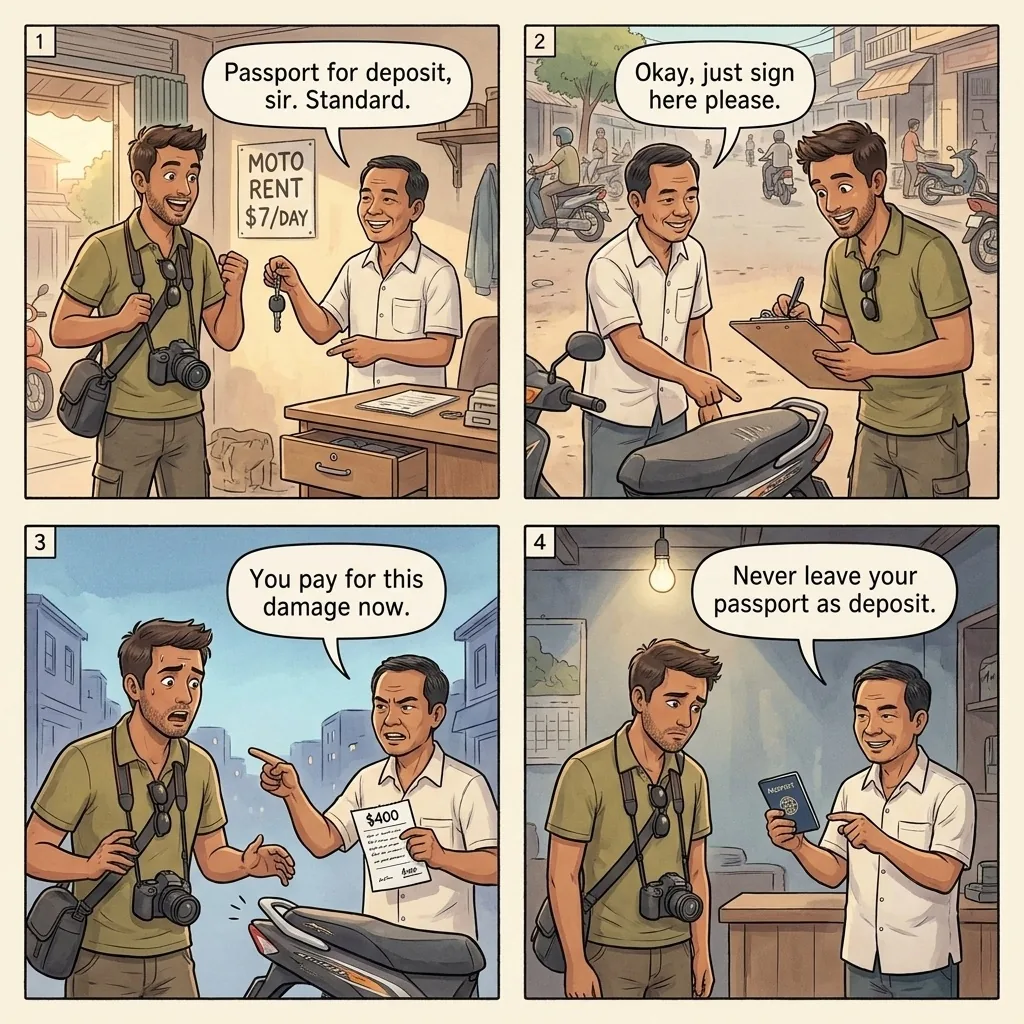
A small shop on a side street in BKK1 advertises 125cc Honda Click rentals at $7 a day, and the owner asks you for your passport — the actual one, not a copy — as the standard deposit before he hands over the keys.
It is your second day in Phnom Penh, you want to ride out to the Russian Market and Tuol Sleng on your own schedule, and the price is fair. The owner does a brief walk-around with you, pointing out the few existing scuffs in casual English, hands you a Xeroxed rental agreement to sign, and stuffs your passport into a drawer behind the counter. You sign without reading the fine print, take the keys, and ride off.
Three days later you bring the bike back unscathed. The owner pulls it onto the curb, walks slowly around it, and stops at the rear panel. He runs his finger along a scratch and says, calm at first, that this damage was not there before. He points to a chip near the foot peg. He flips up the seat and finds a small dent inside the storage compartment that you have certainly never seen. He hands you a bill: $400 for repairs and 'lost rental days.'
You protest. The damage was already there, or never existed at all. He shrugs. He opens the drawer behind the counter, taps your passport with a fingernail, and tells you that of course you can dispute the charge — but until then, the passport stays with him. Without your passport you cannot fly out, you cannot check into another hotel, you cannot reach an embassy easily, and the longer the dispute drags, the more the 'lost rental days' bill grows. Most travelers pay $200–500 to get the passport back rather than fight a multi-day standoff.
The motorbike passport-hostage scam is the most consistently reported high-loss Phnom Penh tourist scam, documented across Reddit, the Cambodia subforum on Lonely Planet's Thorn Tree, and warnings from the U.S., U.K., and Australian embassies. The pattern is consistent: an unusually cheap day rate ($5–10 versus the legitimate $10–15), a shop with few or no online reviews, a passport-only deposit policy, and 'damage' invented after the fact. The Cambodian government has issued statements that surrendering original passports for short-term rentals is not legally required and that shops doing so are operating in a gray zone.
Never surrender your original passport as a rental deposit in Phnom Penh — offer a clear photocopy plus a $50–100 cash deposit instead, and walk out of any shop that refuses. Photograph and video every centimeter of the bike before you ride, including the rear panel, foot pegs, seat compartment, and dashboard, with the owner visible in frame. Use only well-reviewed shops (Lucky! Lucky!, Vannak Bikes) with posted English contracts. If a shop demands inflated damage fees and holds your passport, dial 117 for police and call your embassy (US: +855 23 728 000; UK: +855 23 427 124).
Red Flags
- Rental shop requires your actual passport (not a copy) as deposit
- No detailed written condition report done before rental
- Shop has very few online reviews or negative reviews about damage claims
How to Avoid
- Never surrender your original passport as rental deposit — offer a copy and cash instead.
- Photograph and video every centimeter of the vehicle before driving away.
- Use well-reviewed rental shops with established reputations from hostel recommendations.
🆘 What to Do If You Get Scammed
📋 File a Police Report
Go to the nearest Cambodian Tourist Police station. Call 117 (Police) or 119 (Emergency). Get an official crime report — you'll need this for insurance claims. You can also report online at tourismcambodia.com.
💳 Cancel Your Cards
Call your bank immediately. Most have 24/7 numbers on the back of the card (keep a photo saved separately). Block any suspicious transactions before the thieves use your details.
🛂 Lost Passport?
Contact your nearest embassy or consulate. The US Embassy in Phnom Penh is at #1, Street 96, Sangkat Wat Phnom, Khan Daun Penh. For emergencies: +855 23-728-000.
📱 Track Your Device
If your phone was stolen, use Find My (iPhone) or Find My Device (Android) from another device. Don't confront thieves yourself — share the location with police instead.
Frequently Asked Questions
You just read 6 scams in Phnom Penh. The full Travel Safety Series has 780+ more across 20+ countries.
Tokyo's Kabukichō ¥130,000 bar trap. Rome's gladiator photo extortion. Paris's gold-ring trick. Bali's ATM skimmer scams. Bangkok's grand-palace closure ruse. Every documented scam across 20+ destinations — with the exact scripts, red flags, and local-language phrases that shut each one down. Drawn from Reddit traveler reports, embassy advisories, and consumer-protection cases.
- 780+ documented scams across Tokyo, Rome, Paris, Bali, Bangkok, Rio & 100+ more cities
- 20+ countries covered, with country-by-country phrase cards for every destination
- Updated annually — buy once, re-download future editions free
- All titles $4.99 each on Amazon Kindle