
Key Takeaways
- The #1 reported scam is the Angkor Hologram Ticket Roadside Sale.
- 1 of 6 scams are rated high risk.
- Use official taxi ranks or local ride apps where available — always confirm the fare before departure.
- Never accept unsolicited offers from strangers near tourist sites in Siem Reap.
⚡ Quick Safety Tips
- Book Angkor Wat tours only through your hotel or licensed operators — tuk-tuk drivers who approach at the airport often overcharge and skip temples.
- Buy your Angkor pass only at the official ticket office on Apsara Road — anyone selling tickets elsewhere is selling fakes.
- At Pub Street restaurants, check prices before ordering — some menus show USD prices that are 2-3x the local price.
- Be cautious of children selling souvenirs or postcards near temples — while sympathetic, buying encourages child labor and the money rarely reaches them.
Jump to a Scam
The 6 Scams
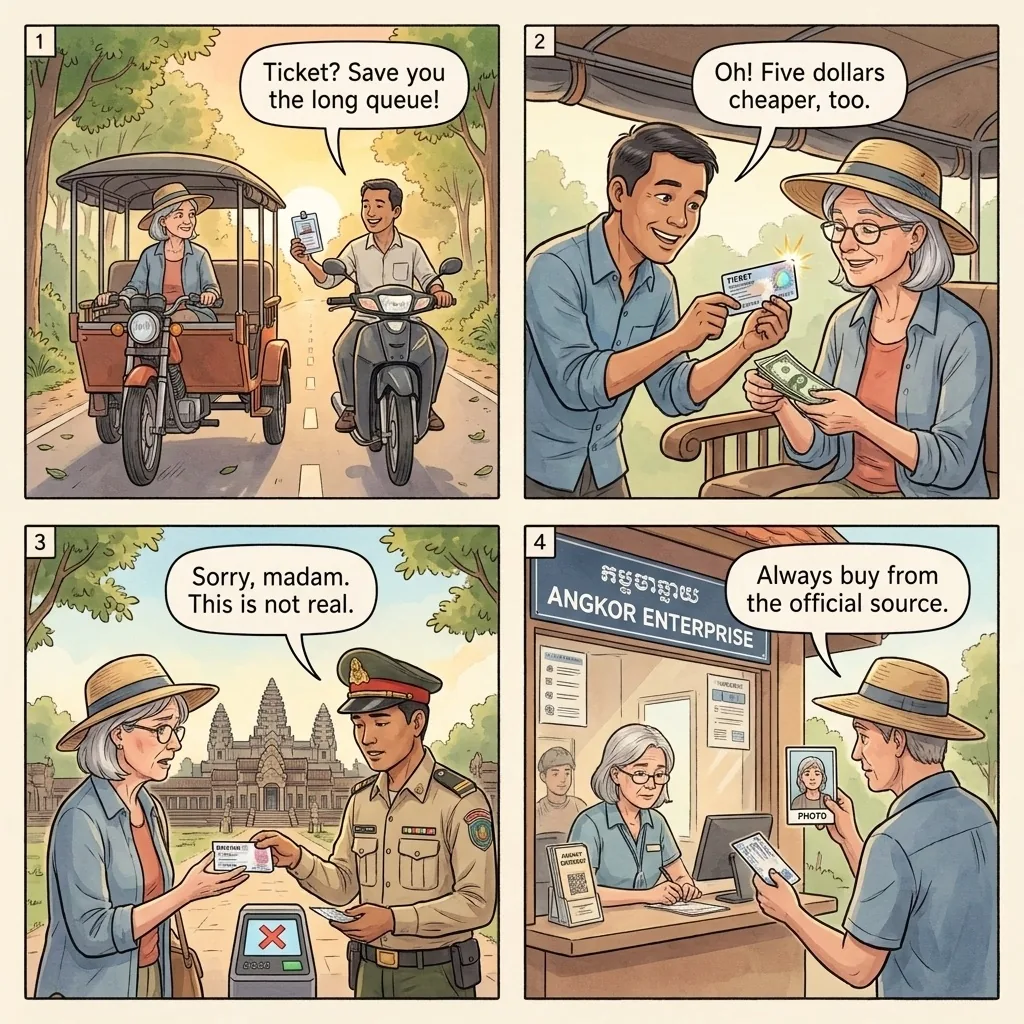
You climb into a tuk-tuk at six in the morning to beat the crowds to Angkor Wat, and a few kilometers up the Charles de Gaulle road a man on a scooter pulls alongside and waves your driver down.
He leans into the back of the tuk-tuk with a friendly smile and a stack of laminated passes. He offers to sell you a one-day pass for $32, three dollars below the official $37, and tells you it will save you the long queue at the ticket center up ahead. The pass looks correct — embossed Angkor logo, hologram strip, plastic card stock, even a printed date matching today. He pulls one out, lets you hold it, and says he just needs your name on the back.
You think about the queue, you think about the heat already building, you hand over the cash, and the scooter peels away before the tuk-tuk has stopped rolling. Twenty minutes later you reach the actual Angkor Wat entry checkpoint. The Apsara Authority guard scans the pass, the scanner buzzes, and he turns it over with the polite resignation of someone who sees this several times a day. The hologram is real-looking. The card is fake. You have lost $32 and now need to ride back to the official ticket center and pay another $37.
The fake-pass roadside sale is the most consistently reported high-loss tourist scam in Siem Reap. The Apsara Authority and the Cambodia Ministry of Tourism have issued repeated warnings since the 2017 introduction of photo-bearing passes, and Reddit plus the long-running TripAdvisor Siem Reap forum carry first-person accounts running at $30–60 per loss. The fakes have improved sharply since 2020 — current ones include holograms, raised printing, and barcodes — which is why even experienced travelers get caught.
A second variation runs through guesthouses. A clerk or 'tour helper' offers to 'organize' your Angkor passes overnight for a small convenience fee, hands you a pass that looks legitimate, and pockets the entire payment. The passes also fail at the gate. Real Angkor passes can only be issued at the official Angkor Enterprise ticketing center — a large, well-signed compound on Apsara Road north of Siem Reap — and require a photograph of you taken at the booth, printed onto the pass, before any guard will accept it.
Buy Angkor passes only at the official Angkor Enterprise ticketing center on Apsara Road — the photo on the pass is the authentication, and no third party can issue one. Refuse every pass offered on the road, by a tuk-tuk driver, by a guesthouse, or by anyone on a scooter, regardless of price or hologram. Pay in cash or by card at the official booth, and keep the pass on you at every checkpoint inside the park. If a roadside seller approaches you, photograph their plate and report them to the Tourist Police at 097-778-0002 or call 117 for police.
Red Flags
- Ticket sellers approaching vehicles on the road before the official booth
- Someone at your guesthouse offers to 'organize' Angkor tickets for you
- Tickets sold at slightly below official price to seem like a bargain
How to Avoid
- Buy Angkor passes only at the official Angkor Enterprise ticketing center (well-signed).
- The official center is at the north of Siem Reap — go directly and don't stop for roadside vendors.
- Angkor passes include a photo taken of you at the booth — that's the authentication.
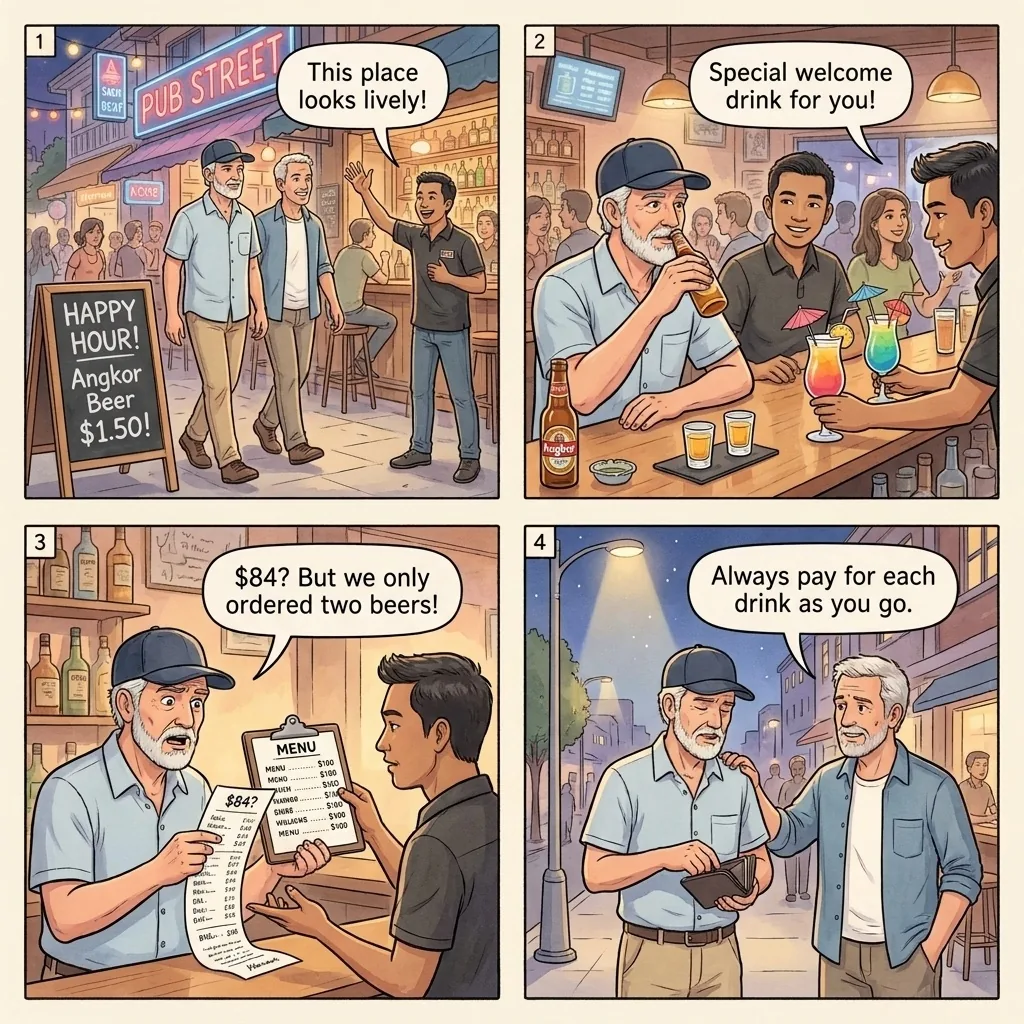
It is your second night in Siem Reap, you and one friend duck into one of the louder bars halfway down Pub Street to get out of the heat, and the staff greet you like old friends and wave you toward two stools at the corner of the bar.
A bartender asks if you want a drink, you say two beers, and another staff member appears with a tray and starts pouring tequila shots that you did not order. Someone on your other side asks where you are from, asks if you have tried the local rum, and a third staff member sets two cocktails in front of you with little umbrellas. The music is loud, the room is packed, and three or four drinks have arrived without an explicit order.
The vibe is party, not pressure, so you do not push back. Twenty minutes later you signal for the bill. The total is $84 for what felt like three rounds. The handwritten chit lists eleven drinks at prices well above the laminated menu — $8 cocktails when the menu shows $4, $6 beers when the chalkboard outside said $1.50 for happy hour. When you point at the menu, the waiter shrugs and says 'this not happy hour, sir' and gestures vaguely at the time.
The Pub Street round-robin is the most documented Siem Reap nightlife scam, with accounts going back to 2015 on TripAdvisor and Reddit. The mechanic is consistent: an overly friendly staff that orders you drinks rather than waiting for you to order, a chalkboard happy-hour price that conveniently expired five minutes before you walked in, and a paper bill that bears no resemblance to the menu pricing. The chaos and the friendliness are the cover for the systematic overcharge.
Reputable Pub Street bars exist — Miss Wong, Asana Wooden House, X Bar, and most of the second-floor places with proper menus and printed receipts — but the worst offenders are the one-room ground-floor bars with handwritten chits, no visible menu inside, and aggressive front-door touts. The ones with neon signs but no TripAdvisor presence are statistically the riskiest, and the Angkor Night Market spillover bars run the same playbook with a 'free shot for ladies' opener.
Pay for each round as it is served rather than running a tab on Pub Street, and refuse any drink you did not explicitly order — push it back across the bar, do not let it sit in front of you. Drink only at bars with a printed menu visible inside (not just a chalkboard outside) and recent TripAdvisor reviews mentioning consistent pricing. Photograph the menu the moment you sit down so you have proof of the listed prices when the bill arrives. If a bar refuses to honor the menu price, refuse to pay the inflated amount, photograph the bill and the menu, and call the Tourist Police at 097-778-0002 or dial 117.
Red Flags
- Staff orders extra drinks without explicitly asking your permission
- Running tab rather than pay-per-drink system
- Bill appears with unfamiliar items or quantities
How to Avoid
- Pay for each round as it's served rather than running a tab.
- Check the menu prices and verify your bill line by line before paying.
- Stick to well-reviewed bars on TripAdvisor with consistent pricing feedback.

You step out of the eastern entrance of Bayon temple after an hour inside, blink in the sun, and a small girl is already at your elbow holding up a fan of postcards in a clear plastic sleeve.
She is maybe seven years old, in clean clothes, and her pitch is sharp and rehearsed. 'Postcards, sir, only one dollar, ten for one dollar.' She speaks English clearly, and as you walk toward your tuk-tuk she switches into French, then Mandarin, naming countries — Spain, Australia, Korea — until she finds yours. Two more children, slightly younger, fall into step on either side of you with bracelets and silk scarves.
It is hard not to buy something. The pitch is practiced and the price is small, and the heat plus the temple awe plus the half-distracted reach for your wallet is a real combination. Many travelers buy a stack of postcards or a few bracelets just to disengage. The kids are working a route — Bayon to Ta Prohm to Pre Rup — that mirrors the standard tourist circuit, and the same children appear in the same uniforms on the same days because the routine is coordinated.
Friends-International, ChildSafe Cambodia, and UNICEF have run public-information campaigns on this for over a decade because the math, on careful examination, runs in the wrong direction. Money paid to child vendors at Angkor flows to adults who organize the operation — relatives, neighbors, sometimes traffickers — and creates direct economic pressure on families to pull children out of school during peak tourist hours. ChildSafe data shows children working the temples are typically out of school three to five mornings a week, the most academically critical window of the day.
The same applies to the slightly older teenagers who pitch 'volunteer English practice' or invite you to 'meet my family' on the temple parking lots. The script varies, but the destination is a sympathy purchase, a guesthouse-school donation, or a 'visit' to a relative's stall. ChildSafe-certified businesses in Siem Reap (badged with a small green logo) have agreed not to engage these patterns, and Friends-International has published a 'ChildSafe Traveler Tips' guide specifically for Angkor visitors.
Do not buy from child vendors at any Angkor temple — however heartbreaking it feels in the moment, every dollar funds school truancy and rewards adults who organize the operation. If you want to help Cambodian children, donate to Friends-International, ChildSafe Cambodia, or Riverkids, and look for the green ChildSafe badge on Siem Reap restaurants and shops. Walk past child vendors firmly but kindly, do not make eye contact for long, and do not offer money or food directly. If you witness a child being directed or punished by an adult organizer, report it to ChildSafe's hotline at +855 92 311 112.
Red Flags
- Children actively selling items at every temple exit
- Child knows exact phrases in many languages to target different tourists
- Large group of children working the same area in coordinated fashion
How to Avoid
- Do not buy from child vendors — however heartbreaking it feels, it funds school truancy.
- If you want to help, donate to established organizations like Riverkids or Friends-International.
- Buying from children perpetuates the cycle — walk past firmly but kindly.
Like what you're reading? Get a full Siem Reap itinerary with safety tips built in.
Browse travel-safety books →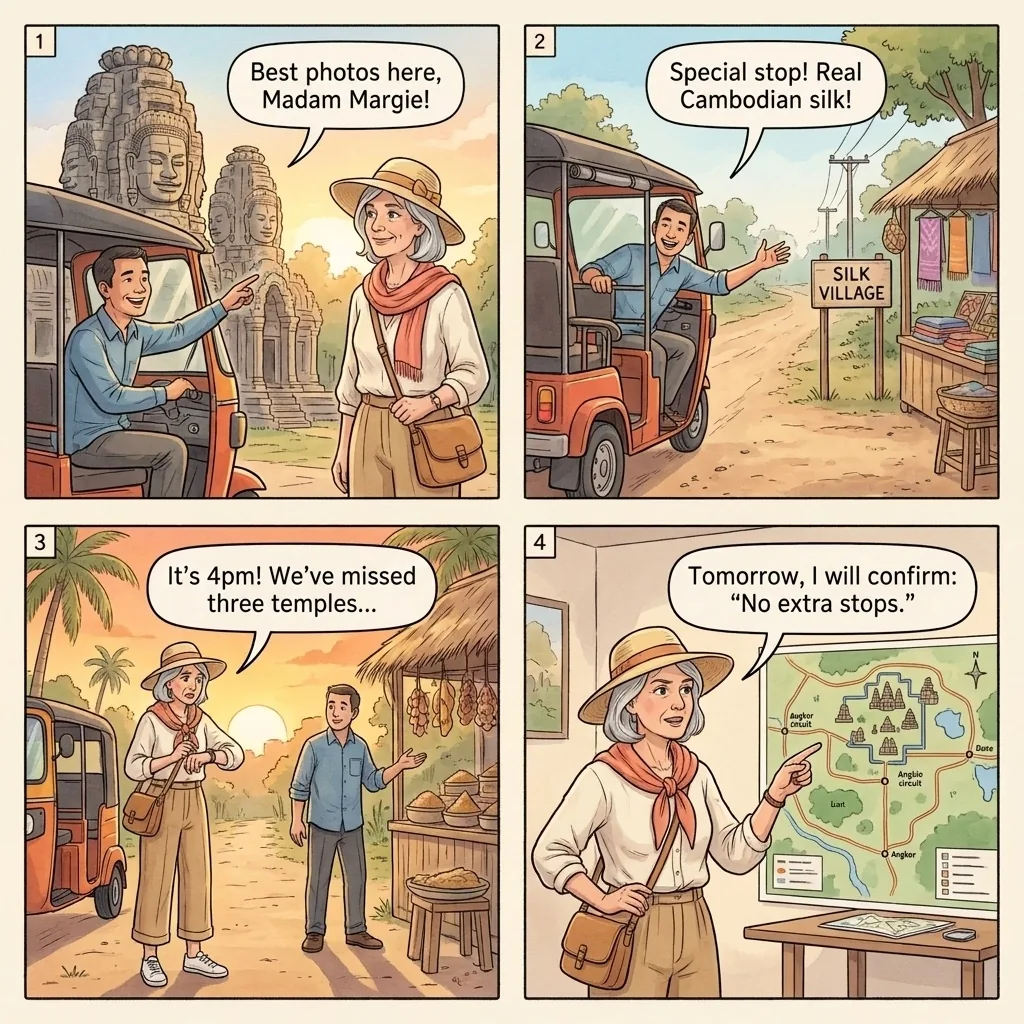
You hire a tuk-tuk driver for the full-day Angkor 'small circuit' for $20 the night before, agree on a list — Bayon, Baphuon, Ta Prohm, Banteay Kdei, Sras Srang, then sunset at Phnom Bakheng — and at sunrise he is at your guesthouse on time with a smile and a cooler of cold water.
The morning runs perfectly. He waits patiently at each temple, points out side paths you would have missed, and lines you up for photos at the Bayon faces. After lunch, on the way to Ta Prohm, he turns left at a junction you do not recognize and tells you about a 'silk village' fifteen minutes off-route — 'very nice, sir, real Cambodian craft, you must see.' You agree to be polite. The visit takes an hour. You buy a small scarf for $12.
From there the day unravels. He suggests a stop at a 'palm sugar workshop' on the way back. Then a 'traditional floating village' near Tonlé Sap that he describes as 'authentic' and 'better than the famous ones.' Each stop takes forty-five minutes to ninety minutes, and at each one a relative or friend appears to walk you through a workshop and quietly suggests a purchase. By four o'clock you have seen Bayon and Ta Prohm but missed Banteay Kdei, Sras Srang, and the entire Phnom Bakheng sunset, and the day on Angkor that you flew across the world for is gone.
The detour-and-commission scam is the most common low-grade Siem Reap rip-off, and it is consistent across drivers because the silk-village and floating-village circuits explicitly pay tuk-tuk drivers $5–10 in commission per delivered tourist plus a percentage on any sale. The 'workshop' is sometimes a real cottage operation, sometimes a warehouse with imported goods relabeled as Cambodian, and the floating-village version routinely charges $25–40 per person for a thirty-minute boat ride that locals access for $2.
The scam survives because the driver is otherwise pleasant and helpful, which makes it socially uncomfortable to push back at the second junction. Hotel-vetted drivers and operators booked through Backstreet Academy, Klook, or your guesthouse's tour desk have written itineraries, fixed-price agreements, and reputations to protect — they almost never run the detour pattern because complaints to the hotel cost them future bookings.
Hand your driver a written list of temples on the morning of the tour and say plainly: 'These are the only stops today, no shopping detours.' Book through your guesthouse or a vetted platform (Klook, GetYourGuide, Backstreet Academy) so the driver is accountable to the booking system. If your driver tries to add a silk village, palm-sugar workshop, or floating-village detour, decline politely but firmly: 'No thank you, today is just temples.' If a driver insists or sulks, do not pay until you reach the agreed final stop, and report him to your guesthouse — and to the Tourist Police at 097-778-0002 if pressure escalates.
Red Flags
- Driver suggests detours not on your agreed itinerary
- Each detour involves a shop, workshop, or village with goods for sale
- Driver is unusually enthusiastic about specific 'authentic' experiences
How to Avoid
- Give the driver a written list of the temples you want to visit and say that's the day's plan.
- Be politely firm: 'Today is just temples, thanks — maybe tomorrow for the village.'
- Book through your hotel for drivers with verified good reputations.
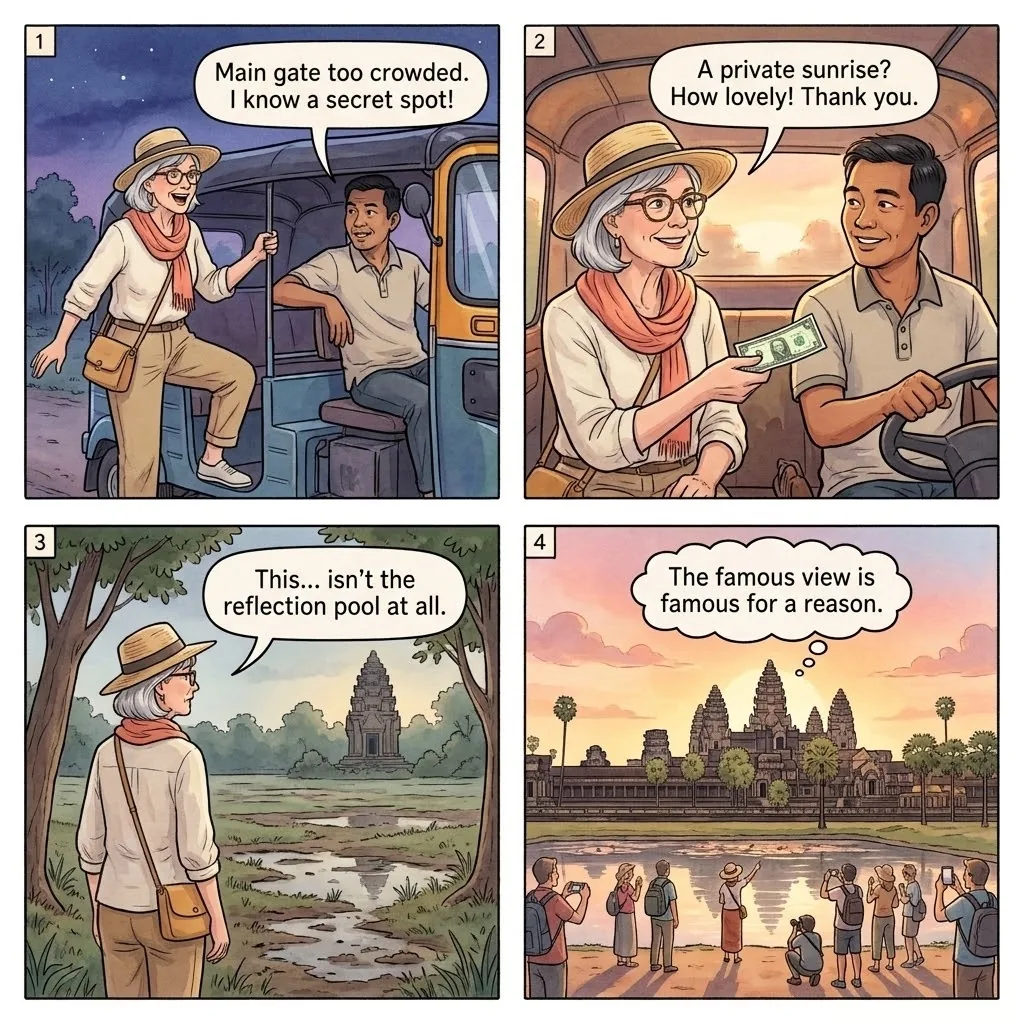
You arrange a 4:30 a.m. tuk-tuk ride to watch sunrise at Angkor Wat — the iconic shot of the temple silhouetted against pink sky and reflected in the lily pond — and your driver leans in conspiratorially as you climb in.
He tells you the main reflection pool will be packed shoulder to shoulder, hundreds of selfie-takers blocking every angle, and that he knows a 'secret' spot only locals use, fifteen minutes out, no crowds, much better photo. He asks for an extra $10 on top of the agreed sunrise rate. You think about a clear sightline versus a sea of camera arms, hand him the cash, and let him drive into the dark.
Twenty minutes later you are standing on a rough field on the back side of the moat, looking through a gap in the trees at a partial silhouette of one tower of Angkor Wat. The view is nothing like the postcard. The light is wrong, the angle is wrong, the lily pond is half a kilometer away on the other side, and the 'crowd' you were avoiding turns out to have been thirty or forty photographers spread across two large reflection pools with plenty of room. You have paid $10 to miss the actual sunrise.
The 'secret sunrise' upsell is one of the most consistent small-dollar scams in Siem Reap, and it is documented on Reddit, the long-running TripAdvisor Angkor forum, and every reputable guidebook. The reflection-pool scene is iconic precisely because it is the actual sightline; there is no genuine secret alternative because the temple is built to face east and the moat geometry only works from one side. The 'secret' versions are either back fields with no real view or paddy-paths that the driver can navigate quickly because no one else goes there.
A second variation involves a hill — Phnom Bakheng or Pre Rup — sold as a 'better sunrise' than Angkor Wat itself. These are genuinely good sunset spots, but at sunrise the sun rises behind the hill rather than in front of it, and the temple of Angkor Wat is not in the frame. Drivers know this and will not refund the upcharge once you are at the wrong location. The actual best variants — sunrise from the eastern Sras Srang reservoir, or a quiet morning at Pre Rup — are not what gets sold under 'secret sunrise' branding.
Skip every 'secret' or 'exclusive' sunrise upsell — the iconic Angkor Wat sunrise shot only works from the north and south reflection pools facing the temple's western causeway, and arriving at the main pools by 5:00 a.m. gets you a clear front-row spot easily. Pay only the agreed sunrise tuk-tuk rate ($15–20 round-trip) and refuse any premium add-on. If you genuinely want a quieter sunrise, ask your guesthouse for the Sras Srang or Pre Rup alternatives — both legitimate and free. If a driver insists on a detour you did not agree to, refuse and ask to be taken to the main reflection pool, or call the Tourist Police at 097-778-0002.
Red Flags
- Any driver offering 'exclusive' or 'hidden' sunrise spots for extra money
- Route goes away from the main temple complex rather than toward it
- Driver discourages the main pool: 'too many tourists, better view I know'
How to Avoid
- The reflection pool in front of Angkor Wat is the classic sunrise view — go directly there.
- Arrive by 5:00 AM to get a good spot at the free viewing area.
- Ignore offers of 'premium' sunrise experiences from anyone other than an established tour company.
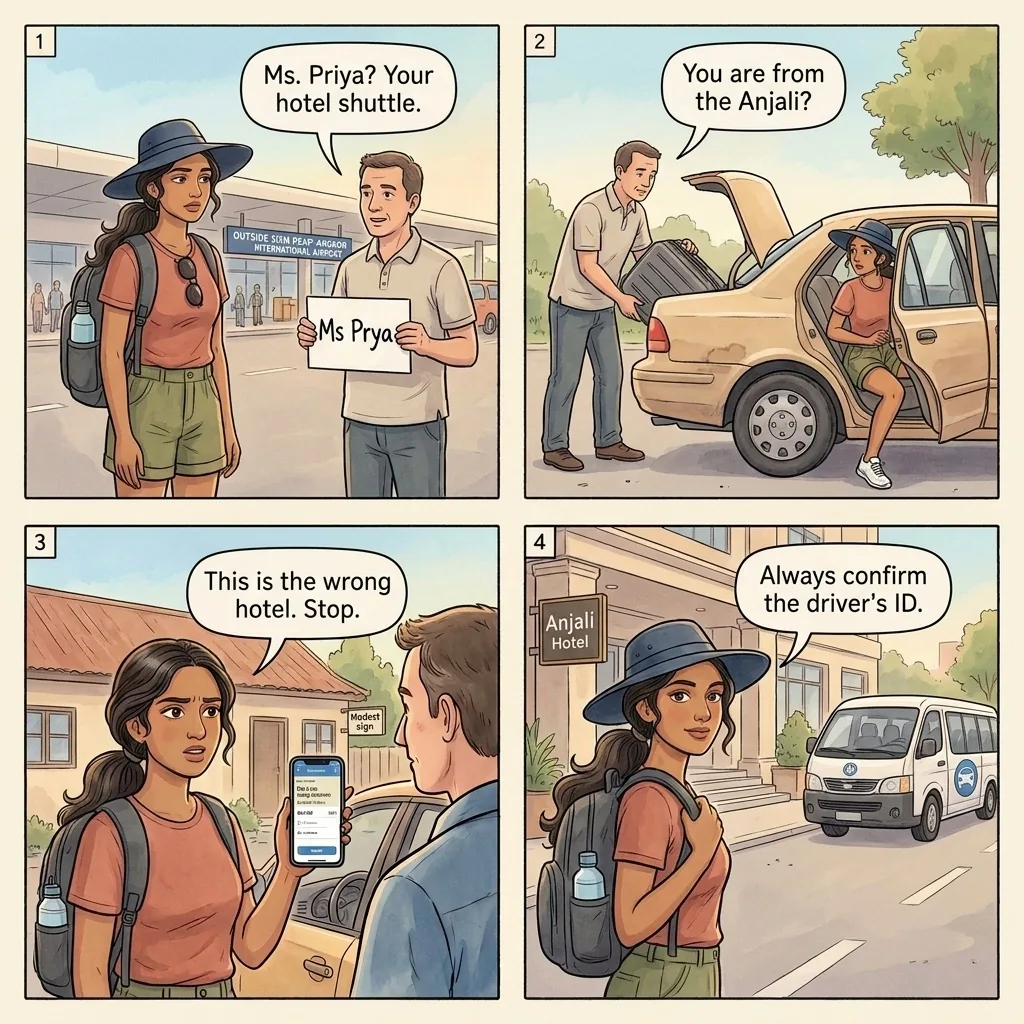
You walk out of arrivals at Siem Reap-Angkor International, look around for the hotel-shuttle driver, and a man stands at the curb holding a sign with what looks like your name written in marker.
He waves at you, smiles, and reaches for your bag before you have fully read the sign. The handwriting is approximate, but he says the right hotel name when you say it out loud, and he is wearing a polo shirt that vaguely resembles a hotel uniform. You assume your hotel sent him. He loads your bag into a worn Toyota Camry parked twenty meters down the curb, you climb in, and he pulls away.
Twenty minutes into Siem Reap, when you arrive at your hotel, things stop fitting. He hands you off at the lobby, the actual hotel staff look puzzled, and the doorman says cheerfully that yes, the hotel's free airport shuttle has been waiting for you on the other side of arrivals. The 'driver' has charged you $20 cash for a ride that was already paid for in your booking. You have no recourse — there is no booking confirmation, no receipt, and the Camry is already gone.
The variation that hurts more is when the driver does not take you to your hotel at all. He drops you instead at a 'partner hotel' — a smaller guesthouse a few blocks away that pays him a commission for delivered tourists — and tells you your booking has been 'changed' or 'upgraded' or that your actual hotel is 'closed for renovation.' If you have not memorized your real hotel's address, the misroute can stick for an entire night before you realize what happened.
The new Siem Reap-Angkor International Airport, opened in 2023 about 50 kilometers from the city, has tightened the curb scene somewhat, but the sign-tout pattern still appears — especially on flights from Bangkok, KL, and Singapore that arrive late. The bus stations on Highway 6 and the boat dock at Chong Khneas (for travelers arriving via Tonlé Sap from Phnom Penh) run the same script with even less oversight, and Reddit's Reddit carries first-person accounts on a near-monthly basis.
Pre-arrange airport pickup directly through your hotel and ask for the driver's name, plate number, and phone number in your booking confirmation email — verify all three before getting into any vehicle. If your hotel does not offer transfers, use Grab or PassApp for a fixed in-app fare ($25–35 to most central hotels) and ignore every sign-tout at the curb. Confirm the hotel name out loud and watch the driver enter it into Google Maps before the car moves. If a driver tries to misroute you, refuse to leave the car at the wrong destination, call your hotel directly, and dial the Tourist Police at 097-778-0002.
Red Flags
- Driver holds your name on a sign but can't name your hotel accurately
- Driver is very eager to get you in the car before you confirm details
- Price much higher than Grab app rates
How to Avoid
- Pre-arrange airport pickup through your hotel directly.
- Use the Grab app for transparent, metered pricing from the airport.
- Confirm the driver's identity and your hotel name before getting into any vehicle.
🆘 What to Do If You Get Scammed
📋 File a Police Report
Go to the nearest Cambodian Tourist Police station. Call 117 (Police) or 119 (Emergency). Get an official crime report — you'll need this for insurance claims. You can also report online at tourismcambodia.com.
💳 Cancel Your Cards
Call your bank immediately. Most have 24/7 numbers on the back of the card (keep a photo saved separately). Block any suspicious transactions before the thieves use your details.
🛂 Lost Passport?
Contact your nearest embassy or consulate. The US Embassy in Phnom Penh is at #1, Street 96, Sangkat Wat Phnom, Khan Daun Penh. For emergencies: +855 23-728-000.
📱 Track Your Device
If your phone was stolen, use Find My (iPhone) or Find My Device (Android) from another device. Don't confront thieves yourself — share the location with police instead.
Frequently Asked Questions
You just read 6 scams in Siem Reap. The full Travel Safety Series has 780+ more across 20+ countries.
Tokyo's Kabukichō ¥130,000 bar trap. Rome's gladiator photo extortion. Paris's gold-ring trick. Bali's ATM skimmer scams. Bangkok's grand-palace closure ruse. Every documented scam across 20+ destinations — with the exact scripts, red flags, and local-language phrases that shut each one down. Drawn from Reddit traveler reports, embassy advisories, and consumer-protection cases.
- 780+ documented scams across Tokyo, Rome, Paris, Bali, Bangkok, Rio & 100+ more cities
- 20+ countries covered, with country-by-country phrase cards for every destination
- Updated annually — buy once, re-download future editions free
- All titles $4.99 each on Amazon Kindle