
Key Takeaways
- The #1 reported scam is the Mactan Airport Broken-Meter Quote.
- 1 of 6 scams are rated high risk.
- Use official taxi ranks or local ride apps where available — always confirm the fare before departure.
- Never accept unsolicited offers from strangers near tourist sites in Cebu.
⚡ Quick Safety Tips
- Keep phones and valuables in secure pockets when in crowded areas.
- Use only licensed taxis or app-based ride services.
- Book tours and tickets through verified operators with online reviews.
- Keep a copy of your passport separate from the original.
Jump to a Scam
The 6 Scams
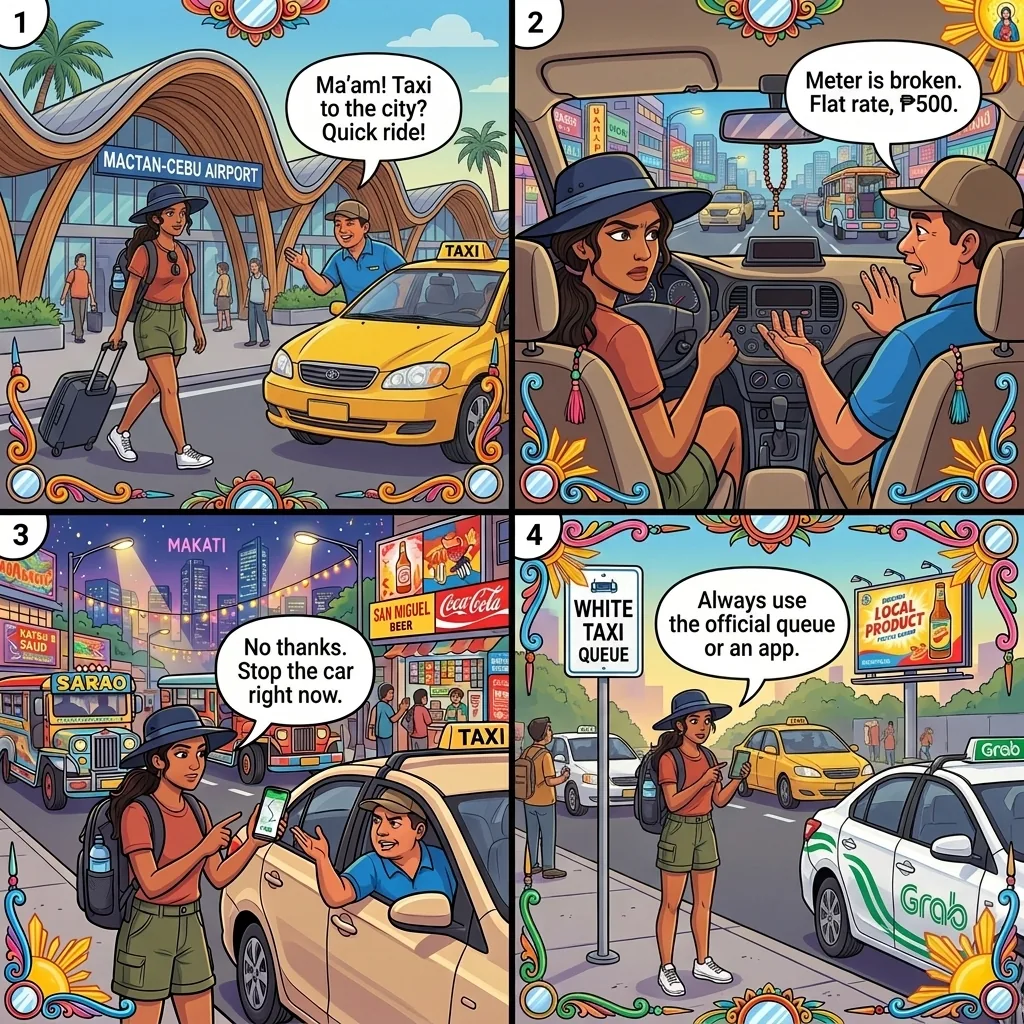
You walk out of Mactan-Cebu International Airport with one bag and a hotel pin in your phone, and the first yellow taxi in line waves you over before you reach the curb.
The driver loads your luggage, you settle into the back seat, and as the car pulls away you ask him to switch on the meter. He waves dismissively and tells you 'Meter broken, sir — five hundred pesos to the city.' You glance at the dashboard. The meter is there, but it is unlit. Outside the window, a steady line of yellow cabs is doing the same routine with the next batch of arrivals.
The actual metered fare from Mactan Airport to Cebu City center runs roughly ₱150–200, depending on traffic and time of day. The 'broken meter' line is the most commonly reported scam in Cebu, and it is consistent enough that locals quote almost the same wording back. Yellow Taxi Cab Drivers Are Scammers — BEWARE, a TripAdvisor thread, documents a driver who demanded ₱300 from the airport to Pier 1 while a working meter displayed only ₱160 the whole way.
CebuParadise's safety guide flags meter manipulation and broken-meter claims as the most prevalent tourist scams in the city. The Guide to the Philippines warns that airport taxi scams 'involve drivers charging exaggerated fare rates to unsuspecting passengers, especially those who appear to be foreigners,' and a long thread in the Philippines Expats Facebook group describes airport drivers quoting two to three times the metered rate. Some cabs run rigged meters that tick fast, adding roughly fifty percent to a legitimate fare without ever 'breaking' anything.
If you push back and insist on the meter, a few drivers shrug and turn it on, then take a deliberately longer route through congested side streets to make the number rise. Others simply refuse the trip and roll the window up, knowing the next foreigner in line will accept the flat ₱500. By the time most travelers realize how far the quoted price is from the metered one, the cab is already on SRP and the moment to negotiate has passed.
Skip the airport taxi line entirely and book Grab on the airport Wi-Fi before you walk outside — the app shows a fixed fare, tracks the route, and pins the driver to a rating system. If you must take a yellow cab, refuse to leave the curb until the meter is on and visible, photograph the plate and operator card on the dashboard, and know the benchmark numbers: roughly ₱150–250 metered to Cebu City center, ₱200–300 to IT Park, and ₱350–500 if you pre-book a hotel transfer. If a driver overcharges, dial 911 for emergencies or the Tourist Police at +63 2 524-1660 with the plate and operator number.
Red Flags
- The driver claims the meter is broken or says it is 'not working today' — this is almost always a lie
- The quoted fixed price is more than double what Google Maps shows for the distance
- The meter appears to be running unusually fast compared to the rate of travel
- The driver refuses to let you check the plate number and operator number displayed on the dashboard
- The driver immediately proposes a fixed fare without you asking — a sign they know the metered rate is much lower
How to Avoid
- Use the Grab app (Southeast Asia's equivalent of Uber) for all rides — prices are fixed, routes are tracked, and you can rate drivers.
- If using a taxi, insist the meter is running before the car moves — if the driver refuses, get out and take the next one.
- Note the taxi's plate number and operator number before getting in — displayed on a card on the dashboard.
- Pre-book airport transfers through your hotel, which typically costs 350-500 PHP to Cebu City center.
- Know the approximate fares: Airport to Cebu City center is 150-250 PHP metered, Airport to IT Park is 200-300 PHP.
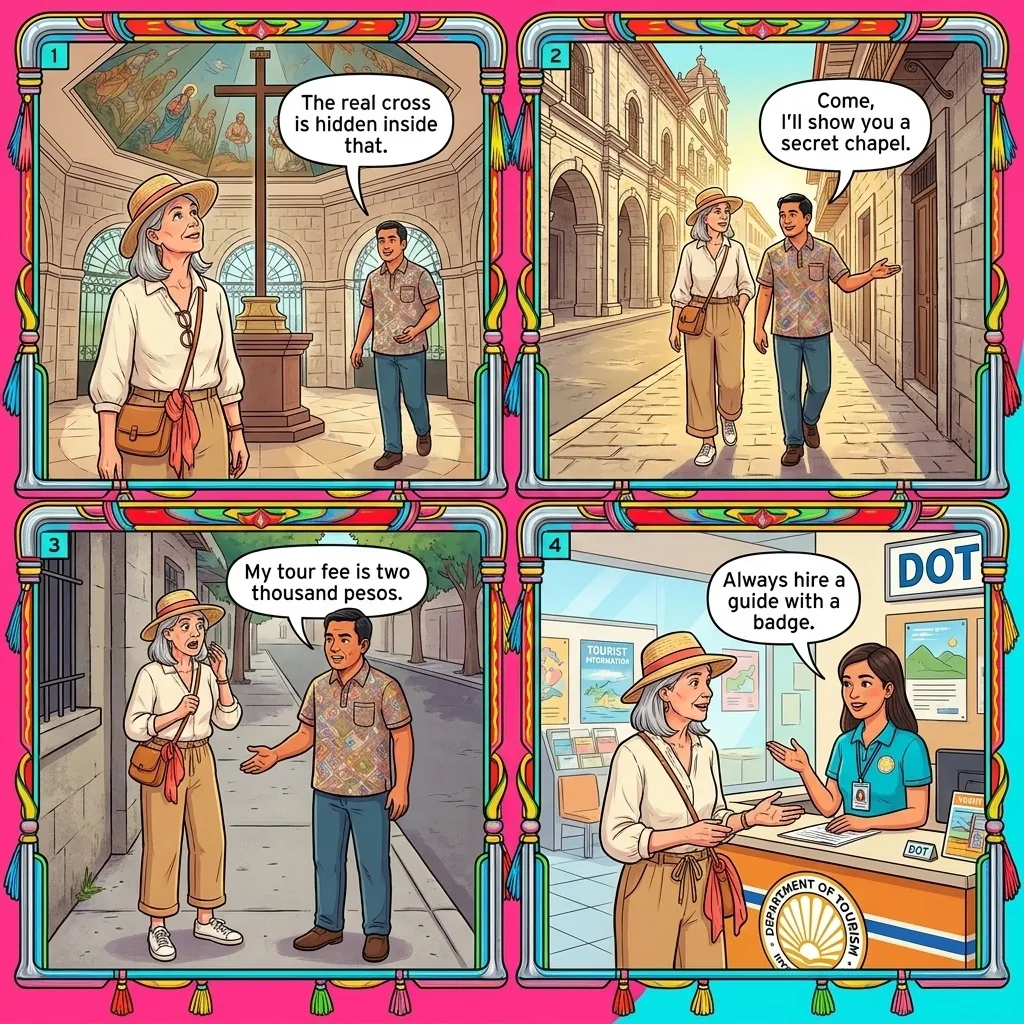
You are standing in the small kiosk at Magellan's Cross, reading the painted ceiling and the historical plaques, when a friendly local steps in beside you and starts narrating the site's history without being asked.
He knows details that are not on the signs — which Spanish friar planted the cross, where the original wood is hidden, why the basilica next door is built the way it is. He has no badge, no clipboard, and no fixed pitch. He just talks, and his English is good. After ten minutes he gestures toward the basilica and offers to show you 'a few hidden spots that tourists never see,' and the conversation slides into a tour without you ever agreeing to one.
An hour later you have walked through the old quarter, ducked into a small chapel, climbed a viewpoint, and lingered inside what he calls a 'local artisan workshop' where a friend of his sells rosaries and shell jewelry. You buy a small souvenir to be polite. Then he stops on a quiet stretch of sidewalk and tells you the tour is over — and that his rate is ₱2,000–3,000, roughly $35–55. When you balk, his tone changes, and he insists you agreed to pay the moment you started walking with him.
The Guide to the Philippines and CebuParadise both warn about locals who 'pose as tour guides and try to take you around and show you unexplored places, then ask for a high price for their services at the end of the tour.' The scam works because the interaction is ambiguous on purpose: the traveler thinks they are having a friendly encounter with a knowledgeable local, while the hustler is running a deliberate unlicensed tour with the price reveal saved for the end, when refusing feels socially harder.
There is a second revenue stream baked into the route. The 'artisan workshop,' the snack stop, the bottled-water vendor — many fake guides earn a commission cut on whatever you buy at those stops, layered on top of the closing fee. Legitimate DOT-accredited guides, by contrast, wear a visible identification badge from the Department of Tourism, discuss pricing before any walk begins, and almost never approach tourists cold at heritage sites. The contrast is sharp once you know what to look for.
If a stranger starts narrating history at you near Magellan's Cross or the basilica, decline within the first minute with a firm 'No thank you, I prefer to explore alone' before any walking happens — silence and distance end this scam cleanly. If you do want a guide, hire only DOT-accredited operators with visible badges, agree on price, duration, and route in writing or text before the tour starts, and book through your hotel, Klook, GetYourGuide, or a licensed local agency. If pressured for payment at the end of an unsolicited walk, hand over ₱200–500 as a tip, walk toward people, and call the Tourist Police at +63 2 524-1660.
Red Flags
- A stranger approaches you at a tourist site and begins giving unsolicited information or history
- They offer to show you 'hidden' or 'secret' spots that only locals know — creating a sense of exclusive access
- They never mention a price or show any identification badge during the entire interaction
- The route includes stops at specific shops or restaurants where the guide seems to know the staff personally
- At the end of the tour, they present a specific price and become confrontational if you do not pay
How to Avoid
- Only hire tour guides who display a DOT (Department of Tourism) accreditation badge.
- Agree on the price, duration, and itinerary before any tour begins — get it in writing or via text message.
- If a stranger starts giving you a tour unsolicited, politely say 'No thank you, I prefer to explore alone' within the first minute.
- Book tours through your hotel, a reputable platform like Klook or GetYourGuide, or a licensed local agency.
- If pressured for payment at the end of an unsolicited tour, offer 200-500 PHP as a tip and walk away — you do not owe the demanded amount.
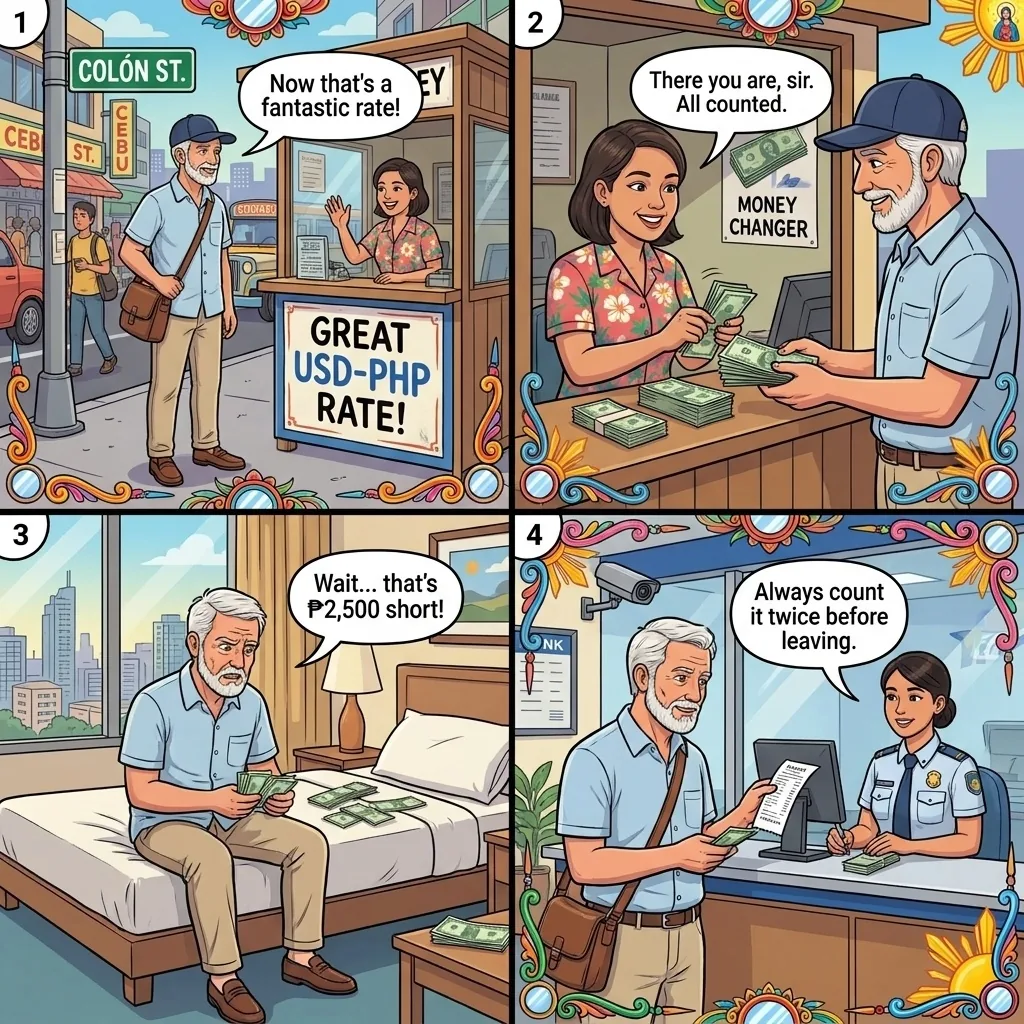
You need to swap USD for Philippine pesos and a small kiosk near Colón Street is advertising a rate noticeably better than the bank, with a hand-painted board that updates twice a day.
You hand over $200 and watch the teller count the pesos out across the counter, fanning the bills as she goes. The math looks right — about ₱11,000 in 500s and 1,000s. She taps the stack square, slides it under the glass, and asks if you want a receipt. You do not. You pocket the cash, thank her, and step back into the heat of Colón Street with your phone already calculating dinner.
Back at the hotel, you recount on the bed. There is ₱8,500. You count again. Still ₱8,500. The teller has palmed roughly ₱2,500 during the count, almost certainly by folding two bills as one and tucking the duplicate under her thumb on the way to the stack. The motion takes a fraction of a second and is invisible across a counter. There are no security cameras inside the kiosk, no receipt, and no realistic way to prove what just happened.
The Guide to the Philippines describes this exact sleight-of-hand technique, where 'the money changer will count out the Filipino peso in front of you and use a sleight-of-hand trick when counting to make some notes vanish.' Respicio Law Philippines has logged formal legal complaints against currency-exchange scammers in Cebu, confirming the practice is prosecutable when documented. The Philippine Influence travel-crime guide is blunter about the street version: changers who approach tourists offering 'special rates' should 'always be avoided, as they will be trying to trick or scam you.'
There is a second variation worth knowing. GoDigit's Philippines safety guide warns that some kiosks slip counterfeit bills into the stack, particularly older ₱500 and ₱1,000 notes that have been retired or recalled but still circulate at the margins. You may walk away with the right total and still discover later that two notes will not be accepted at your hotel. The recommended safe alternatives are exchanges inside Ayala Center Cebu, SM City Cebu, or ALCO Credit in Raintree Mall, plus ATM withdrawals from BDO, BPI, or Metrobank.
Use mall-based money changers only — Ayala Center Cebu and SM City Cebu both have multiple reputable booths with security cameras and visible licenses, and the rate gap versus a sketchy street kiosk is small. Calculate the expected peso amount on your phone before handing over any USD, count every bill yourself at the counter before walking away, and never exchange with anyone who approaches you on the street regardless of the rate. If a kiosk shorts you, file a report at the Tourist Police on +63 2 524-1660 and the BSP counterfeit hotline +63 2 524-7141 with the kiosk address and any receipt.
Red Flags
- The offered rate is significantly better than banks or mall-based changers — if it seems too good to be true, it is
- A person on the street approaches you and offers to change money at a 'special rate'
- The teller counts rapidly, fans the bills, or engages you in conversation during the counting to break your concentration
- The exchange kiosk is a small independent booth, not inside a bank, mall, or established business
- The teller or someone nearby tries to distract you (pointing something out, asking a question) while handing you the money
How to Avoid
- Use money changers inside established malls only — Ayala Center Cebu and SM City Cebu have multiple reputable options.
- Count the money yourself immediately at the counter, bill by bill, before walking away.
- Calculate the expected amount on your phone before the transaction so you know exactly how many pesos to expect.
- Never exchange money with someone who approaches you on the street, regardless of the rate offered.
- Use ATMs from major banks (BDO, BPI, Metrobank) for the safest exchange, accepting the small withdrawal fee.
Like what you're reading? Get a full Cebu itinerary with safety tips built in.
Browse travel-safety books →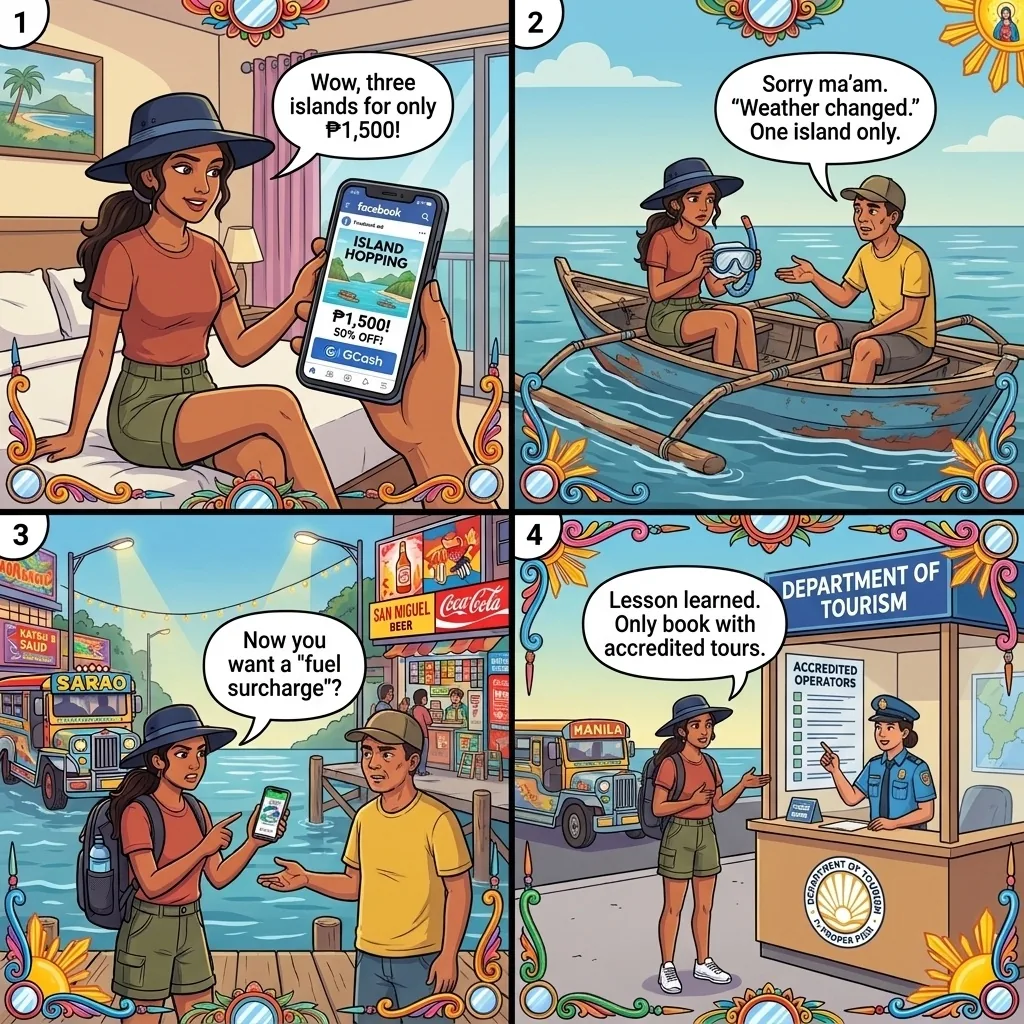
A Facebook ad in your feed promises three islands, snorkeling gear, a beach lunch, and a photographer for ₱1,500 per person — roughly half the price of the established Mactan operators.
The page has hundreds of glossy photos: drone shots of Hilutungan, plates of grilled lapu-lapu, two staff in matching shirts smiling on a banca. You message the page, the reply comes within minutes, and you are asked to send full payment via GCash to confirm the booking. There is no booking confirmation email, no itinerary PDF, and no operator name on the receipt — just a screenshot reference number and a pickup time for the next morning.
On the day, the van takes you to a dock you do not recognize, well past the established jump-off points. The boat is a tired banca with cracked benches, the snorkel masks are loose and fogged, and there are no fins in your size. You visit two islands instead of three because 'the weather changed,' although the sea is flat. Lunch is a few pieces of grilled fish on a paper plate instead of the feast in the photos. At the end, the boatman quietly tells you the bill is not finished.
There is a ₱500-per-person 'fuel surcharge' because diesel went up, plus ₱150 each in 'island entrance fees' that were supposedly included, plus a ₱200 tip 'expected' for the photographer who took perhaps four blurry shots. The tour you booked at ₱1,500 has just become ₱2,350. The operator's leverage is simple: you are on a remote dock with no transport home, and the alternative is a hot, slow walk to find a jeepney with wet feet.
Cebu tourism authorities have been fighting this pattern openly. SunStar Cebu reported across 2024–2025 that provincial tourism chiefs moved to protect bookings after more than 200 documented scam cases since September 2025, with hotspots in Bantayan Island, Badian, and Boljoon. TripAdvisor reviews carry titles like 'Worst Tour of My Life — Company is a Scam' for Island Trek Tours and 'Don't use this Company, refund is a Scam' for Cebu Tours, where the operator stonewalled a refund request. The pattern almost always traces back to a Facebook page using stolen marketing photos and undercutting the established operators.
Book island hopping only through Klook, GetYourGuide, Viator, or hotels that vet their partners — never via cold Facebook pages, and never on full prepayment via GCash. Get every inclusion in writing before paying: islands visited, snorkeling gear, lunch menu, entrance fees, fuel, and photographer fees, with a deposit of no more than thirty percent and the balance settled after the trip. Cross-check the operator's name on TripAdvisor and Google, not just the Facebook reviews, which are routinely faked. If an operator demands surcharges that were not in writing, refuse, photograph the boat and registration, and report the case to the Cebu Provincial Tourism Office and the Tourist Police at +63 2 524-1660.
Red Flags
- The tour is marketed primarily through Facebook with no presence on TripAdvisor, Google, Klook, or other review platforms
- The price is significantly lower than comparable tours from established operators — a legitimate three-island tour runs 2,000-3,500 PHP
- The operator asks for full payment upfront via GCash or bank transfer with no written confirmation of what is included
- Photos on the listing look too professional or are clearly taken from other companies' marketing materials
- The operator cannot provide specifics about the boat, lunch menu, or island itinerary when asked
How to Avoid
- Book island hopping through established platforms (Klook, GetYourGuide, Viator) or directly through hotels that vet their partners.
- Check TripAdvisor and Google reviews for the specific operator — not just the Facebook page reviews which can be faked.
- Get a written or text-based confirmation listing every inclusion: islands visited, snorkeling gear, lunch details, entrance fees, and fuel costs.
- Pay a deposit only, not full payment, and settle the balance after the tour is complete.
- Ask to see the boat before committing — legitimate operators are happy to show their equipment.
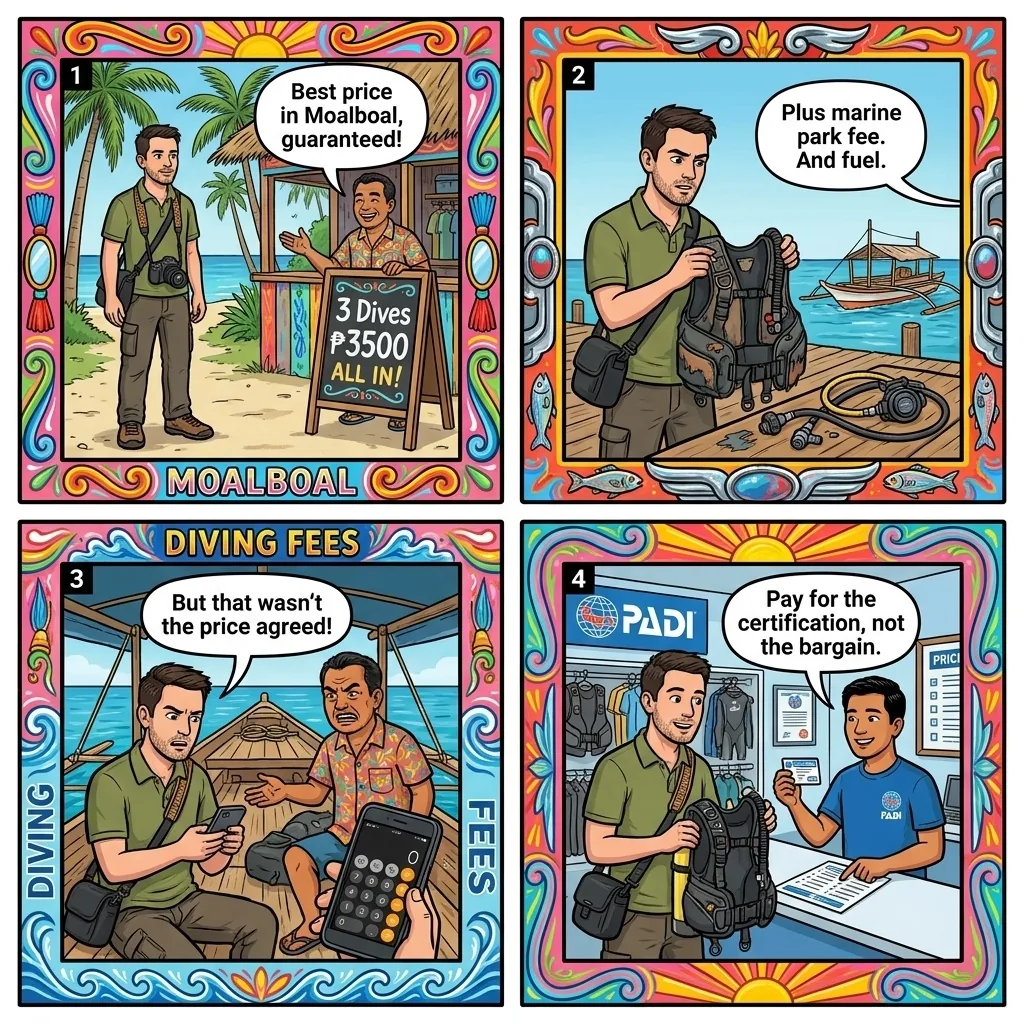
A Moalboal dive shop quotes you a ₱3,500 package: three dives including the famous Panagsama sardine run, equipment rental, a PADI-certified dive master, and boat fees, all in.
The shop has a chalkboard out front, a few diplomas in plastic sleeves on the wall, and a cheerful man in board shorts who books you on the spot. You hand over half the cash as a deposit and walk back to your hostel feeling like you have just landed a deal — every other PADI 5-star center in town is quoting closer to ₱5,000 for the same itinerary. You are told to be back at 7 a.m. with your swimsuit and a towel.
In the morning, the equipment is already on the dock and looks worse than it did in the brochure. The wetsuits are stiff and salt-bleached, the BCDs have frayed straps, and the regulators bubble at the second stage during the surface check. Your dive master introduces himself with a first name only, no certification number, no logbook. He turns out to be an unlicensed local who learned to dive informally from his uncle. The boat captain is the cheerful booking guy from yesterday, doubling roles.
Then the surcharges arrive, one by one. There is a ₱100 Marine Park fee per dive (₱300 total) that the shop says was never included. There is a ₱25 Environmental User Fee per person. There is a 'mandatory local guide fee' of ₱300–500 because regulations now require it, even though you already have a dive master. And there is a fresh fuel surcharge because diesel prices moved last week. Your ₱3,500 package has become ₱5,500 by the time you climb back onto the boat after the second dive.
Moalboal and Mactan have many excellent, reputable PADI 5-star operators, but the low barrier to entry means unlicensed shops regularly pop up, undercutting the established centers and making up the gap with surprise fees and degraded equipment. GoDigit's Philippines travel-scam guide warns about activity operators who 'charge additional exorbitant prices' beyond the advertised rate, and the CebuParadise safety guide flags activity overcharging as a known issue across the dive sector. The equipment shortcut is the part that turns a wallet problem into a safety one — a leaking second stage at twenty meters is not a price dispute.
Book only with PADI 5-star dive centers and verify the certification number on PADI's official site before paying anything beyond a small deposit. Demand a written, itemized breakdown — dives, equipment, boat, Marine Park fees, environmental fees, guide fees — and refuse to settle the balance until you have inspected the gear and met your named dive master with a logbook in hand. For Oslob whale-shark viewing, book through the official Oslob Tourism Office to avoid both inflated pricing and the worst of the unethical operators. Report unlicensed shops to the Tourist Police on +63 2 524-1660 with the shop name and any receipts.
Red Flags
- The advertised price is significantly lower than established PADI 5-star dive centers in the same area
- The booking confirmation does not itemize what is and is not included — especially Marine Park fees, equipment, and boat transfers
- The operator cannot provide their PADI certification number or the name of a certified dive master
- Equipment looks worn, damaged, or does not fit properly — a serious safety concern, not just a comfort issue
- Additional fees are announced on the day of the dive that were not mentioned during booking
How to Avoid
- Book with PADI 5-star dive centers only — check their certification on PADI's website before booking.
- Ask for a complete price breakdown in writing before committing: dives, equipment, boat, park fees, guide fees, and any other charges.
- Pay a small deposit and settle the full amount only after verifying the equipment and meeting your dive master.
- Check recent TripAdvisor and Google reviews specifically mentioning hidden charges or equipment quality.
- For Oslob whale shark viewing, book through the official Oslob Tourism Office to ensure regulated pricing and ethical practices.
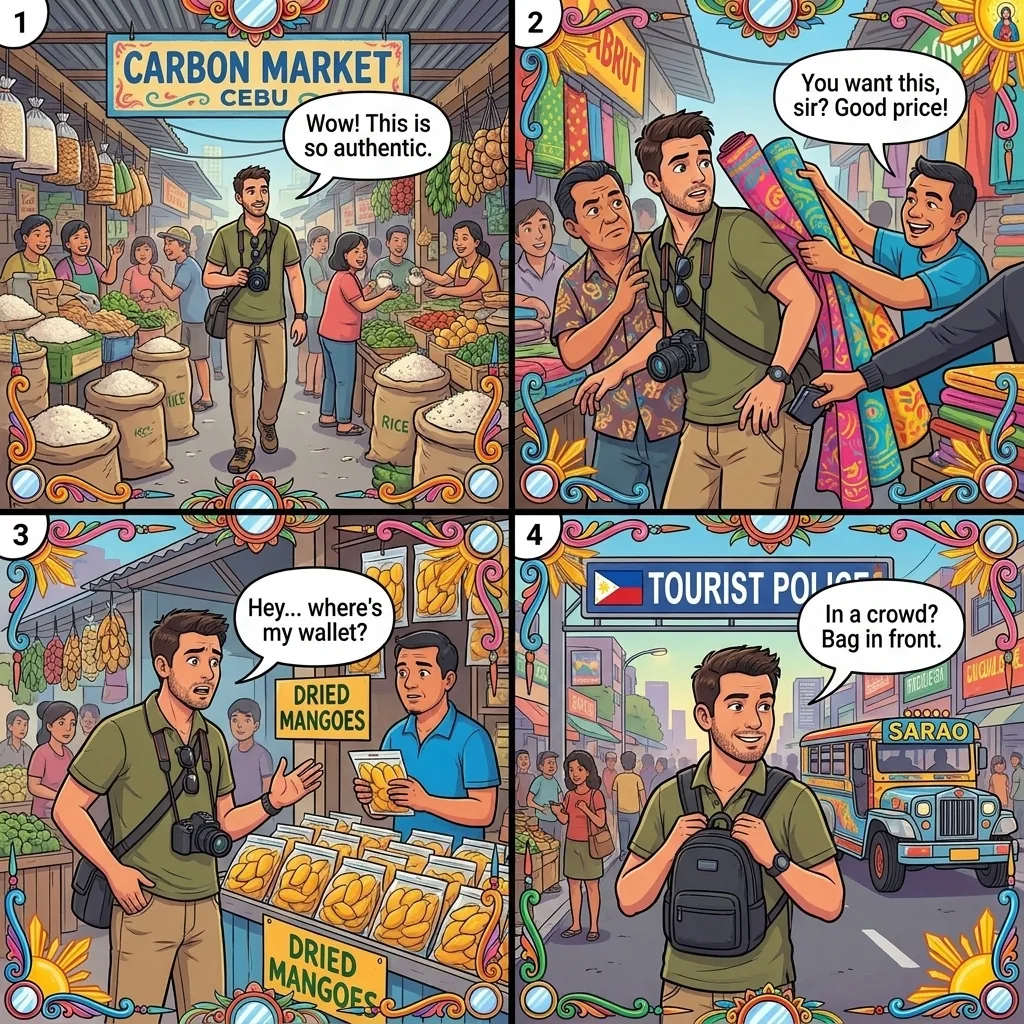
You head to Carbon Market for the local-market experience: dried fish, mangoes, sacks of rice, and the noise of Cebu's biggest public marketplace before redevelopment finishes.
The narrow corrugated-roof aisles are packed shoulder-to-shoulder by mid-morning. Vendors lean across their stalls calling prices, motorbikes inch through the gaps with sacks balanced sideways, and the floor is wet from washed produce. You are working your way toward the fish section when the crowd pinches into a single-file bottleneck. Someone bumps you firmly from behind. At the same moment, a vendor a step in front shoves a bolt of fabric into your face and asks loudly whether you want it.
You instinctively raise your hands to push the fabric aside, the bump becomes a longer press from behind, and the whole episode lasts maybe four seconds before the crowd thins again and you keep walking. Two aisles later, when you reach for your phone to take a photo of a stall, your back pocket is empty. Your day-bag is unzipped at the top. The wallet is gone, an outer pocket has been opened, and your phone is still there only because you had been holding it in your front pocket the whole time.
Carbon Market is both Cebu's most authentic market experience and one of its highest-risk areas for pickpocketing. CebuParadise's safety guide confirms that 'pickpockets are usually found in crowded places like touristy areas or markets in Cebu, and they often work in teams to distract and target unsuspecting travelers.' The narrow corridors are tailor-made for the choreography: one person blocks or shoves, a second creates a face-level distraction, a third works the pocket or bag, and a fourth is already moving the lift toward the exit before the victim turns around.
Basic to Glam Chic Travels lists market pickpocketing in its top-20 Philippines scams roundup, noting that teams specifically target tourists who are visually distinguishable from locals — height, hair, dress, and the half-second of orientation that gives away a first-time visitor. TravelSafe's Cebu City rating flags petty theft as a medium-risk concern with markets and transport hubs as the primary hotspots, and the same teams that work Carbon also work Colón Street, the SM City Cebu jeepney terminals, and the Pier 1 boarding lines around ferry departures.
Leave wallets, passports, and unused cards in the hotel safe — bring only the cash you plan to spend, kept in a front pocket, never the back. Wear a crossbody bag on your front with the zipper facing your body, and rest one hand on it the whole time you are inside the market. Visit Carbon early in the morning when the corridors are still passable, and consider going with a Filipino friend or licensed guide who can watch your back. If you are pickpocketed, dial 911 for emergencies or 117 for police, then follow up with the Tourist Police at +63 2 524-1660 to file a report you can use for insurance.
Red Flags
- You are being jostled more than the crowd density explains — someone is creating unnecessary physical contact
- A vendor aggressively tries to get your attention by grabbing your arm or holding items in your face, even after you say no
- You notice the same person appearing near you multiple times as you move through the market
- Someone bumps into you and apologizes profusely, maintaining contact longer than necessary
- A group seems to be moving in coordination around you — one in front slowing down, others on the sides
How to Avoid
- Leave valuables at your hotel — bring only the cash you need in a front pocket, not a wallet in your back pocket.
- Wear a crossbody bag on your front with the zipper facing your body, and keep one hand on it at all times.
- Visit Carbon Market early in the morning when it is less crowded and visibility is better.
- Go with a local guide or Filipino friend who knows the market layout and can watch your back.
- Keep your phone in a front zippered pocket, not in your hand — phone snatching is as common as wallet theft.
🆘 What to Do If You Get Scammed
📋 File a Police Report
Go to the nearest Philippine National Police (PNP) station. Call 911 or 117 (PNP Hotline). Get an official crime report — you'll need this for insurance claims. You can also report online at pnp.gov.ph.
💳 Cancel Your Cards
Call your bank immediately. Most have 24/7 numbers on the back of the card (keep a photo saved separately). Block any suspicious transactions before the thieves use your details.
🛂 Lost Passport?
Contact your nearest embassy or consulate. The US Embassy in Manila is at 1201 Roxas Boulevard, Ermita, Manila 1000. For emergencies: +63 2-5301-2000.
📱 Track Your Device
If your phone was stolen, use Find My (iPhone) or Find My Device (Android) from another device. Don't confront thieves yourself — share the location with police instead.
Frequently Asked Questions
You just read 6 scams in Cebu. The full Travel Safety Series has 780+ more across 20+ countries.
Tokyo's Kabukichō ¥130,000 bar trap. Rome's gladiator photo extortion. Paris's gold-ring trick. Bali's ATM skimmer scams. Bangkok's grand-palace closure ruse. Every documented scam across 20+ destinations — with the exact scripts, red flags, and local-language phrases that shut each one down. Drawn from Reddit traveler reports, embassy advisories, and consumer-protection cases.
- 780+ documented scams across Tokyo, Rome, Paris, Bali, Bangkok, Rio & 100+ more cities
- 20+ countries covered, with country-by-country phrase cards for every destination
- Updated annually — buy once, re-download future editions free
- All titles $4.99 each on Amazon Kindle