
Key Takeaways
- The #1 reported scam is the New Delhi Station Fake Tourist Office.
- 1 of 6 scams are rated high risk.
- Use app-based ride services (Uber, Ola) instead of street taxis — always confirm the fare before departure.
- Never accept unsolicited offers from strangers near tourist sites in Delhi.
⚡ Quick Safety Tips
- Keep phones and valuables in secure pockets when in crowded areas.
- Use only licensed taxis or app-based ride services.
- Book tours and tickets through verified operators with online reviews.
- Keep a copy of your passport separate from the original.
Jump to a Scam
The 6 Scams
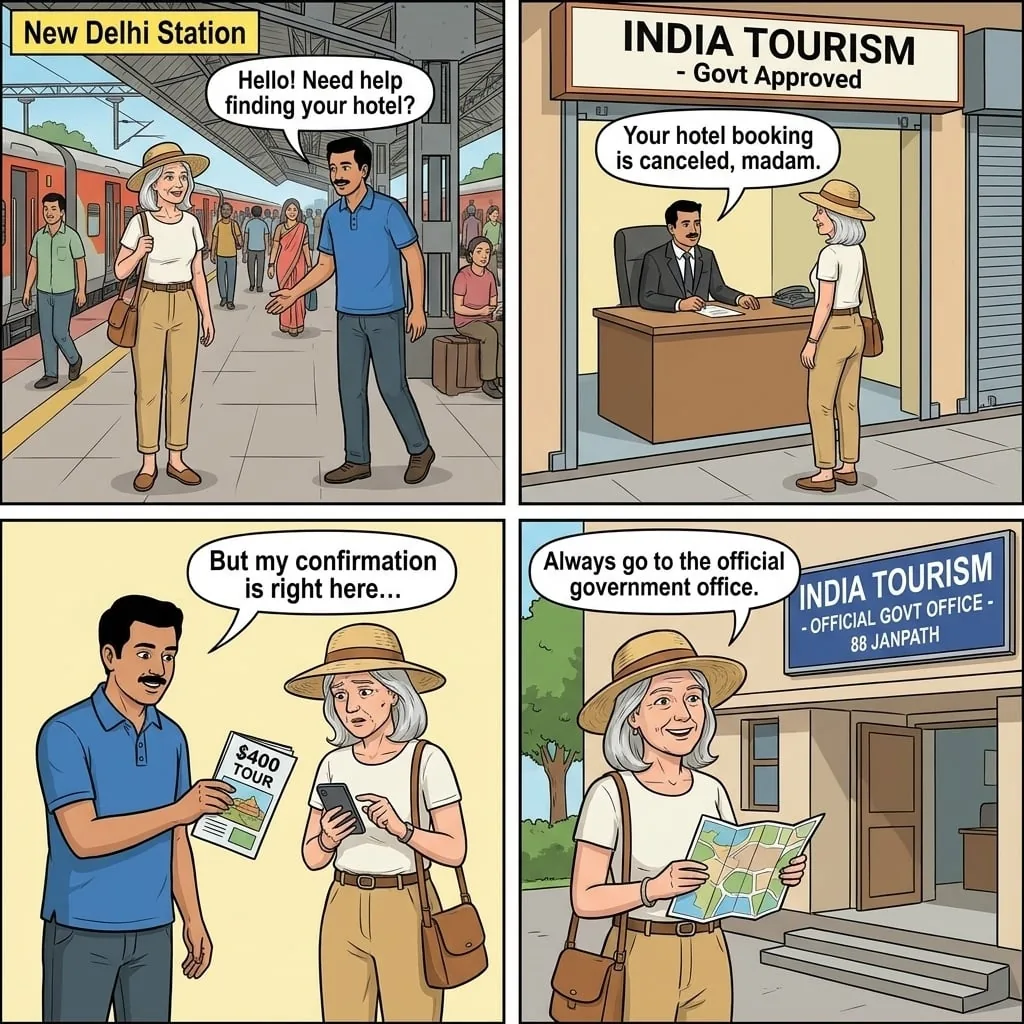
A man in a polo shirt walks you from the New Delhi Railway Station platform to a fake 'India Tourism' storefront in Paharganj where a suited 'agent' tells you your hotel booking has been canceled and rebooks you into a $300 to $500 package — the real India Tourism office is at 88 Janpath.
You have just rolled off the overnight train from Agra and you are standing on the platform at New Delhi Railway Station, bags heavy, looking for the tourist information desk. A man in a neat polo shirt approaches and asks if you need help finding your hotel. He says he is with the Delhi Tourism office — in fact, his office is right outside the station. He leads you through the crowds of Paharganj to a professional-looking establishment with maps on the wall and an 'India Tourism' sign.
Inside, a suited man behind a desk tells you bad news: your hotel booking has been 'canceled' due to a double-booking system failure. But don't worry — they have better options. He lays out a 'tourism package' that includes pre-paid tours, hotel, and transport, totaling $300 to $500. The hotels on the brochure don't exist, and if they do, they will be half the quality promised. One traveler put it bluntly afterward: 'My first interaction in Delhi was being brought to a fake tourist office. Scam central. Luckily the scammer was an idiot and I figured it out before paying.'
The hook is a polo-shirt approach plus a 'rebooking emergency' on arrival jet-lag — by the time you are inside the storefront, refusing feels harder than paying. The defensive move is to know that the real India Tourism office is at 88 Janpath in a government building, refuse every approach inside or outside the station claiming to be a tourism official, and use the prepaid metered taxi booth inside New Delhi station rather than any street tout.
Red Flags
- Person approaches you unprompted at the railway station or airport offering to 'help'
- Claims to work for India Tourism or Delhi Tourism with no official ID to verify
- Tells you your hotel reservation has been canceled or the hotel is 'closed' or 'flooded'
- Office is in a commercial building rather than a government facility
- Pressure to purchase tour packages or prepay for accommodation upfront
How to Avoid
- Book accommodation in advance through verified platforms and confirm directly with the hotel.
- The real India Tourism office is at 88 Janpath — walk there yourself if you need help.
- Use prepaid metered taxis from the official booth inside New Delhi station, not touts.
- Ignore anyone who approaches you in the station claiming to be a tourism official.
- If taken to an office, leave without paying — no contract has been signed.
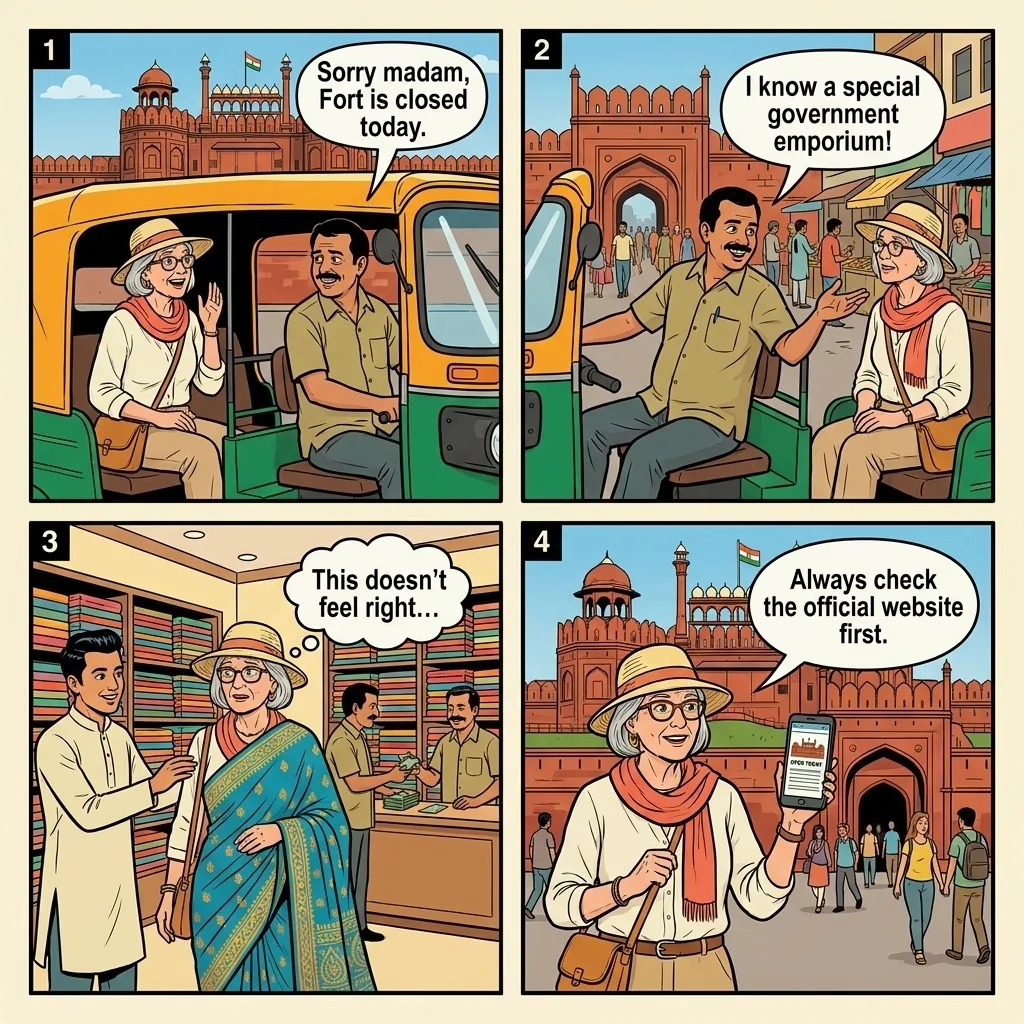
An auto-rickshaw driver heading to the Red Fort slows as you approach the gate, claims the monument is closed for a 'government holiday' or VIP visit, and offers a free ride to a 'better' silk emporium where he earns a 30% to 40% commission on whatever you buy.
You have paid your auto-rickshaw driver to take you to the Red Fort on Netaji Subhash Marg. As you approach, he slows down and shakes his head sadly. 'Today is closed — government holiday.' Or: 'The monument is being cleaned.' Or: 'There is a VIP visit, they are not allowing tourists.' He pivots quickly: 'But I know another place, even better — very famous, very authentic. I take you there free.' That 'free' place is a silk emporium, gem shop, or 'government emporium' where he earns a commission on everything you buy.
The variant is the impersonation. One traveler heading from Delhi to Agra reported a driver who knew a group tour was meeting at 7 — he had gathered the detail from passengers on earlier tours and stepped in to pretend to be the guide. The closed-attraction version is simpler but just as effective because tourists have no easy way to verify opening hours at the moment they are being told.
The hook is information asymmetry weaponized at the gate — the Red Fort, Jama Masjid, and Qutub Minar are rarely actually closed, but you cannot check from inside an auto-rickshaw. The defensive move is to take Ola or Uber directly to the monument and verify the gate yourself, refuse to let any driver redirect you to an alternative destination, and check the Archaeological Survey of India website for opening hours before you leave the hotel.
Red Flags
- Driver announces attraction is 'closed' before you've seen any sign to that effect
- Alternative destination is always a shop, market, or emporium rather than another monument
- Driver offers to take you to the 'alternative' for free or at reduced fare
- The 'government emporium' has prices far above street market rates
- Driver waits outside the shop while you're inside
How to Avoid
- Check ASI (Archaeological Survey of India) official website for opening hours before you leave the hotel.
- Take Uber or Ola directly to the monument gate — not an auto-rickshaw for your first visit.
- Never let a driver choose your next destination — have a plan before you get in.
- If told a site is closed, walk to the entrance yourself and verify.
- Ask at your hotel in the morning if any attractions have unusual closures.
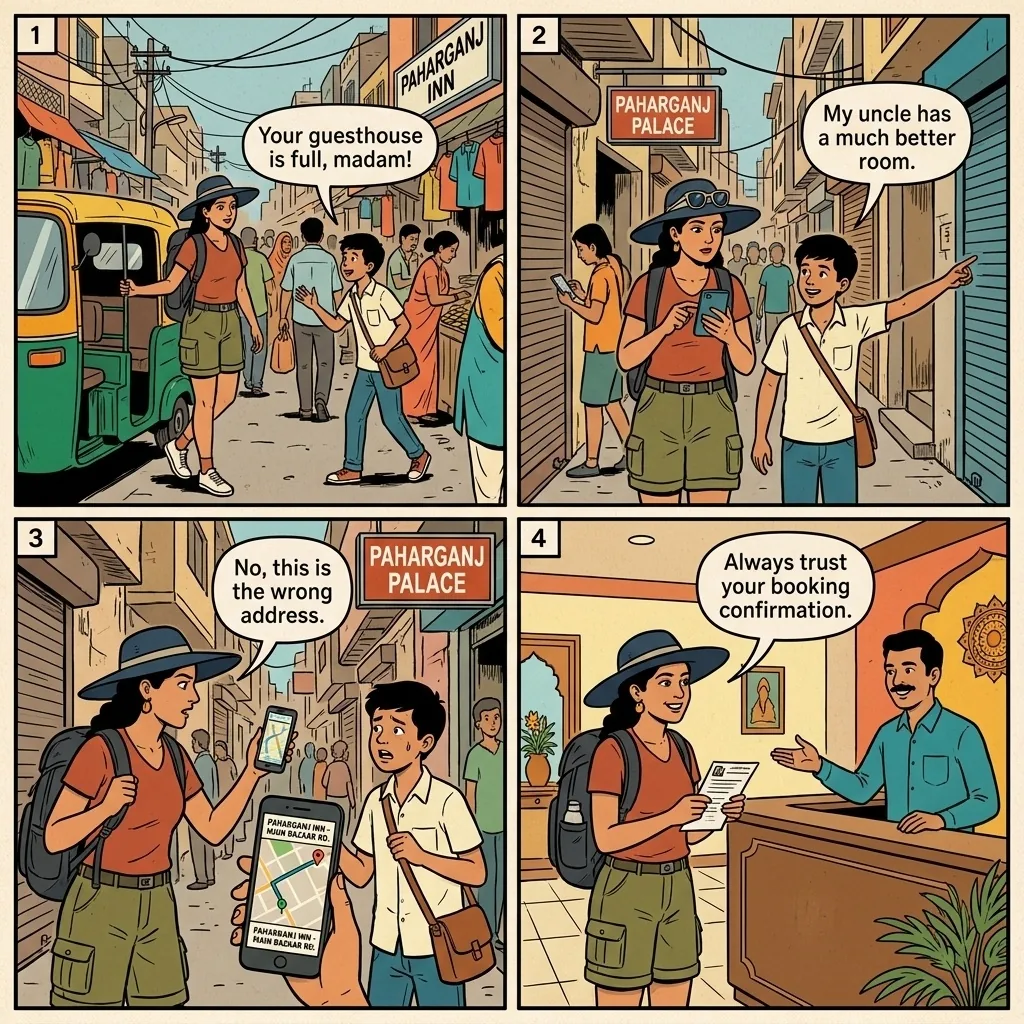
A teenage tout outside your auto-rickshaw drop-off in Paharganj tells you your booked guesthouse is 'full tonight' or 'closed for renovation' and walks you to his uncle's place — often a similarly-named guesthouse that ends up costing double what you booked.
Paharganj, the backpacker neighborhood immediately west of New Delhi Railway Station, is both a brilliant budget hub and a gauntlet. You have booked a guesthouse on Main Bazaar but when your auto-rickshaw drops you off, a boy of about sixteen runs up and says your guesthouse is 'full tonight' or 'closed for renovation.' He offers to walk you to something better — his uncle's place around the corner.
If you follow him, you will end up somewhere significantly more expensive than what you booked, and you will have lost the deposit on your original reservation. Experienced India travelers warn about the 'Tourist Rest House vs Tourist Guest House' switch — two identically named establishments in Paharganj where touts direct confused arrivals to the wrong (more expensive) one. One traveler reported being three days into a stay before realizing they were at the wrong place and had paid double what they had booked.
The hook is name density plus overnight-train exhaustion — Paharganj is packed with guesthouses bearing nearly identical names (Royal, New Royal, Super Royal), and a tired arrival cannot keep them straight. The defensive move is to screenshot your booking confirmation with the exact address, navigate yourself with Google Maps from the platform, and call the guesthouse directly before you exit the station so any 'closed-tonight' claim collapses on contact.
Red Flags
- Boy or man near the station claims your specific booking is canceled or the hotel is full
- Tells you he knows your hotel but leads you in a direction that doesn't match your map
- Destination turns out to be a guesthouse with a very similar name to your actual booking
- Asks for a 'finder's fee' for bringing you to the accommodation
- Original booking website is inaccessible or shows 'error' when you try to verify
How to Avoid
- Screenshot your booking confirmation with address and use Google Maps navigation independently.
- Call your guesthouse from the platform before you exit the station.
- Use prepaid WiFi SIM from the airport or station to have data on arrival.
- Do not follow anyone who claims your hotel is unavailable without calling to verify.
- Consider staying in South Delhi (Lajpat Nagar, Hauz Khas) which has fewer touts than Paharganj.
Like what you're reading? Get a full Delhi itinerary with safety tips built in.
Browse travel-safety books →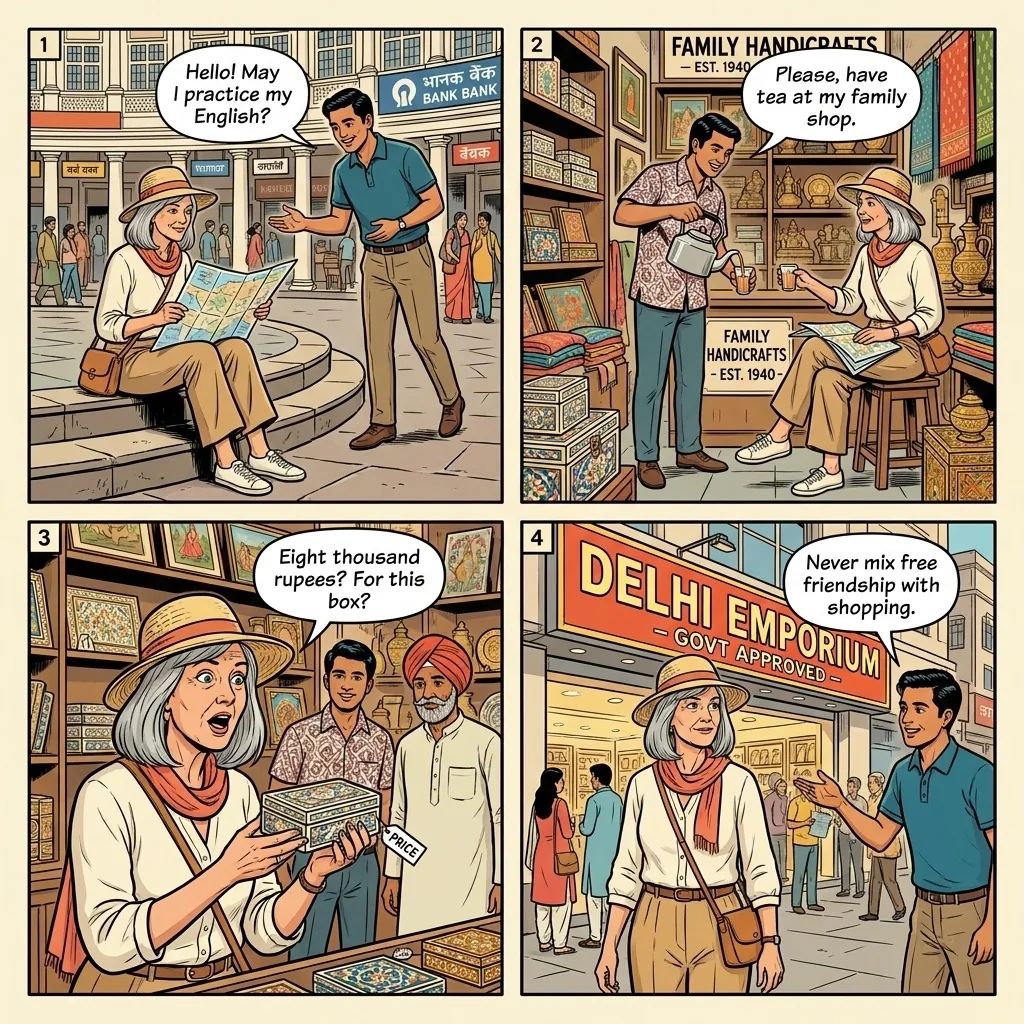
A well-dressed 'student wanting to practice English' chats you up at Connaught Place for twenty minutes, then invites you to his family's 'tea house' where the marble inlay you feel obligated to buy is marked up 5x to 10x over Paharganj prices.
You are sitting on the steps near Connaught Place's inner circle, looking at your map, when a well-dressed young man sits down nearby and strikes up a conversation in perfect English. He is a student, he says, studying English and loves to practice with foreigners. He is friendly, funny, and knows everything about Delhi. After twenty minutes he mentions a wonderful traditional tea house run by his family in a nearby lane — very authentic, very affordable.
The tea house is real and does serve tea. But the 'authentic handicrafts' or 'family business' goods displayed around you cost three to five times their market value, and you will feel intense social pressure to buy something after the hospitality you have received. A group of tourists described spending ₹8,000 on a 'marble inlay piece' from this kind of shop that they later found in Paharganj for ₹800. One traveler wrote afterward that the conversation 'felt like friendship, not reconnaissance' — but the questions about hotel and itinerary were exactly the latter.
The hook is genuine warmth that camouflages a script — the 'student wanting to practice English' opening is so well-known it appears in every major India travel forum, yet it still works because the unhurried interaction does not feel like a sales pitch. The defensive move is to be friendly but firm: a polite 'no thanks' to any unsolicited invitation to a shop or home, and if you genuinely want handicrafts, go to fixed-price emporia like Cottage Industries Exposition on Janpath where the prices are printed.
Red Flags
- Stranger approaches you unprompted and is highly skilled at keeping conversation flowing
- Early in conversation he establishes credibility (student, professional, local guide)
- Mention of family business, home, workshop, or tea house comes up casually
- He seems uninterested in selling anything — makes it harder to object
- Insists on walking with you to the shop rather than just giving an address
How to Avoid
- Be friendly but give a firm 'no thanks' to any unsolicited invitation to a shop or home.
- If genuinely interested in handicrafts, go to fixed-price emporia like Cottage Industries Exposition on Janpath.
- Research fair prices for souvenirs before your trip so you know immediately if you're being overcharged.
- It is okay to enjoy conversation and then decline the shopping portion entirely.
- Trust your instincts — if the conversation pivots to commerce, the friendship was the setup.
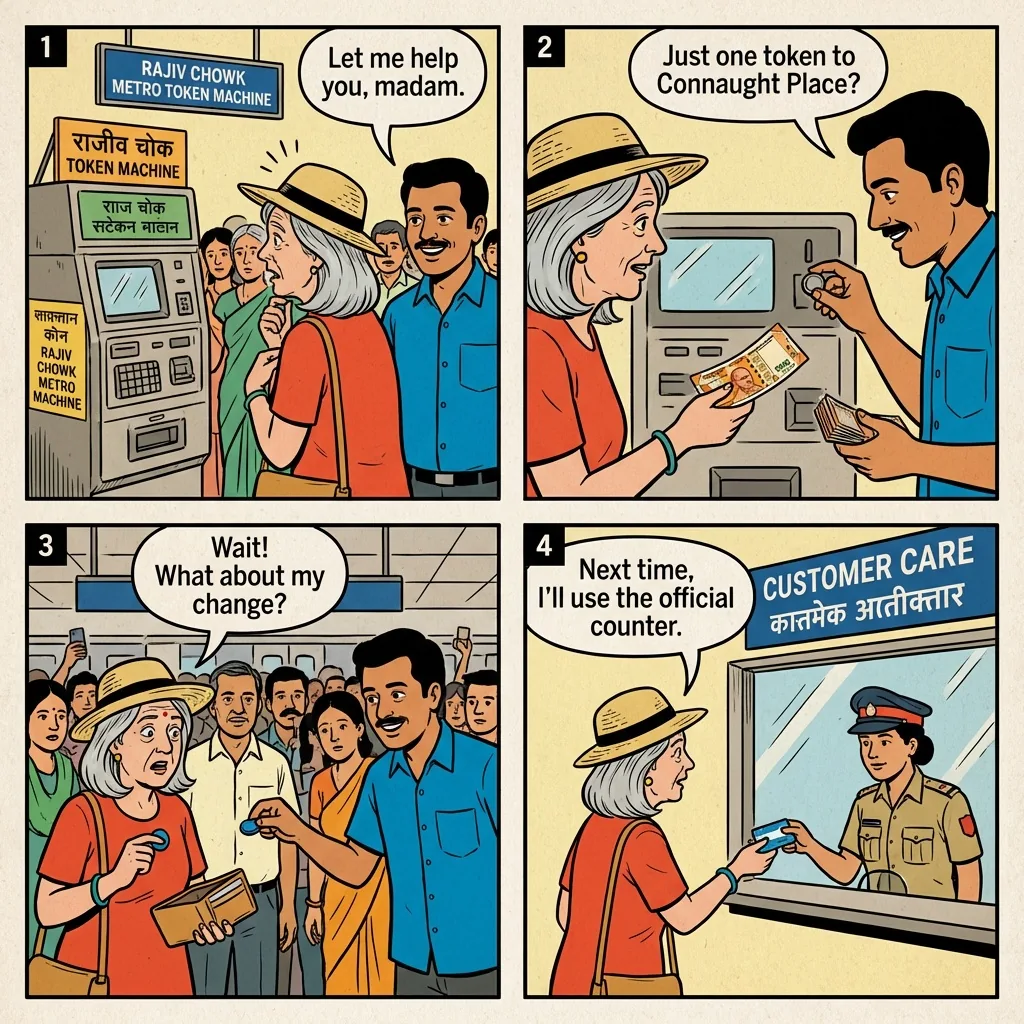
A 'helpful' stranger at Rajiv Chowk metro station offers to buy your token for you — you hand him a ₹500 note, he buys a ₹30 token, pockets the change, and disappears into the crowd.
You are at Rajiv Chowk — the Times Square of Delhi's underground system — trying to figure out the token machine during rush hour. It is hot, there is a queue behind you, and a helpful man offers to buy your token for you. You hand him a ₹500 note, he buys you a token worth ₹30, pockets the change, and walks away in the crowd before you can say anything.
A subtler version involves men outside the station offering to 'activate your metro card' for a processing fee. The Delhi Metro smart card is obtained at any station counter with zero activation fee — the man outside is simply pocketing your money while pointing you to what he would do anyway. Reddit and Reddit posts note that the Delhi Metro is a fantastic system once you learn it, but the stations near major tourist interchanges (Rajiv Chowk serving Connaught Place, and Chandni Chowk serving Old Delhi) have the highest concentration of touts.
The hook is queue-pressure plus a stranger volunteering before you can ask. The defensive move is to use the official token vending machines at the counter where uniformed staff are usually nearby, ignore anyone offering 'help' outside the official ticket area, and ask only uniformed CISF security officers — stationed inside every metro gate — if you genuinely need help.
Red Flags
- Person offers to help buy your ticket 'because the machine is confusing'
- Takes your cash and immediately operates the machine while blocking your view
- Offers to 'activate' or 'register' a metro card outside the official counter
- Asks for your card and then walks away from the machine to 'process' it
- Fee quoted for any metro service that is actually free at official counters
How to Avoid
- Use the official token vending machines at the counter — staff are usually nearby to help genuinely.
- Buy a tourist metro day/week pass at the airport metro station on arrival.
- Use the DMRC official app to plan routes and check fares before entering stations.
- If you need help, ask uniformed CISF security officers stationed inside every metro gate.
- Keep your phone or printed metro map accessible so you don't look lost and become a target.
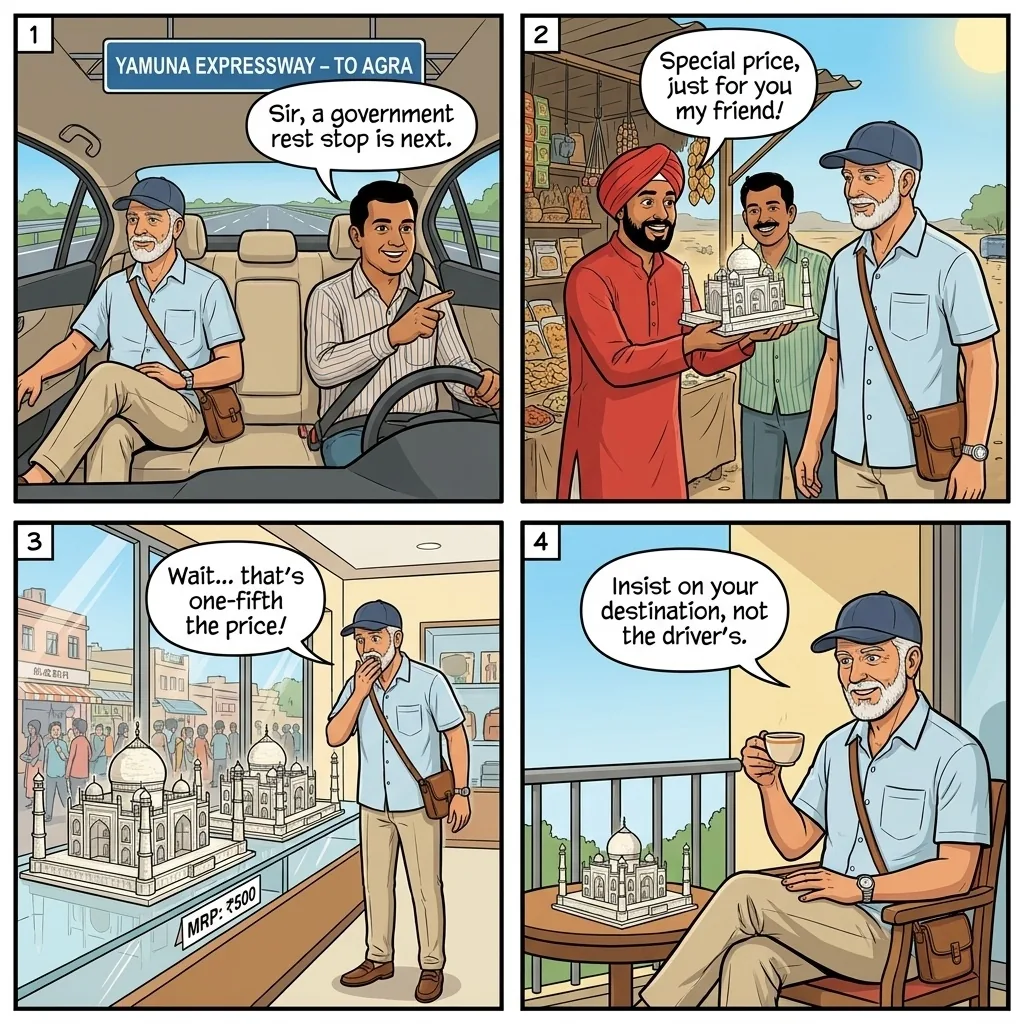
A driver on the Delhi-to-Agra Golden Triangle leg pulls off the Yamuna Expressway for a 'mandatory government rest stop' run by his friend — marble figurines and leather goods inside cost five times Agra's actual shop prices.
You have hired a driver for the Delhi-to-Agra day trip — a classic Golden Triangle move. On the Yamuna Expressway, your driver pulls off for what he says is a 'mandatory government rest stop.' Inside is a chai stall run by his friend, and around it are vendors selling marble figurines and leather goods at prices you will later realize are five times Agra's shop prices.
One traveler described a vivid version of this on the highway: stuck in slow traffic between Delhi and Agra, a monkey in a small vest was trained to snatch something through the open window, the owner quickly 'shooed' it away and returned the item, and a 'tip' was then expected. The scam combines entertainment, social obligation, and surprise — a surprisingly effective combination on a three-hour drive when you are in a good mood.
The hook is a long highway leg plus a 'mandatory' frame that a tired passenger will not question — the stretch through Mathura is particularly known for invented 'customs stops' and inflated tourist rest areas. The defensive move is to book your Delhi-Agra driver through a verified agency like Cleartrip or MakeMyTrip, agree in writing on no unplanned stops and a direct route, and buy marble or souvenirs only at fixed-price shops in Agra's Taj Ganj area.
Red Flags
- Driver takes a rest stop that isn't on any map or obvious highway service area
- Stop location has vendors immediately ready with goods and prices
- Driver says it is 'required by law' to stop or that the vehicle needs petrol even when full
- Performs trained animal trick or has a helper with animals near the road
- Any vendor claims to sell 'Agra marble' at the rest stop — real marble artisans are in Agra
How to Avoid
- Book your Delhi-Agra driver through a verified agency like Cleartrip or MakeMyTrip.
- Agree in writing: no unplanned stops, direct route only.
- Keep car windows up in slow-traffic zones near small towns.
- If stopped, you don't have to get out or buy anything.
- Buy marble and souvenirs only in Agra's Taj Ganj area at fixed-price shops.
🆘 What to Do If You Get Scammed
📋 File a Police Report
Go to the nearest Indian Police station. Call 100 (Police) or 112 (Emergency). Get an official crime report — you'll need this for insurance claims. You can also report online at citizenservices.gov.in.
💳 Cancel Your Cards
Call your bank immediately. Most have 24/7 numbers on the back of the card (keep a photo saved separately). Block any suspicious transactions before the thieves use your details.
🛂 Lost Passport?
Contact your nearest embassy or consulate. The US Embassy in New Delhi is at Shantipath, Chanakyapuri, New Delhi 110021. For emergencies: +91 11-2419-8000.
📱 Track Your Device
If your phone was stolen, use Find My (iPhone) or Find My Device (Android) from another device. Don't confront thieves yourself — share the location with police instead.
Frequently Asked Questions
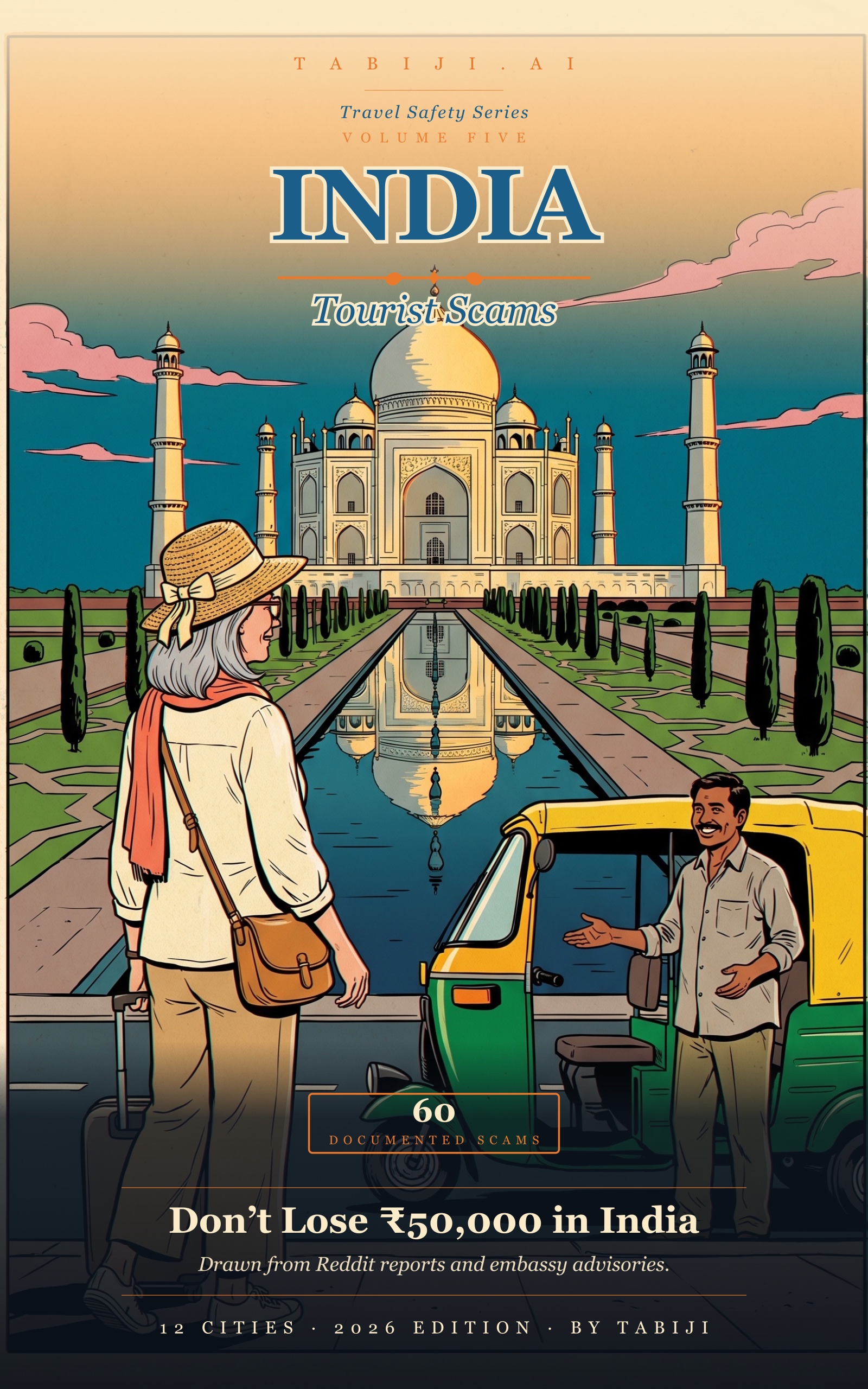
You just read 6 scams in Delhi. The book has 60 across 12 Indian cities.
Delhi’s Paharganj “India Tourism” rebooking trap. Jaipur’s Hawa Mahal rickshaw textile detour. Mumbai’s ₹61,000 dating-app pub bill. The Lake Pichola sunset-photo extortion. The Bengaluru Silk Board meter manipulation. Every documented India scam — with the exact scripts, red flags, and Hindi phrases that shut each one down. Drawn from Reddit, the Times of India, News18, Telangana Today, and embassy advisories.
- 60 documented scams across Delhi, Mumbai, Jaipur, Agra & 8 more cities
- A Hindi exit-phrase card (Devanagari + Latin) you can screenshot to your phone
- Updated annually — buy once, re-download future editions free
- Readable in one flight — $4.99, coming soon on Amazon Kindle