
Key Takeaways
- The #1 reported scam is the Johari Bazaar Gem Export Pitch.
- 3 of 7 scams are rated high risk.
- Use app-based ride services (Uber, Ola) instead of street taxis — always confirm the fare before departure.
- Never accept unsolicited offers from strangers near tourist sites in Jaipur.
⚡ Quick Safety Tips
- Keep phones and valuables in secure pockets when in crowded areas.
- Use only licensed taxis or app-based ride services.
- Book tours and tickets through verified operators with online reviews.
- Keep a copy of your passport separate from the original.
Jump to a Scam
- High The Johari Bazaar Gem Export Pitch
- Medium The Hawa Mahal Rickshaw Textile Detour
- High The Jaipur Station Fake Tourist Office
- Medium Elephant Ride Bait-and-Switch at Amber Fort
- High The Jaipur Station Hotel-Canceled Tout
- Low The Hawa Mahal Free-Henna Pressure Hustle
- Low The Amber Fort Milk-and-Formula Sympathy Hustle
The 7 Scams
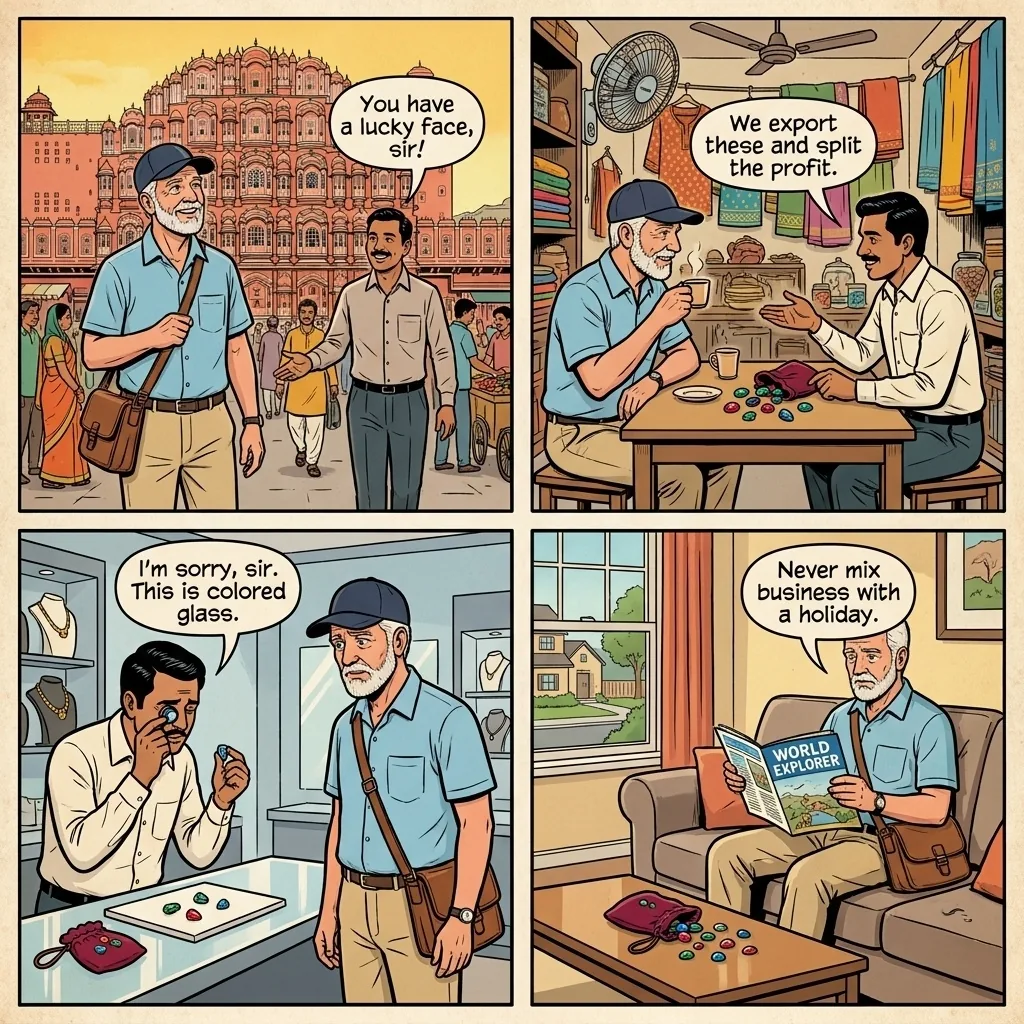
A 'gem trader' near Johari Bazaar invites you for chai and pitches an 'incredible opportunity' — buy ₹45,000 of Jaipur rubies and sapphires, carry them through customs, split the resale profit. The gems turn out to be colored glass.
You are walking near Johari Bazaar — Jaipur's famed gem-cutting district — when a charming local strikes up a conversation. He mentions casually that he works in the gem trade and that Jaipur is one of the world's top ruby and sapphire cutting centers. Over chai at a nearby shop, he explains an 'incredible opportunity': gems bought here can be resold in Europe or North America for five to ten times the price. He just needs a trustworthy foreign partner to carry them through customs — and he will split the profit.
This is one of the most elaborate scams in India's tourism ecosystem and runs across years of Reddit warnings. The gems are either fake (colored glass or synthetic stones) or so low-grade they are worth nothing abroad. The 'profit sharing' is entirely fictional — no one will be waiting to buy them at the airport. One traveler described spending ₹45,000 on a bag of 'investment rubies' that a jeweler back home confirmed were worthless glass.
The hook is a real industry backstory plus a printed-on-site certificate — Jaipur genuinely is a major gem-cutting city, so the pitch sounds credible, and the shop produces certificates that look official until you check who issued them. The defensive move is the rule: never buy gems as 'investment items' from an unsolicited source in India, walk away the moment a stranger offers to make you money by using you as a courier, and for legitimate personal-use gem shopping go to GIA-certified labs or Rajasthan's fixed-price emporia like Rajasthali on MI Road.
Red Flags
- A stranger mentions gem trading and profit-sharing opportunities unprompted
- You're invited for free chai before any 'business discussion'
- The pitch involves carrying gems through customs on the seller's behalf
- Certificates of authenticity are produced but issued by unknown private bodies
- Price is 'specially reduced' because you're helping with their export quota
How to Avoid
- Never buy gems as investment items from unsolicited sources in India.
- Genuine gems for personal purchase should be bought from GIA-certified or government gem labs.
- If a local offers to make you money by using you as a courier, walk away immediately.
- Any legitimate gem purchase for personal use should come with a proper GST invoice from a registered shop.
- For real gemstone shopping, use the Rajasthan government's fixed-price emporia (Rajasthali).
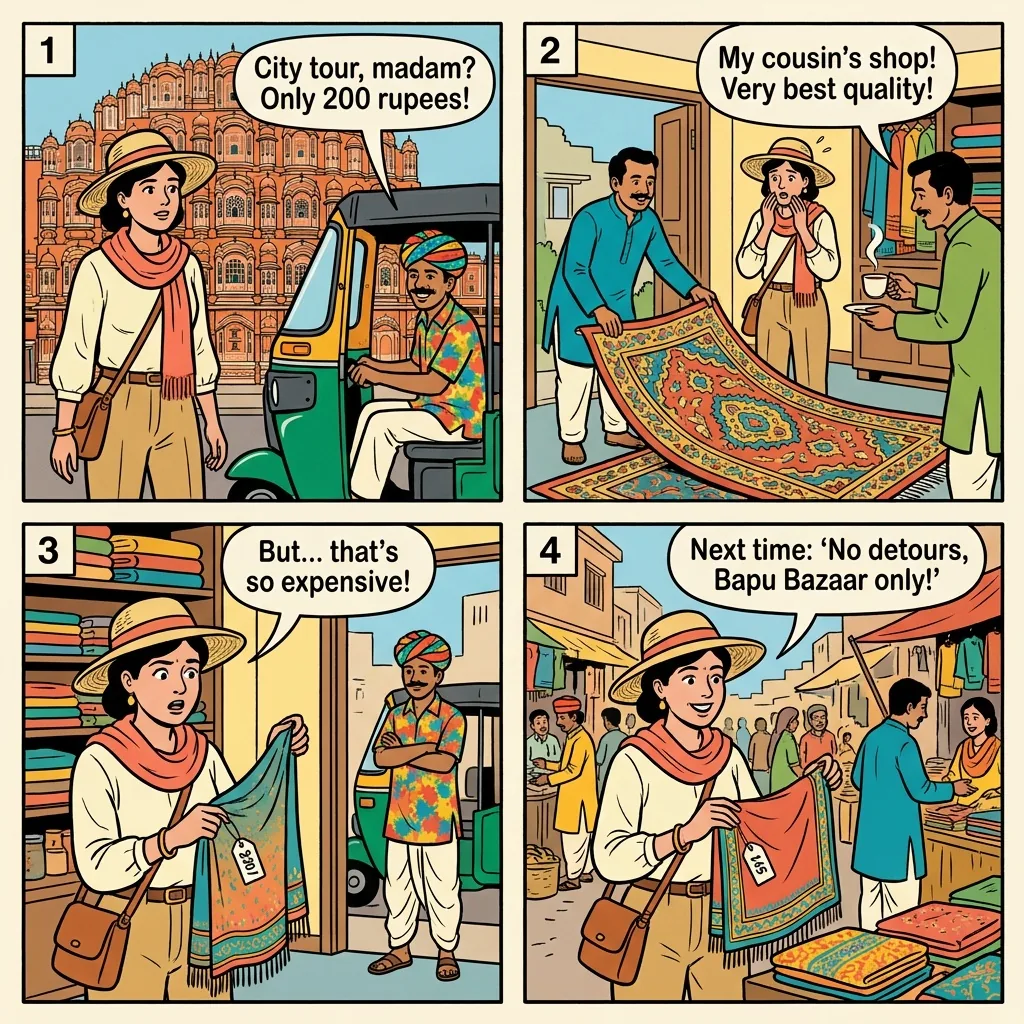
A friendly rickshaw driver near Hawa Mahal offers a half-day city tour at a suspiciously low rate, then detours you to his 'cousin's silk emporium' in the suburbs where textiles are marked up 5x to 10x over Bapu Bazaar prices.
Your auto-rickshaw driver near Hawa Mahal offers a suspiciously cheap rate for a half-day city tour. He is friendly, speaks decent English, and seems knowledgeable. Midway through your itinerary, he mentions his 'cousin's shop' — a silk emporium or carpet showroom — just a 'five-minute detour.' The shop is in the suburbs, far from any tourist area. Inside, staff immediately serve you chai and begin unrolling carpets or laying out shawls, while your driver waits outside.
This is the most consistently reported scam in Jaipur. Travelers describe the cab driver taking them 'to a house out in the burbs' where the textiles are at outrageous prices and every customer in the shop is white. Drivers earn ₹200 to ₹500 per tourist delivered, whether you buy or not. If you buy, the commission goes up to 30 to 40% of your purchase. The prices on textiles are often marked up 5x to 10x over what locals pay at Bapu Bazaar. The real danger is that once you are in an unfamiliar suburb with your driver waiting outside, you feel social pressure to buy something to 'justify' the detour — even buying a ₹500 item often results in more pressure, more unrolled fabric, more chai.
The hook is a sub-market tour rate that buys him your time, plus an unfamiliar suburb that traps you on the way back. The defensive move is to book rickshaws through your hotel's front desk or Ola/Uber for transparent pricing, state at the start of any ride 'no shops, direct to destination only,' and shop yourself at Bapu Bazaar, Johari Bazaar, or the Rajasthali government emporium on MI Road where prices are fixed.
Red Flags
- Driver offers a city tour rate well below market price (under ₹300 for 4 hours)
- Any mention of 'cousin's shop,' 'family business,' or 'just 5 minutes'
- The shop is outside the main tourist bazaar areas and feels like a private residence
- All other customers in the shop appear to be foreign tourists
- You're served free chai immediately upon entering a shop — this creates social obligation
How to Avoid
- Book rickshaws through your hotel's front desk or Ola/Uber app for transparent pricing.
- At the start of any ride, state clearly: 'No shops, direct to destination only.'
- If driver insists on a 'quick stop,' say 'Please take me to [destination] now or I'll find another auto.'
- Shop at Bapu Bazaar or Johari Bazaar yourself — browse independently without a middleman.
- Rajasthali government emporium on MI Road has fixed prices and no commission pressure.
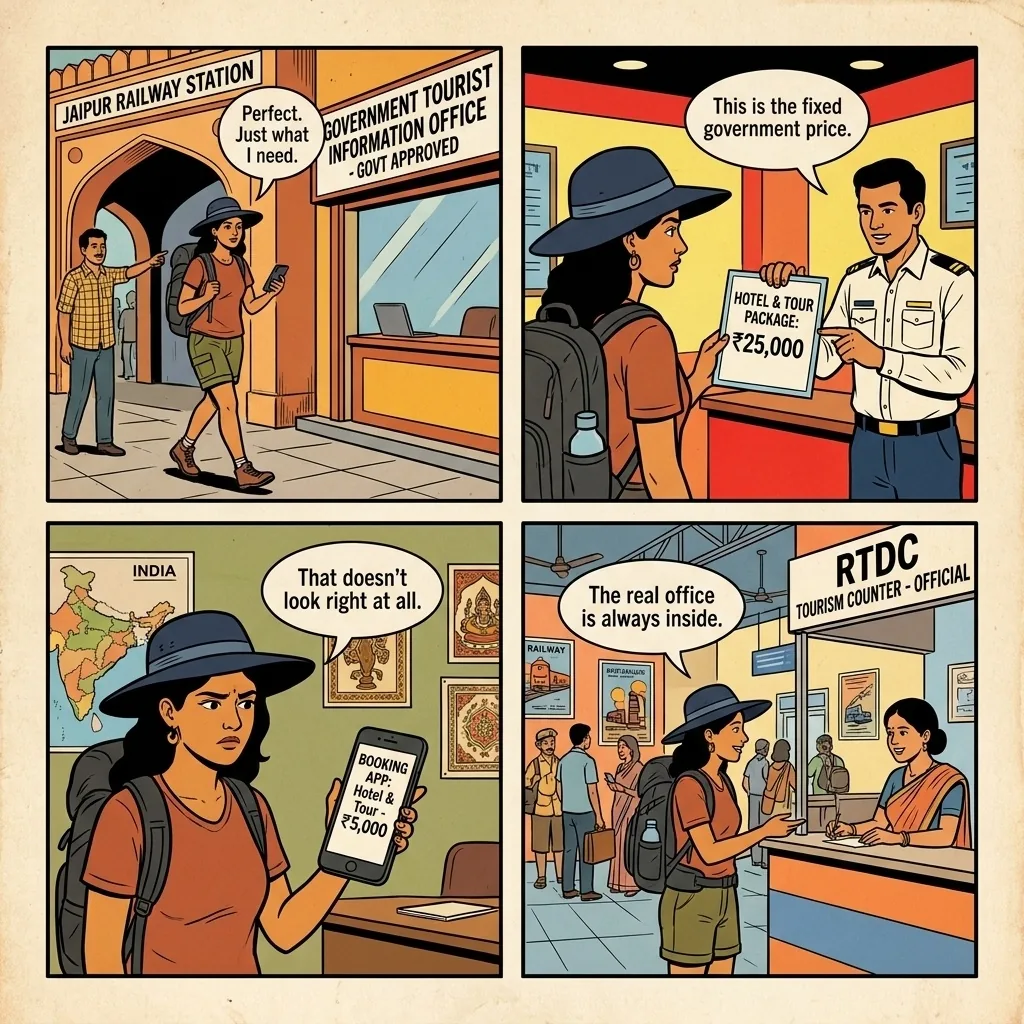
A 'Government Tourist Information Office' near Jaipur Railway Station with smartly-dressed staff and 'Ministry of Tourism' logos quotes 'government rates' for tours and hotels — at three to five times legitimate operator prices.
You have just arrived at Jaipur Railway Station and notice a sign that reads 'Government Tourist Information Office' or 'Rajasthan Tourism Bureau.' Inside, smartly dressed staff offer to book tours, hotels, and transport at 'government rates.' They show you an official-looking rate card and brochures that mimic real government publications. The tours they sell cost three to five times what legitimate operators charge.
This is a well-documented scam throughout Rajasthan. Travelers describe these fake offices as nearly indistinguishable from real ones — staff in khaki-colored shirts, printed ID cards, maps on the wall, and 'Ministry of Tourism' logos that are slightly modified versions of the real thing. The actual Rajasthan Tourism Development Corporation (RTDC) has offices inside or directly adjacent to Jaipur Railway Station, but touts set up nearby storefronts designed to intercept arrivals before they reach the real one. The bigger danger is that these 'offices' often collect full payment for accommodation and tours, then book you into lower-quality properties or do not show up at all — recovering money is nearly impossible.
The hook is visual indistinguishability from the real RTDC office plus the moment of arrival overwhelm. The defensive move is to use only the real RTDC office inside the station building (not the shops nearby), Google any tourism office's name plus 'Jaipur' before paying, never pay full cash upfront for multi-day packages from an operator you just met, and book tours through internationally recognized platforms like Viator or GetYourGuide if you do not have time to verify locally.
Red Flags
- Tourist office is located outside the station or in a shopping area rather than the official tourism counter
- Staff quote 'government rates' but prices are higher than what major booking sites show
- You're asked to pay full cash upfront for multi-day tours
- The office name is slightly different from 'RTDC' (the actual Rajasthan Tourism Development Corporation)
- Staff seem oddly eager to book everything for you on your first visit without any prior research
How to Avoid
- The real RTDC office is inside or directly adjacent to Jaipur Railway Station — use it, not the shops nearby.
- Verify any tourism office by Googling its name + 'Jaipur' before paying anything.
- For tours, book through internationally recognized platforms (Viator, GetYourGuide) or your hotel.
- Never pay full cash upfront for multi-day packages from an operator you just met.
- The Government of India's official tourism website is incredibleindia.org — check it before booking.
Like what you're reading? Get a full Jaipur itinerary with safety tips built in.
Browse travel-safety books →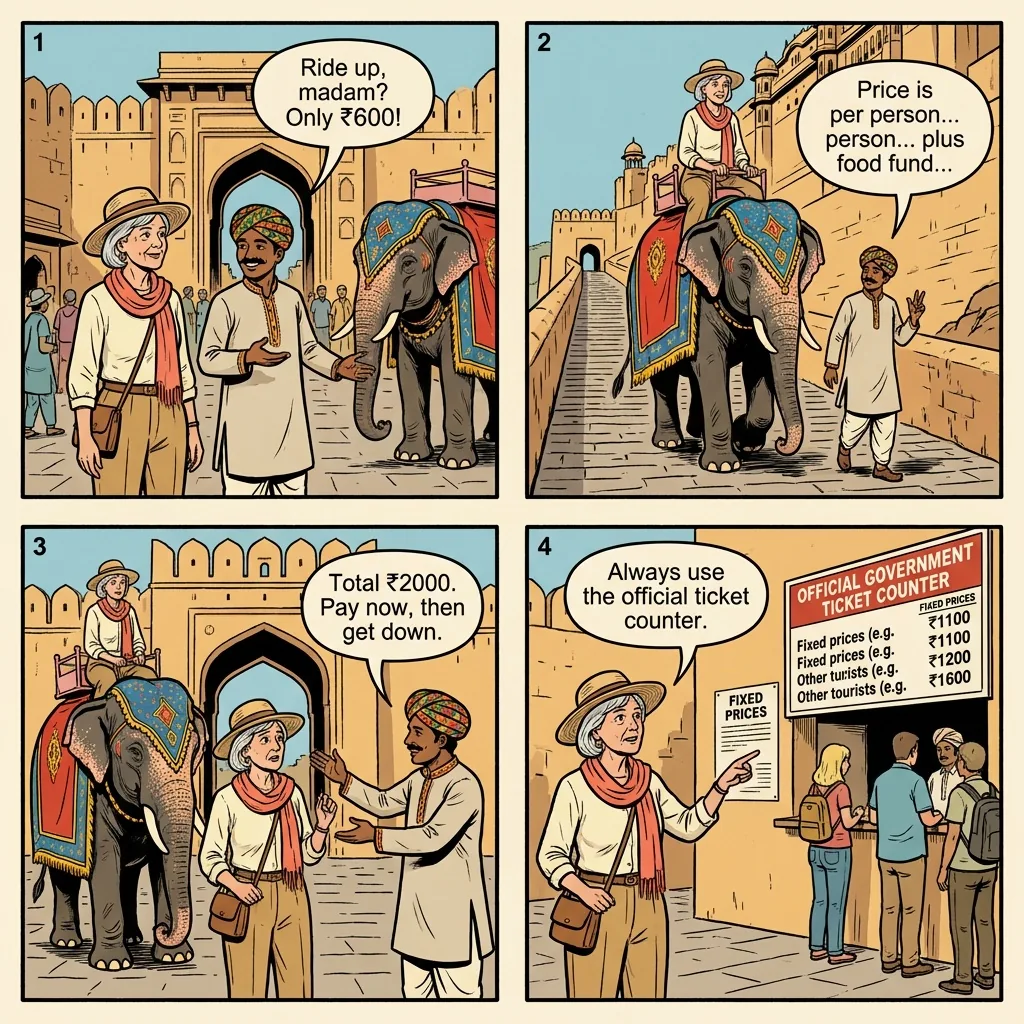
An elephant handler at Amber Fort quotes ₹600 for the ride up, then announces mid-ramp that the price was 'per person' and adds charges for the mahout's tip, an 'elephant food fund,' and a ₹200 'photography charge' — the official posted rate is around ₹900 for two riders.
The elephant ride up to Amber Fort is one of Jaipur's most iconic tourist activities. You arrive early to beat the heat, and a handler approaches with a smiling elephant named something like Lakshmi. He quotes ₹600 for the ride up. You agree and climb on. Halfway up the ramp, he announces the price was 'per person' not 'for the ride,' or adds charges for the mahout's 'tip,' the elephant's 'food fund,' and a ₹200 'photography charge' if you take out your phone.
The official elephant ride booking has a regulated price posted at the base of the fort — currently around ₹900 per elephant (shared, for up to two people) — but touts quote lower prices to hook you, then inflate on the way up. One traveler described reaching the top and being effectively held there until they paid the inflated amount, as the mahout refused to help them dismount until the dispute was settled. (Many animal-welfare organizations have raised concerns about Amber Fort elephant rides; humane alternatives include the electric golf carts at ₹50 or simply walking the twenty-minute ramp.)
The hook is a quote that sounds clean at the bottom of the ramp and a captive position halfway up. The defensive move is to check the official Amber Fort elephant-ride price board before approaching any handler, book only at the official counter inside the fort premises, insist on a printed ticket with total all-inclusive price before boarding, and consider the electric golf cart or the walk — both are scam-free alternatives.
Red Flags
- Handler quotes a price that sounds too low compared to signboards at the entrance
- Price is quoted 'per person' ambiguously without clarifying what's included
- New charges for 'tips,' 'photos,' or 'elephant food' appear mid-ride
- Handler operates from outside the official elephant ride queue area
- No printed ticket or receipt is offered for the booking
How to Avoid
- Check the official Amber Fort elephant ride price board before approaching any handler.
- Book the elephant ride only through the official booking counter inside the fort premises.
- Insist on a printed ticket with total price before boarding.
- Consider the electric golf cart (₹50) or walk — both are scam-free alternatives.
- Agree on total all-inclusive price including any tip before the elephant moves.
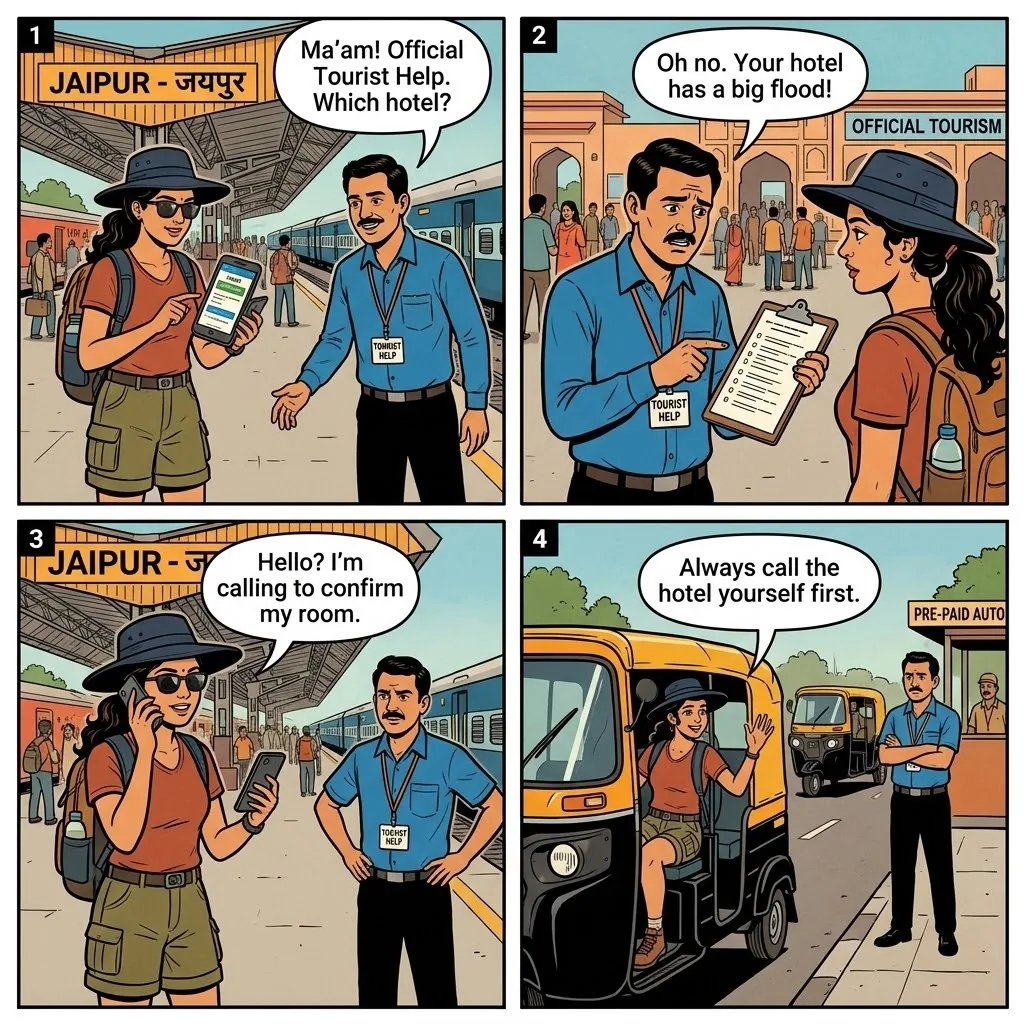
A man in a uniform-like shirt at Jaipur Railway Station tells you your booked hotel had a 'fire' or 'flooding' last night and is closed — he happens to know an alternative (his cousin's place) at a special rate, in a worse location at higher cost.
You arrive at Jaipur station with a hotel booking confirmation in hand. Before you reach the exit, a man in a uniform-like shirt says he works for the railway tourist information center and asks where you are staying. When you mention your hotel, he frowns and picks up his phone. 'I'm sorry, your hotel had a fire last night. It is closed for repairs.' Or: 'That area has flooding.' Or: 'A water-pipe burst — guests have been moved.' He happens to know another hotel — his cousin's — that has a special rate.
This scam mirrors what happens in Mumbai but is reportedly even more common in Jaipur, which sees enormous tourist traffic for the Golden Triangle itinerary. The new hotel is invariably more expensive and in a worse location than your original booking. Some touts also target tourists outside the station and offer 'free lifts' in their car — which takes a very long detour through commission-paying shops before reaching your actual hotel.
The hook is a uniform-like shirt plus a fabricated emergency that arriving travelers cannot verify in the moment. The defensive move is to call your hotel directly using the number on your booking confirmation if anyone tells you it is closed, take only prepaid taxis or Ola/Uber from the station, and remember that the real RTDC tourist information counter is staffed by uniformed officials in official booths — not men in private clothes intercepting you on the platform.
Red Flags
- Anyone at the station proactively asks about your accommodation
- Your confirmed hotel is described as suddenly closed, flooded, or under renovation
- The alternative hotel is suggested within seconds of the 'bad news'
- The person offering help is in civilian clothes but uses officious language
- They offer a 'free lift' to the new hotel in their personal vehicle
How to Avoid
- Call your hotel directly (using the number from your booking confirmation) if told it's closed.
- Pre-book a pick-up with your hotel and have the driver's name/number before you land.
- Only take prepaid taxis or Ola/Uber from the station — avoid anyone who approaches you.
- The real tourist information counter is staffed by RTDC in official booths — not men in private clothes.
- If accommodation is genuinely unavailable, use Booking.com to rebook rather than trusting a stranger.
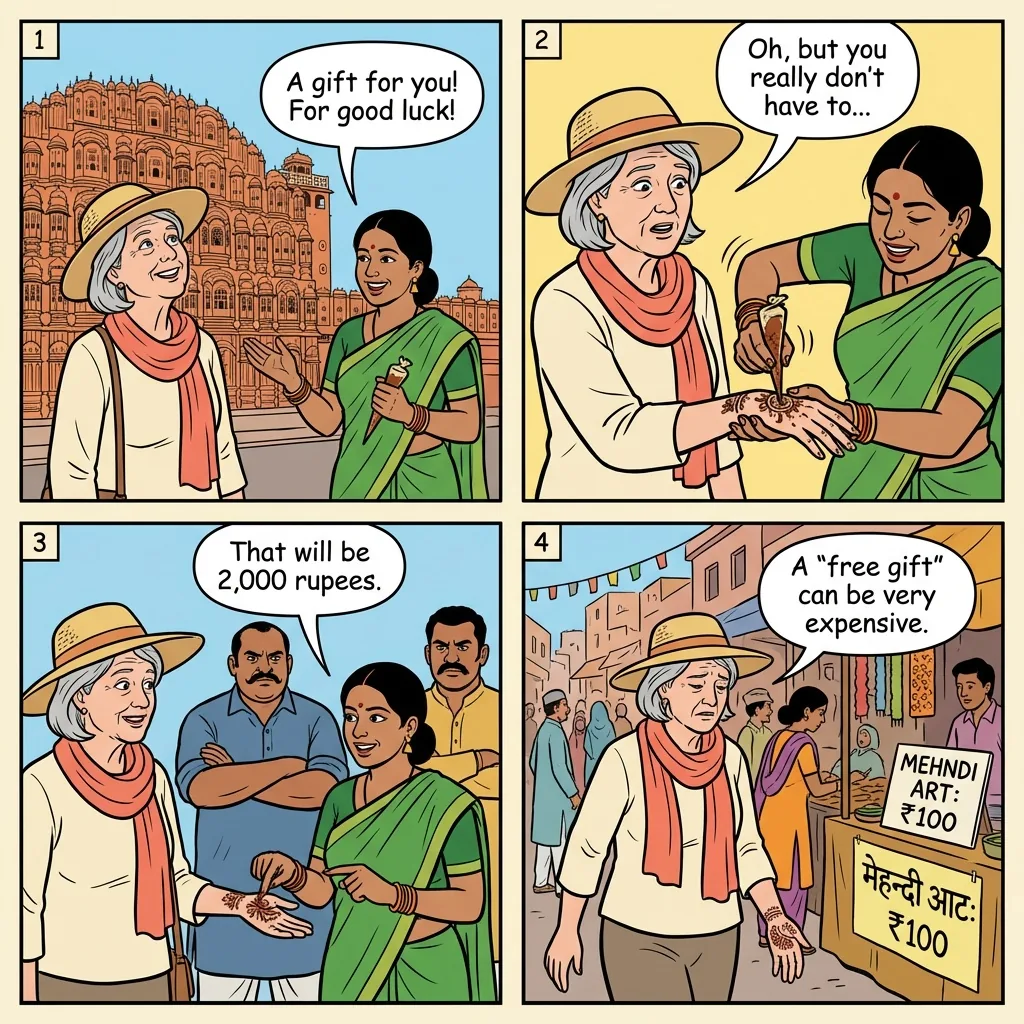
A woman near Hawa Mahal grabs your wrist and starts applying mehndi 'as a welcome gift' before you can decline; five minutes later she demands ₹500 to ₹2,000 for the design — 10 to 15 times the official bazaar rate.
A woman near Hawa Mahal smiles and approaches, offering to apply henna (mehndi) on your hand as a 'welcome gift' or 'for good luck.' She starts before you can respond, squeezing intricate patterns onto your palm with practiced speed. When she finishes five minutes later, she announces a price — ₹500 to ₹2,000 — for the 'free gift.' Her male relatives appear nearby. Refusing to pay becomes socially difficult and sometimes frightening.
This scam is low-violence but psychologically coercive. Travelers describe being physically grabbed by the wrist as the henna artist begins, making it hard to pull away. The design quality is usually poor. The 'safe' henna sellers at official bazaars — the ones with price signs — charge ₹50 to ₹150 for similar work. The street scam version charges ten to fifteen times this amount, and the design will not wash off for two weeks.
The hook is physical contact before consent plus a 'gift' frame that makes a price reveal feel like a betrayal you caused. The defensive move is to decline before contact is made: a firm 'no thank you' while continuing to walk, never let anyone apply anything to your body without agreeing on a price first, and if you want real mehndi, seek out a stall at Johari Bazaar or Bapu Bazaar with a clear price sign.
Red Flags
- Henna application begins without any price discussion or consent
- The word 'free' or 'gift' is used to start the interaction
- The artist physically takes your hand without asking
- Male associates appear nearby as the application progresses
- Price is only mentioned after the design is complete
How to Avoid
- Decline all unsolicited henna offers by saying 'no thank you' and continuing to walk.
- If you want mehndi, seek out a designated stall in Johari Bazaar or Bapu Bazaar with a clear price sign.
- Never let anyone apply anything to your body without agreeing on a price first.
- If henna is applied without consent and a high price demanded, offer only the fair price (₹50–₹150) and walk away.
- Avoid lingering near tourist sites' entrances where hawkers concentrate — move with purpose.
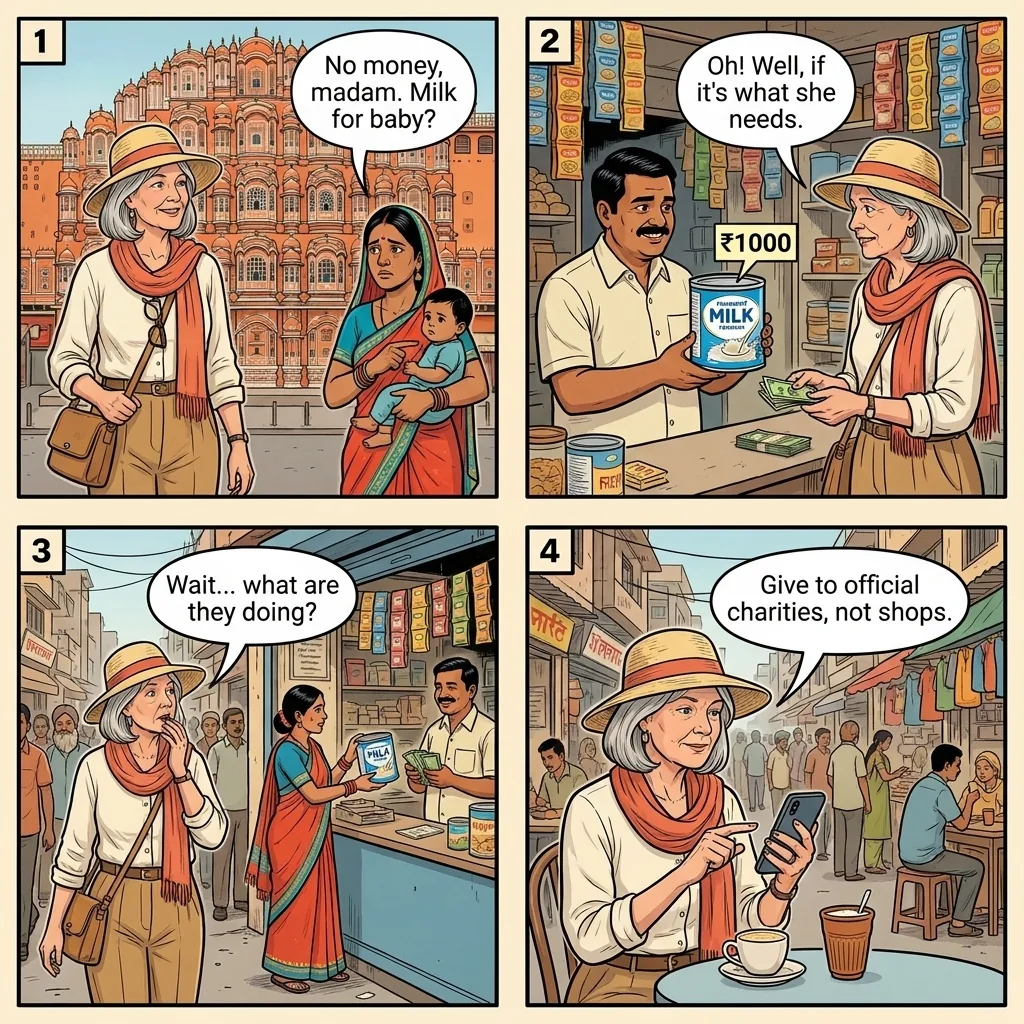
A woman near Amber Fort or Hawa Mahal holds a baby and asks not for money but for milk — pointing to a specific shop. The shop charges ₹800 to ₹1,200 for a tin of formula, and the moment you leave she returns it for a cut of the 'sale.'
Near Jaipur's tourist sites, a woman approaches holding a baby, sometimes with a young child at her feet. She explains, in broken English, that her husband is ill or has died and she cannot afford milk for her baby. She is not asking for money — just milk. She points to a nearby shop where she says they sell the formula she needs. You feel relieved: this is not about cash.
The shop charges you ₹800 to ₹1,200 for a tin of baby formula. The moment you leave, the woman returns the tin to the shopkeeper and splits the 'sale' with them. Travelers have documented this running in Jaipur and other Rajasthan cities for years — one wrote that even after recognizing the scam, refusing was emotionally impossible after seeing the baby cry. The shop and the woman work as a single unit; the baby is real, the formula is real, the relationship between mother and baby is sometimes genuine, but the entire transaction is theatrical.
The hook is a sympathy pitch that swaps cash for goods to make refusal feel cold. The defensive move is to politely decline and continue walking — the right answer for all street sympathy pitches — and if you want to help families in need, donate to verified local NGOs rather than entering a specific shop at the direction of a stranger who has just told you a story.
Red Flags
- Sympathy pitch doesn't ask for money directly but steers you toward a specific nearby shop
- The shop sells only the specific item requested — formula, medicine, or food — at high prices
- Price of the item at the shop is far above normal market rate
- Woman and shopkeeper appear to know each other
- The same woman is seen at the same spot on multiple days
How to Avoid
- Politely decline and continue walking — the best response to all street sympathy pitches.
- If you want to help families in need, donate to verified local NGOs rather than individuals on the street.
- Never enter a specific shop at the direction of a stranger who has just told you a sob story.
- If moved to help with food, offer packaged food you buy independently from a different store.
- Understand that organized begging rings use children specifically because adults find them harder to refuse.
🆘 What to Do If You Get Scammed
📋 File a Police Report
Go to the nearest Indian Police station. Call 100 (Police) or 112 (Emergency). Get an official crime report — you'll need this for insurance claims. You can also report online at citizenservices.gov.in.
💳 Cancel Your Cards
Call your bank immediately. Most have 24/7 numbers on the back of the card (keep a photo saved separately). Block any suspicious transactions before the thieves use your details.
🛂 Lost Passport?
Contact your nearest embassy or consulate. The US Embassy in New Delhi is at Shantipath, Chanakyapuri, New Delhi 110021. For emergencies: +91 11-2419-8000.
📱 Track Your Device
If your phone was stolen, use Find My (iPhone) or Find My Device (Android) from another device. Don't confront thieves yourself — share the location with police instead.
Frequently Asked Questions
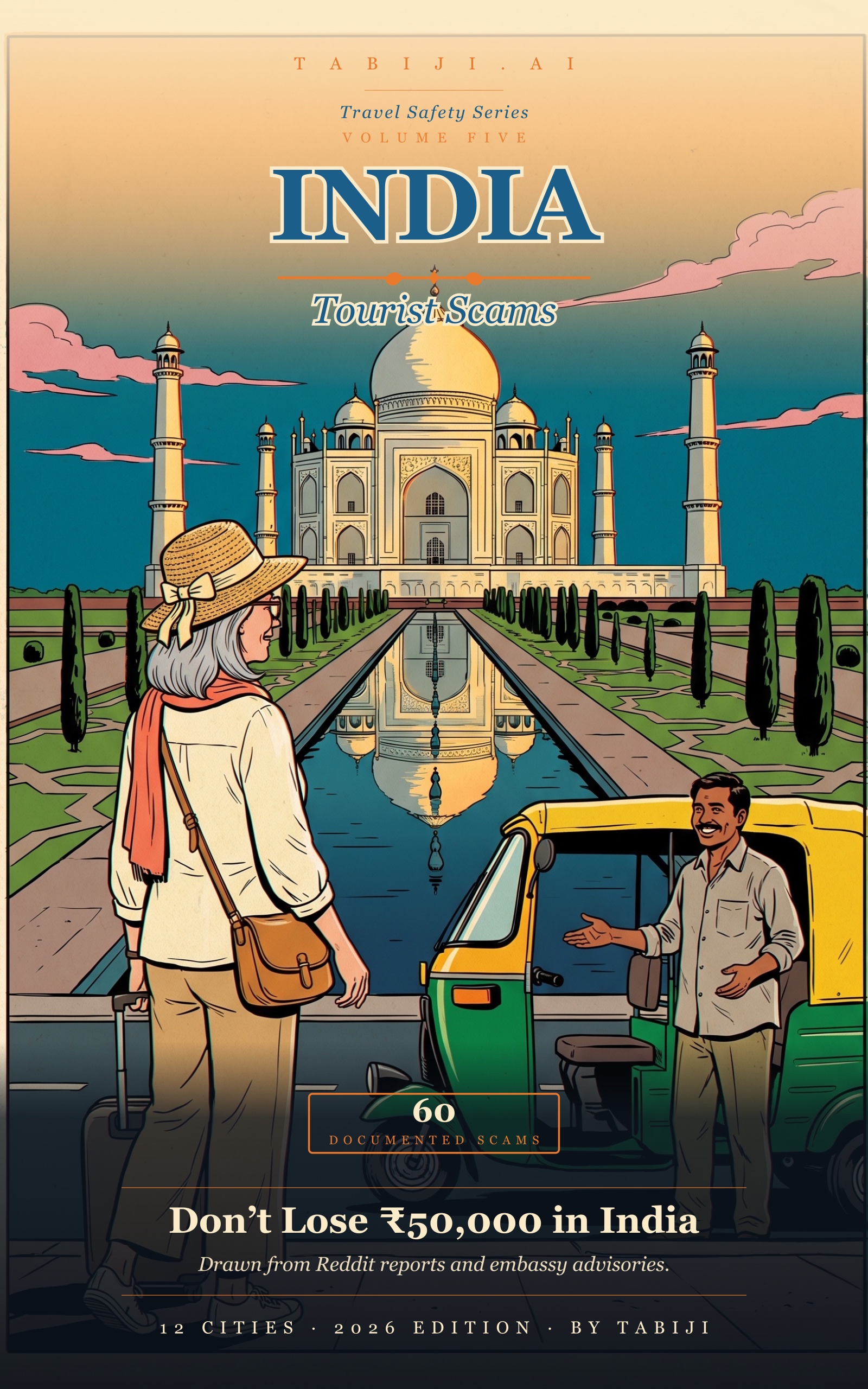
You just read 7 scams in Jaipur. The book has 60 across 12 Indian cities.
Delhi’s Paharganj “India Tourism” rebooking trap. Jaipur’s Hawa Mahal rickshaw textile detour. Mumbai’s ₹61,000 dating-app pub bill. The Lake Pichola sunset-photo extortion. The Bengaluru Silk Board meter manipulation. Every documented India scam — with the exact scripts, red flags, and Hindi phrases that shut each one down. Drawn from Reddit, the Times of India, News18, Telangana Today, and embassy advisories.
- 60 documented scams across Delhi, Mumbai, Jaipur, Agra & 8 more cities
- A Hindi exit-phrase card (Devanagari + Latin) you can screenshot to your phone
- Updated annually — buy once, re-download future editions free
- Readable in one flight — $4.99, coming soon on Amazon Kindle