
Key Takeaways
- The #1 reported scam is the Thamel Art-Student Commission Walk.
- 3 of 7 scams are rated high risk.
- Use app-based ride services (Uber, Ola) instead of street taxis — always confirm the fare before departure.
- Never accept unsolicited offers from strangers near tourist sites in Kathmandu.
⚡ Quick Safety Tips
- Keep phones and valuables in secure pockets when in crowded areas.
- Use only licensed taxis or app-based ride services.
- Book tours and tickets through verified operators with online reviews.
- Keep a copy of your passport separate from the original.
Jump to a Scam
- Medium The Thamel Art-Student Commission Walk
- Low The Boudhanath 'Annapurna Festival' Blessing
- High The Thamel Gem-Resale Profit Pitch
- Medium The Thamel 'Sick Family' Rice-Bag Hustle
- High The Thamel Bargain-Trek Vanish
- Medium The Tribhuvan Airport NPR-vs-USD Quote
- High The Kathmandu Voluntourism 'Orphanage' Setup
The 7 Scams
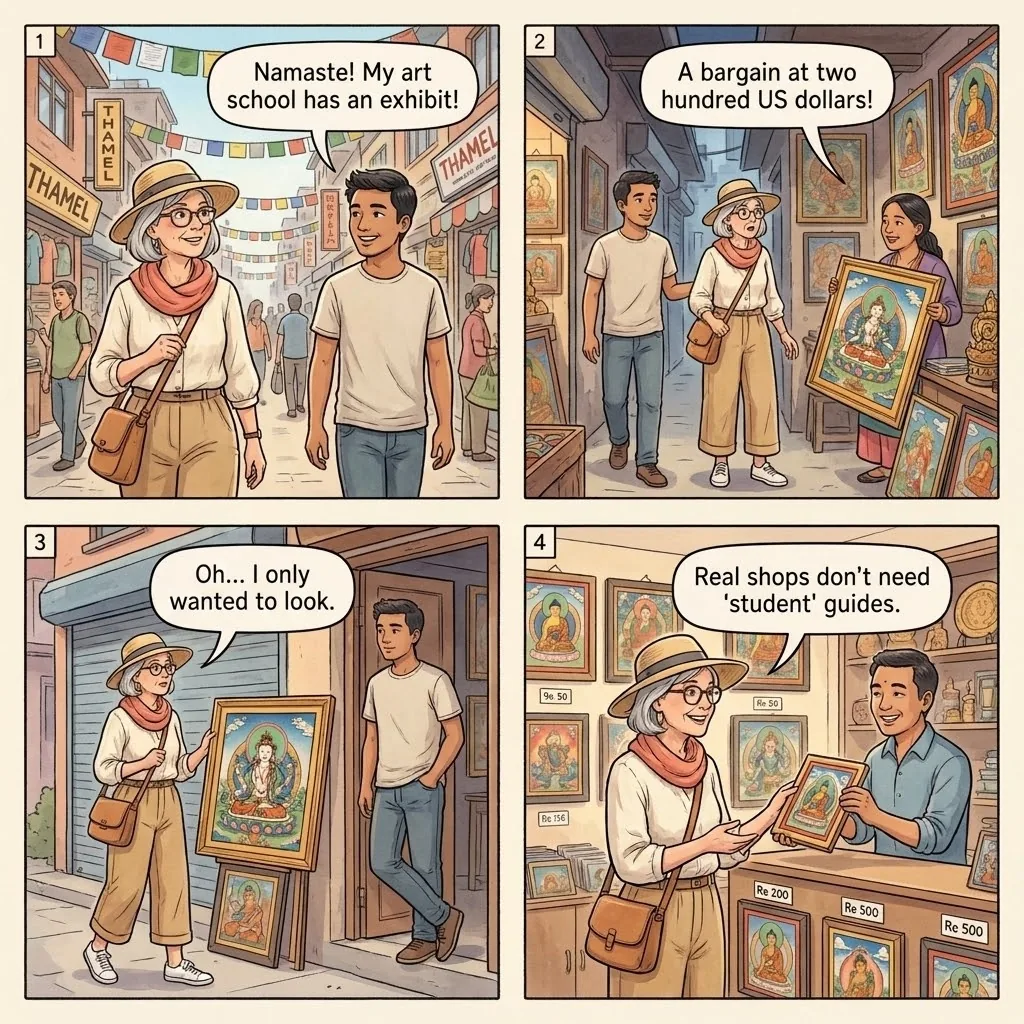
A 'student' in Thamel walks beside you to a hidden side-alley 'art-school exhibit' where mandalas are quoted in USD at $80–$300 — five times the regular shop price — and the friendly guide collects a commission off whatever you buy.
You're wandering the dusty lanes of Thamel, camera around your neck, when a friendly young man falls into step beside you. He introduces himself as a student and says you're lucky — his art school just opened an exhibit nearby and he'd love to show you. 'Just looking, no obligation,' he says with a wide smile. You follow him through a narrow side alley and into a small shop packed with painted mandalas and thangka scrolls.
A woman immediately launches into a passionate explanation of each piece — the symbols, the months of hand-painting, the spiritual significance. The art itself may be genuine. But the moment you show interest, the pressure begins. Prices are quoted in USD — $80, $150, $300 — far above what you'd find at any other shop. The 'student' hovers at the door, blocking your exit psychologically even if not physically.
Multiple traveler reports document being walked to these shops by seemingly random strangers who collect commissions afterward. The two-person staging is the entire mechanic: the friendly guide builds rapport over a 5-minute walk, the shop staff close hard the moment you cross the threshold, and the guide blocks the exit with body language and guilt rather than physical force.
Some versions add a layer. The 'student' tells you today is the 'Annapurna festival, the only day of the year' and gets you to receive a prayer blessing at a stupa before steering you to the shop. The supposed festival has no verifiable existence online, and several travelers report being told the exact same story on consecutive days. The fake-urgency framing is the bridge from a casual walk to a high-pressure sale you didn't agree to.
The defensive move is to politely decline and keep walking — say 'namaste' and don't engage further. Decent mandalas in regular Thamel shops start at NPR 500–1,500 — anything in USD or quoted in the hundreds is a flag. Never let a stranger lead you to a 'friend's shop' for any reason. For pressure or extortion, the Tourist Police office in Bhrikutimandap is +977-1-4247041 (24-hour) and the general police line is 100.
Red Flags
- A stranger in Thamel 'coincidentally' wants to show you his art school for free
- Prices are quoted in US dollars, not Nepali rupees
- You're told today is a unique festival or special occasion
- The shop is tucked in an alley and not a regular storefront
- The guide lingers at the door while you browse, creating social pressure to buy
How to Avoid
- Politely decline and keep walking — say 'namaste' and don't engage further.
- If you want to buy Nepali art, find shops yourself on Thamel's main streets.
- Research what 'festivals' are actually happening on any given day before your visit.
- Know the approximate price ranges for mandalas (decent ones start at 500–1500 NPR in regular shops).
- Never let a stranger lead you to a 'friend's shop' — always go independently.
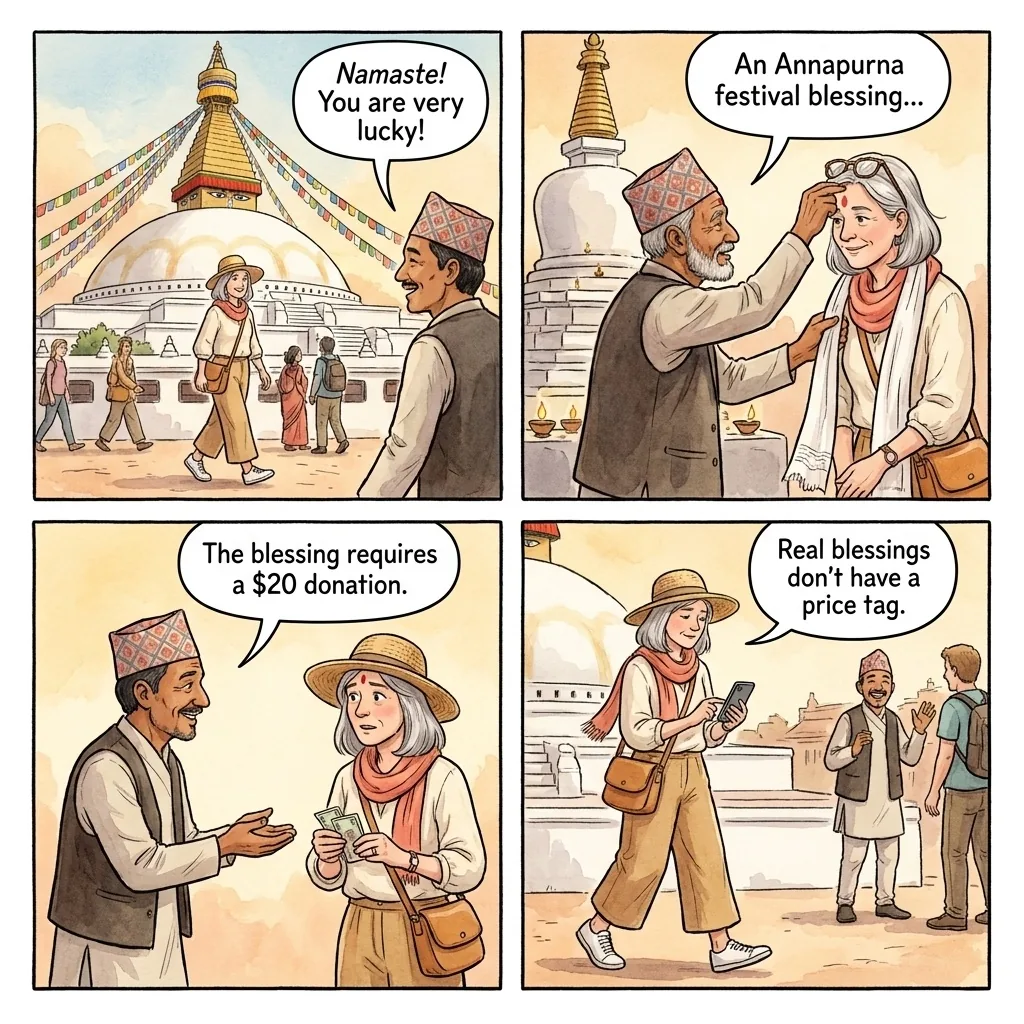
A man in traditional dress at Boudhanath says today is the 'only day of the year' for the Annapurna festival, walks you through a 'free' tika-and-khata blessing at a side stupa, then opens his palms for $20 and visibly disappoints at any lesser amount.
You're walking near Boudhanath Stupa when a man in traditional dress approaches excitedly. 'You are very lucky!' he says. 'Today is the only day of the year for the Annapurna festival. I want to take you to receive a special blessing — completely free!' He walks with you toward a small stupa you hadn't noticed before and explains the significance of each carving along the way.
An older man at the entrance places a tika on your forehead and drapes a khata scarf around your neck. The 'tour' lasts about 20 minutes and feels genuinely cultural — until the moment it ends and the guide turns to you with open palms. The blessing, he explains, requires a donation. The amount isn't fixed. He may name $20 USD or wait for you to offer something, then express disappointment at whatever amount you give.
Multiple traveler reports document being told the 'Annapurna festival' story three days in a row, each time presented as the 'only day of the year.' The community traveler guide calls this out directly: 'When you actually research Annapurna festival there is no information online about it and people will tell you multiple days in a row that this is the only day of the year that it is happening.'
The key tell is the manufactured urgency-and-exclusivity framing. Real Nepali festivals are publicly listed and run on the lunisolar Bikram Sambat calendar — Tihar, Dashain, Buddha Jayanti, and Indra Jatra all have fixed annual dates and abundant English-language coverage. A 'festival' you've never heard of, that no one else seems to be observing, that can only be reached through a stranger's guidance, is invented.
The defensive move is to search any supposed festival before agreeing to attend — if it doesn't appear on Nepal Tourism Board listings, it's invented. Never follow strangers to religious sites; visit independently or hire a licensed guide through your hotel. Carry only small bills when sightseeing so any 'donation' demand stays modest. For pressure, the Tourist Police office is +977-1-4247041 and the general police line is 100.
Red Flags
- A stranger claims today is a unique, once-a-year festival you've never heard of
- The 'guide' emphasizes the blessing is free before the tour begins
- You're walked to a small, obscure stupa rather than a famous temple
- An older man performs a ritual without explaining any costs
- Donation is requested only after the experience is complete
How to Avoid
- Search online for any supposed festival before agreeing to visit — if it doesn't appear in search results, it's likely invented.
- Never follow strangers to religious sites — research and visit independently.
- If you want temple experiences, hire a licensed guide through your hotel.
- Carry only small bills when sightseeing so any demanded payment stays modest.
- Politely say 'no thank you' and walk away — the fake urgency vanishes immediately.
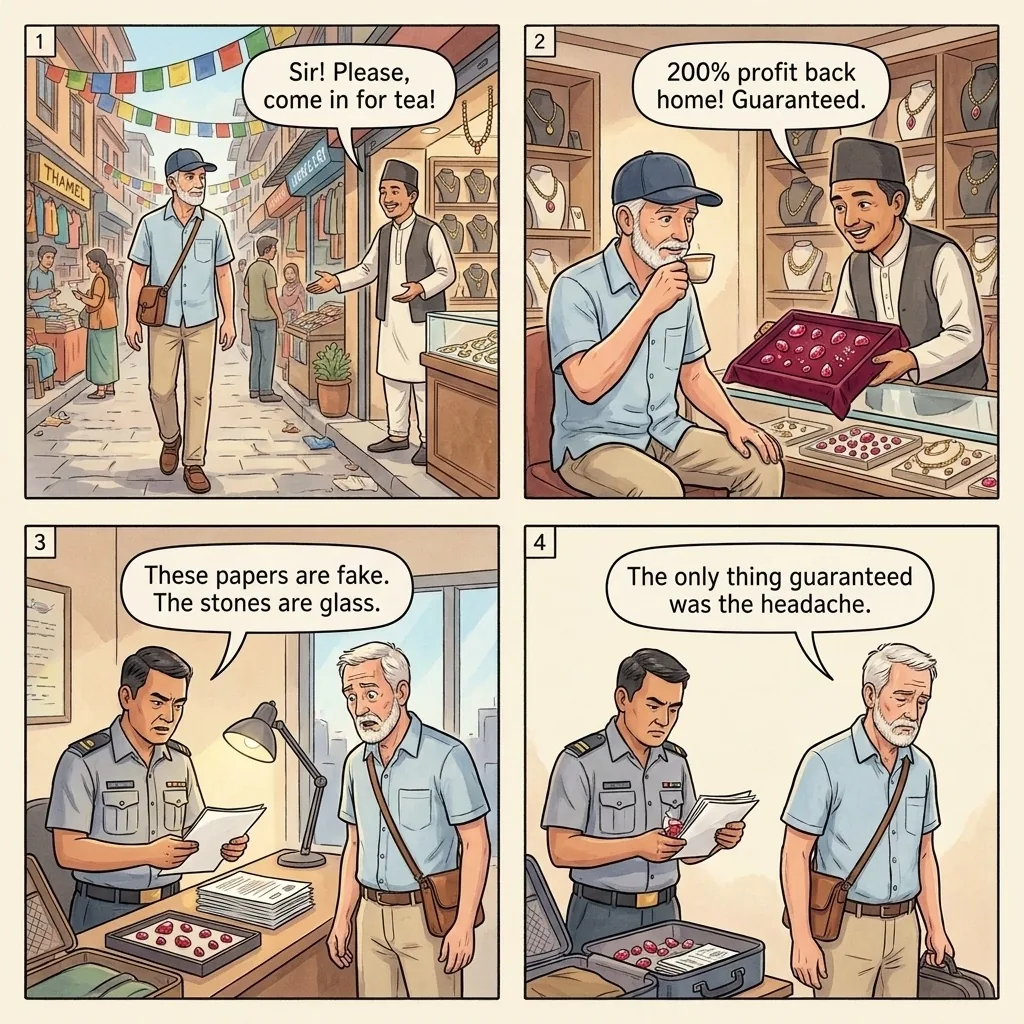
A charming Thamel jeweler invites you in for tea and pitches a 'guaranteed 200% profit' on gem resale back home — the rubies are worthless glass, the export papers are fraudulent, and you face customs confiscation and a fine on departure.
You're browsing the jewelry shops along Thamel's narrow lanes when a shopkeeper invites you in for tea. He's charming, knowledgeable, and seems to genuinely want to educate you about Nepali gemstones. Then comes the proposition: he has a surplus of high-quality gems — rubies, turquoise, lapis — that are worth double in your home country. If you buy them here and resell them, you'll clear a 200% profit. He even offers to handle the export paperwork.
The gems turn out to be worthless glass or low-grade stones. The export paperwork may be fraudulent. Some travelers get stopped at immigration and face serious trouble for attempting to export items they didn't realize were fake or, in rarer cases, illegally acquired antiques. The community traveler scam guide warns directly: 'Either what they will sell you will be worth nothing, or you will be stopped by immigration and fined.'
A second variant swaps gems for 'authentic' Buddhist statues or antique coins. Nepal strictly regulates the export of religious artifacts under the Ancient Monuments Preservation Act — buying from a random shop and trying to take items out of the country can result in customs confiscation and fines far exceeding the purchase price. The shopkeeper is unreachable, and you're holding contraband at Tribhuvan departure security.
The hook is the resale-profit framing — it converts a tourist purchase into an investment story, which lowers the buyer's guard about authenticity. Real gem dealers don't pitch resale schemes to walk-in foreigners; the entire premise is a giveaway. The 'export help' framing is the second flag: legitimate items don't need a stranger's paperwork.
The defensive move is simple: never buy gems or antiques in Nepal with the intent to resell abroad based on a stranger's advice. Nepal bans export of antiques over 100 years old without Ministry of Culture certification. For genuine gems, use a certified gemologist or a reputable Thamel store like Lotus Gems with verifiable Tripadvisor reviews. Stick to mass-produced souvenirs you can clearly identify as modern crafts. The Department of Archaeology export-permit office is at Ramshah Path (+977-1-4250683).
Red Flags
- A shopkeeper proposes a 'too good to be true' resale profit scheme in your home country
- Gems or antiques are sold with promises of guaranteed value abroad
- The seller offers to handle 'export paperwork' for you
- Prices seem too low for supposedly high-value items
- You're asked to buy multiple pieces rather than a single souvenir
How to Avoid
- Never purchase gems or antiques with the intent to resell abroad based on a stranger's advice.
- Know that Nepal bans export of antiques over 100 years old without government certification.
- If buying genuine gems, use a certified gemologist or reputable store with verifiable reviews.
- Stick to mass-produced souvenirs you can clearly identify as modern crafts.
- Declare any significant purchases at customs to avoid problems at the border.
Like what you're reading? Get a full Kathmandu itinerary with safety tips built in.
Browse travel-safety books →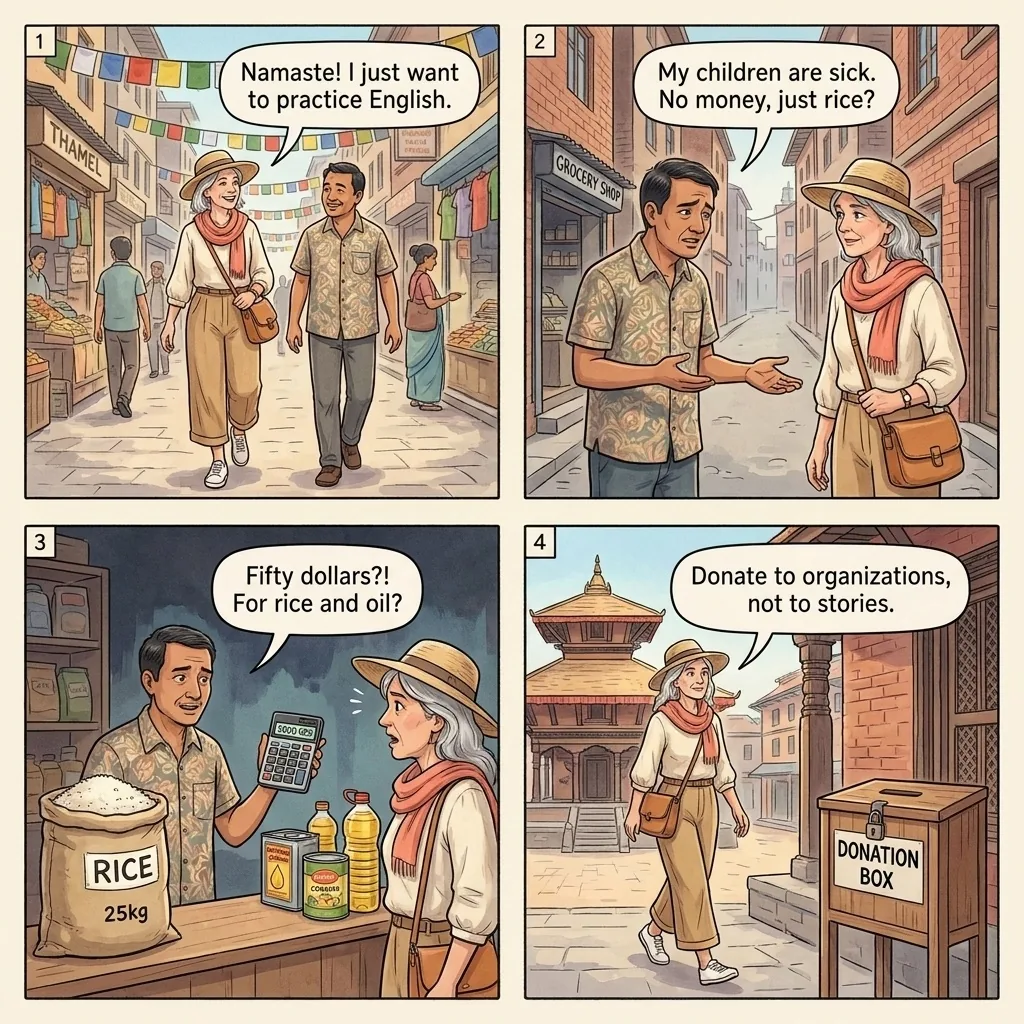
A friendly man walks alongside you in Thamel for 20 minutes saying he 'doesn't want money,' then asks for one small kindness — a 25 kg sack of rice for his sick family — that costs $40 in a shop charging five times the market rate, with the goods returned for a split after you leave.
You're walking down Thamel's main street when a man approaches with warm, unhurried energy. He doesn't want money, he says — he just wants to chat. His English is good, he's curious about where you're from, and he walks alongside you pointing out interesting spots. After 20 minutes, you've relaxed your guard.
Then he brings up his family — his children are sick, his wife hasn't eaten, and he doesn't want money, just a small kindness: some food from that shop over there. You agree, feeling generous. But when you enter the small grocery near the intersection, he starts picking items — a 25 kg sack of rice at NPR 1,000 (market price: NPR 200), 10 liters of cooking oil, powdered milk at triple the normal price. The shopkeeper plays along perfectly.
The total climbs to $40 or $50 USD before you realize what's happening. After the transaction, the items either go back to the shop for a split of the cash, or the 'family member' was never real to begin with. This is one of the most emotionally manipulative scams in Kathmandu because it exploits compassion through a 20-minute rapport build before the ask lands.
The community traveler reports document the play repeatedly with the same opening line: 'He keeps telling me he wants no money from you.....' The 'no money' framing is the entire trick — it disarms the standard 'don't give money to strangers' defense, and the substitution to in-kind goods at a wildly inflated shop converts your goodwill into a cash extraction routed through a complicit grocery.
The defensive move is to politely decline all offers from strangers who walk with you in Thamel for any extended time, however warm the conversation. If you genuinely want to help, donate to a verified local charity like Karuna-Shechen, Maiti Nepal, or Nepal Youth Foundation. 1 kg of rice in Kathmandu costs NPR 80–100 — anything far above that is a flag. Don't enter shops accompanied by someone you just met. For pressure, the Tourist Police line is +977-1-4247041.
Red Flags
- A stranger walks with you unprompted for an extended time, building rapport before asking anything
- They explicitly say 'I don't want your money' — this is a setup for the pivot
- The suggested shop is a specific backstreet location, not a regular supermarket
- Prices in the shop seem wildly inflated compared to normal
- The request is for large quantities of staple goods rather than a single small item
How to Avoid
- Politely decline all offers from strangers who approach you on Thamel's streets.
- If genuinely wanting to help someone, donate to a verified local charity instead.
- Know that 1kg of rice costs roughly 80–100 NPR in Nepal — anything far above that is suspicious.
- Don't enter shops accompanied by someone you just met on the street.
- Use the Pathao app for price-check norms and stay aware of local costs before your trip.
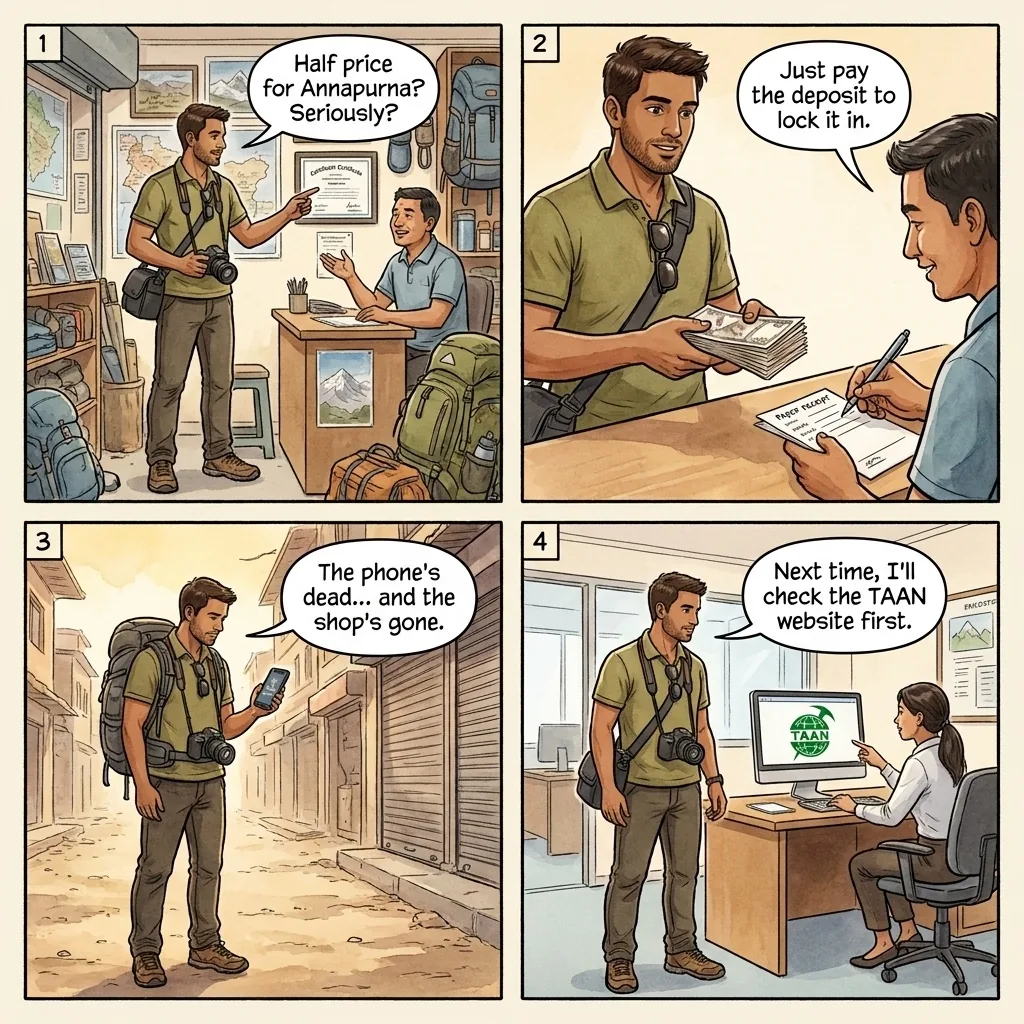
A Thamel trekking shop quotes the Annapurna Circuit at half the going rate with a laminated certificate on the wall — you pay the deposit, and on departure day the agency phone goes dead or an unlicensed guide with no evacuation protocol shows up.
You've finally decided to do the Annapurna Circuit and you're shopping for a trekking company along Thamel's main street. The third shop you enter quotes a suspiciously low price — half the going rate — with a guide who speaks perfect English and a laminated certificate on the wall. You pay a deposit, get a printed itinerary, and go to sleep excited.
On departure day, either the guide doesn't show, the agency number goes dead, or a totally unprepared, unlicensed person appears who has no idea what to do in an emergency. The financial loss is bad, but the safety risk is worse: altitude sickness above 3,500 m can kill in hours, and a guide without a real evacuation protocol — radio coordinates, helicopter contacts, insurance verification — is a liability the moment something goes wrong.
Unlicensed trekking guides and outright fraudulent agencies are a real problem in Nepal. The Nepal Tourism Board licenses guides and requires registration through the Trekking Agencies' Association of Nepal (TAAN), but fake certificates are easily printed. The community traveler guide warns: 'They will be unlicensed and will give a sub-par trek with no safety protocols (e.g. evacuation). Worse they will just disappear with your money.'
A related scam is the helicopter-evacuation insurance fraud: a 'guide' or 'local contact' pressures you to fake altitude sickness and call for a heli-evacuation, then splits the insurance payout. Multiple insurers have blacklisted Nepal claims, and Nepal's CAAN issued public warnings in 2024 after the practice triggered international fraud investigations. Participating in the scheme can carry serious legal consequences and permanent insurance blacklisting.
The defensive move is to verify any trekking agency on the Nepal Tourism Board website (ntb.gov.np) and TAAN (taan.org.np) before booking, ask for the guide's license number and check it independently, and book through internationally reviewed platforms with hundreds of TripAdvisor reviews. Never pay more than 50% upfront — pay the balance after completing the trek. Refuse any insurance-fraud suggestion immediately. Tourist Police: +977-1-4247041. Trekking emergency rescue: +977-1-4711 (CAAN).
Red Flags
- Trekking package prices are significantly lower than competitors without clear explanation
- The agency has no online presence or reviews on TripAdvisor/Google
- Guide certificates can't be verified on the Nepal Tourism Board official website
- Pressure to pay the full amount upfront rather than a deposit
- Any suggestion from a 'guide' to fake an illness for helicopter insurance fraud
How to Avoid
- Verify trekking agencies on the Nepal Tourism Board website (ntb.gov.np) before booking.
- Ask for the guide's license number and check it independently.
- Book through internationally reviewed platforms like TripAdvisor or reputable travel blogs.
- Never pay more than 50% upfront — pay the balance after completing the trek.
- Absolutely refuse any suggestion involving false insurance claims — it's a serious crime.
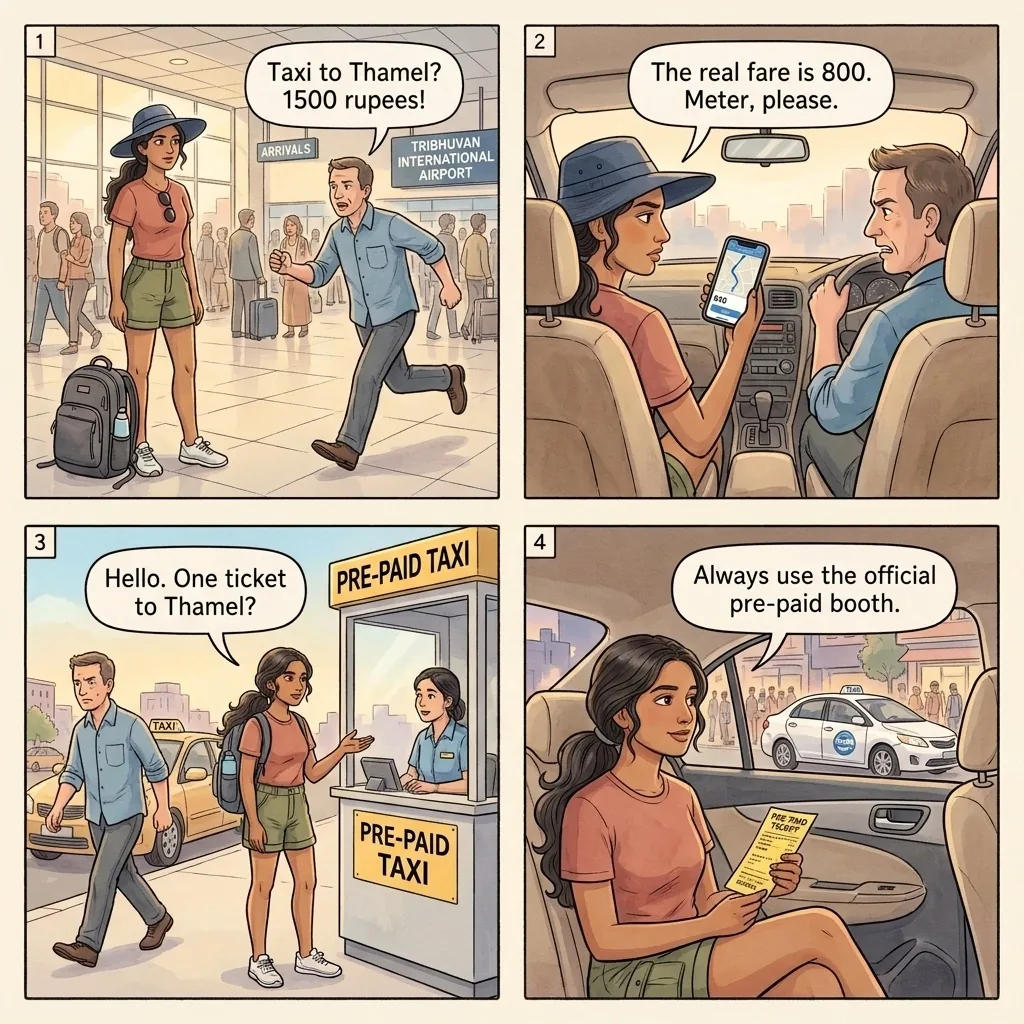
A driver outside Tribhuvan Airport quotes NPR 1,500 to Thamel — the metered fare is NPR 700–800 — and the meter (if the cab has one) gets 'forgotten' until you're halfway there or tampered between tariffs.
You step out of Tribhuvan International Airport after a long flight and immediately get swarmed by taxi drivers. One steps forward confidently and quotes NPR 1,500 to Thamel — a price that sounds reasonable to someone who doesn't know the metered fare should be around NPR 700–800. You're tired, you agree, and you've just paid double without knowing it.
Worse, some drivers will agree to use the meter and then tamper with it or 'forget' to start it until you're well underway. The airport-rank rate is roughly double the in-city rate; the meter-tampering variant adds another 20–40% on top by switching the tariff display partway through the trip. Either way, you're paying two-to-three times what a local would for the same 6 km transfer.
In the city itself, rickshaws near Durbar Square are a classic overcharge zone. Drivers quote foreigner prices that can be five to ten times the local rate, then become aggressive if you try to negotiate down. Some start pedaling before you've agreed on a price, then demand payment on arrival when you're already stuck.
A common trick is agreeing to 'NPR 100' verbally and then having the driver claim you misunderstood and the price was '$100 per hour.' The currency-substitution play exploits the fact that '100 USD' and '100 NPR' sound similar mid-conversation, particularly to a tired traveler navigating a new currency for the first time. Always confirm the figure in writing or get the driver to repeat 'rupees' explicitly.
The defensive move is to use the prepaid taxi counter inside Tribhuvan arrivals (NPR 700–800 fixed to Thamel, receipt issued) or download Pathao before landing — Nepal's Uber-equivalent shows upfront fares. Agree on every fare in NPR explicitly before entering any vehicle, never USD. Insist the meter runs from the moment you sit down; if refused, find another cab. For overcharge disputes, the Tourist Police office at Bhrikutimandap is +977-1-4247041 and most hotels will mediate complaints with the driver's vehicle plate.
Red Flags
- Driver quotes a price in USD rather than Nepali rupees
- Meter is 'broken' or driver refuses to turn it on
- Price is negotiated verbally without being confirmed in writing
- Driver takes noticeably longer routes or circles around before reaching your destination
- The driver didn't come from an official taxi stand or prepaid booth
How to Avoid
- Use the prepaid taxi counter inside the airport arrivals hall — fixed rates, receipts.
- Download the Pathao app before landing — it shows upfront fares like Uber.
- Agree on a price in Nepali rupees before entering any vehicle.
- Research current Thamel taxi rates online before your trip (currently ~700-800 NPR from airport).
- Insist the meter runs from the moment you enter — if refused, find another cab.
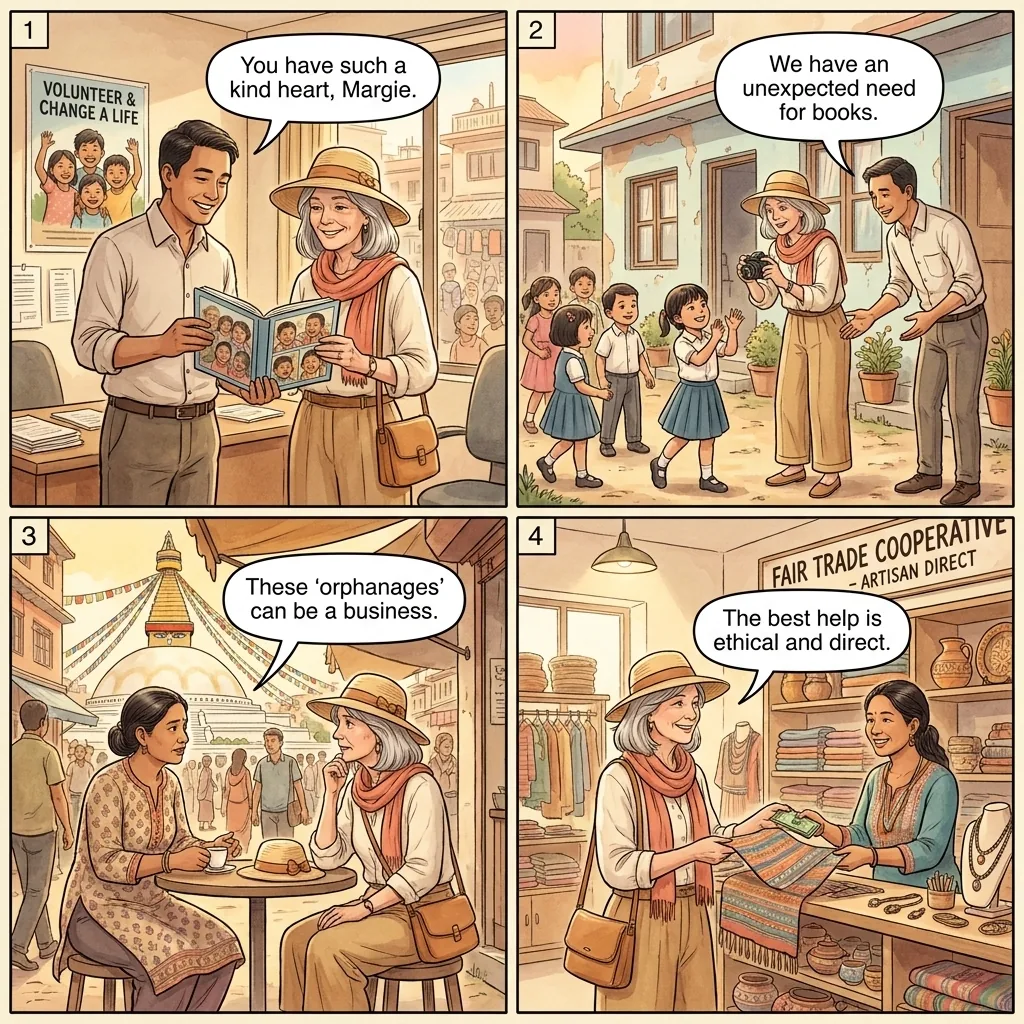
You pay $1,000–$2,000 to a voluntourism operator to teach at a Nepali 'orphanage' — UNICEF documents that most such children aren't orphans at all but were paid for from poor villages, used as props to attract Western fees, and cycled between facilities to look needier.
You want your trip to Nepal to mean something, so you sign up with a volunteer organization you found online. For a fee of $1,000–$2,000, you'll spend two weeks teaching English at an orphanage or helping at a community school near Kathmandu. The website photos are heartbreaking. The cause feels meaningful.
When you arrive, something feels off. The children seem well-fed and not particularly disadvantaged. The 'director' asks for more money for unexpected 'materials.' The teaching you're asked to do is busywork the regular staff could clearly handle on their own. The children appear coached, posing for photos with visiting volunteers in ways that feel rehearsed rather than spontaneous.
Nepal has become a hub for what's called 'voluntourism fraud.' The community traveler explanation is direct: 'Many such orphanages don't have actually orphans. They go to poor villages, pay the parents certain money to have their kids sent to the orphanages.' The children are props to attract Western volunteers and donations; the operators pocket the fees while the children remain in long-term institutional limbo.
UNICEF, Save the Children, and the Nepali Central Child Welfare Board have documented this extensively. Children are sometimes cycled between 'orphanages' to look younger or needier when new groups of volunteers arrive. Your $2,000 funds the operator's profit, not children's welfare — and the practice itself causes documented attachment-disorder harm to the children involved, which is why both UNICEF and the Australian government have moved to outlaw 'orphanage tourism' as a category.
The defensive move is to refuse any voluntourism program that places foreign visitors in direct contact with children — legitimate child-welfare programs almost never do this. Vet operators through the Central Child Welfare Board (ccwb.gov.np), Concerning Children Nepal (CCNN), or Better Care Network. Demand recent independent financial audits before paying any fee. If you want to contribute, donate to vetted organizations with multi-year track records (UNICEF Nepal, Maiti Nepal, SOS Children's Villages Nepal) rather than paying for a 'volunteer experience.'
Red Flags
- Volunteer fees are paid upfront to a small organization with little verifiable history
- The program involves direct contact with children as a selling point
- The organization can't produce audited financials or third-party certifications
- Children seem coached or are presented as props in promotional materials
- The 'orphanage' director keeps asking for additional donations or fees
How to Avoid
- Research any volunteer organization through CCNN (Concerning Children Nepal) or similar watchdog groups.
- Avoid programs that place volunteers with children — legitimate programs rarely do this.
- Look for organizations affiliated with established international NGOs (UNICEF, Save the Children).
- Ask for recent independent financial audits before paying any fees.
- Consider donating to verified organizations rather than paying for a volunteer 'experience.'
🆘 What to Do If You Get Scammed
📋 File a Police Report
Go to the nearest Nepal Police station. Call 100 (Police) or 102 (Emergency). Get an official crime report — you'll need this for insurance claims. You can also report online at nepalpolice.gov.np.
💳 Cancel Your Cards
Call your bank immediately. Most have 24/7 numbers on the back of the card (keep a photo saved separately). Block any suspicious transactions before the thieves use your details.
🛂 Lost Passport?
Contact your nearest embassy or consulate. The US Embassy in Kathmandu is at Maharajgunj, Kathmandu. For emergencies: +977 1-423-4000.
📱 Track Your Device
If your phone was stolen, use Find My (iPhone) or Find My Device (Android) from another device. Don't confront thieves yourself — share the location with police instead.
Sources & further reading
Every scam here is cross-checked against official government advisories, police bulletins, and established reporting. Confirm current details with the primary sources below before you travel.
-
UK Foreign, Commonwealth & Development Office (GOV.UK) — Safety and security - Nepal travel advice
Government advisory
“Be wary of trekking deals that look very cheap and may be scams.”
-
U.S. Department of State — Nepal Travel Advisory
Government advisory
“There have been some scams involving charities in Nepal.”
-
Government of Canada (travel.gc.ca) — Travel advice and advisories for Nepal
Government advisory
“avoid trekking packages that appear unusually inexpensive”
-
Nepal Tourism Board — Tourist Police | Assuring Tourist's Safety | NTB
Official tourism
“Exchange foreign currencies only at Government authorized financial institutions.”
-
The Guardian — Nepal's bogus orphan trade fuelled by rise in 'voluntourism'
News report
“It is a business model built on a double deception: the exploitation of poor families in rural Nepal and the manipulation of wealthy foreigners.”
-
World Nomads — How to Avoid Travel Scams and Crime When Visiting Nepal
Travel-safety guide
“When the tourist goes to the shop, they are charged an inflated sum of money and the milk is then returned by the scammer to the shop where both share in the…”
Frequently Asked Questions
You just read 7 scams in Kathmandu. The full Travel Safety Series has 780+ more across 20+ countries.
Tokyo's Kabukichō ¥130,000 bar trap. Rome's gladiator photo extortion. Paris's gold-ring trick. Bali's ATM skimmer scams. Bangkok's grand-palace closure ruse. Every documented scam across 20+ destinations — with the exact scripts, red flags, and local-language phrases that shut each one down. Drawn from Reddit traveler reports, embassy advisories, and consumer-protection cases.
- 780+ documented scams across Tokyo, Rome, Paris, Bali, Bangkok, Rio & 100+ more cities
- 20+ countries covered, with country-by-country phrase cards for every destination
- Updated annually — buy once, re-download future editions free
- All titles $4.99 each on Amazon Kindle