
Key Takeaways
- The #1 reported scam is the Lakeside Milk-Powder Beggar Pharmacy Con.
- 2 of 6 scams are rated high risk.
- Use app-based ride services (Uber, Ola) instead of street taxis — always confirm the fare before departure.
- Never accept unsolicited offers from strangers near tourist sites in Pokhara.
⚡ Quick Safety Tips
- Keep phones and valuables in secure pockets when in crowded areas.
- Use only licensed taxis or app-based ride services.
- Book tours and tickets through verified operators with online reviews.
- Keep a copy of your passport separate from the original.
Jump to a Scam
- Low The Lakeside Milk-Powder Beggar Pharmacy Con
- High The Pokhara Unlicensed Annapurna-Trek Agency
- High The Annapurna Helicopter-Rescue Insurance Fraud
- Medium The Lakeside Money-Changer Counterfeit Switch
- Medium The Lakeside Massage-Parlor Bait-and-Upsell
- Low The Pokhara Airport Taxi 'Broken Meter' Refusal
The 6 Scams
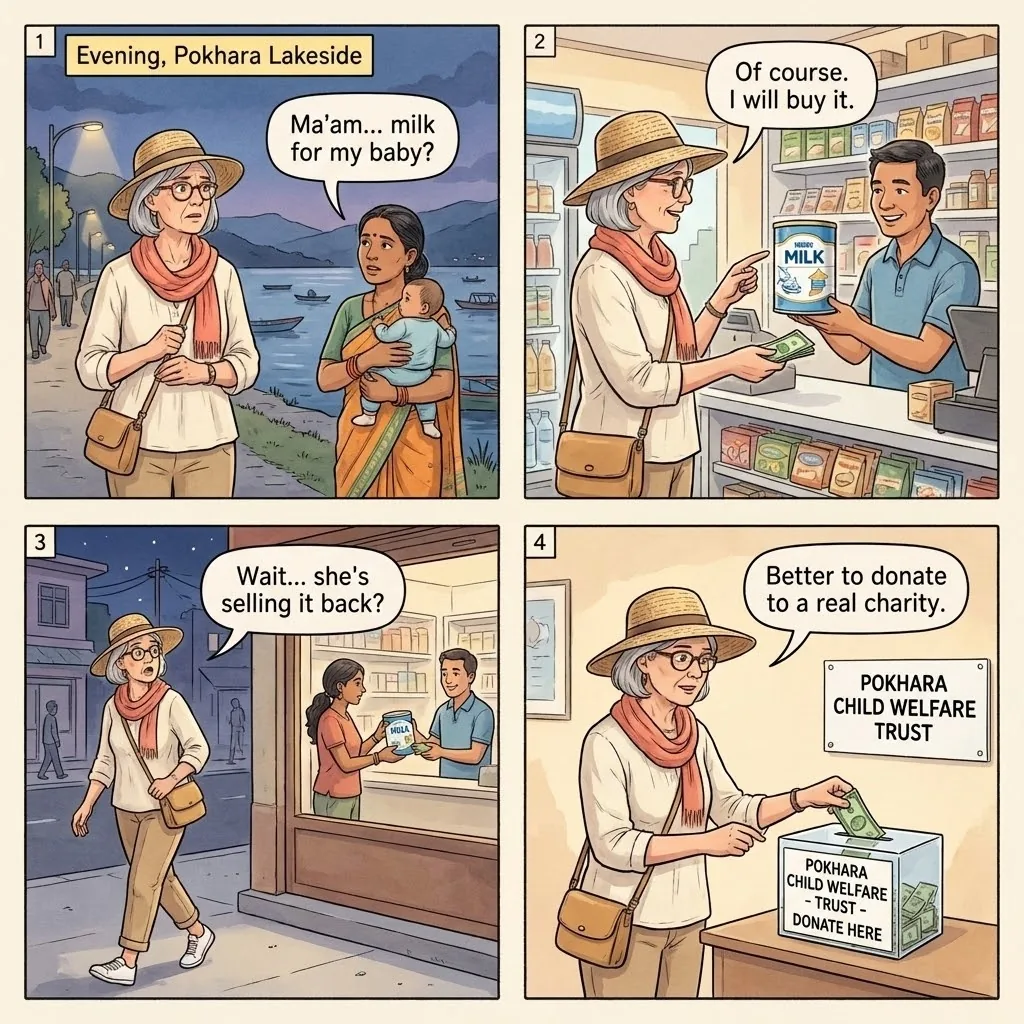
It's an evening walk along Pokhara's Lakeside strip after a long day of paragliding, you're heading toward your guesthouse, and a woman carrying a small baby approaches you and asks if you'd buy milk powder for her child.
She seems genuinely distressed. Rather than handing over cash, you offer to buy the milk yourself — feels safer, the help feels real. She leads you to a nearby shop and points to a specific imported milk powder brand priced at NPR 2,500 (about USD $19). You pay, hand her the can, and walk on feeling like you've done something good. After you leave, she returns the powder to the same shopkeeper, the cashier hands her cash less a 20–30% kickback, and the can goes back on the shelf for the next tourist.
The Lakeside milk-powder con is one of Pokhara's most persistent and well-documented tourist scams. The same handful of women work the Lakeside strip daily, the same shops are confederates, and the same milk-powder cans rotate through dozens of buyers per week. As travelers report across Reddit, the TripAdvisor Pokhara forum, the Lonely Planet Nepal thorntree, and Nepal Tourism Board consumer guidance, this is one of the highest-volume Pokhara tourist frictions despite the per-encounter dollar cost being relatively small.
The mechanism is structural rather than violent. The 'distressed mother' framing is calibrated to bypass the standard tourist-defence of 'don't give cash to street solicitors' — the buyer feels they're being responsible by buying the actual product rather than handing over money. The confederate shop converts the product back to cash via the kickback structure. The legitimate Nepali public-health system covers infant nutrition through MINSA child clinics; a real Nepali mother needing infant formula has access to free or subsidised supply through the public-health channel and isn't standing on Lakeside asking tourists.
The structural defences are clear. Decline the milk-powder request with a polite 'no, dhanyabad' and continued walking. If you genuinely want to support Pokhara's at-risk children, donate to established local NGOs — the Nepal Youth Foundation, Education Through Children, the Children-Women in Social Service and Human Rights organisation — where the donation reaches programmes rather than feeding the kickback chain. If a specific child is hungry, buy them a meal at a daal-bhat eatery rather than handing the mother a high-price 'product' that converts back to cash.
Decline the Lakeside milk-powder beggar approach with a polite 'no, dhanyabad' and continued walking — the entire mechanism converts your milk-powder purchase back to cash through a confederate shop. The legitimate Nepali public-health system covers infant nutrition for real Nepali mothers; the Lakeside encounter is a calibrated con. If you genuinely want to support Pokhara children's services, donate to established local NGOs (Nepal Youth Foundation, Education Through Children, CWISH) where 100% of the donation reaches programmes. Do not buy products for strangers — the kickback chain is the entire scam. Emergency: 100 (Police), 102 (Ambulance); the U.S. Embassy in Kathmandu is at +977 1 423 4000.
Red Flags
- A woman with a child specifically asks for milk rather than money
- She insists on going to a particular shop rather than the nearest one
- She points to the most expensive brand of milk powder available
- The shopkeeper and the woman seem to know each other
How to Avoid
- If you want to help, donate to established charities or NGOs in Pokhara.
- Politely decline and walk away — this is a known daily routine.
- If you do buy something, choose a modest item from a shop of your choosing.
- Don't feel guilty — the money does not go to feed children.
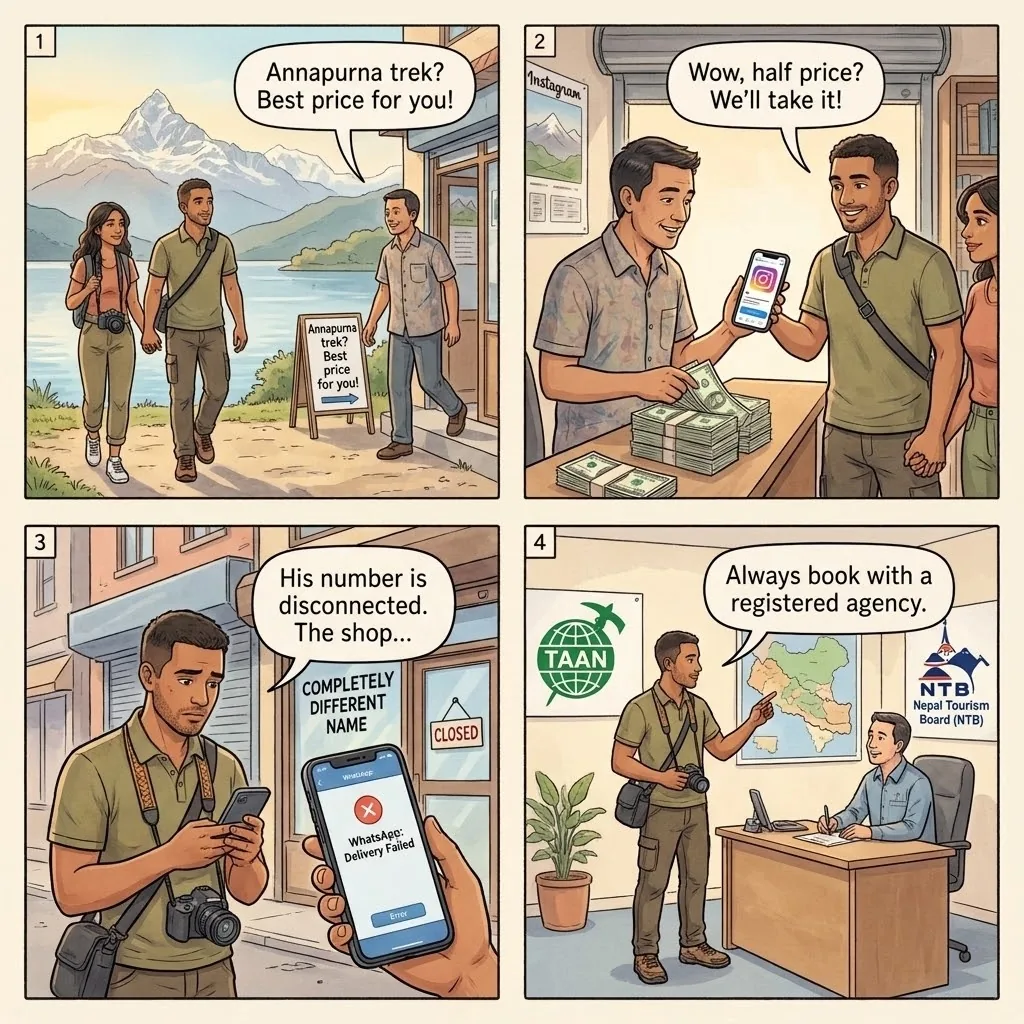
It's three days before your planned Annapurna Circuit start, you're walking the Pokhara Lakeside strip looking for an operator, and a hawker outside a small storefront offers you an all-inclusive 12-day package for USD $700 — half what the established agencies quoted.
The Instagram page he shows you looks polished. The price feels great. He says he's the operator-owner, that the package includes guide, porter, all permits, all teahouses, transfers — everything. He asks for the full $1,400 (two trekkers) in cash up front because 'the bank closes early.' You pay, get a printed itinerary, and the trek start date approaches. Three days before departure, the WhatsApp number stops responding; the storefront has a different name on the door than the receipt; the guide who was supposed to meet you at the trailhead doesn't exist.
The Pokhara unlicensed-trekking-agency phenomenon is one of the most-reported tourist frauds in Nepal. The legitimate Annapurna trek operators are registered with the Nepal Tourism Board (NTB), the Trekking Agencies Association of Nepal (TAAN), and operate with documented insurance, certified guides, and TIMS card processing. The unlicensed operators clone marketing materials, stand up Instagram pages, and run cash-only operations that disappear after the deposit. As travelers report across Reddit, the TripAdvisor Pokhara forum, the Lonely Planet Nepal thorntree, the U.K. Foreign Office Nepal travel advice, and Nepal Tourism Board consumer alerts, the unlicensed-agency category combines high-dollar fraud with meaningful safety risk on the trail.
The downstream consequences extend beyond the deposit. An unlicensed operator who does deliver the trek often uses uninsured vehicles for the trailhead transfer, untrained guides without altitude-sickness certification, no teahouse pre-booking (so you pay cash on the trail at peak rates), and no liability path if anything goes wrong. The most extreme variants — documented in 2026 Nepal Police arrests of 33 people in a $20 million helicopter-rescue racket — involved unlicensed agencies coordinating with rescue companies and hospitals to stage helicopter evacuations and forge insurance claims (covered in the next scam card).
The structural defences are concrete. Book Annapurna treks only through NTB-registered operators with documented TripAdvisor reviews older than two years and TAAN membership — Hi-Mountain Treks, Earthbound Expeditions, Crystal Mountain Treks, Nepal Hiking Team are well-reviewed examples. Verify the operator's NTB licence number on the NTB website, the TAAN membership on the TAAN registry, and the TIMS card processing path before paying. Cap the deposit at 30%; pay the balance only when the guide and porter meet you at the trailhead with paperwork in hand. Pay by credit card or bank transfer for chargeback options.
Book Annapurna treks ONLY through Nepal Tourism Board (NTB) and TAAN-registered operators with two-plus years of TripAdvisor reviews — Hi-Mountain Treks, Earthbound Expeditions, Crystal Mountain Treks, Nepal Hiking Team are well-reviewed examples. Verify NTB licence on ntb.gov.np and TAAN membership at taan.org.np BEFORE paying. Cap your deposit at 30%; pay balance only when guide and porter meet you at the trailhead with paperwork. Pay by card or bank transfer for chargeback options — never cash to a street agent. Decline 'discount' packages 30%+ below market rate; the missing margin is what doesn't get delivered, and the safety implications on Annapurna are serious. Emergency: 100 (Police); the U.S. Embassy in Kathmandu is at +977 1 423 4000.
Red Flags
- Prices significantly below market rate for popular treks
- No physical office — just a hotel desk or street-side operation
- Cash-only payment with no official receipt or contract
- The operator has a flashy social media presence but no verifiable registration
How to Avoid
- Only book through agencies registered with the Nepal Tourism Board (NTB).
- Ask to see the operator's NTB license and TIMS card before paying.
- Read recent reviews on TripAdvisor or Lonely Planet forums, not just Instagram.
- Pay by card or bank transfer with a paper trail, never cash on the street.
- Report suspicious operators to the NTB tourist helpline.
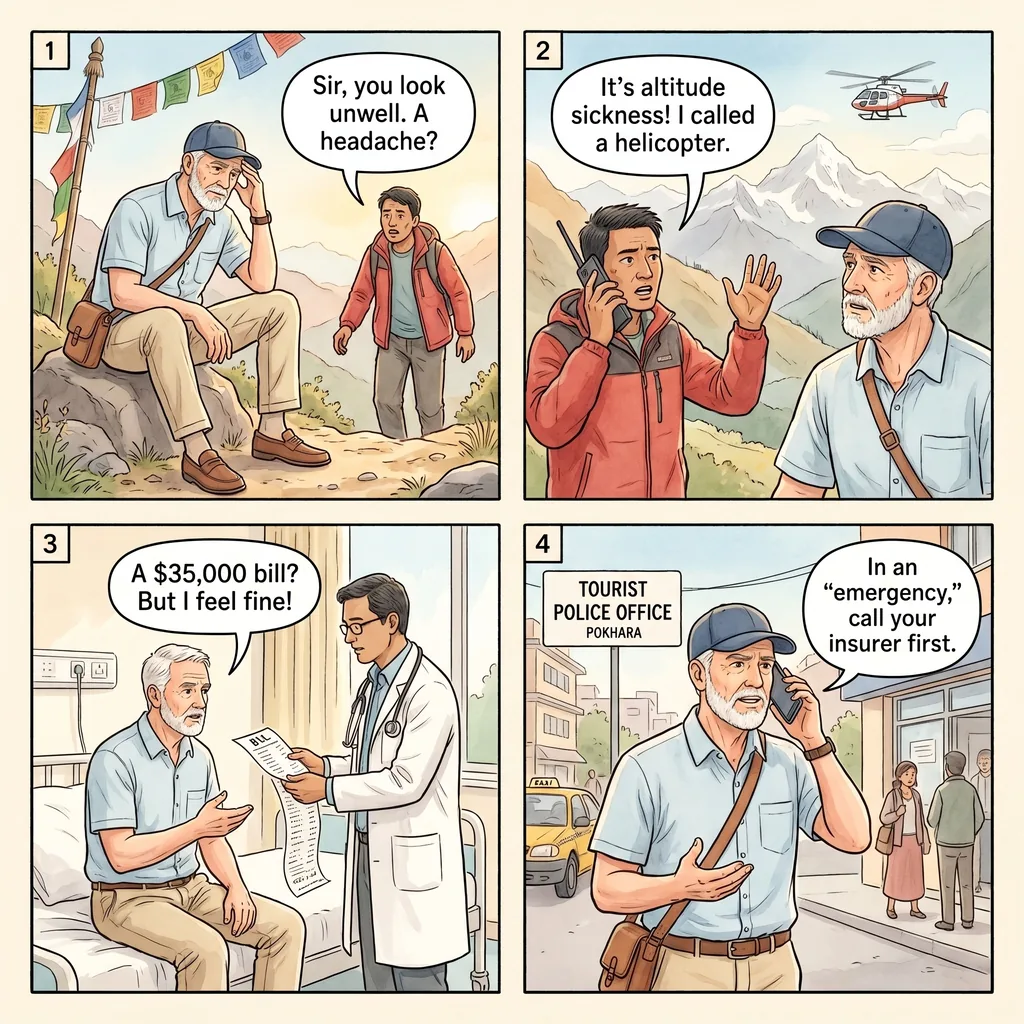
It's day five of your Annapurna Circuit trek, you've ascended to roughly 3,800m at Manang, you feel mostly fine — slight headache, nothing serious — and your guide pulls you aside to insist you need an immediate helicopter evacuation to Pokhara.
He says your symptoms 'look like high-altitude pulmonary edema' and that 'better to be safe.' He has already called a rescue service. The helicopter arrives within 90 minutes, costs $5,000 in his quoted estimate, and 'will be covered by your insurance.' At the Pokhara hospital, doctors run a battery of tests, keep you under observation for two days, and discharge you with a stack of paperwork totaling $35,000 in services billed against your travel insurance. You feel fine the entire time.
The Nepal helicopter-rescue insurance fraud was one of the largest tourist-fraud rackets in South Asian history. Nepal Police arrested 33 people in 2026 in connection with a $20 million scheme; guides, rescue companies, and hospital staff colluded to stage helicopter evacuations of healthy or mildly ill trekkers, forge medical reports of severe altitude illness, and file claims against foreign travel insurers — typically AXA, Allianz Worldwide, World Nomads, and SafetyWing. The scheme operated for several years before the 2026 prosecution. As travelers report across Reddit, the TripAdvisor Pokhara forum, the BBC News Nepal coverage, the Reuters investigative reports, and the U.K. Foreign Office Nepal travel advice, this is the highest-stakes Pokhara-trekking-related scam.
The mechanism relied on the layered structure. The unlicensed budget operator (covered in the previous scam) recruits the trekker. The guide identifies the trekker as a candidate for 'evacuation' based on insurance coverage indicators. The rescue helicopter company executes the airlift at inflated billing rates. The hospital documents fictional or exaggerated symptoms to support the insurance claim. Each layer takes a percentage of the inflated insurance payout; the trekker is sometimes complicit (offered a kickback to corroborate symptoms), sometimes a passive victim. Even where the trekker is innocent, the fraudulent claim against their insurance can lead to policy cancellation, future-coverage denial, or in extreme cases, fraud charges.
The structural defences are concrete. Choose only NTB and TAAN-registered operators with documented TripAdvisor histories. Carry your own pulse oximeter and learn the real symptoms of HAPE/HACE (high-altitude pulmonary/cerebral edema) — descent on foot is the standard treatment, not helicopter evacuation, unless symptoms genuinely warrant. Refuse to exaggerate symptoms for insurance purposes — this is fraud and voids your policy. If a guide pressures you toward an unnecessary helicopter rescue, descend on foot and contact your insurance provider directly before agreeing to anything. Report any coercion to Nepal Tourist Police.
Choose only NTB and TAAN-registered Annapurna trek operators with documented TripAdvisor histories. Carry your own pulse oximeter and learn the real symptoms of altitude illness — descent on foot is the standard treatment for mild AMS, not helicopter evacuation. Refuse to exaggerate symptoms for any 'insurance reason' — this is fraud and will void your travel insurance and may carry legal exposure in your home country. If a guide pressures you toward unnecessary helicopter rescue, descend on foot, contact your insurance provider directly before agreeing to anything, and report the coercion to Nepal Tourist Police. Verify the rescue company is on the Nepal Tourism Board's licensed-operator list before any airlift. Emergency: 100 (Police), 102 (Ambulance); Nepal Tourist Police: +977 1 4247041.
Red Flags
- Your guide pressures you to accept a helicopter rescue when you feel fine
- The guide suggests you exaggerate symptoms for insurance purposes
- A budget agency offered you a suspiciously cheap or 'free' trek
- The hospital insists on extended stays and excessive testing
How to Avoid
- Choose reputable, NTB-registered agencies with verified reviews.
- Carry your own pulse oximeter and know the symptoms of altitude sickness.
- Never agree to exaggerate symptoms — it voids your insurance and is illegal.
- Contact your insurance provider directly before agreeing to any evacuation.
- Report any coercion to Nepal's Tourist Police immediately.
Like what you're reading? Get a full Pokhara itinerary with safety tips built in.
Browse travel-safety books →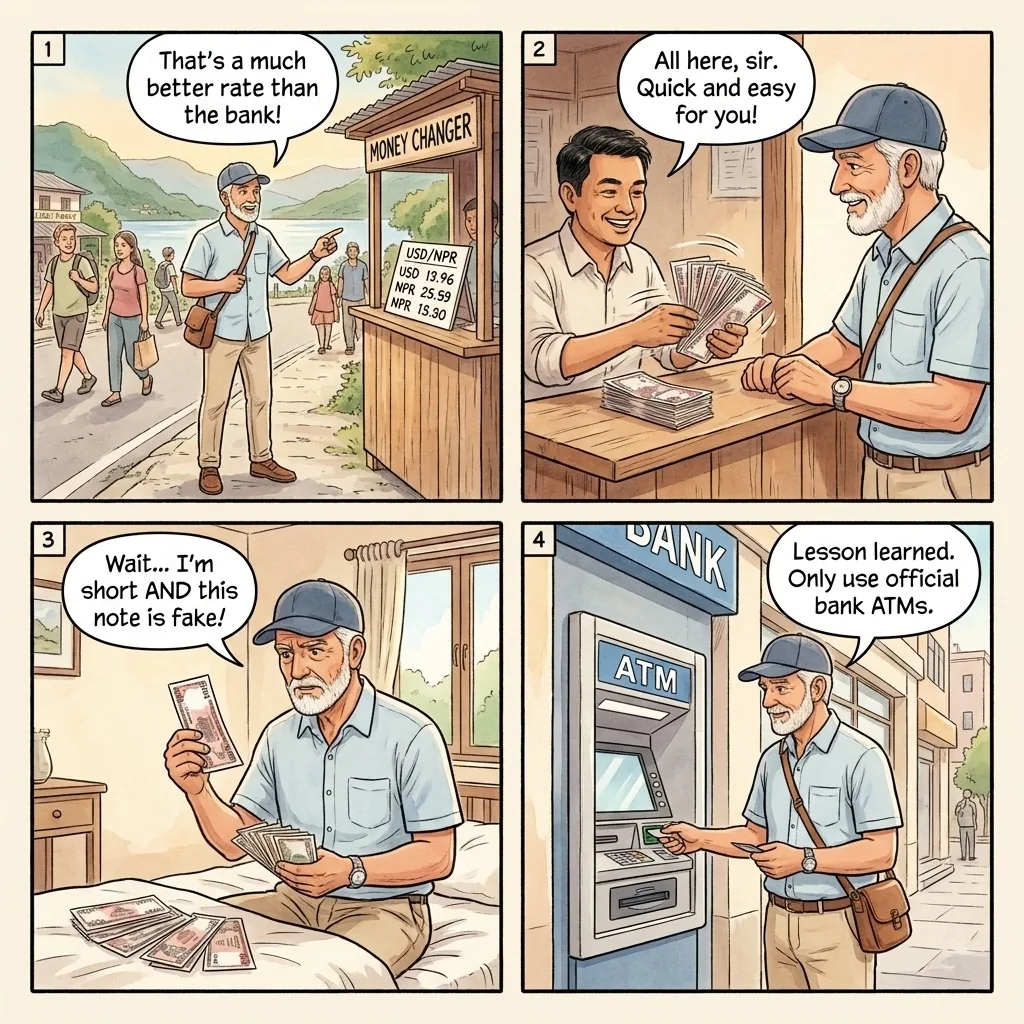
It's a Saturday afternoon on Pokhara's Lakeside strip, you need to convert USD $200 into Nepali rupees for the next few days, and a money-changer storefront posts a rate 5–8% better than the banks.
You hand over the dollars. The changer counts out the rupee notes quickly, fanning the stack so you can see — NPR 26,000, the right number, you think. You take the cash, walk back to your guesthouse, and recount on the bed. The actual rupee total is NPR 24,200 — short by NPR 1,800 (about USD $14). On closer inspection, two of the NPR 1,000 notes feel slightly off — one has a watermark that doesn't quite match, the other has a security thread that doesn't show under the light correctly.
The Pokhara Lakeside money-changer scam combines two common attacks. The fast-count short-change palms 1–3 notes during the rapid fan-out — the count appears legitimate but lands 5–10% short by the time you recount slowly. The counterfeit-mix substitutes one or two real notes for fakes during the same fan-out — the customer doesn't notice on quick inspection but discovers the shortfall when trying to spend the notes at a legitimate shop later. As travelers report across Reddit, the TripAdvisor Pokhara forum, the Lonely Planet Nepal thorntree, and Nepal Rastra Bank's published consumer guidance, the Lakeside changer category is one of the most-reported low-grade Pokhara financial frictions.
The legitimate Nepali exchange options are well-developed. The major bank branches (Nabil Bank, Standard Chartered Nepal, Himalayan Bank, NIC Asia) all have Lakeside-area branches with posted rates and ATM access. ATMs at these branches dispense clean rupee notes at near-interbank rates with a small foreign-card fee. Hotel and guesthouse front desks run slightly worse rates but reliably honest. The 5–8% 'better' rate offered by street changers is precisely the cost of the short-change-and-counterfeit risk.
The structural defences are concrete. Exchange currency only at banks, hotel/guesthouse front desks, or licensed exchange counters with NRB (Nepal Rastra Bank) registration visible on the wall. Use ATMs at bank branches for the cleanest cash access. If you do use a street changer, count the rupee notes back yourself slowly in front of the changer before walking away; check each note for watermark, security thread, and texture. Always get a receipt — you'll need it to convert unused rupees back to your home currency at the airport, and the receipt is a paper trail if anything is wrong.
Exchange currency only at Nepali bank branches (Nabil, Standard Chartered Nepal, Himalayan, NIC Asia), hotel/guesthouse front desks, or licensed exchange counters with visible NRB registration. Use ATMs at bank branches for clean cash access. If you do use a street changer, count rupee notes back slowly in front of the changer; check each note for watermark, security thread, and texture; always get a receipt for the conversion-back chain at the airport. The 5–8% rate gap that street operators offer is the cost of risk, not real savings. Carry only clean USD in good condition; damaged notes are routinely rejected. Emergency: 100 (Police).
Red Flags
- An exchange rate significantly better than bank rates
- No receipt or official documentation provided
- The changer counts very quickly and discourages you from recounting
- The location is a small unregistered shop or a street-side stall
How to Avoid
- Use banks or licensed exchange counters with posted rates and receipts.
- Count your money carefully at the counter before walking away.
- Know the current official exchange rate before approaching any changer.
- Keep the receipt — you'll need it to convert unused rupees back to your currency.
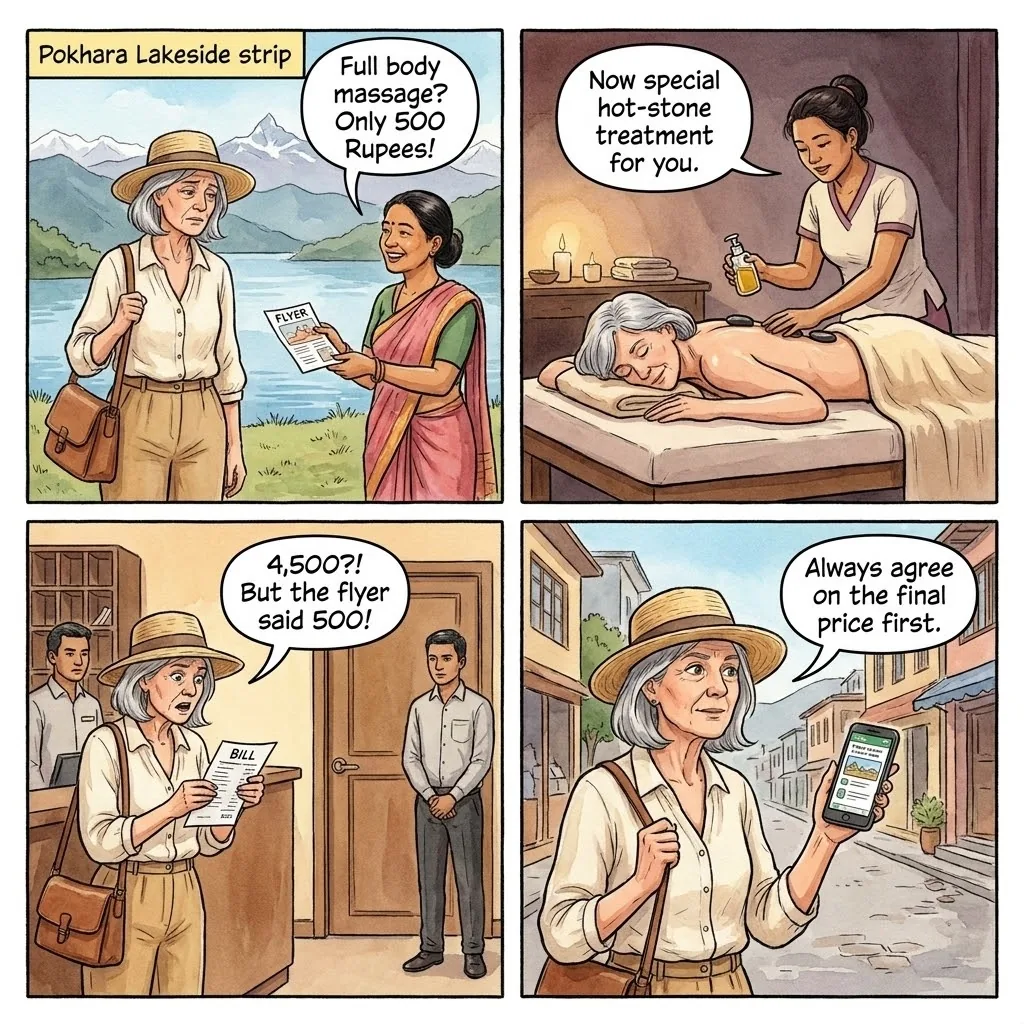
It's an evening on Pokhara's Lakeside strip after a tiring day of trekking, you've been handed a discount flyer for a 'full-body Ayurvedic massage' at NPR 500 (about USD $4), and you walk into the parlor for what looks like a great deal.
The session starts normally. The masseuse is friendly, the room is clean, the oil is warm. Twenty minutes in, she casually mentions she's adding a 'premium hot-stone' technique to your treatment — an extra NPR 800 — and continues without waiting for your reply. Five minutes later it's a 'detoxifying clay wrap' for NPR 1,200. By the end of the session, the bill is NPR 4,500 (about USD $34) instead of the NPR 500 the flyer promised. When you point to the flyer and refuse the upsells, the receptionist becomes hostile, two staff members appear at the door, and the exit is no longer obvious.
The Pokhara Lakeside massage-parlor bait-and-upsell uses three structural failures: a flyer-distributed 'discount' price as a low-friction conversion mechanic, a price list either absent inside the parlor or in tiny print, and 'premium add-ons' that the masseuse executes without explicit consent before quoting their cost. The closing bill lands 5–10× the flyer price. As travelers report across Reddit, the TripAdvisor Pokhara forum, and the Lonely Planet Nepal thorntree, this is a consistently encountered Lakeside friction, and a meaningful fraction of operators add an intimidation layer when the customer refuses the upsells.
The legitimate Pokhara massage-and-spa ecosystem is real and reasonably priced. Guesthouse-recommended spas — Tibetan Healing Centre, Pokhara Holistic Massage, the spas at the larger hotels — run NPR 1,500–3,500 for a 60-minute massage with all-in pricing, no upsell mechanic, and consistent online reviews. The flyer-distributed 'NPR 500' parlors are the entire problem; the price gap between flyer-bait and reality is the upsell margin.
The structural defences are clear. Book massages through your guesthouse or hotel rather than from street flyers. Ask for the full price list with all available services BEFORE any session begins; refuse 'premium add-ons' that aren't on the original list. Confirm the total in writing before lying down. Read recent Google Maps and TripAdvisor reviews specifically searching for 'upsell,' 'bill,' or 'price' to filter past the marketing. If you find yourself in an upsell situation mid-session, refuse the add-on verbally before it begins; if the staff add it anyway, refuse to pay above the original quote and walk out (the legal exposure is on them, not you).
Book massages in Pokhara through your guesthouse, hotel concierge, or established spa with documented Google Maps reviews (Tibetan Healing Centre, Pokhara Holistic Massage, hotel spas) — not from street flyers handed out on Lakeside. Ask for the full price list with ALL services BEFORE the session begins; refuse 'premium add-ons' that aren't on the original list. Confirm the total in writing before lying down. If a masseuse begins adding services mid-session, refuse them out loud before they continue. If the staff add charges anyway, refuse to pay above the original quote and walk out — the legal exposure is on the parlor, not you. Pay by card if accepted for chargeback options. Emergency: 100 (Police); Nepal Tourist Police: +977 1 4247041.
Red Flags
- Flyers or coupons distributed on the street with heavy discounts
- No clear menu or price list displayed inside the parlor
- The masseuse adds services without asking your permission
- Staff become aggressive when you question the final bill
How to Avoid
- Book massages through your hotel or guesthouse, not from street flyers.
- Ask for a full price list before any service begins and confirm the total.
- Refuse any extras that weren't agreed upon from the start.
- Read recent reviews online — legitimate places have consistent feedback.
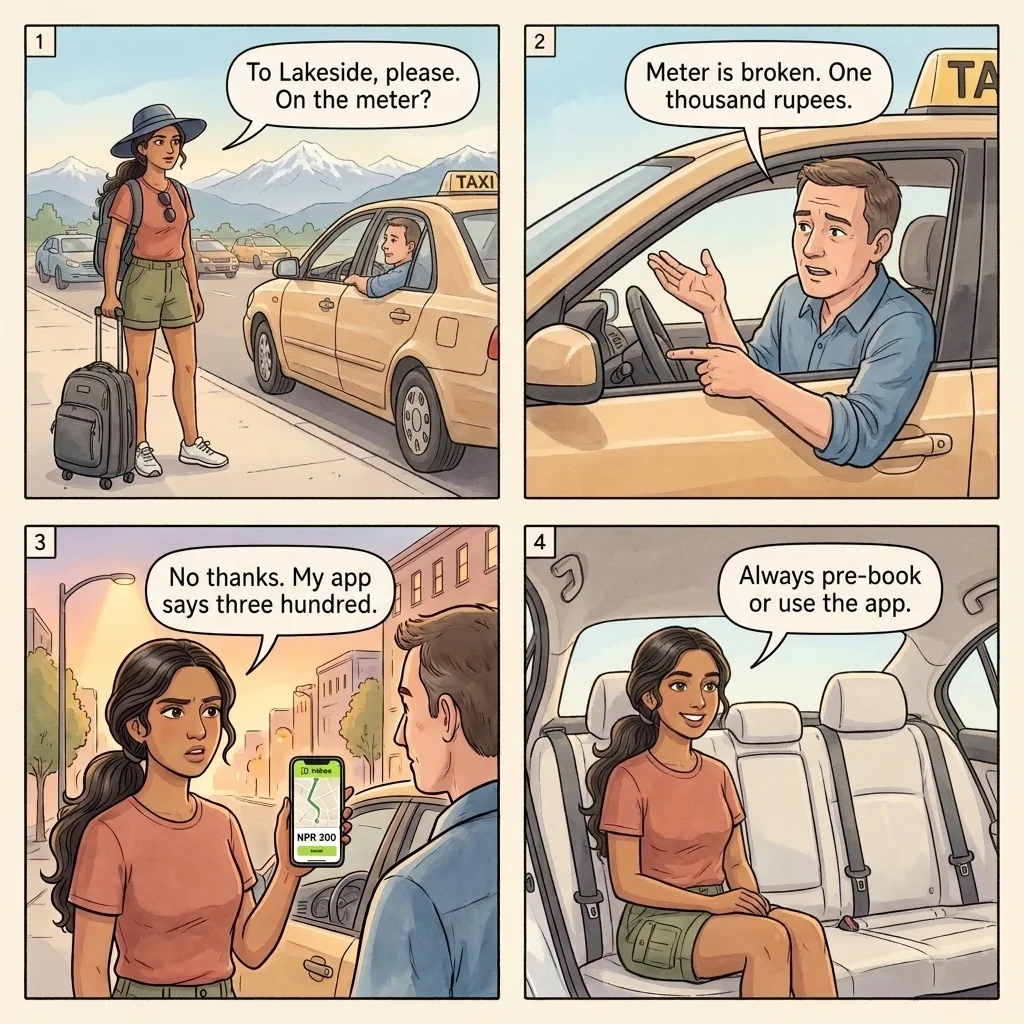
It's a morning flight into Pokhara Airport, you've collected your bag and walked outside, and the first taxi driver you approach quotes you NPR 1,000 for a ride to Lakeside — 'meter is broken, sir.'
The legitimate metered fare for the airport-to-Lakeside trip is NPR 200–300 (about USD $1.50–2.30). The NPR 1,000 quote is roughly four times the fair rate. The 'broken meter' framing is the entire mechanism. As travelers report across Reddit, the TripAdvisor Pokhara forum, and the Lonely Planet Nepal thorntree, almost every Pokhara airport and bus-station taxi refuses the meter for tourists, and the same script runs at the Prithvi Chowk bus stop and the late-night Lakeside ranks.
The variants escalate. The basic 'broken meter' quotes 4× the fair rate. The 'long route' takes you through town for an additional ten minutes to 'justify' the inflated fare. The 'friend's shop' insists on a five-minute stop at a souvenir shop, gem dealer, or trekking-equipment store along the way — the driver takes a commission on anything you buy. The 'no change' refuses to break a NPR 1,000 note when the agreed fare was NPR 300, forcing you to round up.
The legitimate Pokhara taxi options are limited but real. Pre-booking through your guesthouse or hotel typically gets you a fair-rate transfer at NPR 300–400 (about USD $2–3). The InDrive and Pathao apps both operate in Pokhara with airport-pickup zones and fares displayed in advance — InDrive in particular runs at near-meter prices because it's a negotiated-fare model. Walking 100 metres past the immediate kerbside taxi cluster to the main road typically gets you a driver willing to use the meter.
The structural defences are concrete. Pre-arrange airport pickup through your guesthouse or hotel before flying in — most Pokhara accommodations include free or low-cost transfers. Use the InDrive or Pathao apps where available; the in-app fare is displayed in advance. If you must take a kerbside taxi, agree the price in writing before getting in (NPR 300 max for airport-to-Lakeside, NPR 200 max for Lakeside in-city rides). Refuse 'friend's shop' detours and 'broken meter' framings. Walk 100 metres past the immediate kerb to find drivers willing to use the meter.
Pre-arrange airport pickup through your guesthouse or hotel — most Pokhara accommodations include free or low-cost transfers. Use the InDrive or Pathao apps for in-city Pokhara rides where available (in-app fare displayed in advance). If you must take a kerbside taxi at Pokhara Airport, agree the price in writing before getting in: NPR 300 maximum for airport-to-Lakeside, NPR 200 maximum for in-city Lakeside rides. Refuse 'broken meter' and 'friend's shop' framings; refuse 'no change' demands by carrying small NPR notes (100s and 500s). Walk 100 metres past the kerbside cluster to find a metered driver if needed. Emergency: 100 (Police).
Red Flags
- The driver claims the meter is broken or doesn't apply
- The quoted fare is much higher than what locals would pay
- The driver insists on a specific route or wants to stop along the way
- Multiple drivers at a rank all quote the same inflated price
How to Avoid
- Ask your hotel or guesthouse to arrange airport pickup in advance.
- Know approximate fares: Pokhara Airport to Lakeside is around NPR 200-300.
- Use ride-hailing apps like inDrive or Pathao when available.
- Walk to the main road away from the terminal to find drivers willing to use the meter.
🆘 What to Do If You Get Scammed
📋 File a Police Report
Go to the nearest Nepal Police station. Call 100 (Police) or 102 (Emergency). Get an official crime report — you'll need this for insurance claims. You can also report online at nepalpolice.gov.np.
💳 Cancel Your Cards
Call your bank immediately. Most have 24/7 numbers on the back of the card (keep a photo saved separately). Block any suspicious transactions before the thieves use your details.
🛂 Lost Passport?
Contact your nearest embassy or consulate. The US Embassy in Kathmandu is at Maharajgunj, Kathmandu. For emergencies: +977 1-423-4000.
📱 Track Your Device
If your phone was stolen, use Find My (iPhone) or Find My Device (Android) from another device. Don't confront thieves yourself — share the location with police instead.
Frequently Asked Questions
You just read 6 scams in Pokhara. The full Travel Safety Series has 780+ more across 20+ countries.
Tokyo's Kabukichō ¥130,000 bar trap. Rome's gladiator photo extortion. Paris's gold-ring trick. Bali's ATM skimmer scams. Bangkok's grand-palace closure ruse. Every documented scam across 20+ destinations — with the exact scripts, red flags, and local-language phrases that shut each one down. Drawn from Reddit traveler reports, embassy advisories, and consumer-protection cases.
- 780+ documented scams across Tokyo, Rome, Paris, Bali, Bangkok, Rio & 100+ more cities
- 20+ countries covered, with country-by-country phrase cards for every destination
- Updated annually — buy once, re-download future editions free
- All titles $4.99 each on Amazon Kindle