
Key Takeaways
- The #1 reported scam is the CST Black-Taxi Meter Scam.
- 2 of 7 scams are rated high risk.
- Use app-based ride services (Uber, Ola) instead of street taxis — always confirm the fare before departure.
- Never accept unsolicited offers from strangers near tourist sites in Mumbai.
⚡ Quick Safety Tips
- Keep phones and valuables in secure pockets when in crowded areas.
- Use only licensed taxis or app-based ride services.
- Book tours and tickets through verified operators with online reviews.
- Keep a copy of your passport separate from the original.
Jump to a Scam
- Medium The CST Black-Taxi Meter Scam
- Medium Dhobhi Ghat 'Free Guide' Commission Trap
- High Dating App Café Bill Scam
- High Fake 'Your Hotel Is Closed' Redirect
- Low Overpriced Colaba Causeway 'Antique' Sellers
- Medium Elephanta Island Boat Ticket Touting
- Medium Train Ticket 'Reservation Assistance' Scam
The 7 Scams
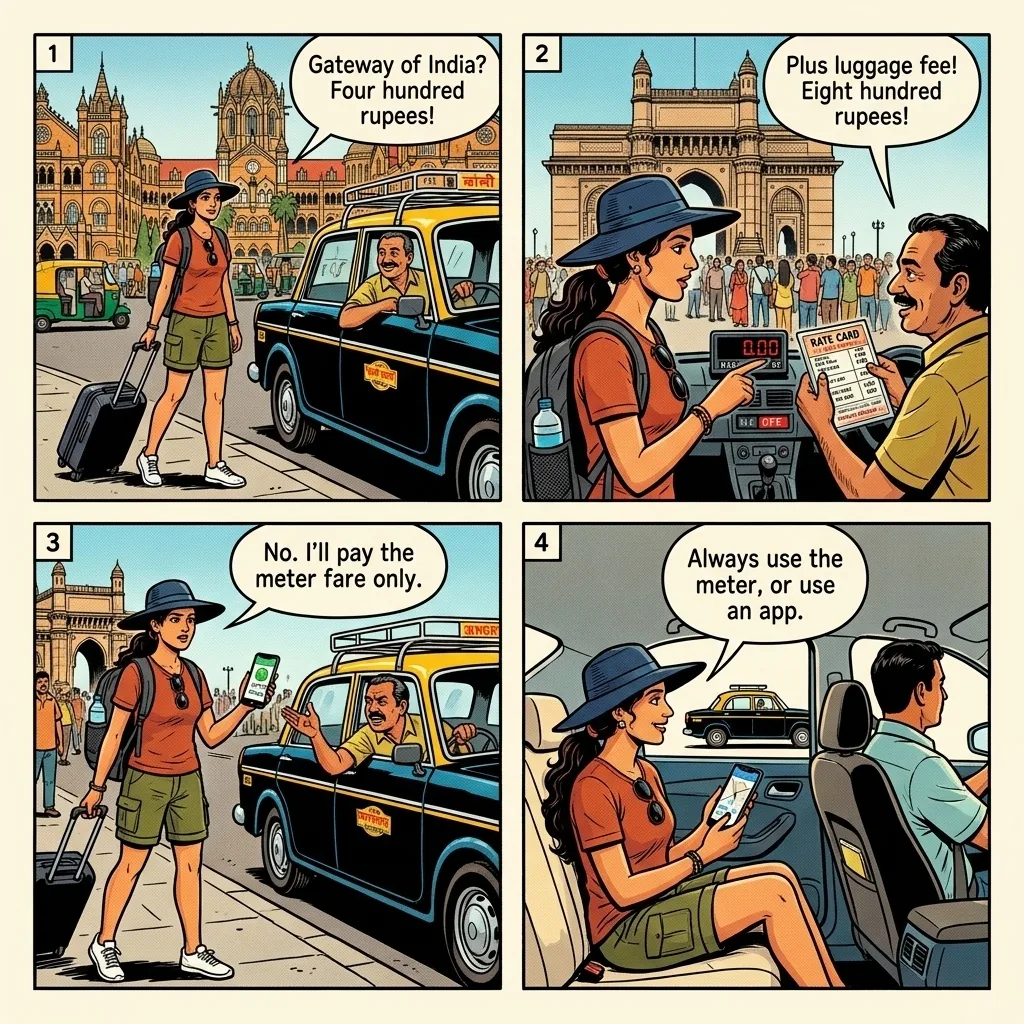
A black-and-yellow kaali peeli at CST, the Gateway of India, or Mumbai Airport quotes you a price that 'somehow' doubles by the destination — meter stays off, a laminated 'rate card' appears, and a 20-minute Bandra-to-Colaba ride that should run ₹180 demands ₹800.
You have just arrived at CST station or the Gateway of India, bags in hand, and a black-and-yellow kaali peeli cab pulls up. The driver smiles and quotes you a price — but when you arrive, the fare has somehow doubled. He claims the meter was 'running on night rate' or shows you a laminated rate card with confusing multipliers. Some drivers simply do not turn the meter on at all, or turn it on partway through the ride and add a 'waiting charge' for every red light.
Travelers describe this as one of Mumbai's oldest tricks. One traveler recounted being taken from Bandra to Colaba — a 20-minute ride — for which the driver demanded ₹800 despite the meter reading ₹180. The driver conveniently 'lost' change and insisted on rounding up heavily. If you push back, some drivers become aggressive and claim they will call the police. Mumbai's app-based alternatives (Ola, Uber) have cut down on this scam, but kaali peelis remain common at tourist-heavy spots where apps have surge pricing.
The hook is a quoted price plus a 'broken meter' that nobody can dispute mid-ride. The defensive move is to use Ola or Uber for all rides where possible (the fare shows upfront), insist any kaali peeli starts the meter before you get in, use only the official prepaid taxi counter inside Mumbai Airport's arrivals hall, and screenshot the Google Maps route before getting in so you know the right road. Approximate fares: ₹25 minimum + ~₹15/km for rickshaws, ~₹25/km for taxis.
Red Flags
- Driver refuses to start the meter or says it's 'broken'
- Driver quotes a fixed price that feels high before starting the trip
- A laminated 'rate card' is produced that you've never seen before
- Driver takes a longer route than Google Maps suggests
- No change is available and driver insists on rounding up heavily
How to Avoid
- Use Ola or Uber for all rides — fixed price shown upfront.
- If using a kaali peeli, insist the driver starts the meter before you get in.
- At the airport, only use the official prepaid taxi counter inside arrivals.
- Screenshot Google Maps route before getting in so you know the right road.
- Know the approximate fare: ₹25 minimum + ~₹15/km for rickshaws, ~₹25/km for taxis.
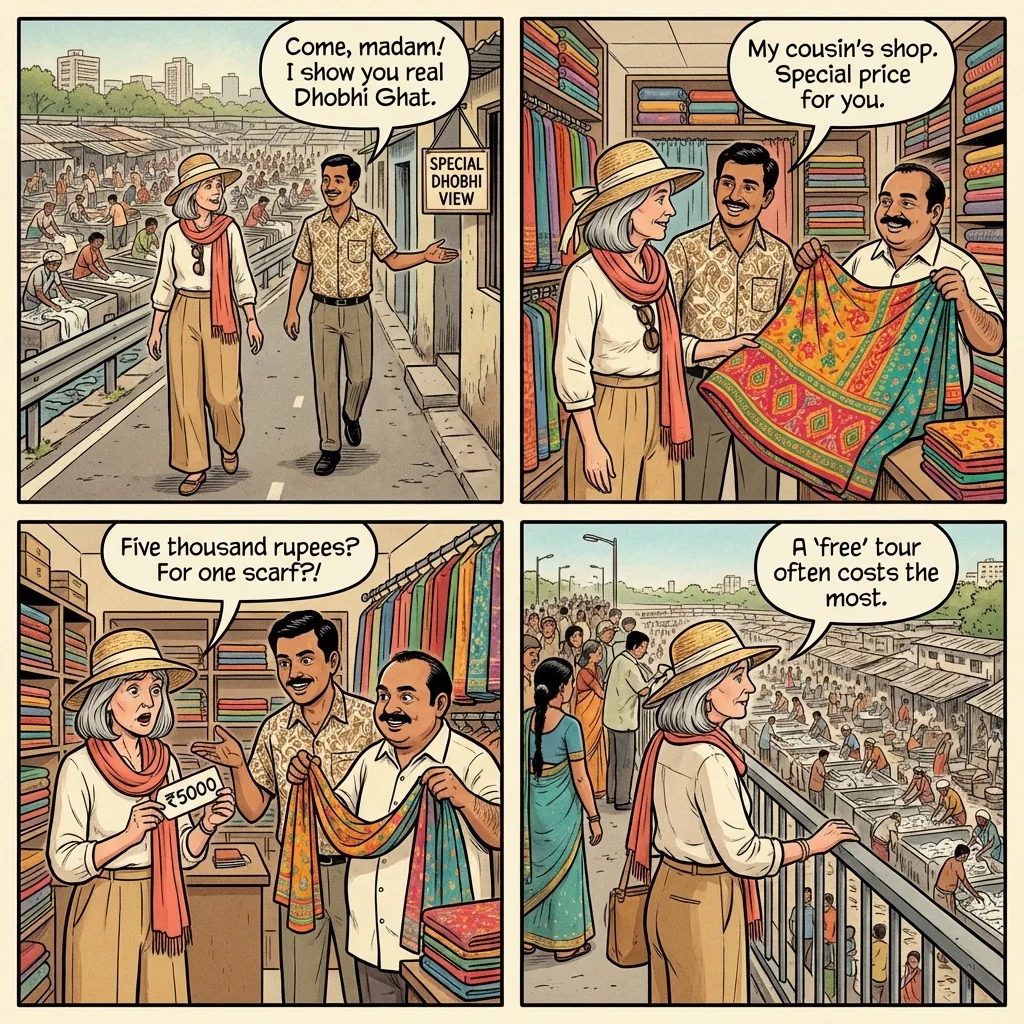
A friendly 'guide' near Mahalaxmi Dhobhi Ghat offers a free tour of the open-air laundry, then steers you to a textile shop where 'Mumbai silk' is marked up 3x to 5x — the viewing bridge on Dr. E. Moses Road has been free this whole time.
You have come to see the famous open-air laundry at Mahalaxmi — one of Mumbai's most photographed sights. As you approach the viewing bridge, a friendly local materializes beside you. He says entry is 'from this side' and leads you down a different path. After giving you a surprisingly informative tour of the washermen below, he suggests a nearby textile shop or chai stall where 'real Mumbai silk' is sold at 'wholesale prices.' The tea is free, the pressure is not.
This follows the classic Indian guide-commission scam. The guide receives 20 to 40% commission from every shop he steers tourists into. The 'wholesale' prices are actually marked up 3x to 5x from what locals pay. If you do not buy, the guide may turn cold or demand a 'tip' for the tour. Some tourists report being led past a series of shops in a circuit, spending an hour in each.
The hook is genuine commentary delivered free, then a shop redirect that reframes the 'free' tour as a debt to repay. The defensive move is to view Dhobhi Ghat from the free public bridge on Dr. E. Moses Road — no guide needed — politely decline all unsolicited 'guide' offers, and refuse free tea or snacks from strangers near tourist areas. If you want a real guide, book through your hotel or a licensed government-approved service.
Red Flags
- A stranger approaches and offers to show you a 'better viewing angle' for free
- The guide steers you away from public streets toward private shops
- Tea or snacks are offered for free as a way to obligate you
- Shop owners seem to know the guide personally and immediately offer 'special prices'
- You feel social pressure to buy after receiving hospitality you didn't ask for
How to Avoid
- View Dhobhi Ghat from the free public bridge on Dr. E. Moses Road — no guide needed.
- Politely decline all unsolicited 'guide' offers near tourist sites.
- If someone walks alongside you uninvited, say firmly: 'No guide needed, thank you.'
- Do not accept free tea, snacks, or gifts from strangers near tourist areas.
- If you want a real guide, book through your hotel or a licensed government-approved service.
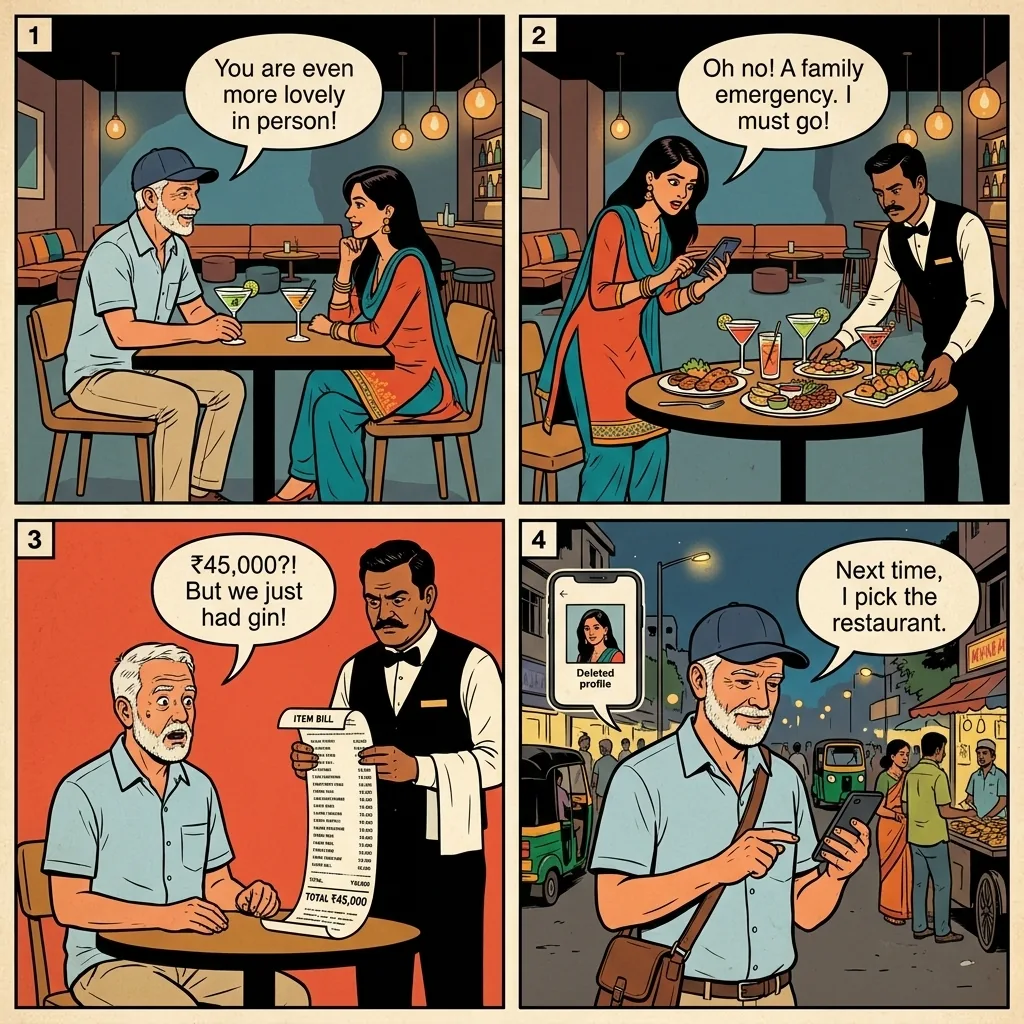
An attractive Tinder or Bumble match suggests a trendy bar in Andheri West or Bandra; the drinks keep coming, your date 'gets an emergency call' and disappears, and a waiter delivers a ₹30,000 to ₹60,000 bill for items you never ordered.
You match with someone attractive on Tinder or Bumble. After a few charming messages, they suggest meeting at a trendy bar or club in Andheri West or Bandra. The conversation flows, the drinks keep coming — and then your date suddenly gets an 'emergency call' and disappears. Minutes later, a waiter delivers a bill for ₹30,000 to ₹60,000. When you protest, intimidating staff appear. The items listed are things you never ordered.
This scam became headline news in Mumbai in 2024 when at least 22 victims were identified at just two pubs, with one man losing ₹61,000 at The Godfather Club in Andheri. The women (or men) involved are paid accomplices who receive a cut of the inflated bill. The bars are complicit, running the scam as their actual business model. A viral Reddit post in April 2024 — 'Be Aware of Delhi's Dating App Scams Rising in Mumbai' — drew hundreds of commenters sharing their own close calls.
The hook is romantic chemistry that bypasses the venue scrutiny you would normally apply — the date picks the place, you trust the choice, the menu prices for 'premium bottles' are printed in tiny text, and you are billed for items you did not realize were ₹8,000 per glass. The defensive move is to pick the venue yourself for any first meet (a well-known, highly reviewed public place), check it on Google Maps and TripAdvisor before going (no reviews is a red flag), ask to see a full menu with prices before sitting down, and call Mumbai Police on 100 if threatened over a fake bill — threatening tourists is illegal regardless of what the menu says.
Red Flags
- Match on dating app immediately suggests an expensive-looking venue you haven't heard of
- Your date is unusually eager and pushes for a same-day meeting
- The venue has minimal online reviews or reviews that seem fake
- Staff seem to know your date personally and are unusually attentive
- Your date disappears shortly after ordering multiple rounds
How to Avoid
- For first meets, always suggest a well-known, highly reviewed public place of your own choosing.
- Check the venue on Google Maps and TripAdvisor before going — no reviews is a red flag.
- Ask to see a full menu with prices before sitting down; leave if staff refuse.
- Never let someone else order on your behalf without seeing prices.
- If threatened over a bill, call Mumbai Police on 100 — threatening tourists over fake bills is illegal.
Like what you're reading? Get a full Mumbai itinerary with safety tips built in.
Browse travel-safety books →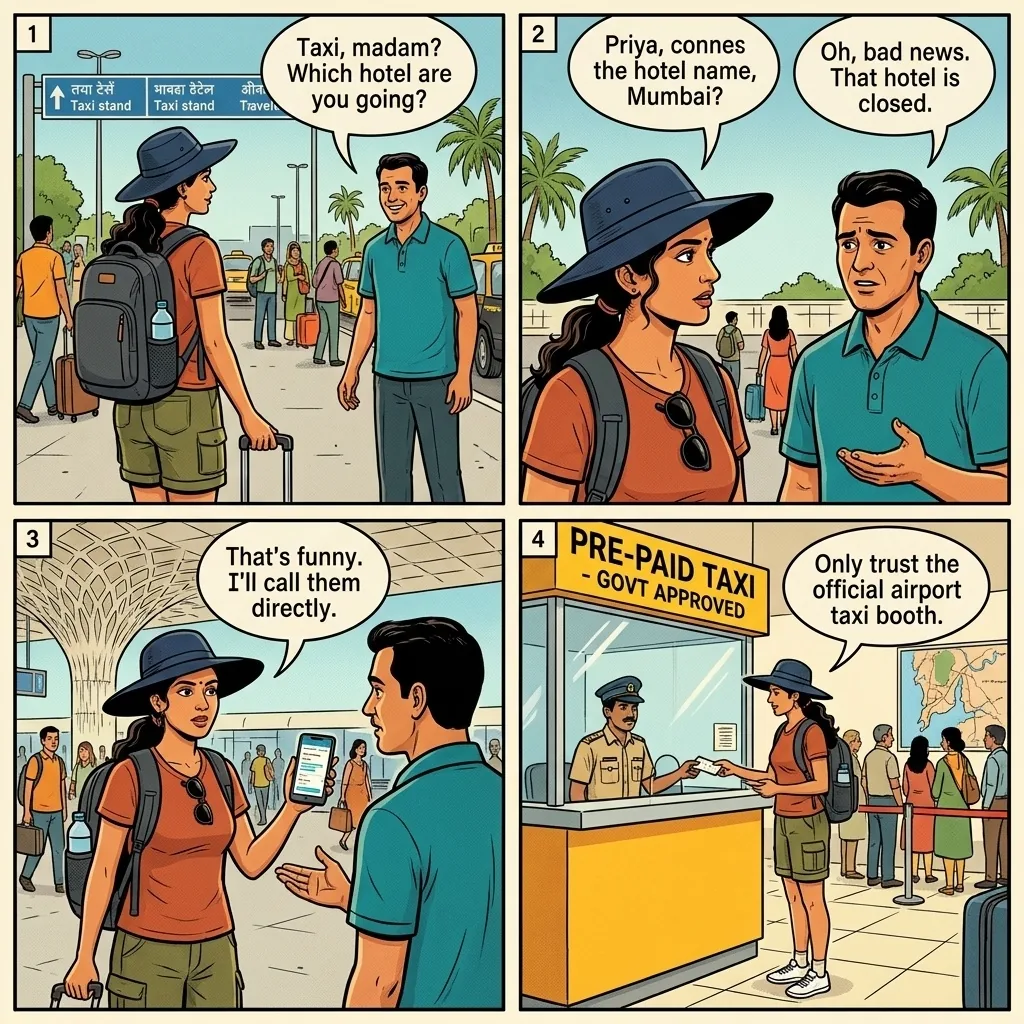
A polo-shirt 'helper' at Mumbai Airport tells you your booked hotel is closed for renovation, flooded, or burned down — he can take you to a 'better place' that pays him ₹500 to ₹2,000 per delivered tourist.
You have just landed at Chhatrapati Shivaji Maharaj International Airport (CSMIA) and are heading toward the taxi stand. A friendly man in a polo shirt — he looks vaguely official — approaches and asks if you are looking for transport. When you mention your hotel name, his face falls. 'Oh, that hotel is closed for renovation this week. I can take you to a better place, same area, better price.' He is already reaching for your bags.
This is one of the oldest scams in the India travel playbook. The driver takes you to a hotel that pays him ₹500 to ₹2,000 per referral, and your 'original' hotel was never closed — the scammer made it up. The substitute hotel is often overpriced, dirty, or in the wrong area. Getting back to your original destination after this detour wastes hours and costs extra. Some victims report that the 'helpful' person at the airport was not a driver at all — just a tout who handed them off to a commission-paying driver.
The hook is arrival exhaustion plus a fabricated emergency that arriving travelers cannot verify in the moment. The defensive move is to pre-book a pickup with your hotel or use the official airport prepaid taxi counter, call your hotel directly using the number from your booking confirmation if anyone tells you it is closed (not a number a stranger provides), never let a stranger carry your bags or guide you toward transport, and screenshot your hotel's address before exiting arrivals.
Red Flags
- Stranger approaches you at the airport claiming to know your hotel's status
- Anyone who isn't a uniformed official warns you that your accommodation is 'closed' or 'flooded'
- The person suggests an alternative hotel immediately after breaking the bad news
- They seem to know the name of your hotel even before you mention it
- The ride to the 'new' hotel takes you further from the area you booked in
How to Avoid
- Pre-book a pickup with your hotel or use the official airport prepaid taxi counter.
- If told your hotel is closed, call the hotel directly using the number from booking confirmation — not a number the stranger provides.
- Never let a stranger carry your bags or guide you toward transport.
- Only exit through the official arrival gates and ignore anyone before you reach the main taxi/app counter.
- Screenshot your hotel's address and share your live location with someone you trust during the ride.
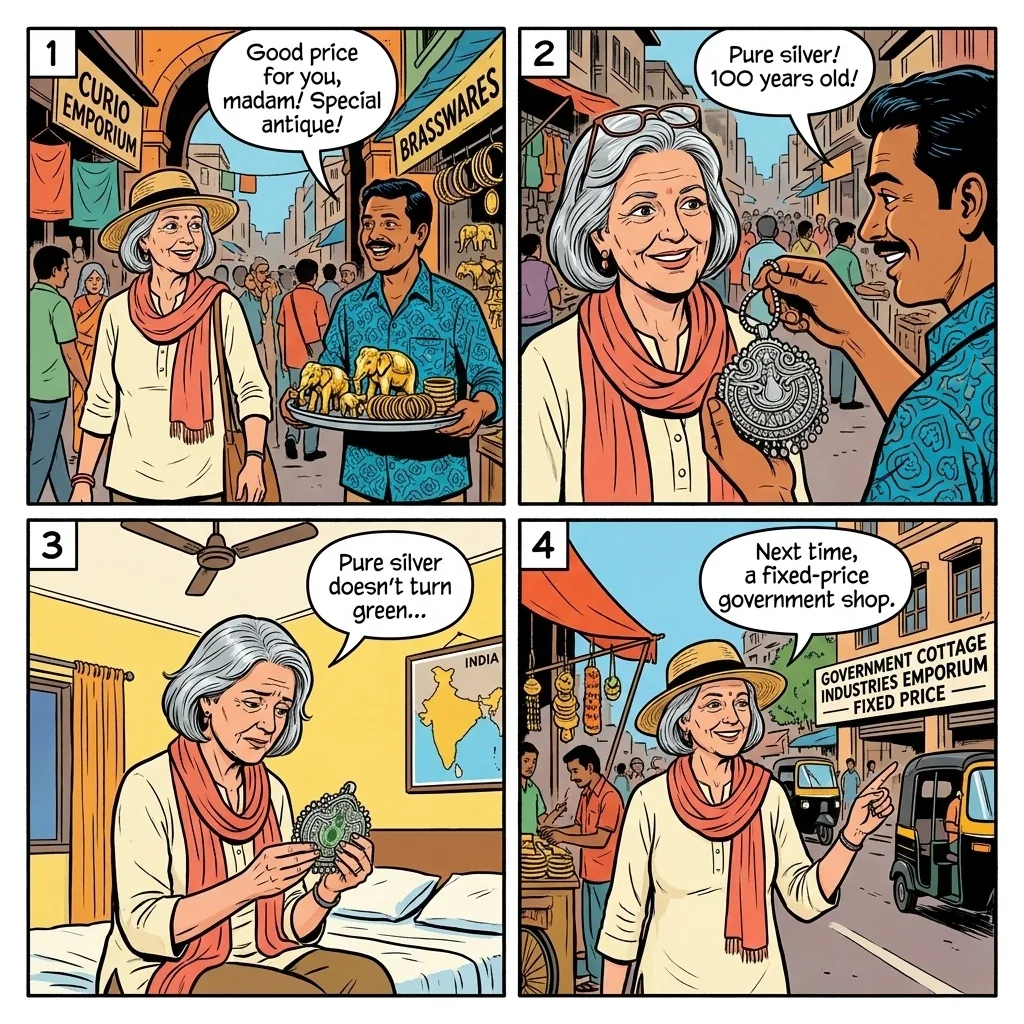
Hawkers on Colaba Causeway spread out brass Ganeshas, 'silver' jewelry, 'Kashmiri' pashminas, and '100-year-old' antiques on cloth — the opening price is 5x to 10x what a local would pay, and the 'silver' often turns green within weeks.
Along Colaba Causeway and around Colaba Market, hawkers spread out brass Ganeshas, silver jewelry, pashminas, and carved wooden boxes on cloth. A seller spots you slowing down and immediately starts his pitch: this pendant is 'real silver,' that bowl is a '100-year-old antique,' and your interest has apparently given him an 'excellent feeling' about your luck. Prices start high but drop dramatically as you walk away.
The items are rarely what they claim. 'Pure silver' jewelry often turns green within weeks. 'Antiques' are mass-produced the week before. 'Kashmiri pashminas' are synthetic acrylic. Travelers consistently note that the opening price on Colaba Causeway is 5x to 10x what a local would pay, and that even hard bargaining rarely gets you to actual fair value. The more concerning version involves a persuasive seller who slowly pulls you inside a shop, out of the street, where the pressure intensifies and prices for 'exclusive' items skyrocket.
The hook is a price drop dramatic enough to feel like winning, anchored against a starting number that was always fictional. The defensive move is to treat all Colaba Causeway goods as decorative souvenirs (not investments), never pay more than 25 to 30% of the opening price for street-market items, decline invitations to enter private back rooms or 'private showrooms,' and buy actual silver or gold only at certified stores with hallmark stamps (BIS hallmark for gold). Walk away completely if the vibe shifts to high-pressure — legitimate sellers let you go.
Red Flags
- Seller claims items are 'pure silver,' 'real gold,' or 'genuine antique' without any certification
- Price drops by more than 50% the moment you show disinterest — real quality goods don't work this way
- Seller draws you into a back room away from the main street to see 'better stock'
- You're told this is a 'special price only for you today' — a common pressure tactic
- The item has no hallmark stamp, certification, or receipt offered for silver/gold
How to Avoid
- Treat all Colaba Causeway goods as decorative souvenirs, not investments.
- Never pay more than 25–30% of the opening price for street market items.
- For actual silver or gold, buy from certified stores with hallmark stamps (BIS hallmark for gold).
- Decline invitations to enter private back rooms or climb stairs to 'private showrooms.'
- Walk away completely if the vibe shifts to high-pressure; legitimate sellers let you go.
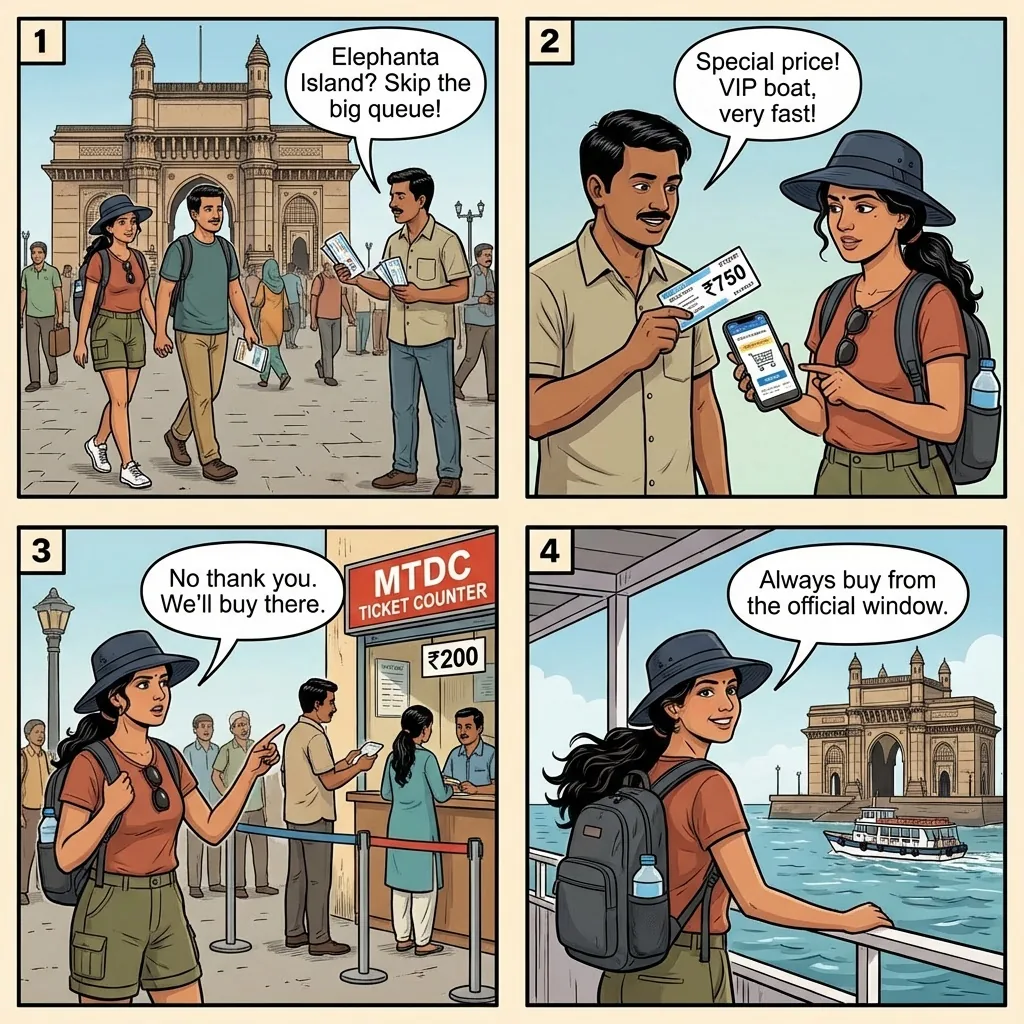
Touts at the Gateway of India ferry terminal sell 'VIP' or 'skip-the-queue' Elephanta Island tickets for ₹500 to ₹800 per person — the official MTDC government ferry is ₹200 round trip from the clearly marked counter.
You want to take the iconic ferry from the Gateway of India to Elephanta Island. Before you reach the official ticket window, men in casual clothes surround you offering 'better boats,' 'VIP seats,' 'skip the queue' tickets, or a combined boat-plus-guide package. They name a price — ₹500 to ₹800 per person — that sounds reasonable for such a famous trip. The actual government ferry costs ₹200 round trip.
Some of these touts sell genuine tickets at inflated prices. Others sell you tickets that are technically valid but for slower, less comfortable boats. The worst version involves paying for a 'guide' who then demands ₹2,000 to ₹3,000 for a 'complete tour' once you are on the island with no way back until the last ferry. Travelers repeatedly note that the official MTDC counter near the Gateway is clearly marked and that the queue moves quickly.
The hook is a tout intercept before you reach the marked counter plus a price that sounds plausible if you have not researched it. The defensive move is to buy tickets only from the official MTDC (Maharashtra Tourism) counter near the Gateway of India, decline all unsolicited guides (you can hire an official licensed guide on the island itself if you want one), and check last ferry times before you go — missing the ~5:30 PM return forces expensive alternatives. Bring snacks: Elephanta has only a handful of food stalls at inflated tourist prices.
Red Flags
- Anyone approaches you with ferry tickets before you reach the official counter
- Price quoted is higher than ₹200–₹250 for the standard round-trip government ferry
- Someone insists a 'guide' is mandatory for Elephanta Island
- You're told the official counter is closed or the queue is 'hours long'
- A guide quotes a vague price for their services rather than a fixed amount before boarding
How to Avoid
- Buy tickets only from the official MTDC (Maharashtra Tourism) counter near the Gateway of India.
- Official round-trip ferry fare is posted clearly — verify the current price before approaching touts.
- Decline all unsolicited guides; you can hire an official licensed guide on the island itself.
- If hiring a guide on Elephanta, agree on the total price before you leave the dock area.
- Check last ferry times before you go — missing the return ferry forces expensive alternatives.
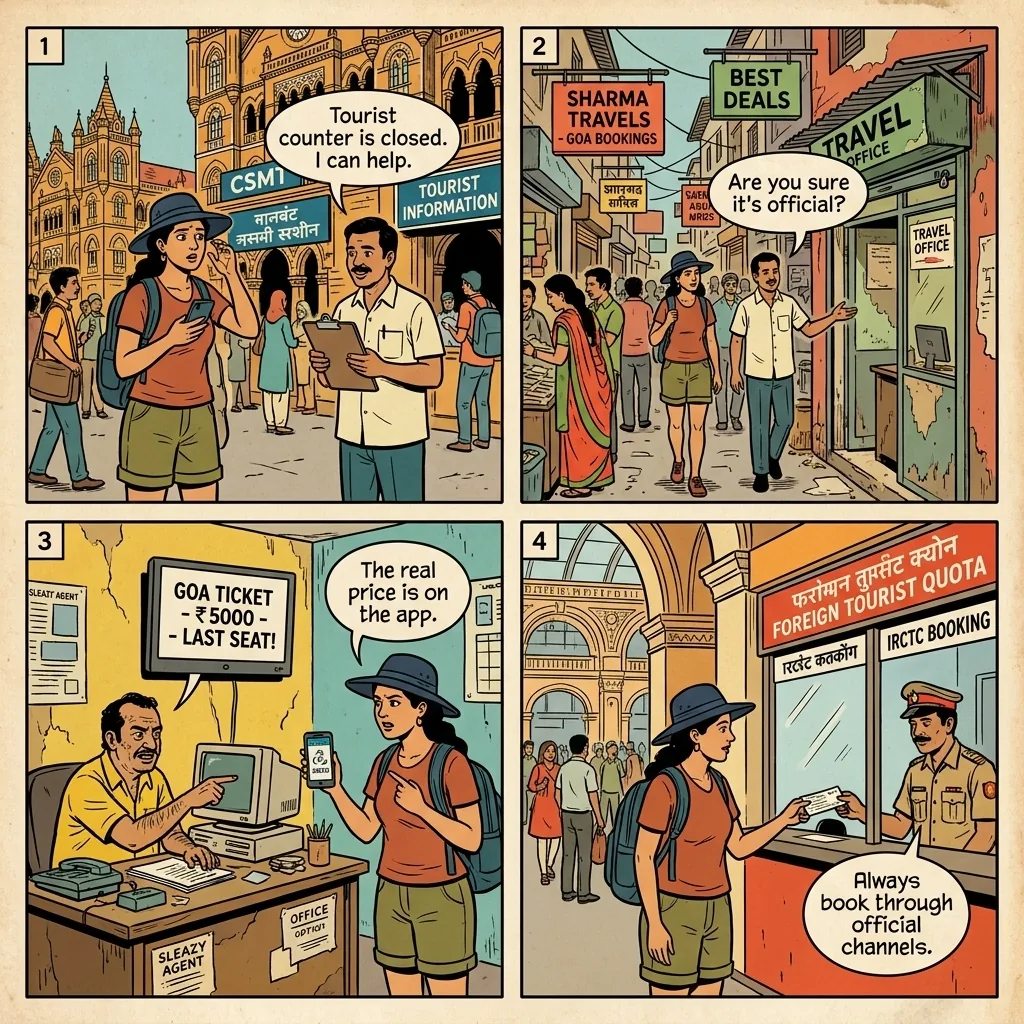
A 'helpful stranger' at CSMT booking office tells you the tourist quota counter is on the second floor or that 'online is broken today' — he leads you to a travel agent two blocks away who sells real tickets at 2x to 3x face value with a 'service fee.'
You want to book a long-distance train out of Mumbai — maybe to Goa or Jaipur — and head to the CSMT booking office. A helpful stranger materializes and says the tourist quota counter 'is on the second floor' or that 'online is broken today.' He can get you a confirmed ticket right now, no queue needed. You follow him to a travel agent's office two blocks away where tickets are sold at two to three times face value with a large 'service fee.'
This scam is so pervasive at Indian railway stations that travel forums have dedicated warning threads. The Indian Railways booking system (IRCTC) has a specific tourist quota for foreign visitors at most major stations — including CSMT Mumbai — but touts redirect tourists before they find it. Some 'agents' sell real tickets at inflated prices; others sell tickets on cancellable quotas that get refunded silently after you leave.
The hook is a single misdirection at the booking-office door that converts into a captive sale two blocks away. The defensive move is to book in advance on IRCTC.co.in or the IRCTC Rail Connect app (international cards work), and at CSMT itself go directly to the Foreign Tourist Quota counter on the ground floor with your passport. Ignore all helpers outside railway stations offering to 'assist' with tickets, and screenshot any confirmed booking — legitimate tickets have a PNR number you can verify on irctc.co.in.
Red Flags
- Anyone outside the station offers to help you buy train tickets 'more easily'
- Told that the official counter is 'closed' or 'only for Indian nationals'
- The 'travel agent' office is located away from the station premises
- Ticket price is significantly higher than what IRCTC website shows
- Asked to pay cash rather than by card for the ticket
How to Avoid
- Book in advance on IRCTC.co.in or the IRCTC Rail Connect app — you can use international cards.
- At CSMT, go directly to the Foreign Tourist Quota counter on the ground floor — show your passport.
- Ignore all helpers outside railway stations offering to 'assist' with tickets.
- If the counter is genuinely full, use a government-approved travel agent with visible IATA/TAAI accreditation.
- Screenshot your confirmed booking — legitimate tickets have a PNR number you can verify on irctc.co.in.
🆘 What to Do If You Get Scammed
📋 File a Police Report
Go to the nearest Indian Police station. Call 100 (Police) or 112 (Emergency). Get an official crime report — you'll need this for insurance claims. You can also report online at citizenservices.gov.in.
💳 Cancel Your Cards
Call your bank immediately. Most have 24/7 numbers on the back of the card (keep a photo saved separately). Block any suspicious transactions before the thieves use your details.
🛂 Lost Passport?
Contact your nearest embassy or consulate. The US Embassy in New Delhi is at Shantipath, Chanakyapuri, New Delhi 110021. For emergencies: +91 11-2419-8000.
📱 Track Your Device
If your phone was stolen, use Find My (iPhone) or Find My Device (Android) from another device. Don't confront thieves yourself — share the location with police instead.
Sources & further reading
Every scam here is cross-checked against official government advisories, police bulletins, and established reporting. Confirm current details with the primary sources below before you travel.
-
U.S. Department of State — India Travel Advisory
Government advisory
“Be careful of taxi drivers, train porters, and others offering cheap transportation to hotels.”
-
UK Foreign, Commonwealth & Development Office (GOV.UK) — Safety and security - India travel advice
Government advisory
“avoid people at railway stations offering tickets and tours as you may be scammed”
-
Government of Canada (travel.gc.ca) — Travel advice and advisories for India
Government advisory
“Beware of offers for cheap transportation or accommodation, extended taxi rides and unsolicited guided tours.”
-
The Free Press Journal — Mumbai News: Dating App Scam Busted In Sakinaka As NGO Yuva Pratishthan Helps Nab 13 Accused
News report
“lured men through dating apps and forced them to pay exorbitant bills for food and drinks when they arrived to meet their 'match' at the café”
-
Free Press Journal — 'Airport Arrival, Instant Overcharge': Mumbai's Taxi Racket Under Scrutiny
News report
“In October 2024, a driver was arrested for using a tampered meter with a hidden switch to inflate fares, exposed by a viral social media video.”
Frequently Asked Questions
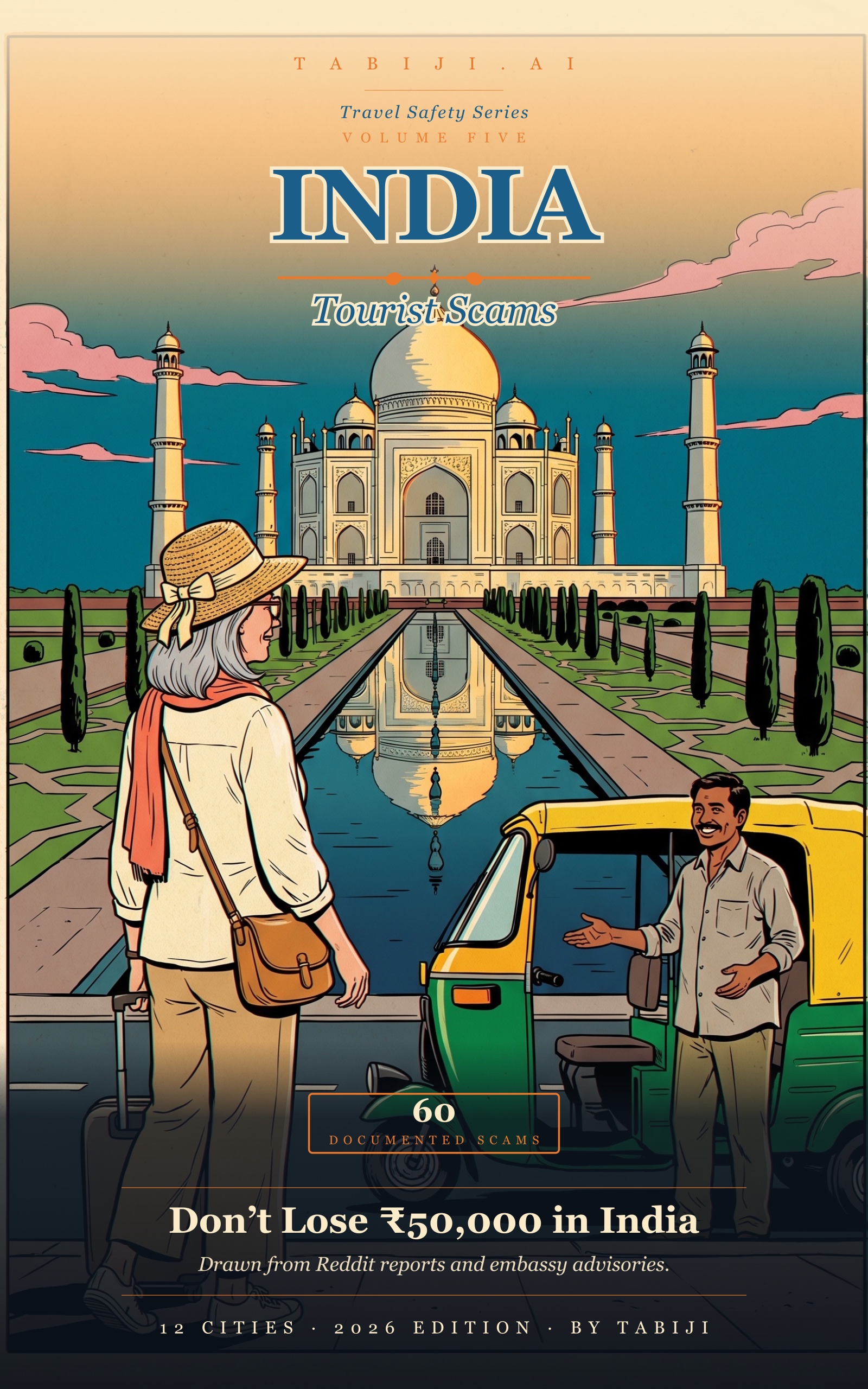
You just read 7 scams in Mumbai. The book has 60 across 12 Indian cities.
Delhi’s Paharganj “India Tourism” rebooking trap. Jaipur’s Hawa Mahal rickshaw textile detour. Mumbai’s ₹61,000 dating-app pub bill. The Lake Pichola sunset-photo extortion. The Bengaluru Silk Board meter manipulation. Every documented India scam — with the exact scripts, red flags, and Hindi phrases that shut each one down. Drawn from Reddit, the Times of India, News18, Telangana Today, and embassy advisories.
- 60 documented scams across Delhi, Mumbai, Jaipur, Agra & 8 more cities
- A Hindi exit-phrase card (Devanagari + Latin) you can screenshot to your phone
- Updated annually — buy once, re-download future editions free
- Readable in one flight — $4.99, coming soon on Amazon Kindle