
Key Takeaways
- The #1 reported scam is the Houmt Souk Tourist-Markup Hustle.
- 1 of 6 scams are rated high risk.
- Use app-based ride services (Uber, Bolt) instead of unmarked taxis — always confirm the fare before departure.
- Never accept unsolicited offers from strangers near tourist sites in Djerba.
⚡ Quick Safety Tips
- Keep phones and valuables in secure pockets when in crowded areas.
- Use only licensed taxis or app-based ride services.
- Book tours and tickets through verified operators with online reviews.
- Keep a copy of your passport separate from the original.
Jump to a Scam
The 6 Scams
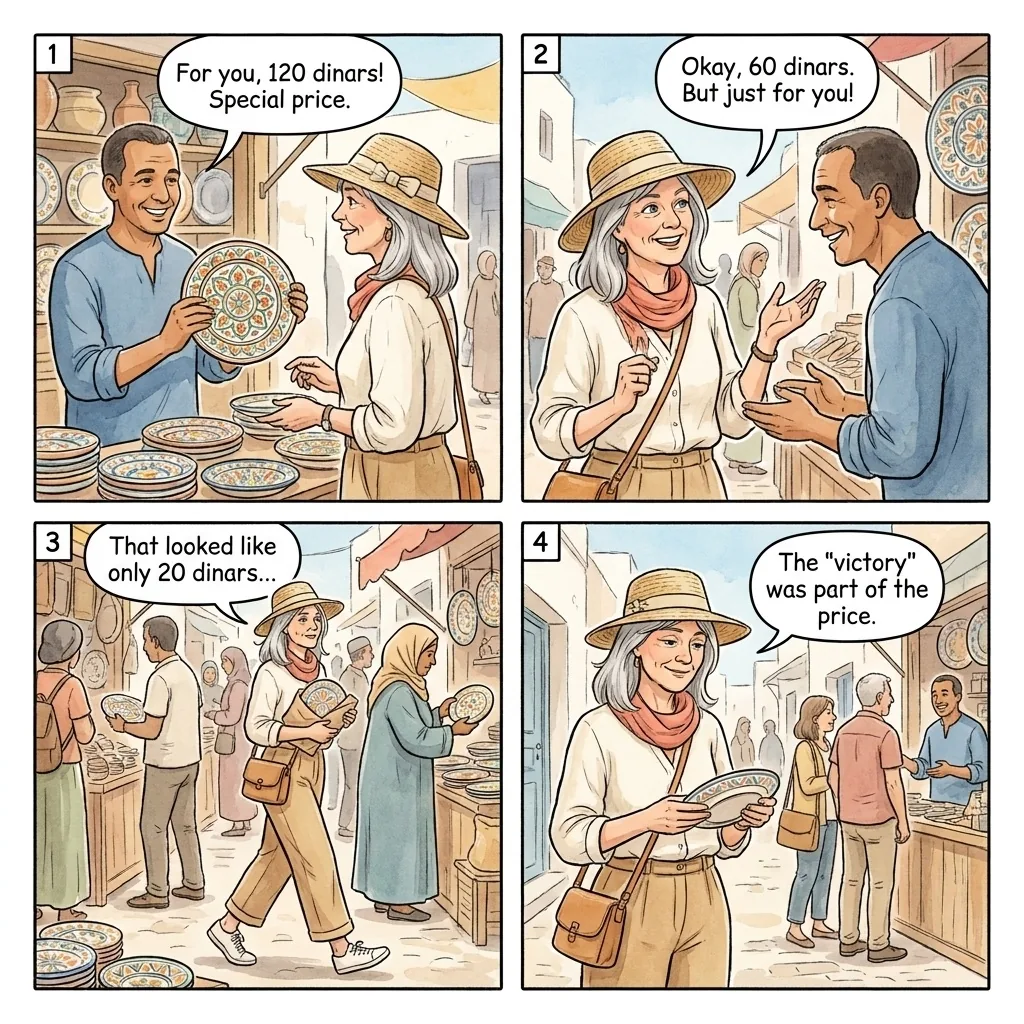
A Houmt Souk shopkeeper quotes 120 TND for a hand-painted ceramic plate — locals pay 15–20 TND for the same item. You haggle to 60 TND and feel victorious; you've still paid 3–4× the real price, which is the whole design of the opening quote.
You wander into the maze-like alleys of Houmt Souk, Djerba's main market town, and spot a beautiful hand-painted ceramic plate. You ask the price. The shopkeeper smiles warmly and says 120 dinars. You have read about haggling and offer 40 dinars. After animated negotiation, you settle on 60 dinars and walk away feeling victorious. What you do not know is that the plate sells to locals for 15–20 dinars.
TunisiaPro.net's shopping guide documents this pattern explicitly: as soon as a dealer recognizes that a person is not local, they will ask for a price that is three, five, even tenfold higher than the normal price. In the haggling process, the seller eases the price substantially — often by 50 percent or more — so the tourist believes they got a deal, but they still pay double or triple the actual price.
TripAdvisor's Tunisia forum has multiple threads about Djerba market haggling, with one traveler describing being chased down the street by a Houmt Souk shopkeeper after walking away from an inflated opening offer. The chase is itself part of the script: it signals 'you got a great deal' (the seller wouldn't pursue otherwise), even though the seller's pursuit price is still well above the local rate.
The layout of the souk itself compounds the problem — the maze-like alleys are confusing and easy to get lost in, which can lead you back to the same aggressive vendors you were trying to avoid. Without a price benchmark established by walking the full medina first, every initial quote feels like the 'real' price even when it's 5× the local rate.
The defensive move is to walk the full souk before buying anything, research approximate local prices online (a standard ceramic plate should cost 15–30 TND), and start your offer at one-fifth of the asking price — be genuinely prepared to walk away. Shop at fixed-price government handicraft stores (ONAT/Artisanat de Tunisie) for guaranteed fair pricing. Politely decline tea in carpet shops unless you intend to buy. Police: 197. Emergency: 190.
Red Flags
- The vendor names a price without you asking and it seems dramatically high compared to what you have seen elsewhere
- The shopkeeper drops the price by 50 percent or more immediately when you hesitate — the real price is much lower still
- You are told this is a special handmade item or family heirloom when identical items are visible in three other shops nearby
- The vendor physically blocks the doorway or follows you out of the shop when you try to leave without buying
- You are offered mint tea and seated in the shop — this creates social obligation to purchase something
How to Avoid
- Visit multiple shops and compare prices before buying anything — walk the entire souk first to understand the real price range.
- Research approximate local prices online before visiting: a standard ceramic plate should cost 15-30 dinars, not 100+.
- Start your offer at roughly one-fifth of the asking price and be genuinely prepared to walk away if the seller will not come down.
- Shop at fixed-price government handicraft stores (ONAT/Artisanat de Tunisie) for guaranteed fair pricing on quality items.
- Politely decline tea in carpet shops unless you genuinely intend to buy — the social pressure after accepting hospitality is real.
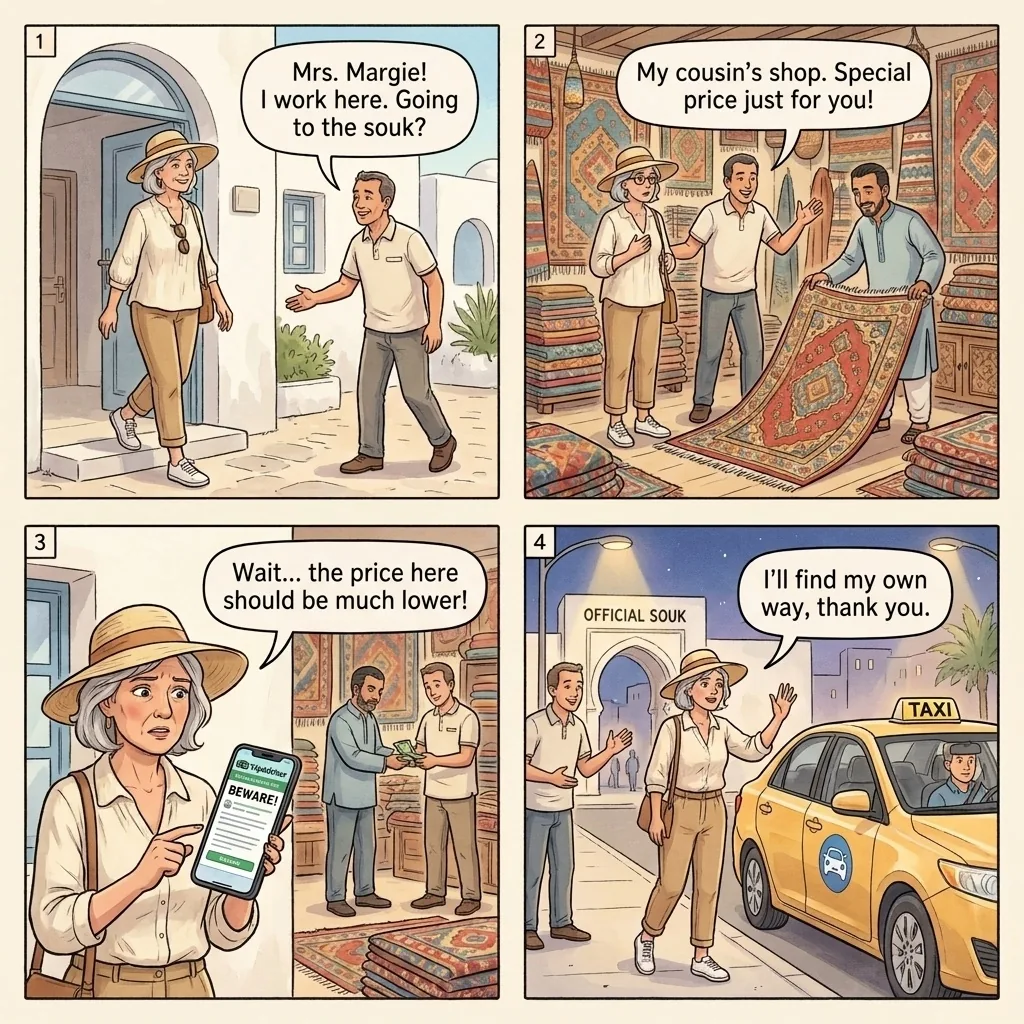
A friendly man at your beach-hotel entrance greets you by name, claims he works at the hotel, and offers a free ride and souk tour — every stop is a carpet, spice, or leather shop where he collects 20–40% commission baked into the inflated prices.
You step out of your beach hotel and a friendly man approaches, greeting you by name. He says he works at your hotel and is heading into Houmt Souk — would you like a ride and a personal tour of the market? He seems legitimate, so you accept. He drives you to the souk and leads you through the alleys, pointing out landmarks. Then the real purpose reveals itself: he steers you into a carpet shop where his friend gives you a hard sell on overpriced rugs, then a spice shop, then a leather goods store.
At each stop, the guide receives a commission on anything you buy, which is baked into the inflated price you pay. The guide's commission isn't an add-on — it's a structural part of the shop's pricing for tourists steered in this way, so even bargaining hard you can't get to the local rate. Locals walking into the same shop pay 60–70% less for the same item.
TripAdvisor's Djerba forum has a specific warning thread titled 'Be aware!' documenting this exact scheme. Taxi drivers who drop tourists off at the market frequently have contacts inside the souk who will approach you claiming to work at your hotel, using the hotel name to build trust before directing you to commission-based shops.
The Atlas Guide's Tunisia scam page confirms that fake guides in Tunisia intercept tourists by claiming hotel affiliation and then lead them to shops where they earn referral fees. The guide will seem helpful and knowledgeable, but every shop he takes you to pays him 20–40 percent of whatever you spend. The guide's apparent disappearance during your shop visits is him collecting his cut behind the counter.
The defensive move is to only accept guide services arranged through your hotel's official concierge desk with a printed receipt — and verify any 'hotel employee' by phoning the front desk before going anywhere. Arrange your own metered taxi or hotel shuttle to Houmt Souk; explore independently using offline Google Maps. If a guide leads you into a shop, leave immediately — you owe nothing. Police: 197.
Red Flags
- Someone claims to work at your hotel but you have never seen them at the reception or pool area
- They know your hotel name but cannot name specific staff members or describe the interior convincingly
- The guide offers their services for free or for a surprisingly small fee — their real income comes from shop commissions
- Every stop on the tour happens to be a shop rather than a historical site or cultural landmark
- The guide disappears briefly at each shop, leaving you alone with the salesperson — he is collecting his commission
How to Avoid
- Only accept guide services arranged through your hotel's official concierge desk with a printed receipt.
- If someone claims to be a hotel employee, verify with the front desk by phone before going anywhere with them.
- Arrange your own transport to Houmt Souk using a metered taxi or the hotel shuttle rather than accepting rides from strangers.
- Explore the souk independently using Google Maps offline — the layout is manageable without a guide.
- If a guide leads you to a shop, thank them and leave immediately — you are under no obligation to enter or buy.
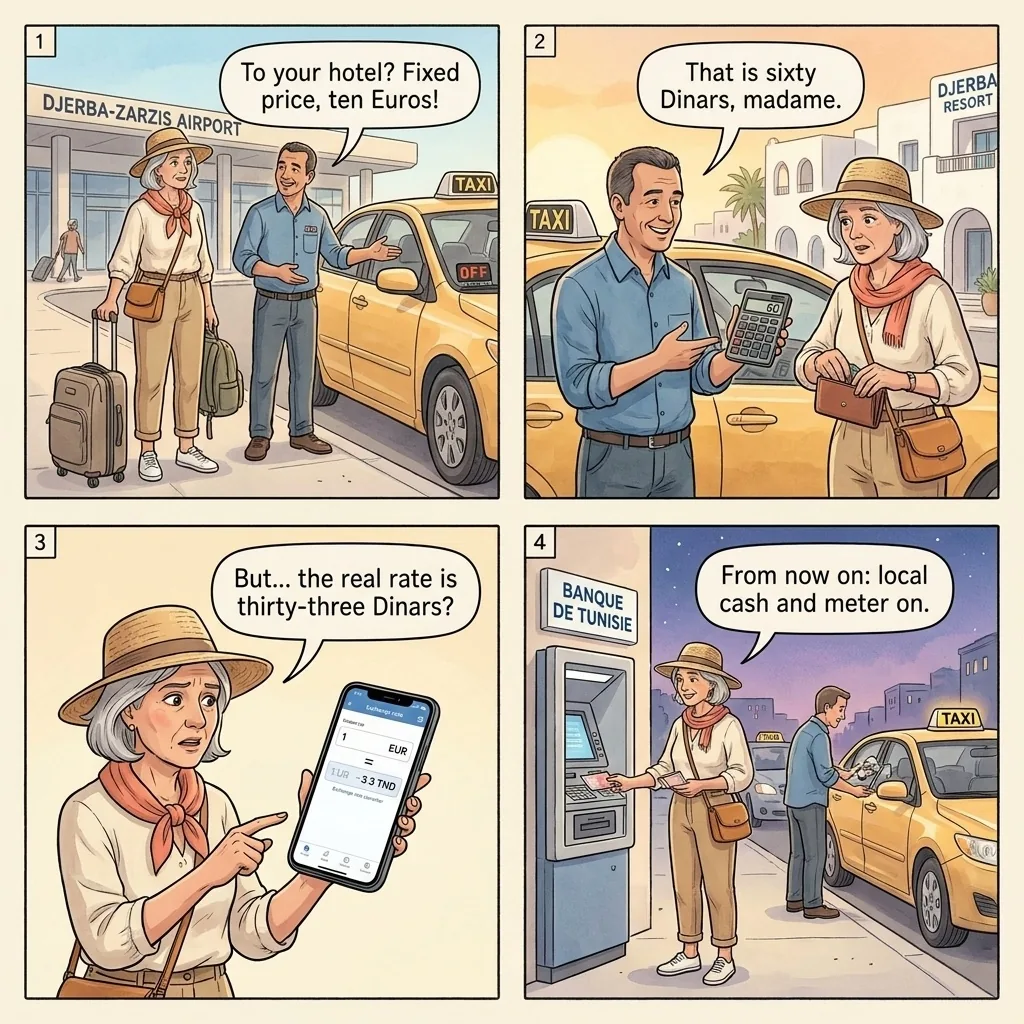
A Djerba taxi driver skips the meter, suggests a 'fixed price' in euros, then on arrival converts at his own rate (or claims the price was per-person not per-car) — effectively doubling the fare. Tourists arriving with only euros are the easiest targets because they can't pay in dinars on the spot.
You flag down a taxi at your Djerba hotel to go to Houmt Souk. The driver cheerfully agrees and does not start the meter, instead suggesting a fixed price. You agree on what sounds reasonable in euros. When you arrive, the driver converts the fare into dinars at an exchange rate that strongly favors him — or he claims the agreed price was actually per person, not for the car. Alternatively, you pay with a large-denomination bill and receive change calculated at a creative exchange rate.
TripAdvisor's Tunisia forum has documented multiple variants of this scam. One traveler on the forum described being persuaded to pay taxi fares in euros rather than dinars, only to realize the conversion rate used was far worse than the official rate — effectively doubling the fare. The Helpful Stranger travel blog's Tunisia guide confirms that if you persuade taxi drivers to accept euros, you will likely be overcharged.
The Tunisia currency exchange system is regulated, and the Tunisian Dinar cannot be exchanged outside the country, which means tourists often arrive with only euros or dollars and are vulnerable to unfavorable conversion rates before they can reach a bank. The driver knows this — Djerba-Zarzis Airport (DJE) arrivals is the highest-yield position to catch tourists before they've extracted dinars from a Tunisian ATM.
A secondary trick is the 'helpful' detour to a currency exchange shop on the way to your hotel — the driver gets a commission, and the exchange shop offers a worse rate than a bank. Both layers compound: bad fare + bad exchange + commission to driver = roughly triple the legitimate door-to-door cost.
The defensive move is to insist the meter runs before the taxi moves — if the driver refuses, exit and find another — and pay only in Tunisian dinars exchanged at an official bank or ATM before taking taxis. Confirm total fare, currency, and per-car-vs-per-person before the ride starts. Use ride-hailing apps (InDrive, Yassir) where available — they show fixed prices. Ask hotel reception for the approximate fare baseline. Police: 197. Emergency: 190.
Red Flags
- The driver does not start the meter and insists on a fixed price, especially for airport or hotel transfers
- The driver offers to accept payment in euros or dollars rather than Tunisian dinars
- At the end of the ride, the agreed price suddenly becomes per person rather than per car
- The driver stops at a currency exchange shop 'as a favor' — these shops offer poor rates and give the driver a commission
- Change is given in a mix of currencies or denominations that is confusing to count quickly
How to Avoid
- Always insist the meter is running before the taxi moves — if the driver refuses, exit and find another taxi.
- Pay in Tunisian dinars only — exchange money at an official bank or ATM before taking taxis.
- Confirm the total fare, the currency, and whether it is per car or per person before the ride starts.
- Use ride-hailing apps like InDrive or Yassir, which show fixed prices upfront and eliminate negotiation.
- Ask your hotel reception what the approximate fare should be to your destination before hailing a taxi.
Like what you're reading? Get a full Djerba itinerary with safety tips built in.
Browse travel-safety books →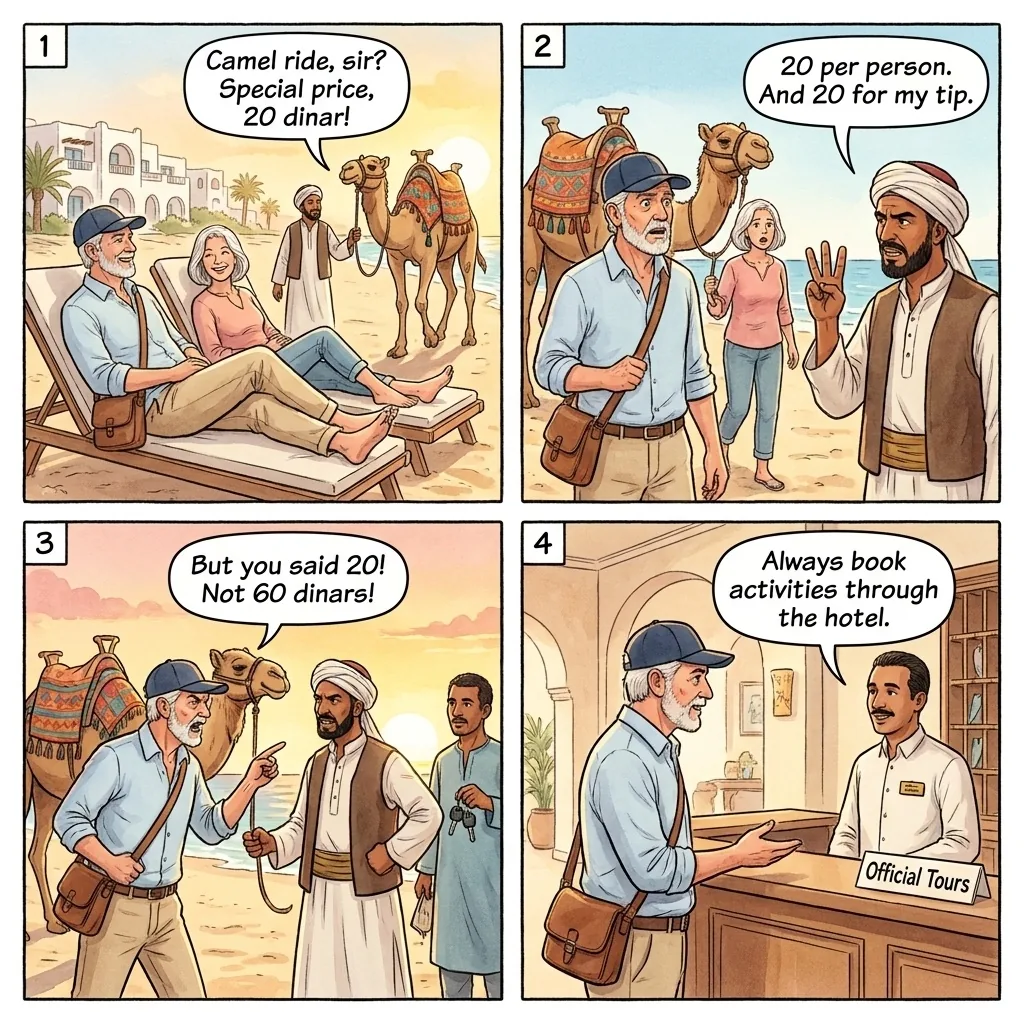
A Midoun-beach vendor offers camel rides at '20 TND' — on dismount it's 20 TND per person + 20 TND handler tip + 10 TND photo fee = 70 TND. The quad bike vendor is already walking over with keys, and the per-person framing only surfaces after you've already had the service.
You are relaxing on the beach in front of your Djerba resort when a man approaches offering camel rides along the shore for a great price — just 20 dinars. You agree and enjoy a lovely ride. When you dismount, the handler demands 20 dinars per person (you are a couple, so 40 dinars), plus a 20-dinar tip for the camel handler, plus 10 dinars for the photo he took. The 20-dinar ride has become 70 dinars. His friend is already approaching with quad bike keys.
Travel blogs and hotel concierge warnings document this pattern extensively on Djerba's beach strips. The OhWYouKnow travel blog reports that at least five different people will offer quad, camel, or horse tours at your hotel beach, and advises booking through your tour operator where you have protection if something goes wrong.
Beach sellers often make promises about pricing but do not comply once the activity is completed. Haggling after an activity is essentially impossible because you have already received the service and the vendor has leverage — the camel ride can't be 'undone,' so the negotiation has shifted entirely in their favor by the time you dismount.
The tourism board has attempted to regulate beach vendors, but enforcement along the long stretches of resort beach remains inconsistent. The same vendor cycles between camels, quad bikes, parasailing, and horse rides depending on what equipment is in service, and the per-person/per-extras framing remains constant across all variants.
The defensive move is to book excursions through your hotel concierge or a licensed tour operator — you have consumer protection and recourse if something goes wrong. If you do deal with a beach vendor, agree on every detail in writing before the activity starts: total price, number of people, duration, photos and tips included. Carry only the exact amount agreed; leave your wallet in the room safe. Pay only after the activity in TND. Police: 197.
Red Flags
- The vendor approaches you on the beach rather than operating from a fixed kiosk with visible pricing
- The quoted price seems surprisingly cheap compared to what your hotel charges for the same activity
- The vendor is vague about what is included — does the price cover one person or two, does it include photos, tips, or extras
- There is no written receipt, no visible license, and no clear identification of the operator or their company
- The vendor pressures you to decide immediately, claiming the price is only available right now
How to Avoid
- Book excursions through your hotel concierge or a licensed tour operator — you have consumer protection and recourse.
- If you deal with a beach vendor, agree on every detail in writing before the activity starts: total price, number of people, duration, and whether photos or tips are included.
- Carry only the exact amount you agreed to pay and leave your wallet in the room safe.
- Politely decline all unsolicited beach offers with a firm but friendly no — engagement leads to extended negotiation.
- Pay in Tunisian dinars only and settle the full amount after the activity, not before.
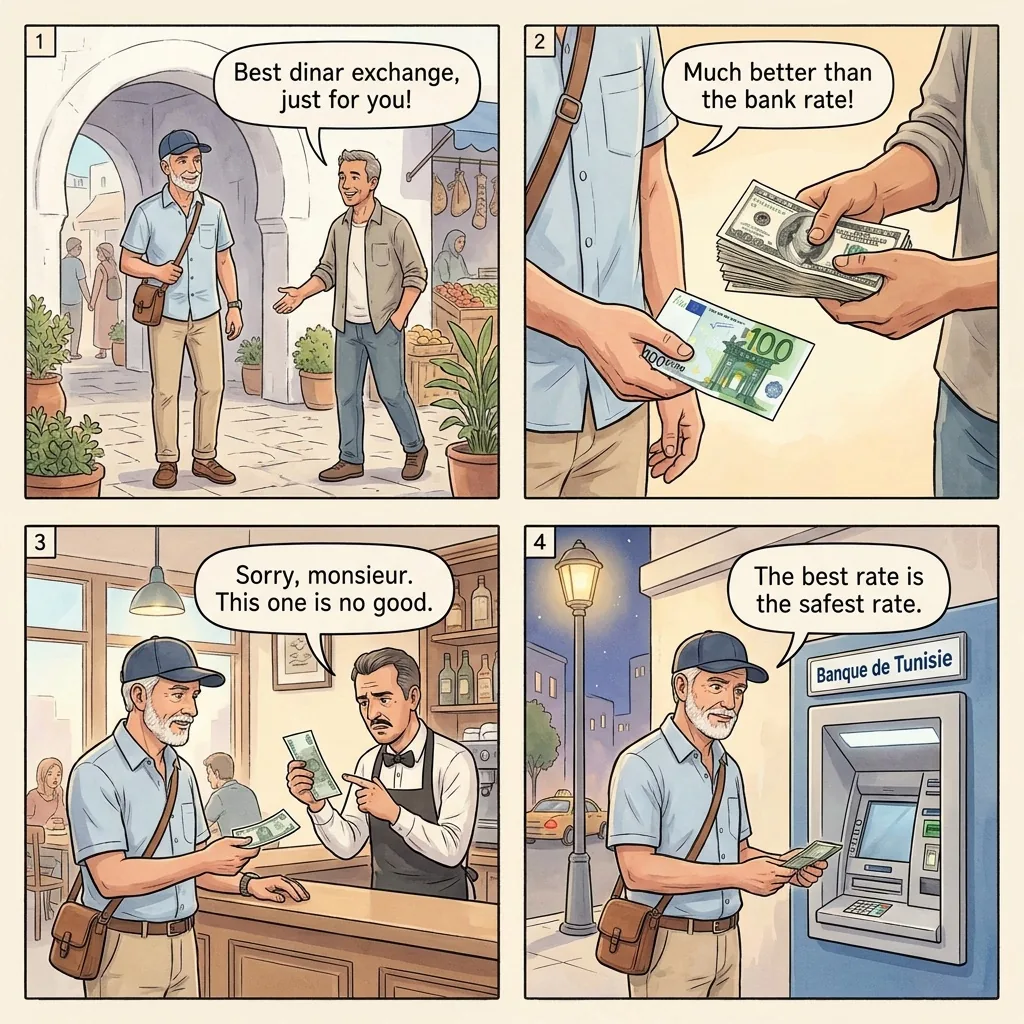
A street exchanger near Houmt Souk offers a better-than-bank rate for your €100, hands you a thick wad of dinars with the legitimate bills sandwiching counterfeit ones in the middle — exchanging outside licensed banks is illegal in Tunisia, and tourists can't tell fake bills from real on first contact.
A man approaches you near Houmt Souk offering an exchange rate for your euros that is noticeably better than the bank. You hand over 100 euros and receive a thick wad of Tunisian dinars. It looks correct at a glance. Later, when you try to pay at a restaurant, the waiter examines a bill, shakes his head, and tells you it is counterfeit. You check the rest of your wad and find that several bills mixed into the stack are fakes — the legitimate bills were on top and bottom of the pile, sandwiching worthless paper.
The World Travel Index's Djerba safety guide specifically warns that tourists could receive counterfeit bills or unfavorable exchange rates from unofficial money changers. Tunisia's currency exchange is regulated by the Central Bank, and exchanging money outside of authorized banks and bureaux de change is technically illegal — meaning even if you knew the bills were counterfeit, you couldn't report it without admitting to your own regulatory violation.
XplrVerse's Tunisia safety guide confirms that only official banks and exchange offices should be used for converting currency, and that street exchangers operate illegally. The 'sandwich' technique is universal: a thick wad looks correct because you can see the outermost bills clearly, but the middle 30–60% of the stack can be counterfeit, smaller-denomination, or worthless paper that fans look like dinars at speed.
The Tunisian Dinar cannot be purchased or sold outside Tunisia, which creates an information gap — tourists arriving for the first time may not know what legitimate bills look or feel like, making counterfeit detection extremely difficult. By the time you've identified the fakes (typically when a restaurant or shop refuses one), the street exchanger is long gone and the rest of your trip's cash is now uncertain.
The defensive move is to exchange currency only at licensed banks, hotel exchange desks, or official bureaux de change with posted rates and printed receipts — never on the street, regardless of the rate. Use ATMs from major Tunisian banks (BIAT, Amen Bank, BNA) for the best rates and guaranteed authentic bills. Familiarize yourself with TND banknote security features via the Central Bank website before traveling. Police: 197. Counterfeit reporting: Banque Centrale de Tunisie +216 71 122-000.
Red Flags
- Someone approaches you on the street offering to exchange money at a rate significantly better than the posted bank rate
- The exchanger conducts the transaction in a hurry, counting bills quickly and pressing you to take the money and go
- The bills feel different from the ones you later get from an ATM or bank — slightly thinner, different texture, or faded colors
- The exchanger insists you count the money later rather than counting carefully on the spot
- There is no receipt, no visible business license, and the exchange happens in a doorway or alley rather than a proper shop
How to Avoid
- Only exchange currency at licensed banks, hotel exchange desks, or official bureaux de change with posted rates and printed receipts.
- Use ATMs from major Tunisian banks (BIAT, Amen Bank, BNA) for the best rates and guaranteed authentic bills.
- Never exchange money on the street, no matter how good the rate seems — the risk of counterfeit bills is extremely high.
- Familiarize yourself with Tunisian banknotes before traveling — the Central Bank website shows images of all current denominations.
- If you suspect you have received a counterfeit bill, report it to the nearest bank or police station immediately.
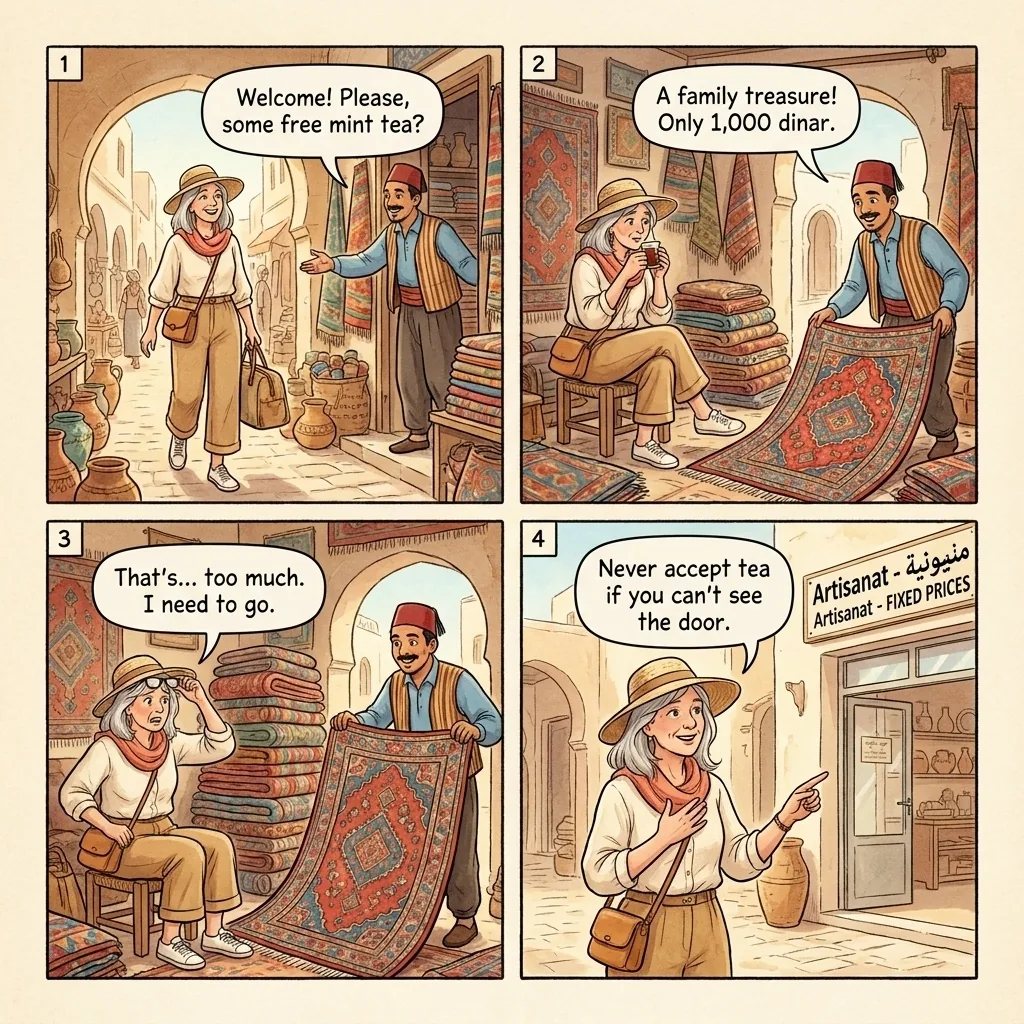
A Houmt Souk carpet-shop owner offers free mint tea 'no obligation,' seats you with rugs stacked between you and the door, and pitches a 200 TND rug for 1,000 TND with stories of family heirlooms — the guide who brought you takes a 20–40% cut and stays outside to block your easy exit.
You are exploring Houmt Souk when a charming shopkeeper invites you in for a free cup of mint tea and a look at his family's handmade carpets. There is no obligation to buy, he insists. You accept the tea, and it is delicious. He begins unrolling carpets one after another, explaining the symbolism of each pattern and the months of work that went into every piece. You mention you like one, and suddenly you are seated against a wall with a stack of rugs blocking the exit while the salesman does not stop talking to give you a chance to leave.
The guide who brought you here has conveniently stepped outside. The tea is genuinely good, the carpets are genuinely beautiful, and the cultural framing of mint-tea hospitality is genuinely real — which is exactly what makes the high-pressure close work. Refusing feels rude in a way that walking out of a department store does not.
TripAdvisor's Tunis and Djerba forums document this exact high-pressure carpet selling tactic in extensive detail. A TripAdvisor thread titled 'Beware of carpet shops. Know the tactics before you go' describes how tourists are seated against a wall holding a free cup of tea with rugs blocking the exit.
The MyChakchouka travel blog reports that a rug worth 200 TND is routinely pushed for 1,000 TND, with the salesman using stories about family heirlooms and cultural significance to create guilt. The tactic works because Tunisian hospitality norms make it feel rude to refuse tea or leave abruptly, and the guide who brought you receives 20–40 percent of any sale — so they have strong motivation to keep you in the shop and stay positioned to remind you that the tea was their introduction.
The defensive move is to politely decline tea in carpet shops unless you genuinely intend to spend time and possibly money — the social debt is real, and the seating layout closes the easy exit. If you enter, stay near the door and refuse seating at the back. Set a clear time limit when entering ('I have 10 minutes before meeting someone'). Research baseline prices at government Artisanat stores first. Practice 'La, shukran' (No, thank you) firmly. Police: 197.
Red Flags
- A shopkeeper or guide insists you come in for free tea with no obligation — the tea IS the obligation
- The shop layout seats you with your back to the wall and merchandise stacked between you and the door
- The salesman talks continuously without natural pauses, making it difficult to politely excuse yourself
- Your guide steps outside and leaves you alone with the salesman, removing your social support
- Prices are never displayed and only quoted verbally, making comparison shopping impossible
How to Avoid
- Politely decline tea in carpet shops unless you genuinely intend to spend time and potentially money — the social debt is real.
- If you enter, stay near the door and do not let them seat you at the back of the shop.
- Set a clear time limit when you enter: say you have 10 minutes before meeting someone, creating an easy exit.
- If you do want to buy a carpet, research prices at government-run Artisanat stores first to establish a fair baseline.
- Practice saying 'La, shukran' (No, thank you) firmly and repeatedly — you are allowed to leave without buying anything.
🆘 What to Do If You Get Scammed
📋 File a Police Report
Go to the nearest Tunisian National Police station. Call 197 (Police) or 190 (Emergency). Get an official crime report — you'll need this for insurance claims. You can also report online at interieur.gov.tn.
💳 Cancel Your Cards
Call your bank immediately. Most have 24/7 numbers on the back of the card (keep a photo saved separately). Block any suspicious transactions before the thieves use your details.
🛂 Lost Passport?
Contact the US Embassy in Tunis at Les Berges du Lac. For emergencies: +216 71-107-000.
📱 Track Your Device
If your phone was stolen, use Find My (iPhone) or Find My Device (Android) from another device. Don't confront thieves yourself — share the location with police instead.
Frequently Asked Questions
You just read 6 scams in Djerba. The full Travel Safety Series has 780+ more across 20+ countries.
Tokyo's Kabukichō ¥130,000 bar trap. Rome's gladiator photo extortion. Paris's gold-ring trick. Bali's ATM skimmer scams. Bangkok's grand-palace closure ruse. Every documented scam across 20+ destinations — with the exact scripts, red flags, and local-language phrases that shut each one down. Drawn from Reddit traveler reports, embassy advisories, and consumer-protection cases.
- 780+ documented scams across Tokyo, Rome, Paris, Bali, Bangkok, Rio & 100+ more cities
- 20+ countries covered, with country-by-country phrase cards for every destination
- Updated annually — buy once, re-download future editions free
- All titles $4.99 each on Amazon Kindle