
Key Takeaways
- The #1 reported scam is the Hammamet Old Medina Carpet-Shop Ambush.
- Most scams in Hammamet are low-to-medium risk.
- Use app-based ride services (Uber, Bolt) instead of unmarked taxis — always confirm the fare before departure.
- Never accept unsolicited offers from strangers near tourist sites in Hammamet.
⚡ Quick Safety Tips
- Keep phones and valuables in secure pockets when in crowded areas.
- Use only licensed taxis or app-based ride services.
- Book tours and tickets through verified operators with online reviews.
- Keep a copy of your passport separate from the original.
Jump to a Scam
The 6 Scams
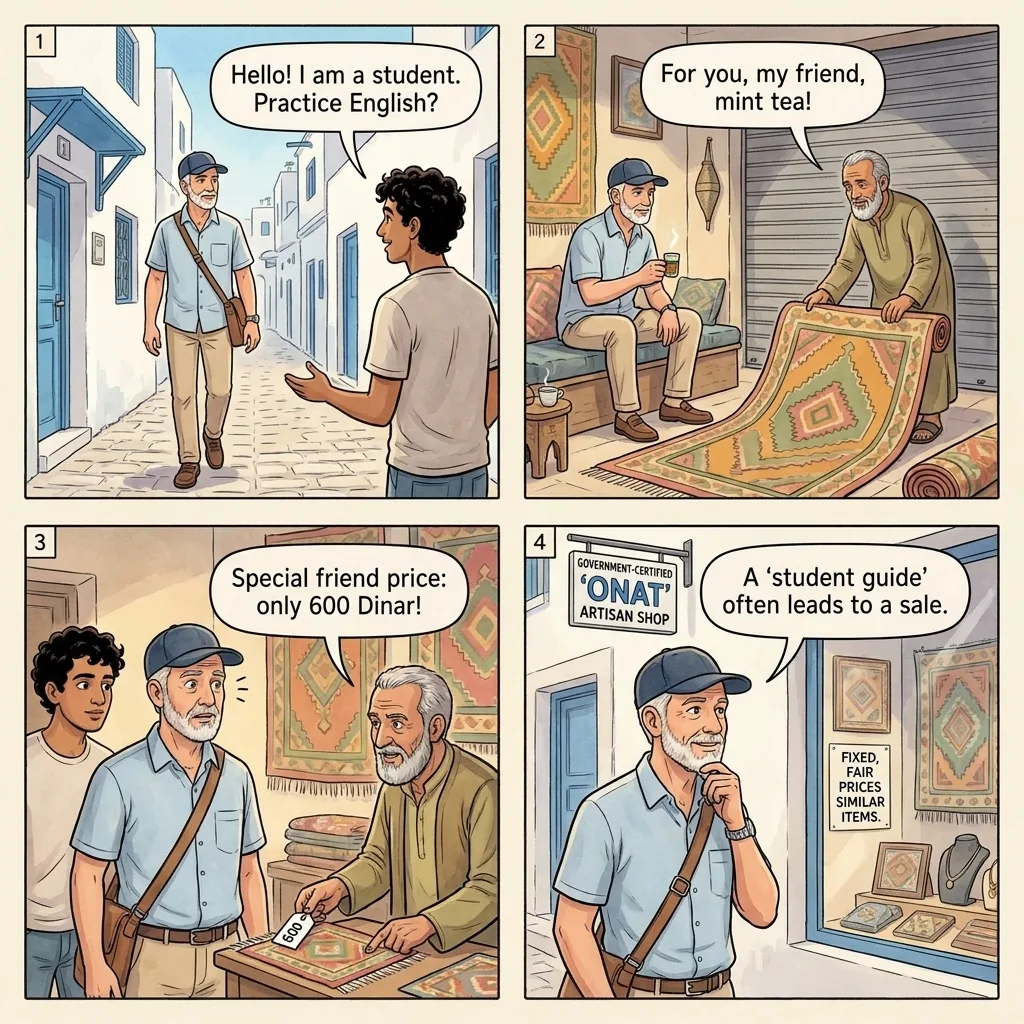
It's an afternoon in Hammamet's Old Medina, you're walking the narrow lanes near the Great Mosque, and a friendly young man in his twenties falls into step beside you and asks where you're from in fluent French and good English.
He says he's a university student who wants to practice his English and offers to show you the 'real' medina that tourists usually miss — the artisan workshops, the carpenters, the silver-makers. The walk lasts twenty pleasant minutes and includes some genuinely interesting alleys. Then it ends, predictably, at his uncle's carpet shop. Mint tea appears in tiny glass cups within thirty seconds of you sitting down on the cushioned bench. The shop's wooden shutters get pulled closed against the heat — and against your easy exit.
The owner is older, more polished, and produces dozens of silk and wool carpets from a back room. The presentation is genuinely interesting — Berber weaving, Kairouan motifs, the geological history of natural dyes. Then the prices appear: a small rug 'worth 1,000 TND' offered to you at 'special friend price' of 600 TND. The actual market value at the ONAT (Office National de l'Artisanat Tunisien) certified shops is roughly 150–200 TND. The 'student' in the doorway looks expectant; the owner watches you carefully; you've been in the shop forty minutes and drunk three cups of tea.
The Hammamet medina carpet-ambush is one of the longest-running tourist scams in North Africa, documented across Reddit, the TripAdvisor Hammamet forum, the Lonely Planet North Africa thorntree, and the U.K. Foreign Office Tunisia travel advice. The mechanism uses three structural failures: the 'student practising English' approach as a low-friction recruiter, the mint-tea hospitality that creates an implicit social obligation, and the inflated initial pricing that lets aggressive 'discounting' (1,000 TND → 600 TND → 400 TND) feel like a victory for the buyer who still ends up paying 2–3× legitimate value.
The legitimate Tunisian artisan economy is real and worth supporting. The ONAT (Office National de l'Artisanat Tunisien) operates fixed-price certified-quality artisan shops in every Tunisian tourist city, including Hammamet, with documented pricing that reflects genuine artisan value. The ONAT shops are the price-anchor reference point for any souk negotiation; visit one before browsing the medina so you have a baseline.
Decline 'student wanting to practice English' approaches in Hammamet's medina with a polite 'la, shukran' (no, thank you) and continued walking — the entire mechanism of the carpet-shop ambush is the recruitment step. If you accept the mint tea, you remain under no obligation to buy anything; this is medina hospitality, not a contract. Visit the ONAT (Office National de l'Artisanat Tunisien) certified-price shop in Hammamet BEFORE souk shopping to anchor your sense of legitimate prices. In any souk negotiation, start at 25% of the asking price and cap your final offer at 30–40%; refuse purchases under social pressure. Hire a licensed guide through your hotel if you want a real medina tour, not from a stranger on the street. Emergency: 197 (Tunisian Police) or 190 (general); the U.S. Embassy in Tunis is at +216 71 107 000.
Red Flags
- Stranger offers a 'free' guided tour of the medina
- Claims to be a student wanting to practice English or French
- Tour conveniently ends inside a carpet or souvenir shop
- Mint tea appears before any prices are discussed
- Door is closed or workers block the exit subtly
How to Avoid
- Politely decline unsolicited tours from strangers in the medina.
- If you accept tea, know you are under no obligation to buy anything.
- Research typical carpet prices before visiting souks.
- Say 'la shukran' (no thanks) firmly and keep walking.
- Hire a licensed guide through your hotel if you want a medina tour.
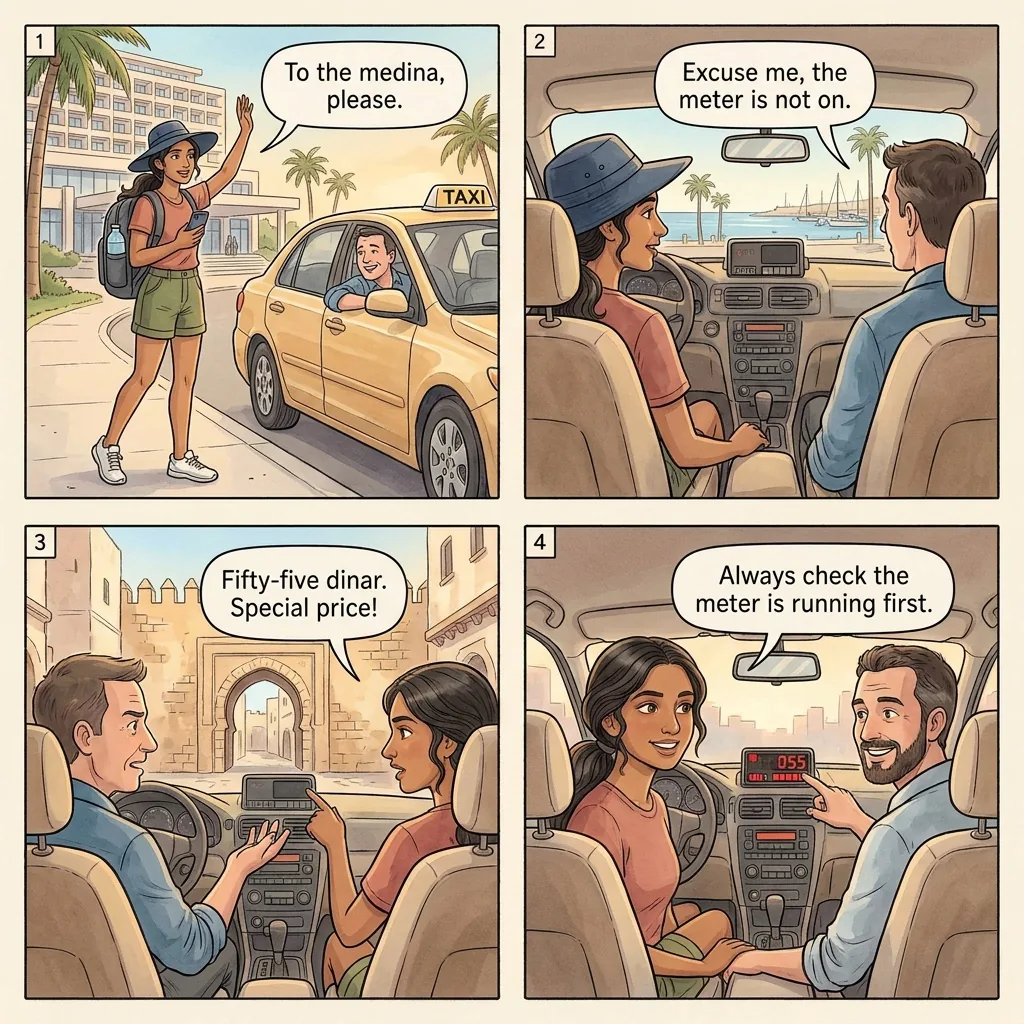
It's a Wednesday afternoon, you've stepped out of your resort hotel in Yasmine Hammamet, and you've hailed a yellow taxi for the short ride to the medina — the legitimate metered fare for the same trip is roughly 15 TND.
The driver nods enthusiastically when you name the medina, helps you in, and pulls into traffic. The meter is not running. He chats about the weather, points out the Yasmine waterfront, and delivers you to the medina entrance fifteen minutes later. The fare he quotes: 55 TND, with a straight face. The legitimate metered rate would have been 15–18 TND. The framing is calibrated: 'meter is broken,' 'special tourist rate,' 'I'll give you a discount because we're friends.' All three are versions of the same scam.
The Hammamet rigged-taxi friction is documented across Reddit, the TripAdvisor Hammamet forum, the Lonely Planet North Africa thorntree, the U.K. Foreign Office Tunisia travel advice, and Tunisian Tourism Authority consumer guidance. The mechanism uses three failures: drivers who 'forget' to start the meter at the start of the ride, drivers who use tampered meters that tick three times the regulated rate, and drivers who take deliberately long routes through Hammamet back streets to inflate the metered total. The cumulative damage on a week of taxi rides at 3× rates can reach $50–100 in invisible markup.
The legitimate Tunisian taxi system is regulated by the Ministry of Transport. Yellow taxis must run on metered rates with a posted base fare of 0.7 TND plus 0.5 TND per kilometre during the day (1.5x at night). The fair Yasmine-Hammamet-to-medina trip should be 12–18 TND on the meter. Bolt operates in larger Tunisian cities (Tunis, Sousse) and is expanding to Hammamet — fares are app-displayed in advance with no negotiation, removing the entire rigged-meter mechanic.
The structural defences are concrete. Insist verbally on the meter (le compteur) being turned on BEFORE the taxi moves; if the driver refuses, get out before the wheels turn. Use Bolt where available — the in-app price is fixed in advance. For airport transfers from Tunis-Carthage to Hammamet (about 60 km), pre-arrange through your hotel — most resort hotels offer transfers at fair fixed rates. Anchor your expected fare against the legitimate metered rate before getting in: 12–18 TND for short Yasmine trips, 25–35 TND for medina-to-old-town crossings, 90–120 TND for the 60 km Hammamet-to-Tunis-airport run.
Insist on the Hammamet taxi meter (le compteur) being turned on BEFORE the cab moves; if the driver refuses, get out before the wheels turn. Use Bolt where available in Hammamet — the in-app price is fixed in advance. Anchor expected fares: 12–18 TND for short Yasmine trips, 25–35 TND for medina crossings, 90–120 TND for the 60 km Hammamet-to-Tunis-airport ride. Pre-arrange airport transfers through your hotel for fair fixed rates. Carry small TND notes (1, 5, 10) to pay only the metered amount without depending on driver change. Refuse 'special tourist rate' and 'meter broken' framings — both are the rig. Emergency: 197 (Tunisian Police); the U.S. Embassy in Tunis is at +216 71 107 000.
Red Flags
- Driver suggests a 'special price' instead of the meter
- Meter is covered, broken, or not turned on at the start
- Driver takes an unfamiliar or winding route
- Price quoted is dramatically higher than what hotel staff suggested
How to Avoid
- Always insist the meter is running before the car moves.
- Ask your hotel reception for the expected fare to your destination.
- Use the Bolt app where available for transparent pricing.
- If the driver refuses the meter, exit and find another taxi.
- Keep small bills ready so you can pay exact change.
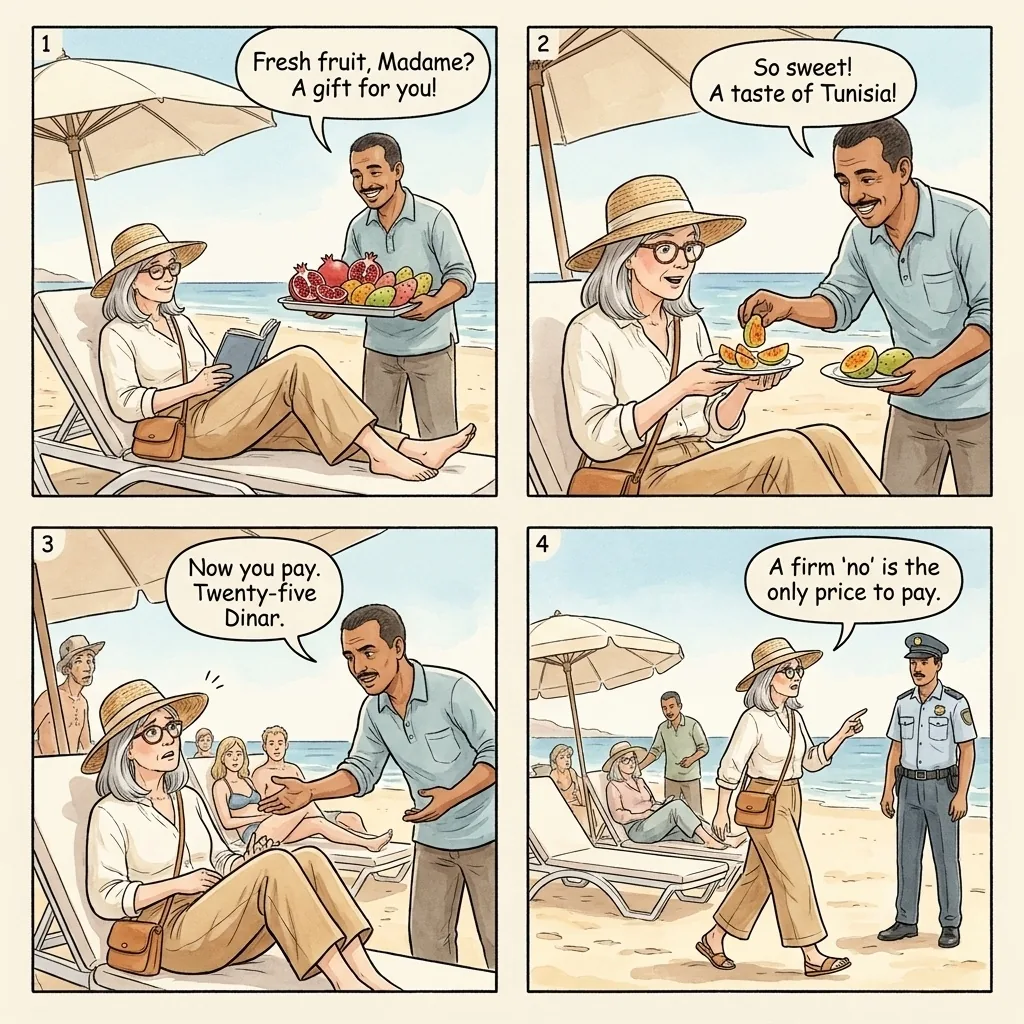
It's an afternoon on Hammamet Beach, you're stretched out under a parasol with a book, and a vendor walks up the sand with a wooden tray of beautifully cut exotic fruit — prickly pears, pomegranates, fresh dates.
Before you can wave him off, he's pulled a small knife and started peeling a prickly pear in front of you, narrating how rare and delicious it is, how it's the perfect beach refreshment, how it's only available in season. The cut fruit goes onto a paper plate. He places the plate in your hands. The transaction has happened in twenty seconds — and now that you've 'accepted' the fruit, he demands 25 TND for it (about USD $8). The actual market price for the same prickly pear at Nabeul market or any local Tunisian shop is 1–2 TND.
When you refuse to pay 25 TND, the vendor's voice rises. He may demand you return the fruit (now sliced and unsellable), refuse to accept it back, draw the attention of nearby beachgoers, or signal to a friend further down the beach who joins the demand. The social-pressure mechanic is calibrated: paying USD $8 to make the awkward situation end feels rational, even though the legitimate price is USD $0.50. As travelers report across Reddit, the TripAdvisor Hammamet forum, the Lonely Planet North Africa thorntree, and TripAdvisor's beach-scam coverage, this is a daily occurrence on the Hammamet tourist beaches.
The mechanism extends beyond fruit. Beach vendors run the same pattern with bracelets (placed on your wrist before the price is named), small toys for children (handed to a kid before the parent reacts), 'free' tea samples that turn out to require payment, and beach-massage offers that escalate from 'try this' to a demanded 30 TND mid-massage. The 'place item in hand before naming price' framing is the entire mechanism across product categories.
The structural defences are concrete. Wave vendors away firmly BEFORE they start cutting fruit, opening bracelets, or handing items to children. Say 'la, shukran' (no, thank you) clearly and do not let any item touch your hand or your child's hand. If a vendor places something in your hand anyway, set it on the sand at his feet and walk back to your spot — never accept the item back into the transaction. If pressured aggressively, walk toward hotel security or a lifeguard station; resort beaches typically have staff who will intervene. Carry only the cash you need for legitimate beach purchases at posted-price kiosks.
Wave Hammamet beach vendors away firmly BEFORE they start cutting fruit or handing items to anyone — say 'la, shukran' (no, thank you) clearly and do not let any item touch your hand or your child's hand. If a vendor places something in your hand or your child's hand anyway, set it on the sand at his feet and walk back to your spot; do NOT accept the item back into the transaction. If pressured aggressively, walk toward hotel security or a lifeguard station — resort beach staff will intervene. Buy beach refreshments only at posted-price kiosks or from your resort's beach-service. The fair Hammamet price for a prickly pear, pomegranate, or fresh dates is 1–3 TND total at any local market or supermarket. Emergency: 197 (Tunisian Police).
Red Flags
- Vendor begins preparing fruit without asking or quoting a price
- Items are placed directly in your hands before any negotiation
- Vendor becomes aggressive or loud when you try to refuse
- Other vendors appear as backup to pressure you
How to Avoid
- Never accept anything placed in your hands without agreeing on a price first.
- Wave vendors away firmly before they start cutting fruit.
- Say 'la, shukran' (no thanks) and do not engage further.
- If pressured, walk toward hotel security or a lifeguard station.
Like what you're reading? Get a full Hammamet itinerary with safety tips built in.
Browse travel-safety books →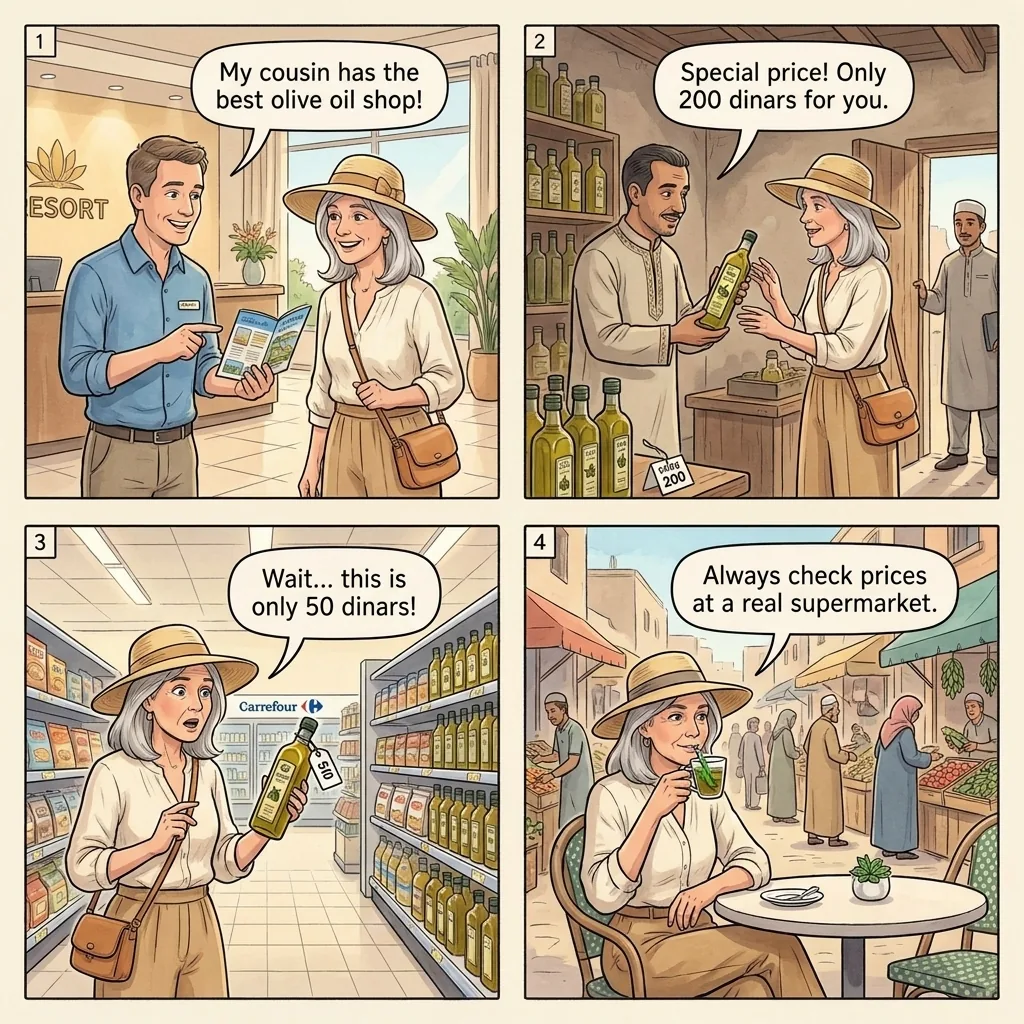
It's an evening at your Yasmine Hammamet resort, you've been chatting with a friendly receptionist about your trip plans, and he casually mentions a 'family friend' who runs an amazing day trip to Carthage and a 'government-regulated' olive oil shop with the best prices in Tunisia.
He says he can arrange transport for you tomorrow morning at no booking fee. The driver who picks you up is friendly and the Carthage portion is real — pleasant ruins, decent guide. But the 'olive oil shop' the driver insists you visit on the way back is far from any other shops, the prices are three to four times what the same products cost at the Hammamet supermarkets, and the driver won't leave until you've bought something. The receptionist's 'family friend' is real, in a sense — the receptionist earns a 30% commission on everything you purchase at the shop, plus a per-tourist referral fee from the driver.
The Hammamet hotel-employee commission economy is documented across Reddit, the TripAdvisor Hammamet forum, the Lonely Planet North Africa thorntree, and Tunisian Tourism Authority consumer guidance. Hotel staff at all-inclusive resorts in Yasmine Hammamet and Hammamet Sud systematically funnel tourists to specific overpriced shops, restaurants, and 'cultural experiences' — olive oil shops, ceramic showrooms, carpet retailers, Berber 'craft cooperatives' — where the family or associate-run operation pays the staff a meaningful commission on every purchase. The customer doesn't see the commission and assumes the recommendation is genuine.
The mechanism is structural. The recommendation comes from someone the customer trusts (the hotel staff member who's been friendly all week). The 'government regulated' or 'factory direct' framing is fictional but plausible. The driver-and-shop coordination ensures the customer ends up at the commission location with limited ability to comparison-shop. The pricing reflects 30–50% kickback to the receptionist plus the operator's normal margin on top of legitimate retail.
The structural defences are concrete. Politely decline hotel-staff recommendations for specific shops, excursions, and cultural experiences — the recommendations are, by default, commission-driven. Research excursions independently through aggregator platforms (Viator, GetYourGuide, Klook) where pricing is transparent and the operator's reviews are documented. For shopping, visit Hammamet's public markets and the ONAT-certified artisan shops where prices are honest. Ask the hotel employee directly what commission they receive — the honest ones will tell you, and the dishonest ones get visibly uncomfortable, which is itself useful information. Compare any 'recommended' shop's prices against three other shops before buying.
Politely decline hotel-staff recommendations for specific shops, excursions, or cultural experiences in Hammamet — the commission-driven default is real and ubiquitous in resort hotels. Research excursions independently through Viator, GetYourGuide, or Klook where pricing is transparent and reviews are documented. Visit Hammamet's public markets and ONAT-certified artisan shops for honest pricing. Ask the hotel employee what commission they earn on the recommendation; honest answers help you calibrate. Compare any 'recommended' shop's prices against three other shops before buying anything meaningful. Pay by card if accepted for chargeback options. Emergency: 197 (Tunisian Police).
Red Flags
- Hotel staff recommends a specific shop or excursion unprompted
- Claims prices are 'government controlled' or 'factory direct'
- A driver materializes immediately to take you there
- The shop is far from other stores, limiting your ability to compare prices
- Staff gets unusually specific about which shop to visit
How to Avoid
- Politely decline and research your own excursions online.
- Book tours through independent platforms like Viator or GetYourGuide.
- If you visit a recommended shop, compare prices at other stores first.
- Ask hotel staff what commission they receive — the honest ones will tell you.
- Visit Hammamet's public markets for better prices on olive oil and souvenirs.
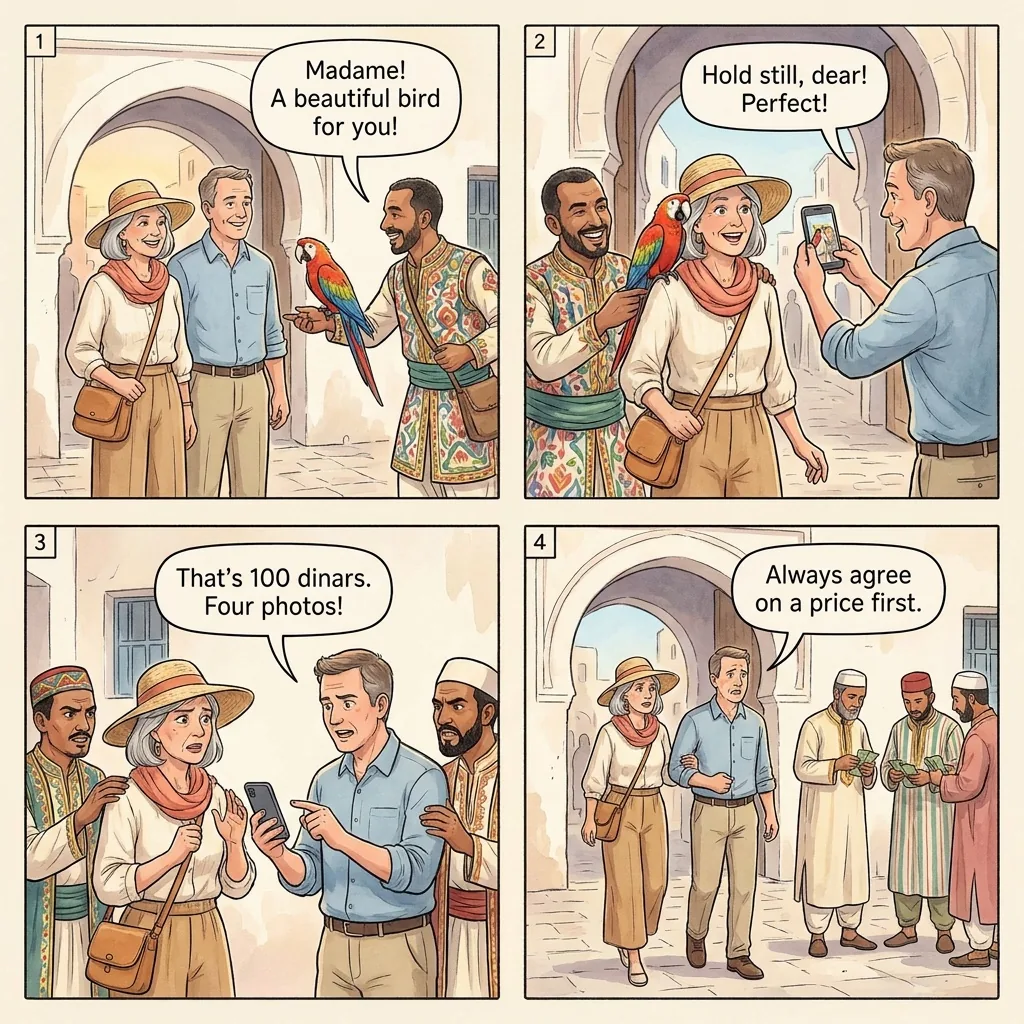
It's an afternoon at the Hammamet medina entrance, you spot a costumed performer — a man in a brightly-coloured traditional Bedouin outfit holding a parrot on his arm, or a snake-charmer with a coiled serpent — and he waves you over with a wide smile.
Before you can ask the price, he's lifted the parrot onto your shoulder or tucked a sprig of jasmine behind your ear. He gestures for your travel companion to take a photo. The moment the picture is taken, he demands 25 TND per photo. If your companion took several angles or burst-shots, he counts each frame separately and demands 100+ TND for the set. Refuse to pay and three or four of his friends — performers and lookouts — materialise around you, voices raised, blocking your easy exit.
The Hammamet photo-with-performer shakedown is documented across Reddit, the TripAdvisor Hammamet forum, the Lonely Planet North Africa thorntree, and Tunisian Tourism Authority consumer guidance. The mechanism uses three structural failures: the costumed-performer photo opportunity is genuinely visually appealing (a real Bedouin tradition exists, the performers know the look), the prop or animal placement happens BEFORE any price discussion (creating physical commitment to the photo), and the social-pressure cohort of confederate 'performers' that materialises to enforce payment.
The financial damage per encounter typically runs USD $10–40, depending on whether the customer paid for one photo or got billed per-frame. The performers also run variant operations: the 'jasmine sprig tuck' (one sprig becomes 25 TND), the 'henna hand-painting' (started before any price is named), and the 'desert-tea ceremony' (a small cup of mint tea served in costume that turns out to cost 30 TND). All three use the same pre-transaction-commitment mechanic.
The structural defences are clear. Negotiate any costumed-performer photo price IN ADVANCE — agree '5 TND for one photo, both of us together' before any prop touches anyone. Refuse the parrot, snake, jasmine, henna, or tea if the performer has not already named a specific price. Keep your camera or phone away while passing performer chokepoints; if you don't have a camera ready, the photo opportunity dissolves. If you took an unsolicited photo and a price is demanded after, refuse to pay above the legitimate rate (5–10 TND) and walk firmly away; the performer will lose interest within seconds because the next tourist is more profitable than the dispute.
Negotiate costumed-performer photo prices IN ADVANCE in Hammamet's medina and tourist zones — agree the specific TND amount for the specific number of photos before ANY prop, animal, jasmine, or henna touches you or your companion. Refuse the prop placement if the performer hasn't named a specific price. Keep your camera or phone away while passing performer chokepoints. If a price is demanded after an unsolicited photo, pay the legitimate rate (5–10 TND total) or walk firmly away. Travel in groups of two or more to reduce intimidation pressure; if a confederate cohort materialises, walk toward the medina's tourist police office (located inside the medina near the Great Mosque). Emergency: 197 (Tunisian Police).
Red Flags
- Costumed performers positioned at tourist chokepoints
- Animals or props placed on you without asking for payment first
- Multiple photographers appearing to multiply the 'debt'
- Aggressive behavior when you try to walk away
How to Avoid
- Never pose with performers or accept items without agreeing on price first.
- If you want a photo, negotiate 2-5 TND before touching anything.
- Keep your camera/phone away when passing these areas.
- Travel in groups to reduce intimidation pressure.
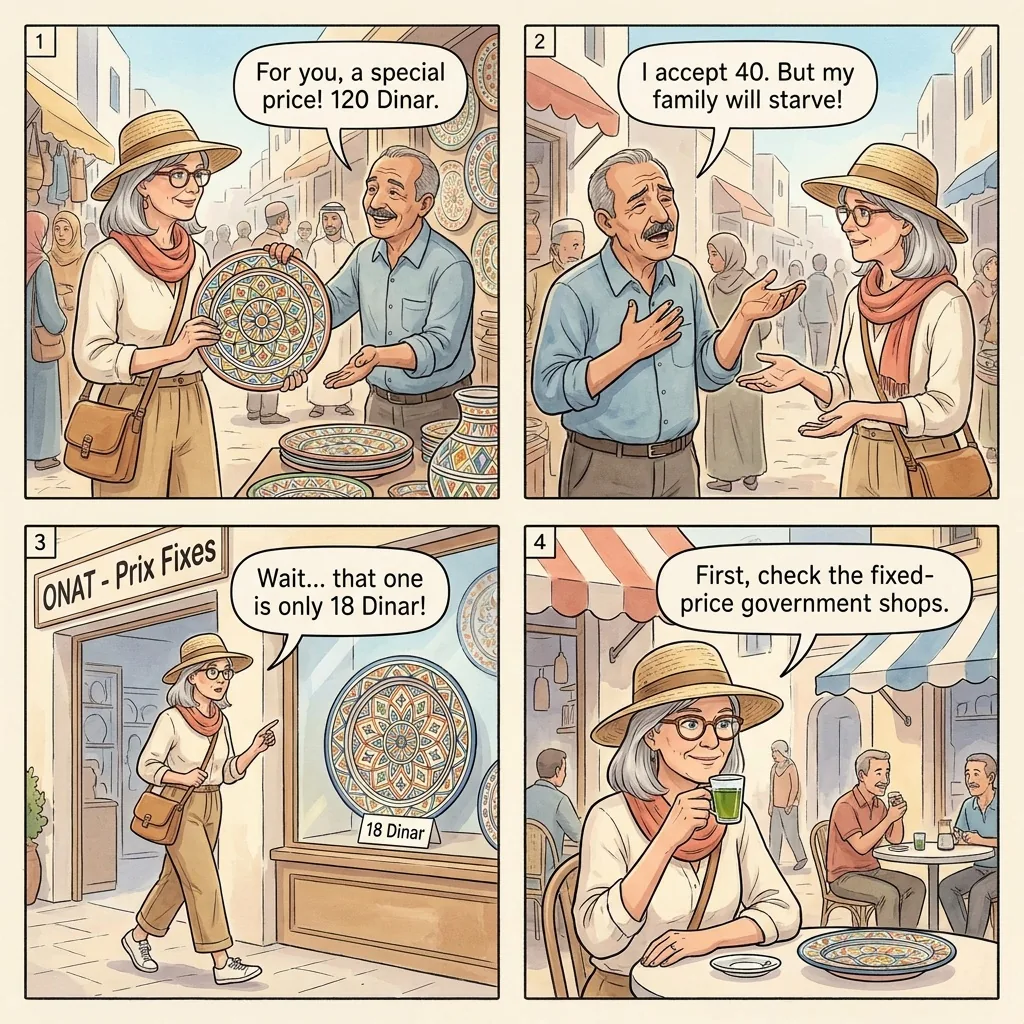
It's a Saturday afternoon at a ceramic shop in Hammamet's Old Medina, you've admired a hand-painted Nabeul-style ceramic plate, and the vendor names an opening price of 120 TND.
You counter at 30 TND. He acts deeply offended — gestures at the painstaking hand-work, the natural pigments, the artisan signature on the back — but accepts 40 TND eventually. You walk out feeling you've negotiated 67% off the asking price. The same plate at the ONAT (Office National de l'Artisanat Tunisien) certified-price shop in Hammamet costs 18 TND with documented artisan provenance. The legitimate ceramic price ceiling at Nabeul market — where the actual ceramicists sell direct from the kiln — is 12–15 TND. You've paid roughly double the legitimate price even after 'aggressive' bargaining.
The Hammamet souk price-inflation is documented across Reddit, the TripAdvisor Hammamet forum, the Lonely Planet North Africa thorntree, and ONAT consumer guidance. The mechanism is structural: vendors inflate initial prices by 400–800% for tourists, knowing that even aggressive 'bargaining down' 50–70% still leaves a meaningful tourist-tax margin. The 'aggrieved offence' theatre at counter-offers is a calibrated negotiation tactic, not a real reaction. Vendors at neighbouring stalls often signal each other about what tourists paid, adjusting their starting prices upward accordingly.
The mechanism extends beyond ceramics. Carpets, jewellery, leather goods, brassware, and 'Berber' rugs run the same pricing pattern in the Hammamet souk. The pricing is the entire scam — the products themselves are typically real (genuine Tunisian ceramics, real leather, actual silver) — but the price the customer pays is meaningfully above legitimate retail.
The structural defences are concrete. Visit the ONAT (Office National de l'Artisanat Tunisien) certified-price shop in Hammamet BEFORE souk shopping — the ONAT prices are the legitimate retail anchor, and seeing them gives you a real sense of what a fair counter-offer is. For ceramics specifically, the Nabeul market (20-minute drive from Hammamet) is the source — ceramicists sell direct at workshop prices that are 50–80% below the Hammamet souk ask. Start any souk negotiation at 20–25% of the asking price and cap your final offer at 30–40%. If a vendor's 'final price' is more than 50% above the ONAT price, walk away — the vendor will frequently call you back with a lower offer.
Visit the ONAT (Office National de l'Artisanat Tunisien) certified-price shop in Hammamet BEFORE souk shopping — the ONAT prices are the legitimate retail anchor and your reference for any negotiation. For ceramics specifically, day-trip to Nabeul (20-minute drive) where ceramicists sell direct at workshop prices 50–80% below the Hammamet souk ask. Start souk negotiations at 20–25% of the asking price and cap your final offer at 30–40%. Walk away if a 'final price' is more than 50% above the ONAT price — vendors frequently call you back with a lower offer. Cap your spend at the ONAT-equivalent rate plus a small artisan-direct premium; refuse 'this is hand-painted by my mother' framings without provenance documentation. Emergency: 197 (Tunisian Police).
Red Flags
- No prices displayed on any merchandise
- Vendor starts extremely high and drops dramatically fast
- Neighboring sellers seem to know what you already paid elsewhere
- Vendor acts offended at reasonable counter-offers but ultimately agrees
How to Avoid
- Research approximate prices for common items before visiting.
- Start at about 25% of the asking price and settle around 30-40%.
- Visit the government-run ONAT artisan shops for fixed-price reference points.
- Walk away if a price feels wrong — the vendor will often call you back with a lower offer.
- Shop at Nabeul's Friday market where competition keeps prices more honest.
🆘 What to Do If You Get Scammed
📋 File a Police Report
Go to the nearest Tunisian National Police station. Call 197 (Police) or 190 (Emergency). Get an official crime report — you'll need this for insurance claims. You can also report online at interieur.gov.tn.
💳 Cancel Your Cards
Call your bank immediately. Most have 24/7 numbers on the back of the card (keep a photo saved separately). Block any suspicious transactions before the thieves use your details.
🛂 Lost Passport?
Contact the US Embassy in Tunis at Les Berges du Lac. For emergencies: +216 71-107-000.
📱 Track Your Device
If your phone was stolen, use Find My (iPhone) or Find My Device (Android) from another device. Don't confront thieves yourself — share the location with police instead.
Frequently Asked Questions
You just read 6 scams in Hammamet. The full Travel Safety Series has 780+ more across 20+ countries.
Tokyo's Kabukichō ¥130,000 bar trap. Rome's gladiator photo extortion. Paris's gold-ring trick. Bali's ATM skimmer scams. Bangkok's grand-palace closure ruse. Every documented scam across 20+ destinations — with the exact scripts, red flags, and local-language phrases that shut each one down. Drawn from Reddit traveler reports, embassy advisories, and consumer-protection cases.
- 780+ documented scams across Tokyo, Rome, Paris, Bali, Bangkok, Rio & 100+ more cities
- 20+ countries covered, with country-by-country phrase cards for every destination
- Updated annually — buy once, re-download future editions free
- All titles $4.99 each on Amazon Kindle