
Key Takeaways
- The #1 reported scam is the Galle Fort Gem-Shop Lure.
- 1 of 6 scams are rated high risk.
- Use app-based ride services (Uber, Ola) instead of street taxis — always confirm the fare before departure.
- Never accept unsolicited offers from strangers near tourist sites in Galle.
⚡ Quick Safety Tips
- Keep phones and valuables in secure pockets when in crowded areas.
- Use only licensed taxis or app-based ride services.
- Book tours and tickets through verified operators with online reviews.
- Keep a copy of your passport separate from the original.
Jump to a Scam
The 6 Scams
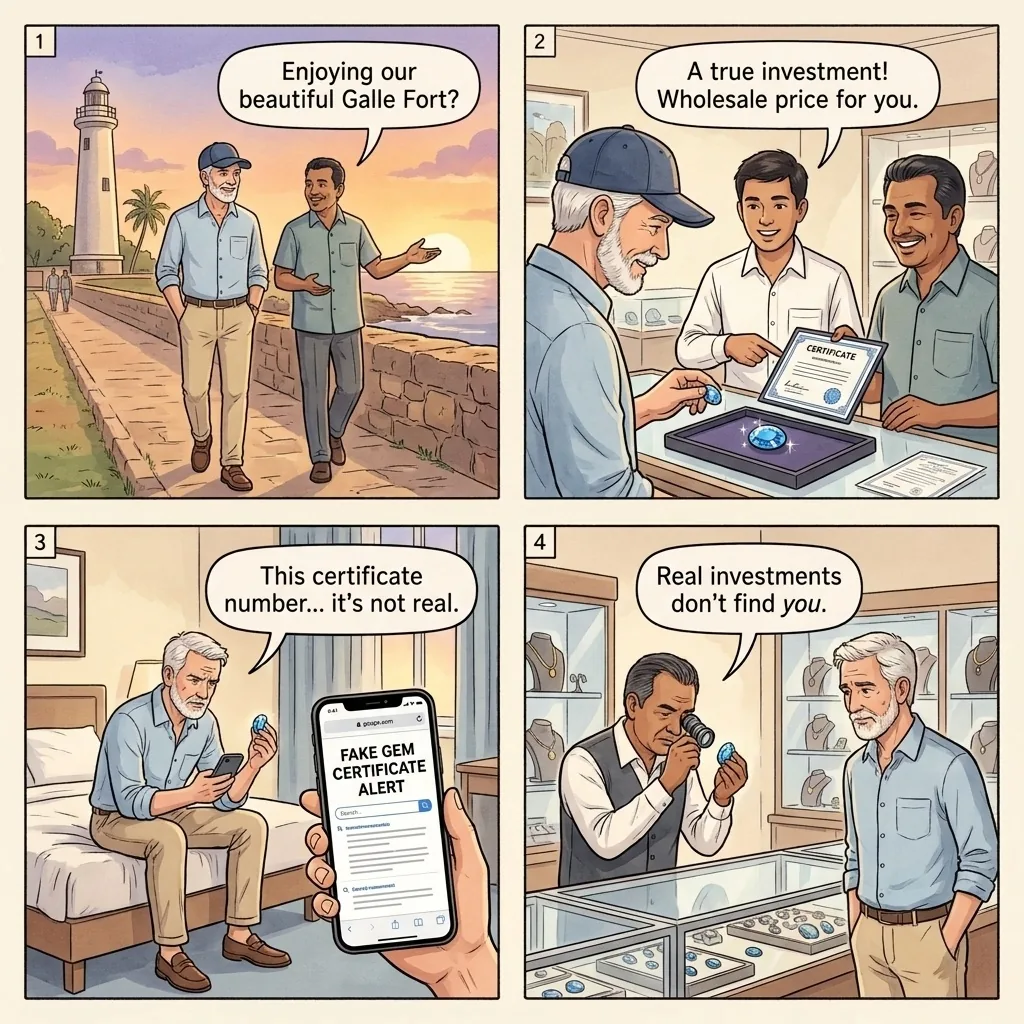
You wander the charming colonial-era lanes of Galle Fort on your second afternoon, the white walls lit gold by late sun, when a well-spoken Sri Lankan in a clean shirt falls into step beside you and starts asking pleasant questions about your trip.
After ten minutes of friendly conversation, he mentions a 'gem museum' inside the fort walls — free entry, no obligation, just an interesting cultural stop where you can learn about Sri Lanka's famous sapphires and the country's gem-cutting tradition. He offers to walk you there. The museum looks legitimate from outside: clean glass cases, polished wood, a guide in a starched shirt who welcomes you and offers tea.
The presentation is genuinely interesting — gem grading, the geology of the Ratnapura mining belt, the history of Ceylon sapphires. After thirty minutes of educational content, the soft pivot begins. A smooth-talking salesman shows you 'certified' sapphires at 'wholesale prices' — a 2-carat blue sapphire for $400, supposedly worth $2,000 retail. He produces a laminated certificate of authenticity from the National Gem and Jewelry Authority. He suggests this is an investment-grade opportunity.
The certificate is fake or unverifiable. The stones are typically low-quality or synthetic — heat-treated commercial-grade sapphires that resell at $30–80 in legitimate markets, or outright lab-grown stones with no value. Tourists have been documented losing $500–$5,000 on what they believe are investment-grade gems. The Galle Fort gem-shop lure is documented across Reddit, the long-running TripAdvisor Galle forum, the U.K. Foreign Office Sri Lanka travel advice, and Sri Lanka National Gem and Jewelry Authority consumer-protection materials.
The pattern is industrial. The 'helpful local' on the street, the museum's tea host, the gem salesman, and the verifying 'expert' who supposedly grades the stones are all part of a coordinated operation. The same play runs in Colombo, Kandy, and Negombo. Anyone who is led to a gem shop by an unsolicited stranger in any Sri Lankan tourist area is, by default, in the scam.
Never buy gems from a shop you were led to by a stranger in Galle Fort or anywhere else in Sri Lanka — the entire chain from the friendly local through the 'museum' to the salesman is a single operation. If you genuinely want to buy a gem, visit a National Gem and Jewelry Authority (NGJA) licensed dealer in Colombo, get a third-party appraisal before payment from an independent gemologist, and pay by credit card for chargeback protection. Walk away the moment anyone offers 'free' tea or a 'gem museum' tour. If pressured, dial 119 (Sri Lanka Police) or 110 (Tourist Police).
Red Flags
- A friendly stranger steers you toward a 'gem museum' or 'gem exhibition'
- You're offered free tea and a presentation before seeing any prices
- The shop claims to offer 'wholesale' or 'duty-free' prices
- Certificates of authenticity look generic or lack verifiable details
How to Avoid
- Never buy gems from a shop you were led to by a stranger.
- If you want gems, visit a National Gem and Jewelry Authority certified dealer.
- Assume that any gem offer inside Galle Fort from an unsolicited contact is a scam.
- Walk away the moment anyone offers 'free' tea followed by a sales pitch.
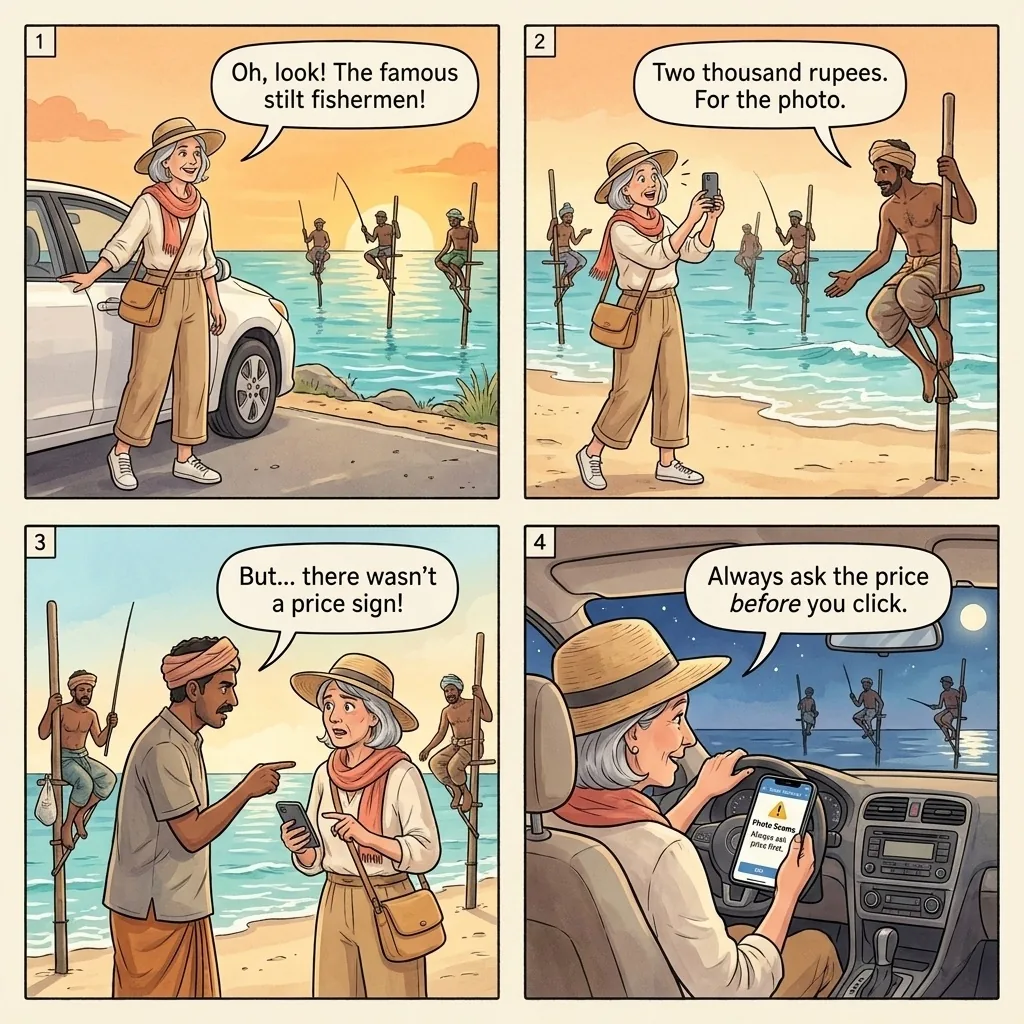
You're driving the coast south of Galle on a Tuesday afternoon and there they are — three men perched on weathered wooden poles in the shallow surf, fishing rods in hand, framed against the Indian Ocean like a postcard of old Ceylon.
You pull the rental car onto the gravel shoulder, walk down to the water, and start taking photos. Within thirty seconds the nearest 'fisherman' has climbed down from his pole, walked up the sand, and stationed himself in front of you with his hand out. The price is LKR 1,000 per photo, sometimes LKR 2,000, and he indicates the camera with a downward jab to underline that he saw you take the shots.
These are not fishermen. The traditional stilt-fishing technique — locals call it ritipanna — was a real coastal livelihood that effectively died out after the 2004 tsunami destroyed the original poles and disrupted the inshore fish populations. The men you see today on the Koggala-to-Weligama coastal strip are paid performers hired by a small syndicate of pole owners to sit on the stilts during daylight hours and charge tourists for photographs. They do not catch fish. Most do not own the rods.
The tourist-board signage and the lack of any visible price up front are part of the trap — you only learn the fee after you've already taken the picture, which weaponises politeness against you. Refusal triggers a louder demand, sometimes a small group of pole-mates walking up the sand to surround you, occasionally a hand on the car door if you try to drive off. Reports of LKR 1,000–2,000 demands for a handful of frames are documented across Reddit, TripAdvisor's Galle and Mirissa forums, the Lonely Planet Sri Lanka thorntree, and travel-advisory pages from the U.K. Foreign Office and the Australian Smartraveller service.
The economic structure is industrial. The pole-syndicate operators pay each performer a daily wage and pocket most of the per-photo fee. The most lucrative pole positions — the picturesque ones at Weligama Bay and the Koggala lagoon mouth — are leased seasonally between operators, and the men who sit on them rotate in shifts so the pose is staffed from morning to dusk. The same model has been imported up the coast to Mirissa and Tangalle. Treating the encounter as a transaction rather than a heritage moment is the only frame that protects you: you are paying a small fee for a stylised photograph, not contributing to a vanishing way of life.
Decide before you stop the car: either you are paying for a posed photo opportunity and you negotiate the price down to LKR 200–500 per group before lifting the camera, or you photograph from inside the vehicle as you drive past and you do not stop. Watch the poles for thirty seconds first — if no one is actually fishing, no fish is in any visible bucket, and the men climb down the moment a tourist appears, it is a paid pose, not heritage. Genuine ritipanna activity, where it survives, happens at dawn and dusk, far from the A2 highway, with no one waiting to be paid. If a demand turns aggressive or someone blocks the car, dial 119 (Sri Lanka Police) or 110 (Tourist Police).
Red Flags
- Fishermen are perched right next to the road where tourists stop
- They are not actually catching any fish
- They immediately climb down and approach your car after photos are taken
- Multiple 'fishermen' are stationed at regular intervals along the coast
How to Avoid
- If you want a photo, agree on a price before taking any pictures — LKR 200-500 is fair.
- Understand this is a paid photo opportunity, not authentic fishing.
- Photograph from a distance without stopping if you don't want to pay.
- Visit early morning or late afternoon to see genuine fishing activity further from tourist routes.
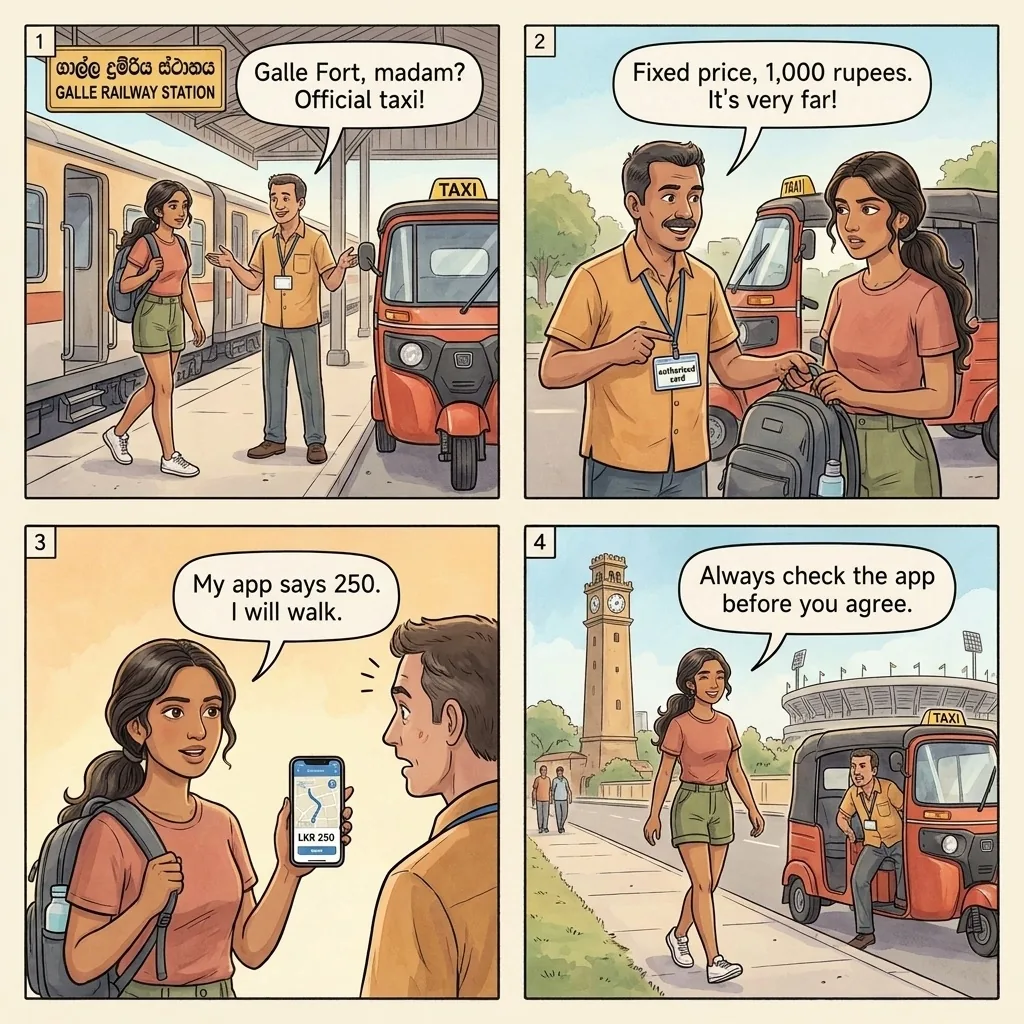
You step off the southern-line train from Colombo onto the Galle Railway Station platform with a small backpack and a hotel name in Galle Fort, and before you reach the exit gate you have already been triangulated by four tuk-tuk drivers competing to walk you to their auto.
The most polished of them speaks fluent English, wears a clean shirt, and produces a laminated 'tourist transport authorised' card from his lanyard. He says the meter is government-approved, that Galle Fort is 'too far to walk,' that it will cost just LKR 800 — maybe LKR 1,000 with the bag. He gestures to his tuk-tuk and starts loading your pack before you've agreed to anything. You climb in and the meter starts running.
The actual distance from the station to the Galle Fort gate is roughly 1 kilometre. It is a flat, sidewalk-lined, ten-minute walk past the Galle International Cricket Stadium. The fair tuk-tuk fare for the same trip, on a properly calibrated PickMe app booking, is LKR 200–300. The 'metered' fare you are about to be charged will land at LKR 800–1,500 because the meter has been re-geared to tick at roughly twice real-time, or because the driver routes through a 'short stop' at a gem shop, a batik factory, or a tea showroom — each detour adding minutes and a commission cut for the driver if you buy anything.
The Galle station tuk-tuk overcharge is one of the most-reported tourist friction points in southern Sri Lanka. It appears across Reddit, the TripAdvisor Galle forum, Lonely Planet's Sri Lanka thorntree, and Sri Lanka Tourism Development Authority complaint logs. The 'authorised tourist transport' card has no legal standing — anyone can have one printed. The same drivers cluster the southern-line stations at Hikkaduwa, Bentota, and Mirissa, and the same script runs at each.
The detour variant is the harder version to spot. A driver who agrees to your fixed price up front will sometimes still divert through a gem shop, a batik factory, or a tea showroom, framing it as 'just five minutes, very famous.' He earns a commission of LKR 500–2,000 if you buy anything at the stop, and the friendly chat in the tuk-tuk is the warm-up. Even if no purchase is made, the detour adds twenty minutes and gives him a second chance to renegotiate the fare on grounds of 'extra distance.' The fixed-price defence only works if you also refuse all stops between the station and your hotel.
Walk to Galle Fort. The route from the station is one straight kilometre on the Wakwella Road, past the cricket ground, into the fort gate — ten minutes with a daypack. If you have heavy luggage or are arriving after dark, ignore the station-forecourt drivers and book a tuk-tuk through the PickMe app, which uses GPS-based fixed pricing and shows the route in advance. If you must take a station tuk-tuk, name your own price (LKR 300 maximum) before the bag goes in, refuse any 'short stop' detour, and pay only the agreed fixed price on arrival regardless of what the meter reads. If a driver becomes aggressive over a fare, dial 119 (Sri Lanka Police) or 110 (Tourist Police).
Red Flags
- Drivers claim to be government-approved with a laminated card
- The meter runs suspiciously fast
- The driver takes a route through commercial areas or shops
- The fare for a short ride seems wildly inflated
How to Avoid
- Walk from Galle Railway Station to Galle Fort — it's only about 1 kilometer.
- Use the PickMe app to book a tuk-tuk with a fixed price.
- If you do take a tuk-tuk, agree on a price before getting in — LKR 200-300 max.
- Ask your accommodation to send directions for walking from the station.
Like what you're reading? Get a full Galle itinerary with safety tips built in.
Browse travel-safety books →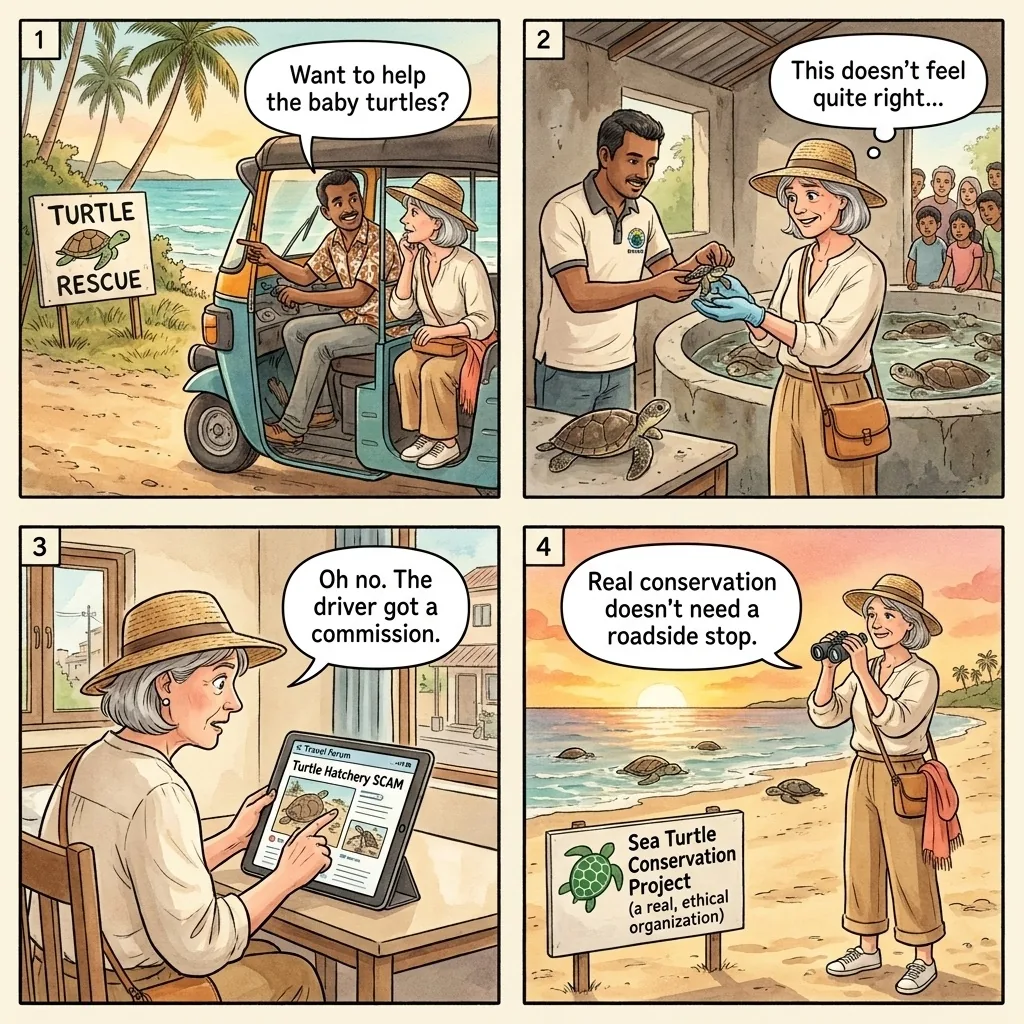
Your tuk-tuk driver in Galle Fort drops a casual suggestion on the way back from Unawatuna beach — there's a 'turtle conservation centre' just up the coast, only LKR 500 to enter, and it's 'good for the environment' to support the rescue work.
You agree because conservation sounds wholesome and the diversion adds only fifteen minutes. The driver pulls into a roadside compound with a hand-painted 'Sea Turtle Hatchery & Rescue' sign, walks you to the gate, and waits in his tuk-tuk. You pay LKR 500–1,000 to a kid at a folding table. Inside, a staff member in a blue polo greets you, explains that this is a 'conservation project,' and starts the tour.
What you actually see is a row of cracked concrete tanks. Adult sea turtles are crammed three or four to a basin, swimming in tight circles. Hatchlings are scooped out of a holding tray and pressed into your hands for photos. A 'blind' or 'injured' turtle in a separate tank is presented as the centre's permanent rescue case — but as travelers across Reddit and the TripAdvisor Galle forum document, the same 'rescue' turtle appears at multiple hatcheries year after year, kept indefinitely as a tourist draw. The Department of Wildlife Conservation has issued public guidance noting that handling stresses hatchlings, that baby turtles must reach the sea within hours of hatching to imprint correctly, and that hatcheries holding hatchlings for days for tourist photos actively harm survival rates.
The economic structure is straightforward. Your tuk-tuk driver receives a commission of LKR 200–500 per tourist he delivers. The hatchery monetises both the gate fee and a gift-shop photo print on the way out. Most of the coastal hatcheries between Bentota and Hikkaduwa operate as for-profit tourist attractions branded as conservation projects, with no Department of Wildlife Conservation accreditation and no measurable release programme. The genuine, peer-reviewed sea-turtle conservation work in Sri Lanka happens through the Turtle Conservation Project at Rekawa and the Department of Wildlife's protected nesting beaches, neither of which run a tourist gate operation.
The animal-welfare cost is not abstract. Hatchlings held in tanks for tourist photos miss the dawn imprinting window that lets them navigate back to the same beach to nest as adults. Adult turtles kept in undersized concrete basins develop shell deformities and skin infections. Studies cited by the Marine Conservation Society and the IUCN Marine Turtle Specialist Group note that captive-release schemes without accreditation can reduce population fitness rather than support it. Paying the LKR 500 entry fee, however well-meant, funds the operation that keeps the turtles in the tanks — a fact most visitors only realise after they've already gone in.
If you genuinely want to support sea-turtle conservation around Galle, skip the roadside hatcheries entirely and join a night-time nesting walk at Rekawa Beach run by the Turtle Conservation Project — you watch wild turtles nest under guide supervision, no animals are touched, and the fee funds beach patrols. If you do enter a roadside hatchery, refuse to handle the hatchlings, decline any 'photo' offer, and walk straight back out if turtles are crammed in undersized tanks. Never let your tuk-tuk driver pick the hatchery — the commission is the only reason it is on your itinerary. Wildlife welfare concerns can be reported to the Department of Wildlife Conservation; for emergencies dial 119 (Sri Lanka Police) or 110 (Tourist Police).
Red Flags
- Your tuk-tuk driver insists on taking you to a specific hatchery
- Turtles are kept in small concrete tanks and seem distressed
- Staff encourage you to handle the turtles and take photos
- The facility claims to be nonprofit but has no verifiable conservation credentials
How to Avoid
- Visit only hatcheries certified by the Department of Wildlife Conservation.
- The Sea Turtle Conservation Project in Koggala is a more reputable option.
- Refuse to handle turtles — legitimate centers do not allow tourist handling.
- Research online reviews before visiting any hatchery.
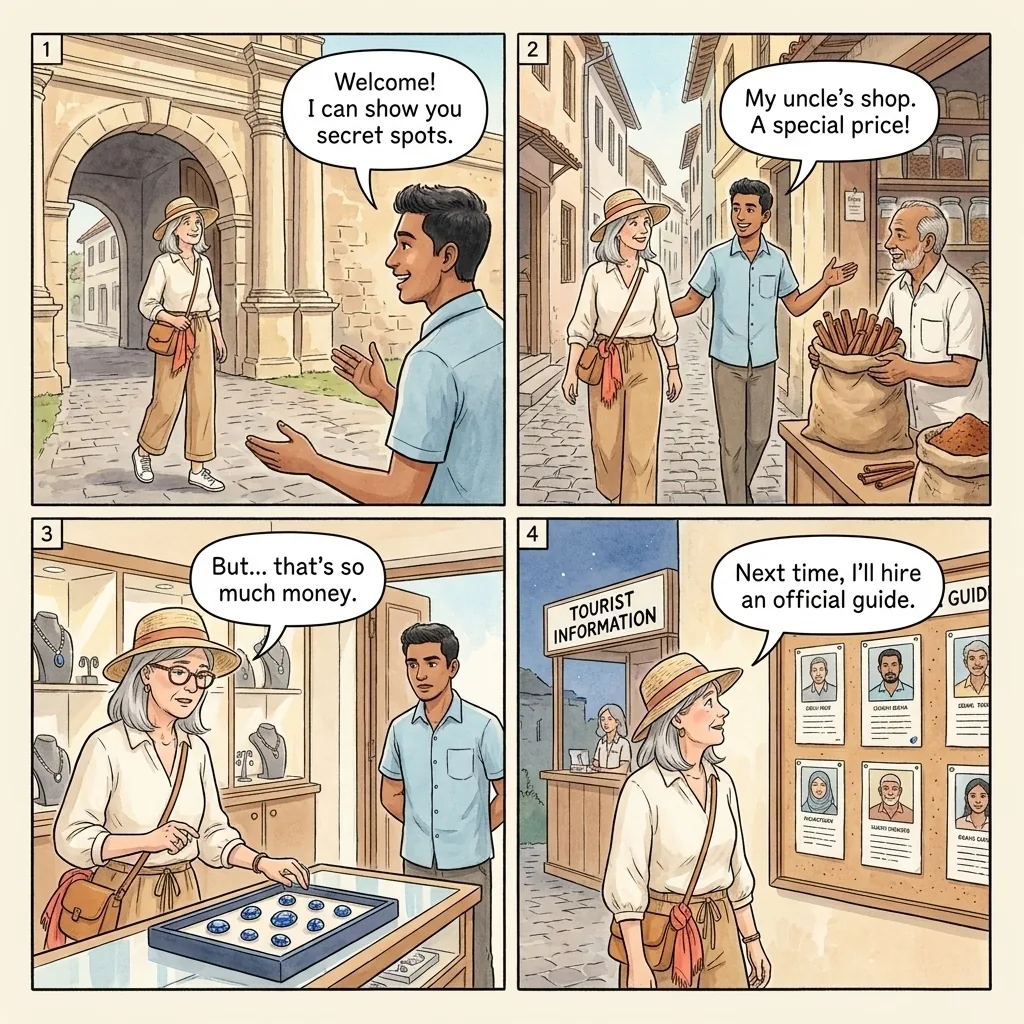
You walk through the main gate of Galle Fort on your first morning and a friendly young man in his late twenties falls into step beside you, asks where you're from, says he lives inside the fort, and offers to point out 'the bits the guidebooks don't tell you.'
He is good company. He shows you the Dutch Reformed Church courtyard, the colonial-era warehouse foundations under the lighthouse, a viewpoint over the cricket ground from the rampart corner that you would not have found on your own. He talks about his grandmother who was born inside the fort, about cinnamon trade history, about which restaurants serve the best koththu. After thirty minutes the tour drifts toward a small lane and the first 'must-see' stop appears.
It is his cousin's lace shop. Then his uncle's spice store, where you are pressed to buy LKR 4,000 worth of cardamom. Then a jewellery showroom set up exactly like the gem-museum operation in Scam #1, with a smooth salesman, free tea, and 'wholesale' sapphires. At each stop the friendly tone shifts subtly — declining to buy is treated as rudeness toward the family, the prices are quoted upward of double the going rate, and your guide hovers near the door so leaving feels confrontational.
When you finally walk out without buying anything, the script flips. The free tour is no longer free. He asks for a 'guide fee' of LKR 2,000–5,000 for the hour you spent together, claiming it was always understood. As travelers report across Reddit, the TripAdvisor Galle forum, and the Lonely Planet thorntree, this commission-tour pattern is the second-most-reported Galle Fort scam after the gem-shop lure, and the two operations frequently share the same network — your 'gem museum' guide and your 'helpful local' may work for the same fixers.
The cues that distinguish a commission tour from a chance friendly encounter are subtle but consistent. The approach happens within the first twenty metres of the main gate or the rampart steps where tourists predictably enter. The opener is a question about your country and a comment that the guide knows it well. The walk drifts inward toward Pedlar Street and the lanes around the lighthouse rather than outward to the ramparts. And the first 'must-see' shop appears at the thirty-minute mark, just long enough that walking away feels socially expensive. Recognising the rhythm in the first five minutes is the only reliable way to step out before the commission segment begins.
The fort is small enough to walk in two hours with a guidebook or Google Maps and you do not need a guide to find the lighthouse, the ramparts, or the Dutch Reformed Church. If a stranger offers an unsolicited walk, decline politely and keep moving — 'no thank you, I'm meeting someone' ends most attempts. If you genuinely want a guide, book through your hotel or the Galle Heritage Foundation office near the Maritime Museum, which provides licensed guides on a posted hourly rate. Never enter a shop your unsolicited companion 'happens' to know, and walk away without paying if a guide fee is suddenly demanded after a 'free' tour. If pressured or intimidated for payment, dial 119 (Sri Lanka Police) or 110 (Tourist Police).
Red Flags
- A stranger offers unsolicited help or a free tour inside the fort
- They know detailed history but have no official credentials
- The walk keeps ending at shops owned by their family or friends
- They become upset or demand payment if you don't buy anything
How to Avoid
- Explore Galle Fort independently using a guidebook or Google Maps.
- Politely but firmly decline unsolicited offers of assistance.
- If you want a guide, book one through your hotel or the Galle Heritage Foundation.
- The fort is small and walkable — you don't need a guide to find the key sites.
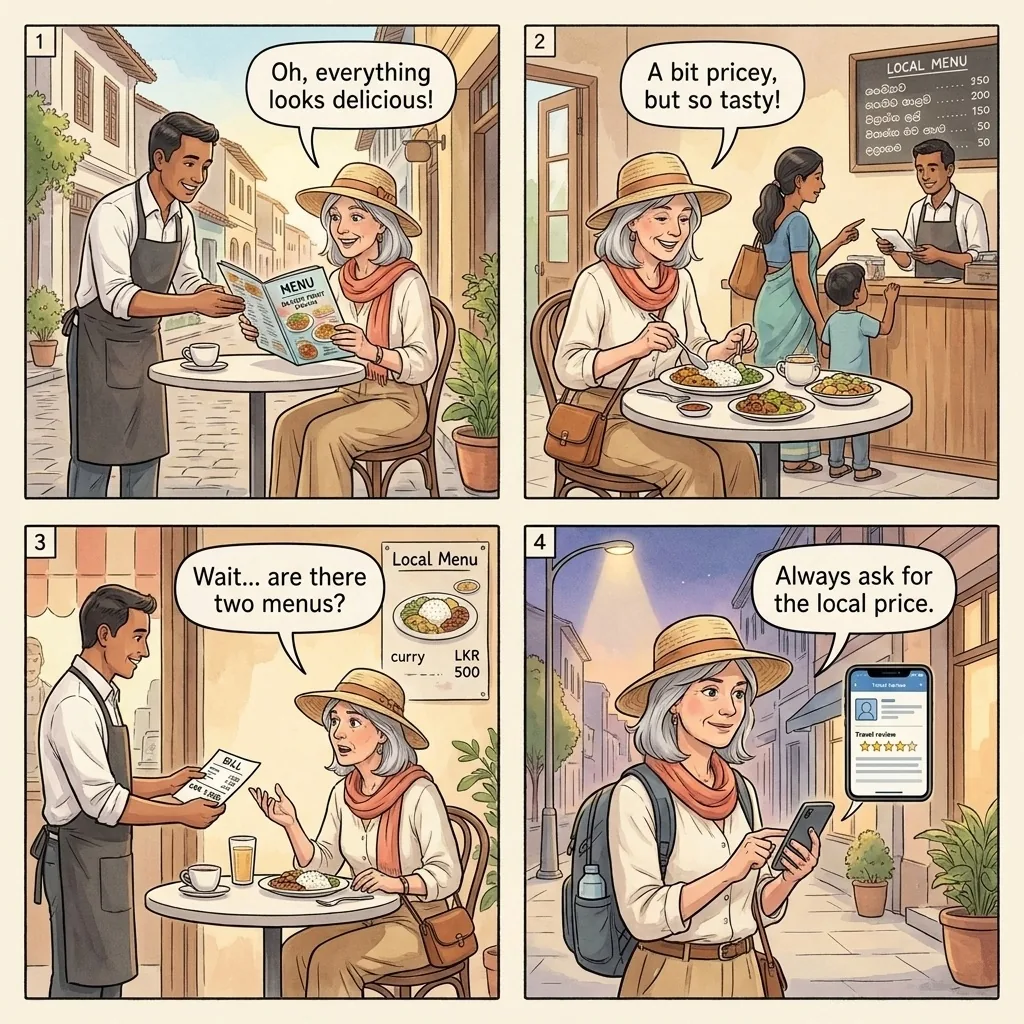
You sit down at a small Galle Fort restaurant on Pedlar Street for lunch, the waiter brings a printed menu in English, and the rice-and-curry plate that costs LKR 500 at the equivalent café outside the fort walls is listed at LKR 1,500.
You order, the food arrives, the bill arrives, and only at this point do you notice the laminated Sinhala-language menu on the counter near the kitchen. The local-language prices on it are not the same. The same rice-and-curry, the same plate, is LKR 500 there. Bottled water is LKR 80 instead of LKR 250. A king coconut is LKR 100 instead of LKR 350. The English menu in your hand is the tourist menu — a parallel version printed at three times the local price.
Dual pricing is endemic in the Galle Fort, Unawatuna, and Mirissa restaurant strips, and it operates at every margin: tuk-tuk fares, beach-chair rentals, snorkel-mask hire, even bottled water at the corner shop. Sri Lankan government policy does set differential foreigner pricing at official cultural sites — the Sigiriya rock fortress, the Anuradhapura ruins, the Polonnaruwa archaeological park — and that pricing is posted, regulated, and legitimate. Restaurants, cafés, retail shops, and beach vendors have no such mandate. The 'tourist menu' is opportunism, not policy.
The pattern is documented across Reddit, the TripAdvisor Galle forum, and Lonely Planet Sri Lanka guidance. The aggressive variants include menus with no prices at all (you are quoted verbally on the way out), bills with surprise 'service' charges of 10–15% on top of an already-inflated total, and unrequested side items — bread baskets, water bottles, condiment plates — added at LKR 200–500 each. The financial damage on any single meal is small, but the cumulative effect across a week in Galle is meaningful and the dynamic — paying double because you are visibly foreign — feels worse than the rupee total.
The structural giveaway is the absence of a price column. Restaurants that operate honestly print their prices next to every dish; restaurants that price by appearance bring out a menu of dish names only and quote prices verbally, or hand over a battered photocopy with prices that match nothing posted at the counter. Galle Fort eateries inside the colonial-era walls run the highest dual-pricing markups; cafés one or two streets outside the fort, around Esplanade and Wakwella Road, charge near-local prices for the same Sri Lankan fare. Walking ten minutes for lunch is the simplest single-step defence.
Look at the prices before you order, not after. If the menu has no prices listed, ask for a printed menu with prices or walk out. Cross-check a couple of common items — a rice-and-curry plate, a bottle of water, a king coconut — against what they cost at the supermarket or a local-only café outside the fort walls; anything more than 50% above is a tourist-menu markup. Refuse unrequested bread, water, or service charges added to the bill, and pay only for items you ordered. For high-value purchases or any felt-pressured transaction, pay by credit card so you have a chargeback path. Disputes over a bill that escalate can be reported to 119 (Sri Lanka Police) or 110 (Tourist Police).
Red Flags
- No menu is provided, or the menu has no prices listed
- Prices are quoted verbally and seem higher than what locals pay
- A different menu in Sinhala or Tamil exists for local customers
- The bill includes unexpected charges for bread, water, or service
How to Avoid
- Always ask for a menu with prices before ordering.
- Check Google Maps reviews for typical prices at restaurants in Galle.
- Eat where locals eat.
- Confirm the total bill before paying and question any unexpected charges.
🆘 What to Do If You Get Scammed
📋 File a Police Report
Go to the nearest Sri Lanka Police station. Call 119 (Police) or 110 (Emergency). Get an official crime report — you'll need this for insurance claims. You can also report online at police.lk.
💳 Cancel Your Cards
Call your bank immediately. Most have 24/7 numbers on the back of the card (keep a photo saved separately). Block any suspicious transactions before the thieves use your details.
🛂 Lost Passport?
Contact your nearest embassy or consulate. The US Embassy in Colombo is at 210 Galle Road, Colombo 03. For emergencies: +94 11-249-8500.
📱 Track Your Device
If your phone was stolen, use Find My (iPhone) or Find My Device (Android) from another device. Don't confront thieves yourself — share the location with police instead.
Frequently Asked Questions
You just read 6 scams in Galle. The full Travel Safety Series has 780+ more across 20+ countries.
Tokyo's Kabukichō ¥130,000 bar trap. Rome's gladiator photo extortion. Paris's gold-ring trick. Bali's ATM skimmer scams. Bangkok's grand-palace closure ruse. Every documented scam across 20+ destinations — with the exact scripts, red flags, and local-language phrases that shut each one down. Drawn from Reddit traveler reports, embassy advisories, and consumer-protection cases.
- 780+ documented scams across Tokyo, Rome, Paris, Bali, Bangkok, Rio & 100+ more cities
- 20+ countries covered, with country-by-country phrase cards for every destination
- Updated annually — buy once, re-download future editions free
- All titles $4.99 each on Amazon Kindle