
Key Takeaways
- The #1 reported scam is the Mahar Aung Myay Jade-Market Gemstone Fraud.
- 1 of 6 scams are rated high risk.
- Use official taxi ranks or local ride apps where available — always confirm the fare before departure.
- Never accept unsolicited offers from strangers near tourist sites in Mandalay.
⚡ Quick Safety Tips
- Keep phones and valuables in secure pockets when in crowded areas.
- Use only licensed taxis or app-based ride services.
- Book tours and tickets through verified operators with online reviews.
- Keep a copy of your passport separate from the original.
Jump to a Scam
The 6 Scams
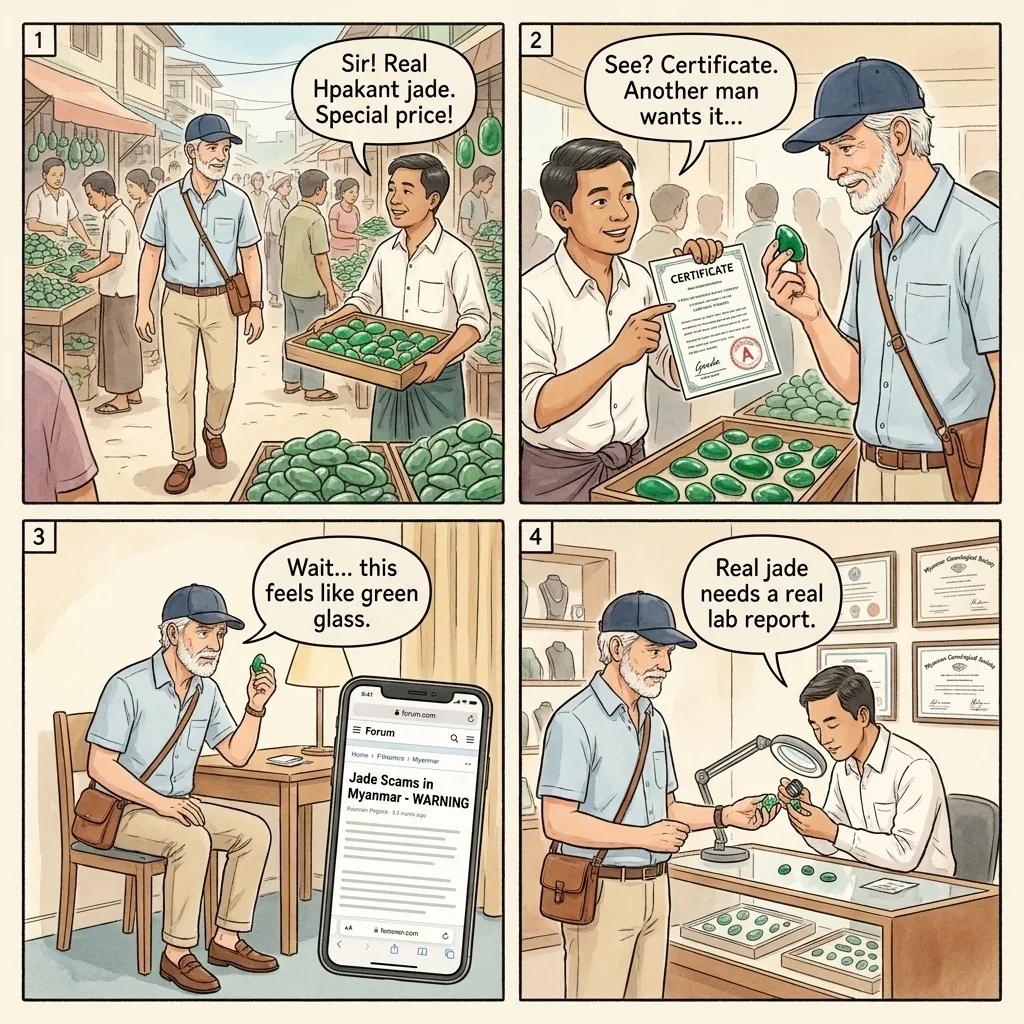
It's a Saturday morning at Mandalay's Mahar Aung Myay Jade Market between 86th and 87th Streets, you've come to look at the world's largest jade trading hub, and a vendor approaches with a tray of luminous green stones.
He claims they are Grade A Kachin State jadeite from the Hpakant mines, 'special price for foreigners' at 200,000 kyat (about USD $95). The stones are visually stunning — translucent, deep green, with what looks like a fine internal structure under the light. He produces a paper certificate of authenticity that looks vaguely official. He hints there's another buyer interested if you don't decide quickly. The price feels like a steal for what would retail at a Western jeweller for thousands.
Without gemological training, you have no way to tell that the 'jade' is dyed quartzite or polymer-impregnated low-grade jadeite or even synthetic glass. The 'certificate' is a printed sheet from any Mandalay print shop. Real Grade A natural jadeite is rare, expensive, and trades through certified dealers with documented gemological-lab paperwork (HKJSI, GIA, or Myanmar Gemological Society certificates with verifiable serial numbers). The Mahar Aung Myay market is genuinely real — it's the world's centre of jade trading — but it operates as a wholesale market for trained professionals, not as a retail venue for tourists. As travelers report across Reddit, the TripAdvisor Mandalay forum, the Lonely Planet Myanmar thorntree, and the U.K. Foreign Office Myanmar travel advice, multiple Reddit travelers have posted about losing hundreds of dollars to worthless 'jade' purchases at this market.
The downstream consequence beyond the financial loss: exporting unregistered gemstones from Myanmar is illegal under Myanmar's gemstone-export regulations, and customs at Yangon and Mandalay airports do confiscate undocumented stones at departure. Even if you bought genuine jade, taking it home requires a Myanmar Gem Enterprise (MGE) export licence and documented purchase paperwork. The market vendors don't provide that paperwork.
The structural defences are concrete. Treat the Mahar Aung Myay market as a sightseeing destination, not a shopping destination — observe the trading, take photos of the dealers, but do not buy anything you can't independently verify. For genuine jade souvenirs, buy small inexpensive pieces (under USD $20) at the official Myanmar Gem Enterprise (MGE) outlets where the export paperwork is included with purchase. Decline 'special foreigner discount' framings, paper certificates, and 'another buyer interested' urgency — all three are calibrated tactics. Anyone serious about a meaningful jade purchase should bring a trained gemologist or buy from a Hong Kong / Bangkok-based certified dealer with documented HKJSI or GIA paperwork.
Treat Mandalay's Mahar Aung Myay Jade Market as a sightseeing destination, not a retail shopping venue — the market operates as a wholesale hub for trained professionals, not for tourists. Do NOT buy 'jade' from market vendors without trained gemological assessment; the 'certificates' provided are printed sheets without verifiable issuer. For genuine jade souvenirs, buy small inexpensive pieces (under USD $20) at official Myanmar Gem Enterprise (MGE) outlets where the export paperwork is included. Exporting unregistered gemstones from Myanmar is illegal and stones are routinely confiscated at airports. Anyone serious about a meaningful jade purchase should buy from a Hong Kong / Bangkok-based certified dealer with documented HKJSI or GIA paperwork rather than at any Myanmar market. Emergency: 199 (Myanmar Police) or 191 (Ambulance); the U.S. Embassy in Yangon is at +95 1 753 6509.
Red Flags
- Vendor claims stones are 'rare' or offers a 'special foreigner discount'
- Paper certificate of authenticity with no verifiable issuer
- Pressure to buy quickly because 'another buyer is interested'
- Stone price is suspiciously low for claimed quality
- Vendor discourages you from getting an independent appraisal
How to Avoid
- Never buy gemstones at a market unless you are a trained gemologist or have one with you.
- If you want jade souvenirs, buy small inexpensive pieces as decorative items rather than 'investment' stones.
- Only buy from government-licensed Myanmar Gem Enterprise outlets with proper documentation.
- Be aware that exporting unregistered gemstones from Myanmar is illegal and can result in confiscation at the airport.
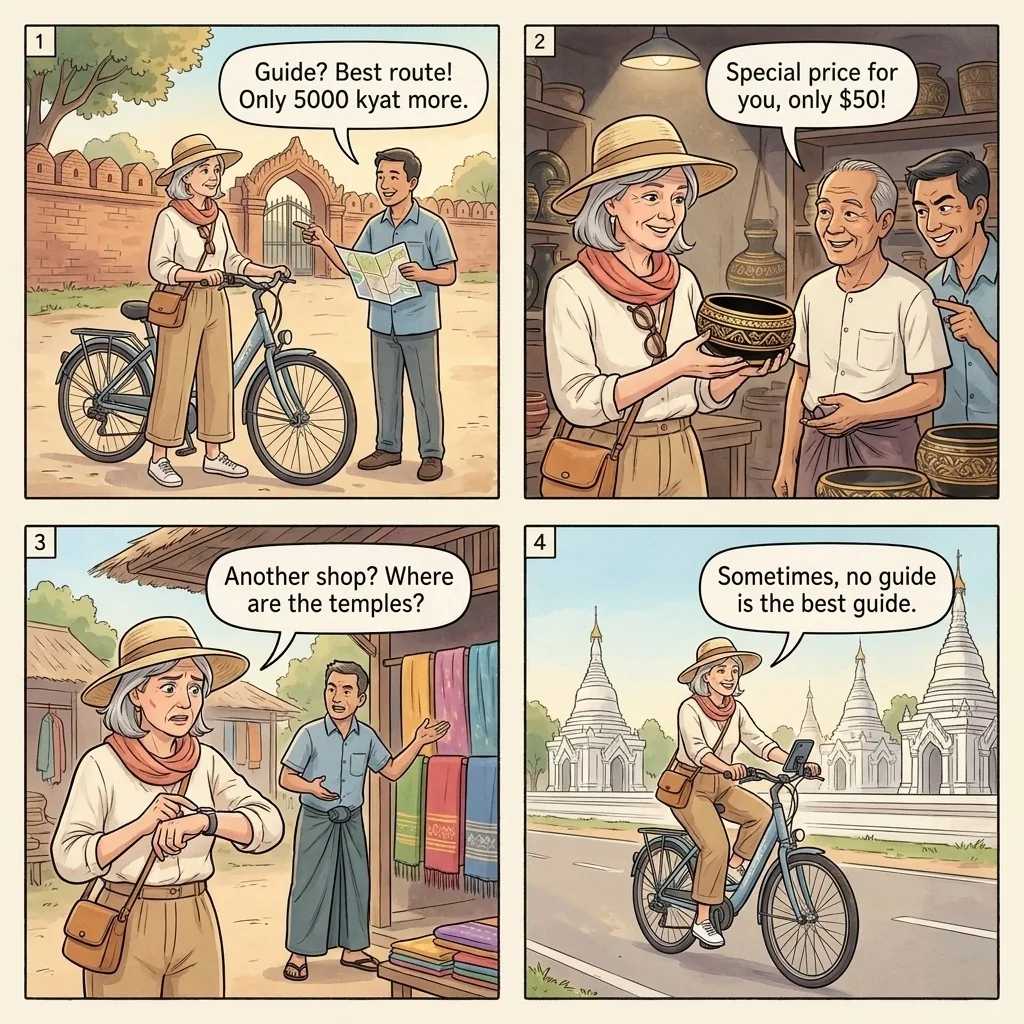
It's a Wednesday morning, you've rented an e-bike from a shop near Mandalay Palace for 8,000 kyat per day, and the rental owner enthusiastically suggests pairing it with a 'guide' for 5,000 extra kyat to show you the best temples and craft workshops.
The combined cost — 13,000 kyat (about USD $6) for a full day — feels like a great deal. The guide is friendly, knowledgeable, and starts with a real temple visit at Kuthodaw Pagoda. Then the route shifts. The next stop is a lacquerware workshop in Sagaing where the owner offers tea, the next is a marionette workshop on 62nd Street, the next is a silk-weaving house. Each stop the guide knows the owner by name, prices are quoted at three to four times legitimate retail, and he visibly waits for you to buy something before moving on. The actual temple visits get rushed to fifteen minutes each. By the end of the day you've visited four shops and three temples, with the shops occupying the majority of the time.
The Mandalay e-bike guide commission economy is documented across Reddit, the TripAdvisor Mandalay forum, the Lonely Planet Myanmar thorntree, and Myanmar Tourism Federation consumer guidance. The mechanism: the rental shop's recommended guide earns 20–35% commission on any tourist purchase at the shop circuit. Multiple travelers report identical commission-route itineraries from different guides — same lacquerware workshop, same marionette shop, same silk-weaving house — strongly suggesting a coordinated kickback network rather than individual guide preferences.
The legitimate Mandalay self-guided experience is genuinely worthwhile and doesn't require a guide. The Mandalay Palace, Kuthodaw Pagoda, Atumashi Monastery, Shwenandaw Monastery, and Mandalay Hill are all walkable or rideable to with offline maps. The U Bein Bridge sunset at Amarapura, the Inwa ruins by horse-cart, and the Sagaing Hill temples are easy day-trips by e-bike or shared taxi at fair prices. None of them require a guide who steers you toward commission shops.
The structural defences are concrete. Rent the e-bike WITHOUT a guide and navigate using Google Maps offline (Maps.me also works offline). Set clear expectations if you do hire a guide: 'temples only, no shopping stops' in writing before you start. If a guide steers you to a shop, you are under no obligation to enter or buy — wait outside, or simply ride on. Hire guides through your hotel concierge rather than through the e-bike rental shop; hotel-recommended guides are paid by the hotel rather than by commission. Set a small fixed-tip rate before the day (10,000 kyat / about USD $5) so the guide knows the upside is the tip, not commission.
Rent Mandalay e-bikes WITHOUT a guide and navigate using Google Maps offline or Maps.me — Mandalay's main attractions are easy to find independently. If you do want a guide, hire through your hotel concierge (paid by the hotel, not by shop commissions) rather than through the e-bike rental shop's 'recommendation.' Set clear expectations in writing: 'temples only, no shopping stops' before you start. If a guide steers you to a craft workshop, you have no obligation to enter or buy — wait outside or ride on. Cap your guide tip at a fixed rate (10,000 kyat / USD $5) so the guide's upside is the tip, not undisclosed commissions on your purchases. Emergency: 199 (Myanmar Police).
Red Flags
- Guide is 'recommended' by the e-bike rental shop rather than independently sourced
- Itinerary includes multiple shopping stops between temple visits
- Guide becomes insistent or upset when you skip a shop or leave quickly
- Shops seem to know the guide by name and offer you 'special prices'
- Temple visits are rushed while shopping stops last 30+ minutes
How to Avoid
- Rent the e-bike without a guide and navigate using Maps.me or Google Maps offline.
- If you want a guide, hire one independently through your hotel rather than through the rental shop.
- Set clear expectations upfront: tell the guide you want temples only, no shopping stops.
- If the guide steers you to a shop, you are under no obligation to enter or buy.
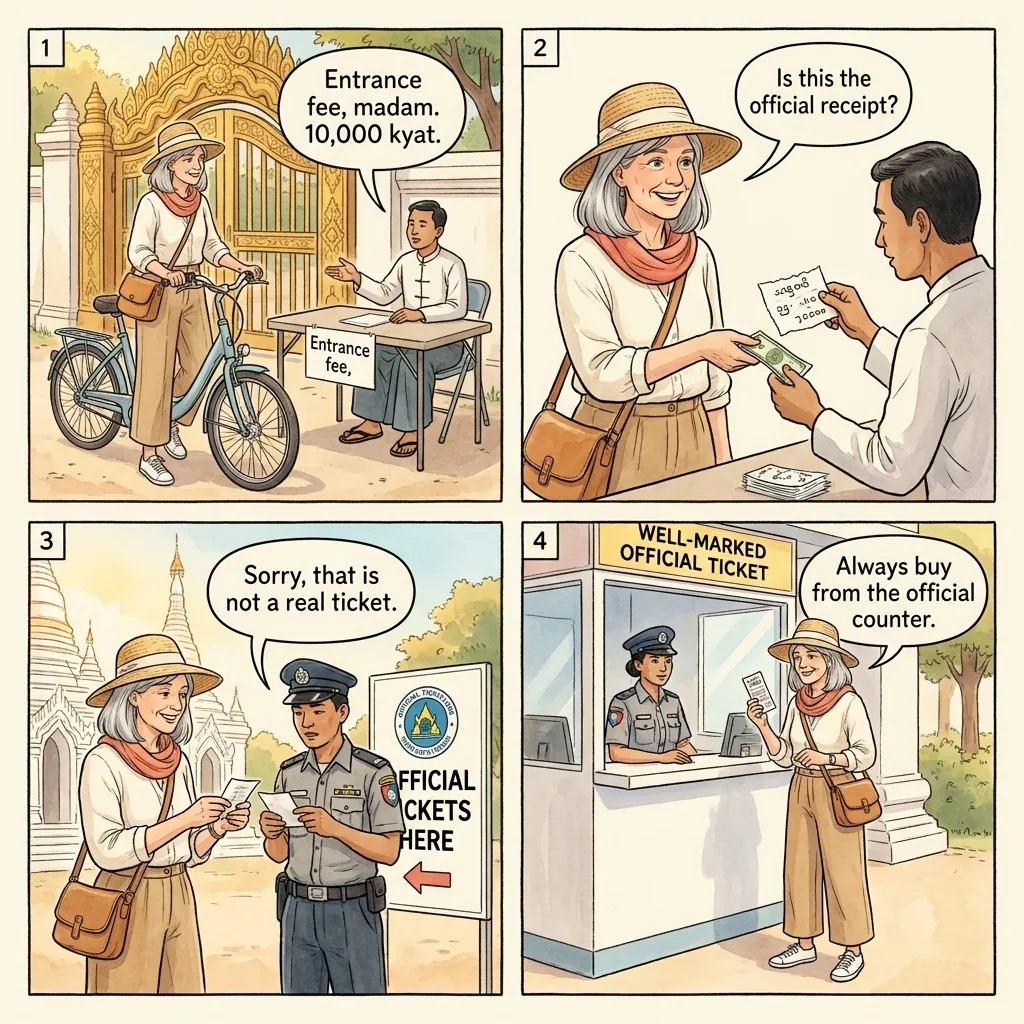
It's an afternoon at Atumashi Monastery on your e-bike temple tour, and a man sitting at a folding table near the entrance asks for a 10,000-kyat 'entrance fee,' handing you a handwritten receipt and gesturing toward the temple gate.
The receipt is a torn slip of paper with a hand-scrawled number; there's no temple-authority logo, no printed denomination, no signature. The collector wears a simple shirt and pants, no uniform, no Ministry of Culture or Department of Archaeology badge. You pay because the framing feels official-ish and the alternative is an awkward conversation. He pockets the cash, hands you the slip, and waves you through the gate.
The legitimate Mandalay archaeological zone fee is 10,000 kyat (about USD $5) and is purchased ONCE at the official Department of Archaeology counter at Mandalay Palace's east gate or at a designated MoC ticket office. The same ticket covers multiple sites — Mandalay Palace, Atumashi, Shwenandaw, Kuthodaw — and is a printed bilingual ticket with a hologram, a date stamp, and a serial number. The man at Atumashi's folding table is collecting cash that goes nowhere except his pocket. As travelers report across Reddit, the TripAdvisor Mandalay forum, and the Lonely Planet Myanmar thorntree, the fake-fee collector pattern is documented at Atumashi, Kuthodaw, and several Mandalay Hill ascents — typically targeting tourists arriving by e-bike without a guide.
The mechanism is structural. The legitimate zone-fee collection happens at one designated location at the start of the tour; the fake-fee collectors set up at peripheral temple entrances where solo tourists arrive by themselves. The handwritten receipt is the tell — real Department of Archaeology tickets are printed, dated, and serialised. The tourists who paid the legitimate zone fee at the start of the day get charged again at the temple by the fake collector, doubling their cost.
The structural defences are concrete. Buy the official Mandalay archaeological zone ticket at the Department of Archaeology counter at Mandalay Palace's east gate before visiting any temples — the ticket covers the major sites and is your defence against secondary fake collectors. Keep the official ticket visible in your bag; show it confidently if anyone asks for a fee at a peripheral temple ('I have the zone ticket — see?'). Refuse to pay anyone at a folding table or chair without proper signage and uniform. If a fake collector insists, walk past or visibly photograph their setup — the operators rarely escalate when documentation begins.
Buy the official Mandalay archaeological zone ticket (10,000 kyat) at the Department of Archaeology counter at Mandalay Palace's east gate BEFORE visiting any temples — the ticket covers Mandalay Palace, Atumashi, Shwenandaw, and Kuthodaw on a single printed bilingual ticket with hologram, date stamp, and serial number. Keep the official ticket visible; show it confidently if anyone at a peripheral temple asks for an additional fee. Refuse to pay anyone at a folding table or chair without proper signage, uniform, or printed bilingual tickets. If a fake collector insists, walk past or photograph their setup; operators rarely escalate when documentation begins. Ask your hotel to confirm which sites legitimately require separate fees beyond the zone ticket. Emergency: 199 (Myanmar Police).
Red Flags
- Handwritten receipt rather than a printed official ticket
- Collection point is a folding table or chair with no signage
- Collector is not in uniform and cannot show official identification
- Fee is demanded at individual temples when you have already paid the zone fee
How to Avoid
- Purchase the official Mandalay archaeological zone ticket (10,000 kyat) at a legitimate counter — it covers Mandalay Palace, Atumashi, Shwenandaw, and Kuthodaw.
- Keep your zone ticket visible and show it confidently if anyone asks for an additional fee.
- Refuse to pay anyone at a makeshift collection point — walk past firmly.
- Ask your hotel to confirm which sites require separate fees, if any.
Like what you're reading? Get a full Mandalay itinerary with safety tips built in.
Browse travel-safety books →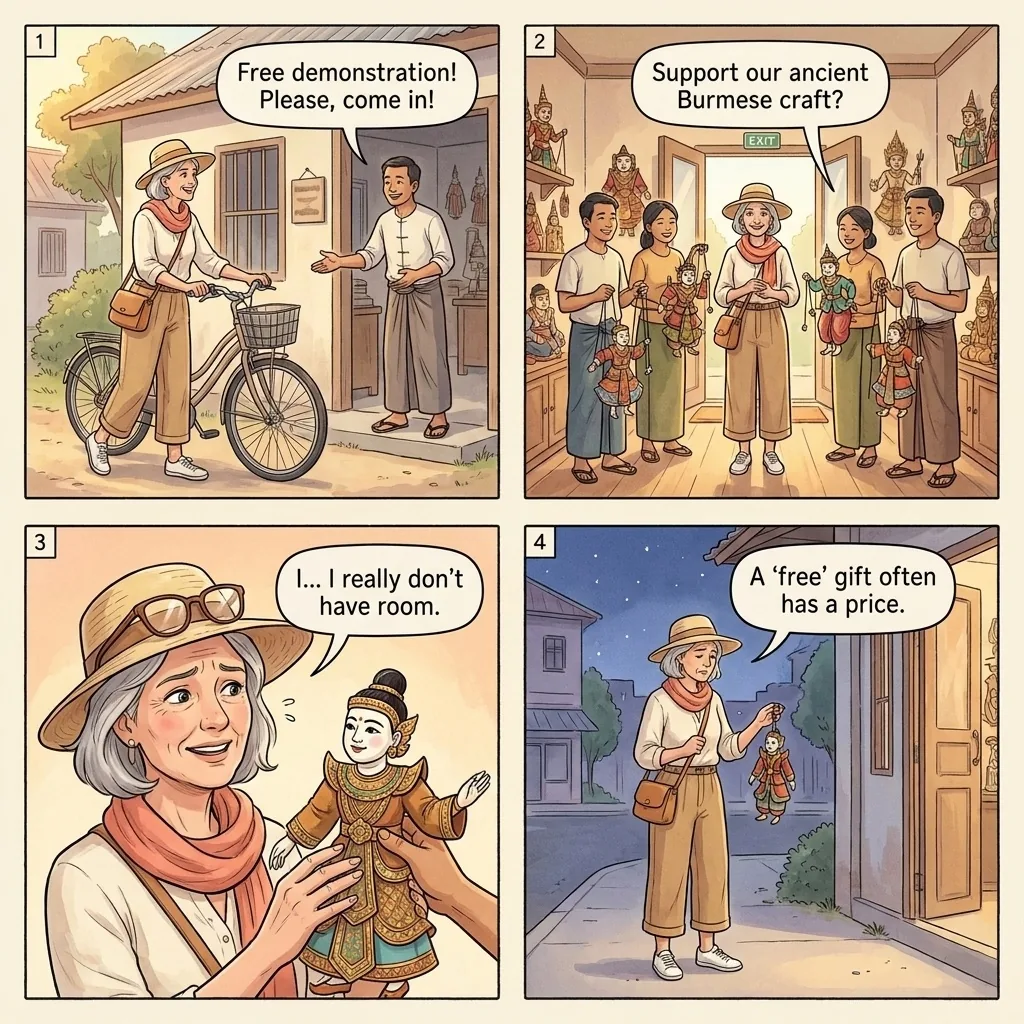
It's an afternoon on your Mandalay e-bike loop, your guide stops at a traditional marionette workshop on 62nd Street, and the craftsman invites you in for a 'free demonstration.'
The demonstration is genuinely charming. A bearded craftsman performs a fifteen-minute show with hand-strung wooden marionettes, explains the centuries-old Burmese marionette tradition (yokthe pwe), demonstrates the operating mechanics of three different character puppets, and lets you try operating one yourself. It's the kind of small cultural experience that justifies the day's e-bike rental. Then the mood shifts.
You're escorted from the demonstration room to an adjacent showroom where dozens of finished marionettes are displayed at 30,000 to 200,000 kyat each (about USD $14–95). Three or four staff members appear and form a loose semi-circle around you, explaining the hours of work that go into each piece, the natural pigments, the family-craft history, the importance of supporting Burmese cultural heritage. Walking out without buying becomes socially excruciating. The exit path passes through the staff cohort.
The Mandalay marionette workshop pressure sale is documented across Reddit, the TripAdvisor Mandalay forum, the Lonely Planet Myanmar thorntree, and Myanmar Tourism Federation guidance. The mechanism uses three structural failures: the 'free demonstration' creates an implicit social debt, the post-demonstration showroom transition is calibrated to capitalise on that debt before the customer can exit, and the staff cohort presence makes the exit feel transactional rather than free. The pricing reflects 2–4× legitimate retail at the Zegyo Market or the official Myanmar marionette-craft cooperatives.
The legitimate Mandalay marionette tradition is real and worth seeing. Yokthe pwe is an authentic Burmese cultural form with documented history and active practitioners. The pressure-sale workshops on 62nd and 63rd Streets are real artisan operations — the demonstrations are genuine — but the retail pricing is calibrated to extract maximum revenue from tourists who feel obliged after the show. Decide your puppet budget BEFORE entering: small souvenir puppets at Zegyo Market run 5,000–10,000 kyat (USD $2–5) without the demonstration theatre.
Decide your marionette-souvenir budget BEFORE entering any 62nd or 63rd Street workshop — small puppets at Zegyo Market run 5,000–10,000 kyat (USD $2–5) without the demonstration pressure. Enjoy the demonstration but feel no obligation to buy; say 'beautiful work, but I am just looking, thank you' and walk toward the exit confidently. The demonstration is advertising, not a favour. If you want a marionette, compare prices at Zegyo Market FIRST where the same pieces sell at 1/3 the workshop price without the showroom pressure. The quality at Zegyo is comparable; the workshop's premium is the demonstration theatre, not better craft. Emergency: 199 (Myanmar Police).
Red Flags
- Free demonstration that transitions directly into a retail showroom
- Multiple staff members surround you after the demonstration ends
- Emotional pitch about supporting traditional craftspeople
- No clear path to exit the showroom without passing through sales staff
How to Avoid
- Enjoy the demonstration but decide your budget before entering — small puppets for 5,000-10,000 kyat are fair souvenirs.
- Say 'beautiful work, but I am just looking' and walk toward the door confidently.
- Do not feel obligated to buy — the demonstration is advertising, not a favor.
- If you want a puppet, compare prices at Zegyo Market first where they sell for less without the theater.
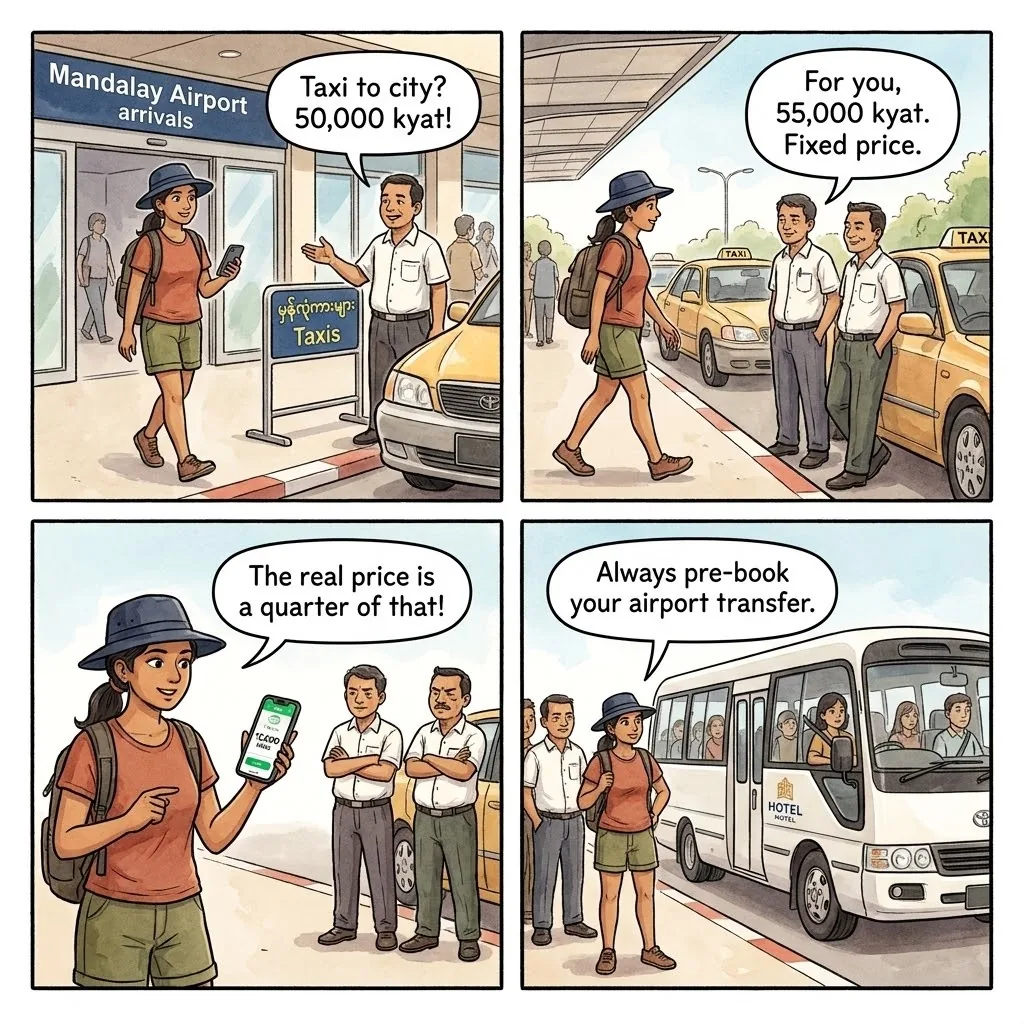
It's a Tuesday afternoon at Mandalay International Airport (MDL), you've cleared customs and walked outside with a small bag, and the taxi drivers at the arrivals exit immediately quote 40,000–60,000 kyat (about USD $19–28) for the ride into central Mandalay city, 35 km away.
The driver in front of you names 50,000 kyat. You walk past him to the next driver. Same quote. Walk past five more drivers — same quote, sometimes 10% higher to punish you for shopping. The drivers see you trying to negotiate and visibly look at each other; the message is clear that they're operating a cartel and the floor price is set. The actual legitimate fare for the airport-to-Mandalay-city run is 10,000–15,000 kyat (USD $5–7) on Grab or via a hotel pickup, so you've been quoted three to five times the fair rate.
The Mandalay airport taxi cartel gouge is documented across Reddit, the TripAdvisor Mandalay forum, the Lonely Planet Myanmar thorntree, and the U.K. Foreign Office Myanmar travel advice. The mechanism uses three structural failures: the airport sits 35 km from central Mandalay (too far to walk, no public transit), Grab coverage is genuinely spotty from MDL because the cartel operators report rideshare pickups to airport security to disrupt them, and all drivers at the stand quote the same inflated price with no inter-driver competition. The cartel-like pricing has been documented for years.
The structural defences are concrete. Pre-arrange airport pickup through your hotel BEFORE arriving — most Mandalay accommodations include free or low-cost transfers from MDL at the legitimate 12,000–20,000 kyat range. If you must take a kerbside taxi, walk past the first row of cartel drivers to the road junction approximately 200 metres from the terminal where independent drivers (who didn't pay the cartel-rank fee) charge 15,000–20,000 kyat. Try booking Grab from inside the terminal before walking out — even spotty coverage gives you a price benchmark for negotiation. Share a taxi with other arriving foreigners by chatting in the customs queue or at the baggage carousel — splitting a 40,000 kyat fare two or three ways neutralises the cartel premium.
A useful alternative: the airport shuttle bus operated by some Mandalay hotels and the public airport-bus service runs a flat 4,000 kyat per person between MDL and central Mandalay several times per day. The schedule is posted at the terminal information desk; the service is irregular but well-priced.
Pre-arrange MDL airport pickup through your Mandalay hotel BEFORE arriving — most accommodations include free or low-cost transfers at the fair 12,000–20,000 kyat range, removing the cartel from the equation entirely. If you must take a kerbside taxi, walk past the first row of drivers to the road junction 200 metres from the terminal where independent drivers charge 15,000–20,000 kyat (versus 40–60,000 at the cartel rank). Book Grab from INSIDE the terminal before walking out for a price benchmark. Share a taxi with other arriving foreigners (chat in the customs queue) to split the cartel fare. Check the public airport-bus schedule at the terminal info desk for a 4,000-kyat-per-person option. Emergency: 199 (Myanmar Police).
Red Flags
- All drivers at the stand quote the same inflated price with no variation
- Driver refuses to use a meter or claims there is a fixed airport rate
- No official taxi counter or rate board visible at the terminal
- Driver discourages you from calling or waiting for a ride-hailing app
How to Avoid
- Arrange airport pickup through your hotel before arriving — most hotels offer transfers at fair rates.
- Try booking a Grab car from inside the terminal; even if coverage is spotty, it sets a price benchmark.
- Walk past the first row of taxis to the road where independent drivers charge less.
- Share a taxi with other arriving passengers to split the cost.
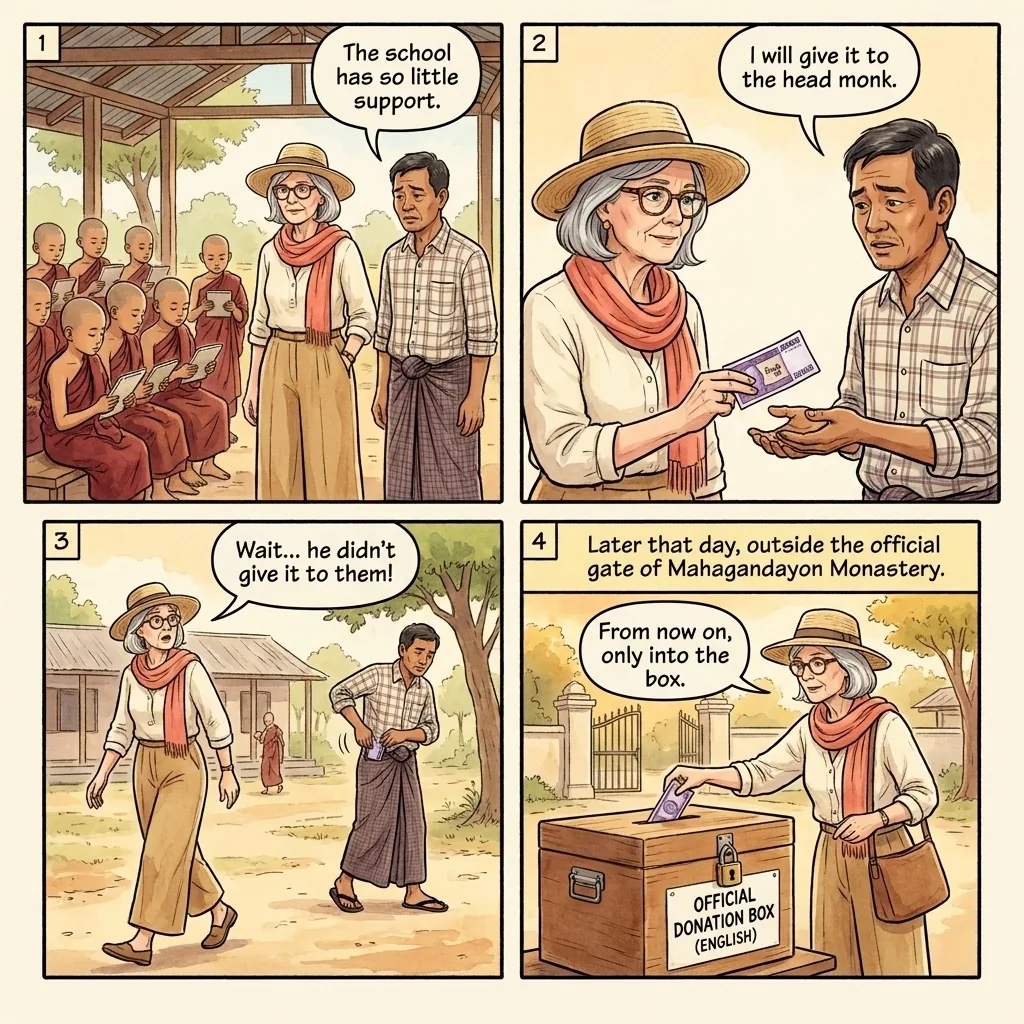
It's an afternoon at a small monastic school near Amarapura on your e-bike loop, you've watched a small group of young novice monks studying in simple classrooms, and your guide explains the school is underfunded.
The guide invites you to make a donation, suggesting 20,000 kyat (about USD $9). He says he will deliver the cash personally to the senior monk on your behalf so you don't have to interrupt the lesson. You hand him the money in good faith — the scene is genuinely moving, the children are real, the school is real. The cash never reaches the school. The guide pockets it entirely, using the monks' poverty as a prop in his own commission economy.
The Mandalay-Amarapura fake monastic donation pattern is documented across Reddit, the TripAdvisor Mandalay forum, and the Lonely Planet Myanmar thorntree. Some travelers have returned to the same schools and discovered that regular visitors' donations are routinely intercepted by unofficial guides — the monks themselves receive nothing. The mechanism uses three structural failures: the genuinely moving setting (real monks, real school, real poverty) creates emotional pressure to donate, the guide's offer to 'deliver personally' bypasses the legitimate donation channel, and the cash transaction with no receipt leaves no audit trail.
The legitimate Mandalay-area monastic donation channels are documented and direct. Every legitimate Buddhist monastery in Myanmar maintains a donation box (often a wooden box near the main shrine) where 100% of the deposit reaches the temple. Direct donations to the senior abbot (sayadaw) or designated monastic administrator at the main hall are also legitimate; the monk will issue a hand-written receipt or simply place the offering on the donation table. The Sangha (the official Myanmar Buddhist monastic body) discourages indirect donations through guides specifically because of the documented interception problem.
The structural defences are concrete. If you want to support a Mandalay-area monastic school, donate DIRECTLY by placing money in the official donation box at the main shrine, OR hand the offering directly to the senior monk (sayadaw) at the main hall. Never give cash to a guide to deliver on your behalf. As a more impactful alternative, donate supplies (school notebooks, pens, rice, soap, candles) rather than cash — supplies are much harder to intercept than money and reach the children directly. Visit monastic schools independently or through a reputable hotel-recommended tour rather than a freelance guide whose incentives align with cash interception.
If you want to support a Mandalay-area monastic school, donate DIRECTLY: place money in the official donation box at the main shrine, OR hand the offering directly to the senior monk (sayadaw) at the main hall. NEVER give cash to a guide to deliver on your behalf — the documented pattern is interception, not delivery. As a more impactful alternative, donate supplies (school notebooks, pens, rice, soap, candles) rather than cash — supplies are much harder to intercept than money and reach the children directly. Visit monastic schools independently or through a reputable hotel-recommended tour, not via a freelance guide. Decline emotional 'they desperately need funds' pitches that route through a third party. Emergency: 199 (Myanmar Police).
Red Flags
- Guide collects the donation rather than you giving it directly to a monk or school administrator
- No receipt or official donation record provided
- Guide takes you to a specific school rather than letting you choose
- Emotional pitch about how desperately the school needs funds
How to Avoid
- If you want to donate, give directly to a senior monk or place money in the official donation box at the monastery.
- Never give cash to a guide to deliver on your behalf.
- Donate supplies like notebooks, pens, or rice rather than cash — harder to intercept.
- Visit monastic schools independently or through a reputable tour company, not a freelance guide.
🆘 What to Do If You Get Scammed
📋 File a Police Report
Go to the nearest Myanmar Police Force station. Call 199 (Police) or 191 (Emergency). Get an official crime report — you'll need this for insurance claims. You can also report online at moi.gov.mm.
💳 Cancel Your Cards
Call your bank immediately. Most have 24/7 numbers on the back of the card (keep a photo saved separately). Block any suspicious transactions before the thieves use your details.
🛂 Lost Passport?
Contact your nearest embassy or consulate. The US Embassy in Yangon is at 110 University Avenue, Kamayut Township, Yangon. For emergencies: +95 1-753-6509.
📱 Track Your Device
If your phone was stolen, use Find My (iPhone) or Find My Device (Android) from another device. Don't confront thieves yourself — share the location with police instead.
Frequently Asked Questions
You just read 6 scams in Mandalay. The full Travel Safety Series has 780+ more across 20+ countries.
Tokyo's Kabukichō ¥130,000 bar trap. Rome's gladiator photo extortion. Paris's gold-ring trick. Bali's ATM skimmer scams. Bangkok's grand-palace closure ruse. Every documented scam across 20+ destinations — with the exact scripts, red flags, and local-language phrases that shut each one down. Drawn from Reddit traveler reports, embassy advisories, and consumer-protection cases.
- 780+ documented scams across Tokyo, Rome, Paris, Bali, Bangkok, Rio & 100+ more cities
- 20+ countries covered, with country-by-country phrase cards for every destination
- Updated annually — buy once, re-download future editions free
- All titles $4.99 each on Amazon Kindle