
Key Takeaways
- The #1 reported scam is the Bogyoke Market Money-Changer Team Switch.
- 1 of 5 scams are rated high risk.
- Use official taxi ranks or local ride apps where available — always confirm the fare before departure.
- Never accept unsolicited offers from strangers near tourist sites in Yangon.
⚡ Quick Safety Tips
- Keep phones and valuables in secure pockets when in crowded areas.
- Use only licensed taxis or app-based ride services.
- Book tours and tickets through verified operators with online reviews.
- Keep a copy of your passport separate from the original.
Jump to a Scam
The 5 Scams
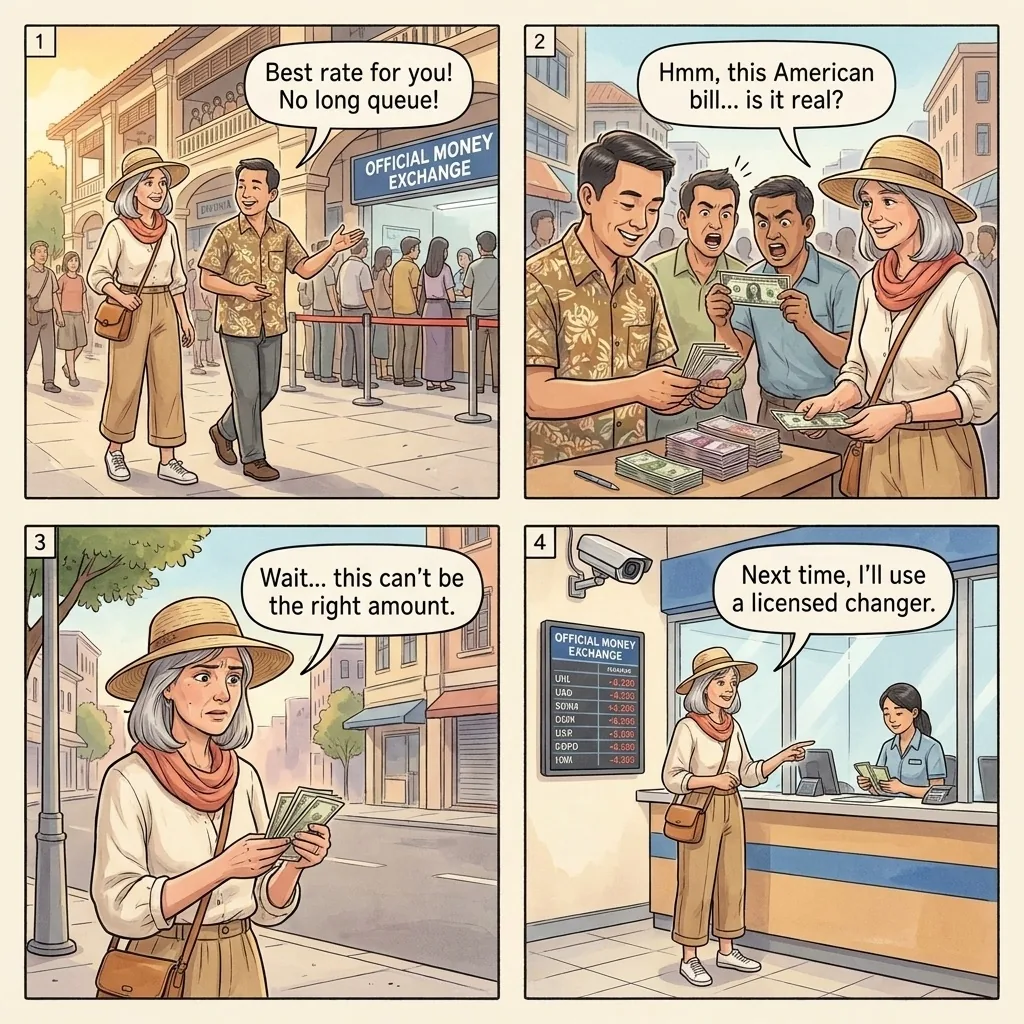
It's your first morning in Yangon, you've walked from your hotel toward Bogyoke Aung San Market to change US$200 into Myanmar kyat, and a friendly man on the street outside the market entrance offers you a rate slightly better than the licensed shops inside.
You agree because the rate is good and the queue inside the market is long. You hand him the $200. He starts counting kyat notes — slowly, deliberately, with the bills fanned out so you can see the count. Midway through he calls over a colleague to 'verify' that your USD bill isn't counterfeit. A second man arrives. A third appears. Suddenly three pairs of hands are moving over the same stack of kyat, the verification of your $200 is happening loudly to the side, and the conversation is moving fast in a language you don't speak.
In the controlled chaos, your kyat is short by roughly 50%. You walk away with about K420,000 instead of the K840,000 you were owed (at then-rates). The mechanism is the team switch — one operator counts out the full amount, a confederate creates the verification distraction, a third pockets a portion of the stack while the count appears to continue. By the time you separately recount in your hotel, you are missing $100 worth of kyat and the operators have dispersed. As travelers report across Reddit, the TripAdvisor Yangon forum, the Lonely Planet Myanmar thorntree, the U.K. Foreign Office Myanmar travel advice, and a Myanmar Times investigative series, the Bogyoke Market money-changer team switch is the highest-dollar Yangon street scam.
The legitimate Yangon currency-exchange ecosystem is reasonably well-developed. The licensed money changers inside Bogyoke Market — X-One Money Changer, Forever, KBZ Bank's exchange counter — operate at posted rates with receipts. The CB Bank, KBZ Bank, and AYA Bank ATMs in central Yangon dispense kyat at near-interbank rates with a small foreign-card fee. Hotel money changers run slightly worse rates but are reliably honest. The street operators outside the market are the entire problem.
The structural defences are concrete. Never exchange currency on the street, no matter how good the rate. Always exchange inside a licensed shop with a posted rate board and a receipt. Count the kyat back yourself, in front of the changer, before handing over any USD. Never let your USD and the kyat both be out of your hands at the same time. If a 'verification' or a 'colleague check' begins during the count, take your money back immediately and walk out — that is the team-switch tell.
Exchange currency only at licensed shops inside Bogyoke Aung San Market (X-One Money Changer, Forever) or at bank counters (KBZ, CB Bank, AYA) with posted rates and receipts. Decline all street offers no matter how attractive the rate. Count the kyat back yourself in front of the changer before handing over your USD; never let both currencies be out of your hands at the same time. If a 'verification' or 'colleague check' starts during the count, take your money back and walk out — that is the team-switch tell. Use ATMs inside bank lobbies for the most reliable cash access. Pay larger purchases by card where accepted to minimise the cash you need. Emergency: 199 (Police) or 192 (fire/ambulance); the U.S. Embassy in Yangon is at +95 1 753 6509.
Red Flags
- Money changer operates from the street rather than an established shop
- Multiple people suddenly involved in counting or verifying your bills
- Rate offered is noticeably better than official shops inside the market
- Aggressive or hurried atmosphere during the transaction
- Changer insists on putting a rubber band around the notes before you count
How to Avoid
- Only exchange money at established shops inside Bogyoke Market like X-one Money Changer.
- Count your kyat carefully before handing over your dollars — never let both be out of your hands at once.
- Use ATMs inside bank lobbies for the best rates with no human trickery.
- If anyone calls over a second person during your exchange, take your money and walk away.
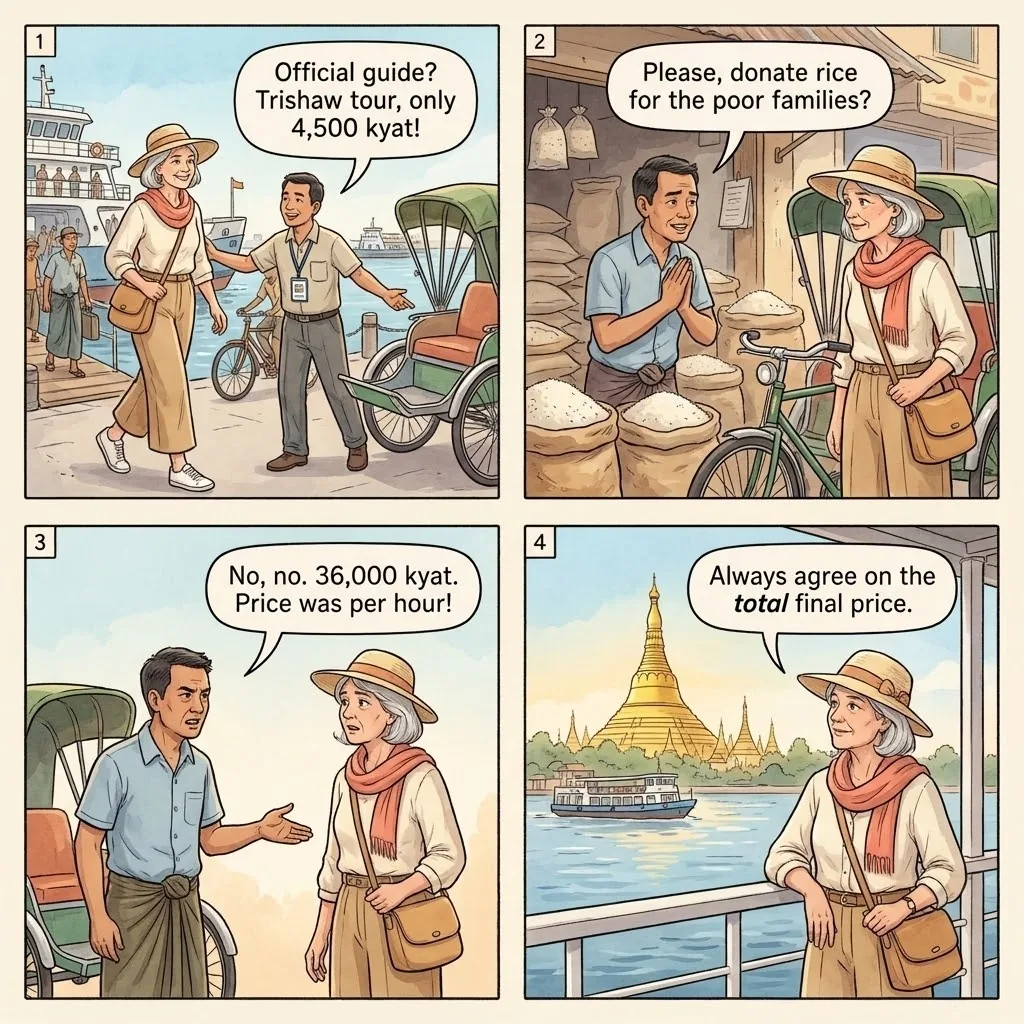
You buy the K4,000 foreigner ferry ticket from Pansodan Ferry Terminal across the Yangon River to Dala Township — a real and well-priced cultural day trip — and step off the boat onto the Dala disembarkation pier into a swarm of trishaw drivers and 'guides.'
A man with a hand-painted lanyard says foreigners need an 'official guide' to visit Dala. He says he'll arrange a trishaw tour for K4,500 — fair price, three hours, monasteries and rice paddies. You agree. He flags a trishaw, you climb in, the rider pedals through the dust toward a small monastery. Three stops later, the 'tour' arrives at a rice shop where the guide-and-rider tag team encourages you to 'donate rice for the poor village families' — bags priced at K40,000 each, twenty times the supermarket rate. Then the trishaw rider demands K36,000 instead of the K4,500 you agreed, claiming the original price was 'per stop' or 'per hour' or some confused new framing.
The Dala Ferry trap is one of the most-reported tourist scams in Myanmar. The Myanmar Times ran an investigative piece in 2017 documenting a journalist losing over K75,000 in a single visit; the U.K. Foreign Office Myanmar travel advice specifically warns about Dala; Reddit and the TripAdvisor Yangon forum carry hundreds of reports of the same script. The scam has three coordinated roles: the 'guide' at the pier sets up the relationship, the trishaw driver runs the route to the rice shop, the rice shop pays kickbacks to both. The end-of-trip price renegotiation is the cash extraction step.
The legitimate Dala visit is a real cultural experience that does not require any of this. Foreign visitors to Dala do not need a guide; the township is open to walk through freely. A trishaw ride should cost K3,000–5,000 for an hour-long ride, agreed in writing before departure. There is no obligation to buy rice at any inflated 'donation' shop; if you want to support Dala residents, buy ordinary supermarket rice in central Yangon and bring it across, or donate via established Myanmar charities (the Phaung Daw U Foundation, KBZ Bank's CSR programs).
The structural defences are concrete. Decline all 'official guide' offers at the Dala pier — they are not officials. Never agree to a trishaw price that includes 'stops' without explicit per-stop pricing in writing. Bring small kyat bills (K500 and K1,000 notes) so you can pay only the agreed amount and walk away from any renegotiation. If a price renegotiation begins at the end of the ride, pay only the original agreed amount in cash and decline anything beyond — the rider has no enforcement leverage with you off the trishaw.
Walk Dala on foot rather than hiring a trishaw — the township is small enough to explore in 90 minutes and you avoid the entire mechanism. If you do want a trishaw, agree the full price in writing (number of kyat, duration, route) before departure; bring exact change in small notes; refuse 'rice donation' shops on the route. Decline all 'official guide' offers at the pier. If you want to support Dala residents, buy supermarket rice in central Yangon at K2,000 per bag and hand-carry it across; never the K40,000 'donation' bags. Pay only the agreed amount on return; if renegotiation starts, leave with the trishaw stationary. Emergency: 199 (Police) or 192 (fire/ambulance).
Red Flags
- Anyone at the Dala terminal claiming foreigners must have an official guide
- Trishaw drivers quoting prices that seem low then inflating at the end
- Pressure to buy rice or make donations at specific shops
- Guides steering you to predetermined stops rather than letting you explore freely
How to Avoid
- Foreigners do NOT need a guide in Dala — decline firmly and explore on foot.
- Negotiate trishaw prices in writing before departing and pay only the agreed amount.
- If you want to donate, bring supplies from Yangon rather than buying at inflated Dala shops.
- Consider visiting Dala with a reputable Yangon-based tour company or local friend.
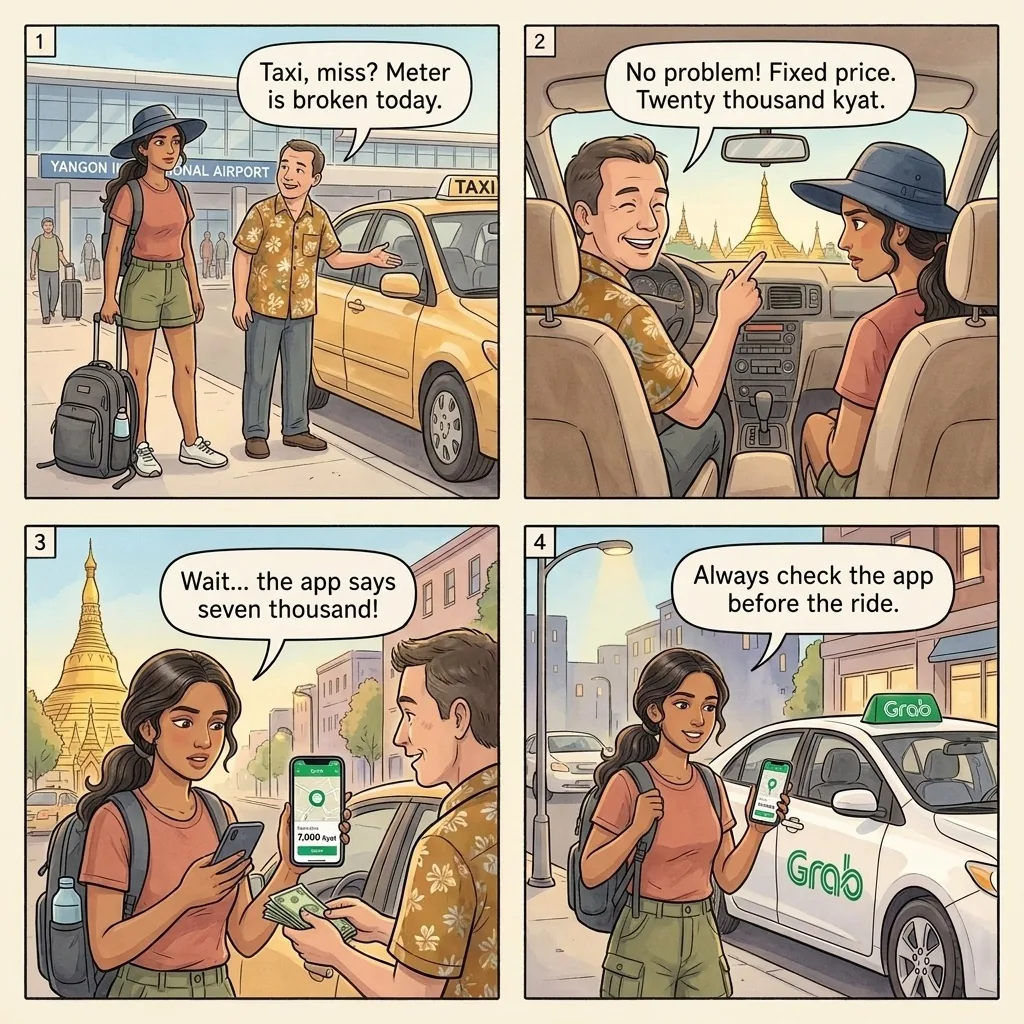
It's the morning your flight lands at Yangon International Airport, you've cleared customs, and a friendly driver outside the arrivals hall agrees to take you to your hotel near Sule Pagoda for K20,000 — 'broken meter, fixed price.'
The ride to central Yangon is real, the driver knows the route, and at the hotel the K20,000 you've already agreed to is what you pay. But the legitimate metered fare for the same airport-to-Sule-Pagoda trip is K7,000–8,000 — about a third of what you just paid. The 'broken meter' framing is the entire mechanism. The same trip booked through the Grab app, which operates reliably in Yangon, would have shown K7,500 in advance.
The Yangon taxi 'broken meter' manipulation runs at three different cost gradients. The airport version (K20,000 quoted vs. K7,000–8,000 actual) is the most expensive single instance. The Shwedagon Pagoda version (K10,000 quoted vs. K2,500–3,500 actual) is the most-encountered because Shwedagon is on every tourist's itinerary. The Sule Pagoda and central Yangon hotel-rank version (K6,000–8,000 quoted vs. K2,500–4,000 actual) is the most-frequently-encountered for visitors moving around the city. The mechanism is identical across all three: meter declared broken, flat fare quoted, no negotiation entertained.
The Grab app (Southeast Asia's dominant rideshare) operates fully in Yangon at near-meter prices, with the fare displayed in advance, the route GPS-tracked, and driver accountability via the rating system. Grab fares from the airport to central Yangon run K7,000–9,000 depending on traffic; Grab fares within central Yangon run K2,000–5,000. As travelers report across Reddit, the TripAdvisor Yangon forum, the Lonely Planet Myanmar thorntree, and the Myanmar Tourism Federation's published consumer guidance, downloading Grab before arrival is the single most-recommended Yangon defence.
The structural defences are concrete. Use Grab for all Yangon taxi rides — the price is fixed in-app before booking, the driver is rated, and there is no 'broken meter' framing. If you must take a street taxi, agree the fare in writing before getting in, refer to recent Grab fares for the same route, and never accept a 'broken meter' explanation as the basis for a fare. At the airport, ignore the kerbside drivers and walk to the official Mingalardon Airport taxi counter inside the terminal, which has posted fixed-fare zones.
Download the Grab app before arriving in Yangon — fares are fixed in-app at metered rates, drivers are rated, and the 'broken meter' framing has no leverage. For airport pickups, use Grab from inside the terminal or the official Mingalardon Airport taxi counter (posted fixed fares); avoid the kerbside drivers offering 'broken meter' flat rates of K20,000+ for what should be K7,000–8,000. For Shwedagon and Sule Pagoda departures, book Grab from inside the venue rather than hailing on the street. If you must take a street taxi, agree the fare in writing before getting in and pay only the agreed amount on arrival; reference Grab pricing for the same route as the anchor. Emergency: 199 (Police).
Red Flags
- Driver claims the meter is broken or not working
- Quoted fare is double or triple what Grab shows for the same route
- Driver takes an unfamiliar or winding route through congested areas
- Aggressive solicitation at the airport arrivals exit
How to Avoid
- Download the Grab app before arriving — it works reliably in Yangon and shows fair prices.
- If you must take a street taxi, agree on the fare before getting in.
- For airport transfers, book through your hotel or use the official taxi counter inside the terminal.
- A fair city ride in Yangon rarely exceeds 3,500 kyat; anything above 5,000 for a short trip is inflated.
Like what you're reading? Get a full Yangon itinerary with safety tips built in.
Browse travel-safety books →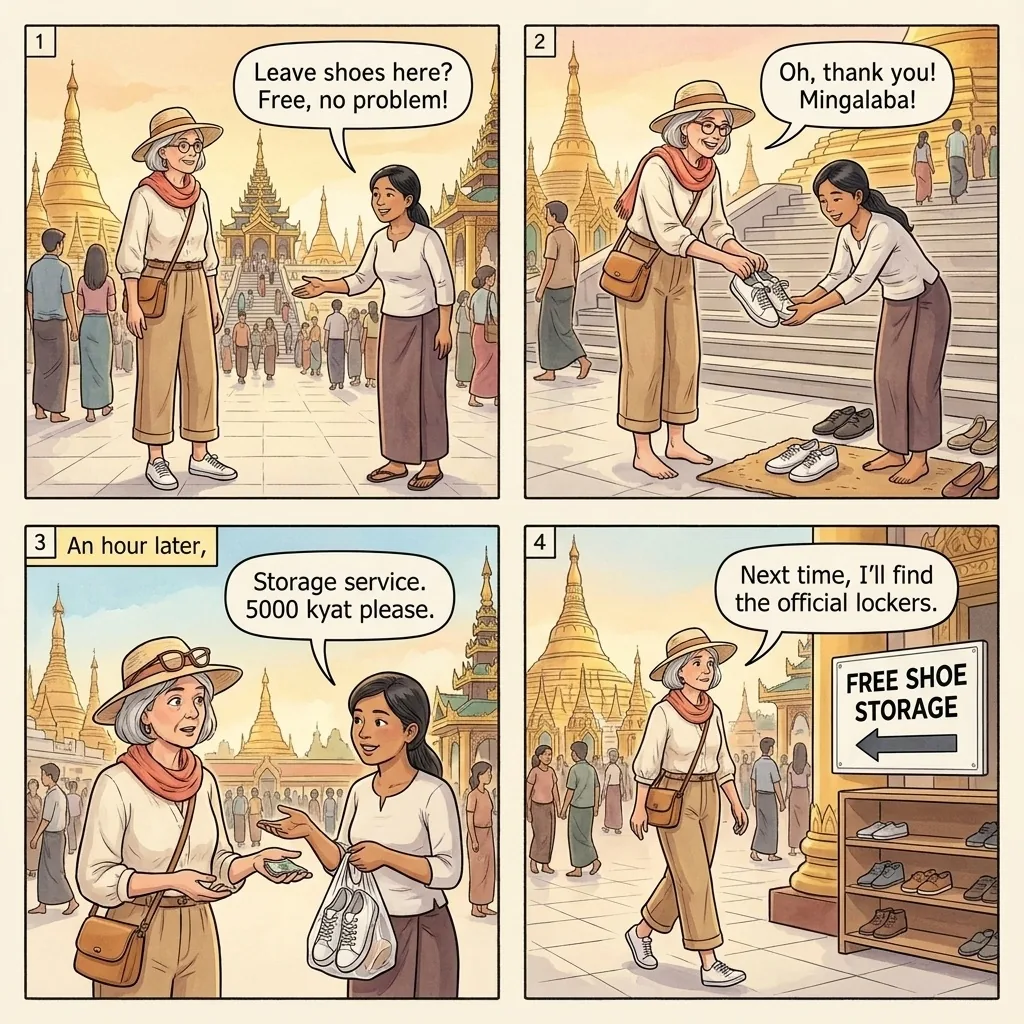
It's late afternoon at Shwedagon Pagoda, you've climbed the south stairway and reached the shoe-removal area at the entrance gate, and a friendly older woman gestures that you can leave your sneakers with her — for free, no problem.
You hand them over because the stairway is crowded and a local-looking offer of help feels normal. You spend ninety minutes circumnavigating the central stupa, watching the late-afternoon light catch the gold leaf. When you return to the south stairway, your shoes are no longer where you left them. The woman has them in a small bag and is now asking for K5,000–10,000 for the 'storage service.' Or worse: she points to a different stairway across the complex and says she 'moved them for safety,' implying you'll need to pay to find them.
The Shwedagon shoe-watcher fee is one of the most consistently encountered low-grade frictions at the pagoda. The mechanism is informal — there are no licensed 'shoe watchers' at Shwedagon, and the official shoe storage at each of the four entrance stairways is free. The 'watchers' position themselves at the visible shoe-removal area to intercept tourists before they reach the proper free-storage shelves, present the helpful offer, and then collect a 'service' charge on return. As travelers report across Reddit, the TripAdvisor Yangon forum, and the Lonely Planet Myanmar thorntree, this is the single most-encountered Shwedagon tourist friction.
The legitimate Shwedagon visit involves removing shoes and socks at the entrance gate (Buddhist tradition, mandatory at the pagoda) and placing them on the free wooden shelves inside the entrance gateway. There is no fee. The pagoda has been managed by the Shwedagon Pagoda Trustees Committee for centuries and the shoe storage is part of the standard visitor protocol — the K5,000–10,000 'watchers' are not affiliated with the trustees.
The structural defences are simple. Use the free official wooden shoe shelves inside the entrance gateway — every stairway has them, clearly marked. Or better, carry a plastic bag and put your shoes in your daypack to take with you (many visitors do this). Decline any 'shoe watcher' offer with a polite 'no, thank you' and a short walk past them to the official shelves. If you have already left shoes with a watcher and a fee is demanded on return, refuse to pay and walk to the trustees' office (located near the south stairway) — the watchers disperse the moment a real official is involved.
At Shwedagon Pagoda, place your shoes on the free official wooden shelves inside any of the four entrance gateways, or carry them in your daypack in a plastic bag. Decline 'shoe watcher' offers with a firm 'no, thank you' and walk past to the official shelves. The fee they ask is illegitimate and not affiliated with the Shwedagon Pagoda Trustees. If you have already left shoes with a watcher and a fee is demanded on return, refuse to pay and report to the trustees' office near the south stairway. The dollar damage is small (K5,000–10,000 = $2–5) but the friction-quality of the experience is significant. Emergency: 199 (Police); Shwedagon Pagoda Trustees: +95 1 386 800.
Red Flags
- Someone offers to watch your shoes rather than you placing them on the free shelves yourself
- No official signage or uniform on the person offering the service
- Your shoes are moved from where you left them when you return
- Demand for payment is aggressive or involves claimed 'storage fees'
How to Avoid
- Use the official free shoe storage shelves at each entrance — look for the racks near the stairway.
- Carry a plastic bag and keep your shoes in your daypack.
- Politely decline anyone offering to hold your shoes with a firm 'no, thank you.'
- If someone moves your shoes, stay calm and retrieve them — you owe nothing.
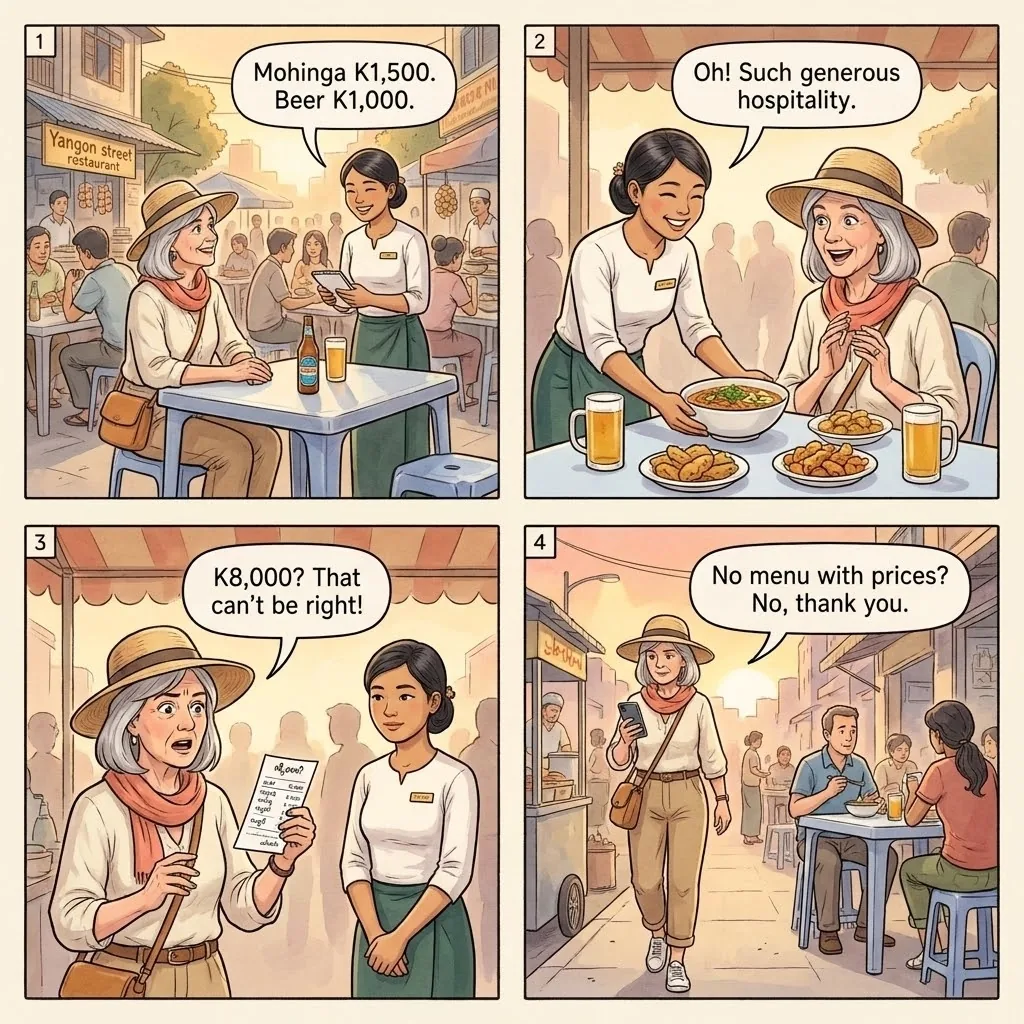
It's evening on 19th Street in Chinatown, the BBQ stalls are smoking and the plastic-chair restaurants are filling with locals and tourists, and you sit down at one for mohinga and tea-leaf salad — Yangon classics, no English menu visible.
The server quotes prices verbally as you order: mohinga K1,500, tea-leaf salad K2,000, a Myanmar Beer K1,000. Fair enough. The food arrives, more food than you ordered — small plates of pickled greens, a soup you didn't ask for, a second beer the server places without confirming. You eat what's on the table because it's there. The bill arrives at K8,000 instead of the K4,500 you mentally tracked: 'service charges,' the unrequested side dishes, the second beer, a 'rice fee,' miscellaneous additions all listed in Burmese script you can't read.
The 19th Street verbal-price bill ambush is documented across Reddit, the TripAdvisor Yangon forum, and the Lonely Planet Myanmar thorntree. The mechanism relies on three structural failures: no written menu with prices (or a Burmese-only menu that tourists can't verify), unrequested 'side dishes' placed on the table that the customer assumes are complimentary, and a closing bill in Burmese script that adds line items the customer can't easily contest. The bill ends up at 1.5–3× what the verbal quotes suggested.
The framing is a friction more than a scam — the food is real, the operators are real local restaurants, the practice clusters at tourist-heavy locations rather than locals-only places. The fair Yangon street-food and small-restaurant pricing for a meal of mohinga + tea-leaf salad + drink runs K4,000–6,000; anything above K7,000 for the same is the ambush rate. Locals at the same table pay the lower rate; tourists pay the higher.
The structural defences are concrete. Ask for the menu with written prices in any restaurant before ordering; if no menu exists or the menu is Burmese-only, write down each verbal price quote on your phone as you order. Refuse any unrequested side dish placed on the table — send it back with 'no, thank you' before you eat any of it. Check the bill line by line on arrival; dispute unrecognised charges. Eat where locals eat: a restaurant full of Myanmar customers and few foreigners is structurally unlikely to run the ambush. A useful rule of thumb is to compare the bill against your phone-noted verbal quotes and refuse anything not in your notes.
Ask for a menu with written prices at every Yangon restaurant before ordering; if no menu exists, write down each verbal price quote on your phone as you order so you have a reference for the bill. Refuse any unrequested side dish placed on the table — send it back before you eat any of it; if you eat it, you will be charged. Check the bill line by line on arrival and dispute unrecognised charges. Eat at restaurants full of Myanmar customers rather than tourist-strip places — the locals provide the price discipline. Pay only the verbal-quoted total plus what you actually ordered; refuse 'service' or 'rice' charges that weren't disclosed. Emergency: 199 (Police).
Red Flags
- No written menu with prices, only verbal quotes
- Dishes placed on your table that you did not order
- Bill significantly higher than the prices quoted when ordering
- Server avoids writing down your order or providing an itemized check
How to Avoid
- Ask for a menu with prices — if none exists, confirm each price verbally and write it down yourself.
- Do not eat anything placed on the table that you did not order; send it back immediately.
- Check the bill line by line before paying and dispute any unrecognized charges.
- Eat where locals eat — if the restaurant is full of tourists and empty of Myanmar people, be cautious.
🆘 What to Do If You Get Scammed
📋 File a Police Report
Go to the nearest Myanmar Police Force station. Call 199 (Police) or 191 (Emergency). Get an official crime report — you'll need this for insurance claims. You can also report online at moi.gov.mm.
💳 Cancel Your Cards
Call your bank immediately. Most have 24/7 numbers on the back of the card (keep a photo saved separately). Block any suspicious transactions before the thieves use your details.
🛂 Lost Passport?
Contact your nearest embassy or consulate. The US Embassy in Yangon is at 110 University Avenue, Kamayut Township, Yangon. For emergencies: +95 1-753-6509.
📱 Track Your Device
If your phone was stolen, use Find My (iPhone) or Find My Device (Android) from another device. Don't confront thieves yourself — share the location with police instead.
Frequently Asked Questions
You just read 5 scams in Yangon. The full Travel Safety Series has 780+ more across 20+ countries.
Tokyo's Kabukichō ¥130,000 bar trap. Rome's gladiator photo extortion. Paris's gold-ring trick. Bali's ATM skimmer scams. Bangkok's grand-palace closure ruse. Every documented scam across 20+ destinations — with the exact scripts, red flags, and local-language phrases that shut each one down. Drawn from Reddit traveler reports, embassy advisories, and consumer-protection cases.
- 780+ documented scams across Tokyo, Rome, Paris, Bali, Bangkok, Rio & 100+ more cities
- 20+ countries covered, with country-by-country phrase cards for every destination
- Updated annually — buy once, re-download future editions free
- All titles $4.99 each on Amazon Kindle