
Key Takeaways
- The #1 reported scam is the Marrakech-to-Merzouga 3-Day Tour Bait-and-Switch — book locally in Merzouga or through a vetted riad, never an online middleman.
- 1 of 6 scams is rated high risk; 4 are rated medium and 1 low.
- Standard fair pricing: sunset camel trek 250–350 MAD; overnight Berber camp 600–900 MAD; "luxury" camp 1,200–2,000 MAD.
- Skip every roadside fossil stall between Ouarzazate and Merzouga — roughly 90% are cement fakes; buy in Erfoud at certified dealers.
⚡ Quick Safety Tips
- Photograph every panel of any quad bike or ATV before mounting — pre-rental documentation is your only defense against bogus damage charges.
- Refuse to hand over your passport for any rental — a copy is fine; original is not legally required and "holding" it is illegal.
- Settle camel-trek and tour pricing in writing before mounting or departing: total amount, duration, photo-fee policy, all-in.
- Print or screenshot your hotel/auberge booking confirmation before you arrive — at check-in, produce it; "no rooms available" upsells fold quickly when the booking is documented.
Jump to a Scam
The 6 Scams

You book a 3-day Sahara tour from Marrakech for €300 — "luxury camp, private 4×4, all meals" — and arrive in Merzouga to a basic tent with no electricity, a minivan with eight strangers, and tagine for every meal; refunds are unobtainable once you're in the desert.
You book a 3-day Marrakech-to-Merzouga desert tour online for €300 ($330) per person — the website says "luxury camp," "private 4×4," all meals included, camel trek to the dunes at sunset. You hand over a credit card from home. The agency emails a polite confirmation with stock photos of a different camp.
When you arrive in Marrakech, the "private 4×4" is a Mercedes minivan with seven strangers. The 9-hour drive over the Atlas Mountains stops at three Berber carpet cooperatives where the driver collects commission. The "luxury camp" in the Erg Chebbi dunes turns out to be a basic Berber tent with no electricity, no Wi-Fi, and shared compost toilets fifty meters out in the sand. Meals are tagine and bread for three days straight.
Reddit's standing "Merzouga desert scam" thread and Reddit desert-tour threads document the same gap between online listing and on-the-ground reality. The agency margin on tourist-side bookings is 200–300% over what the same tour costs booked directly from Merzouga. Genuine Erg Chebbi tours from local operators run 1,200–2,000 MAD ($120–200) per person for the same itinerary, often with better camps and smaller groups. The defense is to wait until you reach Marrakech to book a desert tour, ask your riad for two or three vetted operators, and pay only after seeing photos of the actual camp and the actual vehicle — most online "luxury camp" bookings are ten boilerplate descriptions sharing one set of stock photos.
Red Flags
- Online price is 200–300% higher than the price local Merzouga operators charge
- "Luxury camp" or "private vehicle" used without specifying the actual camp name or vehicle type
- No reviews from verified travelers on independent platforms (Tripadvisor, Google Maps)
- Operator has a slick website but no physical office or address in Merzouga
- Itinerary includes "cultural stops" or "cooperatives" along the route — these are commission shops
How to Avoid
- Wait to book desert tours after arriving in Marrakech — local prices drop by 50–75%.
- Book through your riad or hotel for a vetted local operator with a physical office.
- Ask specifically: how many people per vehicle, what type of camp, what meals are served, what stops are made.
- Get everything in writing including the actual camp name, vehicle photos, and group size.
- Read recent (2–3 month) reviews on Tripadvisor and Google Maps; look for patterns of complaint.

A camel handler at Erg Chebbi quotes 200 MAD for an hour-long sunset trek; ninety minutes in he extends the ride to "make it worth it," then demands an extra 200 MAD per person plus 100 MAD in photo fees with the camels still wedged between dunes.
You stand at the Erg Chebbi camel-trek departure point near Hassi Labied and a handler in a blue Tuareg-style cheche (head wrap) leads four camels over. "Sunset trek to the dunes, 200 dirhams, very cheap." You and your partner mount up and the handler walks you out into the orange sand for what was supposed to be an hour.
Ninety minutes later the handler pulls the camels into a small valley between two dunes and announces a price change. 200 MAD became 400 because "we went further to make it worth it." Plus 100 MAD per photo because he was framing shots on his phone the whole way. The camels are wedged between the dunes; getting down and walking back out without his cooperation is technically possible but not appealing. TripAdvisor's "Terrible scam by Youssef — Merzouga Camel Trekking" review documents the same play with the line "absolutely ridiculous, paid 80 euros for a 30-minute tour."
Honest Merzouga camel operators — the ones with auberge contracts and posted prices — settle the total fee, the duration, and the photo policy in writing before you mount. The standard fair rate for a sunset trek from Hassi Labied to a desert camp and back is 250–350 MAD per person, all-in, with no per-photo fees. The defense is to settle a flat total in writing before mounting: "300 MAD total, 90 minutes round trip, no photo fees, no extras" — refuse "per minute" or open-ended pricing entirely, and use a riad-recommended operator rather than a freelancer at the dune edge.
Red Flags
- Pricing quoted "per minute" or open-ended rather than as a flat total
- Handler intercepts you at the dune edge rather than from a posted stable or auberge
- Handler takes photos on his phone without being asked
- Ride extends beyond the agreed time "to make it worth it"
- Refusal to dismount the camels until payment is settled
How to Avoid
- Settle a flat total before mounting: "300 MAD total, 90 minutes, no extras" — out loud and on paper.
- Refuse "per minute" or open-ended pricing entirely.
- Use a riad-recommended operator from a posted stable, not a freelancer at the dune edge.
- Decline photos taken on the handler's phone — take your own only.
- If the handler refuses to dismount, photograph him and call 19 (police) — auberge operators don't survive that.

A roadside seller between Ouarzazate and Merzouga offers a stunning trilobite fossil for 300 MAD ($30) — about 90% of the trilobites sold to tourists in eastern Morocco are sculpted from cement, painted, and artificially aged; real specimens cost 5–10x more from certified Erfoud dealers.
You're driving the long road between Ouarzazate and Merzouga (the 8-hour route across the Anti-Atlas) and you stop at a roadside stall stacked with trilobite fossils, ammonite plates, and large pieces of black-and-white "marble fossil" slabs. The seller says they're from local Paleozoic deposits, hand-extracted by his family, all real. The price for a beautiful trilobite is 200–500 MAD ($20–50). The work is striking.
Reddit threads, fossil-collector forums, and academic surveys all converge on the same number: roughly 90% of trilobites sold to tourists in eastern Morocco are fabricated. Sculpted from cement, painted with iron oxide, artificially aged with sand and acid. The real Moroccan trilobite trade exists — the Anti-Atlas fossils are world-famous — but real specimens cost 1,500–5,000 MAD for the size sold roadside, and they come from certified Erfoud dealers, not from a stand at a tourist overlook.
A few quick tells: real fossils have natural matrix (surrounding rock) attached, fakes are clean and uniform; real fossils show natural imperfections, fakes look perfect; real specimens have asymmetry, fakes are often suspiciously symmetric. The defense is to skip every roadside fossil stall and buy from a certified Erfoud dealer — the Erfoud Fossil Museum and the dealers around it post prices, run UV-light authentication, and stand behind the product. If you can't make it to Erfoud, photograph the roadside specimen and get a second opinion before paying.
Red Flags
- Fossils sold at roadside stalls or tourist-overlook parking areas
- Suspiciously perfect specimens with no natural imperfections or asymmetry
- Seller has dozens or hundreds of identical-looking pieces
- Price is suspiciously low for a supposedly rare geological specimen
- Surface has a uniform texture that feels like cement rather than stone
How to Avoid
- Buy fossils only from certified dealers at the Erfoud Fossil Museum and surrounding shops.
- Real fossils have natural matrix (surrounding rock) attached — fakes are clean.
- Ask to see the fossil under UV light — real fossils respond differently than cement.
- Visit the fossil museums in Erfoud first to learn what authentic specimens look like.
- Expect to pay 1,500+ MAD for a genuine tourist-sized trilobite from a reputable dealer.
Like what you're reading? Get a full Merzouga itinerary with safety tips built in.
Browse travel-safety books →
You arrive at the auberge you booked online for 400 MAD/night and at check-in the manager explains your room is "not available" but a "VIP suite with desert view" is — for 800 MAD; refuse and the standard room turns out to be in the back without a window.
You arrive at the small Merzouga auberge you booked online — 400 MAD ($40) per night including breakfast, posted on the booking site as a courtyard room with a desert view. At reception the manager smiles, types on his computer, and explains there's been an issue: your room is not available because of "maintenance," but a VIP suite with a private balcony is — for 800 MAD ($80) per night.
If you refuse, the "alternative" turns out to be a small room at the back of the building with no window, no desert view, and a single fluorescent bulb. The script is the same script played at small lodges across the Sahara tourism strip — auberges overbook the desert-view rooms, then steer the lower-paying bookings into worse rooms unless they upsell. Reddit's desert-camp threads document the pattern; some auberges run it almost universally on walk-up tourists.
Booking platforms (Booking.com, Airbnb, Expedia) have a published policy: if the room you booked is not available at the rate you booked, the property is required to provide an equivalent room at the booked rate or refund. The defense is to print or screenshot your booking confirmation with the rate, room type, and view description before you arrive, and at check-in produce it: "ce sont les conditions de ma réservation" — if the auberge cannot honor the booking, contact Booking.com or Airbnb support from the lobby to escalate; in nearly all cases the original room becomes available within ten minutes.
Red Flags
- "Maintenance" or "overbooking" excuse at check-in for a room that was confirmed online
- "VIP suite" upgrade priced at 1.5–2x the original room rate
- Refusal to show the original room or provide a written explanation of why it's unavailable
- Pressure to decide quickly because "another guest is waiting"
- The "alternative" standard room is markedly worse than the booked photos showed
How to Avoid
- Print or screenshot your booking confirmation before arrival; produce it at check-in.
- If the booked room "isn't available," contact your booking platform's support from the lobby.
- Booking.com, Airbnb, and Expedia all require properties to honor confirmed bookings or refund.
- Ask to see the original room and the offered upgrade; refuse blind upsells.
- Leave a public review on the booking platform if the property runs the upsell — it punishes the behavior.

Your tour driver "needs to stop for water" at a Berber carpet cooperative on the route to Merzouga; mint tea appears, a man unrolls thirty rugs across the floor, and your driver steps outside to collect his 30% commission while the pitch runs for an hour.
You're on a multi-day desert tour and your driver pulls into a "Berber cooperative" on the road through the High Atlas — somewhere between Aït Benhaddou, Tinghir, and the Todra Gorge. He says he needs water or a bathroom break and waves you toward the showroom door. Inside, mint tea is already poured.
A man in a long djellaba unrolls thirty carpets across a tiled floor while explaining the weaving traditions of three generations of Berber women. The presentation is genuinely beautiful and the rugs are sometimes real. The price is what's not — first-quoted prices on a 1×2 meter Berber rug run 8,000–15,000 MAD ($800–1,500), settling after pressure to 3,000–5,000. The same rug at the Marrakech ensemble artisanal sells for 1,500–2,500. Your driver collects a 20–40% commission on whatever you buy, which is added to your purchase price.
Reddit threads document the same play running on every Marrakech-to-Merzouga and Ouarzazate-to-Merzouga itinerary. The "water break" or "bathroom break" framing is the universal opener. The defense is to set the rule with the driver before the first day: "no shopping stops, no carpet cooperatives, no commission detours" — said plainly in advance, most drivers respect it. If you do want a Berber rug, buy at the Marrakech ensemble artisanal or a fixed-price cooperative in Fez where the markup goes to the artisans, not to your driver.
Red Flags
- Driver "needs to stop for water" or "for the bathroom" at a remote shop
- Mint tea is poured before any conversation about the products
- Driver disappears outside while the pitch runs (he's collecting commission)
- First-quoted carpet prices are 3–5x what the same item costs at established cooperatives
- Driver becomes cold or distant if you don't buy
How to Avoid
- Set the rule with your driver in advance: "no shopping stops, no cooperatives, no detours."
- If a "water break" stop appears, use the bathroom only and decline the showroom door.
- Don't drink tea unless you're prepared for the social-pressure trap.
- If you want a rug, buy at the Marrakech ensemble artisanal or Fez ensemble for fixed pricing.
- Negotiate to 25–30% of the first quoted price as a starting point if you must buy at a cooperative.

You rent a quad bike from a Merzouga shop for 300 MAD/hour, ride the dunes, and at return the operator points to a scratch on the side panel and demands 1,500 MAD ($150) in damages — the scratch was already there, but no pre-rental inspection happened.
Quad bikes and dune buggies are everywhere in Merzouga, advertised at 300 MAD ($30) per hour to ride the Erg Chebbi dunes. You hand over cash and a passport (the operator may ask to hold it, which is illegal under Moroccan law but common). You get a brief safety lecture, no helmet, and the keys. An hour in the sand is genuinely fun.
At return, the operator walks around the bike with a flashlight and points at a scratch on the side panel. "1,500 dirhams in damage." You don't remember scratching anything. He says you must have rolled the bike. The scratch is old, possibly years old, but no pre-rental inspection happened — your word against his. Some operators escalate to "I'll keep your passport until you pay."
Reddit threads on Merzouga tourism document the pattern — the smaller dune-edge rental shops without a brand or fixed location use the damage charge as a guaranteed exit upcharge. Holding a passport as collateral is illegal in Morocco regardless of how common the practice is. The defense is to photograph or video every panel of the quad bike before mounting, ideally with the operator visible in frame, and to refuse to hand over your passport (a copy is fine; the original is not legally required for a quad rental) — at return, your photos are the contract; if a damage charge appears that wasn't in the photos, escalate to 19 (police) before paying.
Red Flags
- Operator asks to hold your passport as collateral (illegal in Morocco)
- No pre-rental inspection or photo documentation offered
- "Damage" appears at return that you didn't notice or cause
- Demand exceeds 5x the rental fee for a small scratch
- Threat to keep your passport, ID, or backpack until payment
How to Avoid
- Photograph or video every panel of the bike before mounting, with the operator in frame.
- Refuse to hand over your original passport — a photocopy is acceptable.
- Use a brand-name operator with a fixed location and Google Maps reviews, not a dune-edge freelancer.
- Insist on a written rental agreement with the rate and damage waiver terms.
- If a bogus damage charge appears, photograph the alleged damage and call 19 (police) before paying.
🆘 What to Do If You Get Scammed
📋 File a Police Report
The Sûreté Nationale (DGSN) station nearest Merzouga is in Rissani (about 35 km away) or Erfoud (about 50 km away). Call 19 (Police) or 15 (Emergency/SAMU). Get an official crime report — you'll need this for insurance claims. You can also report online at dgsn.ma.
💳 Cancel Your Cards
Call your bank immediately. Most have 24/7 numbers on the back of the card (keep a photo saved separately). For tour-booking disputes, contact your booking platform (Booking.com, Viator, Airbnb) within 48 hours and dispute the credit-card charge.
🛂 Lost Passport?
Contact your nearest embassy or consulate. The US Consulate General in Casablanca is at 8 Boulevard Moulay Youssef, Casablanca. For emergencies: +212 522-64-2099. Allow 1–2 days transit from Merzouga to Casablanca for emergency replacement.
📱 Track Your Device
If your phone was stolen, use Find My (iPhone) or Find My Device (Android) from another device. Don't confront thieves yourself — share the location with police instead.
Frequently Asked Questions
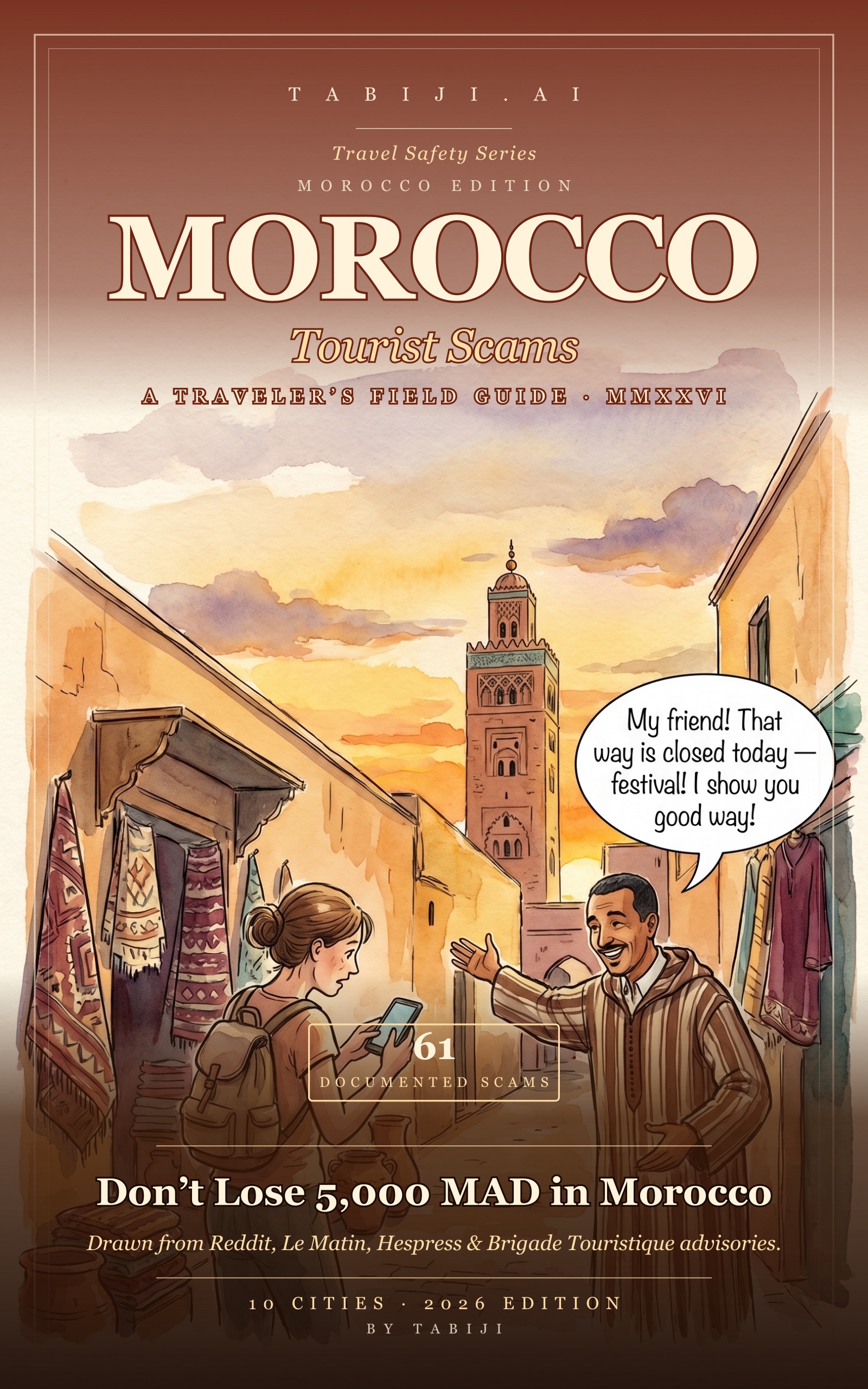
You just read 6 scams in Merzouga. The Morocco book has all 61 across 10 cities — with the exact scripts, red flags, and Darija/French phrases that shut each one down.
61 documented Morocco scams across Marrakech, Fez, Casablanca, Rabat, Tangier, Chefchaouen, Merzouga, Ouarzazate, Agadir & Essaouira — every named scam, every red flag, every Darija and French exit phrase. Drawn from Moroccan press (Hespress, Yabiladi, Le Matin), Sûreté Nationale & Brigade Touristique advisories, and US/UK embassy traveler reports.
- 61 documented scams across 10 Moroccan cities
- Darija and French phrases that shut each scam down
- Post-scam recovery playbook + emergency contacts
- $4.99 on Amazon Kindle — 234 pages, offline-ready