
Key Takeaways
- The #1 reported scam is the Palma Airport (PMI) & Port Taxi Overcharge.
- 2 of 6 scams are rated high risk.
- Use app-based ride services (Uber, Bolt) or official metered taxis instead of unmarked vehicles.
- Never accept unsolicited offers from strangers near tourist sites in Palma de Mallorca.
⚡ Quick Safety Tips
- Use licensed yellow taxis at PMI arrivals (queue at Terminal A) — €20–€30 to Palma center, €25–€35 to cruise port or El Arenal; gives the 2025 regulated-rate baseline. Uber does NOT operate in Mallorca — only Cabify and licensed taxis are legitimate.
- At El Arenal and Magaluf, rent a beachfront locker (€3–€5) for phone and wallet during swims; Traveler reports document 2025 phone theft with phishing follow-ups.
- Decline cruise-line Palma excursions at €80–€150 per person — a self-guided Cathedral + old-town day costs €30–€50; take the port shuttle or Cabify (€15) to center.
- Video-walk-around your rental car at pickup narrating visible marks; decline hotel-recommended rental operators with no independent Google reviews.
- For apartment rentals, book only via Airbnb or Booking documents off-platform payment fraud; check for hidden cameras on arrival per 2025 traveler reports reports.
Jump to a Scam
- Medium Palma Airport (PMI) & Port Taxi Overcharge
- High Palma Old Town & Cathedral (La Seu) Pickpockets
- High El Arenal / Magaluf Beach & Nightlife Phone Theft
- Medium Fake Speeding-Ticket Letters for Rental Cars
- Medium Cruise Excursion Overcharge & 'Exclusive' Shore-Tour Packages
- Medium Palma Short-Term Rental & Airbnb Booking Fraud
The 6 Scams
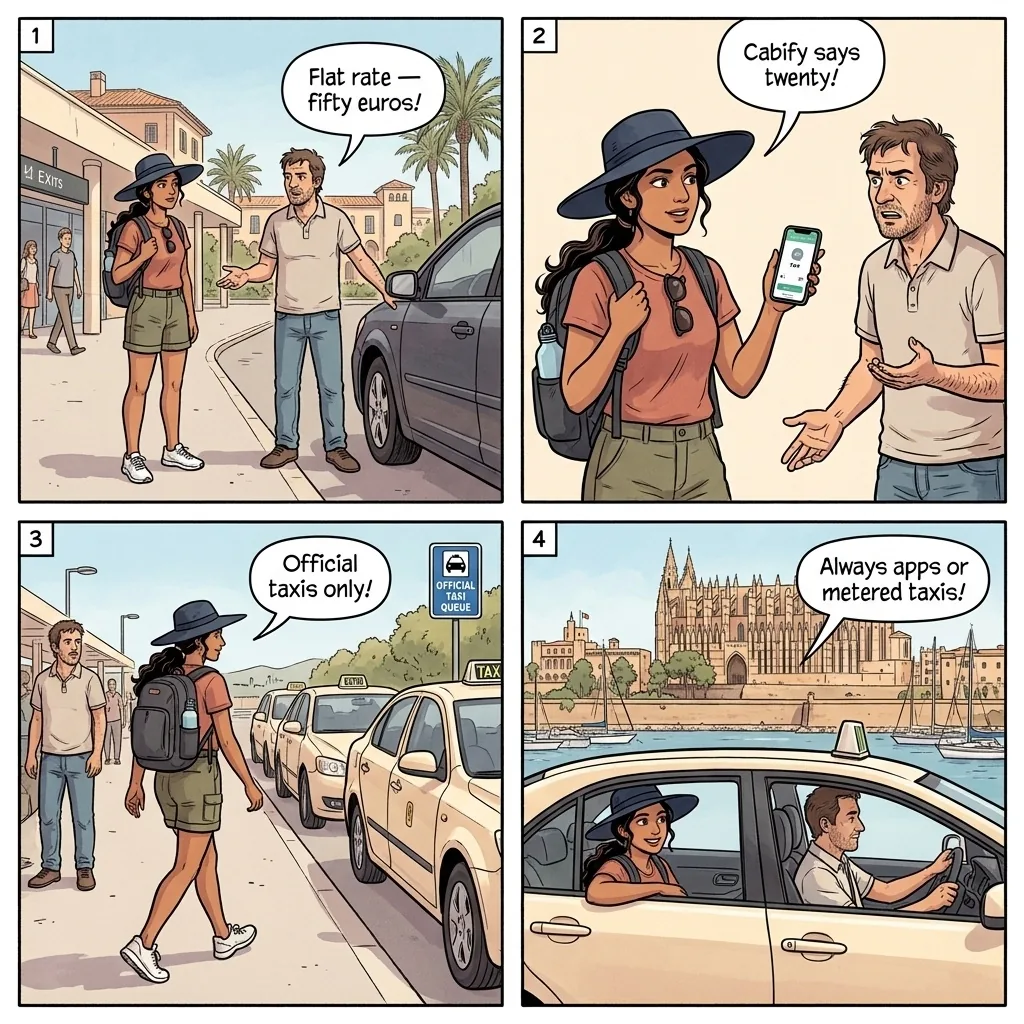
PMI airport touts and unlicensed curb operators quote 'fixed price €50–€70' for the 8-km Palma centre run that's €20–€30 on the meter — and Palma cruise-port hotel concierges push 'private transfer €70+' over the €15–€20 licensed taxi from the same pier.
Palma de Mallorca Airport (PMI) is the third-busiest airport in Spain by passenger volume, handling the high-summer surge of UK, German, and Scandinavian package travelers. The licensed yellow-taxi fare is €20–€30 on the meter to central Palma, €25–€35 to El Arenal or the cruise port — anchored by published Mallorca taxi-association rates and confirmed in long-running traveler guidance that Palma centre to the airport is rarely more than €30 each way. The cruise port has its own licensed rank with similar metered pricing into Palma centre at €15–€20.
The trap menu starts at the PMI rank during peak-summer arrivals, where unofficial operators offer 'fixed-price' quotes of €50–€70 with no meter, often by approaching travelers inside the terminal rather than waiting at the rank. A more aggressive variant runs in summer crunch periods (well-documented in German-language traveler threads): drivers consolidate three groups of luggage-heavy arrivals into one taxi at full single-fare each. The cruise-port mirror is hotel concierges and pier touts pushing 'private transfer €70+' for what's a €15–€20 metered ride, and both ends see app-spoofing where 'Uber pickup' is offered (Uber does not operate in Mallorca — only Cabify and licensed taxis are legitimate). Layered on top: meters that run blurry or stop mid-trip with a 'fixed price' added at the destination, and undeclared 'peak-summer surcharges' that double the published rate without posted disclosure.
For older cruise passengers and summer-package travelers arriving at PMI or Palma cruise port, the defense is to use only the licensed rank or a pre-booked app. Take a licensed yellow taxi from the PMI arrivals rank at Terminal A or the cruise-port rank with the meter running, or pre-book a Cabify ride for app-regulated fares and digital receipts — and refuse every 'fixed-price €50+' airport-curb quote, every private-transfer concierge offer above €30 to Palma centre, and every 'Uber pickup' approach as either fraud or unlicensed operation. Confirm the approximate fare range before boarding (€20–€30 to Palma centre, €25–€35 to cruise port or El Arenal), insist on the meter, and photograph the taxi plate number from the rear windscreen as evidence if the meter is killed mid-trip. Cabify is the strongest defense for travelers who want a fixed app-regulated price; the licensed rank is the strongest defense at the curb. Avoid any driver who approaches you inside the terminal — legitimate Mallorca taxis wait at the rank.
Red Flags
- Driver refuses to run the meter, quoting a 'fixed price' of €50+ to Palma center
- Driver approaches you inside the terminal rather than waiting at the taxi rank
- App-based 'Uber' pickup offered — Uber does not operate in Mallorca; only Cabify and licensed taxis are legitimate
- Meter runs blurry or stops mid-trip, with a 'fixed price' added at the destination
- Peak-summer surcharge that doubles rates without posted disclosure
How to Avoid
- Use licensed yellow taxis at PMI arrivals queue at Terminal A.
- Confirm approximate fare range before boarding: €20–€30 to Palma center, €25–€35 to cruise port or El Arenal.
- Insist on the meter and photograph the taxi plate number from the rear windscreen.
- Use Cabify app for app-regulated fares with digital receipts (Uber does not operate in Mallorca).
- Avoid any driver who approaches inside the terminal rather than waiting at the taxi rank.

Palma Cathedral (La Seu) ticket queues and Old Town narrow lanes run organized pickpocket teams that intensify during cruise-ship mornings (10 AM–12 PM) and summer peaks — Plaça Major, Paseo del Born evening terraces, Passeig Marítim, and Santa Catalina nightlife concentrate the risk, with seasonal crews rotating in from Barcelona and the Costa del Sol.
Palma's pickpocket problem is concentrated in the same Old Town corridor that every cruise-ship day-visitor and summer-package traveler walks: the Cathedral La Seu queue and the immediate surrounds, Plaça Major and the open-air crafts market, Paseo del Born terrace seating, the Passeig Marítim waterfront, and the Santa Catalina nightlife district. The teams aren't local — they're seasonal crews that rotate between Mallorca, Barcelona, and the Costa del Sol following tourist density, and traveler guidance is consistent that crowded tourist attractions are where the lifts happen.
There are five specific risk zones with predictable timing. The Cathedral ticket queue runs hottest during cruise-ship mornings between 10 AM and 12 PM, when 8,000+ passengers from one or two ships funnel toward La Seu in a ninety-minute window. Plaça Major's daytime crafts-market crowd uses its narrow stall lanes for press-against-bag lifts. Paseo del Born evening terraces in summer host bag-on-back-of-chair theft from al-fresco diners. Passeig Marítim absorbs the cruise-excursion unloading crowd at fixed times of day, an obvious distraction-rich target. Santa Catalina on Friday and Saturday evenings runs phone-from-pocket and wallet-from-bag on dance-floor crush. The team mechanics are standard Mediterranean: a 'directions question' or 'photo help' approach distracts the front while a partner lifts from the back, repeat-pass attempts if you don't react to the first, and a third partner handing the goods off down the lane within seconds so a stop-and-search recovers nothing.
For older cruise passengers and Old Town visitors, the defense is body-positioned bags and shifted timing. Wear a zipped crossbody bag in front through the Cathedral La Seu queue, Plaça Major, and every narrow Old Town lane, keep your phone in a zipped inner pocket (never the back pocket or an outer backpack pouch), split valuables so €20 and one card sit in a zipped front pocket while passport and backup card stay locked in the cruise cabin or hotel safe — and refuse every 'directions question' and 'photo help' approach in cathedral-queue density. Shift your Cathedral visit out of the 10 AM–12 PM cruise peak to 2–4 PM, when the morning ships have re-boarded and the queue has thinned. If you are pickpocketed, file a denuncia at Policía Nacional Palma (Calle Simó Ballester 1, +34 971 225 500) within 48 hours — insurance and card-fraud disputes need the report number.
Red Flags
- Cathedral ticket queue during 10 AM–12 PM cruise-peak with someone pressing from behind
- Plaça Major crafts-market crowd with strangers lingering near your bag
- Passeig Marítim cruise-excursion unloading crowd — concentrated distraction target
- Santa Catalina nightlife streets on Friday/Saturday evenings with bumping that feels deliberate
- Someone asks for photo help or directions while companion approaches blind side
How to Avoid
- Wear zipped crossbody bag in front during all old-town walking.
- Never place phone or wallet in back pocket or outer backpack compartment.
- Split valuables: €20 + one card in front pocket; passport + backup in cabin/hotel safe.
- Visit Cathedral at 2–4 PM to avoid 10 AM–12 PM cruise-peak crowd.
- File denuncia at Policía Nacional Palma (+34 971 225 500) within 48 hours for insurance.

El Arenal beach and Magaluf nightclub phone theft now runs as a two-stage operation: organized seasonal crews lift the phone during a beach swim or dance-floor crush, then send phishing 'Apple unlock' messages to the victim's iCloud-linked email afterwards — never respond, activate Find My Lost Mode rather than attempting an iCloud wipe, and file denuncia within 24 hours.
Mallorca's package-tourism strips at El Arenal and Magaluf concentrate huge summer volumes of UK, German, and Scandinavian visitors into a few kilometres of beach and nightlife, and the pickpocket-and-phone-theft economy that has formed around them is now organized rather than opportunistic. A 2025 victim account tracks the full mechanic: an iPhone stolen at El Arenal, tracked via Find My to a Palma address that turned out to be a re-aggregation point, and then phishing 'unlock your iPhone' messages sent to the victim's iCloud-linked email in the days afterwards as a follow-on attempt to harvest the Apple ID password.
The attack sequence is the same every time. Stage one is the lift — phones taken from beach towels at El Arenal during a swim, from bag-on-back-of-chair posture at chiringuito tables, or via dance-floor crush at Magaluf clubs between 11 PM and 3 AM where partially drunk tourists make recovery unlikely. Stage two is the lockout — once the phone is in the operator's hands, a forced iCloud-wipe attempt or repeated passcode tries push the device into a remotely-monitored state. Stage three is the phishing follow-up — fake 'Apple Support' or 'iCloud recovery' messages arrive at the victim's email or via SMS to backup numbers, claiming the device has been located and asking for the Apple ID password to release it. Anyone who provides the password gives the operator the ability to wipe Find My remotely and resell the phone clean. Tourist guidance from longtime Palma-area residents is consistent that the crews operate seasonally and specifically at package-tourism beaches, and the Magaluf nightlife variant has its own well-documented phone-and-wallet-from-pocket pattern.
For older travelers on a Palma cruise or resort stay who venture out to El Arenal or Magaluf, the defense is to skip the night strips and harden the day. Skip Magaluf and El Arenal nightlife strips entirely if you are 60+, and if you must visit, leave your phone and wallet in the resort safe and bring only €50 cash plus a decoy burner phone — for daytime beach visits, rent a chiringuito locker at €3–€5 per session for phone and wallet during swims, use a waterproof neck pouch for phone and one card only, and refuse any 'Apple unlock' or 'iCloud recovery' message that follows a theft as a guaranteed phishing attempt. If your phone is stolen, activate Find My's Lost Mode immediately rather than attempting a remote wipe (wipe attempts feed the phishing follow-up), do not enter your Apple ID into any link arriving by email or SMS in the days afterwards, and file denuncia at Policía Nacional Palma (+34 971 225 500) within 24 hours so insurance and the eventual Apple ID dispute have a report number to anchor.
Red Flags
- Unattended belongings on a towel at El Arenal while you swim 10+ metres out
- Nightclub dance-floor crush where someone presses close with no evident reason
- Phone snatched from a beachfront café table — snatchers operate during the 30-second moment you look away
- Post-theft phishing SMS or email claiming to be 'Apple unlock' or 'iCloud recovery'
- Follow-up 'package delivery failed' SMS scams timed shortly after a reported theft
How to Avoid
- Rent beachfront locker at El Arenal chiringuito (€3–€5 per session) for valuables during swims.
- Use waterproof pouch around your neck for phone and one card only during swims.
- If phone is stolen, activate Find My iPhone's Lost Mode — do not attempt full wipe.
- Ignore any 'Apple unlock' or 'iCloud recovery' messages after a theft — all are phishing.
- File denuncia at Policía Nacional Palma (+34 971 225 500) within 24 hours for insurance.

Mallorca rental-car holders receive fake Spanish DGT speeding-ticket letters at their UK or German home address weeks after returning, built on leaked rental records (correct plate, name, pickup dates) and demanding €60–€150 to a 'collection agency' that isn't the DGT — verify only at dgt.es or +34 060, and never pay a private bank account claiming to be Spanish traffic enforcement.
After a Mallorca rental-car holiday, a growing share of UK, German, and Scandinavian travelers receive official-looking 'speeding ticket' letters at their home address in the weeks after return. The letters claim to show the rental car exceeding a speed limit on a Mallorca road, demand immediate payment of €60–€150 via European bank transfer or card payment, and route the money to a 'collection agency' that has no connection to the Spanish traffic authority (Dirección General de Tráfico). Victims describe the letters as convincing precisely because the rental-car details are correct — number plate, driver name, rental-pickup dates — even though the photographic 'evidence' isn't from a recognisable Spanish traffic camera and the destination account isn't DGT.
The sophistication comes from data leakage rather than from the letter itself. Operators obtain the rental records through three vectors that traveler-fraud reports have repeatedly flagged: corrupt employees at rental-car companies selling bulk datasets, hacked rental-company email systems leaking pickup records, and reuse of personal data from prior Mallorca traffic tickets that were actually paid (the operator now has the matched plate-and-driver pair). The fraud is timed to blend in with real DGT letters that legitimately reach foreign drivers six to twelve weeks after a violation, and it works in tandem with that real flow to confuse victims into paying both. Pressure language is consistent: a 30-day 'pay to avoid surcharge' deadline that doubles the fine if missed, a non-DGT bank IBAN that doesn't match official Spanish government accounts, and email follow-ups (where the operator has the address) telling victims to 'click here to pay' rather than going through dgt.es.
For older travelers returning from a Mallorca rental-car holiday, the defense is independent verification before any payment. For any post-return Spanish 'speeding ticket' letter or email, verify directly at dgt.es or by phoning +34 060 from inside Spain (+34 902 101 062 internationally) before paying anything — never click email links, never wire money to a 'collection agency' bank account, and refuse every 'urgent payment €100 to avoid surcharge' demand as fraud built on leaked rental records. Genuine DGT speeding tickets arrive by registered post and are payable only via dgt.es or the designated bank — not via a private collection agency. Even if you genuinely sped on Mallorca, a 60-day verification delay will not cost you your licence — DGT applies the surcharge only after a real legal process, and a sober verification call is always cheaper than the fraud. If a letter routes payment to a non-DGT account, file a complaint with Policía Nacional in Mallorca at +34 971 225 500 and with Action Fraud in the UK or your home-country fraud authority.
Red Flags
- Payment demanded to a non-DGT bank account or 'collection agency' address
- Letter arrives at a suspicious interval (often weeks after return, when verification is harder)
- No official DGT reference number or the number format is different from standard Spanish tickets
- Photo of the vehicle does not clearly match a Spanish traffic camera aesthetic
- Demand for payment via Western Union, cryptocurrency, or non-European card transfer
How to Avoid
- Pay genuine Spanish DGT tickets only via dgt.es (official) or the designated bank.
- Verify any received ticket by calling DGT directly: +34 060 (within Spain) or +34 902 101 062 (international).
- File a complaint with Policía Nacional Palma (+34 971 225 500) and your home-country fraud authority if scam-suspected.
- Do not pay until verification — DGT will not suspend your license for a 60-day verification delay.
- Retain your rental-car pickup and return documents as reference for disputed fines.

Cruise-line Palma 'Highlights' shore excursions sell at €80–€150 per person for content that's a €15 Cabify ride into Palma centre plus €10 La Seu Cathedral entry plus a self-guided walk through Plaça Major and Paseo del Born — DIY total runs €30–€50 per person, and a paid small-group GetYourGuide tour at €35–€50 is the half-price guided alternative.
Palma is one of the Western Mediterranean's top cruise destinations, taking roughly 1.4 million cruise passengers annually on Royal Caribbean Oasis-class ships, Costa Cruises, and MSC. Every major line sells a 'Palma Highlights' shore excursion at €80–€150 per person marketing 'exclusive' access to the Cathedral La Seu, Bellver Castle, and a coastal drive — the kind of bundled day that reads as the safe choice when you're stepping off a ship into a foreign port. The reality is that Palma is one of the easiest Western Med cruise stops to do independently: the Old Town is compact, the cruise port is well-connected by shuttle and taxi, and the headline monuments are all bookable directly at fair prices.
The DIY anchor is straightforward. The cruise-provided port-to-town shuttle is free or €5, a Cabify ride into central Palma is €15, the Cathedral La Seu is €10 booked at catedraldemallorca.org, Bellver Castle is €4 admission with a 25-minute Cabify ride to reach it, and Plaça Major plus Paseo del Born are free to walk at your own pace. A full day of monuments, lunch, and return totals €30–€50 per person — vs the cruise-line €80–€150 with set timing, large group sizes, and the long-running cruise-passenger complaint that excursion refunds for cancelled or altered tours are notoriously difficult. Veteran cruisers' framing is that Palma is easy enough for an independent day but cruise-line marketing creates the impression you need the package, and one well-documented Palma excursion variant has the local guide drive a coastal road that catches an €80 traffic fine on the route — the kind of irritant that's easy to avoid by going independently. The €120–€250 'premium' tier of these excursions adds a coastal drive to Valldemossa that's genuinely worthwhile, but it's still cheaper to take the L1 bus or rent a Cabify for the day at €60–€80 with two travelers.
For older cruise passengers stepping off a ship in Palma for a single day, the defense is to bypass the on-board excursion desk and book the day independently. Skip cruise-line shore-excursion packages at €80–€250 per person, take the free or €5 port-to-town shuttle (or a €15 Cabify ride) into central Palma, book the Cathedral La Seu directly at catedraldemallorca.org for €10, and walk the Old Town (Plaça Major, Paseo del Born, Passeig del Born) at your own pace — total independent cost €30–€50 per person, vs €80–€150 for the same content on the cruise package. If you genuinely want a guided tour, book a paid small-group tour on GetYourGuide at €35–€50 — same content as the cruise excursion at half the price with flexible timing. For Bellver Castle, take a €15–€20 Cabify each way and pay €4 admission directly. The L1 city bus runs from the cruise port to central Palma for under €5 and is a useful budget alternative when the shuttle is full. Always confirm your re-boarding time with the ship before stepping off, since cruise-line shore excursions guarantee the ship will wait but independent excursions don't — leave a 90-minute buffer between your planned port return and the all-aboard call.
Red Flags
- Cruise-line 'Palma highlights' excursion at €80–€150 per person
- Tout at the cruise terminal offering 'exclusive' Cathedral or Bellver Castle access
- Packaged tour claiming 'skip the queue' at the Cathedral, which rarely has long queues
- Bundled 'Valldemossa + Sóller + Cathedral' at €120+ per person — more stops than feasible in a day
- Pressure to book immediately 'because the ship leaves and spots are limited'
How to Avoid
- Skip cruise-line Palma excursions; plan an independent day at one-third the cost.
- Use the cruise-provided port shuttle (free or €5) or a Cabify ride (€15) to central Palma.
- Book Cathedral tickets at catedraldemallorca.org (€10 admission).
- If you want a guided tour, use GetYourGuide or Tiqets small-group tours (€35–€50) rather than cruise-line packages.
- Walk the old town (Plaça Major, Paseo del Born, Santa Catalina) independently — no queues, full day flexibility.
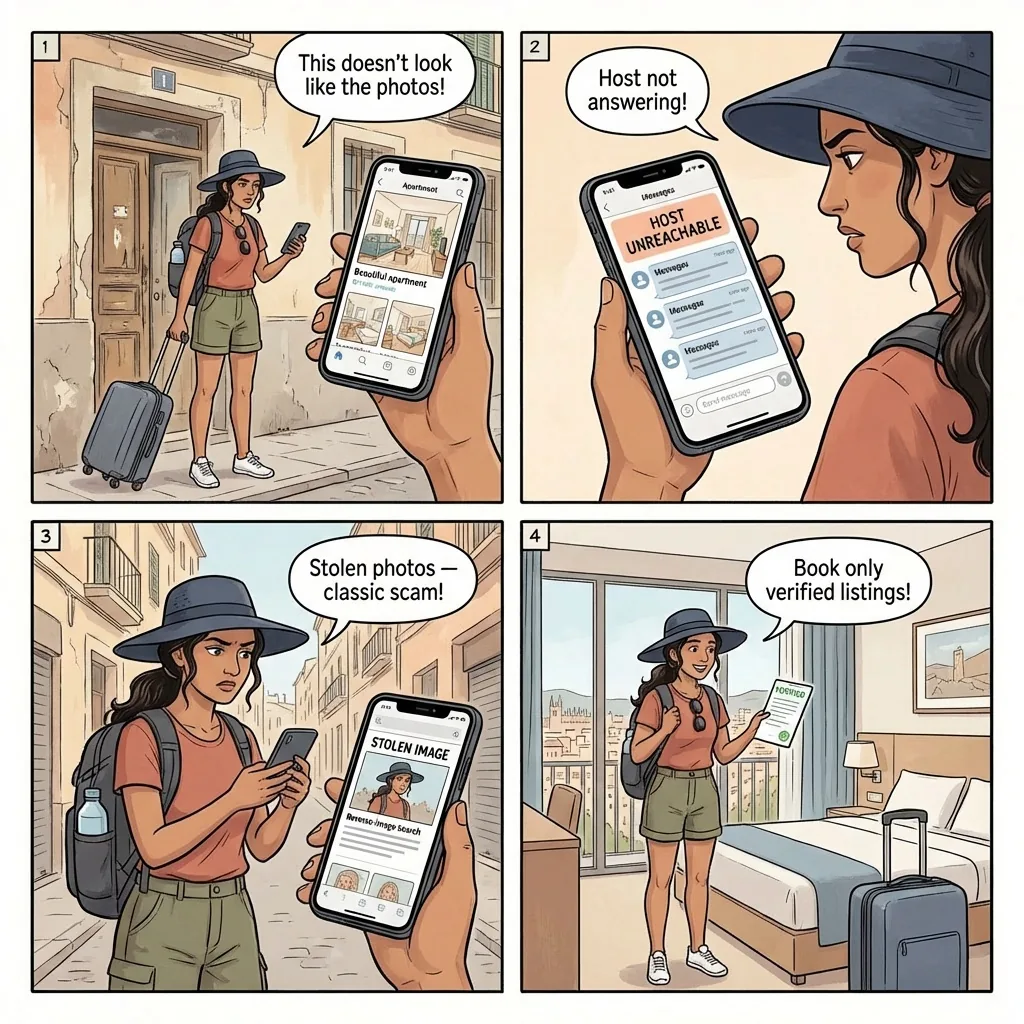
Palma apartment listings on Idealista, Kleinanzeigen, and Facebook Marketplace at 20–30% below comparable hotel rates demand Bizum or bank-transfer deposits sight-unseen, after which the 'landlord' disappears or double-books the same flat to multiple travelers — verify the Mallorca Tourist Registration (ETV) number before any payment, and book only on Airbnb or VRBO with platform card.
Palma's rental-accommodation fraud follows the same playbook as San Sebastián, Valencia, and Córdoba: heavy tourism demand on top of constrained housing supply creates an obvious incentive for scammers to advertise apartments that don't exist or that they don't control. The target is travelers planning stays longer than a hotel week — a fortnight, a month, a winter — where booking-platform fees feel high enough that an Idealista or Facebook Marketplace listing at 20–30% below comparable hotel rates reads as a smart find rather than a red flag.
The mechanic is consistent across Palma. Stage one is the listing: an apartment posted on Idealista, Kleinanzeigen (heavily used by German-speaking travelers booking Mallorca months ahead), or Facebook Marketplace at a rate that beats hotels by 20–30%, with a few generic-looking photos and a Mallorca address. Stage two is the contact: the 'landlord' answers quickly, offers to hold the dates, and asks for a deposit plus first-month rent via Bizum (Spain's instant-payment rail, irreversible once cleared) or a SEPA bank transfer 'to confirm the booking before viewing.' Stage three is the disappearance — once the payment clears, the listing comes down and the contact stops responding. The double-booking variant is more sophisticated: a real apartment is genuinely available, but the operator collects deposits from three or four travelers for the same dates, and only the first arrival actually gets the keys. A separate hidden-camera variant has surfaced in 2025 traveler reports across Spain — flats rented through legitimate-looking listings that contain smoke-detector or alarm-clock cameras pointed at the bed; the deposit isn't the scam, the recording is.
For older travelers planning a Palma apartment stay longer than a hotel weekend, the defense is platform-only payment and ETV verification before any money moves. Book only through Airbnb, VRBO, or Booking.com with platform-verified card payment and cancellation protection — refusing Bizum, Western Union, SEPA wire transfer, and cryptocurrency for any accommodation deposit, demanding the Mallorca Tourist Registration (ETV) number on the listing before payment, and demanding a live video call with the apartment visible (not photos) before any deposit on Idealista or Kleinanzeigen. Reverse-image-search the listing photos on Google Images before paying — duplicate hits across multiple cities are a guaranteed scam. On arrival, briefly check the smoke detector, alarm clock, and any tissue box for the lens reflection that gives away a hidden camera (2025 traveler reports flag these as the most common hiding spots in Spanish short-term rentals). If you've been defrauded, file denuncia at Policía Nacional Palma at +34 971 225 500 immediately — the report number is required for both Bizum dispute claims and your home-country card chargeback.
Red Flags
- Listing price 20–30% below comparable hotel rates for same dates
- 'Landlord' refuses video call or in-person viewing before deposit
- Request for Bizum, Western Union, or cryptocurrency payment rather than platform-protected transaction
- Pressure to 'secure' apartment immediately because 'other interested parties'
- Photos reverse-image-search to a different city or stock-photo library
How to Avoid
- Book only through Airbnb or Booking.com with platform-verified payment and cancellation protection.
- For Idealista listings, demand a video call with the apartment visible before any deposit.
- Reverse-image-search listing photos on Google Images before paying.
- Refuse Bizum, Western Union, or cryptocurrency payment for any accommodation deposit.
- On arrival, briefly check common rooms for hidden cameras (smoke detectors, alarm clocks, tissue boxes are common hiding spots per 2025 traveler reports reports).
🆘 What to Do If You Get Scammed
📋 File a Police Report
Go to the nearest Policía Nacional or Guardia Civil station. Call 091 (Policía Nacional) or 112 (emergency). Get an official crime report — you'll need this for insurance claims. You can also report online at policia.es.
💳 Cancel Your Cards
Call your bank immediately. Most have 24/7 numbers on the back of the card (keep a photo saved separately). Block any suspicious transactions before the thieves use your details.
🛂 Lost Passport?
Contact your nearest embassy or consulate. The US Embassy is at Calle de Serrano, 75, 28006 Madrid. For emergencies: +34 91 587-2200.
📱 Track Your Device
If your phone was stolen, use Find My (iPhone) or Find My Device (Android) from another device. Don't confront thieves yourself — share the location with police instead.
Frequently Asked Questions
You just read 6 scams in Palma De Mallorca. The book has 97 more across 16 Spanish destinations.
Barcelona's La Rambla rosemary-sprig clavel circuit. Madrid's Puerta del Sol three-card trile. Seville's Plaza de España palm-reading gambit. Granada's Alhambra skip-the-line reseller industry. Ibiza and Mallorca scooter deposit-hold cycle. Every documented Spain scam — with the exact scripts, red flags, and Spanish phrases that shut each one down. Drawn from El País, La Vanguardia, ABC, El Mundo, and Policía Nacional and Mossos d'Esquadra records.
- 103 documented scams across Barcelona, Madrid, Seville, Granada & 12 more cities and islands
- A Spanish exit-phrase card you can screenshot to your phone
- Updated annually — buy once, re-download future editions free
- Readable in one flight — $4.99 on Amazon Kindle