
Key Takeaways
- The #1 reported scam is the São Paulo Guarulhos Airport (GRU) Taxi Mafia & Late-Night Uber Confusion.
- 4 of 6 scams are rated high risk.
- Use app-based ride services (Uber, DiDi) instead of street taxis — avoid unmarked vehicles, especially at night.
- Never accept unsolicited offers from strangers near tourist sites in São Paulo.
⚡ Quick Safety Tips
- On Avenida Paulista, if anyone says 'cuidado, caiu algo' ('careful something fell') — Don't LOOK DOWN; immediately step back — canonical 2025 distraction-pickpocket anchor.
- If a well-dressed older woman asks for medical help in English ('blood pressure / dizzy / call my son'), respond 'I will call 192 (SAMU ambulance)' — exposes scam instantly.
- From GRU airport, book Uber/99/Cabify (R$90–R$180 to Paulista) OR Airport Bus Service R$56 — Ignore 'Special Taxi' kiosks quoting R$250–R$500.
- BEFORE sitting at restaurants, confirm couvert artístico R$ amount + serviço % policy in writing — Brazilian Lei 13.419/2017 makes serviço OPTIONAL.
- Centro Histórico (Sé / Anhangabaú / Luz) daytime only (8 AM–5 PM weekdays) — leave valuables in hotel safe; DEATUR São Paulo +55 11 3120 4447 (English) for any theft.
Jump to a Scam
The 6 Scams

A "Special Taxi" kiosk inside GRU arrivals quotes R$320 to your Paulista hotel while you're jet-lagged and hauling luggage. The real Uber fare is R$90–R$180. The Airport Bus Service is R$56 per person and runs every 30 minutes from 5am to midnight.
São Paulo has two airports: Guarulhos International (GRU) 25 kilometers east of the center handling all international and most long-haul domestic traffic, and Congonhas (CGH) on the downtown waterfront handling short-haul domestic flights. Both have Uber, 99, and Cabify coverage with reliable supply, plus the official Airport Bus Service connecting GRU to Tietê, Barra Funda, Congonhas, and Praça da República at R$56. The trap economy operates around the GRU arrivals halls, the Aplicativos pickup zones, and the late-night driver-supply windows that thin out after 10pm.
Real fares anchor at R$90–R$180 GRU to Paulista, Vila Olímpia, or Jardins (35–60 minutes depending on traffic), R$80–R$130 GRU to CGH, and R$30–R$70 CGH to Paulista. The trap menu starts with "Special Taxi" kiosks inside GRU arrivals quoting R$250–R$500 to the Zona Sul neighborhoods. Sign-holders posing as "hotel transfer" agents intercept tourists whose hotels don't include shuttle service (legitimate hotel transfers wait outside arrivals with a printed name). Uber driver cancel-and-recontract works the curb-side handoff — the driver accepts the in-app ride, cancels at the curb, then quotes R$250 cash. "Meter broken" yellow-taxi demands materialize at hotel arrival with R$350 flat-rate cash. GRU-to-CGH "connecting transfer R$400" sold by terminal touts inflates against the R$80–R$130 Uber rate. Credit-card cloning at unofficial taxi-cooperative counters via "manual entry" card-machines is the most damaging variant. "Security escort fee R$150" added unannounced after late-night arrivals isn't a legitimate charge. Reddit airport-arrival threads document each version running side by side in 2026.
Book Uber, 99, or Cabify on airport Wi-Fi after collecting luggage — expect R$90–R$180 to Paulista / Vila Olímpia / Jardins from GRU and R$30–R$70 from CGH — and meet your driver at the signposted Aplicativos pickup zone at each terminal exit. Or take the official Airport Bus Service at airportbusservice.com.br at R$56 per person to Tietê, Barra Funda, Congonhas, or Praça da República (every 30 minutes 5am–midnight). Refuse every "Special Taxi" kiosk quoting R$200+, every sign-holding "hotel transfer agent" inside arrivals, every "meter broken" R$350 cash demand, every "security escort fee R$150" surcharge, and every "manual entry" credit-card transaction at unofficial cooperative counters. For late-night arrivals after 10pm, the R$30–R$50 surcharge for Uber Comfort or Black buys vetted drivers. Pay in-app or cash only — never hand a credit card to any taxi driver. Save DEATUR São Paulo +55 11 3120 4447 (English available) and US Consulate São Paulo +55 11 3250 5000 before arrival.
Red Flags
- A "Special Taxi" kiosk inside GRU arrivals quoting R$250–R$500 to the center — the real Uber fare is half that.
- A sign-holder posing as a "hotel transfer" agent for a hotel that doesn't actually include shuttle service.
- An Uber driver who accepts your in-app ride, then cancels at the curb and re-quotes R$250 cash.
- A yellow-taxi driver telling you the meter is broken and demanding R$350 flat-rate at the hotel.
- A "security escort fee R$150" added unannounced after a late-night ride.
How to Avoid
- Book Uber, 99, or Cabify on airport Wi-Fi — GRU to Paulista is R$90–R$180.
- Meet your driver at the signposted Aplicativos pickup zone, not curbside near the kiosks.
- Or take the Airport Bus Service at R$56 per person, every 30 minutes from 5am to midnight.
- Don't hand a credit card to any taxi driver, and never accept "manual entry" processing.
- For late-night arrivals after 10pm, pay the R$30–R$50 surcharge for Uber Comfort or Black.

A team of three to five men work Avenida Paulista's MASP underpass and the Trianon-MASP and Consolação metro exits with a "cuidado, caiu algo" (careful, something fell) distraction while a partner lifts your wallet from behind. Locals call the ring "os palhaços" (the clowns); the look-down is the lift.
Avenida Paulista is São Paulo's main commercial spine, with 1.5 million daily foot traffic concentrated along a 2.8-kilometer stretch from Praça da Consolação to Rua Vergueiro. That density supports the city's most coordinated organized pickpocket ring, nicknamed "os palhaços" (the clowns) by long-time community observers and documented across multiple years of vigilante-exposure threads on Reddit. The crews rotate members every few weeks but the operating zones and the script remain consistent — they work the dense pedestrian crossings around the MASP museum underpass, the Trianon-MASP metro exit, the Consolação metro exit, and the outdoor café tables along Paulista at peak walking hours.
The mechanic has three coordinated roles. Stage one is the approach: a team member says "cuidado, caiu algo" ("careful, something fell") pointing at the tourist's shoes or pocket area, prompting the instinctive look-down response. Stage two is the lift: a second member positioned behind the target lifts wallet or phone from a back pocket or open bag in the two-second window the look-down creates. Stage three is the cover: a third member picks up the "dropped" item — a peanut shell, a coin, a folded bus ticket — and "returns" it to the tourist, providing the closing courtesy that makes the encounter feel completed before you realize anything is missing. The team disperses in the 30 seconds the cover provides. Variants include "mustard or sauce or bird-poop on jacket" distractions at outdoor café tables on Paulista (a stranger "helps clean" the spill while a partner lifts the bag), and "aren't you the friend of [random Brazilian first name]?" confusion approaches that work the same look-around mechanic. The clowns target inattention rather than violence; Paulista is broadly safe during daytime, but the crews work the rhythm of distracted pedestrians.
Keep your phone in a zipped front pocket or crossbody bag worn in front when walking Avenida Paulista — never back pocket, never on outdoor café tables. If anyone says "cuidado, caiu algo," don't look down; step back, hand on wallet, and walk away as the canonical clowns opening. If "mustard," "sauce," or "bird-poop" lands on you, refuse every stranger's offer to help clean (that is the distraction) and walk into the nearest bank, hotel, or Uber to handle it. Refuse every "aren't you the friend of [name]?" confusion opener and every photo-help offer at the MASP underpass, the Trianon-MASP metro exit, or the Consolação metro exit. The MASP underpass funnels pedestrians through narrow passageways where the clowns work — tighten bag straps and stay alert through that section. Paulista's Sunday cyclovia (avenue closed to cars 7am–4pm) is the safest browsing time with lower team-pickpocket density. DEATUR Tourist Police +55 11 3120 4447 takes incident reports — file a Boletim de Ocorrência within 24 hours for insurance and chargeback paperwork.
Red Flags
- A stranger saying "cuidado, caiu algo" ("careful, something fell") near the MASP underpass.
- A team of three to five men positioned around the Trianon-MASP or Consolação metro exits.
- A "mustard, sauce, or bird-poop on jacket" offer to help clean the spill.
- An "aren't you the friend of [Brazilian first name]?" confusion approach.
- Your phone left on an outdoor café table on Paulista — that's an instant snatch target.
How to Avoid
- Keep your phone in a zipped front pocket or crossbody bag worn in front; never back pocket.
- If anyone says "caiu algo," don't look down — step back, hand on wallet, walk away.
- If "mustard" or "bird-poop" lands on you, do not let strangers help clean — walk to a bank or hotel.
- Refuse "aren't you friend of [name]?" confusion approaches and photo-help offers.
- Sunday cyclovia (7am–4pm) is the safest browsing time on Paulista.

A well-dressed older woman approaches you on Paulista or in Centro with "I'm dizzy, my blood pressure is low, please help" in English. While you focus on the medical emergency, a partner positioned five to ten meters away lifts your wallet. "I need to use your phone to call my son" ends in phone-snatch.
A specifically-documented São Paulo distraction-theft variant operates on Avenida Paulista and in Largo do Arouche / Centro since at least 2024, using an older woman in the 50s–70s age range as the front. The choice of front matters: older travelers are reflexively more likely to help an elderly stranger requesting medical assistance, and a well-dressed older woman with a small medical bag or nurse-styled appearance reads as low-threat. The opening line is consistently in English ("Excuse me, you don't speak Portuguese?"), targeting visibly foreign tourists who appear unlikely to know the script.
The mechanic has four interlocking parts. Stage one: the older woman approaches with "I am dizzy / my blood pressure is low / I need to sit, please can you help" in English. Stage two: the appeal to compassion lands — many tourists feel obligated to help an elderly stranger and offer assistance, eye contact, sometimes a guided arm to a bench. Stage three: while the tourist focuses on the "medical emergency," a partner (often a younger man positioned five to ten meters away) lifts wallet or phone from a back pocket or an open bag. Stage four: the "old lady" recovers quickly once the partner has the items, often saying "I feel better now, thank you" and walking away in a different direction than expected. Three variants run the same logic with different framings. "I need to call my son, please can you let me use your phone?" ends with the woman walking off with the phone. "I dropped my medication, please help find it on the ground" uses the look-down distraction with a bag-lift partner. "My son's apartment is 500 meters away, please walk with me to verify the address" separates the tourist from a public space into a side street where the partner has more freedom to lift.
If a stranger requests medical help in English, the first safe response is "I will call 192 (Brazilian SAMU ambulance) for you" — real medical emergencies require professionals rather than tourist intervention, and this immediately exposes the scam since the "old lady" will refuse the ambulance and walk away. Never hand your phone to any stranger for any reason ("walk to my son's apartment," "just one quick call," "WhatsApp my son" all have phone-snatch endings), and refuse "I dropped my medication" look-down distractions and "walk with me to verify the address" approaches as bag-lift covers. Keep your wallet in a front pocket or a money belt; keep your bag zipped with the strap worn across body. Compassion is good but never at the cost of your wallet — a real elderly Brazilian in distress will be helped by Brazilian passers-by who can communicate, navigate the SAMU system, and accompany the person to legitimate care. São Paulo is broadly safe for older tourists during daytime; these scams target the moment of human kindness, not the streets themselves. DEATUR Tourist Police São Paulo +55 11 3120 4447 (English) handles incident reports; SAMU emergency is 192.
Red Flags
- A well-dressed older woman approaching in English asking for medical help on Paulista or in Centro.
- The opening line "I am dizzy / blood pressure low / need to sit" near the MASP underpass.
- "Please can I use your phone to call my son" — ends in a phone snatch.
- "I dropped my medication on the ground, please help find it" — that's the look-down distraction.
- A younger man positioned five to ten meters away during the medical interaction.
How to Avoid
- Response: "I will call 192 (SAMU ambulance) for you" — exposes the scam instantly.
- Don't hand your phone to any stranger for any reason — "just one quick call" is a phone snatch.
- Wallet in front pocket or money belt; bag zipped with strap worn across body.
- A real elderly Brazilian in distress will be helped by Brazilian passers-by, not tourists.
- DEATUR São Paulo +55 11 3120 4447; SAMU emergency 192.


São Paulo's Centro Histórico (Sé, Anhangabaú, Luz, República, 25 de Março) holds the city's most-photographed colonial sights and its highest tourist-pickpocket density. Praça da Sé teams target Cathedral photographers, the Estação da Luz / Pinacoteca corridor compresses pickpocket geometries, and "helpful local takes photo with your phone" ends in a sprint into Centro alleys.
São Paulo's Centro Histórico is worth visiting for the colonial-era sights — Sé Cathedral, Mosteiro de São Bento, Pinacoteca, Estação da Luz, the Mercadão municipal market — but the same density of camera-ready visitors makes it the city's highest-density tourist-pickpocket zone outside Avenida Paulista. The mechanic mirrors the Paulista clowns template (distraction plus partner lift), but the geography is denser: Praça da Sé concentrates Cathedral photo-takers in a small open plaza, the Estação da Luz / Pinacoteca corridor funnels visitors through narrow pedestrian passages, and the 25 de Março wholesale shopping district pulls 400,000+ daily foot traffic into a few blocks where any tourist with a camera reads as an obvious target.
There are seven specific patterns. Praça da Sé organized teams target visitors photographing the Cathedral with distraction-theft templates identical to the Paulista clowns. The Estação da Luz / Pinacoteca approach funnels visitors through narrow pedestrian corridors that compress pickpocket-team geometries. The 25 de Março wholesale district exploits dense crowd density to brush past tourists in stall corridors. The Vale do Anhangabaú (recently-renovated public plaza) sees phone-snatches from outdoor seating. The República metro corridor sees late-night phone-snatch sprints onto departing trains where the train doors close before pursuit can mobilize. The "helpful local takes photo with your phone" approach at Sé Cathedral ends with the local sprinting into the Centro alleys with your phone. Outdoor café tables in Centro Velho see phone-on-table snatches by sprinting youth from passing groups. The pattern is daytime-but-distracted: Centro is broadly safe for daytime sightseeing on weekdays, dangerous after 6pm on any day, and weekend daytime sees lower foot traffic but also less pickpocket cover.
Visit Centro Histórico daytime only (8am–5pm, weekdays preferred), bring nothing you can't afford to lose (leave passport, jewelry, and valuable watches in the hotel safe), wear a zipped crossbody bag in front and keep your phone in a zipped inner pocket between uses (never on outdoor café tables), take Uber or 99 between sights rather than walking long stretches in Centro, refuse every "helpful local takes photo with your phone" offer at Sé Cathedral or Pinacoteca, avoid Centro entirely after 6pm, and if you sense a pickpocket-team setup forming walk directly into a bank, hotel lobby, or large shop until they disperse. The 25 de Março wholesale district at 400,000+ daily foot traffic is genuinely worth visiting if you want to see São Paulo's commercial energy, but pickpocket density is highest there — go in the morning between 9am and 11am when crowds are sparser. Use the phone selfie timer or ask security guards or hotel staff for photos at Sé Cathedral rather than handing your phone to a stranger. DEATUR São Paulo +55 11 3120 4447 takes incident reports.
Red Flags
- A team approach at Praça da Sé while you photograph the Cathedral.
- A "helpful local" offering to take a photo with your phone — they sprint into the alleys.
- Your phone left on an outdoor café table in Centro Velho — instant snatch target.
- A late-night República metro pickpocket sprint to a departing train.
- Centro after 6pm on any day — pedestrian-only zones with elevated risk.
How to Avoid
- Visit Centro daytime only, 8am–5pm on weekdays preferred.
- Leave valuables in the hotel safe; carry a zipped crossbody bag worn in front.
- Phone in a zipped front pocket between uses; never on outdoor café tables.
- Take Uber or 99 between sights, not long walks through Centro alleys.
- For Cathedral photos, use your phone's selfie timer or ask security/hotel staff.

São Paulo restaurants in Vila Madalena, Itaim, and Jardins pad bills with "couvert artístico R$30–R$80" for a single 30-minute guitarist (legitimate is R$10–R$25), present "serviço 13–15%" against the optional 10% standard, and pull "taxa-de-couvert + serviço" double-charging that's illegal under PROCON SP rules. USD-priced menus pad another 10–15% on top.
São Paulo's restaurant industry has a well-documented abusive-practices problem around couvert artístico (the artistic cover charge for live music) and serviço (the service charge), concentrated in tourist-facing dining zones — Vila Madalena's bohemian bar strip, Itaim's business-traveler restaurant strip, Jardins' upscale dining cluster, and Centro's tourist-menu spots near the Cathedral. Brazilian consumer law (Lei 13.419/2017) makes the 10% serviço charge explicitly optional, INMETRO regulates pricing disclosure on menus, and PROCON São Paulo enforces against double-charging — but disclosure obligations are routinely buried in fine print at tourist-strip venues.
The trap menu has eight recurring mechanics. Vila Madalena bars layer "couvert artístico R$30–R$80 per person" for a single 30-minute guitarist when legitimate couvert for a real performer is R$10–R$25 disclosed before seating. Itaim and Jardins restaurants charge "serviço 13–15%" instead of the standard optional 10%. "Taxa de couvert + serviço" double-charging where both are presented as mandatory is illegal under PROCON SP rules. USD-priced menus at tourist-zone restaurants pad 10–15% on the exchange rate while obscuring the real R$ amount. Bottled "água mineral R$22" replaces the real R$6–R$12. "Cachaça artesanal premium R$80 shot" is poured from house cachaça at R$25–R$45. Bill-switcheroo where the printed R$ receipt total differs from the card-charged amount by R$50–R$200 is the closing variant. Centro tourist-menu spots with "pratos típicos para turistas" menus charge 2–3× the local-language menu prices for the same dishes.
Before sitting at any São Paulo restaurant, photograph the menu and confirm couvert artístico amount per person (legitimate R$10–R$25), serviço policy (10% standard, optional under Lei 13.419/2017 — you can refuse), and credit-card surcharge in writing. Eat at reputable named spots like A Casa do Porco (R$200–R$350 per person, no couvert), Bar Brahma in Centro (classic R$80–R$150, no padding), Boteco São Bento in Itaim (R$80–R$150), or D.O.M., Maní, or Kinoshita in Jardins (fine dining R$350–R$800 with transparent pricing). Refuse abusive couvert + serviço double-charging by requesting the official PROCON SP complaint form (which the restaurant must provide under Brazilian consumer law). Order "água sem gás copo" (free tap water in a glass) at most spots rather than the bottled R$22 markup. Skip USD-priced menus at tourist-zone restaurants entirely and request the real R$ amount. Cachaça shots above R$50 are tourist-trap pricing; legitimate artisanal pours run R$25–R$45 at reputable bars.
Red Flags
- A Vila Madalena bar charging "couvert artístico R$30–R$80 per person" for a single guitarist.
- "Serviço 13–15%" presented as mandatory — under Brazilian law (Lei 13.419/2017) the 10% standard is optional.
- "Taxa de couvert + serviço" double-charging — illegal under PROCON SP rules.
- "Água mineral R$22" — bottled water is R$6–R$12 anywhere reputable.
- A "pratos típicos para turistas" English menu at 2–3× the Portuguese-menu prices.
How to Avoid
- Before sitting, photograph the menu and confirm couvert + serviço + card surcharge in writing.
- Reputable São Paulo spots: A Casa do Porco, Bar Brahma, Boteco São Bento, D.O.M., Maní, Kinoshita.
- "Serviço" is optional under Lei 13.419/2017 — refuse if the service was poor or the charge is padded.
- Order "água sem gás copo" (free tap water) rather than the bottled R$22 markup.
- Request the official PROCON SP complaint form if a restaurant pulls abusive couvert + serviço.

São Paulo rideshare drivers run an off-app fraud layer where "app travado, vamos no WhatsApp" (app frozen, switch to WhatsApp) cancellations land cash quotes 2–3× the app fare. 99 drivers stretch 25-minute trips to 45 minutes claiming traffic. After concerts and Sambódromo events, "Uber substitute" touts approach with cash-only quotes outside venue exits.
São Paulo's rideshare ecosystem — Uber, 99, Cabify, plus the moto-rideshare variants Uber Moto and 99 Moto — is excellent for cost and broadly safer than street taxis when used in-app. The driver-side off-app fraud layer that emerged in 2025 mirrors patterns flagged in Mexico City and Lima: drivers accept in-app rides and then try to push the transaction off-platform where neither the rider nor the rideshare company can enforce the fare. Mayor Nunes's 2025 attempt to block moto-rideshare reflects ongoing safety concerns about the moto variants specifically — older travelers should treat Uber Moto and 99 Moto as out of scope rather than a fast-traffic alternative.
The trap menu has six recurring patterns. The off-app cancellation: a driver accepts your in-app ride then messages "app travado, vamos no WhatsApp" ("app frozen, let's go via WhatsApp") and cancels — when the car arrives, the cash quote is 2–3× the app fare. The 99 long-route variant: the driver deliberately takes a 45-minute route for a 25-minute trip claiming "muito trânsito," and the in-app fare rises with the kilometers. The "preço errado" demand: mid-trip, the driver claims the price was wrong and you need to pay more in cash. The post-event surge exploitation: at Allianz Parque concerts, Anhembi expos, and Sambódromo Carnaval, unauthorized "Uber substitute" touts approach exiting crowds with cash-only quotes claiming "I'll take you for less than surge." The moto-rideshare safety variant: drivers sometimes operate recklessly through traffic, with documented injuries that older travelers shouldn't risk. The credit-card cloning variant: tourists hand cards for "manual entry" in unofficial taxis claiming "I substitute for your Uber" and the card details are skimmed during the transaction.
Pay in-app only — link your credit card to Uber, 99, or Cabify before travel and refuse any driver requesting WhatsApp, cancellation, or cash payment. Verify the license plate matches the app before getting in, watch the route on your phone during the ride and ask "por que essa rota?" if the driver deviates significantly, refuse Uber Moto and 99 Moto entirely (the moto rideshare service is for fit younger riders rather than 60+ travelers), walk 200–500 meters away from venue exits before booking post-event pickups at Allianz Parque or Anhembi, and refuse every "Uber substitute" tout with a cash-only quote outside any event venue. If a driver messages "app travado" or requests cancellation, simply cancel the ride yourself (Uber and 99 don't charge cancellation for driver-initiated issues) and book again. For late-night Paulista or Vila Madalena returns to your hotel, Uber Comfort or 99 Top is worth the R$10–R$25 surcharge for vetted drivers. Never hand a card for "manual entry" to any unofficial driver claiming to substitute for your booked Uber.
Red Flags
- A driver messaging "app travado, vamos no WhatsApp" (app frozen) immediately after accepting your ride.
- A mid-trip "preço errado, pague mais" demand for additional cash.
- A driver deliberately taking a long "muito trânsito" route for a short trip.
- An unauthorized "Uber substitute" approaching after a concert or Sambódromo event with a cash-only quote.
- A demand for "manual entry" on your credit card in an unofficial taxi.
How to Avoid
- Pay in-app only — never WhatsApp, cash, or off-app.
- Verify the license plate matches the app before boarding.
- Cancel any driver-initiated "app travado" ride yourself and rebook (no charge).
- Avoid Uber Moto and 99 Moto entirely — safety variance is too high for older travelers.
- For post-event pickups, walk 200–500 meters from the venue exit before booking.
🆘 What to Do If You Get Scammed
📋 File a Police Report
Go to the nearest Civil Police (Polícia Civil) station. Call 190 (emergency) or 197 (civil police). Get an official crime report — you'll need this for insurance claims. You can also report online at gov.br delegacia virtual.
💳 Cancel Your Cards
Call your bank immediately. Most have 24/7 numbers on the back of the card (keep a photo saved separately). Block any suspicious transactions before the thieves use your details.
🛂 Lost Passport?
Contact your nearest U.S. embassy or consulate. The U.S. maintains an embassy in Brasília and consulates or consular agencies in Rio de Janeiro, São Paulo, Recife, Porto Alegre, Fortaleza, Manaus and Salvador — find the office nearest you and its emergency line at br.usembassy.gov/contact.
📱 Track Your Device
If your phone was stolen, use Find My (iPhone) or Find My Device (Android) from another device. Don't confront thieves yourself — share the location with police instead.
Frequently Asked Questions
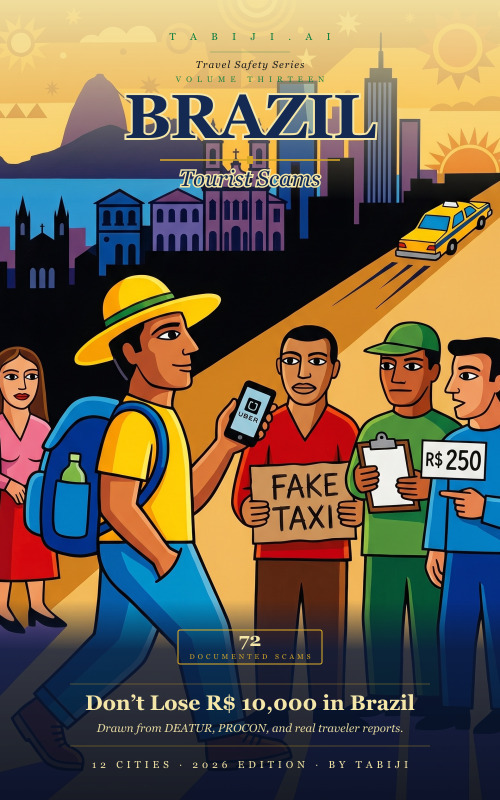
You just read 6 scams in Sao Paulo. The book has 66 more across 12 Brazilian destinations.
Rio Galeão's R$ 250 "Special Taxi" kiosk mafia. Lapa's R$ 10,000 caipirinha-bar honeypot. Salvador Pelourinho's fita do Senhor do Bonfim ribbon-tying forced-tip. Manaus's PIX-irreversible jungle-lodge booking fraud. Every documented Brazil scam — with the exact scripts, red flags, and Brazilian Portuguese phrases that shut each one down. Drawn from DEATUR tourist police, PROCON, IBAMA, and real Reddit traveler reports.
- 72 documented scams across Rio, São Paulo, Salvador, Manaus & 8 more cities
- A Brazilian Portuguese exit-phrase card you can screenshot to your phone
- Updated annually — buy once, re-download future editions free
- Readable in one flight — $4.99 on Amazon Kindle