
Key Takeaways
- The #1 reported scam is the Taxi Card-Swap Fraud.
- 3 of 7 scams are rated high risk.
- Use app-based ride services (Uber, Lyft) instead of unmarked vehicles or unlicensed cabs.
- Never accept unsolicited offers from strangers near tourist sites in Toronto.
⚡ Quick Safety Tips
- In Toronto taxis, ONLY tap — never insert+PIN; and TPS bulletin thread document the $500k+ card-swap ring; pay with Uber/Lyft app or tap credit card on a visible-to-you reader only.
- Apply for your Canada eTA ONLY at canada.ca/eta ($7 CAD direct); any 'Canada eTA' site other than canada.ca is a third-party markup or outright phishing.
- Keep phones in front pockets and OFF restaurant tables at Yonge-Dundas Square, Eaton Centre, and especially Kensington Market name these as current hot zones.
- Hang up on anyone calling claiming to be Toronto Police about your SIN or bank; TPS never calls about SIN fraud. Real TPS non-emergency is 416-808-2222.
- Book accommodation ONLY via Airbnb/Vrbo/Booking document the Toronto Airbnb-to-Kijiji re-list MO where scammers book real Airbnbs then re-list them as long-term rentals.
Jump to a Scam
- High Taxi Card-Swap Fraud
- High Fake eTA Visa Websites
- Medium Pickpocketing at Yonge-Dundas Square and Eaton Centre
- High Airbnb Permit Hijacking and Fake Rental Listings
- Medium Fake Police Identity Check
- Medium TTC Transit Ticket and Presto Card Scams
- Medium Impersonation Phone Scams Targeting Hotel Guests
The 7 Scams
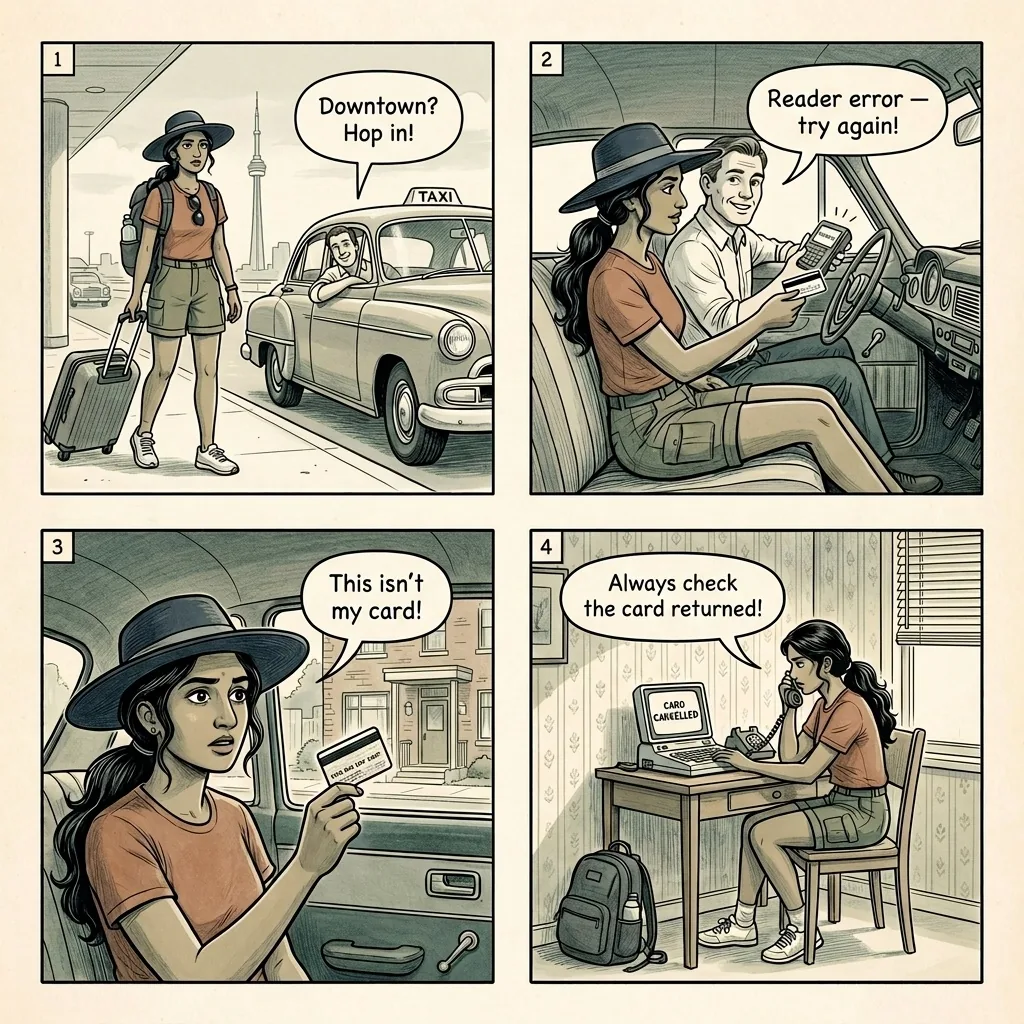
A King Street taxi driver tells you the tap reader is broken and asks you to insert your card and enter your PIN — while you fumble, he swaps your debit card for a dummy and accomplices drain your accounts over the next 48 hours. Toronto Police's "Project Fare" linked 300+ incidents and over $500,000 in losses in just 10 months.
You leave a show in the Theatre District around 11 p.m. and hail a taxi on King Street. The driver is friendly and chatty. When you arrive at your hotel, he hands you a card reader and says the tap function is broken — you'll need to insert your card and enter your PIN. While you fumble with the reader, the driver deftly swaps your debit card for an identical-looking dummy card. He hands you back the dummy, you assume the transaction is done, and you head inside.
Over the next 48 hours, accomplices use your real card and PIN to withdraw thousands from ATMs, deposit fraudulent checks to inflate your balance, and make high-value purchases at electronics stores. By the time you try to use your card and discover the swap, the fraud ring has cleaned out your account and moved on to the next mark. Most victims don't realize what happened until they receive their bank statements.
Toronto Police launched "Project Fare" in July 2024 after receiving dozens of reports. The investigation identified over 300 incidents of this exact scam, resulting in 11 arrests and 108 charges. The fraudsters scammed taxi customers out of more than $500,000 in 10 months. CBC News reported that the suspects specifically targeted areas frequented by tourists — particularly people leaving shows in the Theatre District or exiting bars in King West. The fraud ring bought fake taxi signs and vehicle decals from Amazon to make their personal cars look like licensed cabs. Pay with cash or tap your credit card — never insert your debit card or enter your PIN in a taxi reader. If you must use a card, keep your eyes on it the entire time and verify the last 4 digits when it's returned. Use Uber or Lyft for late-night rides — app-based services don't require physical card handling.
Red Flags
- The driver says contactless tap payment is broken and insists you insert your card and enter your PIN
- The driver takes your card out of sight — behind a partition, under the dashboard, or into a second reader
- The cab picks you up outside a nightlife or entertainment venue late at night when you're tired or intoxicated
- The vehicle's taxi markings look new or slightly off — the decals may be aftermarket purchases from Amazon
- The driver refuses cash payment, which is unusual — legitimate taxi drivers always accept cash
How to Avoid
- Pay with cash or tap your credit card — never insert your debit card or enter your PIN in a taxi card reader.
- If you must use a card, keep your eyes on it the entire time and verify the card returned to you is yours by checking the last 4 digits.
- Use Uber or Lyft instead of street-hail taxis, especially at night in entertainment districts — app-based rides don't require card handling.
- A legitimate taxi driver will never refuse cash — if they do, get out of the cab and report the vehicle number.
- Check that the taxi has a proper City of Toronto license plate, a visible driver ID card, and a functional meter.
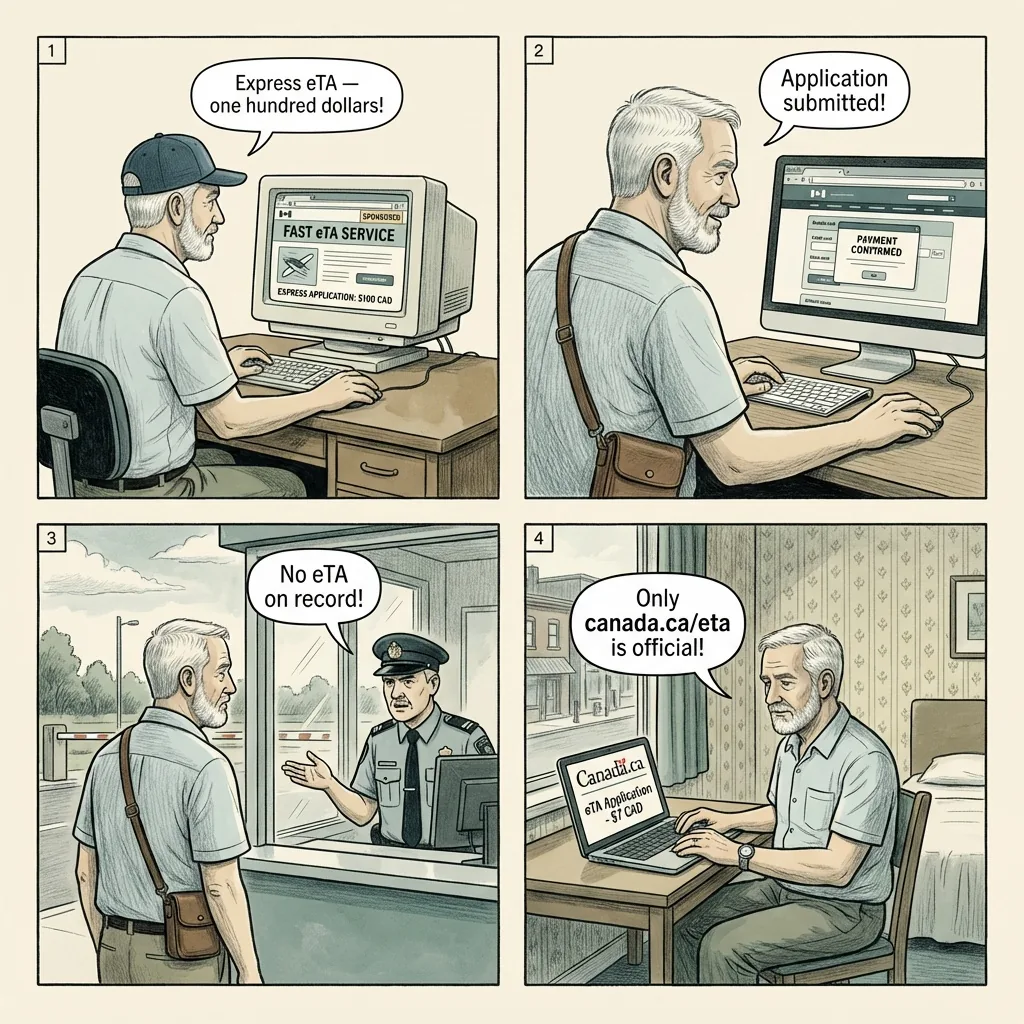
A Google search for "Canada eTA" returns paid-ad sites like etravelcanada.org charging $89–$120 for the $7 official application — they simply submit the same form you could file yourself at canada.ca/eta, and the Government of Canada won't refund the markup.
You're planning a trip to Toronto from the UK and search "Canada eTA application" on Google. The top results include several professional-looking websites with Canadian flag branding and government-style layouts. You click one — etravelcanada.org — and fill out the application form with your full name, passport number, and credit card details. The site charges you $107 CAD.
You later discover that the official Government of Canada eTA costs just $7 CAD, and you've paid $100 extra to a third-party site that simply submitted the same application you could have done yourself on the official canada.ca/eta website. VisaHQ reported in October 2025 that a single traveler was charged $107 for an eTA that costs $7 — a 1,429% markup. TripAdvisor's Canada forum has an entire thread warning about etravelcanada.org specifically; on Trustpilot, visaetacanada.org has reviews from travelers charged $89–$120 USD for the $7 application.
The scam sites use SEO techniques and paid Google ads to appear above the official government website in search results. Some sites go further — Anomali cybersecurity researchers identified phishing operations that spoof the Canadian eTA site to steal passport data and credit card numbers for identity theft. The Government of Canada has stated it does not issue refunds for fees charged by these third-party websites, leaving victims with no recourse. Apply for your eTA ONLY at canada.ca/eta — verify the URL ends in .gc.ca before entering any personal information, and ignore all Google ads at the top of search results. If you've already been charged by a third-party site, file a chargeback with your credit card company immediately.
Red Flags
- The website URL does not end in.gc.ca — the only official eTA site is canada.ca/eta
- The site charges more than $7 CAD for the eTA application
- The site appears as a paid advertisement at the top of Google search results
- The application asks for information beyond what's needed — such as hotel bookings, bank details, or a selfie photo
- The site uses language like 'processing service' or 'expedited review' to justify the extra fee
How to Avoid
- Apply for your eTA ONLY at the official Government of Canada website: canada.ca/eta — the fee is $7 CAD.
- Ignore all Google ads when searching for 'Canada eTA' — scroll past them to find the official.gc.ca result.
- Verify the URL ends in.gc.ca before entering any personal information.
- If you've already been charged by a third-party site, file a chargeback with your credit card company immediately.
- Check IRCC's official help page if you're unsure — they confirm there is 'only one official website' for eTA applications.

A pickpocket couple at Yonge-Dundas Square works as a team — one bumps you from behind on the busy crossing while the other lifts your phone from a back pocket or open bag. Toronto Police issued a December 2025 holiday-season warning specifically about Eaton Centre and downtown events.
You're crossing Yonge-Dundas Square — one of Toronto's busiest intersections — when you feel a slight bump from behind. You think nothing of it; the square is always crowded, especially during Eaton Centre rush hours and special events. You keep walking. Five minutes later, when you reach for your phone, your back pocket is empty. Your iPhone Pro Max is gone.
A viral video later circulates on social media showing a couple working the square as a pickpocket team, with one distracting pedestrians while the other lifts phones and wallets from pockets and open bags. The bump is the misdirect — your attention goes to the apology while a hand goes into your pocket. By the time you process what happened, the pair have separated and walked away in different directions.
Toronto Police issued a public warning in December 2025 about an uptick in pickpocketing in the downtown core during the holiday season, specifically targeting shoppers at Eaton Centre and attendees at special events. NOW Toronto published video footage of pickpockets caught on camera operating at Yonge-Dundas Square. A 2022 police investigation tracked two individuals who conducted "pickpocket-style" thefts at downtown nightclubs for months, stealing phones from jacket pockets hung on chairs. CTV News reported a new wave of "distraction thefts" in 2024 with thieves increasingly working in pairs or groups. Keep your phone in a front zipped pocket and wear a crossbody bag in front at Yonge-Dundas Square, Eaton Centre, and on the TTC — never hang a jacket with your phone on a nightclub chair.
Red Flags
- Someone bumps into you in a crowded area and apologizes excessively while their hand brushes your pocket or bag
- A stranger approaches with a clipboard, flyer, or question that requires you to stop and look down — creating a window for an accomplice
- Your bag or purse is hanging open on your shoulder or behind you in a crowded space like Eaton Centre
- Someone stands unusually close to you on the TTC subway or streetcar, especially during rush hour
- A group of people suddenly crowds around you in a way that feels unnatural — one may be reaching for your belongings
How to Avoid
- Keep your phone in a front pocket, preferably buttoned or zipped, not in a back pocket or open purse.
- Use a crossbody bag worn in front at Yonge-Dundas Square, Eaton Centre, and on the TTC.
- At nightclubs and bars, never leave your jacket with your phone in the pocket hanging on a chair — keep valuables on your body.
- Be especially vigilant during holiday shopping season (November-January) when police report the highest pickpocketing rates.
- If someone bumps into you or creates a sudden distraction, immediately check your pockets and secure your belongings.

An Entertainment District Airbnb at $150/night with a valid Toronto registration number turns out to be a scammer's listing using a stolen permit — police knock on the door two days in to evict you. Toronto renters lost $2.3 million to rental scams in 2025.
You book what looks like a beautiful condo in Toronto's Entertainment District on Airbnb for $150/night — a great deal for the neighborhood. The listing has a valid City of Toronto short-term rental registration number, professional photos, and good reviews. You arrive, the lockbox code works, the apartment matches the photos. Everything seems fine.
Two days into your stay, police knock on the door. The real property owner has reported an unauthorized occupant. The listing was created by a scammer who stole a legitimate host's registration number from the City's public database and used it to post a fraudulent listing. CBC News exposed how Airbnb "pirates" hijack real permits to post fake Toronto listings: the City of Toronto made all 6,277 short-term rental registration numbers publicly available online along with partial postal codes, creating a goldmine for scammers who can clone convincing listings.
Global News reported a New Zealand couple booted by police after their Toronto Airbnb turned out to be unauthorized. The Daily Dot covered a woman scammed by a Toronto Airbnb that gave her the wrong address — affecting multiple victims at the same property. Toronto renters lost $2.3 million to rental scams in 2025 according to Cottage Life, with fake listings appearing on Kijiji and Facebook using stolen photos and permit numbers. The most sophisticated version involves scammers renting a real Airbnb for a week, then listing it as a long-term rental on Kijiji, collecting multiple deposits, and vanishing. Book only through Airbnb or VRBO's official platform and never pay outside the app — the platform's payment protection only works for in-app transactions. For long-term Toronto rentals, verify the landlord's identity through the Ontario Land Registry and visit the property in person before paying.
Red Flags
- The listing price is 30-50% below comparable rentals in the same Toronto neighborhood
- The host's profile is new with few or no reviews despite the listing having a valid registration number
- The host insists on communicating or paying outside the Airbnb or VRBO platform
- The listing photos look professional but a reverse image search shows them on a different property management website
- The host asks for extra deposits, 'security fees,' or advance payment via e-Transfer or wire
How to Avoid
- Book only through Airbnb or VRBO's official platform and never pay outside the app — the platform's payment protection only works for in-app transactions.
- Check the host's profile for a long history of reviews across multiple listings — new accounts with zero reviews are higher risk.
- For long-term Toronto rentals, verify the landlord's identity through the Ontario Land Registry and visit the property in person before paying.
- Cross-reference the listing photos using Google Reverse Image Search to check if the images appear elsewhere.
- If a deal seems too good for downtown Toronto, especially in Liberty Village or the Entertainment District, investigate thoroughly before booking.

Two men near the CN Tower flash police badges, claim they're investigating counterfeit currency, and ask to "verify" the bills in your wallet — they palm several large bills and substitute smaller ones, and you only notice the loss at dinner. Real Canadian police never inspect tourist wallets on the street.
You're walking near the CN Tower with a camera around your neck and a map in your hand — clearly a tourist, the easiest possible mark. Two men in plain clothes approach and flash what appears to be a police badge. One says they're investigating counterfeit currency in the area and need to check your wallet. The other positions himself behind you, just outside your peripheral vision.
The first man asks you to hand over your wallet so he can "verify" your bills. He rifles through it slowly, holds several notes up to the light as if checking watermarks, and palms several large bills while substituting them with lower-denomination notes from his own pocket. He thanks you for your cooperation and the pair walk away briskly. You only realize money is missing when you open your wallet at dinner that night.
This scam, documented on TripAdvisor and GoDigit's Canada tourist-scam guide, typically involves two scammers working as a team — one plays the "officer" while the other acts as either a second officer or a suspect who has already been "cleared." Blogto.com's 2024 piece "Toronto scams are getting out of hand" describes how scams targeting tourists have become increasingly brazen. Canadian police will never ask to inspect your wallet on the street, never conduct currency checks on random pedestrians, and always carry proper photo identification — not just a badge. Never hand your wallet, cash, or documents to anyone on the street — if approached, ask to walk to the nearest police station together to verify their identity, and call Toronto Police non-emergency (416-808-2222) to confirm any active operation.
Red Flags
- Plain-clothes individuals flash a badge quickly without allowing you to read it or note the badge number
- They ask to see your wallet, cash, or credit cards to 'check for counterfeits' or 'verify identity'
- They approach you specifically in a tourist area where you're clearly a visitor — carrying a camera, consulting a map
- There's no police car visible nearby and no uniformed officers present
- They become aggressive or insistent when you hesitate, saying you're 'obstructing an investigation'
How to Avoid
- Never hand your wallet, cash, or documents to anyone on the street — real police will not conduct wallet inspections.
- Ask to see official photo identification, not just a badge, and note the officer's name and badge number.
- If approached, say you'd like to walk to the nearest police station together to verify their identity — real officers will agree.
- Call Toronto Police non-emergency (416-808-2222) to verify if any operation is happening in the area.
- Keep walking if something feels wrong — scammers rely on compliance and will not follow you into a busy store or hotel.

A "helpful" stranger at a Union Station TTC fare machine offers you a pre-loaded Presto card for $20 with "$30 on it" — the card actually has exactly one $3.35 fare and you're stranded at the first transfer. A single TTC fare is $3.35 and Presto cards are sold only at official sources.
You're standing at a TTC fare machine at Union Station looking confused by the Presto card system. The interface is unfamiliar, the line behind you is growing, and you're trying to figure out whether to load a single fare or buy a day pass. A helpful stranger steps over and offers a hand. He says the machine is broken and offers to sell you a loaded Presto card for $20 — "it has $30 on it, so you're getting a deal."
You buy the card, tap into the subway, and it works — green light, you're through. The card had exactly one $3.35 fare on it; the stranger swiped through to confirm it was active before selling it. Your next tap at Bloor-Yonge for a transfer to the Yellow Line is declined. The stranger is nowhere to be found, and you've paid $20 for a card worth $3.35 in actual fare.
GoDigit's Canada tourist-scam guide specifically warns about metro-ticket scams in Toronto where scammers approach confused tourists and offer to "help" them buy tickets, substituting fake or empty cards. A variation involves someone offering to "tap you in" with their card for $2 cash — they tap a card that's already been reported lost (and will be deactivated), pocketing your money while you get stranded. Legitimate Presto cards are sold at Shoppers Drug Mart locations and TTC fare machines — there is never a reason to buy one from a stranger. Use contactless tap payment (credit card, debit, Apple Pay, Google Pay) directly at the TTC fare gate — you don't need a Presto card at all, and a single adult fare is $3.35 fixed. If a fare machine genuinely seems broken, ask a TTC employee in a red vest.
Red Flags
- A stranger approaches you at a fare machine offering to sell you a Presto card or help you buy a ticket
- They claim the fare machine is broken or that there's a 'faster' way to pay
- The offered Presto card price is suspiciously above or below the official cost ($6 for the card plus loaded fare)
- Someone offers to tap you through the fare gate for cash, bypassing the normal purchase process
- The card they offer doesn't look like a standard Presto card or has visible wear suggesting it's been passed around
How to Avoid
- Buy Presto cards only from official sources: TTC fare machines, Shoppers Drug Mart, or the Presto website.
- Download the Presto app to load fare and check balances on your phone — no physical card interactions needed.
- A single adult TTC fare is $3.35 — know the price so you can't be overcharged by a 'helpful' stranger.
- Use contactless tap payment (credit card, debit, Apple Pay, Google Pay) directly at the fare gate — you don't need a Presto card at all.
- If someone says a fare machine is broken, check it yourself or ask a TTC employee in a red vest.

An 11 p.m. call to your Toronto hotel room "from the front desk" claims a system error with your credit card and asks you to confirm the number and CVV — by morning, thousands in charges hit your card from GTA electronics stores. The hotel already has your card on file; they never call to re-verify.
You're in your Toronto hotel room around 11 p.m., tired from a day of sightseeing and packing for a 7 a.m. flight, when the phone rings. The caller says they're from the front desk and there's been a "system error" with your credit card — they need you to confirm the card number, expiry, and CVV to avoid your reservation being canceled. The voice is calm and professional. The caller ID even shows the hotel's name.
You read out the numbers. The call ends quickly with a polite thank-you. The next morning, there are thousands of dollars in charges on your card from electronics stores and gift card purchases across the GTA. The "front desk" was a scam-call operation that randomly targets hotel rooms — some spoof the hotel's own phone number so it appears on the caller ID as an internal call. The hotel actually has your card on file from check-in; they never need to re-verify it over the phone.
Toronto Police warned of a surge in fraudulent impersonation calls in 2023–2024, with hotel guests among the targeted groups. NOW Toronto reported on the trend, quoting a Reddit user who described a "disturbingly realistic" call involving the impersonation of a Toronto Police sergeant using a cloned phone number from a real police division, complete with a false badge number. The hotel-room version is simpler but equally effective — late-night calls plus urgency plus claimed authority equals quick compliance. Never give your credit card number, CVV, or PIN over the phone to anyone claiming to be from the hotel — hang up and walk to the front desk in person to verify. Put your phone on do-not-disturb after 10 p.m. to block social-engineering attempts entirely.
Red Flags
- An incoming call claims to be from the hotel front desk asking for your credit card number, CVV, or PIN
- The caller creates urgency — 'your card was declined,' 'your reservation will be canceled,' 'we need verification now'
- The call comes late at night when you're likely tired and less likely to question the request
- The caller asks you to 'verify' your full card number by reading it back — the hotel already has it from check-in
- The caller asks you to go to a nearby ATM to resolve the issue or to purchase gift cards
How to Avoid
- Never give your credit card number, CVV, or PIN over the phone to anyone claiming to be from the hotel — hang up and call the front desk directly.
- If you receive a suspicious call, hang up and walk to the front desk in person to verify.
- Ask the hotel at check-in whether they ever call rooms to request credit card information — the answer will always be no.
- Put your phone on do-not-disturb after 10 PM to avoid late-night social engineering attempts.
- Report any suspicious calls to hotel management and Toronto Police non-emergency at 416-808-2222.
🆘 What to Do If You Get Scammed
📋 File a Police Report
Go to the nearest Toronto Police Service station. Call 911 for any emergency, or Toronto Police non-emergency 416-808-2222. Get an official crime report — you'll need this for insurance claims. You can also report online at Toronto Police Online Reporting.
💳 Cancel Your Cards
Call your bank immediately. Most have 24/7 numbers on the back of the card (keep a photo saved separately). Block any suspicious transactions before the thieves use your details.
🛂 Lost Passport?
Contact your country's consulate in Toronto. The U.S. Consulate General is at 360 University Ave (416-595-1700). For UK citizens, the British Consulate is at 777 Bay Street (416-593-1290).
📱 Track Your Device
If your phone was stolen, use Find My (iPhone) or Find My Device (Android) from another device. Don't confront thieves yourself — share the location with police instead.
Frequently Asked Questions
You just read 7 scams in Toronto. The book has 68 more across 12 Canadian destinations.
Toronto Pearson's Uber cancel-and-cash. Montreal's winter parking-tow trap. Whistler's CBC-documented QR-sticker parking fraud. Calgary Stampede's ticket-scalper fakes. Banff's Pursuit Collection American-pricing overcharge. Every documented Canada scam — with the exact scripts, red flags, and English and French phrases that shut each one down. Drawn from Globe and Mail, Toronto Star, CBC News, CTV News, and Canadian Anti-Fraud Centre records.
- 75 documented scams across Toronto, Montreal, Vancouver, Banff & 8 more Canadian cities
- An English + French exit-phrase card you can screenshot to your phone
- Updated annually — buy once, re-download future editions free
- Readable in one flight — $4.99 on Amazon Kindle