
Key Takeaways
- The #1 reported scam is the Fake Monks Donation Scam.
- 2 of 7 scams are rated high risk.
- Use app-based ride services (Uber, Lyft) instead of unmarked vehicles or unlicensed cabs.
- Never accept unsolicited offers from strangers near tourist sites in Vancouver.
⚡ Quick Safety Tips
- Book airport transport via the YVR-posted fixed-zone taxi rate or the official Uber/Lyft pickup zone documents in-terminal touts walking tourists to unmarked cars; refuse anyone offering 'Uber' inside the terminal.
- Don't give cash to 'monks' in robes on Granville Street, Robson/Bute, or Gastown confirm: real Buddhist monks never solicit cash and never hand out blessing cards with a gold bracelet.
- Hang up on anyone calling claiming to be Vancouver Police or your bank's fraud department documents the 2025 elaborate scam script; call 311 or VPD non-emergency 604-717-3321 direct to verify.
- Check the parking meter's screen shows paid time BEFORE walking away and Don't scan unsolicited QR stickers; use the official PayByPhone app downloaded from the App Store.
- Book rentals ONLY via Airbnb/Vrbo/Booking — Never Craigslist or Facebook Marketplace; Traveler reports confirms the overseas-landlord first-and-last e-transfer scam is still active.
Jump to a Scam
The 7 Scams

Saffron-robed "monks" work Granville Street, Canada Place, and Gastown pressing small "gift" cards with Buddhist symbols into tourists' hands and pointing to laminated photos of orphanages — the donation goes nowhere; real Buddhist monasteries do not solicit cash on city streets, every legitimate Canadian charity has a registered CRA charity number, and the scam relies entirely on the physical-gift-creates-obligation play (refuse the gift, no scam).
You were walking down Granville Street when two men in saffron robes approached you with warm smiles, pressed a small 'gift' card with Buddhist symbols into your hand, and began chanting softly. They pointed to a laminated card showing an orphanage in Southeast Asia and gestured that they needed donations for the children. The whole encounter was so disarmingly peaceful that you handed over $20. Later you discovered there was no monastery, no orphanage — just organized scammers. A traveler report titled 'Scam alert: fake monks on Granville Street' had locals sharing the exact same encounter, with replies confirming the same 'monks' had been working the street for months. Don't accept anything pressed into your hands — politely decline while still walking. Real Buddhist monasteries don't fundraise on city streets with these tactics; if you want to donate to a legitimate cause, ask for the registered CRA charity number (every Canadian charity is registered). Simply keep walking — they don't persist aggressively if you don't engage. The scam relies entirely on the initial physical gift creating obligation, so refuse the gift and there's no scam.
Red Flags
- Monks who actively approach tourists rather than standing quietly
- Physical contact — pressing beads, cards, or bracelets into your hands
- Laminated cards with orphanage or charity photos rather than official registered charity documentation
- Requests for cash only rather than directing you to a website or official donation portal
- Multiple 'monks' working together with coordinated approaches
How to Avoid
- Don't accept anything pressed into your hands — politely decline while still walking.
- Real Buddhist monasteries don't fundraise on city streets with these tactics.
- If you want to donate to a legitimate cause, ask for the registered charity number (all Canadian charities are registered).
- Simply keep walking — they don't persist aggressively if you don't engage.
- The scam relies entirely on the initial physical gift creating obligation — refuse the gift and there's no scam.

Vancouver Chinatown (Pender Street), Richmond, and busy shopping areas host the Cantonese-language "blessing scam" — an older woman urgently asks for help with "found valuables," a second woman appears to translate, and a switched bag of paper replaces your cash and jewelry; CBC reported Vancouver victims lost ~$150K in a single year, with Chinese-heritage tourists specifically targeted. Walk away — no legitimate ritual requires your valuables, and the on-cue "translator" is the instant tell.
An older woman approached you near Vancouver's Chinatown on Pender Street, speaking urgently in Cantonese and pointing at a small bag she was holding. A second woman materialized to translate — apparently the first woman had found a large amount of 'valuables' and needed help carrying or blessing them to avoid 'bad luck.' The ritual involved putting your own cash or jewelry into a bag for a brief 'blessing,' then switching bags. By the time you realized the bag you walked away with contained nothing but paper, both women had vanished. CBC reported Vancouver victims lost nearly $150K in these blessing scams in a single year — real, documented cases from multiple neighborhoods. Walk away immediately — there is no legitimate reason a stranger needs your valuables for any ritual. The introduction of a convenient "translator" is an instant red flag. Never let your cash, jewelry, or bag out of your direct visual control. Report these encounters to the Vancouver Police Department (VPD) non-emergency at 604-717-3321 — they actively investigate; warn other tourists if you see this happening, since a watching crowd tends to scatter the scammers.
Red Flags
- A stranger claiming to have found valuables and needing your help with a 'blessing'
- Sudden appearance of a 'translator' who happens to be nearby
- Any ritual involving placing your own valuables or cash into a shared bag
- Urgency and claims of spiritual consequences for not participating
- Often targets tourists who appear to be of Chinese or Asian heritage
How to Avoid
- Walk away immediately — there is no legitimate reason a stranger needs your valuables for any ritual.
- The introduction of a convenient 'translator' should be an instant red flag.
- Never let your cash, jewelry, or bag out of your direct visual control.
- Report these encounters to Vancouver Police Department (VPD) at 604-717-3321 — they actively investigate.
- Warn other tourists if you see this happening — a crowd watching tends to scatter the scammers.
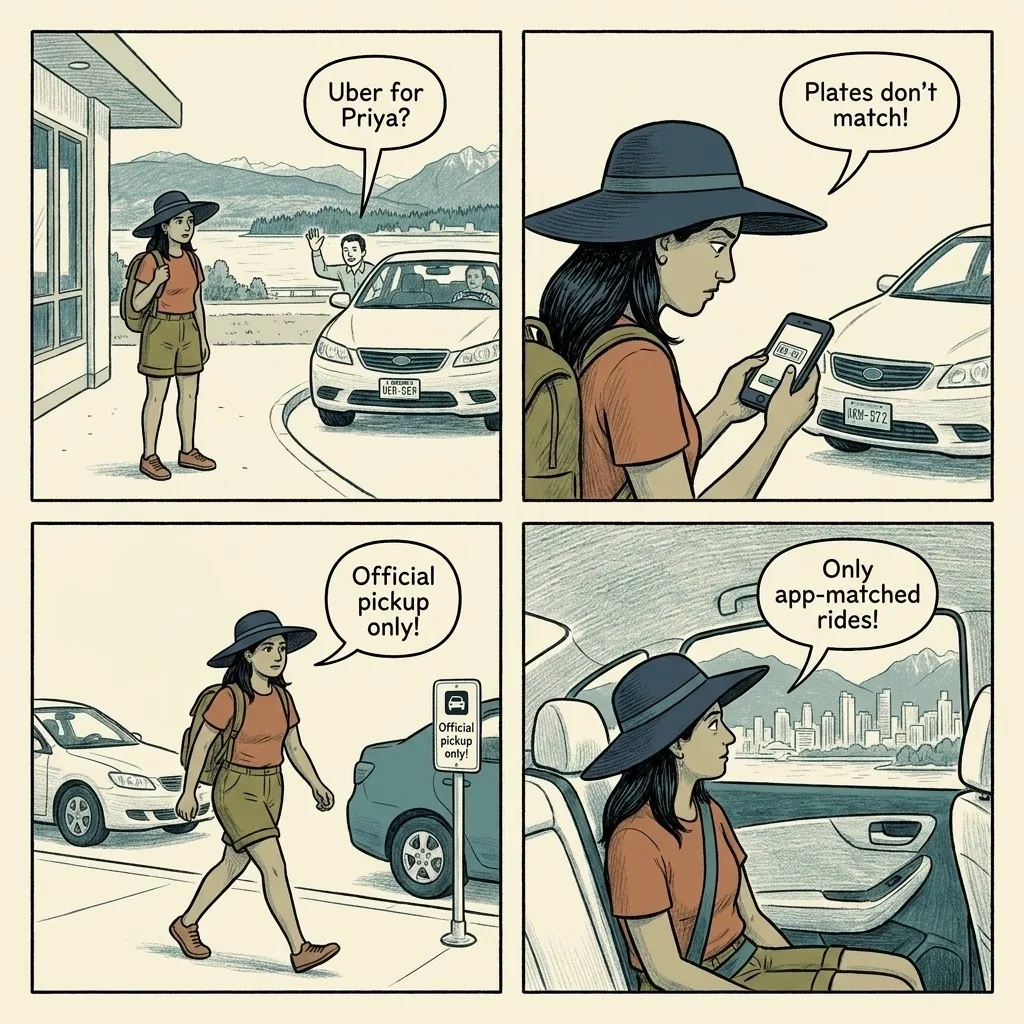
YVR (Vancouver International Airport) arrivals see fake-rideshare drivers position with phones showing arriving passengers' names, charge $80+ flat cash instead of metered fares, and claim "the app had an error" to bypass in-app payment; YVR has designated Uber/Lyft pickup zones (Level 1 domestic, Level 2 international) — go there, verify plate/make/model/driver-photo against your app before boarding, and refuse cash payment. The Canada Line SkyTrain runs YVR → downtown Vancouver for $4.55 (often faster than driving).
When you got outside, a man was standing with a phone showing your name — but something felt slightly off. The car didn't match the plate on your app and the driver said the app 'had an error.' You got in anyway because you were tired and had heavy bags. The driver charged you a flat $80 cash instead of the metered fare and refused to process the in-app payment. A traveler report titled 'Uber driver scamming tourists at YVR — how to report?' documented this exact scenario, with the driver positioning himself to intercept legitimate Uber requests. Always verify plate number, car model, and driver photo against your app BEFORE getting in — if any detail doesn't match, cancel the ride and request again. YVR has designated Uber/Lyft pickup zones on Level 1 (domestic) and Level 2 (international); go there, don't meet drivers at arrivals. Legitimate drivers are paid through the app — refuse any cash payment request. The Canada Line SkyTrain runs directly from YVR to downtown Vancouver for $4.55 and is often faster than driving in traffic.
Red Flags
- Driver's car doesn't match the make, model, or plate shown in your app
- Driver requests cash payment despite being a 'rideshare'
- Claims the app is broken or having an 'error' — this is almost never true
- Driver approaches you rather than waiting in the designated rideshare pickup area
- Pressure to get in the vehicle before you've verified all details
How to Avoid
- Always verify plate number, car model, and driver photo against your app BEFORE getting in.
- If any detail doesn't match, cancel the ride and request again.
- YVR has designated Uber/Lyft pickup zones on Level 1 (domestic) and Level 2 (international) — go there, don't meet drivers at arrivals.
- Legitimate drivers are paid through the app — refuse any cash payment request.
- The Canada Line SkyTrain runs directly from YVR to downtown Vancouver for $4.55 — often faster than driving.

Canada Place waterfront and the Gastown Steam Clock area host street magicians who pull tourists from the audience for a "special trick," then use crowd-pressure humor to extract $40+ "VIP prices" for what should have been a $5 tip — watch from the edges of the crowd (less likely to be pulled in), decide your tip in advance ($2–$5 is generous), and remember "I only have $5" is a complete sentence; performers are salespeople, not muggers.
He was funny, engaging, and genuinely skilled. When the performance ended, he circled the crowd with a hat — totally reasonable. But then he pulled you specifically from the audience for a 'special trick,' made you feel like the star, and when it was over, made a joke about how you'd enjoyed the 'VIP experience' and should pay 'VIP prices.' The social pressure of the crowd watching made you hand over $40 for what you thought would be a $5 tip. A traveler report 'Street scam at Canada Place' had multiple people describing this exact dynamic. Watch street performances from the edges of the crowd (not the front) — you're less likely to be pulled in. Decide in advance what you'd pay for a street show ($2–$5 is generous) and only carry that in your pocket. You can always say "I only have $5" — performers are salespeople, not muggers; they'll take it. If you don't want to tip at all, walking away is absolutely fine. Street performance is legal in Vancouver — just watch the hat-passing cue as your signal to leave.
Red Flags
- Performer who singles you out from the audience and creates a special 'moment'
- Humor and crowd pressure used to make you feel obligated
- No price discussed before the audience participation
- Performer physically closer to you than to others in the crowd
- Other apparent 'audience members' who seem to be prompting your reactions
How to Avoid
- Watch street performances from the edges of the crowd, not the front — you're less likely to be pulled in.
- Decide in advance what you'd pay for a street show (usually $2-5 is generous) and only carry that in your pocket.
- You can always say 'I only have $5' — performers are salespeople, not muggers; they'll take it.
- If you don't want to tip at all, don't feel obligated — walking away is absolutely fine.
- Street performance is legal in Vancouver — just watch the hat-passing cue as your signal to leave.

Downtown Vancouver Impark and similar private-parkade operators issue $40–$75 "penalty notices" claiming improper ticket display when you actually paid — these are technically unenforceable civil matters in BC (cannot affect credit score or license) but look official enough that tourists pay the "discounted" $40 immediately by phone; photograph your dashboard ticket when parking, use the City of Vancouver PayByPhone app for street parking instead, and dispute private-parking notices in writing.
When you returned an hour later, there was a $75 penalty notice claiming you hadn't displayed your ticket correctly, even though it was clearly visible. When you called the number on the notice, they said you could avoid the fine going to collections by paying $40 immediately by credit card. Locals on traveler reports in a thread titled 'Downtown Vancouver Impark parkade scam' described exactly this — fake or unjustified penalty notices from Impark parking that are technically unenforceable but look official enough that tourists pay them. Private parking penalty notices in BC are technically unenforceable civil matters — they cannot affect your credit score or license. Take a photo of your properly displayed ticket on the dashboard when you park; read the full notice carefully (if it says "Parking Notice" from a private company, it is NOT an official ticket). Use the City of Vancouver's PayByPhone app for street parking instead of private lots; if you receive a notice, you can dispute it in writing — many people do, and the notices simply disappear.
Red Flags
- Penalty notices from private parking companies that are disproportionately large
- Notice claims a minor violation (improper display) rather than no payment at all
- Offer to reduce the fine immediately if you pay by phone right now
- No government agency name on the notice — private parking companies cannot fine you like police
- Threats about 'collections' or credit score impact to create fear
How to Avoid
- Private parking penalty notices in BC are technically unenforceable civil matters — they cannot affect your credit score or license.
- Take a photo of your properly displayed ticket on your dashboard when you park.
- Read the full notice carefully — if it says 'Parking Notice' from a private company, it is NOT an official ticket.
- Use the City of Vancouver's app (PayByPhone) for street parking instead of private lots.
- If you receive one, you can dispute it in writing — many people do and the notices simply disappear.

Craigslist and Facebook Marketplace short-term rental listings show stunning False Creek / Yaletown / Coal Harbor views at below-market $120/night rates, demand first-and-last-month deposits via e-Transfer (no payment platform), and disappear with the money — access codes don't work, phone numbers disconnect, and concierges have never heard of the "host"; book only through Airbnb, VRBO, or Booking.com with platform card payment, never wire or e-Transfer to a stranger, and reverse-image-search every listing photo.
The listing photos showed a stunning view of False Creek and the price of $120/night seemed fair for the location. The host asked for the first and last month's deposit via e-Transfer before sending the access code. The code didn't work. The phone number was disconnected. The apartment building's concierge had never heard of the host. You'd lost $2,400 before even arriving. A traveler report titled 'Rental Scams in Vancouver' documented this as a pervasive problem, particularly around peak travel season when legitimate short-term inventory is limited. Book short-term stays only through platforms with payment protection: Airbnb, VRBO, or Booking.com. Never send money via e-Transfer or wire to a stranger for accommodation — there is no protection or recourse in Canada. Do a reverse image search on all listing photos before committing; ask for a video call walkthrough of the property before sending any deposit. If the listing appeared in the last few days and has no reviews, extreme caution is warranted — Craigslist and Facebook Marketplace short-term-rental listings are the highest-risk channel.
Red Flags
- Listings on Craigslist or Facebook Marketplace for fully furnished short-term rentals at below-market prices
- Host requests e-Transfer, wire transfer, or gift cards rather than a secure payment platform
- Host claims to be 'out of the country' or unavailable to show the unit in person
- Photos that appear to be from a different property (do a reverse image search)
- Urgency — 'I have three other people interested, I need a decision today'
How to Avoid
- Book short-term stays only through platforms with payment protection: Airbnb, VRBO, Booking.com.
- Never send money via e-Transfer to a stranger for accommodation — there is no protection or recourse.
- Do a reverse image search on all listing photos before committing.
- Ask for a video call walkthrough of the property before sending any deposit.
- If the listing appeared in the last few days and has no reviews, extreme caution is warranted.

Fake "police officers" in non-VPD uniform flash badges quickly in Gastown, Stanley Park entrances, the Canada Place waterfront, and Granville Island approach streets, claiming "community outreach" or "gas money for going home" — the Vancouver Sun documented this as "phoney cops scamming money from tourists"; real Vancouver police never solicit cash from citizens, ask to examine the ID slowly, and verify by calling VPD non-emergency at 604-717-3321 from your phone.
They spin a story — they are doing community outreach, need directions money for gas, or are collecting for a police charity. They look official enough to create hesitation. The Vancouver Sun reported on 'phoney cops scamming money from tourists in Vancouver.' The scams range from short stories requiring directions followed by asking for $10, to more elaborate schemes requiring gas money to get home. The individuals may carry fake badges and uniform-style clothing. Real Vancouver police officers never ask civilians for money — any such request is a scam. Ask to see their police ID slowly and clearly (real officers carry official identification and will show it properly); if in doubt, call the VPD non-emergency line at 604-717-3321 from your phone to verify the officer's identity. Walk toward a busy, well-lit area if you feel uncomfortable, and report fake officers to the real police by calling 911 or visiting the nearest VPD station.
Red Flags
- Someone approaches you and flashes a badge or ID card quickly without letting you examine it
- The 'officer' is not in a standard Vancouver Police Department uniform
- They ask for money for any reason — real police never solicit cash from citizens
- The story involves personal hardship or a need for your financial help
- They become evasive if you say you want to call the VPD non-emergency line to verify their identity
How to Avoid
- Real Vancouver police officers never ask civilians for money — any such request is a scam.
- Ask to see their police ID slowly and clearly — real officers carry official identification and will show it properly.
- If in doubt, call the VPD non-emergency line at 604-717-3321 to verify the officer's identity.
- Walk toward a busy, well-lit area if you feel uncomfortable with the interaction.
- Report fake officers to the real police by calling 911 or visiting the nearest VPD station.
🆘 What to Do If You Get Scammed
📋 File a Police Report
Go to the nearest Vancouver Police Department (VPD) station. Call 911. Get an official crime report — you'll need this for insurance claims. You can also report online at vpd.ca.
💳 Cancel Your Cards
Call your bank immediately. Most have 24/7 numbers on the back of the card (keep a photo saved separately). Block any suspicious transactions before the thieves use your details.
🛂 Lost Passport?
Contact your nearest embassy or consulate. The US Consulate General in Vancouver is at 1075 West Pender Street, Vancouver, BC V6E 2M6. For emergencies: +1 604-685-4311.
📱 Track Your Device
If your phone was stolen, use Find My (iPhone) or Find My Device (Android) from another device. Don't confront thieves yourself — share the location with police instead.
Frequently Asked Questions
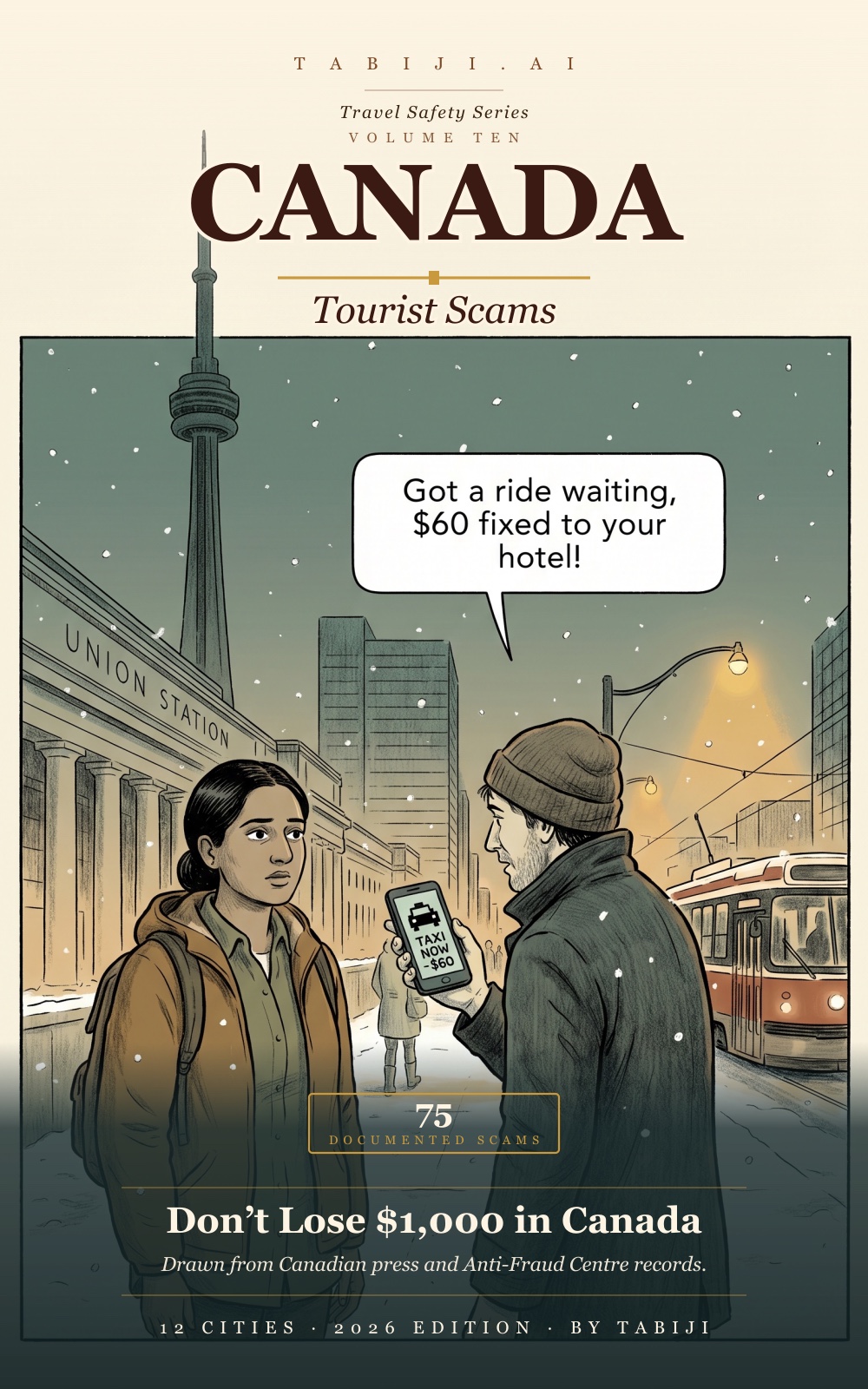
You just read 7 scams in Vancouver. The book has 68 more across 12 Canadian destinations.
Toronto Pearson's Uber cancel-and-cash. Montreal's winter parking-tow trap. Whistler's CBC-documented QR-sticker parking fraud. Calgary Stampede's ticket-scalper fakes. Banff's Pursuit Collection American-pricing overcharge. Every documented Canada scam — with the exact scripts, red flags, and English and French phrases that shut each one down. Drawn from Globe and Mail, Toronto Star, CBC News, CTV News, and Canadian Anti-Fraud agency records.
- 75 documented scams across Toronto, Montreal, Vancouver, Banff & 8 more Canadian cities
- An English + French exit-phrase card you can screenshot to your phone
- Updated annually — buy once, re-download future editions free
- Readable in one flight — $4.99 on Amazon Kindle