
Key Takeaways
- The #1 reported scam is the Paella Tourist-Trap Restaurant Overcharge.
- 4 of 6 scams are rated high risk.
- Use app-based ride services (Uber, Bolt) or official metered taxis instead of unmarked vehicles.
- Never accept unsolicited offers from strangers near tourist sites in Valencia.
⚡ Quick Safety Tips
- Skip Malvarrosa beachfront 'paella restaurants' entirely — book Casa Carmela, La Pepica, or Restaurante La Riua (Ciutat Vella) instead; names Casa Patacona as a documented tourist trap.
- Rent a beachfront locker at Malvarrosa chiringuitos (€3–€5) for valuables during swims documents coordinated scarf-seller crews who target empty-handed victims.
- For Las Fallas (March 15–19), book accommodation 6+ months ahead with full refundability via Airbnb or Booking warns of 3–5x Fallas-week price gouging.
- Never pay cash to a 'parking attendant' in a vest — Malvarrosa Calle del Doctor Lluch and Calle Pavía are free evenings after 8 PM; use the PARKman Valencia or EysaPay app to verify.
- For apartment rentals longer than a weekend, book only via Airbnb or Booking.com — the named 2025 police-investigation anchor.
Jump to a Scam
- Medium Paella Tourist-Trap Restaurant Overcharge
- High Malvarrosa Beach Theft & 'Helpful Scarf-Seller' Con
- Medium Fake Parking Attendants at Malvarrosa Beach & Free Zones
- High Las Fallas Festival Pricing Gouges & Accommodation Fraud
- High Valencia Old Town Pickpocket Gangs
- High Short-Term Rental & Idealista Apartment Booking Fraud
The 6 Scams
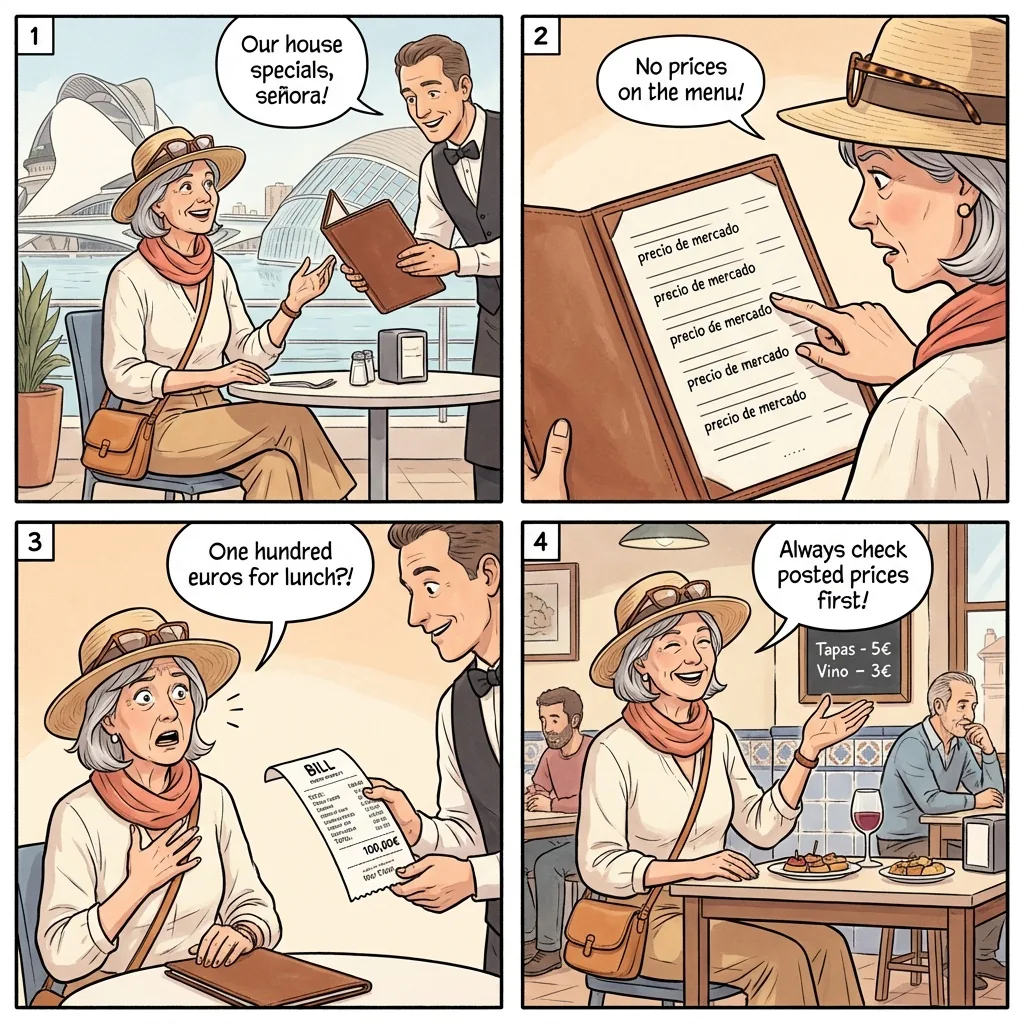
Valencia tourist-strip and Malvarrosa beachfront restaurants serve frozen-and-microwaved 'tourist trap' paella at €30 per person 'minimum two' against €15–€18 in residential Ruzafa, with cover charges of €3–€5 and terrace supplements not mentioned at seating — Casa Patacona — the named beachfront trap; eat at Casa Carmela (1930s family operation), La Pepica (Hemingway-era), or Restaurante La Riua (Ciutat Vella) at lunchtime only since dinner paella is always reheated.
Paella is Valencian — the dish is genuinely from Valencia and the city takes its culinary pride seriously — but tourist-strip and beachfront operators have built a parallel economy of bad, overpriced 'paella' that turns the local pride into a documented tourist trap. A 2025 local PSA names Casa Patacona on the Malvarrosa beachfront as one of the most-flagged traps, with insider accounts describing the operation. Long-time Valencian taxonomy distinguishes three categories: real Paella (Valencian), 'arroz con cosas' (rice with things — what other regions do), and Tourist Trap paella, which is what beachfront and Plaza de la Reina restaurant-strip operators serve.
The trap menu has three recurring mechanics. The 'minimum two persons' paella priced at €30 per person on tourist-strip menus when the same dish at a Ruzafa residential restaurant is €15–€18 — and the tourist-strip version is microwaved-from-frozen rather than the genuine bomba-rice-and-saffron preparation that takes 30 minutes at the table. The 'frozen paella reheated' served as 'traditional' is the most common Casa Patacona-style operation: pre-cooked paella, frozen, reheated in industrial microwaves, served as if freshly prepared. Cover charges of €3–€5 and terrace supplements appear on the bill without mention at seating, with the menu fine print as the only disclosure. The dinner-paella variant is structurally suspect: legitimate Valencian paella is a lunchtime dish (the rice has to come straight off the heat to the table), so any restaurant serving 'fresh' paella at dinner is usually reheating from earlier batches. Authentic Valencian paella includes chicken, rabbit, garrofón beans, green beans, and tomato — any menu adding chorizo or shrimp is deviating from the Valencian tradition.
For older travelers on a Valencia day-trip or overnight stay, the defense is to eat paella at lunchtime only at named authentic restaurants. Skip Malvarrosa beachfront 'paella restaurants' entirely (all are tourist traps with frozen reheated product) and eat paella only at lunchtime at named authentic operators — Casa Carmela on the beachfront (1930s family operation, Calle Isabel de Villena), La Pepica (Hemingway-era on the same Malvarrosa strip but genuine), or Restaurante La Riua in Ciutat Vella — at €18–€25 per person at authentic restaurants or €15–€18 in residential Ruzafa; refuse every 'minimum two persons €30 per person' beachfront paella, every dinner-paella claim of 'fresh,' every menu with chorizo or shrimp as paella ingredients (deviating from Valencian tradition), and every undisclosed cover charge or terrace supplement on the bill. Paella is structurally a lunchtime dish — the rice has to come straight from the pan to the table, and dinner paella is always reheated. The Ruzafa neighbourhood is the right place for residential prices and locals' restaurants. Authentic Valencian paella ingredients are chicken, rabbit, garrofón beans, green beans, and tomato; the 'paella mixta' versions with seafood are still valid but represent a different regional dish than the Valencian original.
Red Flags
- Malvarrosa beachfront 'paella restaurant' with touts outside and laminated English menus
- 'Minimum two persons' paella at €30+ per person
- Paella menu with chorizo, shrimp, or other non-traditional ingredients marked as 'Valencian'
- Reheated paella served at dinner (authentic paella is made to order)
- Cover charges, terrace supplements, or 'bread service' not mentioned at seating
How to Avoid
- Book authentic paella at Casa Carmela, La Pepica (Malvarrosa historical), or Restaurante La Riua (Ciutat Vella).
- Eat paella at lunchtime only — dinner paella is always reheated.
- Expect €18–€25 per person at authentic restaurants; €15–€18 in residential Ruzafa.
- Verify the restaurant's paella includes chicken, rabbit, garrofón beans, green beans, and tomato (traditional recipe).
- Skip Malvarrosa beachfront 'paella restaurants' entirely — all marketed to tourists.
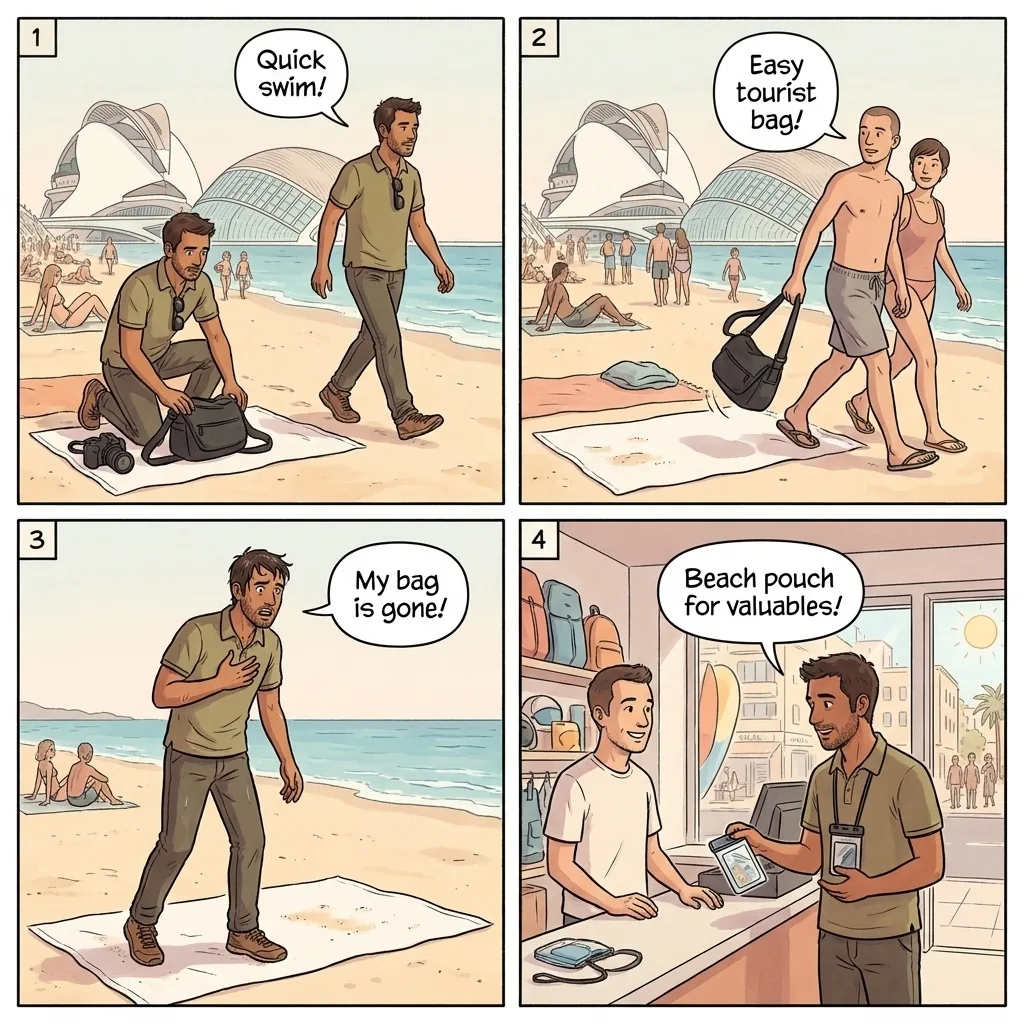
Malvarrosa Beach in Valencia runs an organized two-team beach-theft scheme — Team A steals your bag while you swim, Team B approaches the empty-handed victim offering to sell a 'scarf to cover up' while you walk back to your hotel — with weak police response; rent a beachfront chiringuito locker at €3–€5, use a waterproof neck pouch for phone and one card during swims, and refuse anyone approaching with scarves, flowers, or beach-product sales immediately after a swim.
Malvarrosa Beach is Valencia's main urban beach, drawing massive summer crowds from both city residents and short-stay tourists. Organized crews specifically target the beach during summer afternoons with a coordinated two-team mechanic that's well-documented in 2025 first-person traveler accounts, and the city's police response is notably weak relative to the volume of incidents. Local guidance is consistent that Valencia is 'pretty safe' overall — no one will attack you — but the beach is the documented exception, with thieves working unattended belongings during swim windows.
The mechanic is the most coordinated beach-theft pattern flagged on the Spanish Mediterranean coast. Team A — typically 1–2 people watching from the promenade or a neighbouring towel — steals your bag while you swim, often during a 10–15 minute window when groups disperse to the water. Team B is the chilling twist: 'guys with big scarves' appear within minutes of the theft, knowing the tourist has just been robbed and offering to sell a 'beach scarf to cover up' while you walk back to your hotel without a beach bag, money, or phone. The scarf-sales team isn't a separate opportunist crew — they're coordinated with the theft operation, both providing a 'service' to recently-robbed victims and obscuring the visibility of who else might have been involved. The pattern targets drunk tourists most aggressively and operates predictably during summer-afternoon peak crowds. Recovery rates are poor — Valencian police prioritise other categories, and Malvarrosa beach incidents typically generate a denuncia number rather than active investigation.
For older travelers on a Valencia itinerary including beach days, the defense is locker-and-neck-pouch posture and refusing every beach-product sales approach. Rent a beachfront chiringuito locker at €3–€5 for valuables (Malvarrosa's official chiringuito kiosks offer them), use a waterproof pouch around your neck for phone and one card during swims, and if you must leave items on a towel keep them physically under your body during short dips; refuse every approach from someone offering scarves, flowers, or beach-product sales immediately after you return from a swim as part of the coordinated crew, and never leave a phone or wallet unattended on a towel even during a 5-minute dip. Don't drink heavily on Malvarrosa Beach if you're alone or in a small group — the documented pattern targets drunk tourists most aggressively, and the consequences are real-money losses with low recovery rates. File a denuncia at Policía Nacional Valencia (Gran Vía de Ramón y Cajal, +34 963 539 400) within 48 hours for insurance and chargeback paperwork — even when recovery fails, the report number is what makes the home-country claims work.
Red Flags
- Belongings left unattended on a towel while you swim 10+ metres out at Malvarrosa
- Approach by 'scarf sellers' or 'flower sellers' immediately after you return from a swim — coordinated crew signature
- Crowded summer afternoons (especially August) when density obscures observation
- Someone lingering near your belongings pretending to sunbathe without their own towel or book
- Stranger asks you to 'watch their things' while they go for a swim
How to Avoid
- Rent beachfront locker at Malvarrosa chiringuito kiosks (€3–€5 per session) for valuables.
- Use waterproof pouch around your neck for phone and one card during swims.
- If leaving items on a towel, keep them physically under your body during short dips.
- Ignore 'scarf seller' approaches after returning from a swim — these are coordinated with the thieves.
- File denuncia at Policía Nacional Valencia (+34 963 539 400) within 48 hours for insurance.
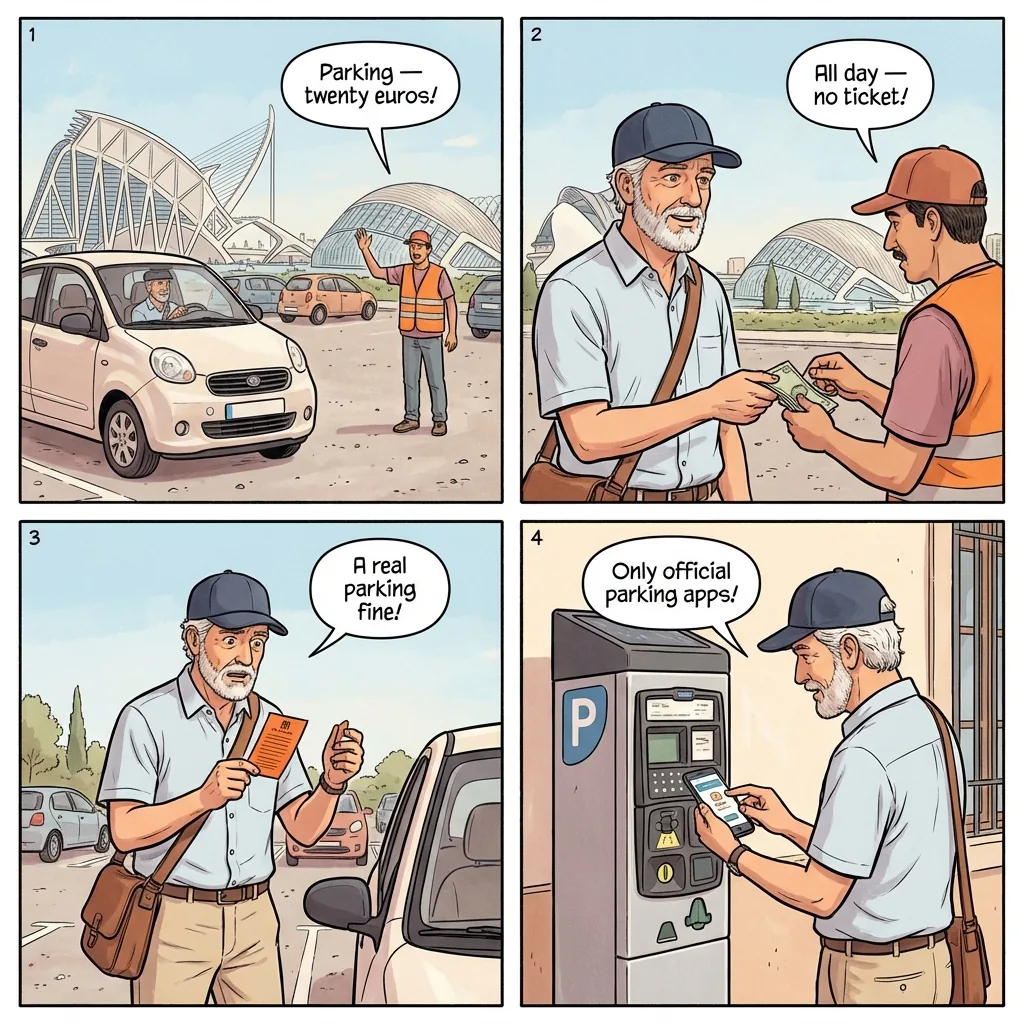
Valencia's fake-parking-attendant scam focuses on Malvarrosa Beach's adjacent streets where scammers in reflective vests position along Calle del Doctor Lluch and Calle Pavía (both legitimately free during evenings and Sundays) and demand €3–€10 'parking fees' from tourists parking rental cars — legitimate Valencia parking is always machine-paid via PARKman Valencia or EysaPay apps, never to a person in a vest.
Valencia's fake-parking-attendant scam focuses on Malvarrosa Beach's adjacent streets, which are legitimately free during many peak beach-going times — Sunday all day and weekday evenings after 8 PM in particular. The trap is straightforward: scammers in reflective vests position themselves along Calle del Doctor Lluch and Calle Pavía (the main Malvarrosa beach-access streets, both legitimately free evening zones) and approach tourists parking rental cars, demanding 'parking fees' of €3–€10 in cash. The pattern persists because tourists return from the beach to find their cars unharmed and conclude the 'fee' was real — which perpetuates the scam through the implicit threat that not paying would have meant returning to a damaged car.
The mechanic relies on three elements working together. First, Valencia's blue-zone parking system has variable rules by time of day and day of week, so visitors arriving for a Sunday beach afternoon don't always know that the zone is free. Second, the reflective-vest visual cue suggests official authority, especially to tourists unfamiliar with the local enforcement uniform — real Valencia parking enforcement officers are actually less visually distinctive than the fake ones because the actual enforcement is machine-payment-based rather than person-collected. Third, the implied-threat dynamic — the scammer's presence near the parked car at departure suggests damage potential if the cash isn't paid. The legitimate Valencia parking system is always machine-paid via the PARKman Valencia or EysaPay apps, never via cash to a person in a vest. The blue-zone signs at every street display operating hours clearly, with Malvarrosa streets free on Sunday and weekday evenings after 8 PM. Long-time Valencia residents describe the constant tourist-targeting scams as 'eroding the experience' of an otherwise excellent city.
For older travelers renting cars for a Malvarrosa Beach day, the defense is to check the blue-zone signs first and pay only via the official apps. Check the blue-zone signs for operating hours before paying anyone (Malvarrosa streets along Calle del Doctor Lluch and Calle Pavía are free on Sunday and weekday evenings after 8 PM), use the Valencia parking apps (PARKman Valencia or EysaPay) for any genuine paid-zone parking, never hand cash to a person in a reflective vest since legitimate Valencia parking is always machine-paid, and park in official paid garages like Parking Playa de la Malvarrosa on Calle Pedro de Valencia for secure parking with no street-side shakedown risk. If a vest-wearing person demands cash, decline politely, photograph their face and any identifying details, and report to Policía Local at 092 with the evidence — repeat reports are how the pattern eventually gets enforcement attention. Valencia's blue-zone signs are clear about operating hours; reading them takes 15 seconds and protects against the entire scam category. For travelers without a rental car, Metro Line 3 from the city centre to Marítim-Serrería plus a short walk reaches Malvarrosa Beach without any parking concern at all.
Red Flags
- Person in reflective vest approaches your car immediately after parking near Malvarrosa
- They cannot point to a working parking meter for the zone
- Zone has no visible parking-meter machines or pay-and-display signs
- Other parked cars nearby have no visible parking tickets on dashboards
- Collector specifically targets rental cars with company stickers or foreign plates
How to Avoid
- Check blue-zone sign hours before paying — Malvarrosa is free Sunday and weekday evenings after 8 PM.
- Use Valencia parking app (PARKman Valencia or EysaPay) to verify if payment is required.
- Never hand cash to a vest — legitimate Valencia parking is always machine-paid.
- Park at Parking Playa de la Malvarrosa garage for secure paid parking.
- Report fake collectors to Policía Local (092) with photographed evidence.

Valencia Las Fallas (mid-March, daily fireworks plus the March 19 La Cremà burning of giant satirical sculptures) draws 2–3 million visitors to a city of 800,000 and inflates accommodation, dining, and transport 3–5× — Airbnb and Booking listings triple non-refundably, restaurants charge €50–€80 'special Fallas menu' for what's €15 normally, taxis quote fixed €30–€50 for 2-km rides that should be €5, and street vendors sell cava, buñuelos, and masks at 3× normal price; book 6+ months ahead with full refundability or skip Fallas dates entirely.
Las Fallas is Valencia's most famous festival — a week of daily fireworks (the mascletà daily at 2 PM), giant satirical sculptures called fallas placed throughout the city, parades, and the massive Cremà burning of the fallas sculptures on the final night, March 19. The festival attracts 2–3 million visitors to a city of 800,000 residents, and the entire accommodation, dining, and transport economy inflates three to five times for the week. Long-time Valencia residents have an ambivalent relationship with Fallas — 'lots of people hate Fallas, it's more like a private massive party that you are not allowed into if you are not part of' — and the local critique is consistent that the festival has become corrupted and commercialised, with tourist-pricing inflation deepening the tourist-trap dynamic.
The trap menu has four recurring mechanics. Airbnb and Booking listings triple their normal rate for the Fallas dates and frequently disclose the actual rate only after non-refundable booking confirmation, leaving travelers with sunk-cost commitments at 3–5× the normal price. Restaurants in the Ciutat Vella festival zone post 'special Fallas menu' offerings at €50–€80 per person for what would be a €15 menú del día in normal weeks. Taxis quote fixed €30–€50 fares for 2-kilometre trips that should be €5 metered, exploiting the high demand and traffic-restricted festival streets. Impromptu street vendors selling cava, buñuelos (the festival doughnut), and Fallas masks charge 3× normal prices, with the 'festival novelty' framing used to obscure the markup. The 6+ month advance-booking window is the only way to lock in genuine Fallas accommodation rates — book in September for March, any later and the listings are already at the inflated tier.
For older travelers considering Las Fallas specifically, the defense is a 6+ month booking window with full refundability, plus residential neighbourhoods for dining and Metro for transport. Book accommodation 6+ months in advance for Fallas dates through Airbnb or Booking with full refundability and platform-verified rates — compare March prices to a regular April baseline since any 2×+ markup is Fallas-specific gouging — eat at residential neighbourhoods (Ruzafa, Benimaclet) rather than the Ciutat Vella festival zone where 'special Fallas menu' inflation runs to €50–€80 per person, take Metro (Line 3 to Colón, Line 1 to Xàtiva) rather than taxis during festival hours when surcharges explode, and refuse every street-vendor cava, buñuelos, or masks offer at 3× normal price. For the March 19 La Cremà (burning of fallas), wear closed-toe shoes and ear protection — the pyrotechnic crowd is extreme and the visual experience is genuinely worth the trip if you've planned ahead. The mascletà daily firecracker display at Plaza del Ayuntamiento at 2 PM is free, loud, and the centerpiece of the daily Fallas rhythm. If you don't have 6+ months to plan, consider visiting Valencia outside Fallas dates — the city itself is excellent at any time and the Fallas inflation makes the festival weeks the worst-value visiting window.
Red Flags
- Airbnb or Booking rate tripled (+ for Fallas week without clear disclosure)
- 'Fallas special menu' at €50–€80 per person when the regular-season price is €15–€25
- Taxi quote of €30–€50 for a 2-km trip during Fallas week
- Impromptu street vendors selling cava, buñuelos, masks at 3x normal prices
- Private 'fallero experience' packages that promise insider access for €100–€200
How to Avoid
- Book Las Fallas accommodation 6+ months in advance through Airbnb or Booking with full refundability.
- Compare March prices to April baseline — any 2x+ markup is Fallas-specific gouging.
- Eat in Ruzafa or Benimaclet residential neighborhoods rather than Ciutat Vella festival zone.
- Take Valencia Metro (Line 3 to Colón, Line 1 to Xàtiva) rather than surge-priced taxis.
- For La Cremà (March 19 night), wear closed-toe shoes and ear protection.

Valencia's pickpocket problem has escalated markedly in the 2020s with organized teams operating Plaza de la Reina (Cathedral hours), Plaza de la Virgen (evening Turia Fountain crowds), Valencia Nord railway station (Madrid/Barcelona arrivals), Metro Lines 3 and 5 (airport-to-city boarding crush), and the Central Market (Saturday morning) — Valencia sits on the mid-tier pickpocket scale, worse than Bilbao or Donostia but milder than Barcelona, and the same crossbody-bag-in-front defense applies.
Valencia's pickpocket problem has escalated markedly in the 2020s, with 2025 community guidance describing the situation as 'getting worse' and explicitly framing the teams as 'organized' rather than opportunistic — meaning crews operate with planning, target identification, and partner-distraction-and-lift mechanics rather than ad-hoc opportunism. Long-time community calibration places Valencia on the mid-tier pickpocket scale: worse than Bilbao or Donostia (where the urban-pickpocket problem is comparatively low) but milder than Barcelona (where the organized-crew density is the worst on the Spanish Mediterranean). Daytime Valencia is broadly safe — 'during the day there is nearly no chance something dangerous happens to you, but you can get robbed or pickpocketed if you let your guard down.'
There are five primary Ciutat Vella and city-wide risk zones with predictable mechanics. Plaza de la Reina crowds during Valencia Cathedral visiting hours concentrate camera-ready visitors in a small open square — the standard Spanish-Mediterranean distraction-and-lift template applies. Plaza de la Virgen evening crowds around the Turia Fountain and Basílica concentrate dinner-hour pedestrians at table-density that supports brush-past lifts. Valencia Nord railway station on arrival from Madrid or Barcelona presents the standard luggage-juggling-and-phone-checking moment that station crews work. Metro Line 3 (airport to city) and Line 5 boarding crush during peak hours concentrate distracted commuters and tourists in narrow door zones. The Central Market during Saturday morning crowds — the city's iconic market hall — runs the same brush-past mechanic as similar markets in Madrid and Barcelona. The Spain-wide rule applies in Valencia: pickpocketing is uncommon unless you're in a very touristic zone of a very touristic city looking like a tourist, which means the defense posture matters more than the city's average safety reputation.
For older travelers on a Valencia itinerary, the defense is the standard Spanish-Mediterranean crossbody-bag-in-front posture across all five risk zones. Wear a zipped crossbody bag in front during any Ciutat Vella walking or Metro ride, keep your phone in a zipped inner pocket between uses (never back pocket or outer backpack pouch), carry a single €20 bill and one card in a zipped front pocket for an evening with passport and backup card in the hotel safe, and refuse 'photo help' approaches and 'directions question' openers in Plaza de la Reina, Plaza de la Virgen, Valencia Nord station, Metro Line 3 and Line 5 boarding zones, and the Central Market during Saturday-morning peak crowds. The Spain-wide rule applies: pickpocketing concentrates in very touristic zones of very touristic cities targeting people who look like tourists, so the defense posture matters more than Valencia's mid-tier safety average. File a denuncia at Policía Nacional Valencia (Gran Vía de Ramón y Cajal, +34 963 539 400) within 48 hours of any incident for insurance and chargeback paperwork. Daytime Valencia outside the five risk zones is genuinely safe and pleasant for older travelers; the defense posture is concentrated rather than constant.
Red Flags
- Plaza de la Reina or Plaza de la Virgen crowd pressure during tourist-peak hours
- Valencia Nord station arrival moment when juggling luggage and phone
- Metro Line 3 boarding crush (airport line) at peak hours
- Someone asks for photo help or directions while companion approaches from blind side
- Crowded Central Market on Saturday morning with bumping that feels deliberate
How to Avoid
- Wear zipped crossbody bag in front during Ciutat Vella walking and Metro rides.
- Never put phone or wallet in back pocket or outer backpack compartment.
- Single €20 bill and one card in front pocket for an evening; leave passport in hotel safe.
- At Valencia Nord station, keep luggage against a wall while checking phone or map.
- File denuncia at Policía Nacional Valencia (+34 963 539 400) within 48 hours for insurance.

Valencia has one of Spain's most-documented rental-fraud ecosystems with a 2025 named-anchor police investigation (Avenida de Burjassot case: 3 police reports, criminal investigation open, 18+ illegal units in a building with fraudulent leases) — Idealista and Facebook Marketplace listings 20–30% below market demand full deposit plus first-month rent via Bizum or bank transfer before viewing, then the 'landlord' disappears or the apartment is double-booked to multiple travelers; book Airbnb/Booking/VRBO with platform-verified payment only.
Valencia has one of Spain's most-documented rental-fraud ecosystems, with 2025 producing a named-anchor police investigation (the Avenida de Burjassot case: 3 police reports, criminal investigation open, 18+ illegal units in a single building under fraudulent leases). The pattern matches the Spain-wide rental-fraud playbook flagged in Palma de Mallorca, San Sebastián, and Tenerife — Idealista and Facebook Marketplace listings at 20–30% below comparable hotel rates, with off-platform payment demands and disappearing 'landlords' — but Valencia's documented case volume and the Burjassot investigation make it a particularly high-risk market for travelers looking for apartment-style stays beyond a hotel weekend.
The mechanic runs across all variants. A listing on Idealista, Facebook Marketplace, or a private WhatsApp referral advertises a Valencia apartment at 20–30% below comparable hotel rates, with charming photos and a Valencia address. The 'landlord' sends a formal-looking contract via email and demands a full deposit plus first-month rent via Bizum (Spain's instant-payment rail, irreversible once cleared) or bank transfer before any viewing, often with 'other interested parties' urgency framing. Payment clears, and one of three outcomes follows: the 'landlord' disappears and the apartment doesn't exist, the apartment is an illegal rental with no lease signed by the real owner (the Avenida de Burjassot case pattern), or the same apartment has been rented to three or more other travelers simultaneously and only the first arrival gets the keys. The universal Spanish rental rule applies: 'neither pay anything nor sign any contract until you have personally seen the apartment.' The defensive alternative is platform-only — Airbnb, Booking.com, or VRBO with platform-verified payment and cancellation protection — which costs slightly more but eliminates the entire fraud category.
For older travelers considering a Valencia apartment stay longer than a weekend, the defense is platform-only payment and live video verification before any money moves. Book only through Airbnb, Booking.com, or VRBO with platform-verified payment and cancellation protection — refusing Western Union, Bizum, SEPA wire transfer, and cryptocurrency for any accommodation deposit since legitimate disputes go through platform channels — demanding a live video call with the apartment visible (not photos) before any payment on Idealista or Facebook Marketplace listings, and reverse-image-searching every listing photo on Google Images before paying since duplicate hits across cities are a guaranteed scam signature. Pressure to 'secure' the apartment immediately because of 'other interested parties' is the urgency lever — legitimate landlords don't time-pressure deposits. If you've been defrauded, file a denuncia at Policía Nacional Valencia (Gran Vía de Ramón y Cajal, +34 963 539 400) immediately and reference the 2025 Avenida de Burjassot case for police-investigation precedent — the report number is required for both Bizum dispute claims and credit-card chargeback paperwork. Don't sign any contract without personal apartment viewing first; that single rule eliminates almost the entire Valencia rental-fraud category.
Red Flags
- Listing price 20–30% below comparable hotel or Airbnb rates for same dates
- 'Landlord' refuses video call or in-person viewing before deposit
- Request for Western Union, Bizum, or cryptocurrency payment rather than platform-protected transaction
- Pressure to 'secure' apartment immediately because 'other interested parties'
- Photos reverse-image-search to a different city or stock-photo library
How to Avoid
- Book only through Airbnb or Booking.com with platform-verified payment and cancellation protection.
- For Idealista listings, demand a video call with the apartment visible before any deposit.
- Reverse-image-search listing photos on Google Images before paying.
- Refuse Western Union, Bizum, or cryptocurrency payment for any accommodation deposit.
- If defrauded, file a denuncia at Policía Nacional Valencia (+34 963 539 400) immediately.
🆘 What to Do If You Get Scammed
📋 File a Police Report
Go to the nearest Policía Nacional or Guardia Civil station. Call 091 (Policía Nacional) or 112 (emergency). Get an official crime report — you'll need this for insurance claims. You can also report online at policia.es.
💳 Cancel Your Cards
Call your bank immediately. Most have 24/7 numbers on the back of the card (keep a photo saved separately). Block any suspicious transactions before the thieves use your details.
🛂 Lost Passport?
Contact your nearest embassy or consulate. The US Embassy is at Calle de Serrano, 75, 28006 Madrid. For emergencies: +34 91 587-2200.
📱 Track Your Device
If your phone was stolen, use Find My (iPhone) or Find My Device (Android) from another device. Don't confront thieves yourself — share the location with police instead.
Frequently Asked Questions
You just read 6 scams in Valencia. The book has 97 more across 16 Spanish destinations.
Barcelona's La Rambla rosemary-sprig clavel circuit. Madrid's Puerta del Sol three-card trile. Seville's Plaza de España palm-reading gambit. Granada's Alhambra skip-the-line reseller industry. Ibiza and Mallorca scooter deposit-hold cycle. Every documented Spain scam — with the exact scripts, red flags, and Spanish phrases that shut each one down. Drawn from El País, La Vanguardia, ABC, El Mundo, and Policía Nacional and Mossos d'Esquadra records.
- 103 documented scams across Barcelona, Madrid, Seville, Granada & 12 more cities and islands
- A Spanish exit-phrase card you can screenshot to your phone
- Updated annually — buy once, re-download future editions free
- Readable in one flight — $4.99 on Amazon Kindle