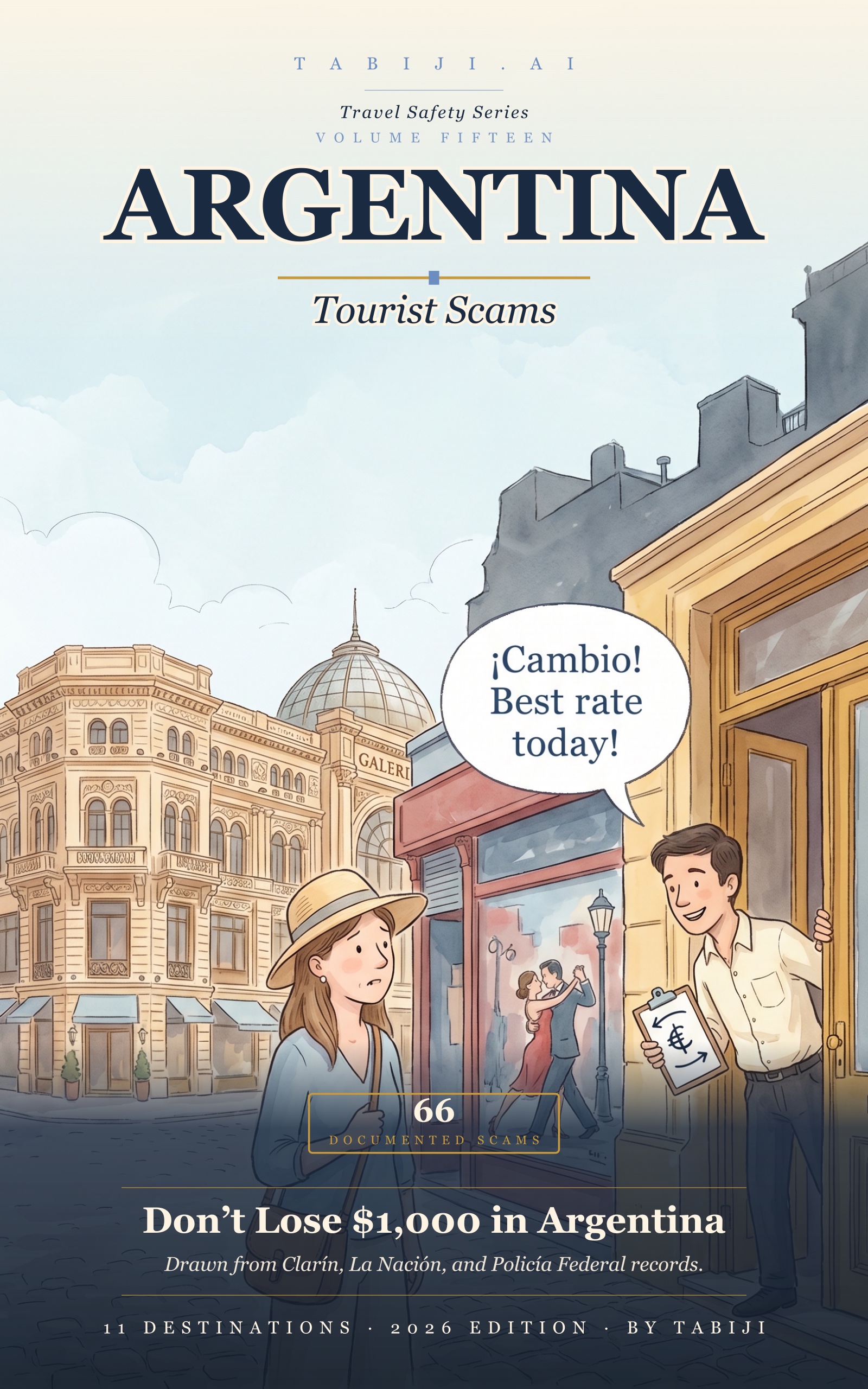
Florida Avenue Cambio Hustle: Buenos Aires signature, Latin America cousin variants.
Calle Florida arbolitos call cambio cambio dolar dolar to every passing tourist; the side-street cueva offers a blue-dollar rate that is 5-15% better than banks; the variants run during the count. The licensed-cambio rule and the count-twice rule defeat every Argentine cambio scam plus cousin variants in Brazil and Mexico.


The Florida Avenue cambio hustle runs five mechanics targeting tourists exchanging USD to Argentine pesos: arbolito blue-rate bait-and-switch (Calle Florida arbolitos quote a blue-dollar rate; the cueva exchange itself runs the variant), counterfeit-bill swap (1-2 counterfeits slid into a genuine stack during the cueva count), WhatsApp arbolito meeting (off-platform meeting at coffee shop or hotel lobby; sometimes tourist is followed and mugged after), receipt-less cueva overcharge (informal exchanges refuse to issue receipts; rate is 1-3% worse than quoted), cross-border bus cambio (Iguazu / Paraguay border bus-terminal kiosks at unfavorable rates 10-20% worse than fair). Cousin variants run in Mexico (Centro Mexico City informal cambios) and Brazil (Sao Paulo Avenida Paulista). Argentine cambio scams documented continuously since the 1970s; intensified during the 2019-2024 currency crisis when blue-dollar rates were 50-150% above official. The universal defenses are two rules: the licensed-cambio rule (use only AFIP-licensed casas de cambio, banks, ATMs, or crypto on-ramps; the 3-8% better rate at arbolitos is not worth the counterfeit / theft risks) and the count-twice rule (count pesos twice — once after the operator counts, then again on your own surface — to catch counterfeit-bill swaps). Argentine Tourist Police 02 4810 9000.
"Cambio cambio dolar dolar, mejor precio, casa atras."
You and your travel partner walk south on Calle Florida from Plaza San Martin. The afternoon is bright; tango buskers play near the Galerias Pacifico shopping arcade; office workers walk past on lunch break. Every twenty meters an arbolito stands holding a wad of pesos and calling out: cambio cambio dolar dolar, blue rate, casa atras (exchange exchange dollar dollar, blue rate, house behind). Four arbolitos call to you in the first hundred meters; you keep walking.
You stop at the corner of Florida and Lavalle to figure out which way to the Cafe Tortoni. An arbolito approaches with a friendly smile: "amigo, blue rate today is 1,400 pesos to the dollar; bank rate only 1,200; come, my casa is just one block, very fast, very safe, you save 200 pesos per dollar." 1,400 ARS to 1 USD versus 1,200 at the bank: a 16% better rate. You have 200 USD you want to exchange. The math: 200 × 1,400 = 280,000 ARS at the cueva versus 240,000 at the bank — 40,000 ARS savings (about 30 USD).
You follow him. Half a block down Lavalle, up a flight of stairs in an unmarked building, into a small office with a desk, a money counter, and one staff member. You hand over 200 USD. The cambio operator runs the bills through the counter ("verifying counterfeits, important"), then opens a drawer and counts out 280,000 ARS in 1,000-peso notes. He counts in front of you twice, fans the stack to show. Then he hands the stack to you, asks if you want a Coke, gestures at the door.
You pocket the stack and walk back down to Calle Florida. Twenty minutes later at the Cafe Tortoni you order coffee and pay with one of the 1,000-peso notes. The waiter holds it up to the light, frowns, hands it back: "no es bueno, falsificado." Counterfeit. You check the rest of the stack carefully: of 280 1,000-peso notes, 6 are counterfeit. Your loss is 6,000 ARS (about 5 USD); the savings over bank rate were about 30 USD; net you saved 25 USD but with a counterfeit-circulation risk if you try to spend any of the others.
This is the Calle Florida cueva counterfeit-bill swap, the most-documented Buenos Aires cambio scam. The Argentine Banco Central issues counterfeit-detection guidance; the Comisaria del Turista (Tourist Police) at Av. Corrientes 436 handles complaints; the variant has run continuously on Calle Florida since at least the 1970s, with intensification during the 2019-2024 currency crisis when blue-dollar rates were 50-150% above the official rate. Cuevas range from clean (counterfeit-free, real receipts) to operator-aligned (counterfeit-mixed); the tourist cannot reliably distinguish.
The defense is two rules. The licensed-cambio rule: use only AFIP-licensed Argentine casas de cambio (Cambio America, Cambio Lugano, Banco Nacion / Banco Galicia branches), banks, ATMs, or crypto on-ramps (Lemon Cash, Belo, Buenbit, Ripio). The licensed cambios offer rates 3-8% worse than blue-dollar but issue printed receipts with AFIP authorization numbers; the legal recourse path is open for any counterfeit. The count-twice rule: if you do use a cueva, count the pesos twice — once after the operator counts in front of you, then again on a separate surface (hand, table, counter) before walking away. The counterfeit-bill swap requires the tourist to accept the operator count; second count on your own surface catches the swap.
That is the Calle Florida cueva variant of the Argentine cambio family, executed at the most-documented Buenos Aires exchange location. The rest of this page is the five-mechanic playbook, the four other places and methods (WhatsApp arbolito, receipt-less cueva, cross-border bus, cousin Latin American variants), and the two rules that defeat every variant.
Read the full Buenos Aires scam guide →Key Takeaways
The licensed-cambio rule and the count-twice rule
Every variant of the Florida Avenue cambio hustle is defeated by the same two rules. The licensed-cambio rule: use only AFIP-licensed Argentine casas de cambio (Cambio America, Cambio Lugano, Banco Nacion, Banco Galicia branches), banks, ATMs, or crypto on-ramps (Lemon Cash, Belo, Buenbit, Ripio). The 3-8 percent better rate at street arbolitos is not worth the counterfeit-bill, short-count, and theft risks. The count-twice rule: if you do use a cueva, count the pesos twice — once after the operator counts in front of you, then again on a separate surface (hand, table, counter) before walking away.
The first rule addresses the legal-recourse asymmetry. Licensed Argentine cambios operate under AFIP supervision; they issue printed receipts with authorization numbers; counterfeit-bill discoveries within 30 days are recoverable through the cambio reissue process. Unlicensed arbolitos and cuevas operate outside this system; the recourse path is closed for any counterfeit, short-count, or after-exchange dispute. The 3-8 percent rate-difference between licensed cambios and street rates is small compared to a 10-30 percent loss from a single counterfeit-bill swap.
The second rule addresses the count-substitution asymmetry. The cambio operator counts in front of the tourist (sometimes twice for show), then briefly distracts the tourist (asks about another transaction, gestures at the door, claims to verify the operator pesos count), and slides one or two counterfeit notes into the stack during the distraction window. The tourist accepts the stack and walks away. Counting again on the tourist own surface (hand, table, separate counter) catches the swap because the operator hand is no longer in contact with the stack.
The third defense is the alternative-path rule. Crypto on-ramps offer Argentine peso payouts at rates near-cueva (typically 1-3 percent worse than blue-dollar but with full transaction transparency and AFIP-compliant peso receipts). Western Union receives USD and pays out at a blended official-blue rate (slightly worse than cueva, better than bank). Argentine ATMs charge high fees (5,000-15,000 ARS plus 3-5 percent foreign-card fee) but the official rate plus chargeback corridor is safer than street arbolitos for amounts under 200 USD.
The fourth defense is the receipt rule. Demand a printed receipt from any cambio with the AFIP authorization number, transaction date and time, exchange rate, amount in / amount out. Without receipt, the tourist has no documentation for any later dispute and no recourse for counterfeit bills discovered later. Licensed Argentine cambios issue receipts; receipt-less cuevas refuse and use the receipt-refusal as part of the higher-rate justification (which is itself the variant signal).
The fifth defense, when escalation is needed: phone the Argentine Tourist Police (Comisaria del Turista) at Av. Corrientes 436 (phone 02 4810 9000). The Tourist Police accept counterfeit-bill cases, investigate the cueva location, and have a documented track record of recovering funds in cases where the cueva is identifiable. Reports also contribute to operator-license enforcement.
The five mechanics
The Florida Avenue cambio hustle runs in five distinct mechanics across Argentina and cousin Latin American variants. The mechanic is currency-exchange specific; the operator deception strategy varies.
1. Calle Florida arbolito blue-rate bait-and-switch (Argentina)
The canonical Buenos Aires variant. Arbolitos (street currency exchangers) line Calle Florida from Plaza San Martin to Plaza de Mayo, calling cambio cambio dolar dolar to passing tourists. The arbolito quotes a blue-dollar rate 5-15 percent above the official bank rate and walks the tourist to a side-street cueva (unmarked office). The cueva exchange runs one or more sub-variants: counterfeit-bill swap, short count, receipt-less higher-rate. Documented continuously since the 1970s. Defense: licensed-cambio rule.
2. Counterfeit-bill swap during count (Argentina, Mexico)
The cambio operator counts pesos in front of the tourist (sometimes twice for show), then slides 1-2 counterfeit 1,000-ARS notes into the genuine stack during a brief moment of distraction. Tourist receives stack with 1-2 counterfeits; loss is 1,000-2,000 ARS per fake. Variant scales: a single tourist might lose 5,000-15,000 ARS over one exchange. Documented heavily on Calle Florida cuevas; cousin variant in Mexico City Centro informal cambios. Defense: count-twice rule on tourist own surface.
3. WhatsApp / Telegram arbolito meeting (Argentina)
Argentine arbolito WhatsApp / Telegram groups offer rates 2-5 percent above cueva blue-dollar. Meeting at coffee shop, hotel lobby, or street corner. Variant operates two ways: (1) arbolito hands over a stack with counterfeits; (2) arbolito brings partner; after exchange the partner follows the tourist and mugs them around the corner, retrieving both pesos and original USD. Documented in Microcentro, Palermo, Recoleta. Defense: never meet WhatsApp arbolitos; the licensed-cambio rule applies.
4. Receipt-less cueva overcharge (Argentina)
Cuevas in side-street offices sometimes refuse to issue printed receipts, instead offering a verbal rate that is 1-3 percent below the genuine blue-dollar rate. The tourist accepts because the rate is still better than bank rates; the loss is 1-3 percent of the exchange amount. Without receipt, the tourist has no documentation for any later dispute and no recourse for counterfeit bills. Defense: only use cuevas that issue printed receipts with AFIP authorization number.
5. Cross-border bus cambio (Argentina-Brazil-Paraguay-Chile)
At Iguazu Falls (Argentina-Brazil-Paraguay tri-border), Argentine-Chilean Andes crossings (Mendoza-Santiago bus route), Argentine-Bolivian altiplano crossings, bus-station cambios offer to exchange leftover Argentine pesos to reais / chilean pesos / bolivianos / guaranis at unfavorable rates (often 10-20 percent worse than fair). Tourists who do not check rate online beforehand accept the bad rate because they are about to leave Argentina. Cousin variants in Brazil-Paraguay border, Mexico-Guatemala border. Defense: check official cross-rate online (XE.com, Google) before exchanging; refuse rates significantly worse than online; use ATMs in destination country.
Where it runs
The Florida Avenue cambio hustle concentrates on the Calle Florida pedestrian street in central Buenos Aires plus cousin variants across Latin American currency-exchange hotspots.
- Argentina (canonical hotspot): Buenos Aires Calle Florida (Plaza San Martin to Plaza de Mayo, the most-documented stretch); Microcentro adjacent (Avenida 9 de Julio area, Reconquista, San Martin); Recoleta cambios; Palermo Soho cambios; San Telmo Sunday market cambios; La Boca tourist strip cambios; Iguazu Falls border bus terminal; Mendoza-Santiago bus crossing; Salta-Bolivia altiplano crossing.
- Brazil: Sao Paulo Avenida Paulista informal cambios; Rio de Janeiro Copacabana boardwalk cambios; Foz do Iguacu Brazilian-Argentine border (Iguazu); Sao Paulo Galeao airport informal exchanges. Brazilian Real Plan and stable Brazilian banks (Bradesco, Itau, Banco do Brasil, Caixa) make Brazilian cambio scams less common than Argentine.
- Mexico: Mexico City Centro informal cambios near Zocalo; Cancun Hotel Zone tourist cambios; Playa del Carmen Fifth Avenue cambios; Cabo San Lucas Marina cambios; Tijuana border cambios. Mexican peso parallel-market is less developed than Argentine but tourist-trap cambios in Hotel Zone and Caribbean coast operate similar mechanics.
- Adjacent (also documented): Venezuela (parallel-market dollar trades remain common despite official restrictions; tourist-cambio risks similar to Argentine arbolitos but with safety-of-area concerns layered on); Cuba (informal CUC / USD exchanges; legal complexity); Bolivia La Paz; Peru Cuzco; Colombia Cartagena beach-strip cambios.
Three more places, three more cambio variants
Buenos Aires WhatsApp arbolito: the meet-and-mug
Buenos Aires, Palermo Soho, evening. You messaged an arbolito on a Buenos Aires Travel Tips Facebook group offering 1,420 ARS per USD (cueva rate that day was 1,400). You arrange to meet at a coffee shop on Honduras Street at 19:30. The arbolito arrives with a backpack, sits at your table, hands over 284,000 ARS for your 200 USD. You count once, pocket the cash, leave the coffee shop.
Half a block away, two men step out from an alley, push you against a wall, demand the backpack and pesos. The arbolito has signaled them via WhatsApp from inside the coffee shop. They take the 284,000 ARS and your USD wallet (which you used to pay for the coffee 5 minutes earlier — the wallet still had 100 USD plus cards). Total loss: 200 USD exchanged plus 100 USD residual plus card-cancellation hassle. They run; you phone 911 and the Tourist Police 02 4810 9000; the Buenos Aires Mossos respond in 8 minutes; the operator and partners are gone.
Defense: never meet WhatsApp arbolitos. The 1-2 percent rate advantage over the cueva blue rate is not worth the mugging risk. Use Lemon Cash or Belo (crypto on-ramp) for similar rates with no in-person exchange. Buenos Aires Tourist Police are responsive but recovery rate for street muggings is under 10 percent.
Iguazu Falls border: the bus-terminal cambio
Puerto Iguazu, Argentine-Brazilian-Paraguayan tri-border. You and your travel partner have spent 3 days in Argentina and are crossing to Brazil for 5 days at the Foz do Iguacu side. You have 80,000 leftover Argentine pesos. At the Puerto Iguazu bus terminal, a cambio kiosk advertises ARS to BRL exchange. You ask the rate: 1 BRL = 200 ARS. The kiosk operator counts and hands you 400 BRL for your 80,000 ARS.
You check XE.com on your phone after leaving the bus terminal: the official ARS to BRL cross-rate that day was 1 BRL = 165 ARS. The fair amount for 80,000 ARS would have been about 485 BRL. You received 400. Loss: 85 BRL (about 17 USD), an 18 percent rate-discrepancy. The cambio kiosk is operating with an inflated cross-rate that the tourist did not check.
Defense: check the official cross-rate online (XE.com, Google) before exchanging at any border. If the kiosk rate is more than 5 percent worse than online, refuse and use a Foz do Iguacu Brazilian ATM after crossing the border instead. Brazilian banks (Bradesco, Itau, Banco do Brasil) at Foz airport ATMs offer near-official rates with 3-5 percent foreign-card fee.
Mexico City Centro: the cousin counterfeit variant
Mexico City Centro Historico, near Zocalo, mid-afternoon. You walk past Banamex (closed for siesta) and see a cambio kiosk advertising USD to MXN exchange at 18.5 to 1 (slightly above the bank rate of 18.2). You hand over 100 USD; the operator counts out 1,850 MXN in 200-peso notes. You count once, accept, walk to the Cathedral.
An hour later you try to pay for tacos with one of the 200-peso notes. The vendor holds it to the light, frowns, hands it back: "no es bueno." Counterfeit. You check the rest: of 9 200-peso notes, 1 is counterfeit. Loss: 200 MXN (about 11 USD); the rate advantage over Banamex was about 3 USD. Net: you lost 8 USD.
Defense: Mexican counterfeit-bill variant runs the same mechanic as Argentine. Use Banamex / Banorte / Banco Azteca ATMs (slightly worse rate, no counterfeit risk) or licensed casas de cambio with displayed government license. Centro informal kiosks are the variant by definition.
San Telmo Sunday market: the receipt-less cueva
Buenos Aires, San Telmo, Sunday morning. You walk through Plaza Dorrego antique market. An arbolito on a corner offers 1,440 ARS per USD (slightly above the Calle Florida cueva rate of 1,400). You follow him to a cueva on Defensa Street. The operator counts 144,000 ARS for your 100 USD; you ask for a receipt. He smiles: "no receipts here, mejor precio." (no receipts here, better price.)
You hesitate, but the rate advantage over the licensed cambio is about 5 USD. You accept. You count once, pocket, leave. Three days later you discover one 1,000-peso note is counterfeit. Loss: 1,000 ARS (about 1 USD). With no receipt, no recourse path; the cueva does not exist on any AFIP record; the Tourist Police accept the report but cannot identify the operator.
Defense: only use cuevas that issue printed receipts with AFIP authorization number. The 1-3 percent rate advantage of receipt-less cuevas is not worth the closed recourse path. Even one counterfeit makes the receipt-less savings negative.
Red flags
- Quoted rate significantly above blue-dollar / official bank rate. The bait for the operator's variant; the savings come back as counterfeits or short counts.
- Cambio operator refuses to issue printed receipt. Recourse path is closed; the variant by definition.
- Cambio in unmarked office on side street, not signposted from the main avenue. The cuevas concentration; some are clean, but the unmarked status is operator-aligned signal.
- Operator counts pesos twice in front of you. The double-count is for cover; the swap happens in the brief distraction window between counts.
- Operator distracts during the count: asks question, gestures, opens drawer. The distraction window is the swap moment.
- WhatsApp / Facebook offer above cueva rate. The off-platform meeting is the variant; mugging-after-exchange is documented.
- Cross-border bus-terminal cambio with rate not posted. The unposted rate is the variant; check XE.com on your phone first.
- Operator counts 1,000-peso notes too quickly to follow. The fast-count is for cover; the substitution happens during the speed.
The phrases that shut it down
Each phrase below refuses arbolitos firmly while continuing to walk. Said in Spanish at normal pace, no eye contact.
If you got hit
If you discover counterfeit pesos after a cueva exchange: return to the cueva immediately if within minutes; the operator will sometimes replace if confronted quickly. After a few hours, the cueva will deny the original transaction. File a report with the Argentine Tourist Police (Comisaria del Turista) at Av. Corrientes 436 (phone 02 4810 9000); the Tourist Police accept counterfeit-bill cases and have a documented track record of recovering funds when the cueva is identifiable. Bring the counterfeit notes; do not try to spend them (passing counterfeit currency is a crime in Argentina).
If you were mugged after a WhatsApp arbolito meeting: phone 911 immediately. Buenos Aires response time is 5-10 minutes in central districts. File a denuncia (police report) at the nearest commissariat or via the Buenos Aires Comisaria Virtual online. The denuncia is required for any travel insurance claim and for embassy notification. US Embassy Buenos Aires (+54 11 5777 4533); UK Embassy (+54 11 4808 2200); Canadian Embassy (+54 11 4808 1000).
If you used a cross-border bus cambio at a bad rate: the loss is typically not recoverable since the rate was disclosed verbally and you accepted. Document for travel-insurance claim if exchange was over 100 USD; some policies cover currency-exchange fraud as a covered loss.
For amounts over 200 USD, prefer crypto on-ramps (Lemon Cash, Belo, Buenbit, Ripio — all Argentine-licensed and AFIP-compliant) or Western Union (USA branches and Argentine receiving locations). The crypto rate is typically within 1-3 percent of cueva blue-dollar; the recourse path is full chargeback / dispute via the platform. Wise (formerly TransferWise) multi-currency account also works for longer Argentine stays.
If you are a long-stay traveler and want to use cuevas regularly: develop a relationship with one licensed cambio (Cambio America in Microcentro, Cambio Lugano in Recoleta) where the operator knows you. Repeat customers receive better rates, fewer counterfeit-swap attempts, and faster service. The unfamiliar Calle Florida arbolito is the highest-risk option; the relationship-cambio is the lowest-risk paid option.
Related atlas entries
Sources & references
- Argentina: Buenos Aires Tourist Police (Comisaria del Turista) Av. Corrientes 436, phone 02 4810 9000; Buenos Aires Police Central 911.
- Argentine Banco Central: counterfeit-detection guidance and AFIP cambio licensing.
- Argentine licensed cambios: Cambio America, Cambio Lugano, Banco Nacion, Banco Galicia.
- Argentine crypto on-ramps: Lemon Cash, Belo, Buenbit, Ripio (all AFIP-compliant).
- Brazil: Banco Central do Brasil; tourist police 190; Banco do Brasil / Itau / Bradesco / Caixa for licensed exchanges.
- Mexico: Banamex / Banorte / Banco Azteca ATMs; tourist helpline (CPTM) 078; consumer-protection PROFECO.
- UK FCO travel advice: Argentina, Brazil, Mexico country pages reference informal currency exchange risks.
- Tabiji field reports: Buenos Aires Calle Florida cuevas, Iguazu border bus-terminal cambios, Mexico City Centro informal exchanges (2024-2026).
Get the full cambio & currency playbook for your destination.
Each Travel Safety atlas covers every documented currency-exchange, counterfeit-bill, and ATM scam in one country, plus the full scam catalog: pickpocket, taxi, restaurant, fake authority, vendor. Buy once, lifetime updates as scams evolve. $4.99 on Kindle.