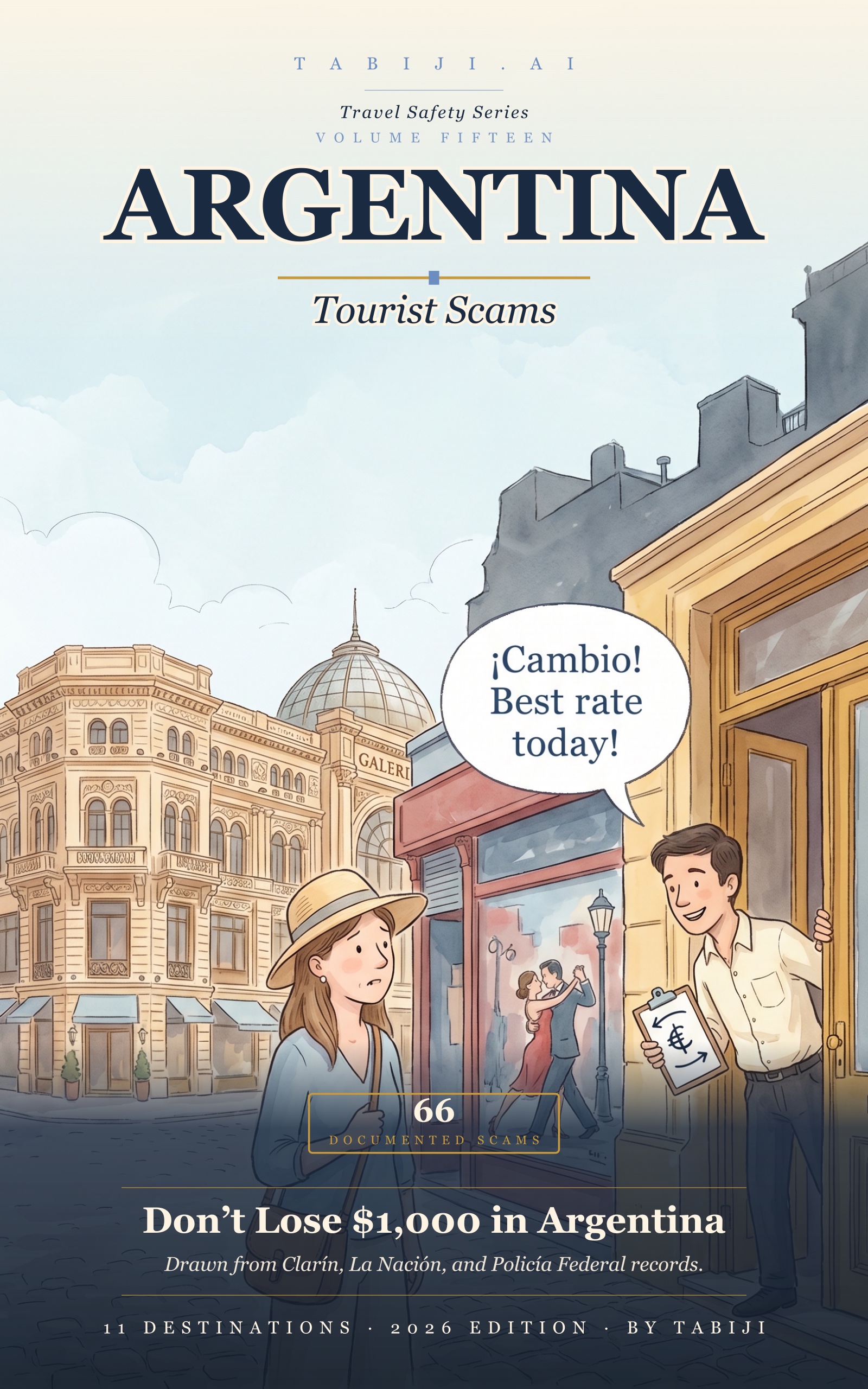
Cambio scams, four ways the rate moves.
A "Cambio! Cambio!" arbolito on Florida Avenue. A Casablanca airport window quoting 8.5 dirham per dollar (interbank is 10.1). A back-room cueva that drops the rate 12% during the count. A small-bill short-count at a Cancun resort cashier. Four sub-variants across 13 countries, defeated by the same one rule: skip the cambio, use Western Union or a major-bank ATM.


Currency-exchange and cambio scams run four mechanics across 13 countries: street cambio hustle, airport-window markup, back-room cueva rate-switch, and small-bill short-count. The universal defense is one decision made before the trip: use Western Union pickup or a Wise/Revolut multi-currency card for everything. Withdraw cash only at major-bank main-branch ATMs. Refuse every street cambio approach with "no gracias" and keep walking. Count change audibly in front of the cashier. The fee differential vs cambio rates is at most 1-2% in your favor; the cambio markup-plus-fraud differential runs 8-25% against you.
"Cambio, cambio! Best rate today!" The cueva said the rate dropped 12 percent.
You walk south on Calle Florida from the obelisk toward Plaza de Mayo at 3pm on a Tuesday. The pedestrian street is full: tango performers, leather-shop hawkers, day-trip groups, and on every block a different man shouting "Cambio, cambio! Dollar, euro, real! Best rate today!" One of them, mid-thirties, friendly, gestures you over with a clipboard showing handwritten rates: USD to ARS at 1,420 pesos per dollar. The official banking rate that morning was 1,250.
You agree. You have 200 USD in twenties. He says he cannot exchange on the street, leads you down a side passage off Florida between Galerias Pacifico and the leather-goods row, into a small unmarked apartment on the second floor of a turn-of-the-century building. A woman behind a counter takes your cash, fans the twenties, nods.
"Excelente," she says. "But the rate today, at this hour, you understand, is 1,250. Not 1,420. The rate on the street is for higher-volume transactions only. For 200 dollars I can offer 1,250."
You started this transaction expecting 284,000 pesos. You leave with 250,000. The 34,000-peso difference, about 27 USD, is the cueva's margin on the rate-switch variant. Calle Florida runs this play continuously through the trading day; the BCRA, the Comisaria Turistica at Av. Corrientes 436, and the Policia de la Ciudad have logged the arbolito-to-cueva pattern for two decades. Under the 2024-2025 Milei reforms the historic "blue dollar" arbitrage has largely collapsed, so the rate quoted on the street often barely beats the official one before the cueva-side fraud lands.
That is the canonical street-cambio-to-cueva-rate-switch variant, executed at the global archetype. The rest of this page is the four-mechanic playbook, the four other cities where it runs (Tangier, Casablanca, Cairo, Cancun), and the official-channel rule that makes every cambio approach end before it starts.
Read the full Buenos Aires scam guide →Key Takeaways
The official-channel rule
Cambio scams depend on you doing the exchange transaction at all. Every variant assumes you have local-currency cash to obtain through a non-bank channel. The defense is one structural decision made before the trip: use the official channels (Western Union, Wise, Revolut, major-bank ATMs) and never enter the cambio supply chain.
- Use Western Union or Wise/Revolut for the trip. Argentina: Western Union pickup at Plaza San Martin (and 40+ branches) gives the legal blue-equivalent rate with zero counterfeit risk. Globally: Wise and Revolut multi-currency cards offer interbank rates with a small spread for daily payments and ATM withdrawals. Both eliminate the cambio transaction entirely. Single most effective preventive decision; made once at home before the trip.
- ATM at major-bank main branches for cash. Argentina: Banco Nacion, Santander, BBVA, HSBC, Galicia, Macro. Morocco: Attijariwafa, BMCE, Banque Populaire. Egypt: NBE, CIB, QNB. Mexico: BBVA Mexico, Santander, Banamex. Turkey: Garanti, Isbank, Akbank. The fee is at most 1-2% over interbank; the alternative (cambio shops, hotel exchanges, airport windows) costs 3-15% in markup plus counterfeit risk.
- Refuse every street cambio approach. Florida Avenue arbolitos shouting "Cambio! Cambio! Best rate!" run the back-room cueva variant where the rate quoted on the street drops 5-15% by the time you sign. The play depends on you walking off the public street into a back-room office. Refuse with "no gracias" and keep walking. Same play in Tangier ferry exit, Cancun Hotel Zone, Cairo Khan el-Khalili, Istanbul Sultanahmet.
- Count cash in front of the cashier, in daylight. Hold each high-denomination note up to the light for the watermark check. Count audibly while the cashier watches. Any short-count or counterfeit gets challenged before the transaction is functionally over; once you pocket and walk away, recovery is near-zero.
- Avoid airport exchange windows entirely. Casablanca, Cancun, Cairo, and Istanbul airport exchange windows charge 8-15% over interbank. Withdraw 100-200 USD equivalent from the in-arrivals-hall ATM for first-48-hour cash. Save the rest for the city major-bank ATM. The "Global Exchange" chain at Moroccan airports has been called out repeatedly for posted rates 15-20% worse than interbank plus a buried commission line.
The four mechanics
Different cities and different operator crews lean on different mechanics within the same family. Here are the four sub-variants documented globally. Each has a recognition tell, a primary geography, and the routine step that defeats it.
1. Street Cambio (Arbolito) Hustle
An arbolito (street money-changer) shouts "Cambio! Cambio! Best rate!" to passing tourists and offers a rate that beats the official banking rate by 10-15%. The arbolito is the front-end of a cueva (back-room) operation; the rate on the street is bait. The actual exchange happens in a back-room where rate-switch, counterfeit-mix, or short-count fraud follows.
Defense: refuse with "no gracias" and keep walking. Most reported in: Buenos Aires Calle Florida; Tangier ferry exit; Cancun Hotel Zone; Cairo Khan el-Khalili; Istanbul Sultanahmet.
2. Airport-Window Markup
Airport exchange windows charge 8-15% over interbank rates with hidden commission lines on the receipt. The "Global Exchange" chain at Moroccan airports posts rates 15-20% worse than interbank plus a 3-5% commission line buried at the bottom of the receipt. The transaction itself is legitimate (real cash, correct count) but the rate is pure tourist tax.
Defense: use the in-arrivals-hall ATM. Most reported in: Casablanca CMN; Cancun CUN; Cairo CAI; Istanbul IST; Marrakech RAK; Mexico City MEX.
3. Back-Room Cueva Rate-Switch
An arbolito leads you off the public street into an unmarked apartment or shop. The cashier behind the counter quotes a rate 5-15% lower than what was promised, framed as a "commission" or "today's rate at this hour." Variants include fast-fan-count (bills counted face-down too fast for verification), counterfeit-mix (one or two fakes slipped in), and rapid sleight-of-hand swaps.
Defense: never go off the public street for an exchange transaction. Most reported in: Buenos Aires Microcentro cuevas; Caracas downtown; La Paz Sopocachi.
4. Small-Bill Short-Count
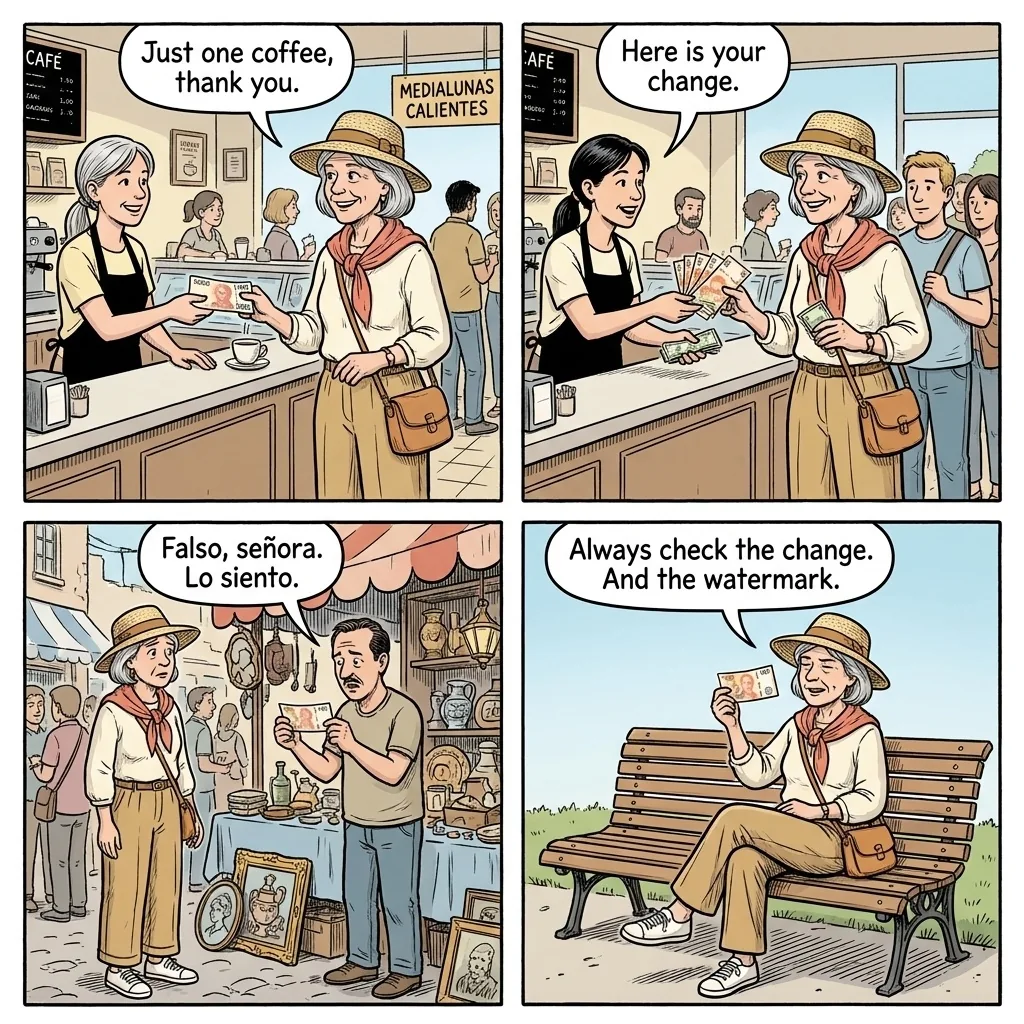
The cashier counts audibly to the agreed amount, slides the stack to you, then takes back "one to recount" or "one to verify against the watermark" and palms it. The total comes back one to three notes short. Runs at small cambio shops, hotel front desks, and tourist-zone exchange counters globally.
Defense: count audibly yourself before pocketing; refuse to hand the stack back for any "recount." Most reported in: small Cancun Hotel Zone resorts; Cairo Khan el-Khalili; Istanbul Grand Bazaar; Bangkok Sukhumvit.
Where it runs
Cambio scams concentrate where two conditions overlap: structural currency mismatch (high inflation, weak local currency, or capital controls) and dense tourist foot traffic that creates a stable supply of marks. Latin America, North Africa, and Southeast Asia account for over 80% of documented variants.
| Country | Documented variants | Iconic location pattern |
|---|---|---|
| 🇦🇷 Argentina | 6 | Buenos Aires Calle Florida arbolitos and Microcentro cuevas · Mendoza Peatonal Sarmiento · Bariloche centro |
| 🇲🇦 Morocco | 5 | Tangier ferry-exit street exchanges · Casablanca and Marrakech airport "Global Exchange" · Fez old-medina shops |
| 🇪🇬 Egypt | 4 | Cairo Khan el-Khalili · Tahrir Square corner shops · Aswan riverboat market · Cairo airport exchange counters |
| 🇲🇽 Mexico | 3 | Cancun Hotel Zone · Mexico City Centro Historico · Playa del Carmen Quinta Avenida |
| 🇹🇷 Turkey | 2 | Istanbul Sultanahmet and Grand Bazaar exchanges · Antalya old-town |
| 🇻🇪 Venezuela | 2 | Caracas downtown casas de cambio · Maracaibo border zone |
| 🇰🇭 Cambodia | 1 | Phnom Penh Russian Market · Sisowath Quay riverside |
| 🇹🇭 Thailand | 1 | Bangkok Sukhumvit small cambio shops · Phuket Patong |
Bar width is data-bound at 10 pixels per documented variant. The eight countries above account for 24 of 26 total variants, or 92% of the global atlas.
Four more cities, four more cambios
The Florida Avenue scene above showed the arbolito-to-cueva rate-switch variant. Here are four more cities where different sub-variants dominate. Each links to the full city scam guide.
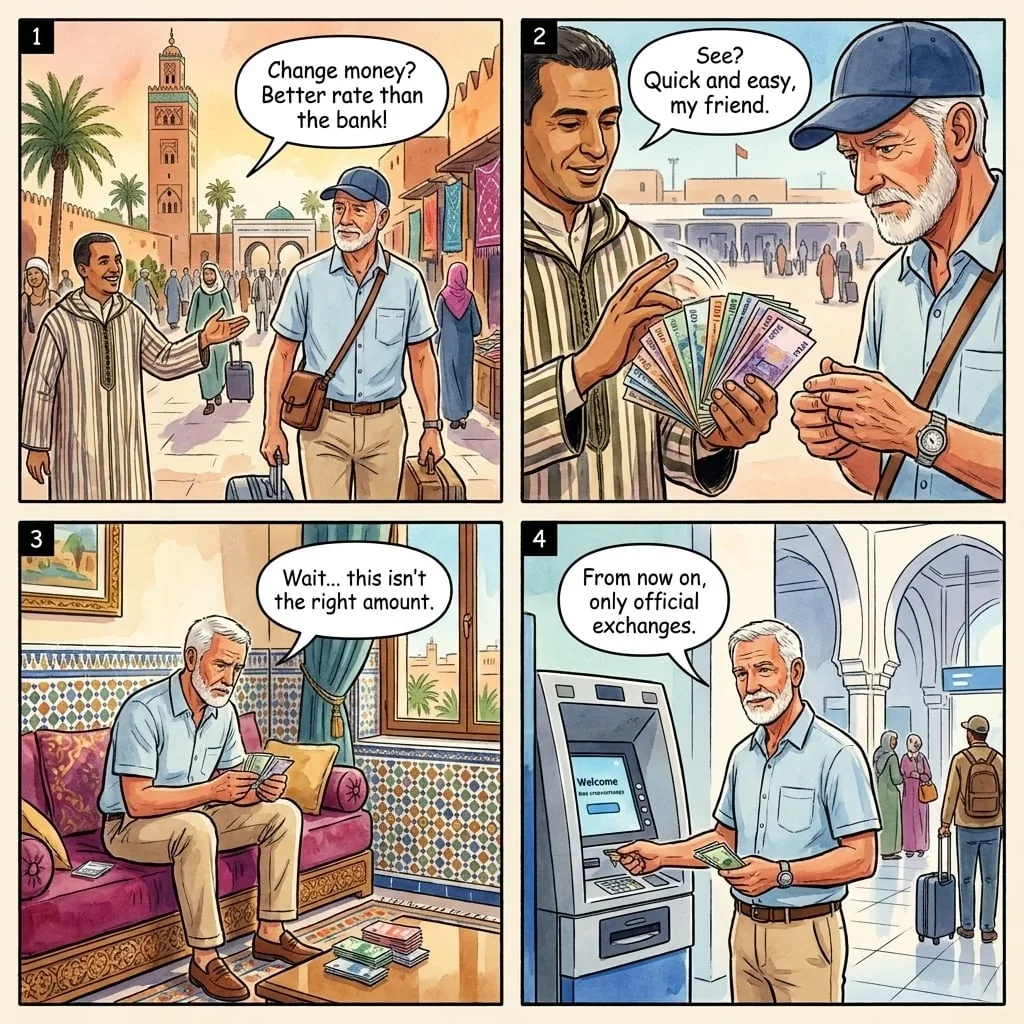
You step off the FRS Iberia ferry from Tarifa at Tangier Med port at 1pm. The terminal building empties into a small forecourt where unofficial money-changers approach with calculators and stacks of dirham. The street rate quoted is 10.5 MAD per EUR (interbank that morning is 10.8); the tourist agrees, exchanges 200 EUR, receives 2,100 MAD. At the hotel that night, the watermark check on three of the high-denomination 200-MAD notes fails. The Tangier ferry-exit cambios run the counterfeit-mix variant continuously; the Bank Al-Maghrib (Moroccan central bank) has issued repeated warnings; Le Matin and L'Economiste publish quarterly bulletins. The Brigade Touristique in Tangier accepts tourist-fraud reports. Defense: walk past every ferry-exit cambio. The Attijariwafa Bank ATM in the ferry terminal building (and the Banque Populaire ATM at the Tanger Ville train station) gives interbank rate plus a small fee for the 200-300 MAD you need for the first 48 hours. Save the rest for the city.
Read the full Tangier scam guide →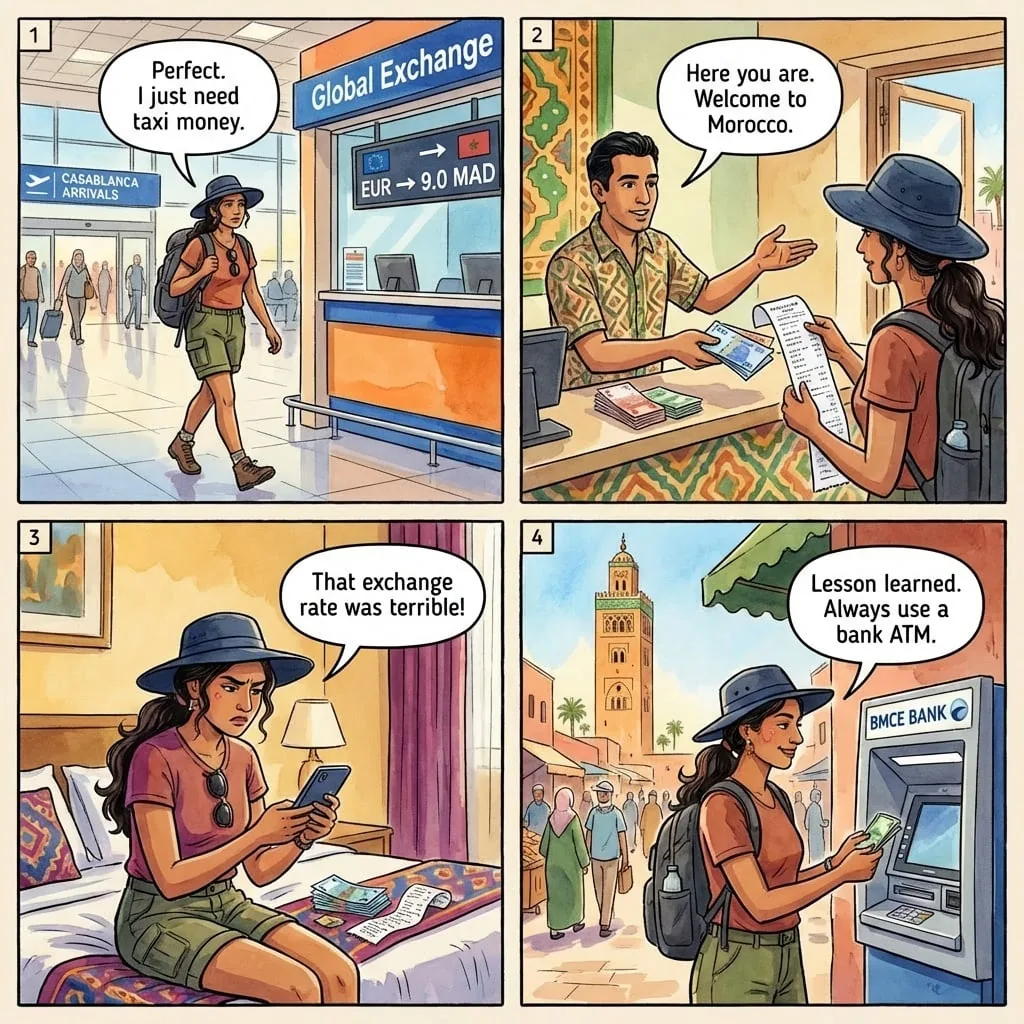
You arrive at Mohammed V Airport in Casablanca at 11pm after a long flight. The arrivals hall has two exchange counters branded "Global Exchange," posted rates 8.5 MAD per EUR. The interbank rate that day is 10.2. The 17% spread is the highest-margin moment in the airport, when tired travelers prioritize getting any cash over getting good cash. r/Morocco's "Scammed by Global Exchange at Casablanca Airport" thread and the parallel TripAdvisor "Don't use Global Exchange at Marrakech Airport" warning thread document the same operator running the same play at every Moroccan airport: posted rates 15-20% worse than interbank, plus a "commission" line buried on the receipt that erases another 3-5%. The Bank Al-Maghrib has not regulated airport-exchange spreads. Defense: walk past every airport exchange counter. Use the Attijariwafa Bank ATM in the arrivals hall (next to the SIM-card kiosk, marked with the green logo) for 1,500-2,500 MAD covering the first 48 hours. Save the rest for the city.
Read the full Casablanca scam guide →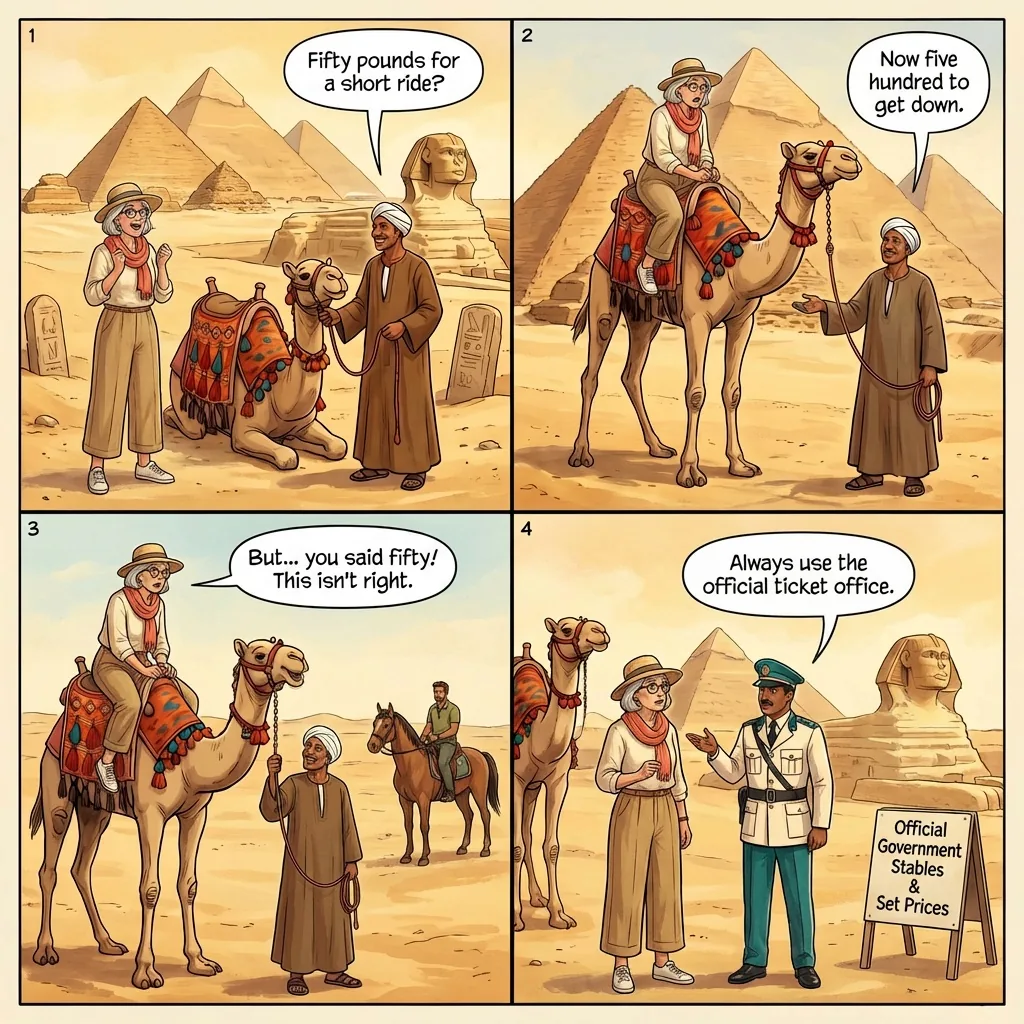
You walk into a small cambio shop on Sikket El-Khan in Khan el-Khalili at 4pm to exchange 100 USD. The cashier quotes 49 EGP per dollar (the official rate is 49.5; close enough that this part is legitimate). He counts the stack of 4,900 EGP audibly: ten 100-pound notes, eight 200-pound notes, plus 3,300 in 50s and 20s. He slides the stack across, then takes one 200-pound note back: "Watermark check, sir." He holds it up to the bulb above the counter, returns it. You pocket the cash and walk on. At dinner, you count the stack: 4,700 EGP. The 200-pound note he palmed during the watermark check is gone. The Cairo small-bill short-count runs continuously in Khan el-Khalili and around Tahrir Square; the Tourist Police line +20 126 takes English-language reports but recovery from a cambio shop after the transaction is essentially zero. Defense: use the National Bank of Egypt (NBE) main-branch ATM at Tahrir Square or the Commercial International Bank (CIB) ATM at the Egyptian Museum entrance for cash withdrawals. The fee is 30-60 EGP; the cambio short-count costs 200-1000 EGP per transaction.
Read the full Cairo scam guide →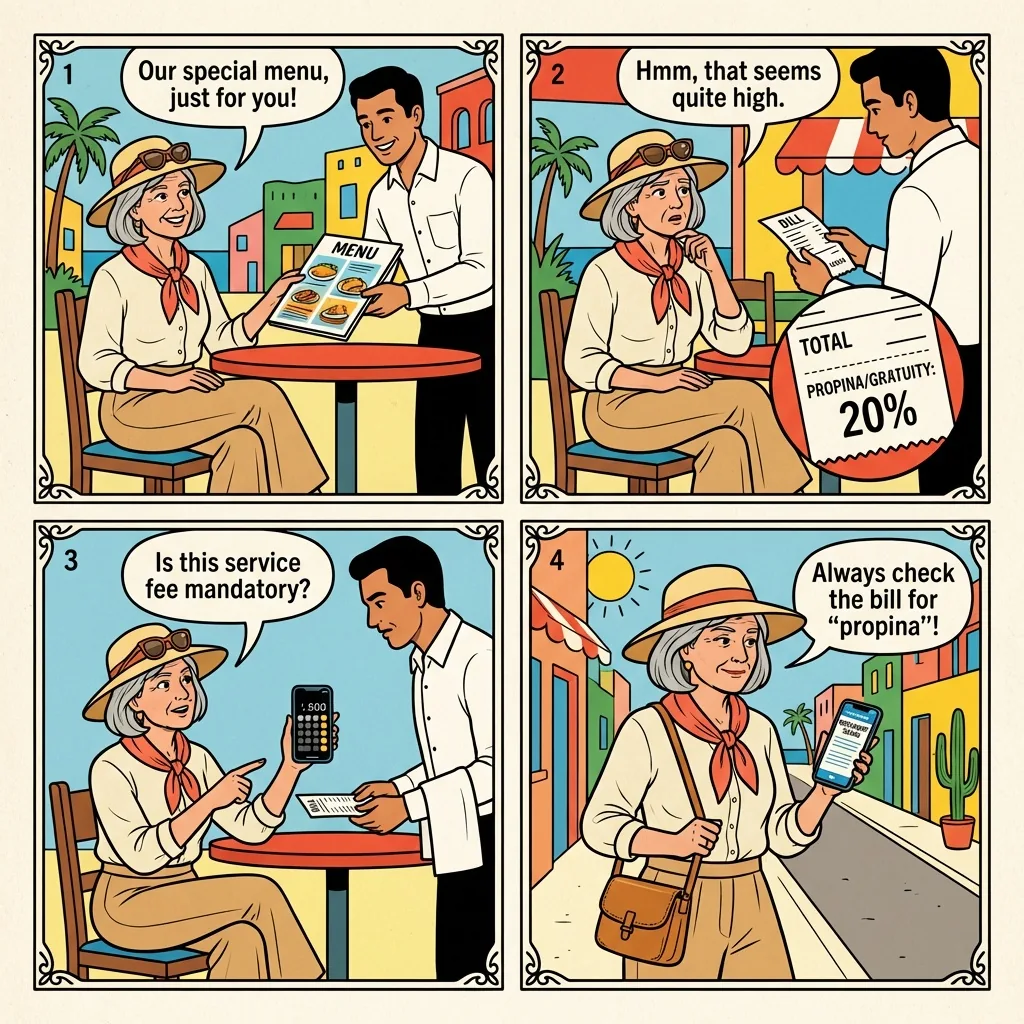
You ask the front desk at your all-inclusive resort on Boulevard Kukulcan in the Hotel Zone to exchange 100 USD for tipping cash. The posted rate is 16.5 MXN per dollar; the interbank rate that morning was 19.2. The 14% spread is the resort-cambio markup. You exchange anyway because the resort is closed-perimeter and the in-room safe is the alternative. The cashier counts 1,650 MXN audibly: three 500-peso notes, plus 150 in smaller bills. She takes one 500-peso note back to "verify under the UV light," returns it. The total comes out to 1,150 MXN once you count back at the room. The Cancun Hotel Zone runs both the airport-window-style markup AND the small-bill short-count at resort cambios; the Cancun consumer-protection agency (PROFECO) accepts complaints but recovery is near-zero. Defense: use BBVA Mexico, Santander, or Banamex ATMs in central Cancun (10-minute taxi from the Hotel Zone) for interbank-rate cash. Bring 200-300 USD in small bills (twenties and fives) from home for tipping; resort tipping is supposed to be in pesos but staff also accept dollars at fair rates.
Read the full Cancun scam guide →Red flags
If two or more of these signals fire when you are about to exchange currency, walk away and use an official channel. The compounding rule: a single signal might be a coincidence; two signals are a script.
- The exchange is on the street with a man shouting "Cambio!"
- The rate quoted is 5-15% better than the official banking rate
- You are asked to walk off the public street to a back-room office
- The exchange counter is in an airport arrivals hall
- The posted rate is 8-15% worse than interbank (Wise app shows interbank live)
- A "commission" line appears on the receipt for 3-5% of the total
- The cashier counts the stack face-down too fast for you to follow each bill
- The cashier takes a high-denomination note back to "verify the watermark"
- The hotel front-desk exchange rate is 10-15% worse than ATM rate
- The cambio shop is in a tourist-zone street with no official central-bank licensing visible
The phrases that shut it down
Refusing a cambio works when you signal you are using the official channel. The phrase is the same idea in every language: I do not need an exchange.
If you got hit
You exchanged at a cambio and the count came up short, the rate switched in the back room, or the airport window charged 15% over interbank. Recovery depends on which variant ran and where you noticed; act fast in the first thirty minutes.
Within five minutes (best case): if you are still at the cashier window, count the stack again loudly and announce the discrepancy. Most operators reverse the take when caught at the window because the alternative is the police being called. If you have already walked away, recovery is near-zero.
Within thirty minutes: file a police report with the local tourist-police line. The report number is required by your travel-insurance carrier for currency-fraud claims (covered up to a per-incident cap on most premium-tier policies, typically $200-500).
- Buenos Aires: Comisaria Turistica, Av. Corrientes 436, +54 11 4346 5748 (24/7 English); BCRA hotline 0800-999-6663 for counterfeit-peso reports.
- Tangier · Casablanca · Marrakech: Brigade Touristique, located at central police stations; Bank Al-Maghrib counterfeit-deposit at any main branch.
- Cairo: Tourist Police +20 126 (24/7 short code); Central Bank of Egypt counterfeit reporting via NBE branches.
- Mexico City · Cancun · Playa del Carmen: PROFECO consumer-protection agency for cambio markup complaints; Policia Turistica for theft reports.
- Istanbul: Tourism Police, Sultanahmet station off Yerebatan Caddesi; Police 155.
Within 24 hours: if cards or accounts were exposed (some cambio scams pair with quishing or skimming), call your card issuer and freeze. Most premium-tier travel cards include currency-fraud insurance up to a small cap. The cambio loss itself is rarely recoverable; the actionable response is preventive for the next encounter, not recovery for this one. Treat the loss as cost-of-traveling and update your routine: Wise or Revolut card + major-bank ATM in every country going forward.
Related atlas entries
Sister entries in the Scam Atlas. Cambio scams overlap with counterfeit currency (the cueva variant slips counterfeits into the count) and with ATM skimming (both involve cash transactions in tourist zones).
Sources
- Banco Central de la Republica Argentina (BCRA), public guidance on Calle Florida arbolito and cueva enforcement (verified April 2026).
- Clarin, La Nacion, Pagina 12, multi-year coverage of Florida Avenue cambio arrests and the Milei-era reform context (Buenos Aires, 2018-2025).
- Bank Al-Maghrib (Moroccan central bank), counterfeit-currency reporting framework via main-branch deposits (verified 2025).
- Le Matin and L'Economiste, Tangier ferry-exit and Casablanca airport exchange-markup reporting (Morocco, 2023-2025).
- r/Morocco "Scammed by Global Exchange at Casablanca Airport" thread and parallel Marrakech warning thread (TripAdvisor, ongoing).
- Central Bank of Egypt counterfeit reporting; Al-Ahram Weekly and Egypt Today Khan el-Khalili cambio coverage (Cairo, 2022-2025).
- PROFECO (Mexican consumer-protection agency) Cancun Hotel Zone exchange-markup complaint data.
- r/travel, r/argentina, r/Morocco, r/egypt, r/mexico continuing thread monitoring 2018-2026.
Get the full cambio playbook for your destination.
Each Travel Safety atlas covers every documented cambio variant in one country, plus the country's full scam catalog: pickpocket, taxi, ATM, restaurant, fake authority. Buy once, lifetime updates as scams evolve. $4.99 on Kindle.