Photo-Fee Shakedown: the same scam, in 4 countries.
From Roman centurions at the Colosseum to snake charmers at Jemaa el-Fnaa to camel handlers at the Pyramids to costumed dancers at Bali temples, the same mechanic recurs: a costume, a tourist camera, an aggressive demand. The no-camera rule and the no-touch rule defeat every variant.


Photo-fee shakedowns run five mechanics across 4 countries: Italian Roman centurion / gladiator at the Colosseum, Spanish Steps, Trevi Fountain (poses dramatically when tourists raise cameras; demands 5-20 EUR per photo, more if the helmet or sword touches you), Marrakech Jemaa el-Fnaa snake charmer or monkey handler (places the snake or macaque on tourist shoulders for the camera; 100-500 dirham demand), Egypt Giza Pyramids camel handler (initial 50 EGP quoted price escalates to 500-2,000 EGP after mounting; some refuse to let tourist dismount), Bali Uluwatu / Tanah Lot / Ubud Monkey Forest costumed dancer or macaque handler (50-500K IDR demand), and Times Square / Hollywood Walk of Fame Disney-character mascot (5-50 USD per pose). The universal defenses are two rules: the no-camera rule (never raise camera or phone toward a costumed tout, animal handler, or anyone in costume at a tourist site; the camera-up gesture is implicit consent), and the no-touch rule (do not let the costume / animal / sword / hat be placed on your body; placement is the contract trigger). Police: Italy 113, Morocco 19, Egypt 126, Indonesia 110.
"Forty euros, signore. The helmet was on your head, that is the contract."
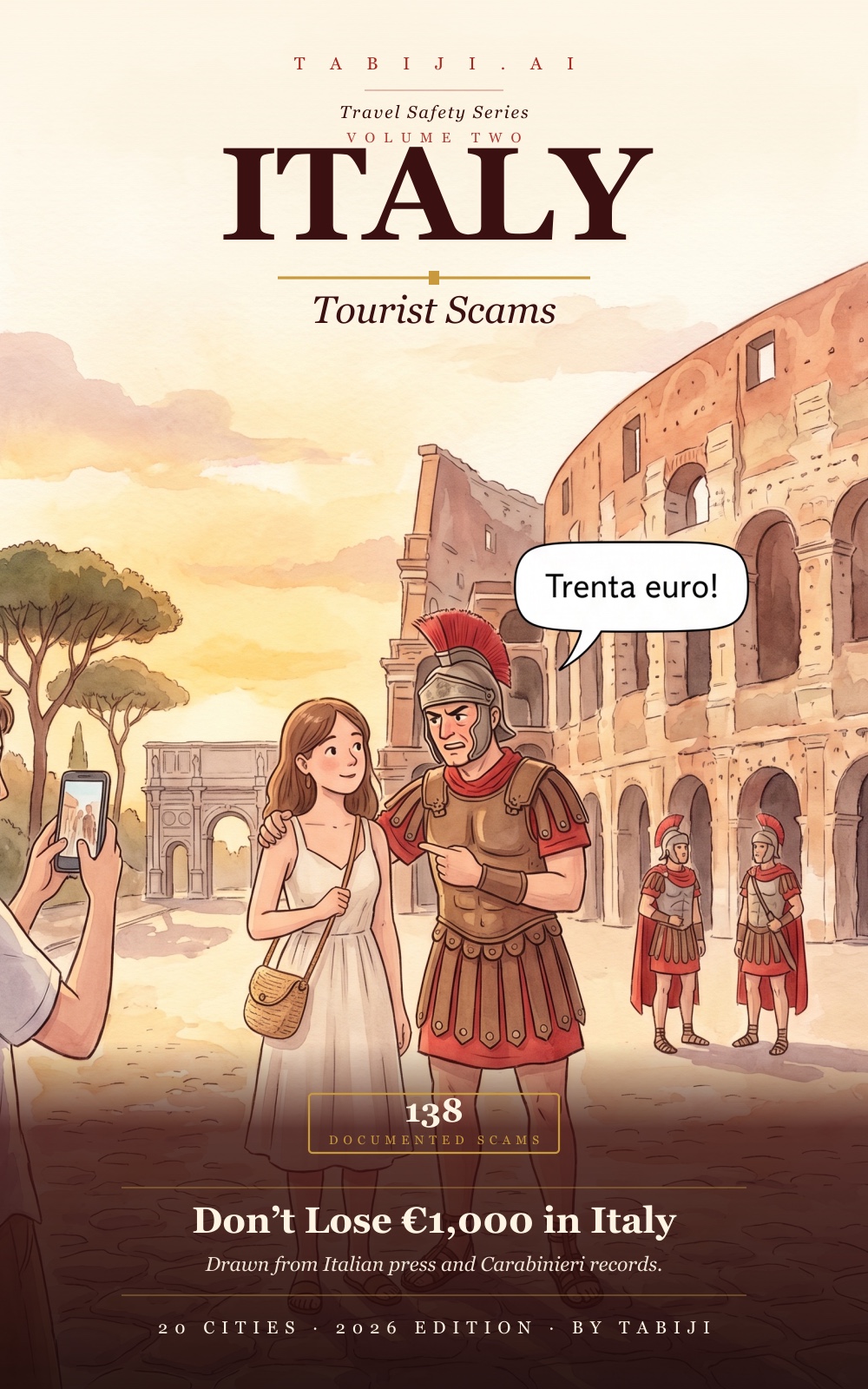
You and your travel partner walk up to the Colosseum from the Via dei Fori Imperiali. The Colosseum stone glows in the late-morning sun. Two men in elaborate Roman centurion costumes (red tunics, plumed helmets, swords, leather sandals) stand near the southern arches. As you raise your phone for the canonical Colosseum photo, one of the centurions strides toward you, helmet in hand, broad smile. He drops the helmet onto your travel partner's head, postures dramatically with his sword raised, gestures at his companion to take a photo with their phone for you.
You take the photo on your phone. He takes one on his phone too (he says, "for memory"). Your partner pulls the helmet off, laughs. The centurion's smile changes. He says: "Forty euro, signore. Twenty for the helmet, twenty for the photo. The helmet was on your head, that is the contract."
You hesitate. Forty euros for what you thought was a friendly costume photo. Behind him, his companion has stepped two paces closer, arms crossed. You realize the variant. You say "no grazie" and start walking; the centurion follows, voice rising. "You take the photo, you pay, signore, this is how we work, this is our profession, you respect."
This is the Italian centurion photo-fee shakedown, the most-documented Roman tourist scam. The Roman municipal government banned costumed performers from the Colosseum perimeter in 2015 with periodic enforcement waves; the centurions return after each crackdown. The Polizia di Stato Colosseum substation (113) handles dispatch; tourist losses average 20-50 EUR per incident, sometimes higher with multiple costumes (gladiator + centurion + senator).
The defense is two rules. The no-camera rule: never raise your camera or phone toward a costumed tout, animal handler, or anyone in costume at a tourist monument. The camera-up gesture is implicit consent; the photo is the contract. Take the Colosseum photo from a different angle (the Arch of Constantine side, or from across Via dei Fori) where centurions are not staged. The no-touch rule: do not let the costume — helmet, sword, sandals, anything — be placed on your body or in your hand. The placement is the contract trigger. If a centurion approaches with a helmet held out, step back and shake your head firmly.
That is the Italian centurion photo-fee variant of the costumed-tout family, executed at the most-documented Roman monument. The rest of this page is the five-mechanic playbook, the four other places where it runs in different forms (Marrakech Jemaa el-Fnaa snake charmer, Giza Pyramids camel handler, Bali Uluwatu costumed dancer, Times Square Mickey Mouse), and the two rules that defeat every variant.
Read the full Rome scam guide →Key Takeaways
The no-camera rule and the no-touch rule
Every variant of the photo-fee shakedown is defeated by the same two rules. The no-camera rule: never raise your camera or phone toward a costumed tout, animal handler, or anyone in costume at a tourist monument. The camera-up gesture is implicit consent; the operator considers any photo (including from across the plaza) as an act that creates a debt. The no-touch rule: do not let the costume, animal, sword, helmet, or hat be placed on your body or in your hand. The placement is the contract trigger; demands escalate after placement.
The first rule addresses the consent asymmetry. Operators position themselves at iconic photo angles (Colosseum southern arches, Jemaa el-Fnaa central square, Sphinx eastern viewpoint, Bali Uluwatu cliff edge); tourists raise cameras almost reflexively at these locations; the operator then claims a fee for being in the frame. The defense is photographic discipline: take photos from angles or distances where costumed touts are not staged, or skip the costumed-tout shot entirely.
The second rule addresses the placement asymmetry. Operators offer to "let you wear the helmet" or "hold the snake" or "ride the camel" with framing as a friendly gesture; once placed, the operator considers a contract created. Demands escalate after placement: the first quote may be 5-10 EUR; after the snake / helmet / camel touch, the demand becomes 30-100 EUR. Refusing placement at the door denies the lever.
The third defense is gait and gaze. Costumed touts target tourists who slow, stop, or make eye contact. Walking at normal pace through Colosseum, Jemaa el-Fnaa, Giza, Bali temple complexes with neutral gaze defeats most approaches. Operators who realize you are not engaging move to the next tourist within five seconds.
The fourth defense is the pre-quote rule. If you do want a costumed photo (rare, but happens — e.g., children with the Bali Kecak dancer, or with a Disney mascot), agree on the price in writing or on a printed sign before the camera goes up. Some legitimate Bali Kecak and Pyramid camel rides have published rates; if the rate is not posted, walk away.
The fifth defense, when a demand has been made: refuse politely without engaging in extended negotiation. Walking past at normal pace ends most demands; aggressive operators may persist for 30-60 seconds before moving on. Do not pay; do not hand over phone or camera (some operators will threaten to delete photos or break the phone). If escalation occurs, summon the local tourist police: Italy 113 dispatches from Colosseum substation within 5-10 minutes; Morocco 19; Egypt 126; Indonesia 110.
The five mechanics
Photo-fee shakedowns run five distinct mechanics across the major tourist iconic-monument circuit. Each has a signature country, a signature costume or animal, and a signature placement trigger.
1. Italian gladiator / centurion (Italy)
Men dressed as Roman centurions (red tunic, plumed helmet, sword, sandals) station themselves at the Colosseum, Roman Forum, Spanish Steps, Trevi Fountain. They pose dramatically when they see tourists with cameras, then demand 5-20 EUR per photo. Some place a helmet on the tourist or pose with a sword. Documented continuously since the 1990s; the Roman city government banned costumed performers from the Colosseum perimeter in 2015 with periodic enforcement waves. Defense: walk past, no camera up; if approached, polite refusal in Italian (no grazie); if escalation, Polizia di Stato 113 dispatch.
2. Marrakech snake charmer / monkey handler (Morocco)
At Jemaa el-Fnaa square, snake charmers play flutes for cobras in baskets; monkey handlers walk with chained Barbary macaques. When a tourist points a camera, the operator places the snake on the tourist shoulders or the monkey on the tourist arm; demands 100-500 dirham (10-50 EUR) per photo follow. Animal-welfare concerns are also significant; international and Moroccan agencies advise against engagement entirely. Defense: do not raise camera; walk through the square at normal pace; if grabbed, pull away firmly; report to Marrakech tourist police 19.
3. Egypt camel handler at Pyramids (Egypt)
At Giza Pyramids, Sphinx, Saqqara, Luxor Karnak Temple, costumed Bedouin or Pharaonic-attire operators offer camel rides, photos, or short tours. Initial price quoted as 50 EGP (about 1 USD); after the tourist mounts or the photo is taken, the demand escalates to 500-2,000 EGP (10-40 USD). Some handlers refuse to let the tourist dismount until additional payment is made. The Egyptian Tourism and Antiquities Police 126 issue ongoing advisories. Defense: book official Pyramid tours through authorized operators; do not engage with off-tour camel handlers; if mounted, request to dismount immediately.
4. Bali costumed dancer / macaque handler (Indonesia)
At Bali Uluwatu Temple, Tanah Lot, Tirta Empul, Ubud Monkey Forest, costumed Balinese dancers and macaque handlers operate. The variant runs in two forms: (1) costumed dancer poses for photos with tourists, demands 50-200K IDR (3-12 EUR); (2) macaque handler places fruit on tourist shoulder to attract a monkey, takes photo, demands 100-500K IDR (6-30 EUR). The Ubud Monkey Forest also has a documented variant where macaques snatch glasses or hats; a "helpful local" offers to retrieve for a fee. Defense: stick to official temple-tour operators; do not feed or photograph monkeys with phones in the open.
5. Times Square / Hollywood mascot (United States)
Costumed mascots (Mickey Mouse, Spider-Man, Elmo, Statue of Liberty, characters from current movies) stand at Times Square Manhattan and Hollywood Walk of Fame Los Angeles. They pose with tourists in photos, then demand 5-50 USD tips; some are aggressive about the demand. NYC and LA both passed regulations requiring costumed performers to register and wear ID badges (NYC 2017, LA 2019); enforcement is spotty. Some performers are documented as part of organized rings. Defense: do not pose with mascots without first asking the price in writing; in NYC, the mascot NYPD-issued vendor ID should be visible.
Where it runs
Photo-fee shakedowns concentrate at the most-photographed tourist monuments in each country. The geography below covers the most-documented locations.
- Italy (centurion / gladiator): Rome Colosseum exterior plaza (southern arches especially), Roman Forum (Via dei Fori Imperiali), Spanish Steps, Trevi Fountain, Piazza Navona, Vatican Square (Bernini Colonnade). Pompeii archaeological site (Pompeii Scavi entrance). Florence Piazza della Signoria (Michelangelo David replica area).
- Morocco (snake charmer / monkey handler): Marrakech Jemaa el-Fnaa central square (peak hours late afternoon to night). Fez Bab Boujloud and Talaa Kebira souk approach. Casablanca Mohammed V Square. Rabat Hassan Tower plaza. Tangier Petit Socco.
- Egypt (camel handler / Pharaonic costume): Giza Pyramids (Cheops, Khafre, Menkaure plateau approaches and Sphinx eastern side). Saqqara stepped pyramid. Luxor Karnak Temple, Luxor Temple, Valley of the Kings entrance. Aswan Philae Temple, Edfu Horus Temple. Cairo Khan el-Khalili (less common, more vendor-based).
- Indonesia (Bali, Lombok): Bali Uluwatu Temple (cliff plaza, especially during Kecak dance), Tanah Lot Temple, Tirta Empul, Ubud Monkey Forest entrance, Besakih Mother Temple, Pura Lempuyang (gates of heaven viewpoint). Lombok Senaru and Pura Lingsar.
- United States (mascots / costumed touts): NYC Times Square (Broadway and 7th Ave intersection especially), Statue of Liberty Battery Park ferry approach. LA Hollywood Walk of Fame (Hollywood Boulevard / Highland Avenue intersection), Universal CityWalk perimeter. Las Vegas Strip (Bellagio fountains, Caesars Palace).
- Adjacent (also documented): France: Paris Sacre-Coeur (artist portrait variant). Spain: Barcelona Las Ramblas (living statue tip-shakedown). Mexico: Mexico City Zocalo (Aztec costume photo-fee). Brazil: Rio Copacabana boardwalk (samba costume). Thailand: Bangkok Wat Arun (traditional Thai costume rental, less variant). India: Agra Taj Mahal east gate (Mughal costume photo).
Four more places, four more photo-fee variants
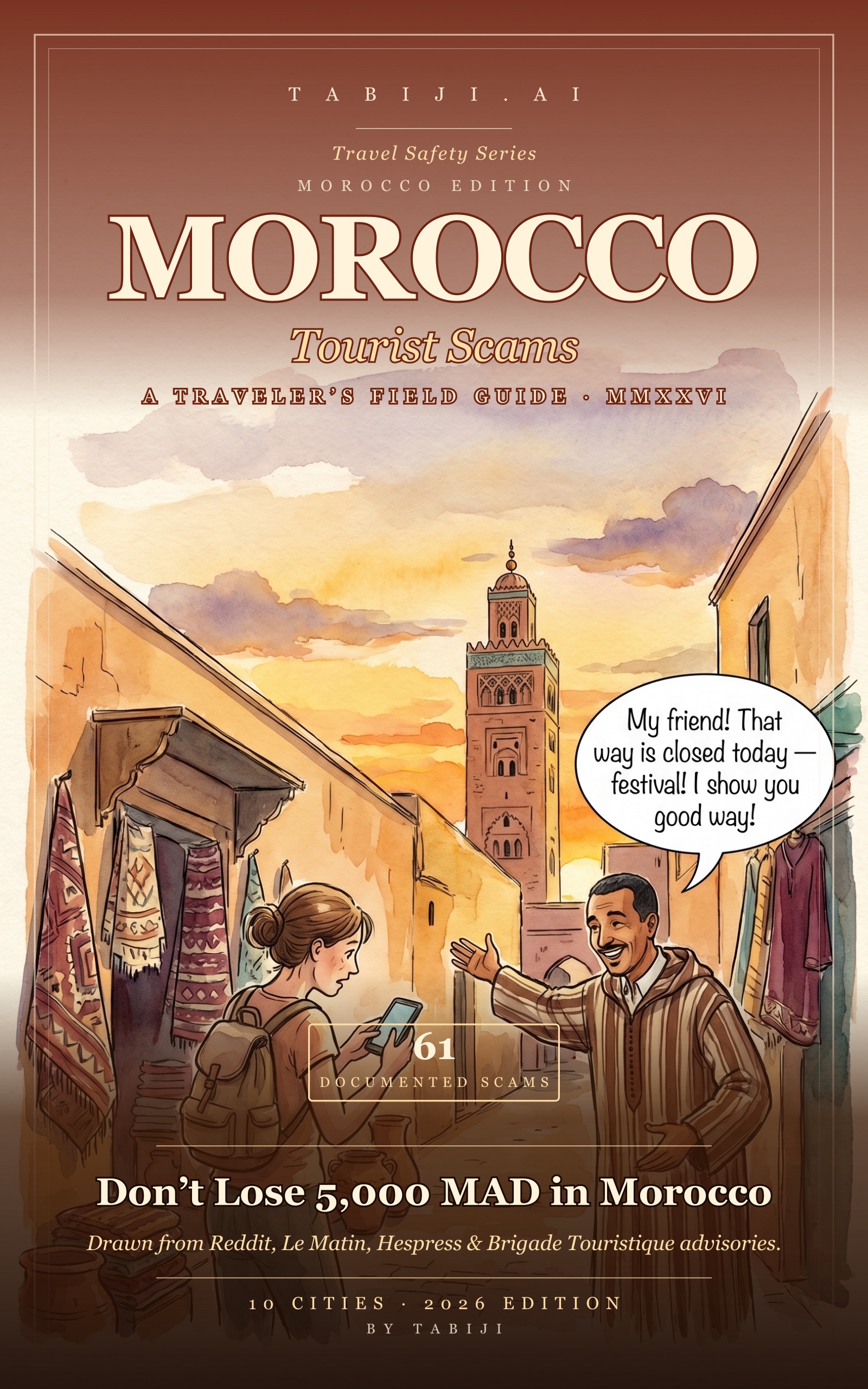
Marrakech Jemaa el-Fnaa: the cobra on your shoulders
Jemaa el-Fnaa, Marrakech medina, late afternoon. The square fills with food stalls, drum circles, snake charmers playing flutes. You approach a snake charmer (man in white djellaba, three baskets of cobras) for a photo from ten meters away. He rises, walks toward you with a cobra coiled around his arm; before you can step back, he has draped the snake over your shoulders. You hold still. He takes a photo with his own phone. Then he says, "two hundred dirham, monsieur, two hundred."
Two hundred dirham is about 20 USD. You hand over a hundred; he insists on two hundred. He gestures emphatically at the snake, still on your shoulders. You hand over the second hundred; he removes the snake. The photo on his phone is yours if you Bluetooth it; he charges 50 dirham for the transfer.
Defense: do not raise camera at any snake charmer or animal handler. Walk through Jemaa el-Fnaa at normal pace; the square is dense with legitimate food stalls and drumming circles that are free to enjoy. The Marrakech tourist police (19) handle aggressive-photographer complaints; the variant is also a documented animal-welfare issue (the cobras have venom glands removed and lifespans of 6-12 months in captivity).
Giza Pyramids: the camel that will not let you down
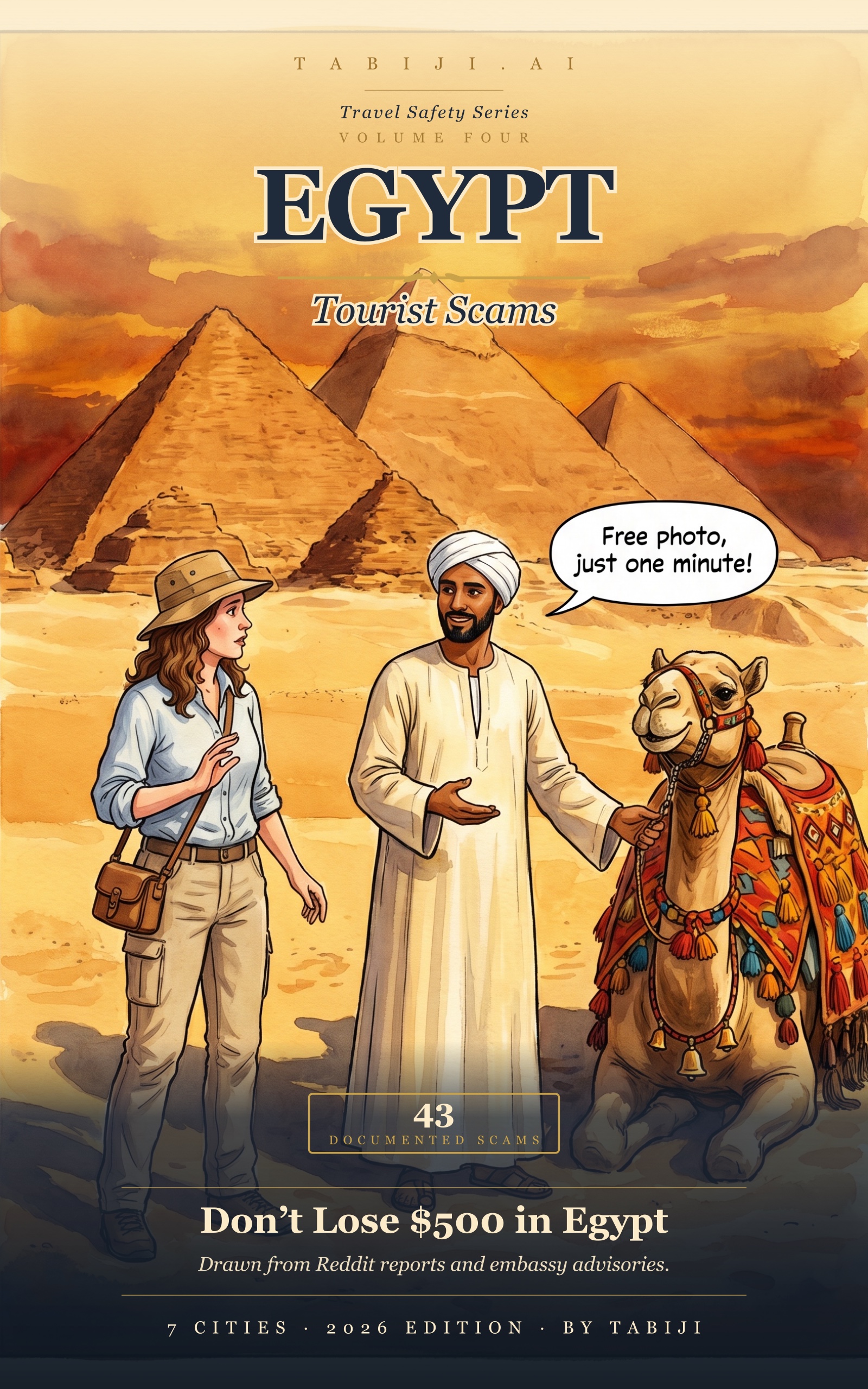
Giza Pyramids plateau, mid-morning. You walk from the Sphinx toward the Cheops Pyramid. A man in flowing Bedouin robes approaches with a kneeling camel. "Photo with camel, fifty pound, very good price." Fifty Egyptian pounds is about 1 USD. You agree, take a photo from beside the camel. He says, "now you ride, very nice for memory." You climb on the camel; he stands the camel up. The view is excellent. You take more photos.
You ask to dismount. He says, "first the photo fee, two thousand pound." Two thousand EGP is about 40 USD. You point at the original quote of 50; he shakes his head: "fifty for photo only, two thousand for ride, you rode, you pay." The camel is still standing. You can dismount yourself but he is holding the camel's lead rope close. You realize the variant.
Defense: the Egyptian Tourism and Antiquities Police 126 patrol the Pyramids plateau; phoning them collapses most demands. Better: book official Pyramid tours through authorized operators (any Cairo hotel concierge, Egyptian Tourism Authority website); off-tour camel handlers are the variant by definition. Photographs from the path without engaging the camel handlers cost nothing.
Bali Ubud Monkey Forest: the macaque snatch and retrieve
Ubud Monkey Forest, mid-afternoon. You walk through the forest path with your travel partner. A man in a traditional Balinese sash approaches with a small bunch of bananas. "Sir, give monkey banana, take photo, very lucky." You decline. You continue walking; you have your phone in your hand to photograph the temple in the distance.
A macaque jumps from a tree branch onto your shoulder, grabs the phone, leaps to a nearby branch with the phone in its hand. The Balinese man rushes over: "monkey took your phone, very bad luck, I help you, two hundred thousand rupiah, I get it back." Two hundred K IDR is about 12 USD. He produces a banana, throws it; the macaque drops the phone for the banana; he picks up the phone.
Defense: do not carry phone in hand at the Ubud Monkey Forest. Macaques are trained (or at minimum opportunistic) to grab shiny objects; the "helpful local" retrieve is a documented coordinated variant. The Monkey Forest official guides are licensed and wear photo IDs; non-guide locals offering retrieves are the variant. Keep phones, glasses, hats, and bags fully secured before entering.
Times Square Manhattan: the Mickey Mouse tip demand
Times Square, Saturday evening. A person in a Mickey Mouse costume walks toward you and your travel partner; they have already photographed a similar costumed Spider-Man with a different couple. Mickey gestures friendly, your partner smiles, they pose for a photo. After the photo, Mickey points at his costume head: "tip, twenty dollars, family of two, twenty dollars." Behind him, Elmo and a Statue of Liberty have stepped closer.
You hand over a five-dollar bill. Mickey shakes his head: "twenty, twenty, family is twenty." He gestures at Elmo who has stepped to your right. Your partner has the photos on her phone; she is not deleting them. You hand over a ten. Mickey accepts and walks off; you have lost 15 USD on a photo you did not particularly want.
Defense: NYC vendors are required to register; mascots wearing NYPD-issued vendor IDs and posting tip rates are the legitimate operators. Mascots without IDs (most of Times Square mascots are unregistered) are the variant. NYPD Times Square dispatches tourist-incident officers; calling 311 (non-emergency) for aggressive mascots is the documented response.
Red flags
- Costumed performer at a major monument without posted price. Operator-aligned. Real performers post fees clearly.
- Operator approaches you with the costume / animal / object held out. Placement-trigger setup.
- Initial price quoted as very low, then "ride" / "extra" / "service" added. The escalation pattern.
- Camel handler does not let you dismount on request. Variant in process. Phone tourist police on the spot.
- Snake or monkey already on your shoulders before consent. Placement contract trigger; pull back firmly.
- Performer follows you after refusal, persisting beyond 30 seconds. Real performers move on; persistence is the variant.
- Times Square mascot without visible NYPD vendor ID. Unregistered, the variant by definition.
- Group of costumed performers converging when you slow. Team-formation variant.
The phrases that shut it down
Each language below refuses the costumed tout firmly without breaking stride. Said while walking past at normal pace, no eye contact, no camera up.
If you got hit
If a costumed tout aggressively demanded payment after a photo: refuse politely without engaging. Walking past at normal pace ends most demands. If escalation occurs (operator follows, blocks path, threatens), summon the local tourist police. Italy: Polizia di Stato Colosseum substation 113 dispatches 5-10 minutes. Morocco: Marrakech tourist police 19. Egypt: Tourism and Antiquities Police 126. Indonesia: 110 (Bali Tourist Police English-speaking dispatch in Kuta and Seminyak; Uluwatu and Ubud have local police presence).
If you paid by card under duress: file a chargeback within 30 days. Visa, Mastercard, and Amex accept "billed amount differs from agreed amount" disputes for tourist-photo shakedowns when the cardholder has documentation (photo of the location, no receipt issued). Recovery rate is moderate; the chargeback corridor mainly serves as a deterrent for higher-value demands.
If a camel handler refused to let you dismount or a snake handler refused to remove the snake: phone tourist police on the spot. The variant is documented criminal coercion (not just a fee dispute) and police agencies treat it as such. Photograph the operator if safely possible; the costume is identifying.
If you were physically threatened: phone the embassy emergency duty officer in addition to local police. US +1 202 501 4444; UK +44 20 7008 5000; Canadian +1 613 996 8885; Australian +61 2 6261 3305. Embassies in Rome, Marrakech, Cairo, Jakarta / Denpasar all have 24-hour duty officers; threats to tourists at named monuments occasionally produce diplomatic intervention.
Related atlas entries
Sources & references
- Italy: Polizia di Stato 113 (Colosseum substation); Roma Capitale 2015 ordinance banning costumed performers at Colosseum perimeter; periodic enforcement waves.
- Morocco: Royal Gendarmerie tourist police 19; Marrakech Jemaa el-Fnaa advisories for snake charmer / monkey handler engagement; PETA and local NGO documentation of animal welfare.
- Egypt: Tourism and Antiquities Police 126; Egyptian Tourism Authority advisories for Giza, Saqqara, Luxor.
- Indonesia: Bali Tourist Police 110 (Kuta / Seminyak English-language dispatch); Indonesian Ministry of Tourism advisories for Uluwatu and Ubud.
- United States: NYPD Times Square Vendor Enforcement (2017 ordinance); LAPD Hollywood Boulevard Vendor Enforcement (2019 ordinance).
- UK FCO travel advice: Italy, Morocco, Egypt, Indonesia, USA country pages all warn about photo-fee shakedowns at named monuments.
- Tabiji field reports: Rome Colosseum, Marrakech Jemaa el-Fnaa, Giza Pyramids, Bali Ubud Monkey Forest, NYC Times Square (2024-2026).
Get the full photo-fee & tout playbook for your destination.
Each Travel Safety atlas covers every documented photo-fee, costumed-tout, and street-vendor scam in one country, plus the full scam catalog: pickpocket, taxi, ATM, restaurant, fake authority. Buy once, lifetime updates as scams evolve. $4.99 on Kindle.