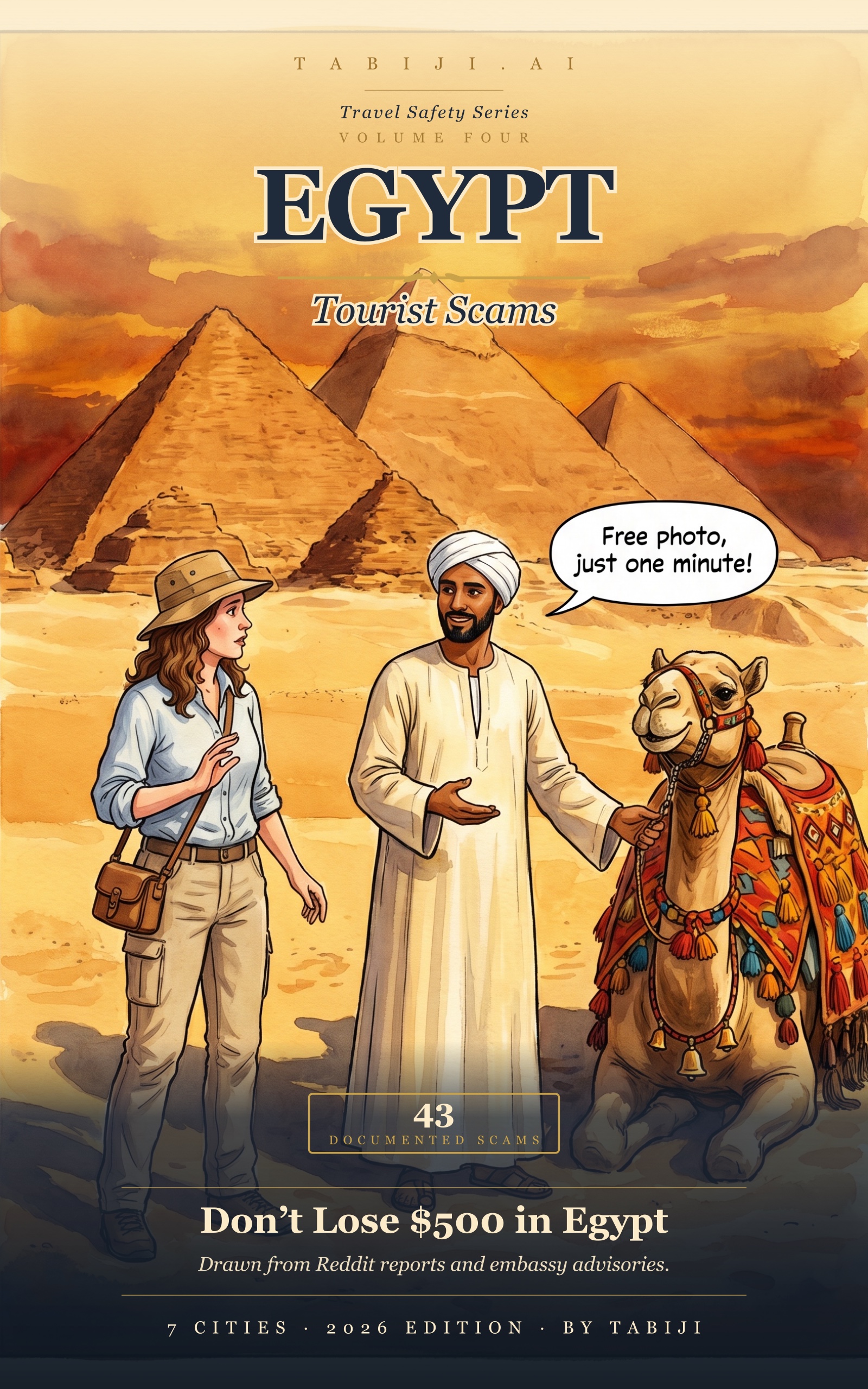
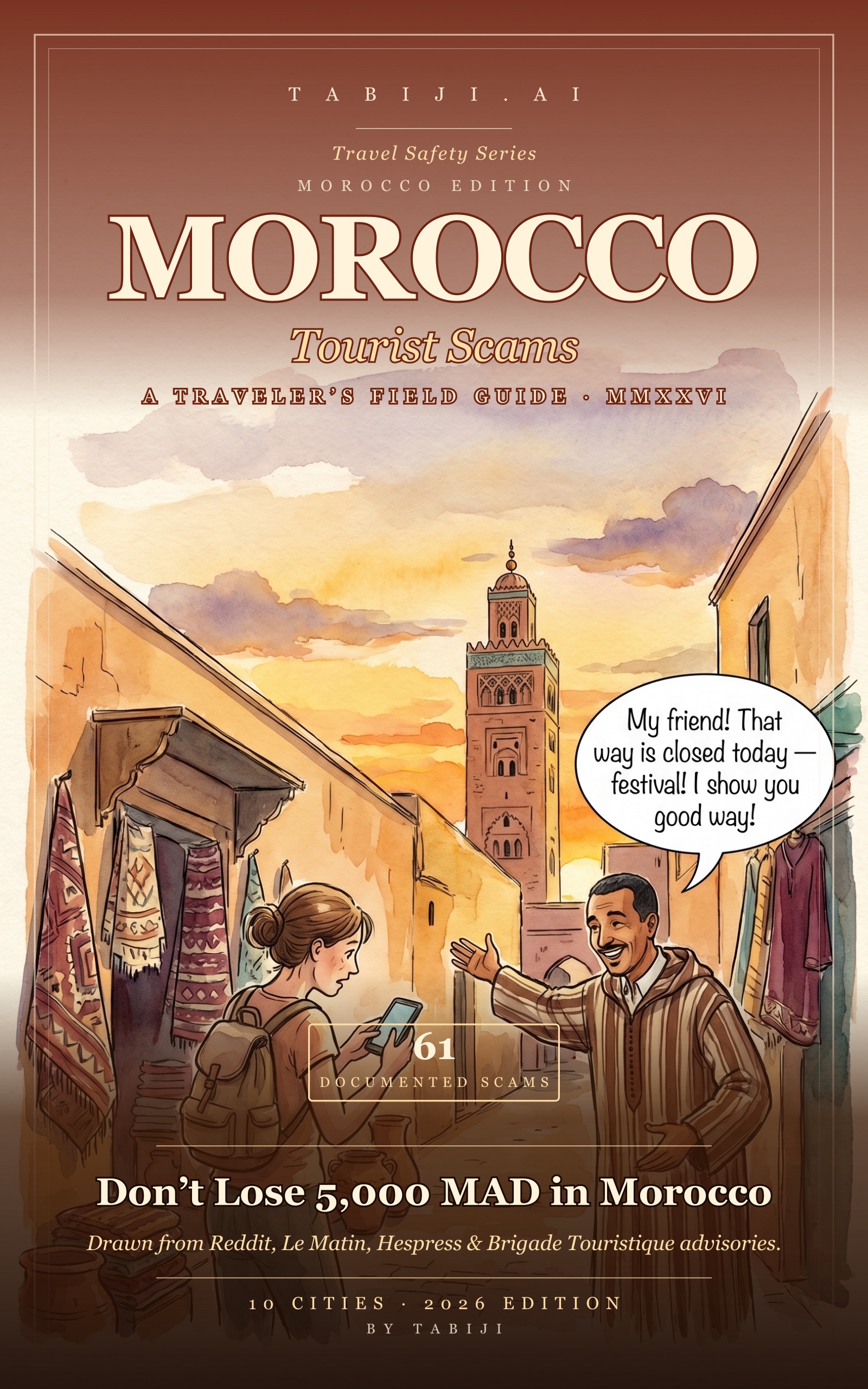
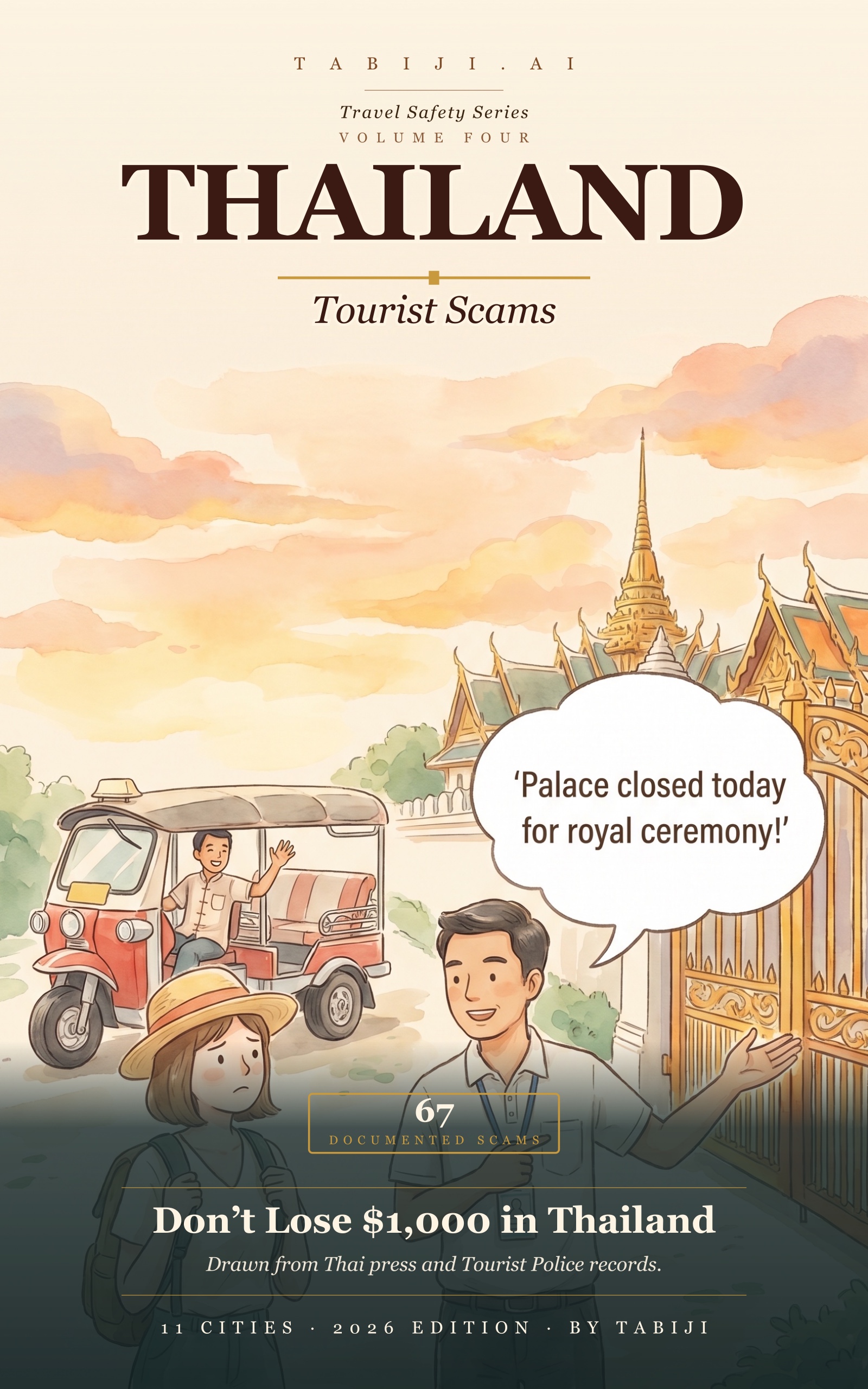
Fake and unlicensed tour guides, five mechanics from monument curb to mid-trail.
A man with a horse at the Giza Pyramid entrance who quotes 200 EGP for a ride to the Sphinx, then demands 1,500 more mid-trail. A "guide" outside the Bangkok Grand Palace insisting it's closed today, "I show you a different one." A polo-shirt guy with a printed lanyard collecting fake park fees in Cappadocia. Five mechanics across 7 countries, defeated by the same five-second rule: refuse unsolicited guide offers at every major monument.


Fake and unlicensed tour guide scams run five mechanics across 7 countries: closed-attraction redirect (Bangkok / Istanbul), fake museum guide (Rome / Vatican), mountain-trail mid-extortion (Atlas / Wadi Rum), horseback or camel mid-trail extortion (Giza / Petra), and fake park ranger (Cappadocia / Costa Rica). The universal defense is one five-second rule: refuse unsolicited guide offers at every major monument or trailhead. Real licensed guides do not solicit at monument curbs; they are booked through agencies, hotels, or licensed platforms (Get Your Guide, Viator, Klook). The defense in depth is verifying the license card before paying any guide and pre-negotiating full price in writing for any horseback / camel / ATV / boat / trail tour.
"Sir, the camel is two hundred Egyptian pounds to the Sphinx, no problem, very cheap."
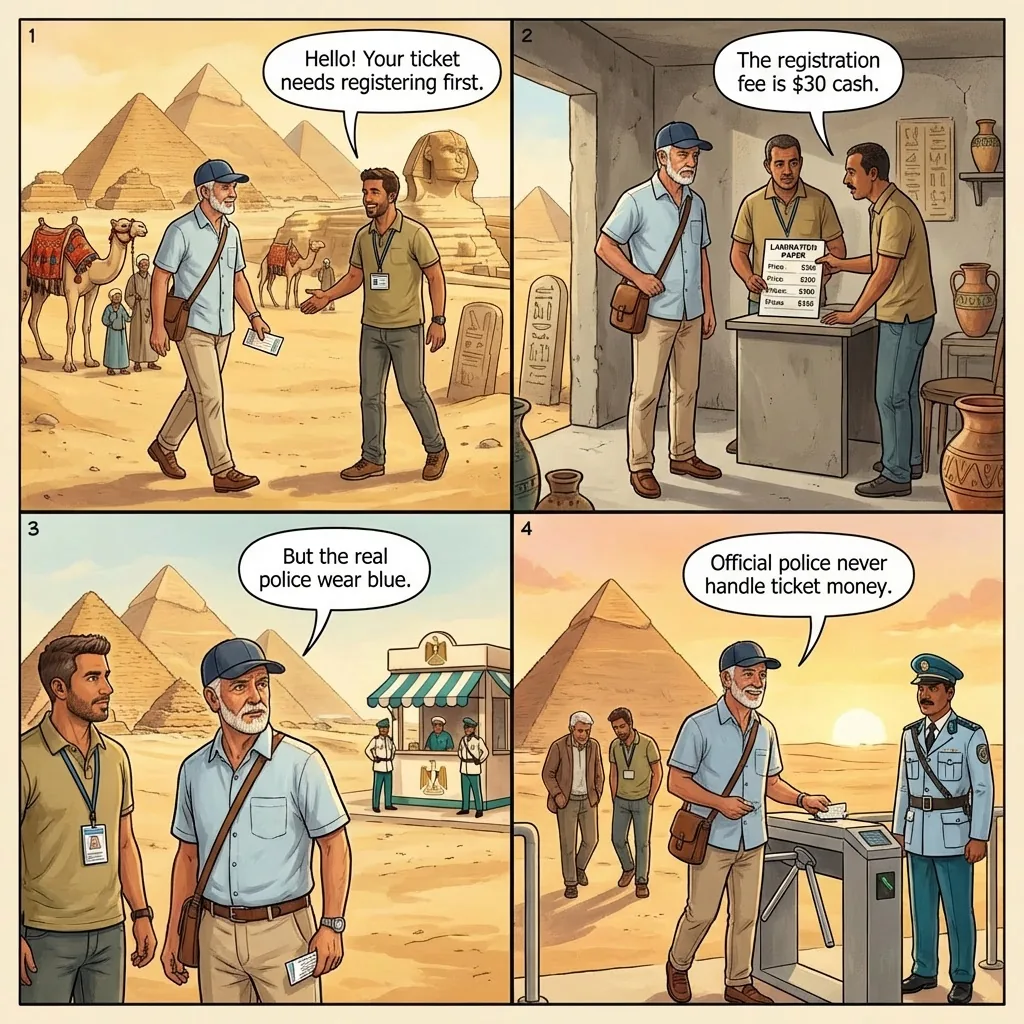
You arrive at the Giza Pyramids entrance at 11am on a Tuesday. The Great Pyramid rises behind the ticket gate; the Sphinx is visible through the haze a few hundred meters to the southeast. As you walk toward the official ticket office, three men with horses and camels approach. The lead man, in his forties, smiles wide: "Sir, the camel is two hundred Egyptian pounds to the Sphinx, no problem, very cheap. The walk is too long in the sun, take the camel, very nice."
200 EGP is about 6.50 USD. The walk to the Sphinx is roughly 600 meters across hot sand. The price seems competitive. You agree. The man helps you onto a camel; you set off across the sand at a slow walk. Five minutes in, you are halfway between the Great Pyramid and the Sphinx, in open desert with nobody else nearby.
The guide stops the camel. He turns to you and says: "Sir, the price is two hundred to the Sphinx. To go back to the entrance is another five hundred Egyptian pounds. If you want to go to the panoramic viewpoint, that is another thousand. Or you can walk back, but the camel needs water before it can carry you again." His tone is friendly but firm. The camel is sitting; he holds the lead rope.
The Egyptian Tourist Police 126 office is at the visitor entrance, perhaps 800 meters across hot sand. You can dismount and walk; you can pay the additional 500-1,500 EGP; you can argue with the guide for ten minutes while the sun gets higher. The variant works because most tourists, in this geography, pay rather than walk. The Egyptian Tourist Guide Syndicate (EGOTH) publishes quarterly enforcement bulletins about Giza horseback and camel mid-extortion, but the structural problem is that no licensed agency officially operates the rides at the inner pyramid grounds; the men with horses and camels are individual operators who buy temporary access permits.
You take ninety seconds to think. You dismount. You hand the man 200 EGP, saying "this is what we agreed." You walk back toward the Sphinx in the direction of the entrance, hand on the front pocket of your shorts, sun on your back. He shouts after you in Arabic. He does not follow.
That is the canonical horseback / camel mid-extortion variant of the fake-and-unlicensed tour guide family, executed at one of the most-documented locations in the world. The rest of this page is the five-mechanic playbook, the four other places where it runs in different forms (Marrakech, Bangkok, Rome, Istanbul), and the licensed-only rule that defeats every variant.
Read the full Cairo scam guide →Key Takeaways
The licensed-only rule
Fake-and-unlicensed tour guide scams depend on you accepting an in-person solicitation as legitimate. Real licensed guides do not solicit at monument curbs; they are booked through agencies, hotels, or licensed tour platforms with verified credentials and refund protection. The defensive routine is a single trained habit: refuse unsolicited guide offers at every major monument and verify the license card before any payment.
- Refuse all unsolicited guide offers at major monuments. Anyone approaching you at the entrance to the Pyramids, the Acropolis, the Vatican Museums, the Grand Palace, or any other major monument with "I am a guide, special price for you" is unlicensed. Real licensed guides do not solicit at monument entrances; they are booked through agencies, hotels, or licensed tour platforms.
- Verify guide license before any payment. Licensed tour guides carry photo ID with a license number and expiration date. Demand to see the license before paying or starting any tour. Real guides expect this; fake guides cannot produce.
- Refuse "closed-attraction" redirects. If a stranger near a major attraction tells you "the museum is closed today, follow me to a different museum / a craft shop / a friend's gallery," walk away. The closed-attraction redirect is a kickback play that ends at a tourist-trap shop or a fake museum charging extortion-level entry.
- Pre-negotiate full price for any horseback / camel / boat / trail tour. Before mounting any horse, camel, ATV, or boat at the Pyramids, Petra, the Atlas Mountains, or any similar destination, agree on the full price for the full activity in writing. Mid-trail or mid-trip extortion (the operator demands additional cash to take you back) depends on the original price being ambiguous.
- Book through licensed agencies, not in-person solicitations. For any monument tour, book through Get Your Guide, Viator, Klook, or licensed local agencies. The platform fee is 10-20% above direct booking but includes refund protection, guide credential verification, and dispute resolution.
The five mechanics
Different geographies and operator types lean on different mechanics within the same family. Here are the five sub-variants documented globally. Each has a recognition tell, a primary geography, and the routine step that defeats it.
1. Closed-Attraction Redirect
The most-documented variant in Bangkok and Istanbul. As you approach a major attraction, a stranger says "the museum is closed today, but I know a different one nearby, very special, only open to tourists today." The "different museum" is a tourist-trap craft shop, a gemstone scam, or a kickback restaurant. The original attraction is not closed; the stranger is paid commission by the kickback venue.
Defense: verify hours on Google Maps or the official website. Walk past anyone telling you a major attraction is closed. Most reported in: Bangkok Grand Palace and Wat Phra Kaew; Istanbul Sultanahmet (Hagia Sophia, Blue Mosque); Cairo Egyptian Museum and Khan el-Khalili; Marrakech medina; Athens Acropolis approach.
2. Fake Museum / Monument Guide
An uncredentialed person at the entrance to a major monument or queue offers a "private guide" tour for 50-150 EUR per person. They claim to be a "professor" or "archaeologist" or "official guide" but cannot produce a license. They take payment up front, lead a 30-60 minute tour with mostly accurate but unverifiable information, and disappear into the crowd at the end. The variant runs at every major monument with high English-speaking tourist traffic.
Defense: demand to see the photo ID license card before paying. Most reported in: Rome Colosseum and Vatican Museums queue; Pompei; Pisa Tower; Athens Acropolis; Istanbul Topkapi; Cairo Khan el-Khalili.
3. Fake Mountain / Trail Instructor
An unlicensed local approaches at the base of a mountain or at a hostel and offers to guide a multi-day trek. The price quoted is competitive. Mid-trek, on a high pass or in difficult terrain, the guide stops and demands additional cash to continue or to take you down safely. The variant has resulted in multiple tourist deaths globally where unlicensed guides abandoned clients in dangerous terrain.
Defense: book mountain treks through licensed mountain-guide associations (UIAGM/IFMGA-certified) or established tour operators. Most reported in: Morocco Atlas Mountains (Imlil, Ourika Valley, Mount Toubkal); Jordan Wadi Rum desert; Iceland glacier and gravel-road areas; northern Thailand Chiang Mai and Pai mountains; Nepal lower-altitude treks.
4. Horseback / Camel / ATV Mid-Extortion
Documented continuously since the 1990s at the Giza Pyramid grounds; same pattern at Petra and Luxor. The price is quoted competitively at the start point. Once the tourist is on the horse / camel / ATV in difficult-to-walk-back terrain, the operator stops and demands additional cash to continue or to return. The variant works because the geography forces a payment decision under physical and psychological pressure.
Defense: book horseback and camel rides through licensed agencies; never accept curb solicitations. Pre-negotiate full round-trip price in writing before mounting. Most reported in: Cairo Giza Pyramid grounds (camels and horses); Luxor West Bank Valley of the Kings approach; Petra Treasury approach; Marrakech Saadian Tombs and Atlas foothills.
5. Fake Park Ranger
A person in a quasi-uniform (often a polo shirt with a crest, sometimes with a printed lanyard) stops tourists at an unofficial entry point or trail and demands an entry fee, claiming it is the "official park fee." The real park entry is at a different gate or is free. The fake ranger pockets the cash. The variant runs at parks where the entry geography is ambiguous and signage is in local language only.
Defense: verify the official park entry on the park's website or at the visitor center before approaching any side trail. Real park rangers carry photo ID. Most reported in: Cappadocia Goreme National Park (Turkey); Costa Rica Manuel Antonio and Cahuita national parks; Thailand Khao Yai and Doi Inthanon; parts of Indonesia (Komodo, Bromo).
Where it runs
Fake and unlicensed tour guide scams concentrate at major world monuments and natural attractions where licensing enforcement is weak relative to tourist volume. The seven countries below cover the bulk of global tourist exposure.
| Country | Documented variants | Iconic location pattern |
|---|---|---|
| 🇪🇬 Egypt | 6 | Cairo Giza Pyramid horseback / camel mid-extortion; Saqqara, Dahshur fake-guide solicitations; Luxor Karnak Temple unlicensed guides |
| 🇲🇦 Morocco | 5 | Marrakech medina fake-guide solicitations; Atlas Mountains fake mountain-instructor; Sahara desert overnight tours |
| 🇹🇭 Thailand | 4 | Bangkok Grand Palace "closed today" redirect; Chiang Mai elephant-camp guide; northern mountains |
| 🇮🇹 Italy | 3 | Rome Colosseum and Vatican Museums queue unlicensed guides; Pompei fake-museum-guide; Pisa |
| 🇬🇷 Greece | 2 | Athens Acropolis approach unlicensed guides; Delphi fake guides; Olympia archaeological site |
| 🇹🇷 Turkey | 2 | Istanbul Sultanahmet unlicensed guide solicitations; Cappadocia balloon-and-ATV fake park-ranger |
| 🇯🇴 Jordan | 1 | Petra horseback mid-trail extortion; Wadi Rum fake mountain instructor |
Bar width is data-bound at 20 pixels per documented variant. Egypt alone accounts for 27% of global exposure, driven by Giza Pyramid horseback and camel mid-extortion density.
Four more places, four more guide variants
The Giza horseback mid-extortion scene above showed the canonical Egyptian variant. Here are four more places where different sub-variants dominate. Each links to the full city scam guide.
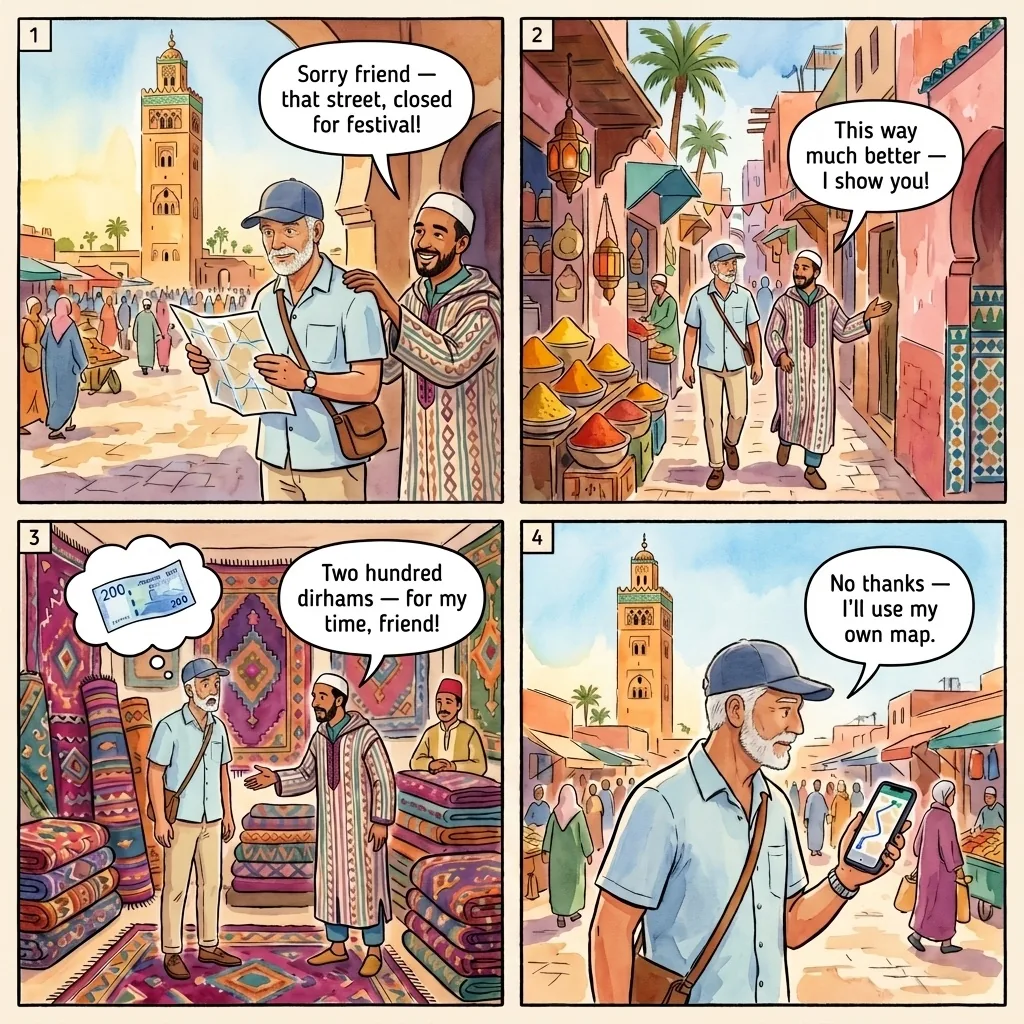
You walk through Marrakech's Bab Doukkala gate at 11am to head to the Saadian Tombs. A man in his thirties intercepts at the gate: "Sir, the Saadian Tombs are closed today, prayer day, but I know a beautiful palace just five minutes that way, very special, only open today." The Saadian Tombs are not closed. The "beautiful palace" is a craft shop where the man receives a 10-30% commission on any rug or leather goods sold. The same play runs at the Bahia Palace, the Ben Youssef Madrasa, and the Koutoubia Mosque. Separately, in the Atlas Mountains 1.5 hours from Marrakech, unlicensed mountain instructors offer "guided treks of Mount Toubkal" without UIAGM/IFMGA certification; mid-trek demands for additional cash to continue have been documented continuously. The Marrakech Brigade Touristique at Place Bab Doukkala (24/7) accepts walk-in reports. Defense: verify monument hours on Google Maps before approaching any Marrakech medina gate. For Atlas Mountains treks, book through licensed agencies (Maroc High Atlas Mountaineering Federation members) or established tour operators (Mountain Travel Sobek, REI Adventures). The certification carries safety training and insurance.
Read the full Marrakech scam guide →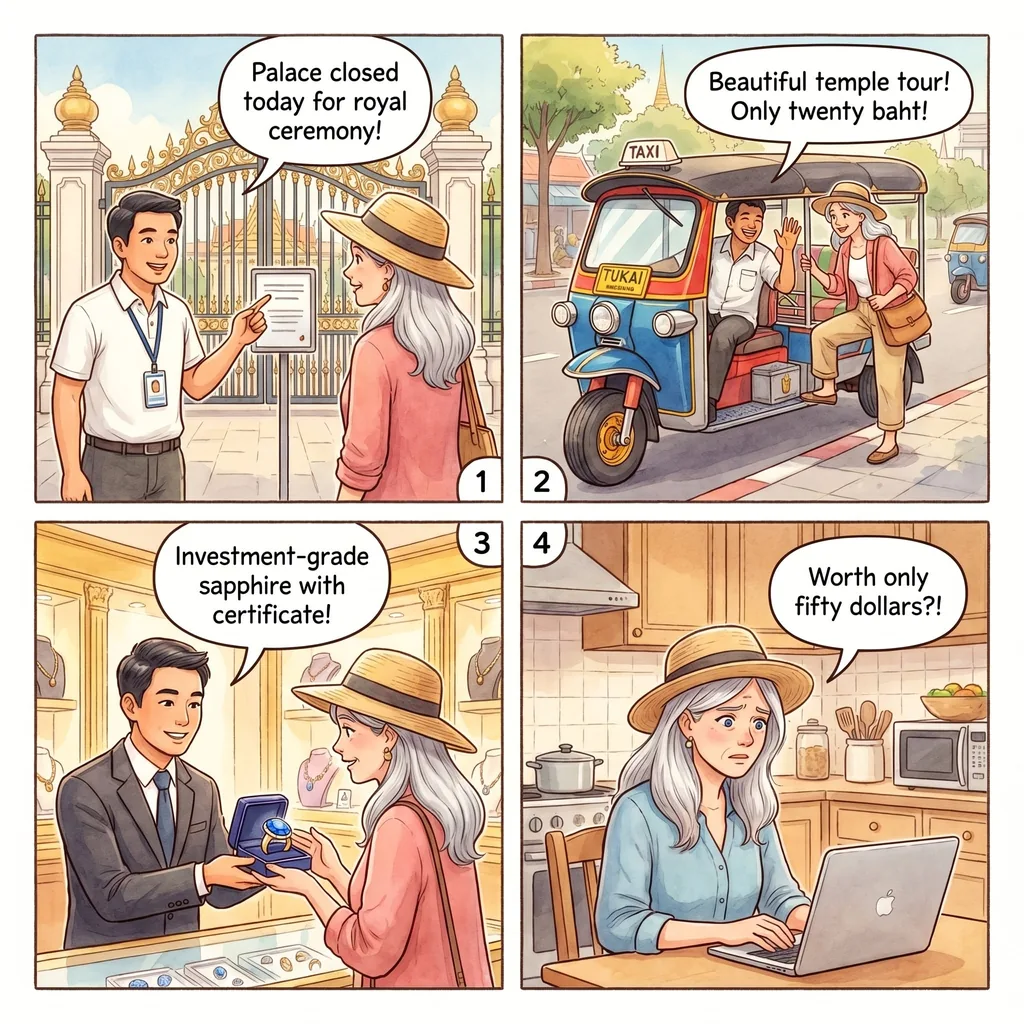
You approach the Grand Palace and Wat Phra Kaew compound on the south side of the Chao Phraya River at 9am on a Sunday. A man in business casual approaches at the corner before the official entrance: "Sir, the palace is closed today for special ceremony, but I show you a different temple, very beautiful, only ten minutes by tuk-tuk." The Grand Palace is not closed. The man is paid commission by a gem shop on the other side of Bangkok where the tuk-tuk will stop "for a quick visit" before the alleged temple. The variant has been documented continuously since the 1990s; the Tourism Authority of Thailand (TAT) issues annual advisories warning of the Grand Palace closed-redirect specifically. The Tourist Police 1155 at the Grand Palace gate runs spot enforcement. Defense: walk directly to the official Grand Palace entrance gate. The hours are posted at the gate and on the official Grand Palace website (8:30am-3:30pm daily, no closures except for state ceremonies announced weeks in advance). Anyone telling you the palace is closed is running the redirect. Same advice for Wat Pho and Wat Arun.
Read the full Bangkok scam guide →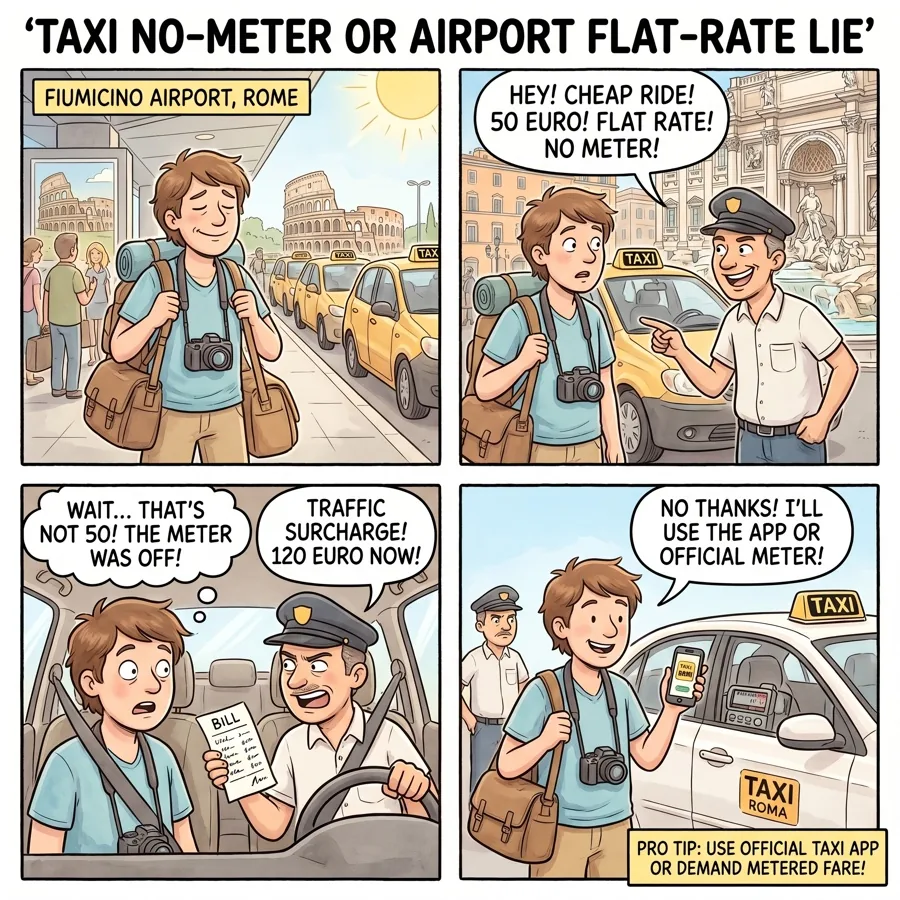
You wait in the Colosseum queue near the Arch of Constantine at 10am on a Wednesday. A man in his fifties, with a clipboard and a lanyard that reads "Roma Cultural Tours," approaches: "Sir, the queue today is over two hours, I am a professor of Roman archaeology, I can take you in immediately with a private tour, sixty euros for the family." The man's lanyard is a printed-at-home plastic card with no Comune di Roma credentials. The "private tour" route uses a third-party ticket operator with separate-priced entrance, not skip-the-line at the main gate. The tourist pays 60 EUR, gets a 30-minute walking talk that mostly repeats Wikipedia-level Roman history, and is left at the inner Colosseum gate to wait in a separate (sometimes shorter) queue. The Carabinieri 112 takes English-language reports of unlicensed Colosseum guides; the Polizia Municipale Roma runs irregular sweeps. Defense: book Colosseum + Roman Forum tours through Get Your Guide, Viator, or the official CoopCulture Italy site (which manages the Colosseum). All three platforms verify guide credentials. Real licensed guides at the Colosseum carry a Comune di Roma photo ID with license number; demand to see it before any payment. The fake-museum-guide variant overlaps with the Fake Skip-the-Line Tickets atlas entry; refer to that for the queue-jumping defense pattern.
Read the full Rome scam guide →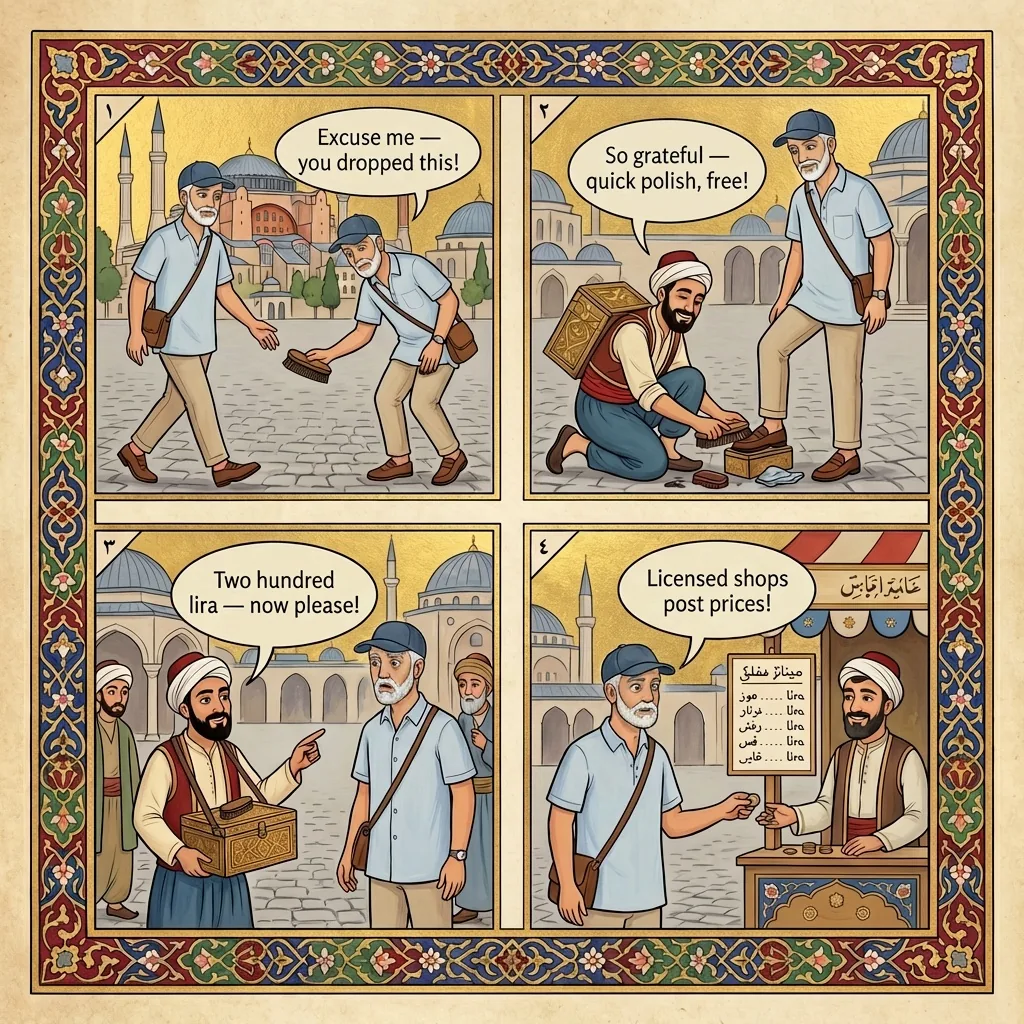
You walk into Sultanahmet from your hotel near the Hagia Sophia at 1pm on a Friday. A man in business casual approaches: "Sir, the Hagia Sophia is closed for Friday prayers, but I show you a different mosque, very special, only ten minutes." Hagia Sophia closes for two hours during Friday afternoon prayers (12:30-2:30pm), but the "different mosque" the man wants to lead you to is a kickback rug shop in the Grand Bazaar perimeter; you would skip the actual prayer-closure window in 90 minutes if you waited. Separately, in Cappadocia Goreme National Park, men in polo shirts with printed lanyards stop tourists at unofficial trail entrances and collect "national park fees" that are not the real fees (the real Goreme National Park fees are paid at official ticket offices at the Open Air Museum entrance). The Istanbul Tourist Police office and the Cappadocia Goreme Tourist Information Center accept English-language reports. Defense: walk directly to the Hagia Sophia, Blue Mosque, or Topkapi Palace official entrances; verify hours on the official Turkish Ministry of Culture website. For Cappadocia, the Goreme National Park entry fees are at the Open Air Museum kiosk only; do not pay any individual on a trail.
Read the full Istanbul scam guide →Red flags
If two or more of these signals fire when approaching any major monument or natural attraction, refuse the offer and walk on. The compounding rule: a single signal might be a coincidence; two signals are a script.
- A stranger approaches at a monument entrance offering a "private tour" or "guide service"
- The stranger says the attraction is closed today and offers to lead you elsewhere
- A "guide" cannot produce a photo ID license card on demand
- The price for a horseback / camel / ATV ride is unusually low at the start
- The route takes you far from the entrance into terrain difficult to walk back from
- A person in a quasi-uniform demands an "entry fee" on a trail or unofficial entrance
- The "park ranger" or "guide" carries a printed-at-home lanyard, not government photo ID
- The mountain or trek "guide" claims certification but cannot show UIAGM/IFMGA card
- The price quoted is significantly below what major platforms (Get Your Guide, Viator) charge
- A hotel concierge or taxi driver insists on a specific "private guide" they recommend
The phrases that shut it down
Refusing a fake guide works when you signal you do not need a guide. The phrase pattern is the same in every language: I don't need a guide.
If you got hit
The "guide" took 80 EUR up front, gave a 20-minute walk through Wikipedia history, and disappeared. Fake-tour-guide losses are partially recoverable through credit-card chargeback if paid by card, rarely recoverable for cash payments, and rarely worth pursuing through local police because the guide population is large and individually anonymous. The actionable response is preventive for the next encounter, not recovery for this one.
Within twenty-four hours: file a credit-card chargeback claim if the guide payment was on card. The grounds: "service not as described" or "merchant misrepresentation" if the guide claimed credentials they did not hold. Visa and Mastercard chargeback windows are 60-120 days; submit the description of what was promised, what was delivered, and any photos or receipts.
Within seven days: file a complaint with the local tourism authority. Egypt EGOTH (Egyptian Tourist Guide Syndicate), Morocco ONMT (Office National Marocain du Tourisme), Italy Comune-issued credentials authority for the city in question, Greece Hellenic Tourist Guide Federation, Thailand TAT (Tourism Authority of Thailand), Turkey TPRD (Turkiye Profesyonel Turist Rehberleri Dernegi), Jordan Jordan Tourism Board all accept English-language complaints about unlicensed guide solicitations.
For mid-trail or mid-trip extortion that escalated to threat or detention: contact local tourist police immediately. The escalation from extortionate framing to overt extortion is rare but does happen, especially in remote terrain.
- Cairo: Tourist Police 126 (24/7); Egyptian Tourist Guide Syndicate (EGOTH) for license complaints.
- Marrakech: Brigade Touristique, Place Bab Doukkala (24/7); ONMT (Office National Marocain du Tourisme) for unlicensed-guide complaints.
- Bangkok: Tourist Police 1155 (24/7, English-speaking); TAT (Tourism Authority of Thailand) for closed-redirect complaints.
- Rome: Carabinieri 112; Polizia di Stato 113; Polizia Municipale Roma for unlicensed guide enforcement at Colosseum and Vatican queues.
- Athens: Tourist Police 1571 (24/7, English-speaking); Hellenic Tourist Guide Federation for license complaints.
- Istanbul: Istanbul Tourist Police 0212 527 4503; TPRD for license verification and complaints.
- Petra: Petra Tourism and Antiquities Police; Jordan Tourism Board for unlicensed Petra guide and horseback complaints.
- Cappadocia: Goreme Tourist Information Center; TPRD for fake park ranger complaints.
For platform-paid bookings (Get Your Guide, Viator, Klook, GetYourGuide), the in-app refund process is the highest-yield recovery channel; success rates exceed 80% for service-not-as-described claims. For cash-paid in-person solicitations, recovery rates are below 5%. The actionable response is preventive: refuse curb solicitations; verify license; pre-negotiate full price for any horseback / camel / trail activity; book through licensed platforms.
Related atlas entries
Sister entries in the Scam Atlas. Fake and unlicensed tour guide overlaps with the Fake Skip-the-Line Tickets family at major monuments; the "closed attraction" variant overlaps with broader closed-attraction redirect plays.
Sources
- Egyptian Tourist Police 126, Giza Pyramid horseback / camel mid-extortion enforcement bulletins (Egypt, ongoing).
- Egyptian Tourist Guide Syndicate (EGOTH) and ATTA Egypt, licensed-guide directory and complaint resolution (Egypt, ongoing).
- Office National Marocain du Tourisme (ONMT), Marrakech medina and Atlas Mountains advisories (Morocco, peak-season).
- Tourism Authority of Thailand (TAT), Grand Palace closed-redirect annual advisories (Thailand, ongoing).
- Polizia Municipale Roma, Colosseum and Vatican Museums queue unlicensed-guide enforcement (Italy, ongoing).
- Hellenic Tourist Guide Federation, Athens Acropolis approach unlicensed-guide complaints (Greece, ongoing).
- Turkiye Profesyonel Turist Rehberleri Dernegi (TPRD), Sultanahmet and Cappadocia license verification logs (Turkey, ongoing).
- Egypt Today, The National, Cairo Giza horseback extortion investigative coverage (Egypt, 2019-2025).
- r/travel, r/Egypt, r/Morocco, r/Thailand, r/turkey continuing thread monitoring 2018-2026.
Get the full fake-tour-guide playbook for your destination.
Each Travel Safety atlas covers every documented monument and tour scam in one country, plus the country's full scam catalog: pickpocket, taxi, ATM, restaurant, fake authority. Buy once, lifetime updates as scams evolve. $4.99 on Kindle.