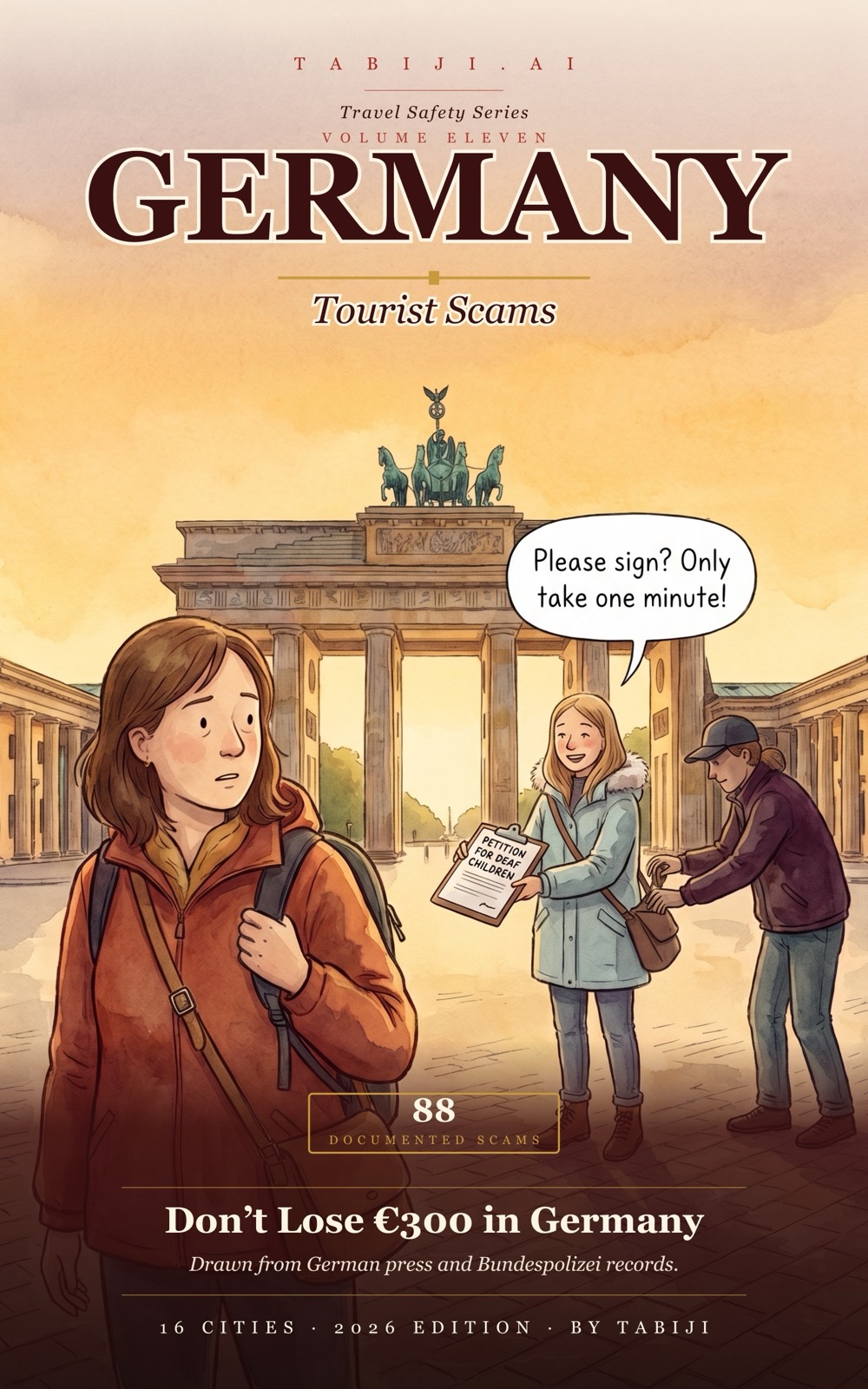
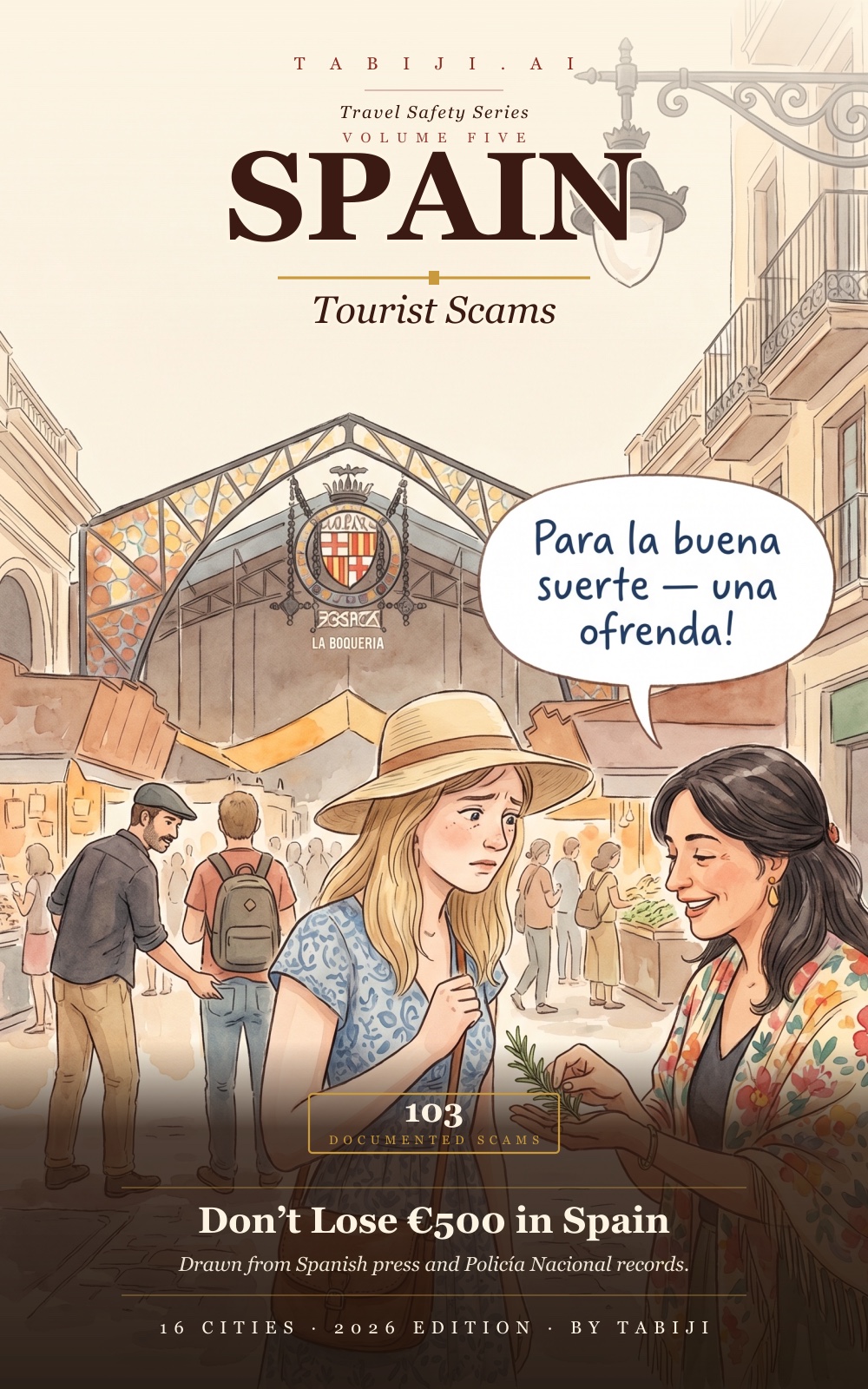
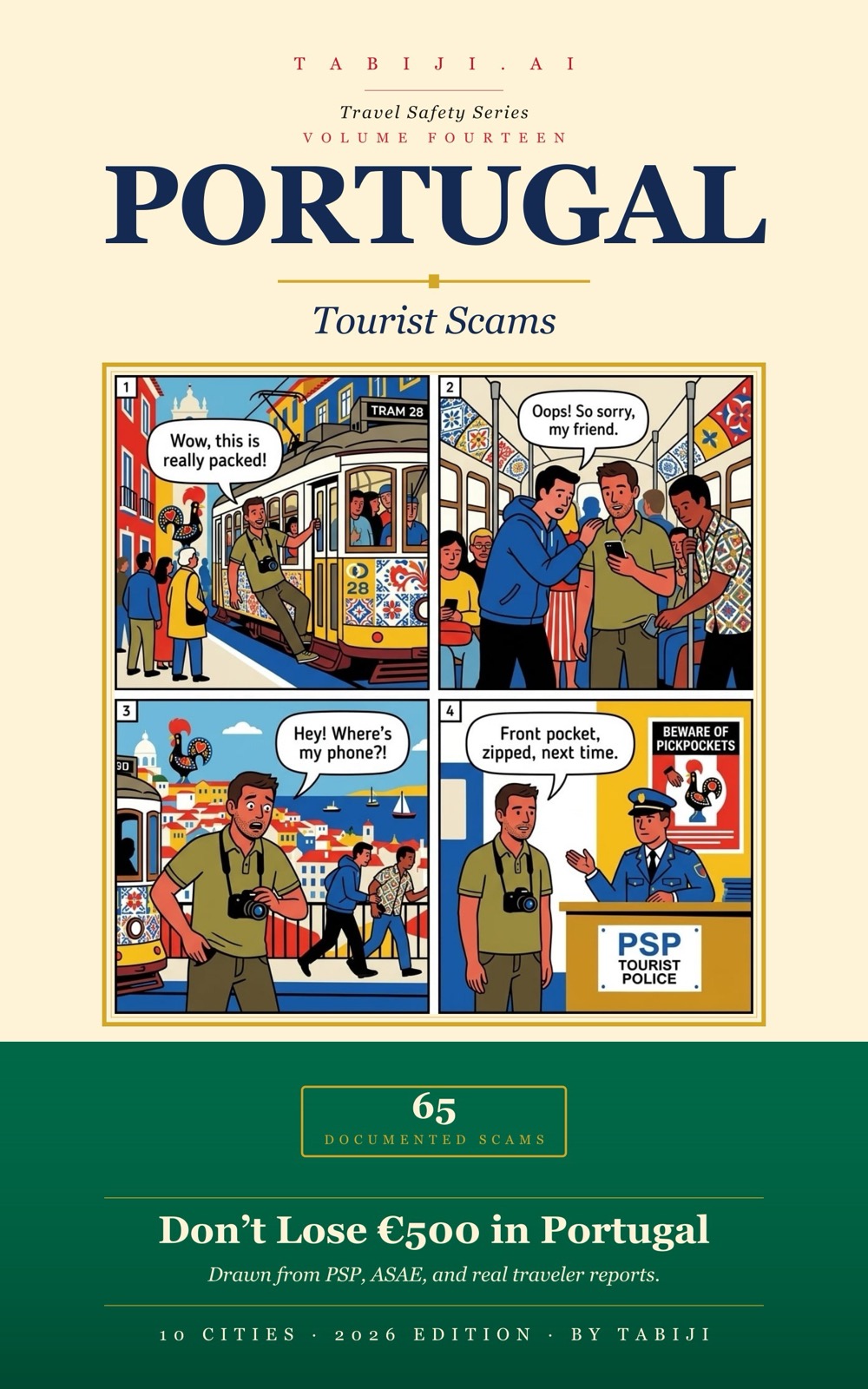
The free walking tour, four ways the ‘tip’ becomes a contract.
A Berlin Brandenburg Gate guide who closes by saying "the standard tip in Berlin is twenty euros per person." A Madrid Plaza Mayor guide pitching an extra museum visit for 10 EUR mid-tour. A Prague Old Town guide who only takes Czech crowns at the end of an English-advertised tour. An Edinburgh Royal Mile guide passing a hat in the center of the group. Four mechanics across 8 countries, defeated by the same five-second rule: set your tip budget before the tour starts.


Free walking tour tip-extortion runs four mechanics across 8 countries: minimum-tip pressure (guide names "standard" 20-30 EUR per person at end), hidden up-sells (mid-tour paid additions), currency mismatch (advertised in EUR, cash-only local at end), and group-shaming (public hat-passing or audible tip comparison). The universal defense is one five-second rule: set your tip budget before the tour starts based on expected quality (5-15 EUR per person is standard for a 2-3 hour tour). Bring exact-change cash in that amount. Refuse all on-tour up-sells, tip privately, walk away if the guide pressures verbally.
"The standard tip in Berlin is around twenty euros per person."
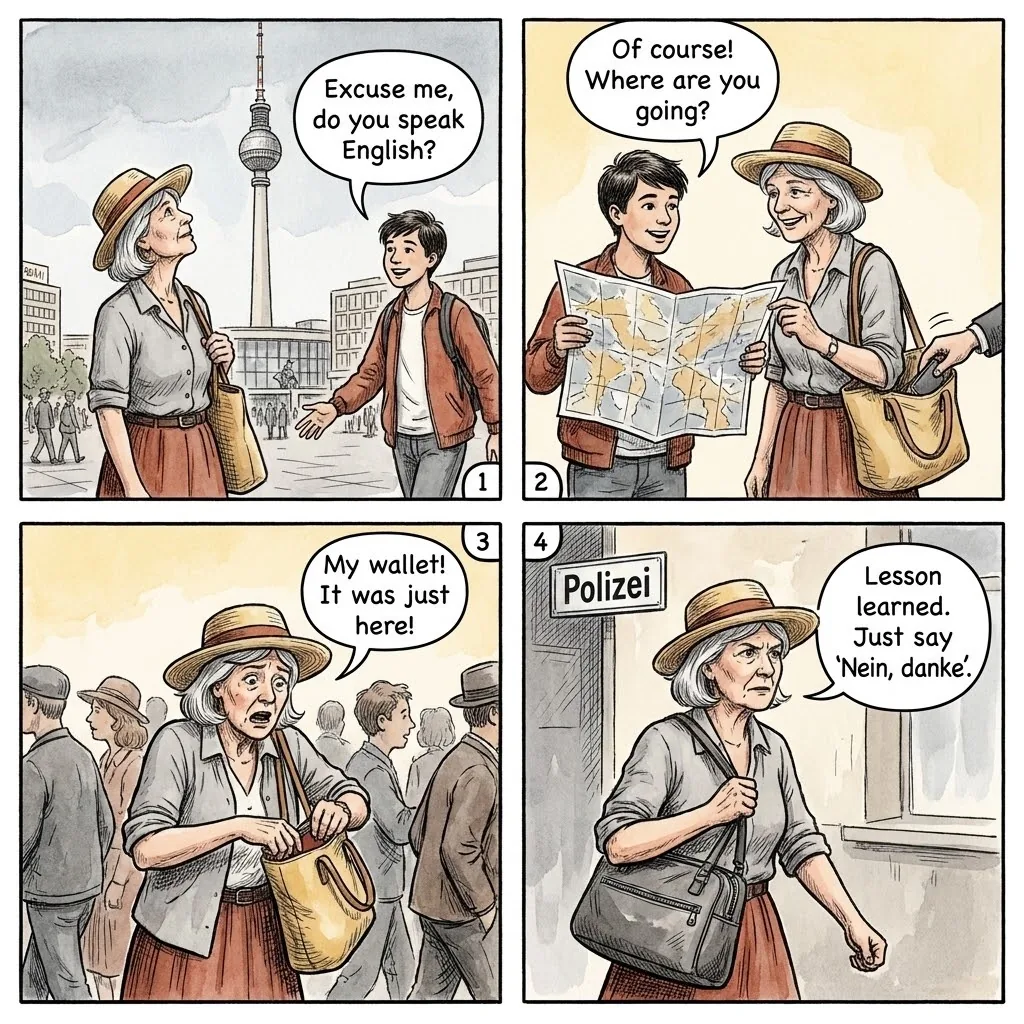
You meet the Sandemans New Europe Berlin walking tour at 11am at the Sandemans flag near the Reichstag. The tour is advertised as "free" with tips welcome at the end. The guide is in his late twenties, an Australian expat in Berlin for four years; the tour group is about thirty people, mostly young Anglophone tourists. The route is good: Reichstag, Brandenburg Gate, Memorial to the Murdered Jews of Europe, the empty lot above Hitler's bunker, Checkpoint Charlie, Bebelplatz where the Nazis burned books, the Berlin Cathedral. The guide is articulate and well-read; the tour is genuinely worth listening to.
At 2:45pm the group reassembles outside the Brandenburg Gate. The guide gives the closing speech. He thanks the group for "such a great tour today, you've been one of my favorite groups in months." Then he transitions: "I want to remind everyone, this tour is technically free, but it costs Sandemans about twenty-five euros per person to put on, with insurance and licensing and the company's overhead. The standard tip in Berlin is around twenty euros per person. Please consider that when you tip. We do not work for Sandemans on a salary; this is how I make my living."
You did the math during his earlier transitions. You expected to tip 10 EUR, which is at the high end of fair for a 3.5-hour walking tour in Berlin (the standard range is 5-15 EUR for a quality tour). Twenty euros per person is double that. The guide is now standing at the front of the group, hand visibly extended; tour members are stepping up one at a time and placing bills.
You take ninety seconds to think. You step away from the group, walk fifteen meters toward the Tiergarten, take 10 EUR out of your pocket. You walk back, hand the 10 EUR to the guide directly with eye contact and a "thanks, that was a great tour." You walk on toward Tiergarten without checking what others tipped or what the guide said in response. The guide does not push back; he says "thanks, mate." You walk to your hotel.
You check Sandemans' Berlin tour reviews that evening. Half the recent reviews mention the same 20-EUR-per-person framing in the closing speech. The corporate Sandemans tip recommendation is "what you can afford," with no minimum quoted by the company. The 20 EUR figure is the individual guide's framing, repeated across guides because it works on enough of the group to clear the floor. The guide takes 70-80% of tips; Sandemans takes the rest as platform commission.
That is the canonical minimum-tip pressure variant of the free-walking-tour tip-extortion family. The rest of this page is the four-mechanic playbook, the four other cities where it runs in different forms (Madrid, Prague, Lisbon, Edinburgh), and the fixed-budget rule that defeats every variant.
Read the full Berlin scam guide →Key Takeaways
The fixed-budget rule
Free walking tour tip-extortion depends on your tip amount being decided in the closing-speech moment. The guide's pitch is calibrated to maximize the tip from a still-undecided customer in front of a group. The defensive routine is a single trained habit: decide your tip number before the tour starts. The play falls apart instantly because the guide cannot extract more than what you decided in advance.
- Set your tip budget before the tour starts. Decide a tip amount in your head before the tour begins, based on the tour quality you expect (5-15 EUR is standard for a quality 2-3 hour tour). Stick to your number regardless of the guide's end-of-tour pitch. The tip is a tip, not a contractual fee.
- Bring exact-change cash in your tip-budget amount. Bring the exact tip amount in small bills (5, 10, or 20 EUR notes) to the tour. The guide cannot pressure you for more than what is in your hand. Avoid bringing larger denominations or your entire wallet to the tip moment.
- Refuse all on-tour up-sells. If the guide proposes "an extra 30-minute visit to the museum for 10 EUR" or "a special tasting at a friend's bar" or "a tip-only post-tour walk," politely decline. The on-tour up-sells are commission deals between the guide and the venue; the post-tour walks are tip-only second-bites.
- Tip privately, not in front of the group. If the guide makes the tip moment public ("how much did everyone tip?" or holds out a hat in the center of the group), step away from the group, hand your tip privately, and walk on. Group-shaming relies on social pressure; private tipping defeats the variant.
- Walk away if the guide pressures verbally. If the guide says "standard is 20 EUR per person" or "the tour costs the company 25 EUR per head, please match," walk away with your prepared tip. The tour is genuinely free; the contractual minimum framing is the scam.
The four mechanics
Different cities and operator companies lean on different mechanics within the same family. Here are the four sub-variants documented globally. Each has a recognition tell, a primary geography, and the routine step that defeats it.
1. Minimum-Tip Pressure
At the end of the tour, the guide gives a closing speech that includes a specific minimum-tip number, framed as either "standard" or "what the company costs per person." Numbers vary: 20-30 EUR per person in Western Europe, 200-500 CZK in Prague, 3,000-5,000 HUF in Budapest. The figures are framed as a floor; the guide's actual take depends on guests matching or exceeding.
Defense: set your tip budget before the tour starts based on tour quality. Most reported in: Berlin Brandenburg Gate Sandemans tours; Madrid Plaza Mayor Free Tour Madrid and Strawberry Tours; Prague Old Town Square Sandemans; Lisbon Rossio Sandemans; Edinburgh Royal Mile.
2. Hidden Up-Sells
Mid-tour, the guide proposes "an extra 30-minute visit to the museum for 10 EUR additional," "a special tasting at a friend's bar for 15 EUR," or "a tip-only post-tour walk to my favorite hidden spots, just give what you feel." The on-tour up-sells are commission deals between the guide and the venue; the post-tour walks are tip-only second-bites that can extract another 10-20 EUR per person.
Defense: politely decline all on-tour up-sells. The base 2-3 hour tour is the tour you signed up for. Most reported in: Berlin Sandemans (East Berlin extension); Madrid (tapas-tasting up-sell); Lisbon (Fado bar up-sell); Edinburgh (whisky tasting up-sell); Prague (beer cellar tasting).
3. Currency Mismatch
The tour is advertised on Sandemans' or competitor's English-language website in USD or EUR. At the end, the guide passes a hat or asks for tips and accepts only local currency cash (CZK in Prague, HUF in Budapest, PLN in Warsaw and Krakow, NOK in Oslo). Tourists who only have EUR / USD / GBP are pressured to find an ATM mid-tour or pay in foreign currency at unfavorable rates.
Defense: bring local-currency cash to any walking tour in non-Euro countries. Most reported in: Prague Old Town tours (CZK); Budapest Castle District tours (HUF); Warsaw Old Town tours (PLN); Krakow Wawel tours (PLN); Oslo Royal Palace tours (NOK).
4. Group-Shaming
At the end of the tour, the guide makes the tip moment public. Variants: holding a hat in the center of the group while members place visible bills; asking "how much did everyone tip?" aloud; publicly thanking generous tippers and noting names; staging the tip moment as a circle so every member sees what every other member tips. Group-shaming relies on social pressure to escalate the average tip.
Defense: tip privately. Step away from the group, hand your tip directly to the guide as the group disperses. Most reported in: Berlin Brandenburg Gate Sandemans hat-passing; Madrid Plaza Mayor "circle" tip ritual; Prague Old Town public tip naming; Edinburgh Royal Mile Castle Esplanade hat-passing.
Where it runs
Free walking tours run in 60+ cities globally. Tip-extortion variants concentrate in cities with high-density Anglophone tourist flows and an established Sandemans-or-competitor walking tour ecosystem. The eight countries below cover the bulk of global tourist exposure.
| Country | Documented variants | Iconic location pattern |
|---|---|---|
| 🇩🇪 Germany | 4 | Berlin Brandenburg Gate, Reichstag, East Side Gallery; Munich Marienplatz; Hamburg Rathaus |
| 🇪🇸 Spain | 3 | Madrid Plaza Mayor, Sol; Barcelona Gothic Quarter, Park Guell; Sevilla Cathedral; Granada Albayzin |
| 🇨🇿 Czech Republic | 2 | Prague Old Town Square, Charles Bridge, Wenceslas Square |
| 🇵🇹 Portugal | 2 | Lisbon Rossio, Praca do Comercio, Alfama; Porto Ribeira |
| 🇬🇧 UK / Scotland | 1 | Edinburgh Royal Mile, Castle Esplanade; London (multiple operators) |
| 🇮🇹 Italy | 1 | Rome Pantheon, Piazza Navona, Trastevere; Florence Duomo; Venice Rialto |
| 🇭🇺 Hungary | 2 | Budapest Vaci Street, Castle District, Heroes' Square |
| 🇮🇪 Ireland · 🇳🇱 Netherlands | 1 | Dublin Trinity College, Temple Bar; Amsterdam Dam Square |
Bar width is data-bound at 30 pixels per documented variant. Germany alone accounts for 25% of global exposure, driven by Berlin Brandenburg Gate Sandemans tour density.
Four more cities, four more tip-extortion mechanics
The Berlin Brandenburg Gate minimum-tip-pressure scene above showed the canonical variant. Here are four more cities where different sub-variants dominate. Each links to the full city scam guide.
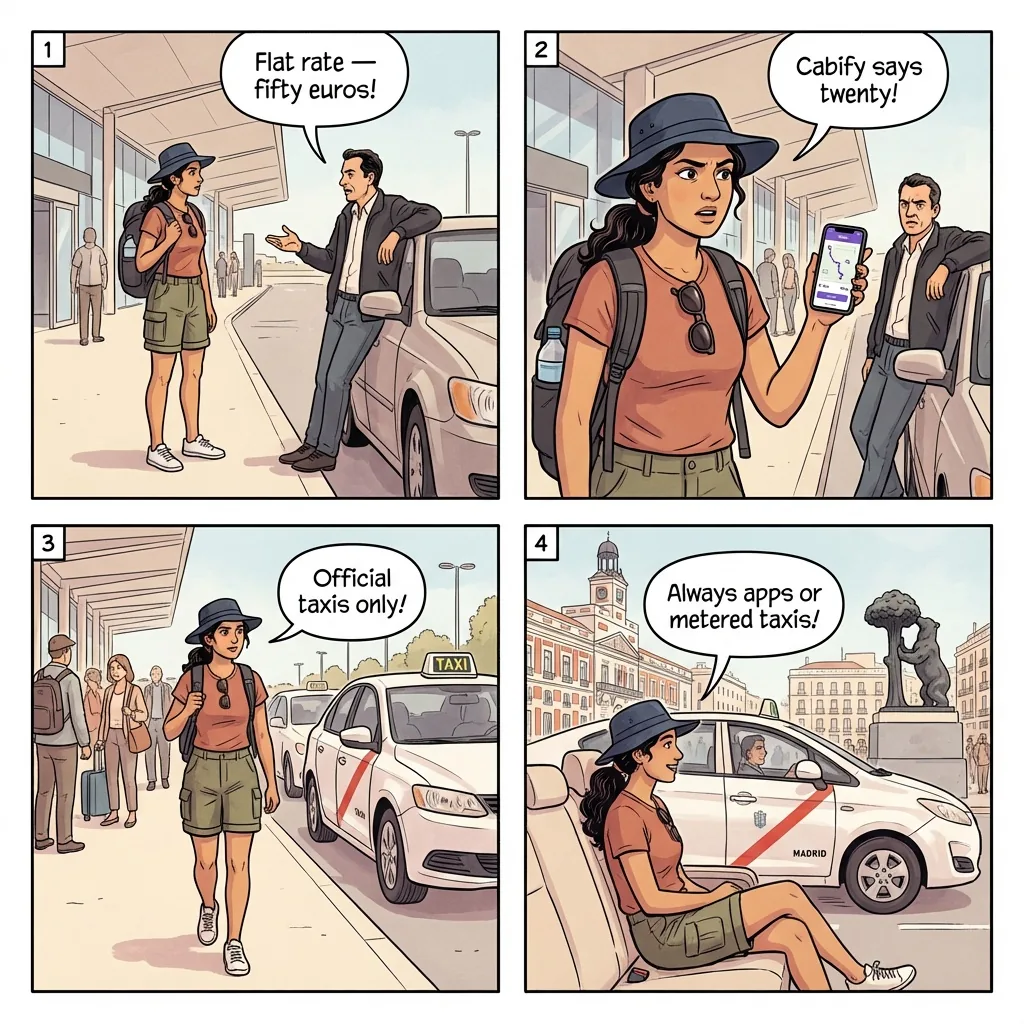
You meet the Free Tour Madrid morning tour at 11am at Plaza Mayor's central column. The guide leads a 3-hour Habsburg Madrid tour through Plaza de la Villa, the Royal Palace, the Almudena Cathedral, Puerta del Sol. At 2pm, the tour ends back at Plaza Mayor. The guide stages the closing as a circle: "Let's gather round, everyone, in a circle." The 25 tour members stand shoulder-to-shoulder in a tight circle. The guide stands in the center and gives a closing speech that ends with: "Now, who would like to come up and give a tip first?" One by one, members step forward, place a bill in the guide's hand visibly, return to the circle. The 4-EUR tippers and the 25-EUR tippers are both visible to the entire group. The tip average creeps up under the social pressure. The Spanish tourism board and the Federacion Espanola de Asociaciones de Profesionales de Turismo do not regulate walking tour tips, but Madrid's Direccion General de Consumo accepts complaints about minimum-tip extortion. Defense: when the guide announces the circle, do not join. Step five meters away from the circle, wait for the tip ritual to end, hand your prepared tip privately to the guide as the group disperses, walk on. The variant cannot work against private tipping.
Read the full Madrid scam guide →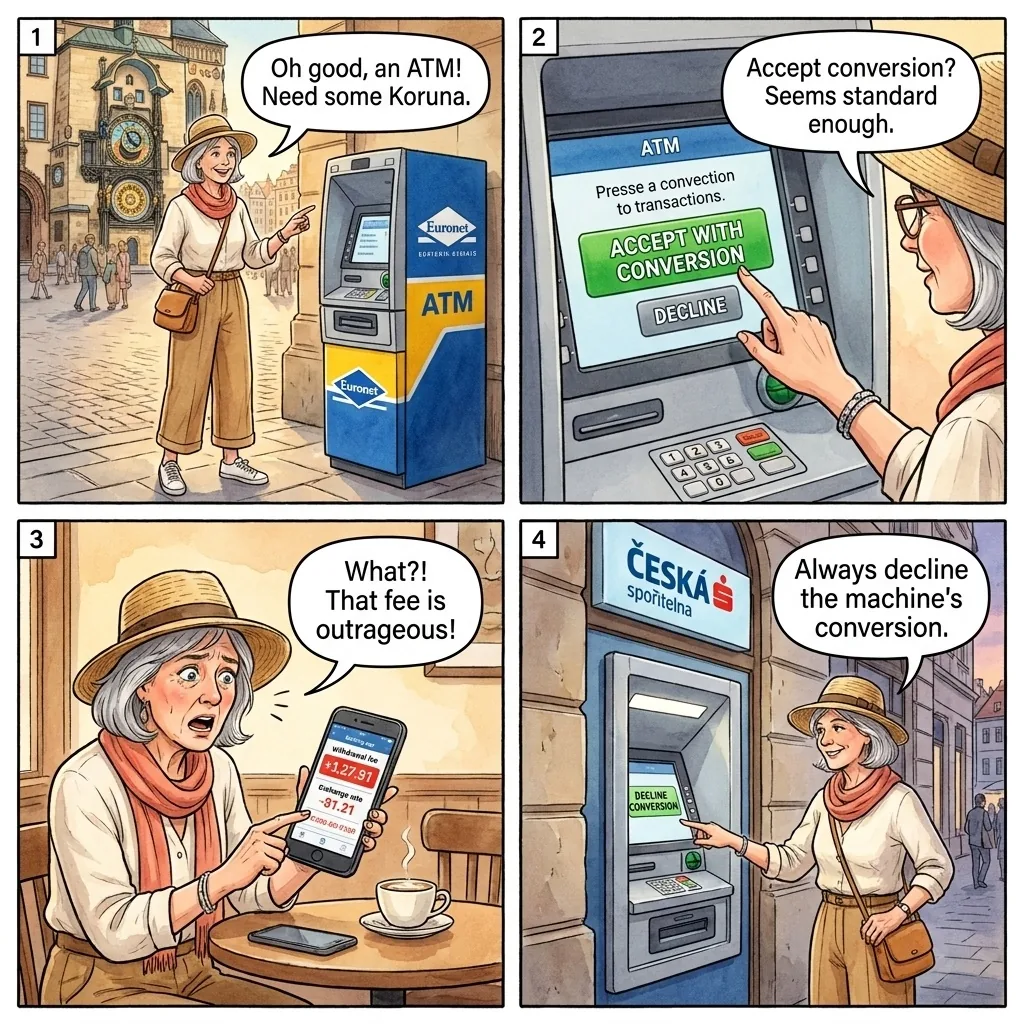
You join the Sandemans Prague morning tour at 11am at the Astronomical Clock in Old Town Square. The tour is advertised on Sandemans' English-language website with prices and tip suggestions in USD/EUR. The 2.5-hour tour covers Old Town, the Jewish Quarter, Charles Bridge, and ends at the National Theater. At 1:30pm the guide gives the closing speech, names "the standard tip in Prague is 500 CZK per person" (about 20 EUR), and asks for tips. You pull out a 20-EUR note. The guide says "I am sorry, I only take Czech crowns. There is a Western Union exchange across the bridge if you need to convert. Or you can use the small ATM in the cafe over there." The exchange / ATM rate is unfavorable. The variant runs in Prague, Budapest, Warsaw, Krakow, and other Eastern European Sandemans-style tour hubs. Czech consumer protection authority (CTIA) accepts complaints about Sandemans guide practices, but resolution rates are low. Defense: bring local-currency cash to any walking tour in non-Euro countries. Withdraw 200-500 CZK before the tour from a major bank ATM with low fees (CSOB, Komercni Banka). The guide cannot extract foreign currency from a guest who only carries local cash.
Read the full Prague scam guide →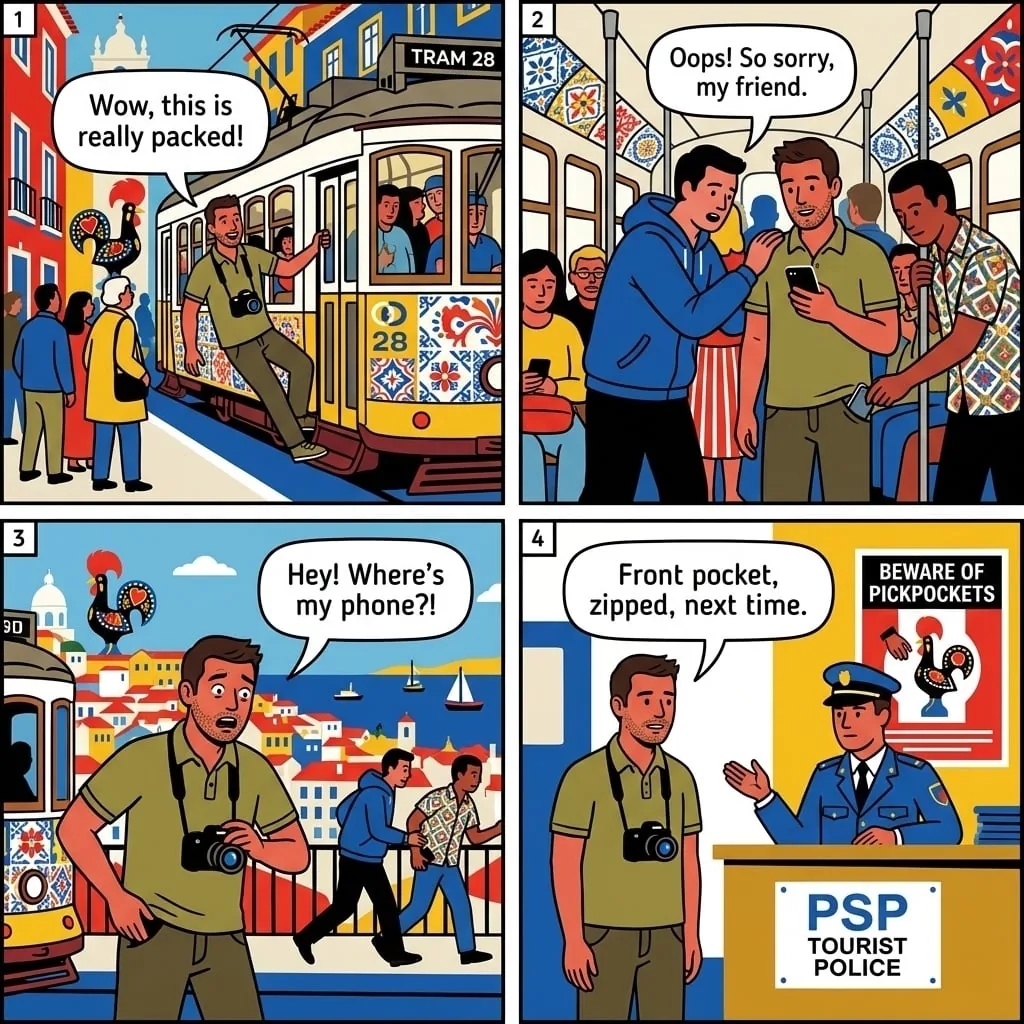
You join a Sandemans Lisbon afternoon tour at 2pm at Rossio Square. The 3-hour tour covers Baixa, Chiado, Alfama, ends at the Miradouro de Santa Luzia viewpoint at 5pm. The guide closes with the standard minimum-tip speech and gets 10-15 EUR per person from most of the group. He then says: "Now, for those of you who want to continue the experience, I am leading a tip-only Fado bar visit at 6pm, only ten minutes' walk from here, just for our group, the bar owner is a personal friend, you tip what you feel. We will hear three songs and have a glass of wine." About 8 of 25 tour members go. The Fado visit is an hour; the wine is included; the songs are real. At the end, the guide passes a hat: "10-15 EUR per person is what people normally give for a setup like this." The on-tour tip-only second-bite extracted another 10-15 EUR per person from the most committed eight members. The variant is structural; the post-tour Fado / tasting / hidden-spot walks are commission deals. Defense: politely decline all on-tour and post-tour up-sells. The base 2-3 hour tour is the tour you signed up for; everything beyond is a separate transaction.
Read the full Lisbon scam guide →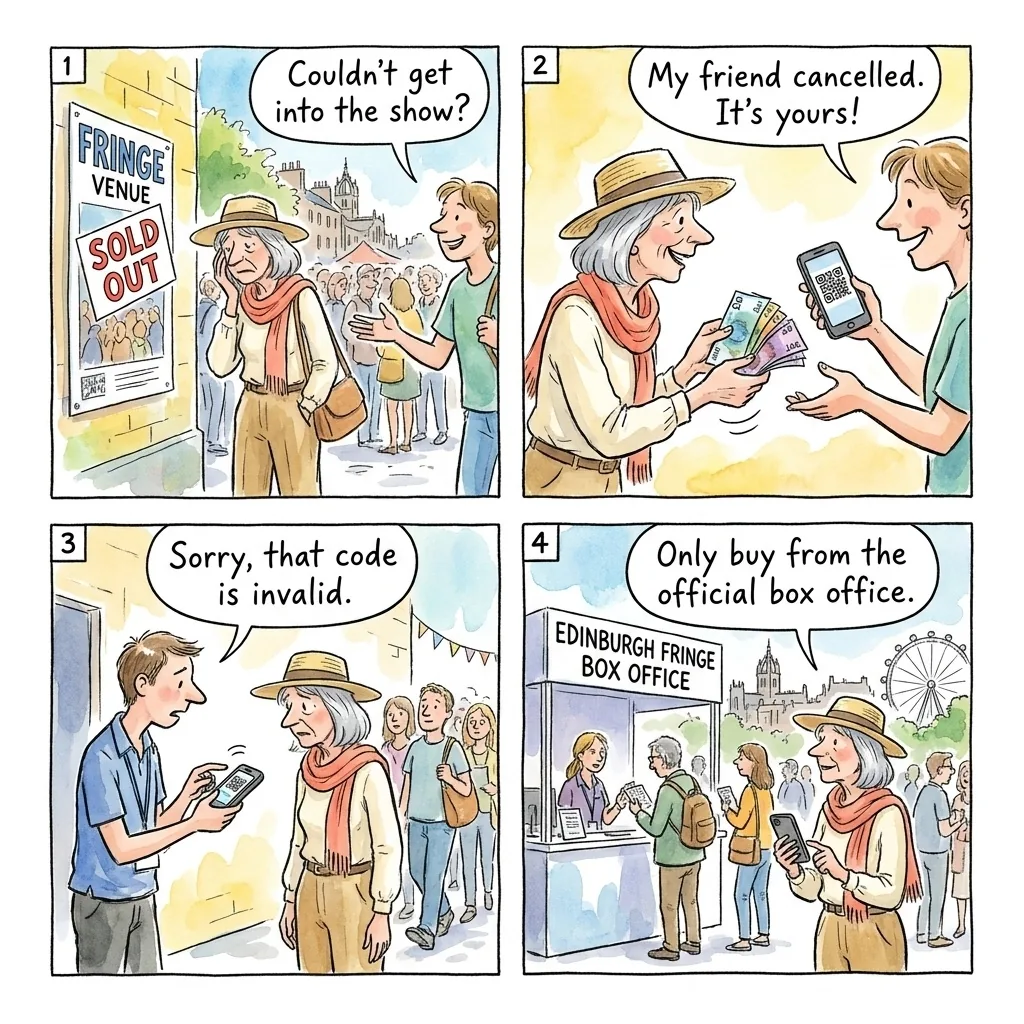
You join the Edinburgh Free Walking Tour at noon at the Royal Mile near St Giles' Cathedral. The 3-hour tour covers Old Town, Greyfriars, the Grassmarket, ends at Edinburgh Castle Esplanade. At 3pm the guide gives the closing speech in a thick Scottish accent, names "20 quid is the standard for Edinburgh tours" (slightly higher than the 15 GBP standard for a quality 3-hour tour). The guide passes a hat in the center of the now-25-person group. Members place 5-10 GBP notes; some place 20 GBP notes; the average creeps up. The guide briefly thanks "the generous folks in the group" while looking at the higher tippers, which most of the group notices. The Edinburgh Tourist Information centre on Princes Street accepts complaints about walking tour practices, though enforcement is limited; Trading Standards Edinburgh (citizensadvice.org.uk) accepts written complaints about minimum-tip extortion. Defense: bring exact-change in your tip-budget amount (10 GBP for a quality 3-hour Edinburgh tour). Tip privately, not in the hat. Step away from the group when the hat circulates, hand your prepared tip directly to the guide as the group disperses, walk on toward Princes Street.
Read the full Edinburgh scam guide →Red flags
If two or more of these signals fire during a free walking tour, set your tip in advance and execute the private-tip strategy. The compounding rule: a single signal might be a coincidence; two signals are a script.
- The guide names a "standard tip" of 20-30 EUR per person in the closing speech
- The guide says "the tour costs the company X EUR per person" and asks you to match
- The guide proposes a mid-tour paid extension (extra museum, special tasting)
- The guide proposes a tip-only post-tour walk to "favorite hidden spots"
- The guide passes a hat in the center of the group during the tip moment
- The guide asks "how much did everyone tip?" or stages a circle for tipping
- The guide thanks "generous tippers" by name during the tip moment
- The tour is advertised in EUR/USD but only local-currency cash is accepted at end
- The tour is in Berlin, Madrid, Prague, Lisbon, Edinburgh and the group is large (25+)
- The guide is openly hustling for tips throughout the tour, not just at the end
The phrases that shut it down
Refusing the up-sell or the minimum tip works when you signal you have already decided your tip and you are not going to be moved. The phrase pattern is the same in every language: thanks but no.
If you got hit
You tipped 25 EUR after the guide named that as "standard" and now feel the tour was not worth it. Free walking tour tip-extortion is the smallest-stakes scam in the Atlas (10-50 EUR per incident) and is the most ambiguous: tips are voluntary, the guide's framing is not technically illegal in any of the documented countries, and there is no recovery channel for the tip itself. The actionable response is preventive for the next tour, not recovery for this one.
If the variant involved a paid-up-sell mid-tour (museum entry, tasting fee, separate paid extension), and the experience was significantly different from what was advertised, you may be able to dispute the credit-card charge if the up-sell was paid by card. Most up-sells are cash; cash is unrecoverable.
If the guide's pressure rose to the level of refusing to release the group at the end of the tour without payment, that crosses from extortionate framing into actionable extortion, and local police should be contacted. This is rare; most variants are framing-and-pressure rather than overt threat.
For Sandemans specifically, the Sandemans New Europe corporate office accepts complaints about specific guides via their website and customer service channels. The corporate Sandemans tip recommendation is "what you can afford," with no minimum quoted by the company; individual guide pressure is a Sandemans Terms of Service violation. Repeated complaints can result in the guide being removed from the rotation.
- Sandemans New Europe: customer service via Sandemans website; specific guide complaints accepted by corporate.
- Berlin: Berlin Tourism (visitBerlin); Berliner Senatsverwaltung fur Wirtschaft for tour operator complaints.
- Madrid: Direccion General de Consumo (Comunidad de Madrid); Federacion Espanola de Asociaciones de Profesionales de Turismo.
- Prague: CTIA (Czech Trade Inspection Authority) for cash extortion complaints; Prague City Tourism for general feedback.
- Lisbon: Turismo de Portugal; ASAE (Autoridade de Seguranca Alimentar e Economica) for misrepresentation.
- Edinburgh: Trading Standards Edinburgh (citizensadvice.org.uk); VisitScotland.
- Rome / Florence / Venice: Comune Tourist Office (Roma Capitale Turismo); Polizia Annonaria for misrepresentation.
- Budapest: Hungarian Consumer Protection Authority; Budapest Tourism.
Tip-extortion losses are typically not worth pursuing through official channels because the financial harm is small and the framing is technically legal. The actionable response is preventive: set the tip budget before the tour starts; bring exact-change cash; refuse all on-tour up-sells; tip privately. The fixed-budget rule defeats every variant in advance.
Related atlas entries
Sister entries in the Scam Atlas. Free walking tour tip-extortion sits in the Tours section alongside other ticket and sightseeing scams; the on-tour pickpocket overlap connects to the Distraction Theft and Pickpocketing Tactics entries.
Sources
- Sandemans New Europe published guide tip policy (corporate, ongoing).
- Berlin Tourism (visitBerlin) and Berliner Senatsverwaltung fur Wirtschaft, walking tour complaint logs (Germany, ongoing).
- Direccion General de Consumo Comunidad de Madrid, Plaza Mayor walking tour pressure complaints (Spain, ongoing).
- CTIA (Czech Trade Inspection Authority), Old Town Square cash extortion enforcement bulletins (Czech Republic, ongoing).
- Turismo de Portugal, Lisbon walking tour up-sell coverage (Portugal, ongoing).
- Trading Standards Edinburgh (citizensadvice.org.uk), Royal Mile walking tour complaints (Scotland, ongoing).
- Tagesspiegel Berlin and Suddeutsche Zeitung, Brandenburg Gate Sandemans tour-tip coverage (Germany, 2019-2025).
- El Pais, Madrid walking tour minimum-tip practices coverage (Spain, 2020-2025).
- r/travel, r/Berlin, r/madrid, r/Prague, r/Lisbon, r/Edinburgh continuing thread monitoring 2018-2026.
Get the full walking-tour-and-tour-scam playbook for your destination.
Each Travel Safety atlas covers every documented tour and ticket scam in one country, plus the country's full scam catalog: pickpocket, taxi, ATM, restaurant, fake authority. Buy once, lifetime updates as scams evolve. $4.99 on Kindle.