
Key Takeaways
- The #1 reported scam is the Silk Board Auto Meter-Speed Trick.
- 1 of 5 scams are rated high risk.
- Use app-based ride services (Uber, Ola) instead of street taxis — always confirm the fare before departure.
- Never accept unsolicited offers from strangers near tourist sites in Bangalore.
⚡ Quick Safety Tips
- Keep phones and valuables in secure pockets when in crowded areas.
- Use only licensed taxis or app-based ride services.
- Book tours and tickets through verified operators with online reviews.
- Keep a copy of your passport separate from the original.
Jump to a Scam
The 5 Scams
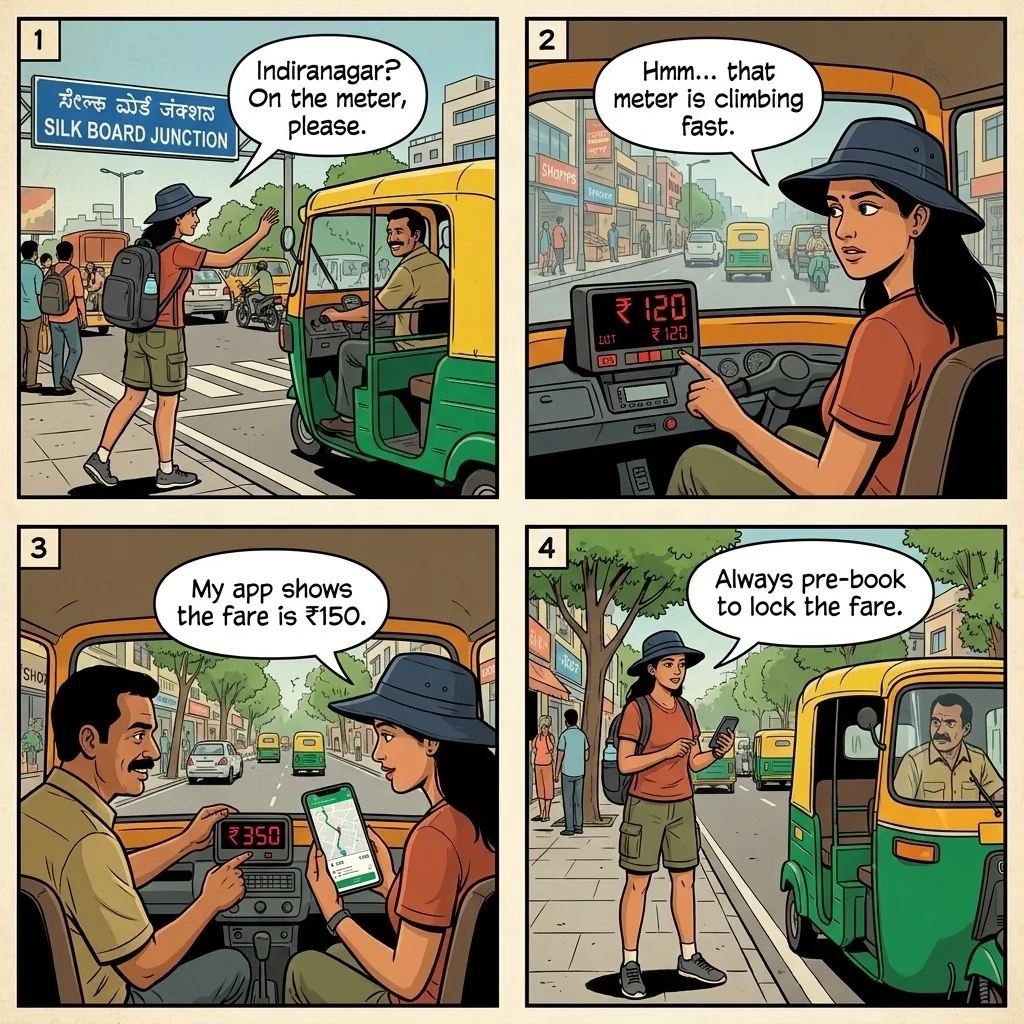
You flag down an auto at Silk Board Junction, the meter ticks at twice the rate it should, and by Indiranagar you owe ₹350 for a ride that should run ₹150.
The setup looks clean. The driver agrees to run the meter without arguing — a small red flag in itself, since most Bangalore auto disputes start with drivers refusing the meter outright. He pulls out, the digits start clicking, and you settle in. Five minutes later you glance at the readout and the numbers don't make sense: 40, 70, 120, skipping increments that no honest meter could clock at this speed.
By the time you reach Indiranagar the display reads ₹350 for a ride that should cost ₹150 at the official Bangalore rate of ₹30 base plus ₹15 per kilometer. The driver shrugs and points at the meter as if it is a neutral arbiter, citing 'night rates' or a 'traffic surcharge' that does not appear on any rate card. Confrontation rarely works — he has rehearsed the script.
The hook is a hardware tweak hidden behind a software-feeling display — drivers buy aftermarket meter chips that double or triple the per-kilometer tick. The defensive move is to skip street autos entirely on routes from Silk Board, Majestic, and KR Market and book Ola Auto or Uber Auto through the app, where the fare is fixed before you climb in.
Red Flags
- The meter display jumps in large increments rather than ticking smoothly
- The fare seems to be climbing much faster than the distance traveled
- The driver was unusually eager to use the meter rather than negotiating a flat rate
- When questioned, the driver blames 'night rates' or 'traffic surcharges' not reflected on any rate card
- The meter unit is positioned where you cannot easily see it during the ride
How to Avoid
- Use Ola or Uber instead -- transparent pricing, GPS tracking, and digital receipts.
- Check Google Maps for estimated travel time and fare before getting in any auto.
- If the meter seems fast, note the starting fare and check it against the official Bangalore auto fare chart (₹30 base + ₹15/km).
- Take a photo of the meter at the start of the ride as evidence.
- If the fare is clearly inflated, pay what is reasonable and walk away calmly.
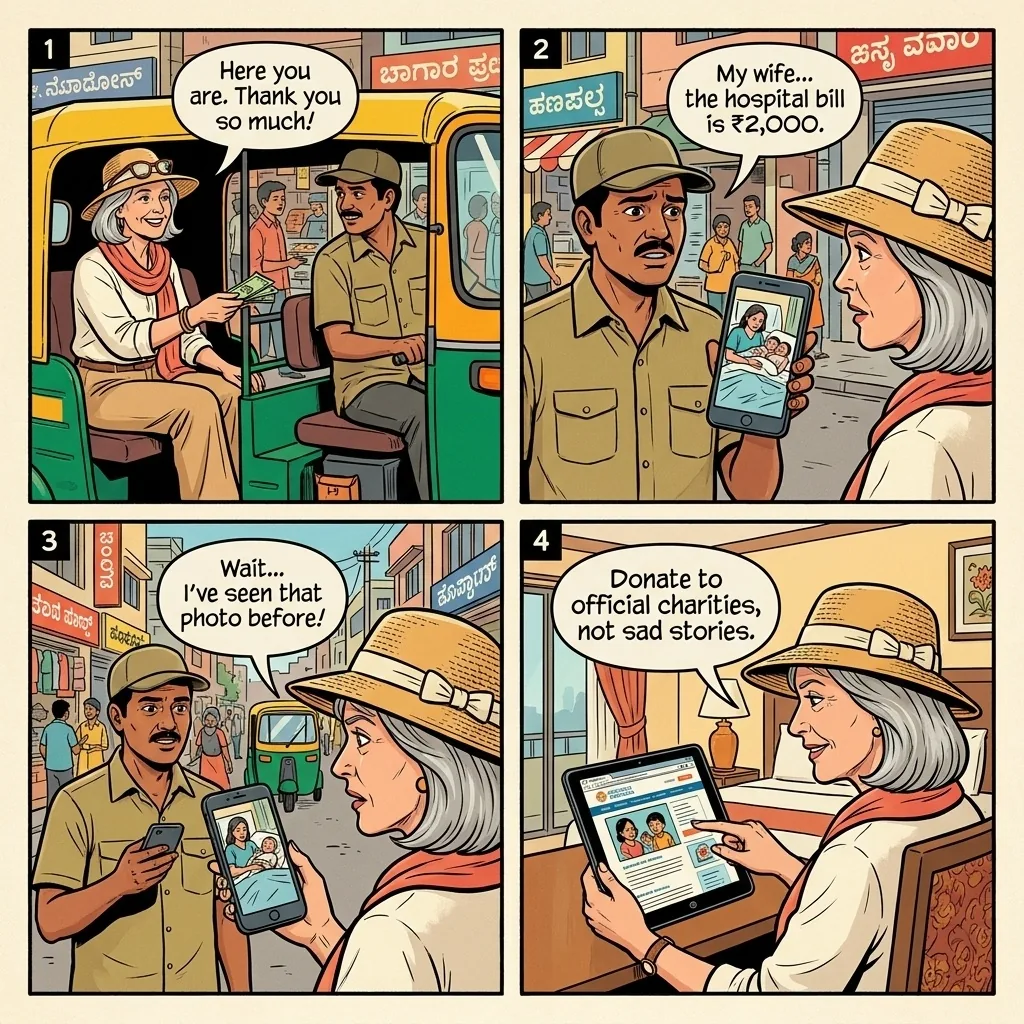
An HSR Layout auto driver pulls out a hospital photo of a wife and newborn twins and asks for ₹2,000 to cover the medical bill — until you realize the next driver shows you the exact same photo.
The pivot comes at payment. You hand over the fare, and as you do the driver pulls out his phone and shows you photos of a woman and newborn twins in a hospital bed. His wife has just given birth, he says, and he cannot afford the medical bills. He asks for ₹2,000 — small money, urgent need, and a face on the screen.
The trick is that the photos circulate. A Deccan Herald investigation documented HSR Layout drivers sharing identical hospital photographs for over a year — same wife, same twins, same heart-pulling timing at the end of the ride. When one passenger pushed for specifics, asking for the hospital name and a phone number for the wife, the driver immediately dropped the act and drove off.
The hook is guilt at the handover plus zero verification window — by the time you would call the hospital you have already paid. The defensive move is a polite, firm 'I'm sorry, I can't help' and zero cash transfer; ask for the hospital name in the first sentence and the act usually collapses.
Red Flags
- The driver shows hospital photos on his phone at the end of an otherwise normal ride
- The story involves a wife, newborn, or seriously ill family member needing immediate funds
- The requested amount is disproportionately large (₹1,000 to ₹5,000) compared to the fare
- Multiple drivers in the same area tell suspiciously similar stories with similar photos
- The driver becomes evasive when you ask for specific details like hospital name or patient ID
How to Avoid
- Ask for specifics: hospital name, ward number, patient name -- genuine cases will have answers.
- Offer to donate through an official hospital fund or GoFundMe rather than cash.
- Be aware that this scam is widespread in HSR Layout and Koramangala specifically.
- A polite but firm 'I'm sorry, I can't help' is sufficient -- do not feel guilty.
- Report repeat offenders to the auto-rickshaw union or local police station.
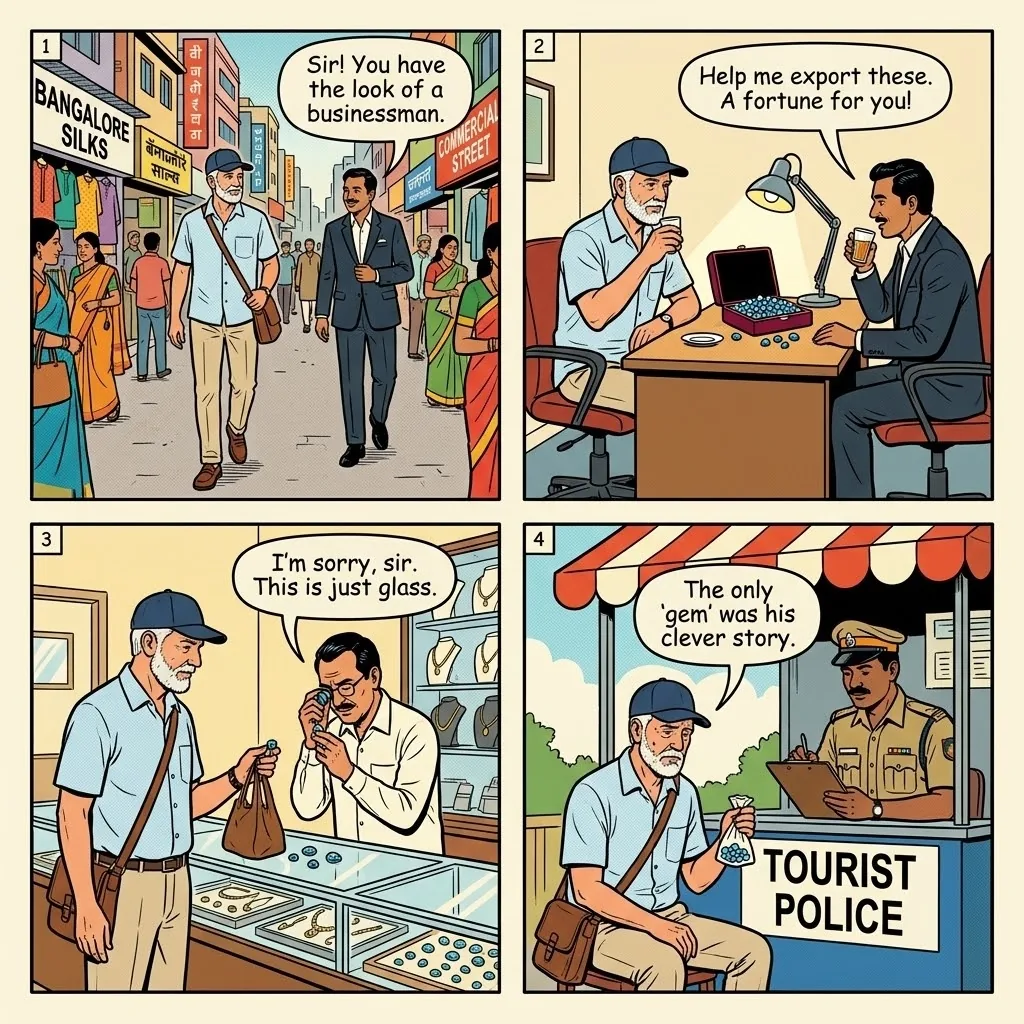
A well-dressed stranger on Commercial Street offers to make you a fortune carrying gemstones home — first you just need to buy ₹50,000 in 'samples' that turn out to be cut glass.
The opener is friendly and articulate. He owns a gemstone business, he says, and needs foreign tourists to help 'export' precious stones because of import-tax advantages back in their home countries. He will give you the gems on consignment to carry home and sell for triple the price — he just needs you to buy a small sample batch for ₹50,000 to prove you are serious about the partnership.
The 'samples' are worthless glass. The variation that catches more travelers is the showroom invitation: free chai, a private back room, and high-pressure salespeople who convince you that sapphires worth ₹500 in any Indian wholesale market are valued at ₹50,000 abroad. The numbers always include a tax-loophole story that sounds plausible if you have never sold a gemstone in your life.
The hook is flattery plus a hand-rolled tax fantasy — every variant requires you to be 'special' and to act fast before the deal expires. The defensive move is the rule: no legitimate gem business recruits random tourists on Commercial Street, and any 'investment opportunity' from a stranger you met five minutes ago is a scam.
Red Flags
- A stranger approaches you with a 'business opportunity' involving gemstones or jewelry
- Claims of tax loopholes or export advantages that require a foreign tourist's involvement
- You are invited to a private showroom or office away from the main shopping area
- Free tea, snacks, or compliments are used to build rapport before the sales pitch
- Pressure to buy immediately because the 'deal' expires or stock is limited
How to Avoid
- No legitimate business recruits random tourists for gem exports -- this is always a scam.
- Never follow a stranger to a private showroom or office, no matter how convincing the pitch.
- If you want gems, buy from government-certified jewelers with GIA or IGI certification.
- Tell persistent touts you are a gemologist or journalist -- they'll back off quickly.
- Walk away from any 'investment opportunity' pitched by someone you just met on the street.
Like what you're reading? Get a full Bangalore itinerary with safety tips built in.
Browse travel-safety books →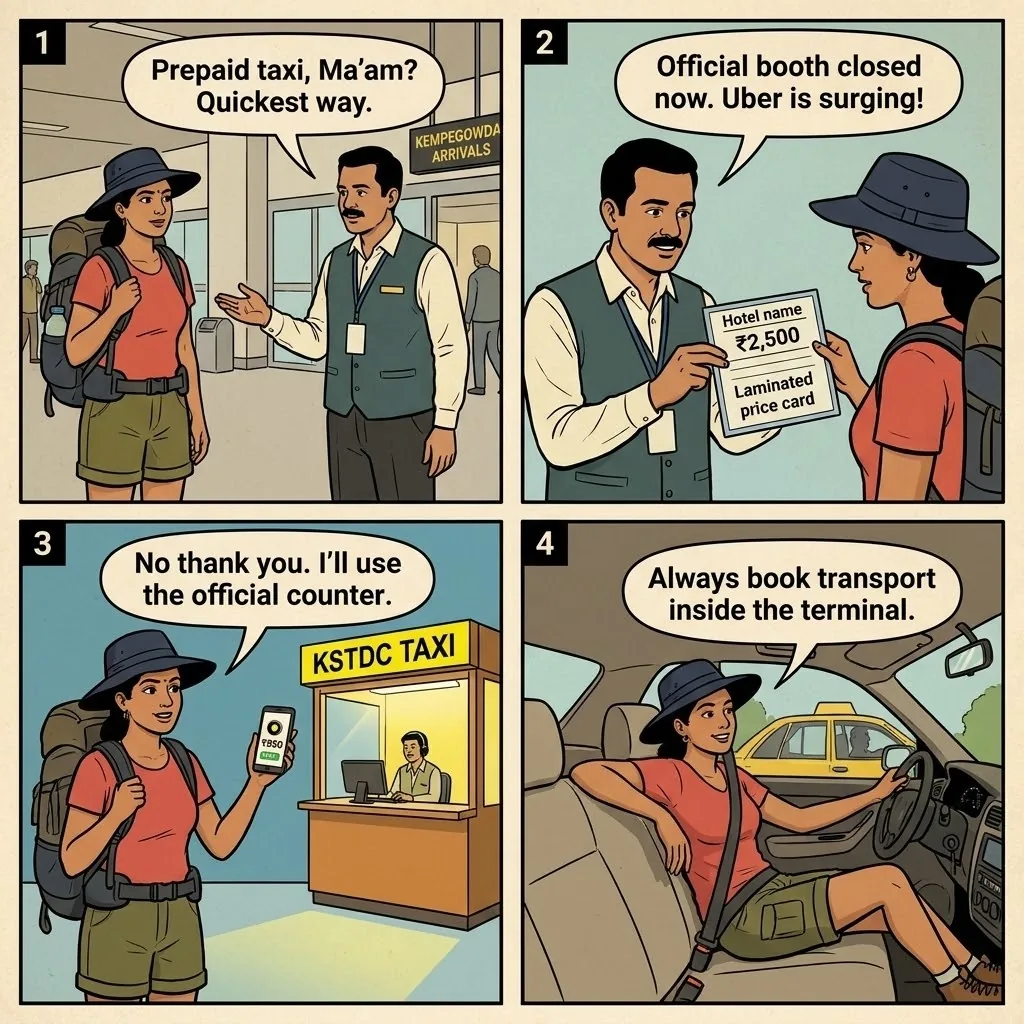
A man in a quasi-official vest at Kempegowda Airport offers a 'prepaid taxi' for ₹2,500 — three times the official KIAL counter rate of ₹800 to ₹1,200.
The intercept happens before you reach the official counter. You land at Kempegowda after midnight, jet-lagged, and a man in a vest that looks semi-official approaches with a laminated rate card. He offers a 'prepaid taxi' to your hotel for ₹2,500 and insists the Ola/Uber surge price is higher, that the official booth is closed for the night, and that he can have you in a car immediately.
The diversion comes mid-ride. Halfway to the city the driver claims your hotel area is 'restricted' or 'unsafe' and tries to redirect you to a partner hotel paying him a commission. By the time you realize what has happened you are on the Outer Ring Road in an unmarked car you hailed from a man you cannot identify.
The hook is airport disorientation plus a fake-authority vest — the official KIAL prepaid taxi booth is in fact open 24 hours and charges ₹800 to ₹1,200 to most city areas, roughly a third of the tout's price. The defensive move is to walk straight past every approach inside the terminal to the official prepaid counter, or pre-book Ola or Uber and meet the driver at the designated app-pickup zone.
Red Flags
- Someone approaches you before you reach the official prepaid taxi counter
- The person wears a vest that looks semi-official but has no airport authority branding
- Claims that the official taxi counter is closed, broken, or has a long wait
- The quoted fare is significantly higher than what Ola/Uber shows for the same route
- The vehicle is unmarked with no taxi permit displayed on the dashboard
How to Avoid
- Walk past all touts and go directly to the official airport prepaid taxi counter inside the terminal.
- Pre-book an Ola or Uber from the designated pickup zone -- the app works at Bangalore airport.
- Know approximate fares in advance: airport to central Bangalore should be ₹800 to ₹1,200.
- If a driver claims your hotel is closed or inaccessible, call the hotel directly to confirm.
- Share your live location with someone before getting into any vehicle.
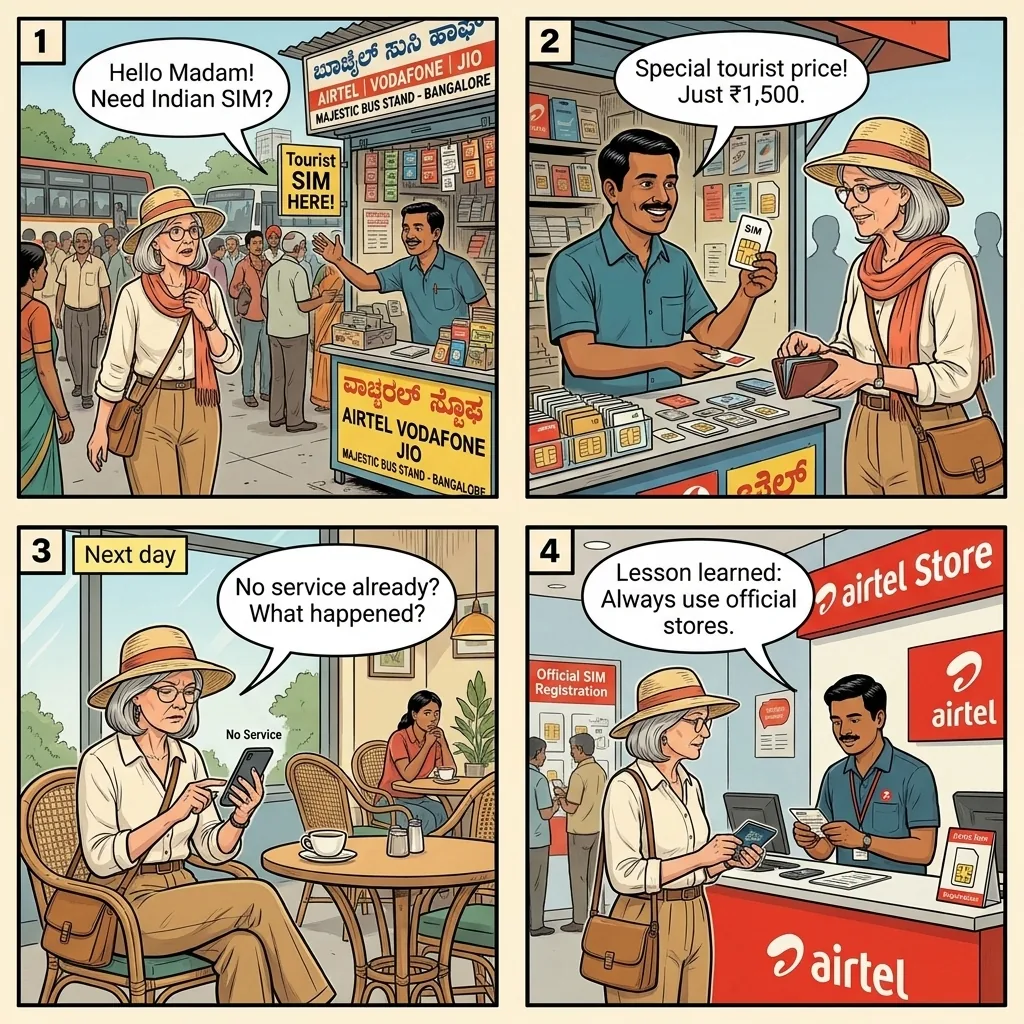
A small shop near Majestic sells a 'tourist SIM' for ₹1,500 — the same SIM at an official Airtel or Jio counter is ₹300 to ₹700, and the back-channel one may be registered against someone else's Aadhaar.
The pitch is simple. A small shop near Majestic Bus Stand offers you a 'tourist SIM' for ₹1,500 with 'unlimited data,' often with a confident promise that this is the special foreigner price. The same SIM at a branded Airtel, Jio, or Vi counter costs ₹300 to ₹700 with the same data allotment.
The bigger problem is registration. Indian SIM cards must be registered against an Aadhaar identity, and the vendor's quick-issue model often skips that step or registers the SIM against someone else's documents. Travelers have reported their SIMs going dead 24 to 48 hours after purchase because they were flagged as fraudulently registered — no phone service, no refund, and a thin line of legal exposure if the SIM is later used for fraud.
The hook is price-versus-convenience inversion — the vendor charges more than the official channel for a service that may not work. The defensive move is to buy SIMs only at the airport's official Airtel and Jio counters or any branded carrier store, expect to show your passport for eKYC, and confirm activation with a test call before leaving the counter.
Red Flags
- The shop is not a branded Airtel, Jio, or Vi outlet but a generic 'mobile accessories' stall
- The SIM price is two to three times higher than official tourist SIM rates
- The vendor does not ask for your passport or perform biometric verification
- They promise 'instant activation' without the normal 2-24 hour verification period
- No proper receipt or documentation is provided
How to Avoid
- Buy SIM cards only from official carrier stores -- Airtel and Jio have counters at the airport.
- Expect to show your passport and complete an eKYC biometric process for legitimate registration.
- Know the real price: tourist SIM packs from major carriers cost ₹300 to ₹700 with ample data.
- Confirm activation on the spot by making a test call before leaving the store.
- Keep your receipt and activation reference number in case of issues.
🆘 What to Do If You Get Scammed
📋 File a Police Report
Go to the nearest Indian Police station. Call 100 (Police) or 112 (Emergency). Get an official crime report — you'll need this for insurance claims. You can also report online at citizenservices.gov.in.
💳 Cancel Your Cards
Call your bank immediately. Most have 24/7 numbers on the back of the card (keep a photo saved separately). Block any suspicious transactions before the thieves use your details.
🛂 Lost Passport?
Contact your nearest embassy or consulate. The US Embassy in New Delhi is at Shantipath, Chanakyapuri, New Delhi 110021. For emergencies: +91 11-2419-8000.
📱 Track Your Device
If your phone was stolen, use Find My (iPhone) or Find My Device (Android) from another device. Don't confront thieves yourself — share the location with police instead.
Frequently Asked Questions
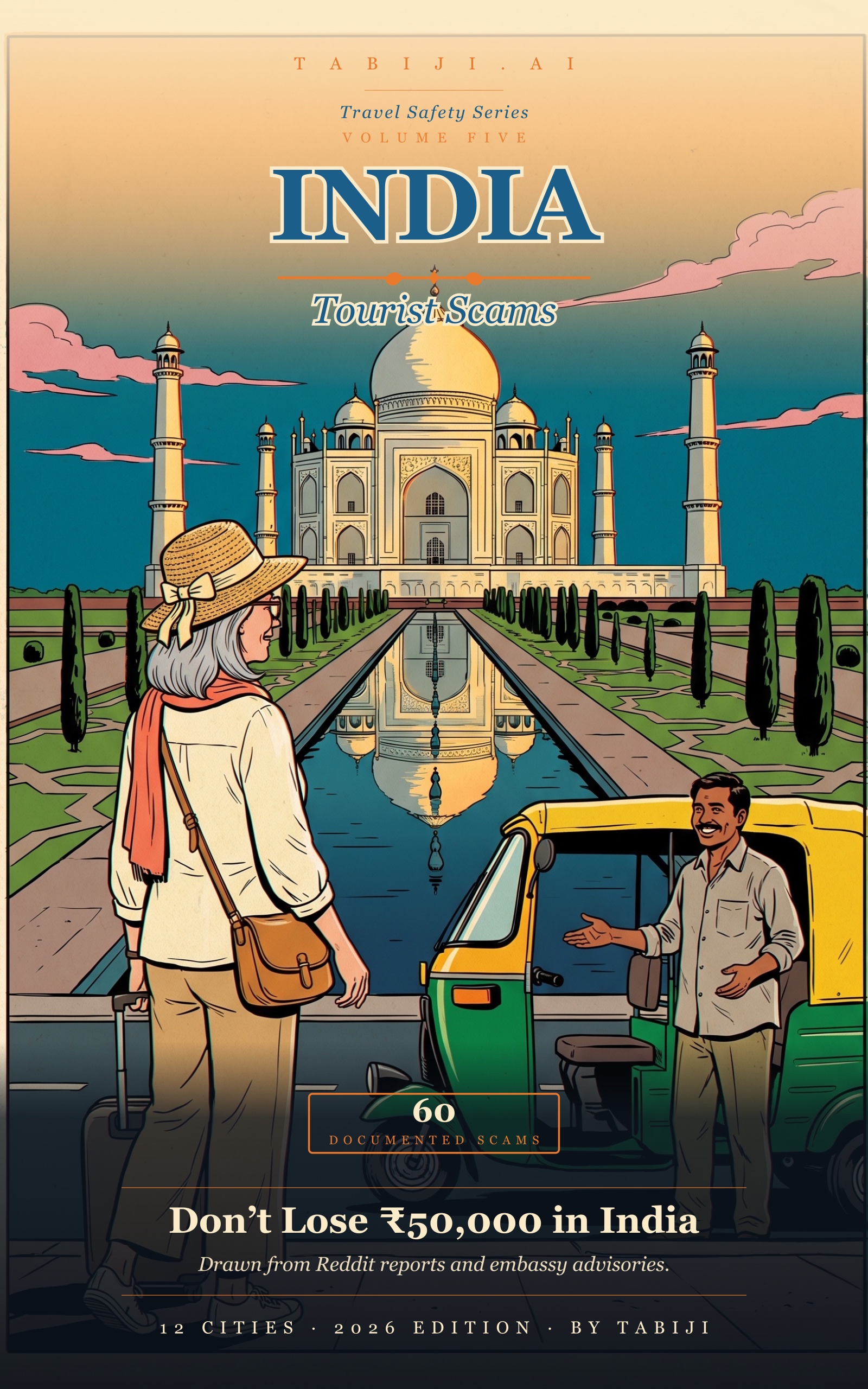
You just read 5 scams in Bangalore. The book has 60 across 12 Indian cities.
Delhi’s Paharganj “India Tourism” rebooking trap. Jaipur’s Hawa Mahal rickshaw textile detour. Mumbai’s ₹61,000 dating-app pub bill. The Lake Pichola sunset-photo extortion. The Bengaluru Silk Board meter manipulation. Every documented India scam — with the exact scripts, red flags, and Hindi phrases that shut each one down. Drawn from Reddit, the Times of India, News18, Telangana Today, and embassy advisories.
- 60 documented scams across Delhi, Mumbai, Jaipur, Agra & 8 more cities
- A Hindi exit-phrase card (Devanagari + Latin) you can screenshot to your phone
- Updated annually — buy once, re-download future editions free
- Readable in one flight — $4.99, coming soon on Amazon Kindle