
Key Takeaways
- The #1 reported scam is the Bukhara Trading-Dome Silk-Carpet 'Certificate' Inflation.
- 2 of 6 scams are rated high risk.
- Use app-based ride services (Uber, Bolt) or official metered taxis instead of unmarked vehicles.
- Never accept unsolicited offers from strangers near tourist sites in Bukhara.
⚡ Quick Safety Tips
- Keep phones and valuables in secure pockets when in crowded areas.
- Use only licensed taxis or app-based ride services.
- Book tours and tickets through verified operators with online reviews.
- Keep a copy of your passport separate from the original.
Jump to a Scam
The 6 Scams
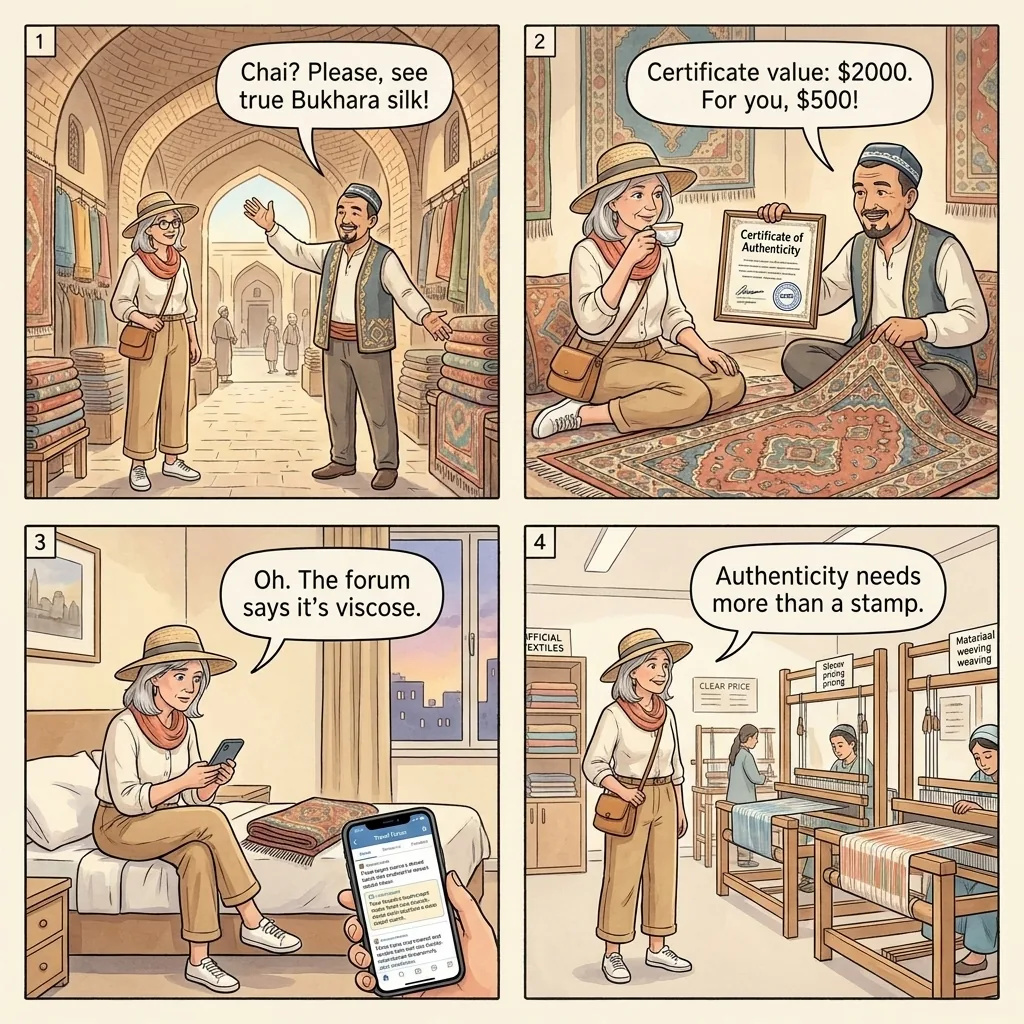
It's an afternoon in Bukhara's old town, you've wandered into the 16th-century covered trading dome of Toki Sarrafon, and a friendly carpet seller waves you into his cool stone-vaulted shop for chai and a look at his silk rugs.
He unrolls one stunning piece after another, talks knowledgeably about Bukhara's centuries-old silk weaving tradition, and presents a 'certificate of authenticity' — a printed sheet in Cyrillic with a stamp and a signature, claiming the rug is hand-knotted pure Bukhara silk worth $2,000. His opening price is $800, which 'because it's the end of the season' he can drop to $500. The price feels like a steal compared to the claimed value.
A meaningful fraction of carpets sold in Bukhara's tourist trading-dome shops are not what they're sold as. The 'pure silk' framing often refers to a silk-and-viscose blend, sometimes pure viscose with a 'silk' marketing label. The 'antique' or '100-year-old' framing rarely holds up to dye analysis (synthetic dyes were available in Central Asia from the early 20th century, and many 'antique' carpets are 1990s-era stock). The 'certificate of authenticity' is a generic Cyrillic-language printable that any Bukhara print shop produces on demand. As travelers report across Reddit, the TripAdvisor Bukhara forum, the Lonely Planet Central Asia thorntree, and Uzbekistan Tourism Committee guidance, the trading-dome carpet inflation is the most-reported Bukhara tourist friction.
The mechanism is structural rather than fraudulent in the narrow sense — the carpets are real, the trading domes are genuinely 16th-century, the chai is real. The problem is that the price is anchored to a fictional 'retail value' the customer has no way to verify, and the 'certificate' provides false legitimacy to that anchor. A real silk Bukhara carpet at proper hand-knot density runs $200–600 per square metre at the wholesale source; the same rug at a tourist trading dome runs $800–2,500.
The structural giveaways are visible to a careful buyer. Real silk feels warm and slightly textured under the fingertip; viscose and synthetic blends feel cool and smooth. The burn test — a single thread, a flame — produces the smell of burning hair on real silk, the smell of burning plastic on synthetics. Real hand-knotted carpets show pattern asymmetries on the back; machine-made carpets have perfect grid alignment. The trading-dome operators discourage these tests; legitimate carpet dealers welcome them.
For genuine silk carpet purchases in Bukhara, buy from a state-licensed cooperative (the Tezkor Bukhara Carpet Cooperative on Khakikat Street, the UNESCO-recognised Khiva Silk Carpet Cooperative if you're in the region) where pricing is documented and certificates are real. At the trading domes, treat all 'antique' and 'pure silk' claims with skepticism — ask to do a burn test on a single thread (real silk smells like burning hair, viscose like plastic); inspect the back for hand-knot pattern asymmetries; bargain from 25–30% of the asking price and cap your offer at 40%. Items over 50 years old require an export permit from the Uzbekistan Cultural Heritage Department; sellers who claim '100-year-old' should also be the ones providing the export paperwork. Pay by card if accepted for chargeback options. Emergency: 102 (Police), 103 (ambulance), 101 (fire); the U.S. Embassy in Tashkent is at +998 78 120 5450.
Red Flags
- Certificate of authenticity is a simple printed document in Cyrillic
- Vendor claims the carpet is 'antique' or '100 years old'
- Initial price drops dramatically with minimal bargaining
- Vendor discourages you from checking thread count or doing a burn test
- Claims of export certificates or customs clearance are thrown in casually
How to Avoid
- Learn basic silk vs synthetic tests: real silk feels warm, synthetics feel cool.
- Ask to burn a small thread — real silk smells like burning hair, synthetics melt like plastic.
- Start bargaining at 25% of the asking price and don't exceed 40%.
- Buy from cooperatives recommended by your guesthouse rather than bazaar stalls.
- Be aware that exporting items over 50 years old requires a government permit you won't get.
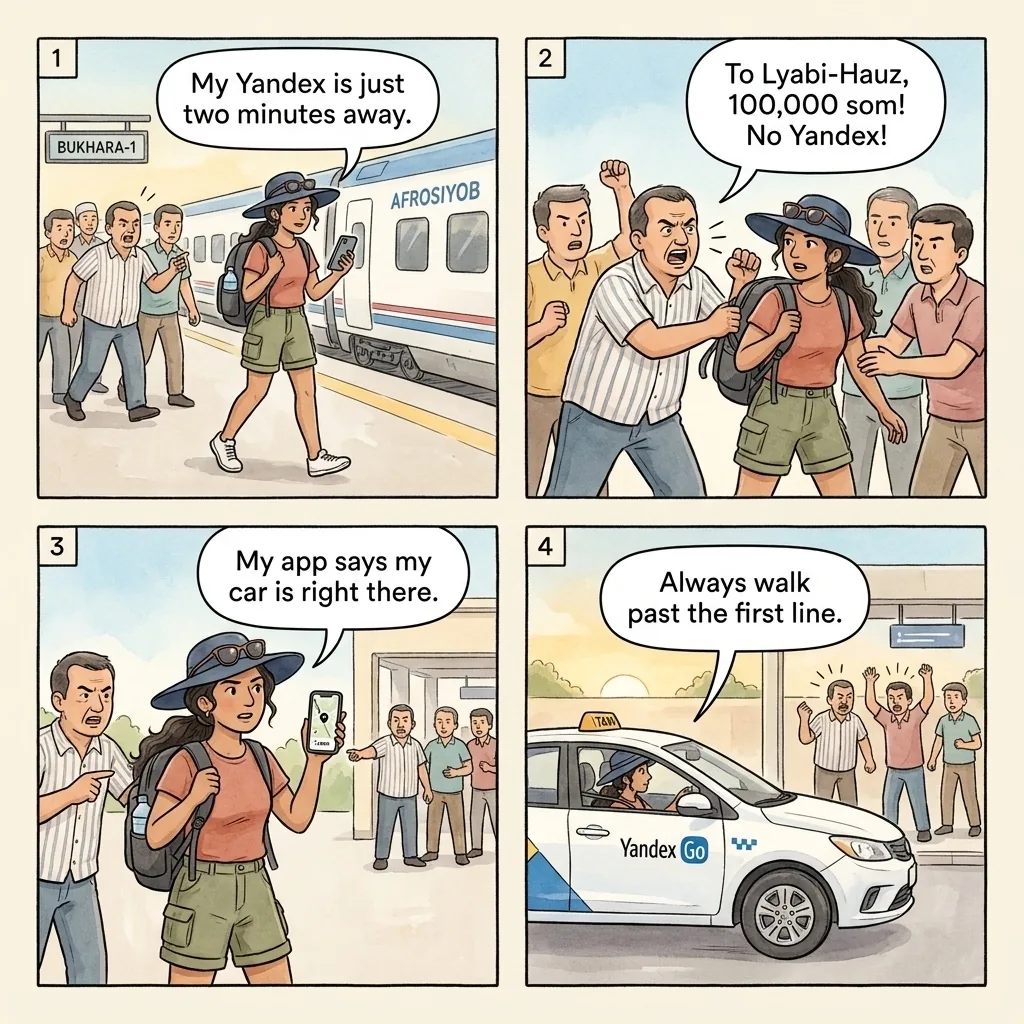
It's a morning at Bukhara-1 Railway Station, you've just arrived on the high-speed Afrosiyob from Tashkent with a backpack, and the moment you step off the platform you're surrounded by a group of six or seven shouting taxi drivers.
The loudest of them grabs your bag and quotes 100,000 UZS — about USD $8 — for a ride to Lyabi-Hauz in the old town. The legitimate Yandex Go fare for the same trip is 15,000–20,000 UZS (about USD $1.20–1.60). The Yandex driver who's already accepted your booking on the app is two minutes away in the parking lot, but you can't get to him because three other drivers are physically blocking your path and claiming 'Yandex doesn't work here.'
The Bukhara taxi mafia operates as a coordinated group at the high-traffic transport hubs — Bukhara-1 station, Bukhara International Airport, and the late-night Lyabi-Hauz rank. The mechanism is structural: the loudest operators block alternative options, the price quoted is 5–10× the Yandex rate, the 'Yandex doesn't work' framing is fictional but plausible to a tired traveler, and the bag-grab creates physical commitment before the price is confirmed. As travelers report across Reddit, the TripAdvisor Bukhara forum, the Lonely Planet Central Asia thorntree, and the Uzbekistan Tourism Committee's published consumer guidance, the Bukhara taxi friction is one of the most-reported Uzbekistan tourist annoyances.
Yandex Go works perfectly throughout Bukhara — at the station, at the airport, in the old town, everywhere — and the prices are app-displayed in advance, drivers are rated, fares are fixed. The 'doesn't work here' framing is the entire mechanism of the mafia overcharge. The legitimate fares: Bukhara-1 to Lyabi-Hauz UZS 15,000–20,000; Bukhara airport to old town UZS 25,000–35,000; Lyabi-Hauz to Poi Kalon UZS 8,000–12,000. The scaled-up mafia rates are 5–10× these.
The structural defences are concrete. Set up Yandex Go on your phone before you arrive in Uzbekistan — it requires a Russian or Uzbek number for SMS verification, which most international SIMs handle. At the station or airport, walk 100 metres past the immediate kerbside crowd before booking — this gets you to a quieter pickup point where Yandex drivers can actually reach you. Refuse to let any stranger carry your bags before a price is agreed. If a driver insists 'Yandex doesn't work,' open the app in front of him to demonstrate that it does, then walk away.
Use Yandex Go for all in-Bukhara taxi rides — fares are app-displayed, drivers are rated, and the mafia overcharge has no leverage. Set up Yandex Go on your phone BEFORE arriving in Uzbekistan (works on most international numbers via SMS verification). At Bukhara-1 station and Bukhara airport, walk 100 metres past the immediate taxi crowd before booking via app, where Yandex drivers can actually reach you. Refuse to let any stranger carry your bag before a price is agreed; refuse 'Yandex doesn't work here' framings (it does). Pre-book airport transfers through your guesthouse if you prefer to avoid the kerb entirely. Pay by card where the driver accepts it. Emergency: 102 (Police), 103 (ambulance), 101 (fire); the U.S. Embassy in Tashkent is at +998 78 120 5450.
Red Flags
- Drivers swarm you at stations and grab your luggage
- Price quoted is 5-10 times the Yandex Go estimate
- Driver claims Yandex 'doesn't work' in this area
- Group of drivers work together to block you from alternatives
- No meter offered and cash-only demanded
How to Avoid
- Download and set up Yandex Go before arriving in Uzbekistan.
- Pre-book airport transfers through your guesthouse or hotel.
- Walk 100 meters away from the station to book a Yandex ride without harassment.
- Never let a stranger carry your bags without agreeing on a price first.
- If negotiating, offer one-third of their asking price and walk away if they refuse.
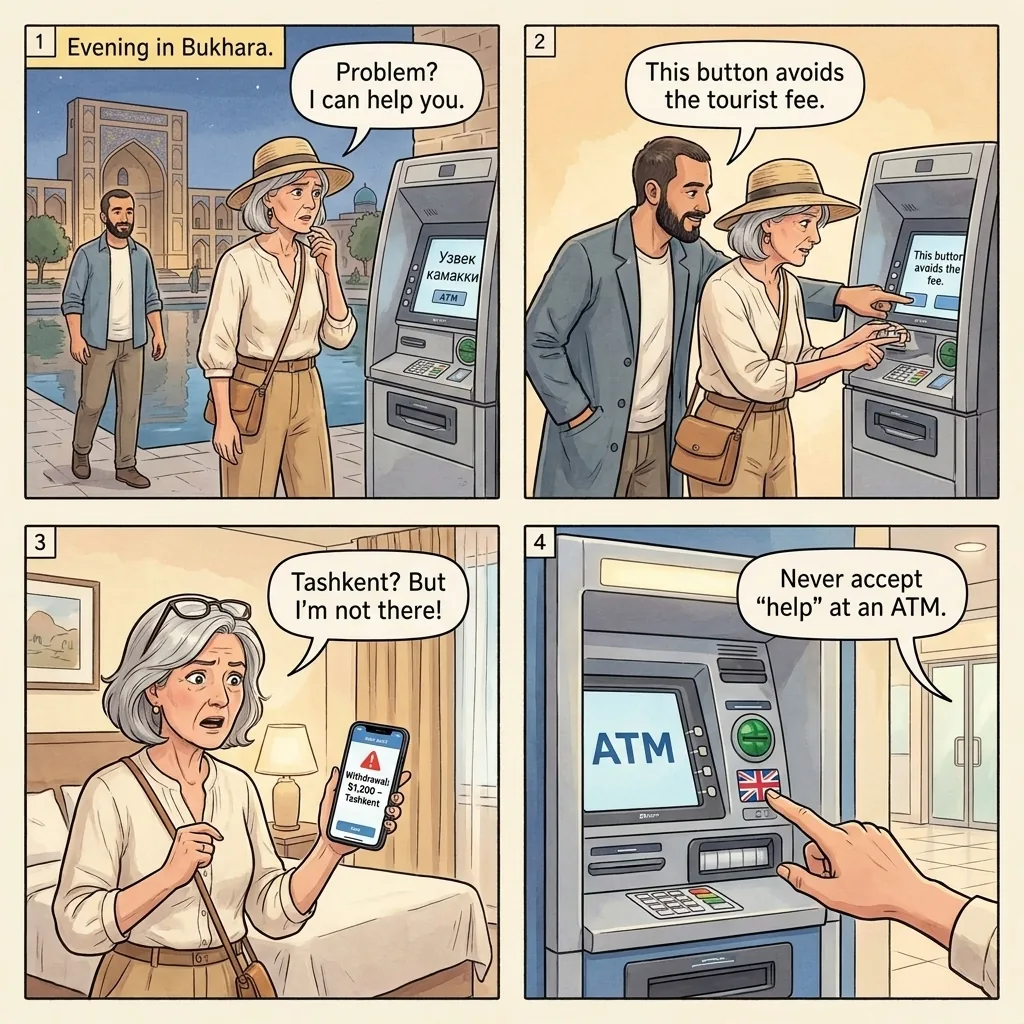
It's an evening near Lyabi-Hauz, you're at a standalone ATM trying to withdraw 1,000,000 UZS (about USD $80) for the next two days, and the screen is in Uzbek which you don't read.
A friendly local approaches and offers to help you navigate the menu. He says the machine charges foreigners a 'local bank fee' but he can help you avoid it. He offers to either insert his card first 'as a test' or stand close enough to walk you through the Uzbek-language prompts in English. While he's helping with the menu, he's watching your PIN entry and operating a small handheld skimmer in his coat pocket that clones your card data via the chip read.
Three days later, after you've left Uzbekistan, your bank statement shows USD $1,200 in unauthorised withdrawals at ATMs in Tashkent and Almaty. The card has been cloned with the PIN attached, and the operators have run it at compromised machines elsewhere in the region within 24–72 hours of the original Bukhara transaction. As travelers report across Reddit, the TripAdvisor Bukhara forum, the Lonely Planet Central Asia thorntree, and the Uzbekistan Banking Association consumer alerts, the ATM-helper card-skimmer is the highest-stakes Bukhara tourist crime.
The targeting is deliberate. The standalone ATMs around Lyabi-Hauz, Poi Kalon, and the old town's tourist sites lack the bank-branch CCTV that would deter the attack. The 'helper' framing is the calibrated reason to stand close enough for both the shoulder-surf and the skimmer clone. The 'avoid the foreigner fee' premise is fictional but plausible to a tourist who hasn't seen Uzbek-language ATM menus before.
The structural defences are concrete. Use ATMs only inside bank branches during business hours — Hamkorbank, Asaka Bank, Kapitalbank, and Ipoteka Bank all have central-Bukhara branches with indoor machines. Cover the keypad fully when entering your PIN. Decline ALL unsolicited 'help' at ATMs without exception — there is no legitimate ATM-helper category in Uzbekistan. Inspect the card slot for looseness or unusual bulk before inserting (an ATM-mounted skimmer is a different attack vector with the same defence). Enable real-time transaction notifications on your banking app so you see fraudulent withdrawals immediately. Decline Dynamic Currency Conversion (DCC) at any ATM.
Use ATMs ONLY inside bank branches during business hours — Hamkorbank, Asaka Bank, Kapitalbank, Ipoteka Bank all have central-Bukhara branches with indoor machines. Cover the keypad fully when entering your PIN. Decline ALL unsolicited 'help' at ATMs no matter how plausible — there is no legitimate ATM-helper category in Uzbekistan. Inspect the card slot for looseness before inserting. Enable real-time transaction notifications on your banking app. Decline Dynamic Currency Conversion. Withdraw small amounts more often rather than carrying large sums; consider exchanging USD at your guesthouse for routine cash needs to minimise ATM exposure. If unauthorised withdrawals appear, dispute with your bank within 60 days for chargeback under most card-issuer policies. Emergency: 102 (Police); the U.S. Embassy in Tashkent is at +998 78 120 5450.
Red Flags
- Stranger approaches while you're using or approaching an ATM
- Offers to help you avoid fees or navigate the interface
- Stands unusually close and watches your PIN entry
- ATM card slot feels loose, bulky, or has an unusual attachment
- Person lingers even after you decline help
How to Avoid
- Never accept help from strangers at ATMs — politely but firmly refuse.
- Use ATMs inside bank branches during business hours.
- Cover the keypad completely when entering your PIN.
- Check the card slot for loose fittings before inserting your card.
- Carry enough cash from your hotel exchange to minimize ATM visits.
Like what you're reading? Get a full Bukhara itinerary with safety tips built in.
Browse travel-safety books →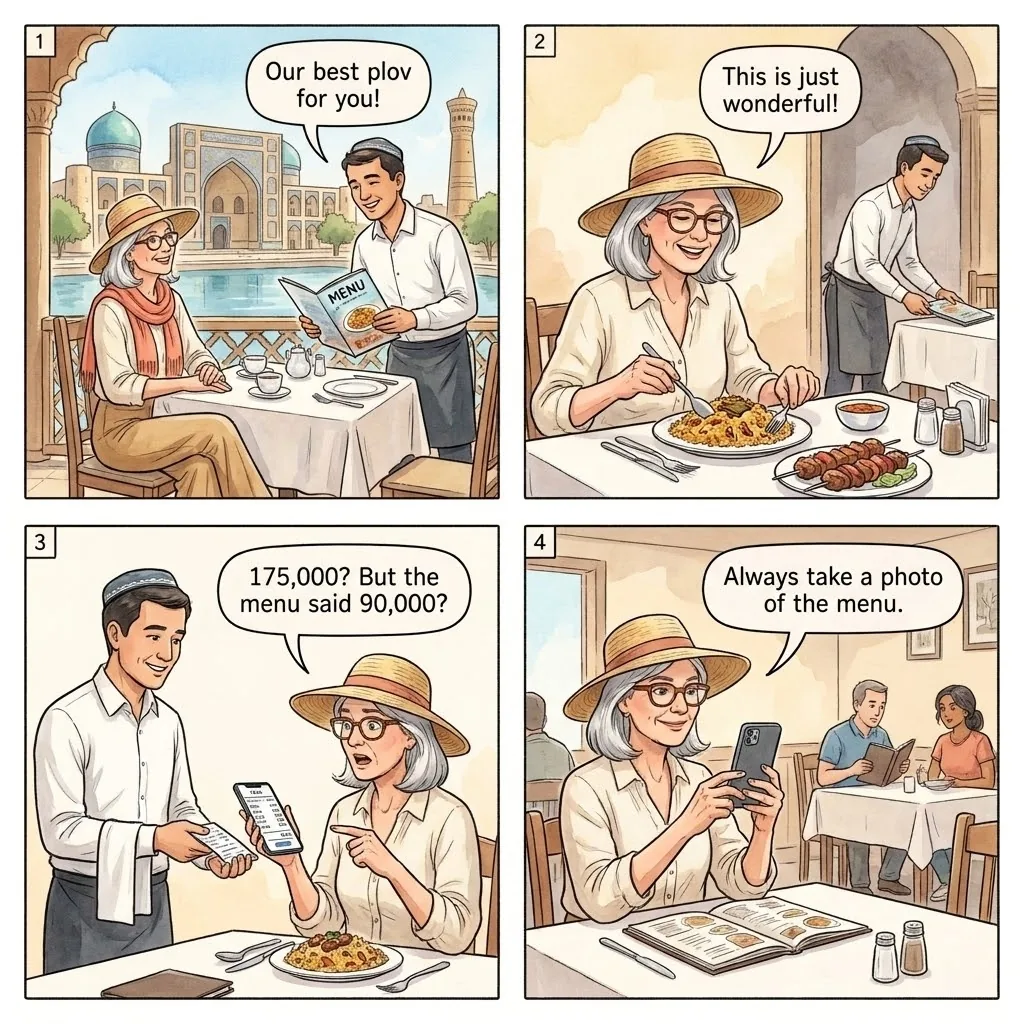
It's a warm evening at one of the terrace restaurants overlooking the Lyabi-Hauz pool, you've been brought a glossy English menu, and you order plov, shashlik, and a salad — total quoted at UZS 90,000.
The food arrives and it's genuinely good. Then the waiter takes the menu away. The bill comes at UZS 175,000 (about USD $14) — almost double the menu-listed total. The plov has been re-listed at UZS 80,000 instead of UZS 40,000; a bread basket you didn't order appears at UZS 15,000; a 'service charge' has been added at 10%. When you ask to see the menu, the waiter brings a different menu with the higher prices, or claims 'the menu changed today.'
The Lyabi-Hauz restaurant menu-switch is one of the most-reported Bukhara restaurant frictions. The mechanism uses three structural failures: a glossy English menu shown at ordering, the menu removed before the bill arrives, and a 'different menu' brought when the bill is questioned. The tourist markup at Lyabi-Hauz prime-location restaurants can be 100% over what locals pay at the same establishment a few streets back. As travelers report across Reddit, the TripAdvisor Bukhara forum, and the Lonely Planet Central Asia thorntree, this is the friction tourists most commonly encounter.
The fair Bukhara restaurant pricing for the same plov-and-shashlik combo at neighbourhood cafés one or two streets away from Lyabi-Hauz runs UZS 50,000–80,000 (about USD $4–6.50). The Lyabi-Hauz prime-location pricing legitimately runs UZS 80,000–110,000 (USD $6.50–9) for a view-with-view dinner; the menu-switch operators land the bill at UZS 150,000–200,000+ (USD $12–16) — meaningfully above even the legitimate prime-location rate.
The structural defences are concrete. Photograph the menu with prices BEFORE ordering — keep the photo on your phone for the bill comparison. Confirm each item's price verbally when ordering. Refuse unrequested bread, water, or 'complimentary' items placed on the table. Check the bill line by line on arrival; dispute any items that don't match the photographed menu. Eat at neighbourhood cafés one or two streets back from Lyabi-Hauz where pricing is consistent (Old Bukhara Restaurant, Minzifa, the Joni cafés away from the pool). Pay by card if accepted for chargeback options.
Photograph the menu with prices BEFORE ordering at any Bukhara restaurant — keep the photo on your phone for the bill comparison. Confirm each item's price verbally when ordering. Refuse unrequested bread, water, or 'complimentary' items placed on the table. Check the bill line by line on arrival and dispute any items that don't match your photographed menu. Eat at neighbourhood cafés one or two streets back from Lyabi-Hauz (Old Bukhara Restaurant, Minzifa, Joni's away from the pool) where pricing is honest. Pay by card if accepted for chargeback options. Emergency: 102 (Police).
Red Flags
- Menu has no prices or prices are written in pencil
- Waiter takes the menu away quickly after you order
- Bill includes items you didn't order like bread, water, or service charges
- Staff claims prices changed 'today' when you compare to the menu
- Different menus exist for locals and tourists
How to Avoid
- Photograph the menu with prices before ordering.
- Confirm each item's price verbally when placing your order.
- Check the bill line by line and dispute any items you didn't order.
- Eat where locals eat — one or two streets back from Lyabi-Hauz.
- Use Google Maps reviews to find restaurants with consistent pricing.
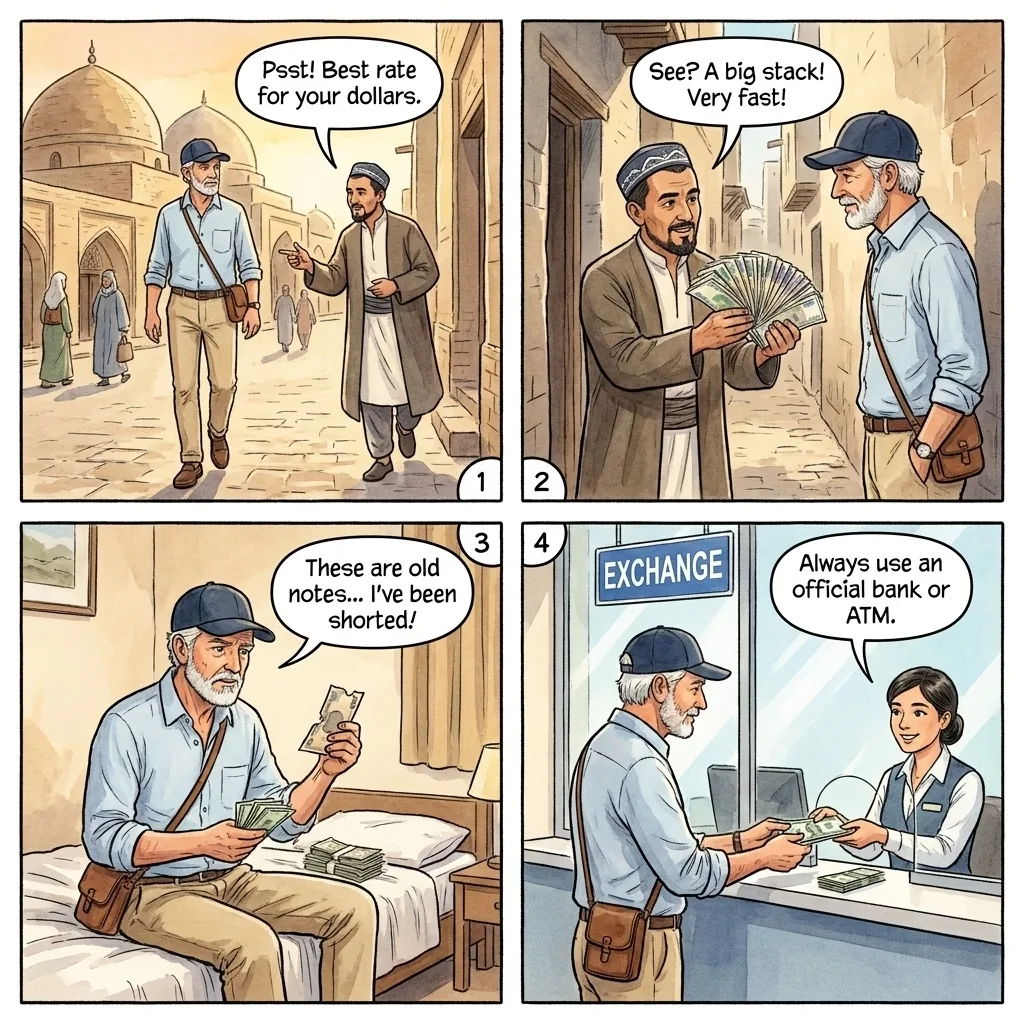
It's a Saturday afternoon near Bukhara's covered bazaar, you're walking back to your guesthouse with a few hundred USD in your daypack, and a man approaches you in the lane and whispers an exchange rate 10–15% better than official rates.
He says he can give you UZS 1,400,000 for $100 (when the official rate is roughly UZS 1,250,000). The math feels attractive — an extra UZS 150,000 (USD $12) is meaningful on a backpacker budget. You agree, he leads you a few steps into a quieter lane, and he counts out an impressive wad of soum notes. The bundle is fanned, the count appears legitimate, and you walk away with what looks like a great deal.
Back at the guesthouse, you recount the soum and discover several issues. Some notes are old, damaged, or in smaller denominations than they appeared during the fan-out count. Some are counterfeit — printed copies that look real on quick inspection but fail UV-light or texture tests. The shortfall is anywhere from UZS 200,000 to UZS 600,000 of what you thought you'd received. As travelers report across Reddit, the TripAdvisor Bukhara forum, and the Lonely Planet Central Asia thorntree, the bazaar money-exchange switch is one of the most-reported Bukhara financial frictions.
The legal framing is hostile to the victim. Street money exchange is illegal in Uzbekistan, so you cannot file a police complaint without risking your own legal exposure. The Uzbekistan currency liberalisation of 2017 effectively eliminated the historical official-vs-black-market spread that made this exchange attractive — official banks and exchange offices now run rates within 1–3% of the actual market rate. The 'black market' framing is now a fiction; the only people offering 10–15% better rates are running the switch.
The structural defences are concrete. Exchange currency only at banks (Hamkorbank, Asaka Bank, Kapitalbank, Ipoteka Bank), licensed exchange offices (the кassа windows inside major hotels), or guesthouse front desks. Since 2017, the official-and-licensed rates are within 1–3% of any 'black market' offer — there is no economic upside to the street exchange. Use ATMs at bank branches for the cleanest cash access. Carry only clean US dollars in recent series (2009 or newer) for any exchange; older or damaged notes are routinely rejected.
Exchange currency only at banks (Hamkorbank, Asaka Bank, Kapitalbank, Ipoteka Bank), licensed hotel kassa windows, or your guesthouse front desk. Since the 2017 currency liberalisation, the official-vs-street spread is 1–3% — there is no real economic upside to street exchange. Decline ALL street money-exchange offers no matter how attractive the rate; the rate is the bait, the switch is the mechanism. If you do exchange anywhere, count the notes carefully and check for counterfeit before walking away. Carry only clean USD in recent series (2009 or newer) — damaged or older notes are routinely rejected. ATMs at bank branches give the cleanest rate; consider exchanging USD at your guesthouse for routine cash needs. Emergency: 102 (Police).
Red Flags
- Stranger offers exchange rate better than banks or official bureaus
- Transaction happens on the street rather than in an exchange office
- Money is counted quickly and the person rushes you to agree
- Notes are old, worn, or in unexpectedly small denominations
- Exchanger watches to see how much cash you carry
How to Avoid
- Exchange money only at banks, hotels, or official exchange bureaus.
- Since 2017, official and black market rates are nearly identical — there's no benefit to street exchange.
- Use ATMs at bank branches for the best rates with lowest risk.
- If you must carry cash, bring clean US dollars in recent series.
- Never show your full cash supply to anyone on the street.
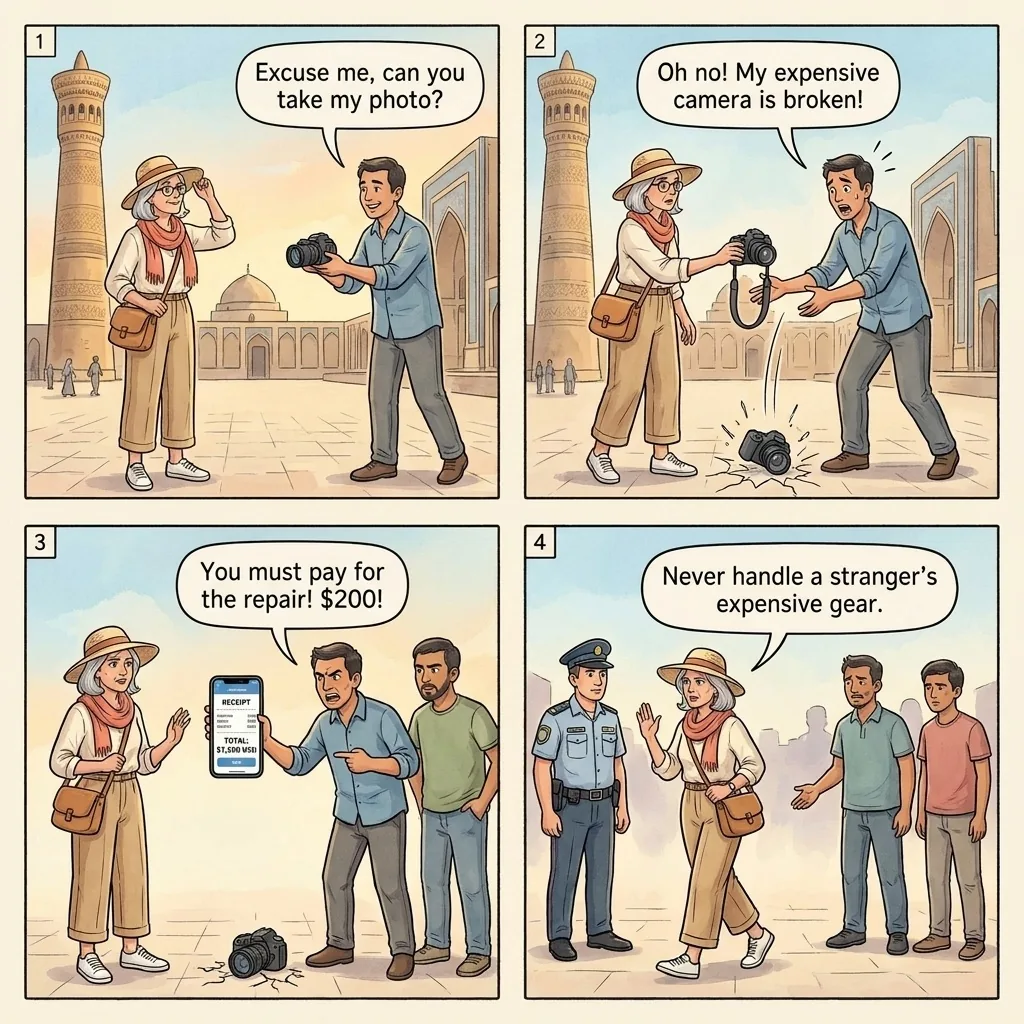
It's an afternoon at Poi Kalon, you're standing at the base of the Kalon Minaret framing a photo, and a smiling local approaches with a slightly-aged DSLR camera and asks if you can take a photo of him in front of the minaret.
You oblige because the request is friendly and harmless. He hands you the camera. You take the photo. As you hand it back, he fumbles the exchange and the camera drops. He picks it up, looks at the screen, and his face falls — the screen is cracked, the lens has shifted, and 'this was an expensive camera.' He pulls out his phone and shows you a receipt for the camera at USD $1,200 — would you please pay $100–200 toward repairs? Two friends materialise to support his account of the exchange.
The camera was already broken before he handed it to you. The 'fumble' has been practiced dozens of times. The receipt is a fabrication or for a different camera entirely. The two 'witnesses' are confederates from the same operation. The mechanism targets tourists who look sympathetic and are carrying their own expensive gear (because that establishes both ability-to-pay and a guilt response). As travelers report across Reddit, the TripAdvisor Bukhara forum, and the Lonely Planet Central Asia thorntree, the dropped-camera setup clusters at Bukhara's most-photographed monuments — Poi Kalon, Ark Fortress, Chor-Minor, Lyabi-Hauz.
The structural giveaways are visible to a careful observer. The camera body is older or shows wear. The 'fumble' happens in a way that's awkwardly choreographed — the local turns slightly as he hands the camera over, creating a drop angle. The 'receipt' produced is on a phone screen rather than a paper receipt or original purchase paperwork. Witnesses appear with timing that suggests they were waiting for the moment. The cash demand is calibrated at $100–200 — high enough to be meaningful, low enough to feel paying-it-off-and-leaving rational.
The defence is procedural rather than confrontational. Decline polite requests to handle a stranger's camera at high-tourist sites in Bukhara. If you do help, grip the device firmly with both hands, use the strap if available, and inspect the screen briefly before taking the camera (so you have a baseline if a 'crack' appears later). If accused of breaking a camera you handled, suggest going to the police together — real cases will get there, fake setups will dissolve. Walk away calmly without paying; you have no legal obligation to pay for what was likely already-damaged equipment, and the operators won't follow you to a police-station confrontation.
Politely decline strangers' requests to handle their camera or phone at Bukhara's high-tourist sites (Poi Kalon, Ark Fortress, Chor-Minor, Lyabi-Hauz). If you do help, grip the device firmly with both hands and inspect the screen briefly before taking it (a quick mental baseline if a 'crack' appears after). If accused of breaking equipment you handled, suggest going to the nearest police station together — real cases will go; fake setups won't. Walk away calmly without paying; you have no legal obligation to pay for what was likely already-damaged kit. Carry your own travel-insurance evidence (photos, receipts) so any genuine third-party damage you cause has a real claim path. Emergency: 102 (Police).
Red Flags
- Stranger asks you to take their photo at a busy tourist site
- Camera is handed over awkwardly, making a drop likely
- Screen was already damaged — check if you can before accepting
- Immediate demand for cash compensation rather than insurance
- Accomplices nearby who witnessed the 'accident' and support the claim
How to Avoid
- Politely decline requests to handle strangers' cameras or phones.
- If you do help, grip the device firmly with both hands and use the strap.
- Inspect the screen briefly before taking the camera.
- If accused of breaking it, suggest going to the police together — scammers won't agree.
- Walk away calmly — you have no legal obligation to pay for an accidental fumble.
🆘 What to Do If You Get Scammed
📋 File a Police Report
Go to the nearest Uzbekistan Police (Militsiya) station. Call 102 (Police) or 101 (Fire) or 103 (Ambulance). Get an official crime report — you'll need this for insurance claims. You can also report online at iiv.uz.
💳 Cancel Your Cards
Call your bank immediately. Most have 24/7 numbers on the back of the card (keep a photo saved separately). Block any suspicious transactions before the thieves use your details.
🛂 Lost Passport?
Contact the US Embassy in Tashkent at 3 Moyqorghon Street, Tashkent 100093. For emergencies: +998 78-120-5450.
📱 Track Your Device
If your phone was stolen, use Find My (iPhone) or Find My Device (Android) from another device. Don't confront thieves yourself — share the location with police instead.
Frequently Asked Questions
You just read 6 scams in Bukhara. The full Travel Safety Series has 780+ more across 20+ countries.
Tokyo's Kabukichō ¥130,000 bar trap. Rome's gladiator photo extortion. Paris's gold-ring trick. Bali's ATM skimmer scams. Bangkok's grand-palace closure ruse. Every documented scam across 20+ destinations — with the exact scripts, red flags, and local-language phrases that shut each one down. Drawn from Reddit traveler reports, embassy advisories, and consumer-protection cases.
- 780+ documented scams across Tokyo, Rome, Paris, Bali, Bangkok, Rio & 100+ more cities
- 20+ countries covered, with country-by-country phrase cards for every destination
- Updated annually — buy once, re-download future editions free
- All titles $4.99 each on Amazon Kindle