
Key Takeaways
- The #1 reported scam is the Samarkand Railway Taxi Mob.
- Most scams in Samarkand are low-to-medium risk.
- Use app-based ride services (Uber, Bolt) or official metered taxis instead of unmarked vehicles.
- Never accept unsolicited offers from strangers near tourist sites in Samarkand.
⚡ Quick Safety Tips
- Keep phones and valuables in secure pockets when in crowded areas.
- Use only licensed taxis or app-based ride services.
- Book tours and tickets through verified operators with online reviews.
- Keep a copy of your passport separate from the original.
Jump to a Scam
The 6 Scams
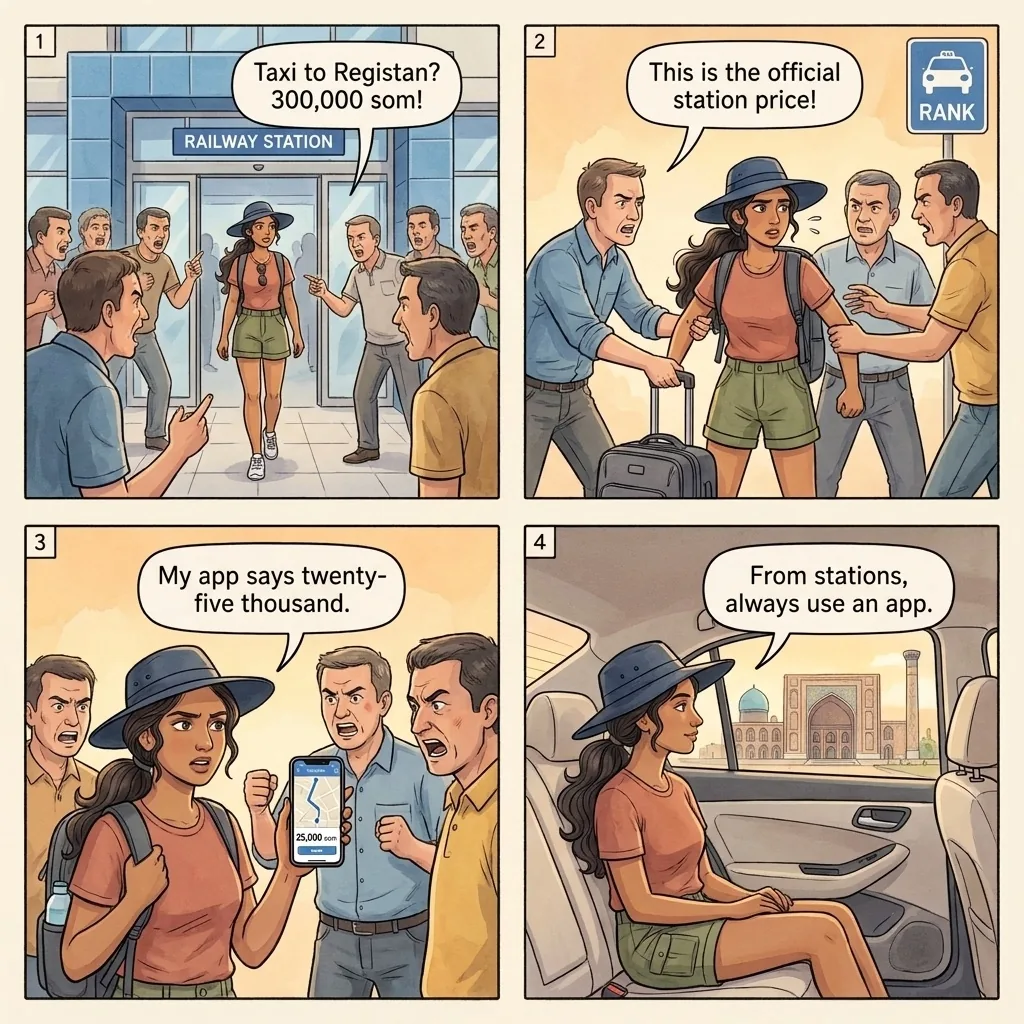
You step off the high-speed Afrosiyob train from Tashkent at Samarkand Railway Station with a single bag, walk through the modern arrivals hall, and emerge onto a curb dominated by a tight crowd of taxi drivers shouting prices.
They open with 300,000 UZS for a ride to the Registan area — about $24, ten times the fair price. The crowd is dense, six or seven men deep, and the loudest of them follows you across the parking lot, grabbing at your suitcase handle. He insists 300,000 is the 'official rate.' Two of his associates flank you, blocking the path toward the taxi line further out. The encounter is calibrated to break first-time-arrival composure, and most travelers either cave to the inflated quote or negotiate down to 150,000–200,000 UZS, still 5–7x the fair rate.
The legitimate fare from Samarkand Railway Station to the Registan area runs 20,000–30,000 UZS (about $1.50–2.50) for a regular metered taxi or registered private car. The 300,000-UZS quote is calibrated against tourists who have just arrived, do not yet know the local rates, and are tired from the two-hour high-speed train. Backpacker blogs and Reddit threads describe the station taxi mob as 'hellbent on souring your first impression' of one of Central Asia's most beautiful cities.
Unlike Tashkent, where Yandex Taxi works smoothly, the Yandex Go app has inconsistent driver coverage in Samarkand — sometimes available, sometimes not. The MyTaxi app is a sometimes-better alternative, and a few local apps (Uzum Tezkor, Express24) operate at smaller scale. When apps fail, the cleanest move is to walk past the mob to the main road outside the station forecourt and flag a passing regular car (Samarkand has a strong informal taxi culture where any private car will give a lift for 20,000-30,000 UZS).
A second variation runs at the airport rather than the train station, with the same script: a mob, an inflated opening quote, physical pressure, and 'official rate' framing. The Samarkand International Airport (SKD) has an official taxi rank inside the terminal that the mob bypasses by intercepting passengers at the curb. The rates inside are posted; outside they are negotiable.
Walk past the taxi mob at Samarkand Railway Station with a firm 'yo'q, rahmat' (no, thank you in Uzbek) — do not engage, do not slow down, do not let anyone touch your bag. Try Yandex Go on the station Wi-Fi first; if it works, fares are 25,000–40,000 UZS in-app. If apps fail, walk 100 meters past the official rank to the main road and flag a passing private car for 20,000–30,000 UZS. Pre-arrange hotel pickup at the train station if possible. The fair price to Registan is roughly 25,000 UZS; refuse anything above 50,000. If a tout becomes aggressive, dial 102 (Uzbek police).
Red Flags
- Opening price of 100,000+ UZS for a ride to the city center
- Drivers physically grabbing your luggage
- Claims that ride-hailing apps don't work here
- Multiple drivers working together to block cheaper options
- Quoting prices in US dollars to confused arrivals
How to Avoid
- Try Yandex Go app despite inconsistent coverage -- it sometimes works.
- Walk 100 meters past the taxi crowd to the main road and flag a regular car.
- The fair price to Registan is 20,000-30,000 UZS -- don't pay more.
- Arrange airport/station pickup through your hotel in advance.
- Have the Uzbek for 'how much to Registan?' ready on your phone translator.
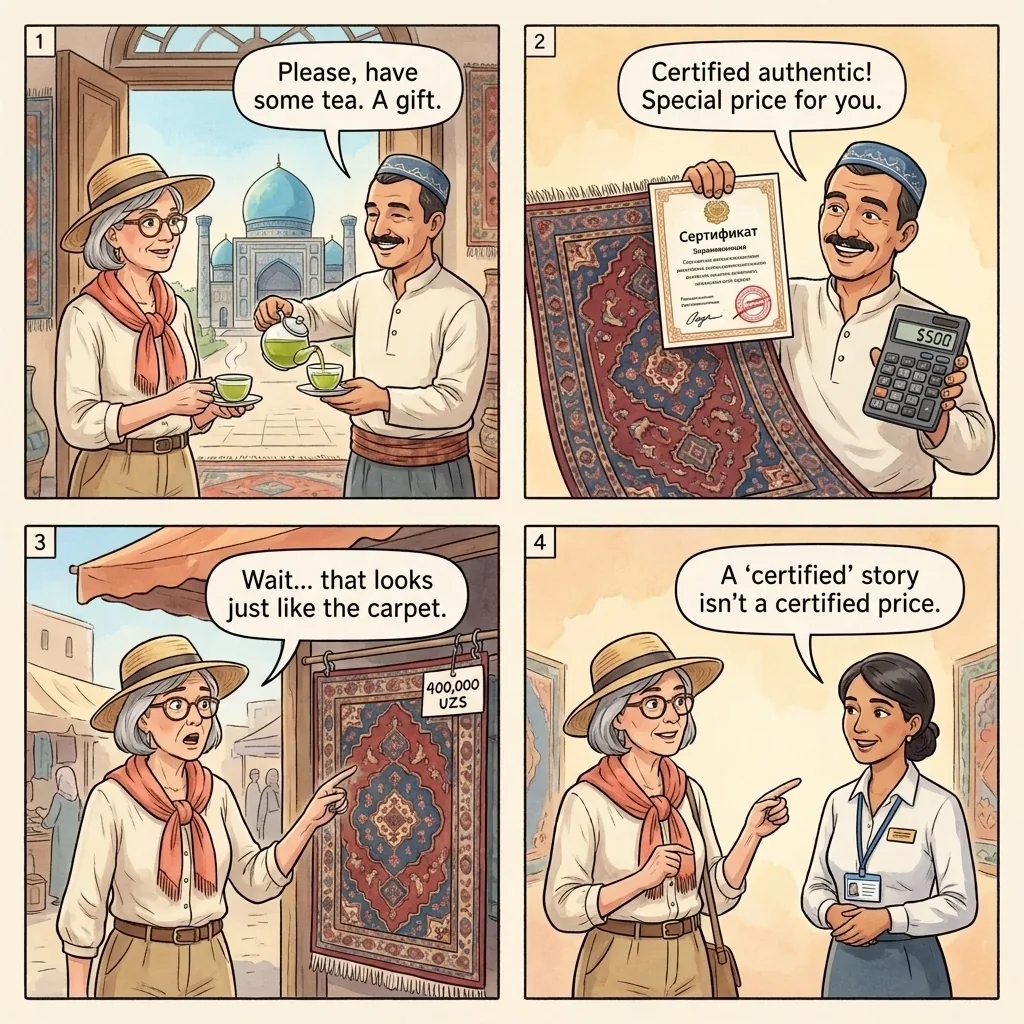
You wander into a beautifully appointed carpet shop near the Registan, admire a deep-blue handwoven piece on the wall, and the vendor invites you to sit on a low cushion for tea while he tells you the story of Samarkand silk weaving.
After twenty minutes of warm conversation, he produces a 'certificate of authenticity' in Cyrillic script, claiming the carpet is genuine Samarkand silk, hand-knotted by a master weaver in Khujand, certified by the Uzbek Crafts Union, and worth $2,000. He pulls out a calculator. The 'special tourist price' he offers is $500 — a quarter of the supposed value. He frames it as an opportunity. You feel the social weight of having drunk three cups of his tea.
The certificate is meaningless. The carpet is machine-woven with synthetic fibers, almost certainly produced in a small factory near Tashkent or imported from Iran, and similar items sell at Siab Bazaar's outer rows for $30–50. The Cyrillic script and the official-looking stamp are theatre. Vendors have been documented adding decades to a carpet's age, claiming Persian provenance for Uzbek pieces, and misrepresenting silk content (most 'silk' carpets at Registan-area shops contain less than 30% actual silk).
The pattern is documented across Reddit, the long-running TripAdvisor Samarkand forum, the U.S. Embassy in Tashkent's traveler-safety materials, and most updated guidebooks. Tourist-area shops near the Registan routinely charge 3-4x the fair value, with the 'certificate' as the upsell mechanic. The real Samarkand silk-weaving tradition exists at the Hujum Silk Carpets Factory and the Konigil paper mill near the city, where production is visible and prices are transparent.
A second variation involves the 'antique' label. Some vendors claim a carpet is 50, 80, or 100 years old, hand-knotted in pre-Soviet Bukhara, and offer it at a premium for 'antique value.' Real antique carpets exist but are rare, expensive, and almost always sold by named auction houses with provenance documentation — not by Registan vendors with hand-stamped Cyrillic certificates.
Visit the Hujum Silk Carpets Factory or the Bukhara Silk Carpets workshop in Bukhara to see real silk-carpet production and learn fair prices before buying — genuine handmade silk carpets start at $100+ per square meter, not $500 for a small piece. Dismiss any Cyrillic 'certificate of authenticity' as theatre. Compare prices at multiple non-tourist shops, haggle aggressively (start at 25-30% of the asking price), and never feel obligated by tea hospitality. For carpets under $100, Siab Bazaar's outer rows are fine. If a vendor pressures you, walk away — the price drops fast.
Red Flags
- Certificate of authenticity written only in Cyrillic or Uzbek
- Starting price 3-4 times what similar items sell for elsewhere
- Vendor claims the carpet is an antique or rare piece
- High-pressure sales with tea and prolonged conversation
- Located directly adjacent to a major tourist attraction
How to Avoid
- Visit the Samarkand Bukhara Silk Carpets Factory to see real production and fair prices.
- If you want a carpet, compare prices at multiple non-tourist shops first.
- Haggle aggressively -- offer one-third of the asking price.
- A Cyrillic certificate proves nothing about authenticity.
- Know that genuine handmade silk carpets start at $100+ per square meter at fair prices.
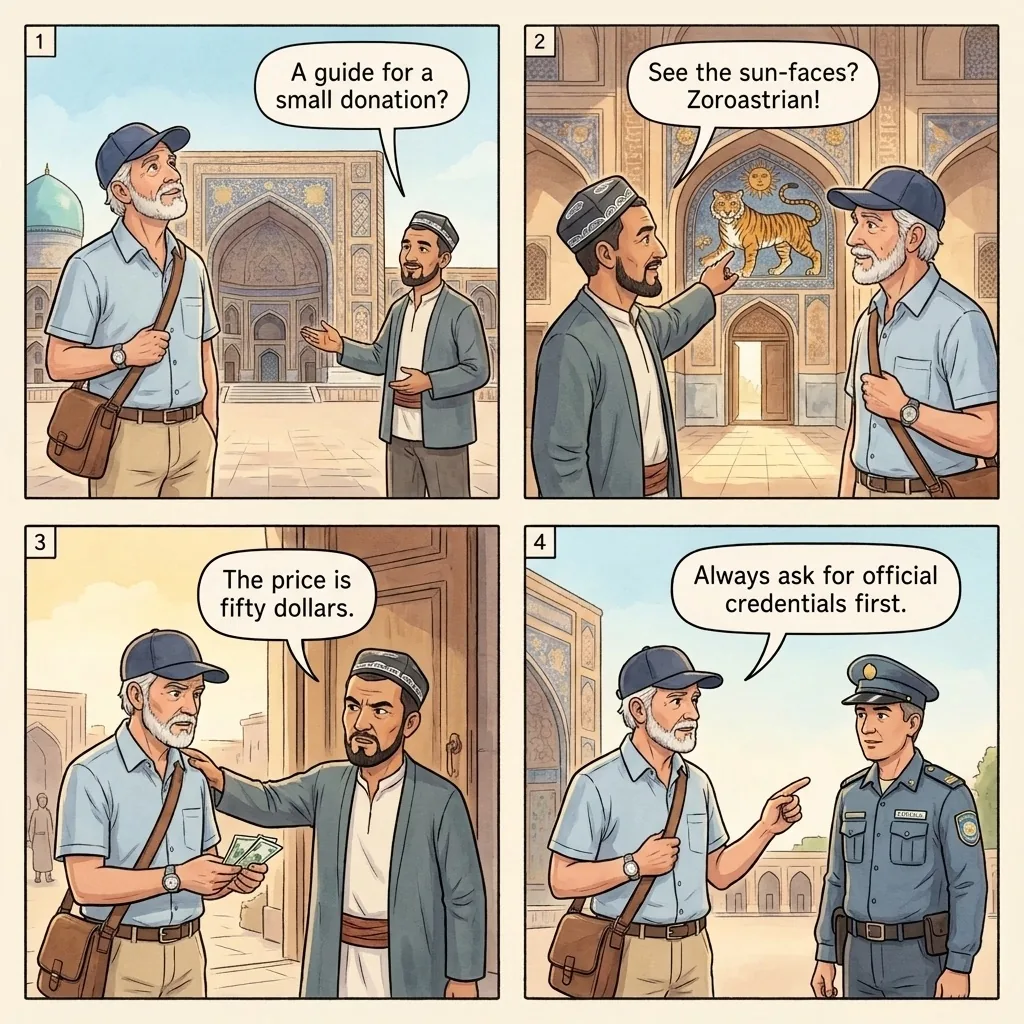
You approach the Registan — Samarkand's iconic three-madrasa complex — and a friendly local in his fifties falls into step beside you, asks where you are from, and offers to be your guide for a 'small donation.'
His English is fluent, his manner is warm, and within minutes he is sharing genuinely interesting facts about Ulugh Beg's astronomical madrasa, the symbolism of the Sher-Dor lions on the second madrasa's iwan, and the Tilya-Kori's gold-leaf interior. The information is real, the delivery is engaging, and you feel like you are learning more than a guidebook would offer. The walk takes about an hour, the photo stops are well-chosen, and you genuinely enjoy the experience.
When the tour winds down at the exit gate, he stops walking and tells you the fee is $30 — sometimes $50, sometimes more depending on his read of the day. The earlier 'small donation' framing has vanished. If you protest or offer less, his tone shifts and he positions himself between you and the exit, claiming you agreed to a specific price earlier. Some unofficial guides also steer the route through specific souvenir shops where they earn 10–25% commission on any purchase, double-dipping on the take.
The Registan unofficial-guide shakedown is documented across Reddit, the long-running TripAdvisor Samarkand forum, and the Uzbek Tourism Authority's consumer-protection materials. Samarkand has official Tourist Police at major sites and licensed guides operating through the Uzbektourism credentialing system, but the unofficial guides operate just outside the police line of sight. The pattern is most consistent during high season (April-June, September-October) when tourist density makes interception easy.
Real licensed Samarkand guides wear visible Uzbektourism badges with photo ID and license numbers, can be booked through your hotel or through the Uzbektourism office near the Registan, and quote in Uzbek soum with written contracts. The going rate is roughly 200,000–400,000 UZS ($16–32) for a two-hour Registan tour, comparable to or below what the unofficial guides extract — but with no shakedown at the end.
Hire only licensed Uzbektourism guides booked through your hotel or the Uzbektourism office near the Registan — they wear visible photo ID badges and provide written contracts in advance. Agree on the exact price in soum (not USD) before any tour starts. The Registan also has an excellent free audio guide bookable at the entrance kiosk; a self-guided visit with a good guidebook (Lonely Planet Central Asia) is also a fine option. Approach the Tourist Police at the Registan if you feel pressured. Pay only after the tour is complete and only the agreed amount.
Red Flags
- Unsolicited guide approaching at the entrance without official badge
- Vague language about payment -- 'small donation' or 'whatever you want'
- Tour ending at a specific shop or with blocking behavior
- No visible Tourist Police badge or Uzbektourism credential
- Guide positioning between you and the exit when discussing payment
How to Avoid
- Hire licensed guides wearing official Uzbektourism badges.
- Agree on the exact price before the tour starts -- in writing if needed.
- Approach the Tourist Police at Registan if you feel pressured.
- Pay only after the tour is complete and you're satisfied.
- Explore with a guidebook or audio guide from your hotel instead.
Like what you're reading? Get a full Samarkand itinerary with safety tips built in.
Browse travel-safety books →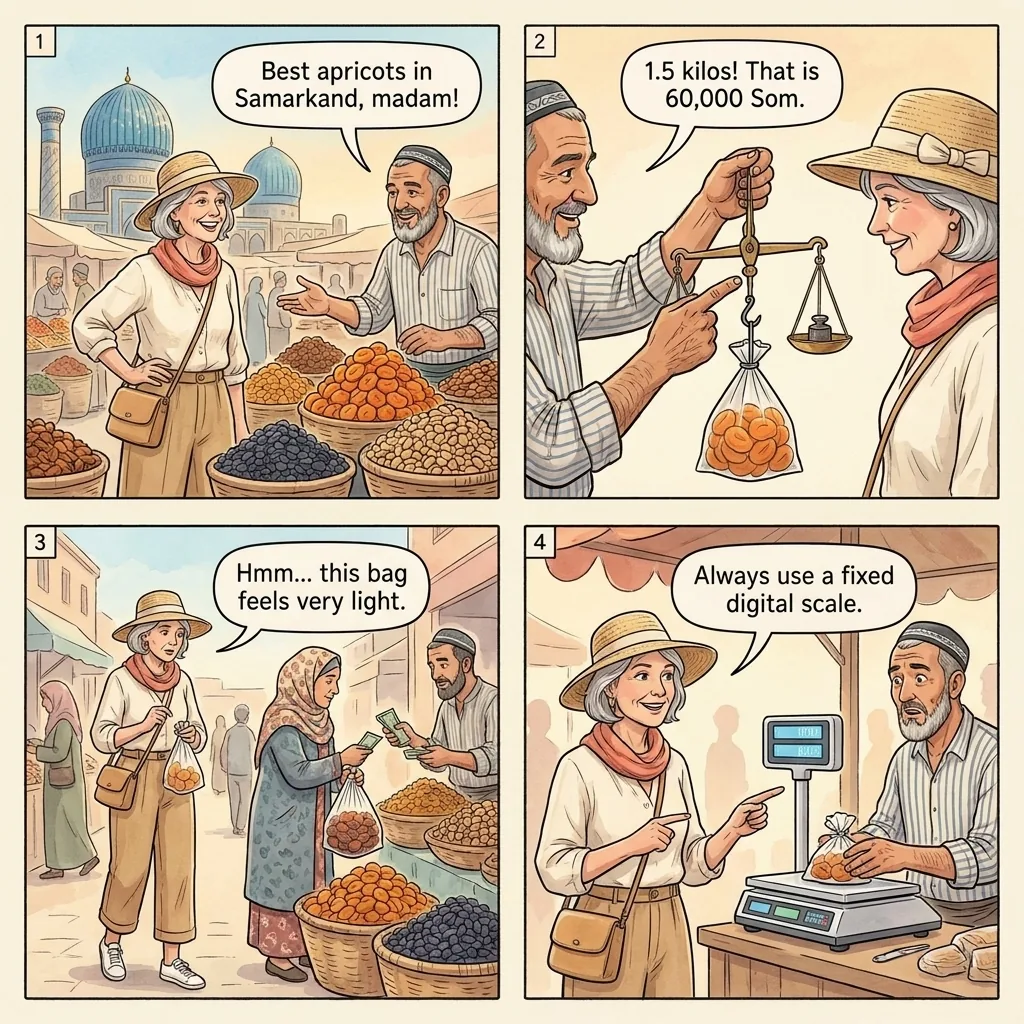
You wander into Siab Bazaar — the legendary market next to Bibi-Khanym Mosque — looking for Samarkand's famous non bread, dried apricots, and tea, and the air is rich with the smell of saffron and warm bread.
A vendor in the souvenir section calls you over to admire embroidered suzani textiles and small ceramic pieces. He glances at you, takes you in for half a second, and quotes 200,000 UZS for a small ceramic plate. The price feels high but plausible for handmade work, and you nod. What you do not see is that the same vendor sold an identical plate to a Samarkand grandmother an hour earlier for 70,000 UZS — the price was set the moment you opened your mouth in a foreign accent.
In the dried-fruit aisles, vendors run a different play. They weigh your purchase on a small handheld scale that may or may not be calibrated, and after you agree on a price per kilo (say 40,000 UZS/kg for dried apricots), they add extra weight by pressing a finger discreetly on the scale or tilting the platform during the count. A 1-kg bag becomes a 1.4-kg bag, the price per kilo applies, and the math nominally works out — except the scale was wrong.
The Siab Bazaar tourist-price pattern is documented across Reddit, the long-running TripAdvisor Samarkand forum, and most updated guidebooks. The covered souvenir section near the Bibi-Khanym entrance is the densest concentration of inflated quotes; the dried-fruit aisles in the open-air section are the densest concentration of scale tricks. The food side of the bazaar (fresh non bread, vegetables, prepared food) is generally fairly priced because locals shop there too.
A second issue is the verbal-quote-vs-haggle dynamic. Bargaining is the expected norm at Siab Bazaar — the seller assumes you will counter, and a flat 'no thank you' followed by walking away is the most reliable way to compress the price. Tourists who pay the first quoted price are not being scammed in a strict sense; they are paying the inexperienced-tourist tier of a multi-tier pricing system.
Always counter-offer at one-third of the first quoted price at Siab Bazaar souvenir stalls, and walk away if the vendor refuses to negotiate — the price almost always drops sharply as you walk. Watch the scale carefully in the dried-fruit aisles; ask the vendor to zero it before weighing, and bring your own small bag so they cannot add unwanted items. Compare prices at three vendors before buying anything significant. For non bread and fresh food, the prices are mostly fair already. If a scale gives obviously wrong readings, walk to a different vendor; reporting it rarely produces results.
Red Flags
- Prices quoted without you asking -- vendors calling out to you
- Scales that seem to jump or give inconsistent readings
- First price quoted with no expectation of haggling
- Vendor adding items to your bag before you agree
- Products identical to what you can find cheaper in non-tourist shops
How to Avoid
- Offer one-third of the first quoted price and negotiate from there.
- Watch the scale carefully -- ask them to zero it before weighing.
- Buy non bread and fresh items from the local food section, not the tourist side.
- Compare prices with at least three vendors before buying.
- Bring your own small bag so vendors can't add unwanted items.
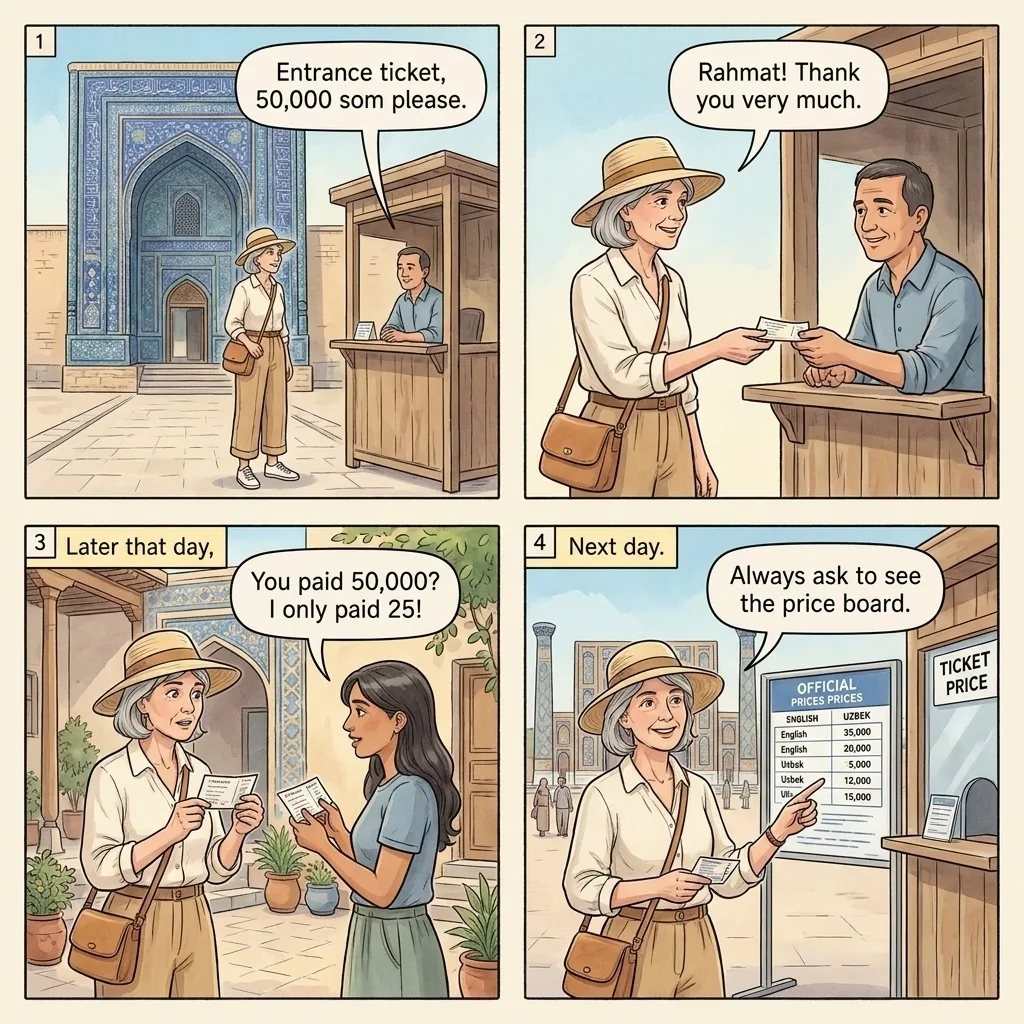
You approach the entrance to Shah-i-Zinda — Samarkand's avenue of mausoleums covered in cobalt-blue tile — and the ticket seller at the small wooden booth charges you 50,000 UZS for entry.
You pay, take the small printed ticket, and walk through the gate. Later that afternoon, talking to another traveler at your guesthouse, you discover she paid 25,000 UZS at the same site that morning — half what you paid. The ticket seller had quoted her 25,000 directly when she stood at the booth; he quoted you 50,000 with the same casual confidence and the same printed ticket.
Entrance staff at some Samarkand attractions have been documented charging tourists different amounts depending on how informed they look, what they are wearing, and how the conversation opens. The flexibility runs in both directions — one TripAdvisor poster reported being charged 10,000 UZS per person at a small site while watching another tourist pay 25,000 the same hour. The inconsistency is partly a function of poorly posted prices and partly a function of staff using their judgment about what tourists will accept.
The pattern is documented across Reddit, the TripAdvisor Samarkand forum, and the Uzbekistan Tourism Authority's consumer-protection page. Major heritage sites like the Registan have clearly posted official prices (50,000 UZS for foreigners as of 2026), and these are consistent. Smaller sites — Bibi-Khanym Mosque, Shah-i-Zinda, the Ulugh Beg Observatory, Gur-e-Amir, the Konigil paper mill — have less consistent enforcement, and the cashier may quote whatever they think will work.
A second variation involves printing tickets from a counter that does not match the official rate. Some sites have a 'foreigner' surcharge that is technically legal under Uzbek heritage policy but the magnitude of the surcharge varies; others have no posted differential and the staff invent one. Asking for a printed ticket every time is the simplest defense.
Research entrance fees on recent travel blogs (Caravanistan, Uzbekistan Travel forums, Reddit) before visiting each Samarkand site so you have a reference price. Always ask to see the official price list at the booth before paying, and demand a printed ticket or receipt for every payment. Use the Registan's posted 50,000 UZS as a benchmark for major sites; smaller sites should run 10,000–30,000 UZS. Ask your hotel reception for current entrance fees the morning of your visit. If you are clearly overcharged, ask for the supervisor; the price often drops.
Red Flags
- No clearly posted price list at the entrance
- Ticket price quoted verbally rather than shown on a board
- Different prices charged to different visitors
- No printed ticket or receipt for your payment
- Cashier asking where you're from before quoting a price
How to Avoid
- Research entrance fees on recent travel blogs before visiting each site.
- Ask to see the official price list before paying.
- Request a printed ticket or receipt for every payment.
- The Registan entrance is officially 50,000 UZS -- use that as a benchmark.
- Ask your hotel reception for current entrance fees to plan your budget.
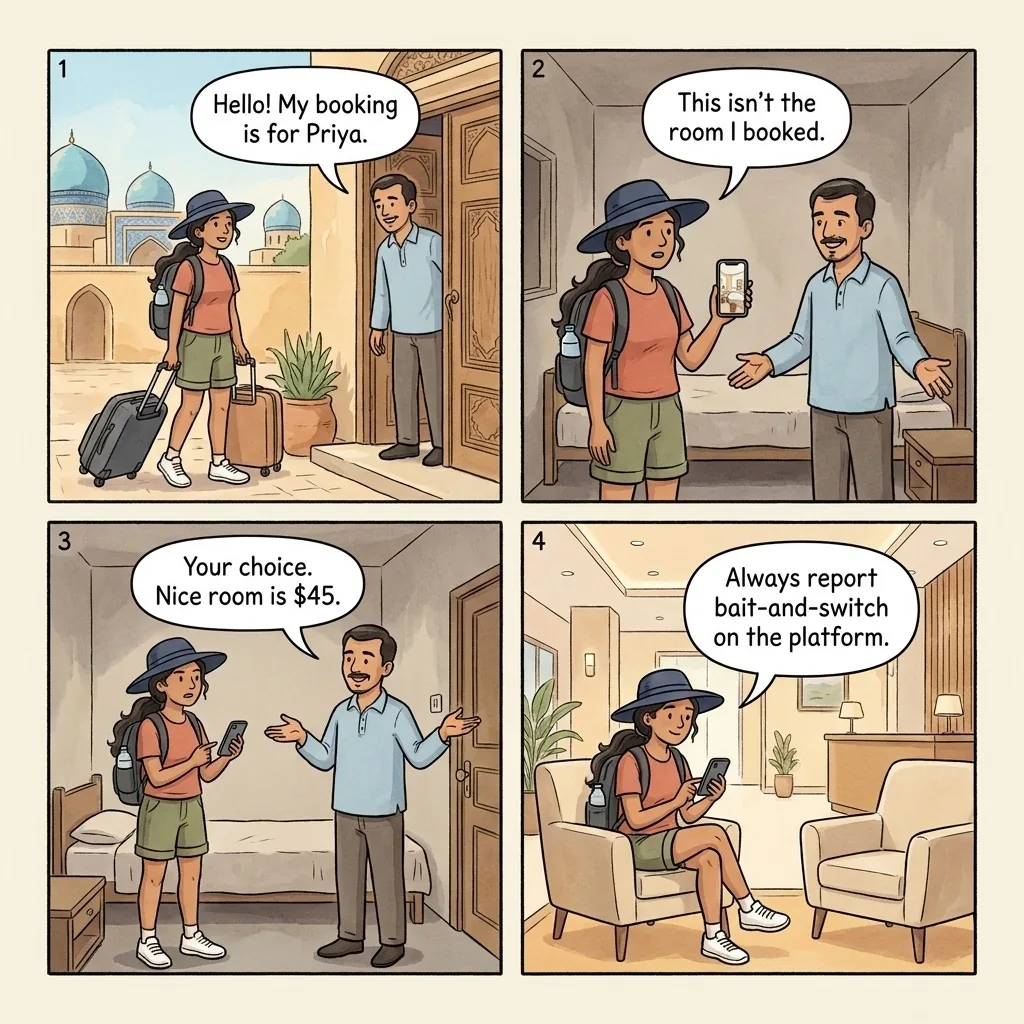
You book a charming Samarkand guesthouse on Booking.com a month before your trip — $25 per night, photos of a cosy courtyard with a wooden chaikhana platform, glowing reviews about the host's hospitality.
When you arrive after the train from Tashkent, the host welcomes you warmly and shows you to a room that looks nothing like the photos. The room is smaller, dirtier, has no air conditioning despite the listing promising it, and the bathroom is shared rather than private. The host explains that the 'nice room' you saw in the listing is currently taken by another guest, and offers you this room at the same price — or, alternatively, a 'proper' room with the listing's amenities for $45 per night.
If you refuse and insist on the room you booked, the host shrugs and says the booking can be canceled. You are now stranded in Samarkand at 8 p.m. with no accommodation. Most travelers cave and either accept the substandard room at the original price or upgrade for the additional $20/night, paying $200 over a 10-night stay rather than the $250 they originally budgeted.
Some Samarkand guesthouses also demand cash payment in USD and threaten to cancel the Booking.com reservation if you insist on paying through the platform. The cash-only demand circumvents Booking.com's chargeback protection and the platform's review-flagging system, since cash payments do not generate platform records the company can act on.
The Samarkand guesthouse bait-and-switch pattern is documented across Reddit, the long-running TripAdvisor Samarkand forum, and Booking.com's review section. The pattern affects budget guesthouses near the Registan disproportionately, where small operators have less to lose from the occasional bad review. Major branded hotels (Hilton Samarkand, Silk Road by Minyoun, Bibikhanim Hotel) operate properly through booking platforms with photo-accurate listings.
Book Samarkand accommodation through platforms with free cancellation (Booking.com Genius rates, Airbnb with flexible cancellation) so you can walk away from a bait-and-switch. Read the most recent reviews carefully, not just the overall rating; specific complaints about photos-versus-reality and cash demands signal the bait-and-switch pattern. Message the host the day before to reconfirm your exact room. Pay through the booking platform only — never agree to cash-only demands. Have a backup hotel identified in case of a problem. If you arrive and the room does not match the listing, photograph everything, refuse to upgrade, and dispute via Booking.com or Airbnb's customer service.
Red Flags
- Room doesn't match the listing photos at all
- Owner claims the booked room is 'unavailable' upon arrival
- Pressure to upgrade to a more expensive room on the spot
- Demand for cash payment instead of through the booking platform
- Threat to cancel your reservation if you don't comply
How to Avoid
- Book through platforms with free cancellation so you can walk away.
- Read the most recent reviews, not just the overall rating.
- Message the hotel the day before to reconfirm your exact room.
- Have a backup accommodation option identified in case of bait-and-switch.
- Pay through the platform only -- never agree to cash-only demands.
🆘 What to Do If You Get Scammed
📋 File a Police Report
Go to the nearest Uzbekistan Police (Militsiya) station. Call 102 (Police) or 101 (Fire) or 103 (Ambulance). Get an official crime report — you'll need this for insurance claims. You can also report online at iiv.uz.
💳 Cancel Your Cards
Call your bank immediately. Most have 24/7 numbers on the back of the card (keep a photo saved separately). Block any suspicious transactions before the thieves use your details.
🛂 Lost Passport?
Contact the US Embassy in Tashkent at 3 Moyqorghon Street, Tashkent 100093. For emergencies: +998 78-120-5450.
📱 Track Your Device
If your phone was stolen, use Find My (iPhone) or Find My Device (Android) from another device. Don't confront thieves yourself — share the location with police instead.
Frequently Asked Questions
You just read 6 scams in Samarkand. The full Travel Safety Series has 780+ more across 20+ countries.
Tokyo's Kabukichō ¥130,000 bar trap. Rome's gladiator photo extortion. Paris's gold-ring trick. Bali's ATM skimmer scams. Bangkok's grand-palace closure ruse. Every documented scam across 20+ destinations — with the exact scripts, red flags, and local-language phrases that shut each one down. Drawn from Reddit traveler reports, embassy advisories, and consumer-protection cases.
- 780+ documented scams across Tokyo, Rome, Paris, Bali, Bangkok, Rio & 100+ more cities
- 20+ countries covered, with country-by-country phrase cards for every destination
- Updated annually — buy once, re-download future editions free
- All titles $4.99 each on Amazon Kindle