
Key Takeaways
- The #1 reported scam is the Tashkent Airport Taxi-Tout Mob.
- Most scams in Tashkent are low-to-medium risk.
- Use app-based ride services (Uber, Bolt) or official metered taxis instead of unmarked vehicles.
- Never accept unsolicited offers from strangers near tourist sites in Tashkent.
⚡ Quick Safety Tips
- Keep phones and valuables in secure pockets when in crowded areas.
- Use only licensed taxis or app-based ride services.
- Book tours and tickets through verified operators with online reviews.
- Keep a copy of your passport separate from the original.
Jump to a Scam
The 6 Scams
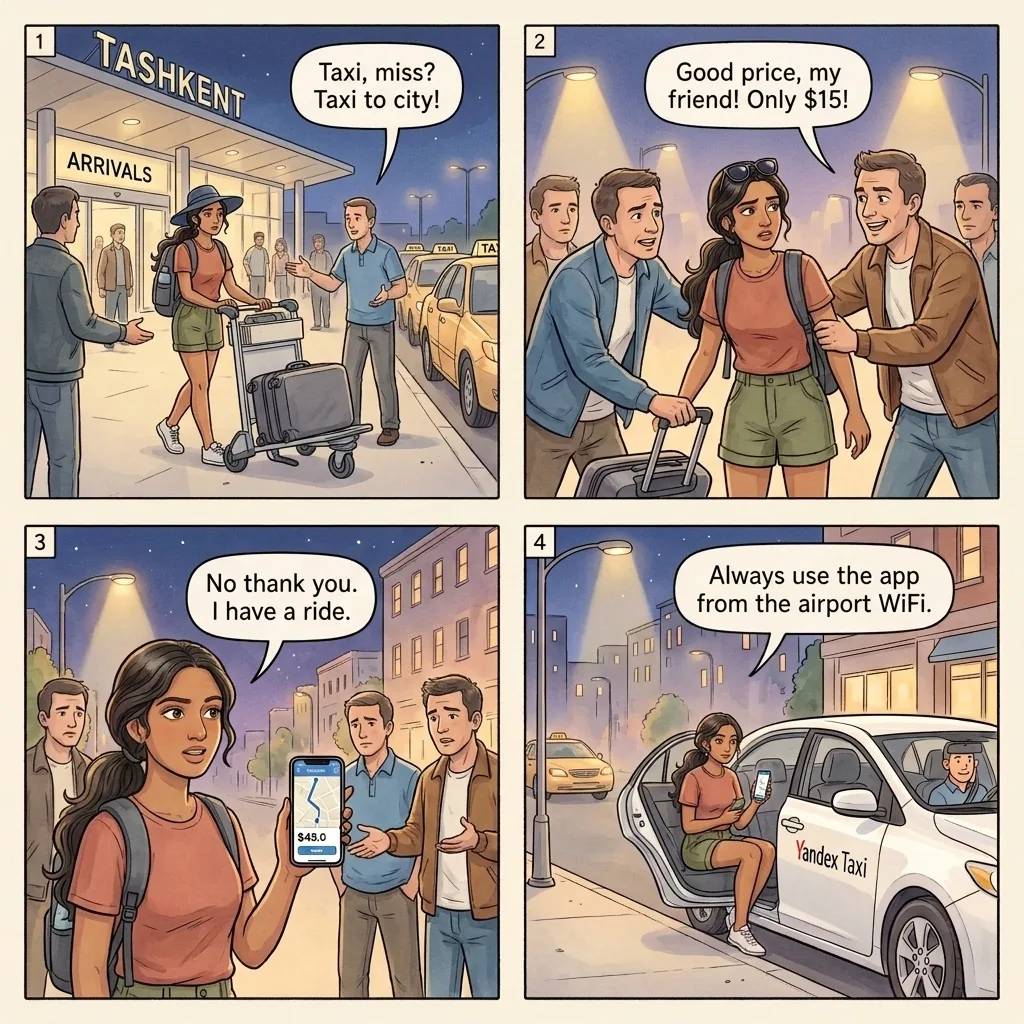
You walk out of Tashkent Airport arrivals at midnight after a long flight and are immediately swarmed by six or seven men shouting 'taxi, taxi, my friend, taxi to city.'
They follow you across the arrivals hall, two of them flanking you, one reaching for the handle of your suitcase, another holding up a hand and quoting $15 for the five-kilometer ride to the city center. Their English is enough for the pitch but not for negotiation. The mob is loud, physically close, and calibrated to break first-time-arrival composure. The legitimate fare for the same ride runs about 30,000–40,000 soum (roughly $2.50–3.50) through Yandex Taxi, which means the $15 quote is roughly five times the local rate.
If you protest or try to walk past, the chase continues into the parking lot. They drop the price progressively — $15 to $10 to $7 to $5 — but the floor never reaches the actual Yandex rate. Travelers documented at The Foodie Nomad and across Reddit describe being followed across the entire parking area until their pre-booked driver arrived. The persistence is the play; the goal is to wear you down before you reach the proper taxi options.
The real fix is to skip every interaction with the airport touts entirely. Yandex Taxi works on the Tashkent airport Wi-Fi, the app shows the fare upfront in soum, and pickup happens at a labeled zone in the parking lot a short walk from the terminal. MyTaxi (a smaller local app) operates similarly. Both have driver ratings and GPS tracking. The Uzbektourism desk in the arrivals hall will also call a fair-rate licensed cab for you on request — they speak English and are accountable.
A second variation runs at the train stations (Tashkent's Yuzhny and Severny stations) where the same script runs at lower stakes — quotes of 100,000–150,000 soum for what should be 30,000-soum rides. The Tashkent Metro is also extremely cheap (1,400 soum per ride) and has stops near most major hotels, removing the airport-taxi conversation entirely on subsequent days.
Download Yandex Taxi (or MyTaxi) before landing in Tashkent and order from inside the terminal — the airport-to-city ride is roughly 30,000 soum fixed in the app. Walk past every tout in arrivals without making eye contact; do not let anyone touch your luggage. If Yandex is unavailable, use the Uzbektourism desk in the arrivals hall to call a fair-rate cab. Quote prices in soum, never USD, and refuse any 'official rate' framing from a tout. If a tout becomes aggressive, dial 102 (Uzbek police) or report to airport security at the information desk.
Red Flags
- Multiple drivers aggressively competing for your attention at arrivals
- Quoted price in US dollars rather than Uzbek soum
- Driver grabbing your luggage without permission
- No visible taxi license or meter in the vehicle
- Refusal to use the Yandex or MyTaxi app
How to Avoid
- Download Yandex Taxi or MyTaxi before landing and order from inside the terminal.
- Visit the Uzbektourism desk in the arrivals hall -- they'll call a fair taxi.
- Walk past the taxi crowd to the main road and hail a regular cab.
- Never let anyone grab your luggage -- it creates obligation.
- Know the real rate: airport to city center should be 25,000-40,000 UZS.
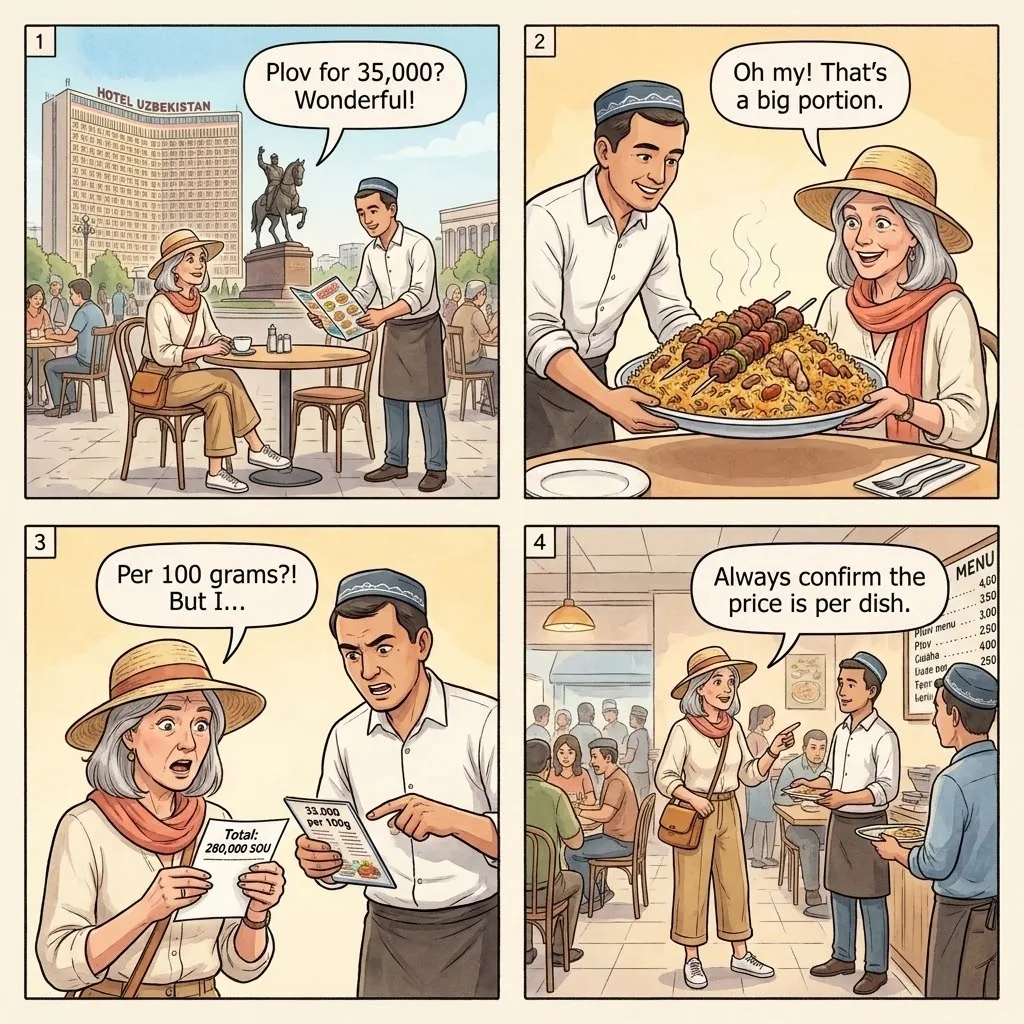
You sit down at a restaurant near Amir Timur Square in central Tashkent and order plov (the national rice dish), shashlik (grilled meat skewers), and a non-alcoholic drink from a menu with clearly marked prices.
The plov is listed at 35,000 soum, the shashlik at 25,000 per skewer, and the drink at 8,000. You expect a bill around 100,000 soum. The food arrives quickly, the portions look generous, and you eat. When the bill comes, it is 280,000 soum — almost three times what you expected. The waiter shrugs and points at a small line on the menu next to the plov: '500g — 35,000 soum per 100g.'
The plov was priced per 100 grams, not per portion. Your serving was 500 grams (175,000 soum). The shashlik you ordered was 'large' (50,000 each). A service charge of 10% has been added. The drink was the 'special' price, not the menu price. None of these were explained at the table; the menu format was deliberately calibrated to obscure the actual cost of a normal meal.
The per-100g menu trick and the related 'service charge' and 'tourist menu' patterns are documented across Reddit, the long-running TripAdvisor Tashkent forum, and Lonely Planet's Uzbekistan guide. The pattern concentrates in the restaurants directly facing Amir Timur Square, the strip along Broadway (Sayilgoh Street), and the cluster near Hotel Uzbekistan that depend on one-time tourist traffic. Authentic Uzbek restaurants frequented by locals (Plov Center on Iftikhor, Caravan, Beshqozon Plov Markazi) post prices clearly per portion and do not run the per-gram trick.
A second variation involves the change. Some waiters return change in a confusing combination of small bills and ten or twenty thousand soum notes that look similar to a non-Uzbek eye, hoping the count fails. Always count change at the table. The soum has multiple banknote denominations (1,000, 5,000, 10,000, 20,000, 50,000, 100,000) that look broadly similar in their orange-pink-blue scheme, and a fast wave of bills can hide a 50,000-soum short.
Confirm the total price for any dish before ordering — ask 'how much for one full serving?' and watch out for per-100g pricing on plov, shashlik, and salads. Eat where locals eat: Plov Center on Iftikhor (the iconic local plov canteen), Caravan, Beshqozon Plov Markazi, and Khan Atlas. Use Google Translate's camera mode on Uzbek-language menus where prices are typically lower than the English versions. Count every bill of your change at the table before stepping away. If a restaurant adds undisclosed surcharges, dispute the bill at the table or via your card issuer.
Red Flags
- Menu prices listed per 100g rather than per serving
- No prices on the menu at all -- or a 'tourist menu' vs local menu
- Bill includes undisclosed service charge or table fee
- Waiter claims prices changed 'today' or portion was 'premium'
- Incorrect change returned, always in the restaurant's favor
How to Avoid
- Confirm the total price before ordering -- ask 'how much for one full serving?'
- Watch for per-100g pricing and calculate the full portion cost.
- Count your change carefully at the table.
- Eat where locals eat, away from the main tourist strips.
- Use Google Translate to read Uzbek-language menus for real prices.
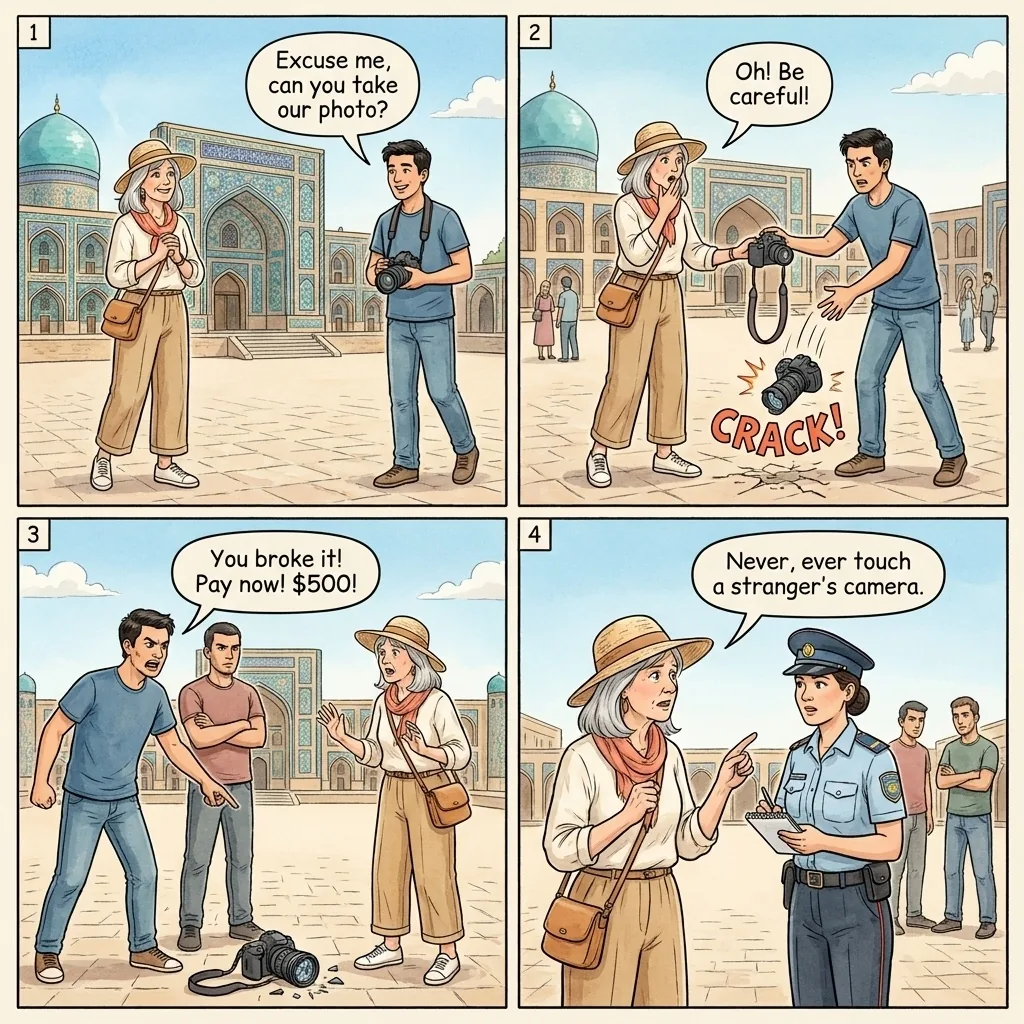
A friendly local at the Khast Imam Complex approaches you with what looks like a chunky DSLR around his neck and asks in pleasant English if you would take a photo of him and his cousin with the Hazrati Imam Mosque in the background.
It is a normal request and they look like normal travelers. He hands the camera over carefully, you frame the shot, click, and hold the camera out to give it back. As his hand closes around the strap, something fumbles between you. The camera tips, slips, and either you drop it onto the courtyard tiles or — more often — he steps back at the wrong moment and lets it fall. The lens cracks audibly on the stone.
His tone changes immediately. The camera, he says, was professional gear — $400, $600, sometimes more — and he needs you to pay for the damage right now, in cash, ideally USD. His cousin echoes him. A second 'witness' may appear from a few meters away to confirm that you dropped it. The camera body looks expensive enough to be plausible, and the broken lens is real, and your instinct is to apologize and reach for your wallet.
The camera is a key prop. The body is often a cheap older DSLR purchased for $30 at a market, the lens was already cracked or stuck on a broken model, and the entire 'drop' is choreographed. World Nomads, the long-running TripAdvisor Uzbekistan forum, and Reddit all document the pattern at Tashkent's major photo-worthy landmarks — Khast Imam, the TV Tower area, Minor Mosque, and the courtyard at Hazrati Imam are the consistent hotspots. The same pattern runs in Samarkand, Bukhara, and across the wider Central Asian tourist circuit.
A second variation skips the camera entirely. A 'tourist' bumps into you at the steps near Independence Square, claims you broke their phone or sunglasses, and demands cash. The pattern is the same: a contrived collision, a fragile prop, a calm but firm demand for immediate payment, and a 'witness' to back the story. Real travelers who break their own gear shrug and move on; the demand for immediate cash is the signature of the scam.
Politely decline to handle strangers' camera or phone equipment at Khast Imam, the TV Tower, or any tourist landmark in Tashkent — say 'sorry, my hands are full' and keep walking. If you do agree, hand the device back carefully with both hands and inspect it visually before letting go. If you are pressured after a contrived 'drop,' do not pay; refuse the demand, walk to a public area with crowds, and call the Tourist Police or dial 102. Photograph the 'damaged' equipment, the people involved, and any 'witnesses' before leaving — real victims welcome police; scammers melt away.
Red Flags
- Stranger asks you specifically to take their photo at a tourist site
- Deliberately awkward handoff when returning the device
- Immediate demand for cash compensation
- Pre-existing crack visible on close inspection
- Accomplice nearby who 'witnessed' the drop and backs up the claim
How to Avoid
- Politely decline photo requests from strangers at tourist sites.
- If you do take a photo, hand the device back carefully with both hands.
- Inspect the device before accepting it -- note any existing damage.
- Walk away if damage is claimed -- you have no legal obligation.
- If confronted, offer to resolve it at the nearest tourist police station.
Like what you're reading? Get a full Tashkent itinerary with safety tips built in.
Browse travel-safety books →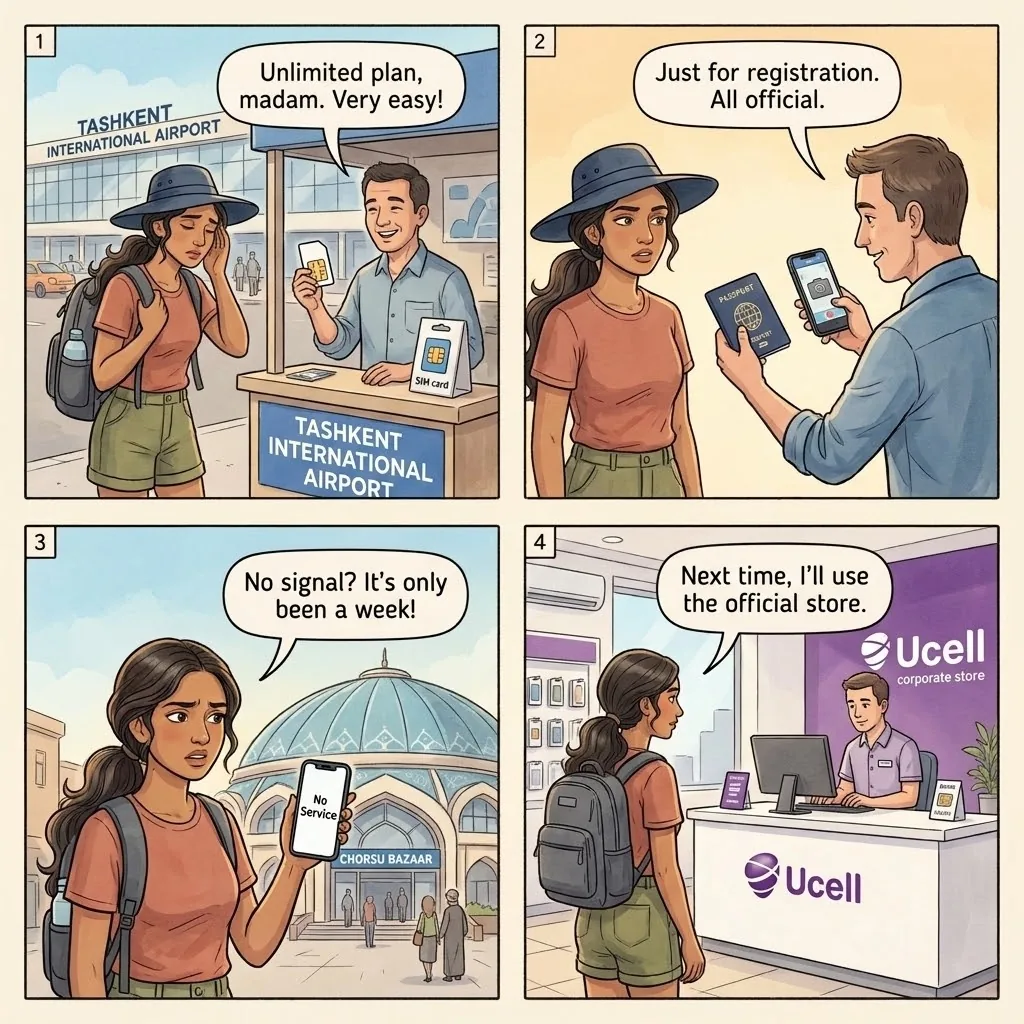
You buy a local SIM card from a small kiosk near Tashkent Airport on arrival, the vendor quotes 50,000 soum (about $4) for a 'monthly unlimited' plan, and you hand over your passport for the registration.
The vendor takes a quick photo of your passport with his phone, slots in the SIM for you, runs a brief test call, and sends you on your way. The data works, you can call hotels, you message friends. The transaction took five minutes and felt entirely normal. Over the next several days you use the SIM without issue, navigating Yandex maps, posting photos, calling restaurants for reservations.
A week into the trip, the SIM stops working entirely — no signal, no data, no calls. When you try to top up at a different kiosk, the staff tell you the SIM has been deactivated by the carrier (Ucell, Beeline, or Mobiuz) because the registration was never properly completed. The vendor at the airport never actually filed your passport details with the network; he simply photographed your passport for show, sold you a SIM that was already on borrowed time, and pocketed the full price.
A worse variation involves recycled SIMs. The 'monthly unlimited' plan turns out to have only a few days remaining on a prepaid balance someone else pre-funded, and once that balance runs out the SIM goes dead with no recourse. Backpackers on Reddit and Reddit describe losing connectivity mid-trip with no way to contact the kiosk vendor — the kiosk has no name, no receipt, and no accountability.
The honest fix is structural: buy SIMs only from official carrier stores. Tashkent International Airport's arrivals hall has official Ucell, Beeline, and Mobiuz counters; central Tashkent has flagship stores on Sayilgoh Street and inside Compass shopping center. Official store SIMs cost roughly the same as kiosk SIMs (35,000–60,000 soum for a tourist data plan), but with proper passport registration, a printed receipt, and SMS confirmation that the line is active for the full plan duration.
Buy SIM cards only from official Ucell, Beeline, or Mobiuz stores in Tashkent — never from unmarked kiosks, even if they appear convenient at the airport curb or near Chorsu. The arrivals hall at TAS has official carrier counters; use those. Confirm the vendor scans your passport into the network's actual registration system (not just a phone photo), insist on a printed receipt showing plan duration and data allowance, and test the SIM before leaving the store. If a SIM stops working mid-trip, visit any official carrier store with your passport — they can sometimes re-activate or re-issue.
Red Flags
- SIM sold from an unmarked kiosk rather than an official carrier store
- Vendor doesn't scan or photocopy your passport during registration
- Price significantly below what official stores charge
- Vendor rushes the transaction without explaining the plan details
- No receipt or documentation of the plan you purchased
How to Avoid
- Buy SIM cards only from official Ucell, Beeline, or Mobiuz stores.
- The airport arrivals hall has official carrier counters -- use those.
- Ensure the vendor scans your passport and completes registration.
- Ask for a receipt showing the plan duration and data allowance.
- Test the SIM in the store before leaving to confirm it works.
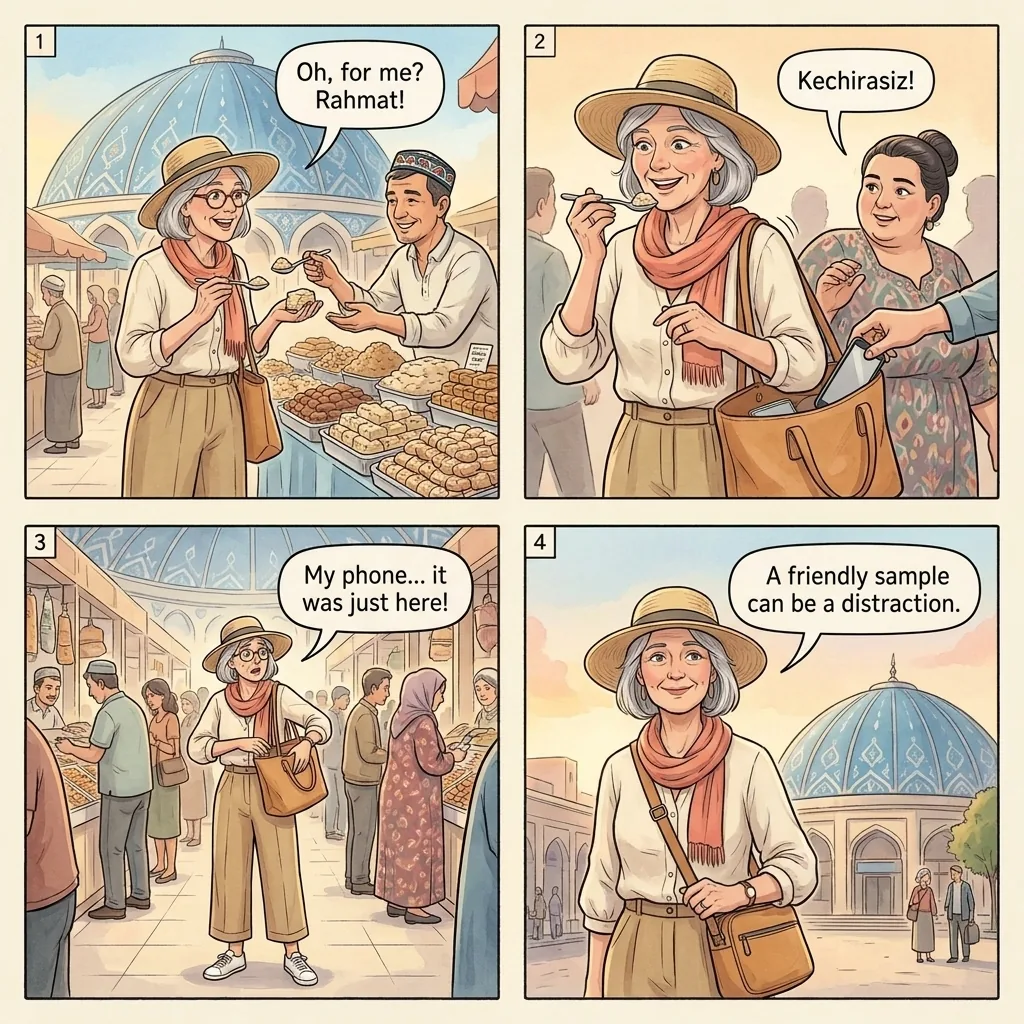
You step under the iconic blue dome of Chorsu Bazaar on a Saturday morning, the air thick with cumin and dried apricot, and the narrow aisles between vendor stalls are already packed shoulder-to-shoulder.
A spice vendor calls you over enthusiastically, scoops a fistful of dried barberries into your hand, and pours sample teas as you pass. Two stalls down, another vendor pushes a piece of halva on a wooden spoon directly into your face for a taste. The friendly chaos pulls you in — you stop, smile, sample, take photos. Behind you the aisle is shoulder-tight with shoppers and the sensory overload makes it hard to track who is close.
A heavier-set woman pushes past you in the narrow gap, mumbling 'kechirasiz' (excuse me), and the contact is firm enough to rock you forward. In the second your weight shifts, hands have been at your jacket pocket and your daypack. By the time you orient again the woman is gone into the next aisle, and so is your phone. The lift took maybe three seconds, masked by the press of a normal Saturday-bazaar crowd.
The Chorsu Bazaar pickpocket pattern is documented across Reddit, the long-running TripAdvisor Tashkent forum, and Lonely Planet's Uzbekistan guide. Travel guides note that while the bazaar is perfectly safe to visit and the vast majority of vendors are honest, organized pickpocket pairs work the densest crowded sections during peak hours (Saturday and Sunday mornings, late-afternoon weekday rush). The covered dome's spice and dried-fruit area, the clothing aisles, and the meat hall are the consistent hotspots.
The vendors are typically not part of the lift — the sample-pushing is genuine sales technique, but it creates the perfect cover by absorbing your attention. The pickpockets pair the sample distraction with a contrived bump or push, and rotate quickly between aisles to stay ahead of bazaar security. The same pattern operates at Tashkent's smaller Mirobod and Olmazor markets but at lower density.
Wear a crossbody bag on your front with a zipper at Chorsu Bazaar, and keep your wallet and phone in zipped front pockets — never back pockets, never an open jacket pocket. Visit early morning (7–9 a.m.) when the aisles are still walkable and visibility is good; by 11 a.m. on weekends the crowd density makes pickpocketing far easier. Decline aggressive sample pushes politely; the goal is to keep moving rather than stand still in a pinch point. If you are pickpocketed, dial 102 (Uzbek police) and report immediately at the bazaar's administration office near the main entrance.
Red Flags
- Unusual crowding or someone pressing against you unnecessarily
- Vendor aggressively pushing samples into your hands as a distraction
- Someone bumping into you from behind in a narrow aisle
- Children surrounding you asking questions simultaneously
- Open bags or pockets in the densely packed sections
How to Avoid
- Use a crossbody bag with zippers facing inward.
- Keep your phone in a front pocket, not back pocket or open bag.
- Be extra alert in the crowded covered dome sections.
- Don't carry more cash than you plan to spend.
- Visit early morning when the bazaar is less crowded.
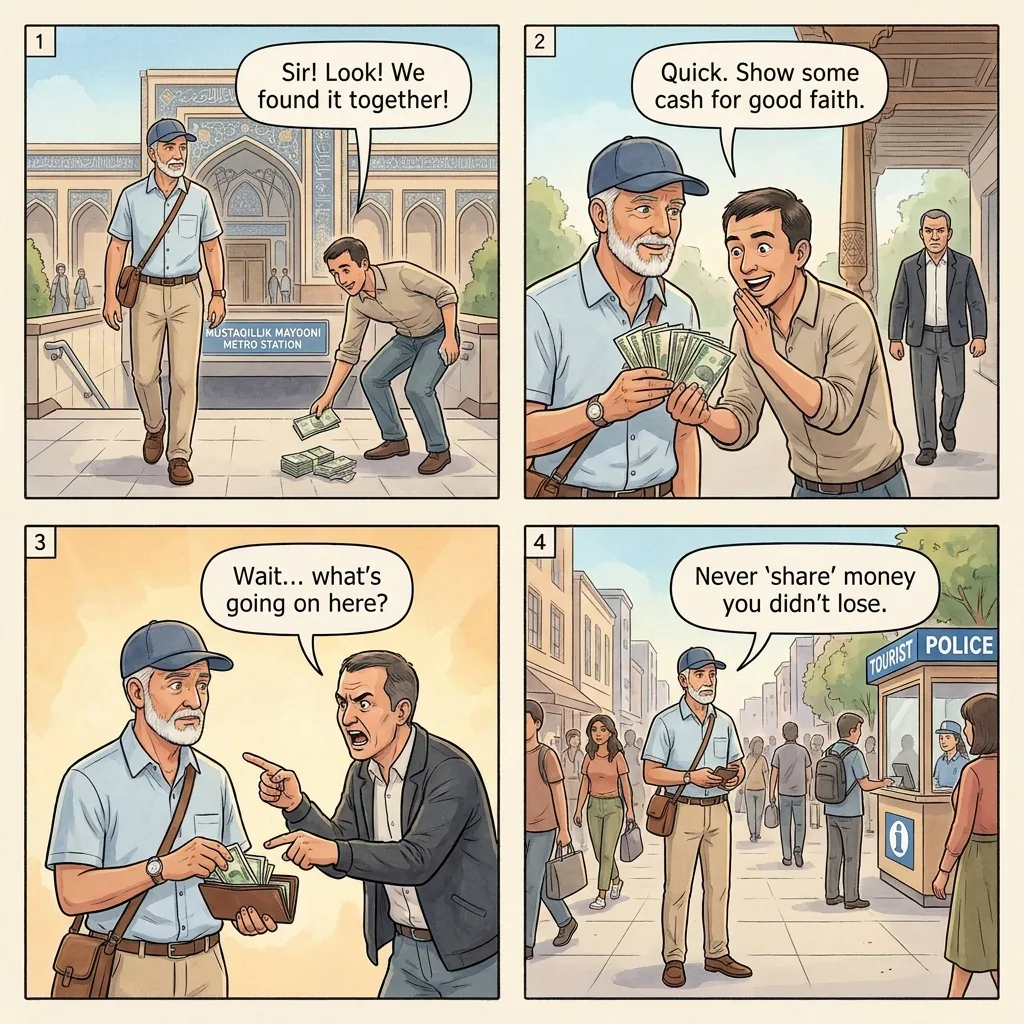
You walk out of the Mustaqillik Maydoni metro station underpass into the late-afternoon foot traffic when the man two steps ahead of you suddenly stops, bends down, and excitedly picks up what looks like a folded wad of soum notes from the pavement.
He turns to you with the cash, his face all surprise and goodwill, and gestures that you should split it — he found it together with you, after all, you must have seen it too. The notes look real, the situation looks plausible, and his pitch is fast and friendly. Before you have time to think clearly, a second man across the underpass starts walking toward you with a confused look on his face.
The first man whispers urgently that you both need to settle this quickly before someone else comes — he suggests you put up some of your own cash as a 'good faith deposit' or 'show of trust' to demonstrate you both intend to share fairly. While you reach for your wallet to humor him, the second man arrives and starts shouting in Uzbek that the money is his, that he just dropped it, and that he wants both your wallets checked.
In the ensuing confusion — you hand over a few notes from your wallet to 'prove your share,' the first man helpfully holds the 'found' cash, the second man grabs at both — and within a minute, both men have melted away. The 'found' cash was theirs to begin with (often counterfeit or short-stack), the 'deposit' you handed over is gone, and what looked like an unlikely windfall has cost you anywhere from $20 to several hundred dollars depending on how much you produced.
The Tashkent found-cash hustle is the classic 'pigeon drop' confidence trick that runs in cities worldwide, documented across Reddit, the long-running TripAdvisor Tashkent forum, and most updated guidebooks. Variants include 'I found this gold ring, want to split it' (Paris near the Eiffel Tower) and 'this dollar bill blew out of your bag, here it is' (Lima Centro). The Tashkent version concentrates near metro station underpasses where foot traffic narrows and exits are limited.
Never engage with anyone who claims to have found money or jewelry on the street in Tashkent — walk away immediately without responding, do not slow down, do not look at the cash. Never hand over your own money in any street transaction; the 'good faith deposit' framing is the universal signal of the pigeon-drop con. If someone drops money near you, ignore it — it is almost always a setup. Keep your wallet in a zipped front pocket so reaching for it feels like effort rather than reflex. If you witness the scam happening to someone else, dial 102 (Uzbek police).
Red Flags
- Stranger excitedly 'finds' money right in front of you
- Immediate suggestion to split the found cash
- Request for you to put up your own money as a deposit
- A third person conveniently appears to claim the money
- The entire scene feels rehearsed and moves very quickly
How to Avoid
- Never engage with anyone who claims to have found money.
- Walk away immediately without responding.
- Never hand over your own money in a street transaction.
- If someone drops money, ignore it -- it's always a setup.
- Report the scam to tourist police if you see it happening.
🆘 What to Do If You Get Scammed
📋 File a Police Report
Go to the nearest Uzbekistan Police (Militsiya) station. Call 102 (Police) or 101 (Fire) or 103 (Ambulance). Get an official crime report — you'll need this for insurance claims. You can also report online at iiv.uz.
💳 Cancel Your Cards
Call your bank immediately. Most have 24/7 numbers on the back of the card (keep a photo saved separately). Block any suspicious transactions before the thieves use your details.
🛂 Lost Passport?
Contact the US Embassy in Tashkent at 3 Moyqorghon Street, Tashkent 100093. For emergencies: +998 78-120-5450.
📱 Track Your Device
If your phone was stolen, use Find My (iPhone) or Find My Device (Android) from another device. Don't confront thieves yourself — share the location with police instead.
Frequently Asked Questions
You just read 6 scams in Tashkent. The full Travel Safety Series has 780+ more across 20+ countries.
Tokyo's Kabukichō ¥130,000 bar trap. Rome's gladiator photo extortion. Paris's gold-ring trick. Bali's ATM skimmer scams. Bangkok's grand-palace closure ruse. Every documented scam across 20+ destinations — with the exact scripts, red flags, and local-language phrases that shut each one down. Drawn from Reddit traveler reports, embassy advisories, and consumer-protection cases.
- 780+ documented scams across Tokyo, Rome, Paris, Bali, Bangkok, Rio & 100+ more cities
- 20+ countries covered, with country-by-country phrase cards for every destination
- Updated annually — buy once, re-download future editions free
- All titles $4.99 each on Amazon Kindle