Key Takeaways
Canberra is one of the safest Australian capitals with very low violent and property crime. The tourist-relevant financial scams are (1) ACT Cabs / taxi 'quoted price' overcharging (traveler reports 1d6875v explicitly names ACT Cabs), (2) Uber driver-coordinated fake surges during peak hours, (3) cloned Booking.com and AllHomes rental listings, and (4) AFP / Services Australia phone-impersonation scams that target visitors on working/student visas.
⚡ Quick Safety Tips
- At Canberra Airport (CBR) use Uber from the rideshare bay — traveler reports 1d6875v specifically warns about ACT Cabs 'quoted price' scams.
- For rental apartments verify the AllHomes or Booking.com listing against real addresses on Google Street View — traveler reports px0si2 documents a specific Moore St Turner scam.
- Never give personal or bank details to a caller claiming to be from the AFP, Services Australia or the ATO — the AFP has issued public warnings.
- Canberra's free intra-city Blue City bus route circulates the parliamentary triangle — use it rather than taking short taxi runs.
- At the National Gallery, Parliament House and War Memorial — all entry is free; anyone asking for a 'ticket fee' is scamming.
- If offered 'official Parliament House tour tickets' outside the building, ignore — free daily tours are booked at aph.gov.au.
Jump to a Scam
- High ACT Cabs / EzyCab 'Quoted Price' Overcharge
- High Fake Booking.com / AllHomes Rental Listing
- Medium Canberra Airport Uber Surge-Cartel Squeeze
- High AFP / Services Australia / ATO Phone Impersonation Scam
- Low Parliament House / 'Official Tour' Ticket Scam
- Low Canberra Charity Door-Knocker & Street Solicitor Pressure
The 6 Scams
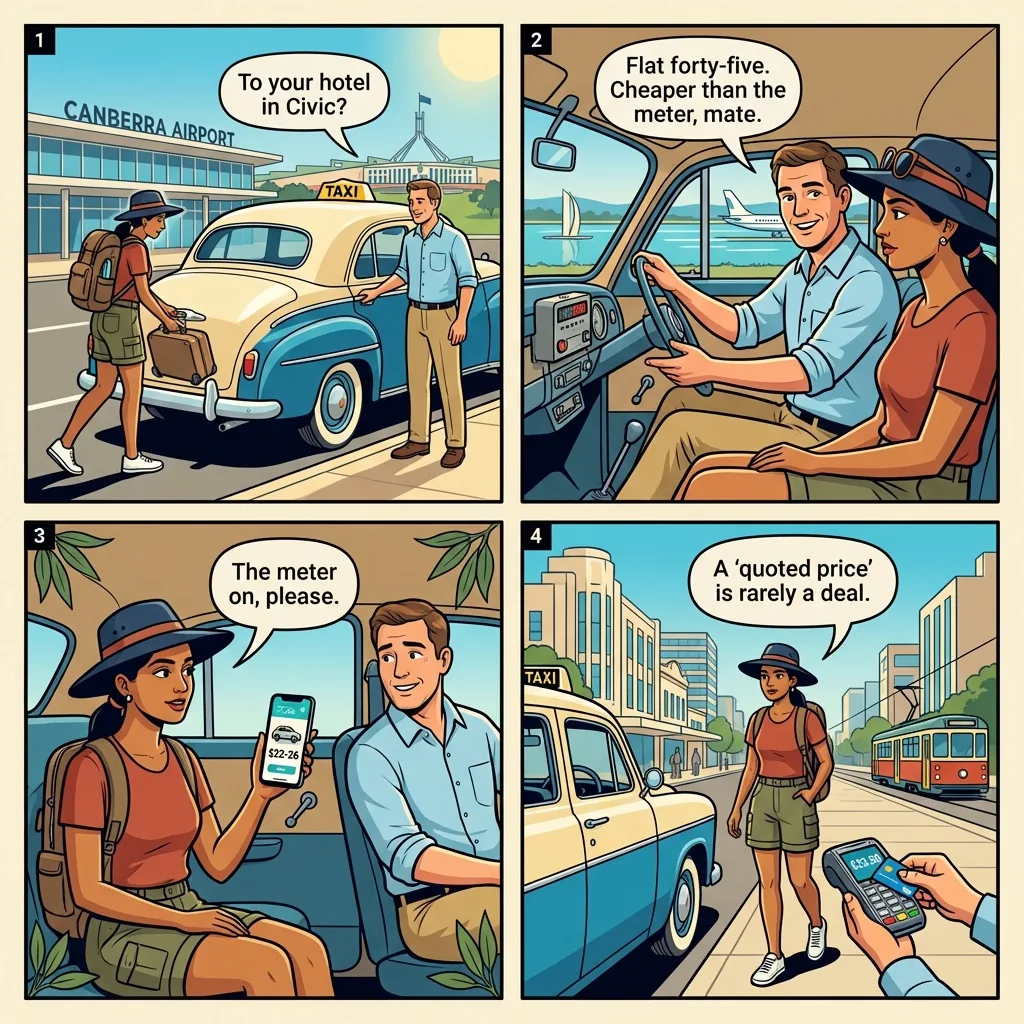
ACT Cabs and EzyCab drivers at Canberra Airport and CBD ranks quote flat rates of $40–$55 for rides where the legal metered fare is $18–$28 — the 'quoted price' is framed as transparency but is a structured overcharge targeting visitors unfamiliar with Canberra's distances.
Canberra Airport (CBR) is 7 km from Civic, a direct run on Airport Drive and Northbourne Avenue with no tolls and minimal traffic at most hours. The legitimate metered fare from CBR to a central Civic hotel is $18–$28. At the taxi rank, drivers approach new arrivals and quote a flat rate before the passenger can gauge the journey length — $40–$55 is the typical opening quote, pitched as a 'convenience' that saves watching the meter. The quote is timed for when the visitor has luggage and just wants to get moving.
If the visitor accepts — 'sure, sounds fine' — the overcharge is locked in before the engine starts. The driver has secured 50–100% above the metered fare as a matter of consent. If the visitor discovers the real fare later from a hotel concierge or the Uber app, there is no recourse. In ACT, licensed taxi drivers are legally required to run the meter on passenger demand — but most visitors don't know this and don't ask before agreeing to a quoted price.
Use Uber from the CBR rideshare bay — the app displays the fixed upfront fare of $18–$28 to Civic — or take Transport Canberra's Route 3 bus for $5 — if you must use a taxi, say 'turn the meter on please' before the car moves, confirm it is running, and pay by card on the in-car terminal.
Red Flags
- Driver offers a 'quoted price' or 'flat rate' above the legal metered fare
- Driver claims 'the meter is broken' or 'it's cheaper flat'
- Cash-only demand with card reader 'not working'
- Flat rate quoted over $35 for a CBD-Civic run from CBR
- Driver gets irritable when you ask to run the meter — that's your cue
How to Avoid
- Use Uber from CBR rideshare bay — typical Civic fare $18–$28.
- Take Route 3 Transport Canberra bus ($5) — tourist-proof fixed fare.
- Insist on metered fare — 'turn the meter on please'.
- Pay by card on the in-car terminal only.
- Report bad drivers via transport.act.gov.au with plate number.
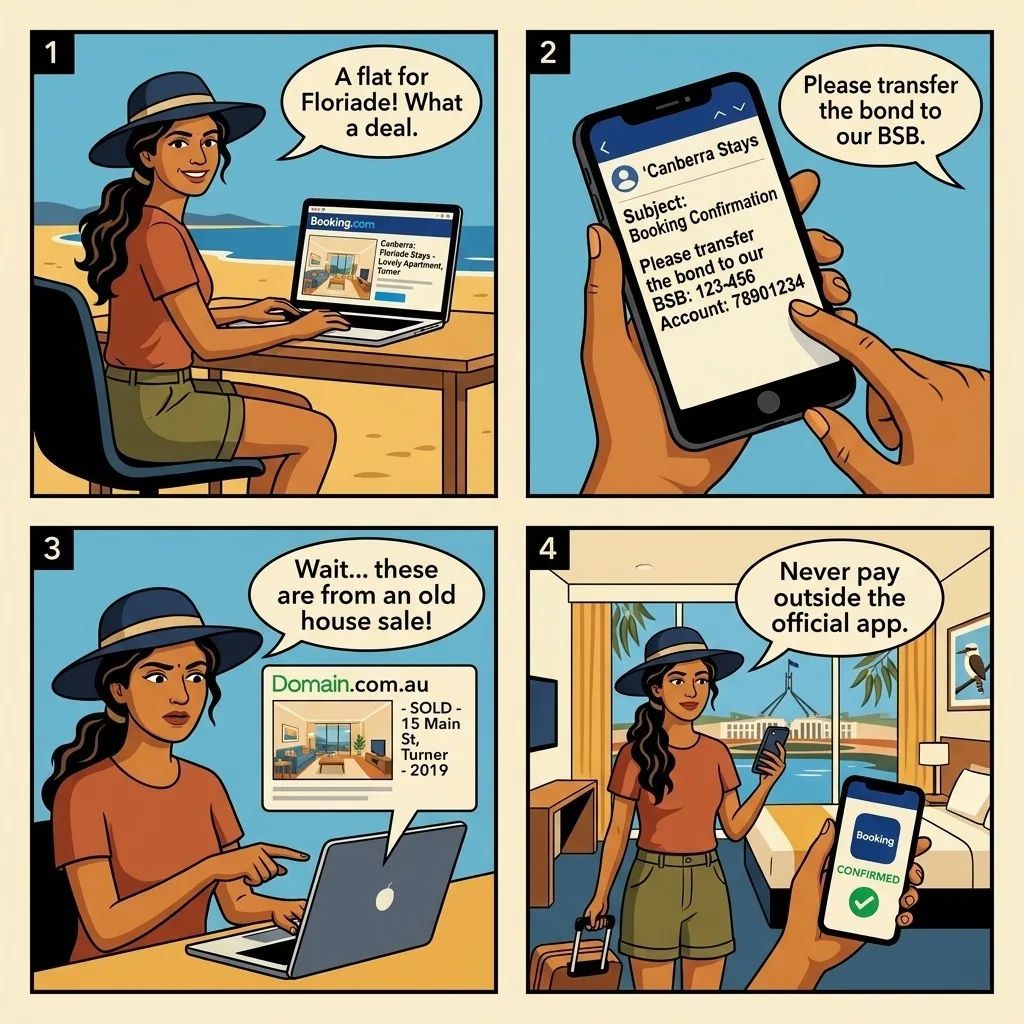
Clone sites mimicking Booking.com and AllHomes list Canberra apartments in Civic, Braddon, Turner, and Kingston at $100–$140/night, collect bank-transfer deposits of $700–$1,400, and vanish — listing photos are typically sourced from Domain.com.au or realestate.com.au sales records for the same addresses.
Canberra's rental market is tight year-round — government city, high demand, low vacancy — which makes a 'below-market' short-stay listing credible to visitors booking from interstate or overseas. Scammers build Booking.com-style clone sites or insert listings into AllHomes using real-estate marketing photos pulled from Domain.com.au for properties at real Canberra addresses. The photos are accurate — the building exists — but the lister has no connection to it. Pricing is set 25–40% below comparable genuine Airbnb stock to encourage immediate booking without further research.
Payment is directed outside the platform via bank transfer, Wise, or crypto, citing a 'direct booking discount.' Once the transfer clears — $700–$1,400 for a week — the host goes silent, the clone site comes down, and the emails bounce. On arrival, the building concierge or current resident has no knowledge of any rental booking. Canberra is particularly exposed because many international government visitors and conference attendees book weeks ahead from overseas, making pre-arrival physical verification impossible.
Book all Canberra short-stay accommodation only through airbnb.com, booking.com, or stayz.com.au via the official app or a bookmarked URL — not via a link in any email — and never pay by bank transfer outside the platform — reverse image-search every listing photo in Google Images, as most Canberra scam listings reuse Domain.com.au or realestate.com.au sales photography for the exact same address.
Red Flags
- Host asks for bank transfer or crypto instead of in-platform payment
- Listing price is 30–50% below comparable Canberra short-stays
- Photos reverse image-search to Domain.com.au or realestate.com.au
- Listing is on AllHomes but 'host' pushes you to pay outside the site
- Apartment number doesn't exist on the building's floor plan (check Google Street View)
How to Avoid
- Book only through airbnb.com, booking.com or stayz.com.au via the app.
- Never pay by bank transfer outside the platform.
- Reverse image-search photos in Google Images — the critical step.
- Inspect in person for any long-stay arrangement.
- Require reviews from 3+ guests in the last 12 months for short stays.

Uber displays 2–4× surge pricing at Canberra Civic on Friday and Saturday nights, reaching $35–$55 for trips that cost $12–$18 at standard fare — driver coordination around late-night demand windows has been documented, with fares dropping to normal within minutes of a traveler accepting a surge quote.
Canberra's rideshare driver pool is smaller than Sydney or Melbourne — fewer active ACT-registered drivers means demand spikes during Friday and Saturday post-midnight hours hit harder and faster. Surge pricing appears in the app transparently, but the scale — 2.7× to 4× during windows when no weather or major event applies — is disproportionate to actual demand. The mechanism: drivers decline requests at standard price to thin apparent supply, triggering the algorithm to raise the multiplier until someone accepts.
The traveler accepts a $38 quote for a $14 trip and confirms. Within 30–60 seconds, the displayed surge drops for the next user — the driver secured the overcharge without any real demand pressure behind it. Because surge pricing is a disclosed platform feature, there is no basis for a refund or dispute. The incremental amount per trip ($15–$30) sits below most users' dispute threshold, making the pattern economically self-sustaining.
When Uber surges above 2× at Civic, open DiDi in parallel — DiDi operates in Canberra and does not always surge simultaneously — or wait 10 minutes and retry; surges reset quickly once driver coordination breaks — for post-event departures from the AIS Arena or Exhibition Park, prebook a hotel shuttle to avoid the peak window entirely.
Red Flags
- Uber quote is 2–4× above typical fare with no weather or event cause
- Multiple driver cancellations in a row before one accepts at a higher price
- Surge multiplier fluctuates visibly every 30–60 seconds
- Drivers visible on the map but not accepting requests at standard price
- Price drops significantly after you accept — suggests artificial scarcity
How to Avoid
- Compare Uber with DiDi and Ola before ordering — one is usually normal-priced.
- Wait 10 minutes and retry if surges seem extreme.
- Take night buses or Light Rail where available.
- Prebook hotel shuttles for post-event late-night departures.
- Screenshot surge quotes if you suspect manipulation — useful for disputes.
Like what you're reading? Get a full Canberra itinerary with safety tips built in.
Browse travel-safety books →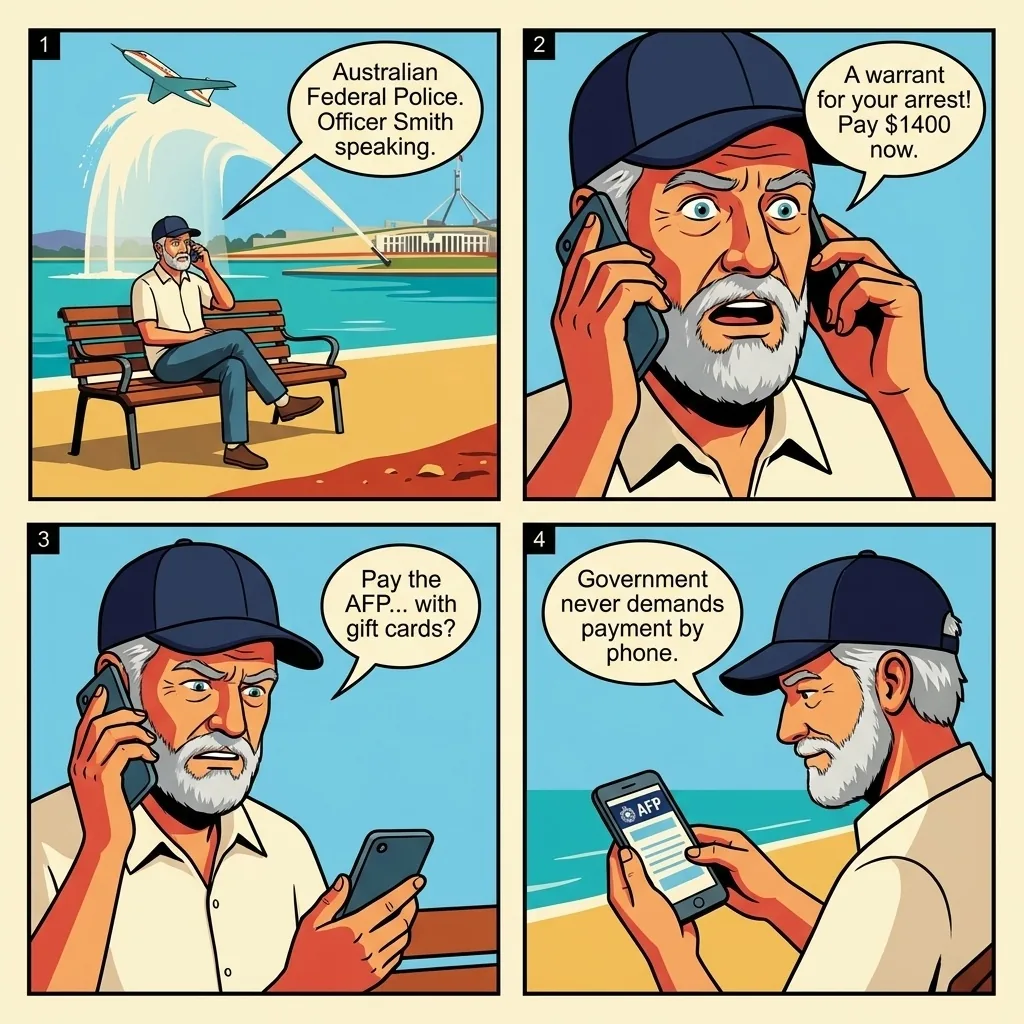
Scammers impersonating the Australian Federal Police, Services Australia, and the ATO target Canberra visitors and residents — especially international students and visa holders at ANU and UC — with calls claiming arrest warrants or visa cancellations resolvable by immediate bank transfer; losses of $1,000–$15,000 per incident are documented.
The call begins with an automated message or live voice claiming to be from the AFP, ATO, Services Australia, Border Force, or Medicare. It names a 'case number,' a 'warrant for arrest,' or a 'tax debt' — the details are plausible enough to create fear in anyone with a visa complication, an outstanding fine, or a complex tax situation. Canberra is a specific target because the city's large international student population (ANU, UC, ADFA) and diplomatic community include people who are genuinely uncertain about their legal status and unlikely to challenge a government authority call.
The scammer escalates: pay immediately by bank transfer, Bitcoin, gift cards, or Wise to 'clear the warrant' or 'prevent deportation.' Victims who comply lose $1,000–$15,000 in a single call. The AFP has issued public warnings confirming the agency never demands payment by phone, never accepts gift cards, and never threatens immediate arrest without prior written notification — but the calls are sophisticated enough that victims under pressure don't verify in time.
Hang up immediately — no Australian government agency (AFP, ATO, Services Australia, Border Force, Medicare) ever demands payment by bank transfer, gift cards, or crypto over the phone — call the agency back on the number published at its official website (afp.gov.au, ato.gov.au, servicesaustralia.gov.au) and report the call to ScamWatch at scamwatch.gov.au.
Red Flags
- Caller claims to be AFP, Services Australia, ATO, Border Force or Medicare
- Demands immediate payment by bank transfer, Bitcoin, gift cards or Wise
- Threatens arrest, visa cancellation or deportation unless you pay today
- Requires you to stay on the line and not contact anyone else
- Provides a 'case number' and 'officer badge number' that sound convincing
How to Avoid
- Hang up and call back on the agency's published number from its official website.
- No legitimate government agency accepts payment by bank transfer or gift cards.
- Never give personal details (DOB, Medicare number, bank details) to a caller.
- Report the call to ScamWatch (scamwatch.gov.au) and the actual agency.
- If you've paid, contact your bank for a recall within 24 hours.
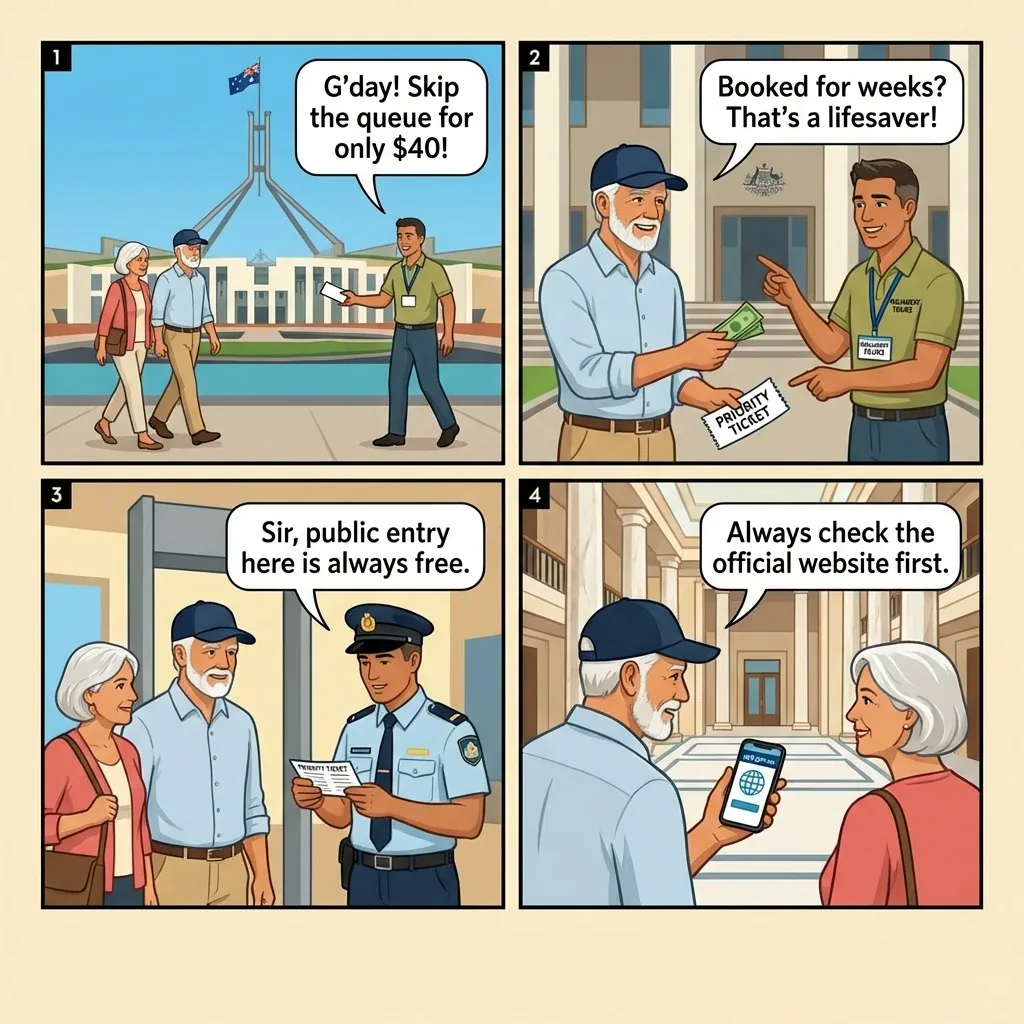
Touts outside Parliament House and other Canberra national institutions sell 'priority access' or 'skip-the-queue' tour tickets at $30–$50 per person — Parliament House, the National Gallery of Australia, the National Library, and the Australian War Memorial all have free entry and free guided tours available throughout the day with no pre-booking required.
Canberra's national institutions are free by design — Parliament House, the National Gallery of Australia, the National Library, the Museum of Australian Democracy at Old Parliament House, and the Australian War Memorial all offer free entry and free guided tours as a matter of public policy. This is not widely known among first-time international visitors, who assume major cultural institutions require paid admission. Touts exploit this gap: a person with a 'Parliament Tours' lanyard and printed tickets near the Commonwealth Avenue visitor streams looks plausible.
The tout claims the day's free public tours are 'fully booked' or 'reserved for school groups' and offers a 'priority access' alternative at $30–$50 per person. The printed ticket looks convincing. At the building entrance, parliamentary security confirms no ticket is needed and guided tours run throughout the day on a first-come basis. The loss is $30–$50 per person paid to a person who is no longer present; no recovery is possible.
Walk directly into Parliament House, the NGA, the NLA, and the AWM — entry is free with no ticket and public guided tours run on a first-come basis throughout the day — if you want a specialist paid tour, book only at aph.gov.au, nga.gov.au, nla.gov.au, or awm.gov.au directly, and ignore anyone outside the buildings selling tickets.
Red Flags
- Stranger outside Parliament House, War Memorial or NGA offering paid 'priority' access
- Printed 'tickets' that look like government-issued passes
- Claim that 'free tours are booked out' to create urgency
- Lanyard with generic 'Parliament Tours' branding, not institution-specific
- Cash-only payment required
How to Avoid
- Walk into Parliament House, NGA, NLA and AWM — entry is free, no ticket required.
- Book specialist paid tours only via aph.gov.au, nga.gov.au, nla.gov.au, awm.gov.au.
- Ignore 'guides' outside buildings — real staff are inside.
- If in doubt, ask building security — they'll confirm what's free.
- Report tout activity to the institution's security or ACT Policing.
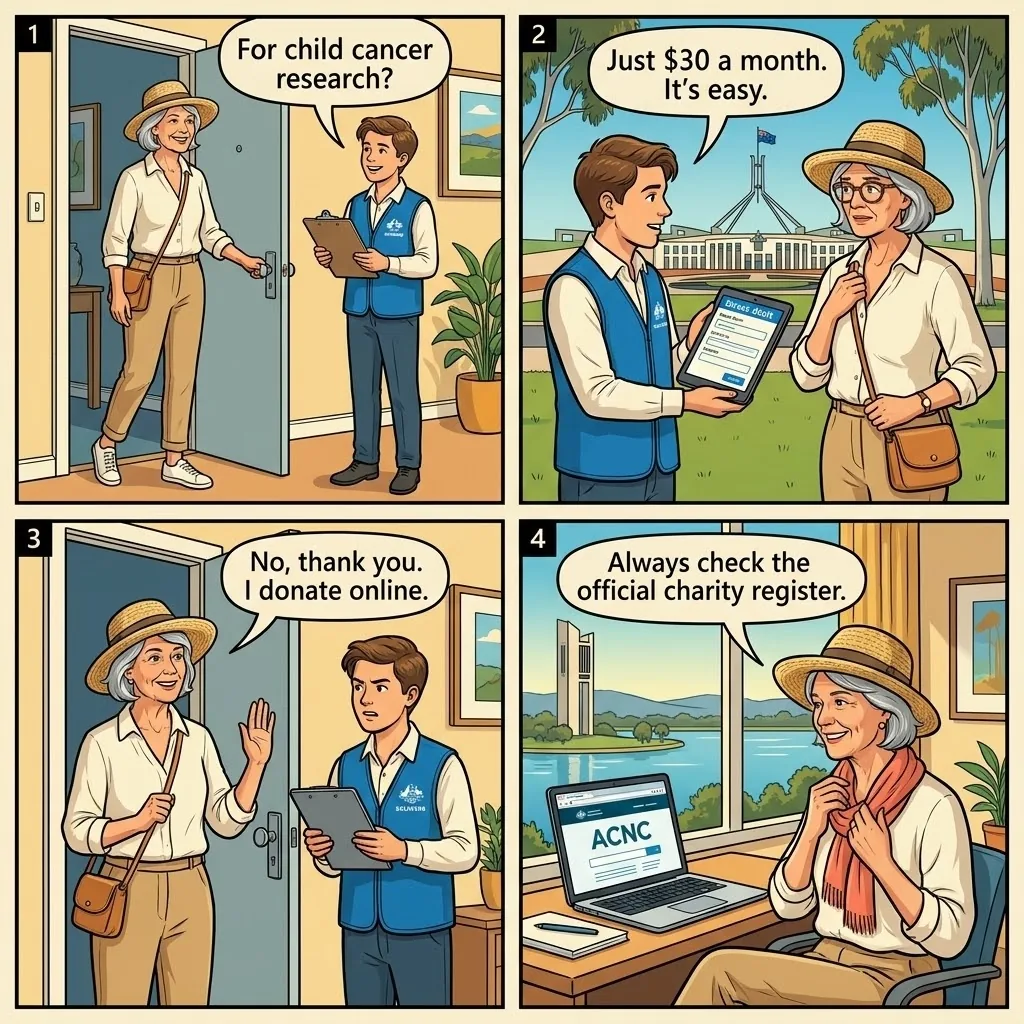
Commission-based 'chuggers' (charity muggers) operate door-to-door in Canberra suburbs at dusk and on Civic and Braddon footpaths, using high-pressure scripted sales tactics to sign visitors and residents up for direct-debit charity donations — a majority of first-year funds goes to the fundraising agency rather than the cause, and some variants are fully fraudulent.
Australia's professional fundraising industry hires third-party agencies to run door-to-door and street-solicitation campaigns for legitimate charities, paying the agency 50–80% of first-year donor revenue as commission. The solicitors are trained with objection-handling scripts and emotional pressure tactics — emotive cause descriptions, pre-answered refusals, direct-debit forms that assume consent once an initial 'yes' is obtained. Some variants are fully fraudulent, collecting cash for non-existent charities with no ACNC registration. Both legitimate and fraudulent variants operate in Canberra's suburban residential areas and the Civic commercial precinct.
The harm is structural: donors who sign up at the door contribute primarily to fundraising overhead rather than the cause, and canceling a direct-debit requires separate action with the bank after the fact. Fully fraudulent solicitors pocket cash with no charity registration at all. The high-pressure element is the scripted objection handling — the solicitor has a prepared response to every refusal, making it socially awkward to simply close the door without engaging further.
Say 'no thank you' once and close the door or keep walking — do not engage the script, as every reply resets the objection-handling sequence — if the cause appeals, look it up on the ACNC charity register at acnc.gov.au and donate directly through the charity's own website, where substantially more of your money reaches the cause.
Red Flags
- Door-knocker or street solicitor pushes for direct debit rather than one-off donation
- Charity isn't searchable on the ACNC register (acnc.gov.au)
- Solicitor uses emotive language and pre-scripted objection handling
- Persistence — won't take a polite no for an answer
- Cash-only or 'can we have a check' request
How to Avoid
- Polite firm 'no thank you' and close the door or keep walking.
- Verify any charity at acnc.gov.au before donating.
- Donate directly via the charity's own website for maximum impact.
- Ask hotel reception to screen door-knockers.
- Never commit to direct debit on the spot — always 'I'll think about it'.
🆘 What to Do If You Get Scammed
📋 File a Police Report
Go to the nearest ACT Policing station. Call 000 (emergency) or 131 444 (non-emergency). Get an official crime report — you'll need this for insurance claims. You can also report online at police.act.gov.au.
💳 Cancel Your Cards
Call your bank immediately. Most have 24/7 numbers on the back of the card (keep a photo saved separately). Block any suspicious transactions before the thieves use your details.
🛂 Lost Passport?
Contact your nearest embassy or consulate. Most major embassies and high commissions are in Canberra: US Embassy at Moonah Place, Yarralumla (+61 2-6214-5600); UK High Commission at Commonwealth Ave, Yarralumla (+61 2-6270-6666); Canadian High Commission at Commonwealth Ave (+61 2-6270-4000). Report scams to ScamWatch at scamwatch.gov.au.
📱 Track Your Device
If your phone was stolen, use Find My (iPhone) or Find My Device (Android) from another device. Don't confront thieves yourself — share the location with police instead.