
Key Takeaways
- The #1 reported scam is the Chennai Central Auto Commission Loop.
- 1 of 5 scams are rated high risk.
- Use app-based ride services (Uber, Ola) instead of street taxis — always confirm the fare before departure.
- Never accept unsolicited offers from strangers near tourist sites in Chennai.
⚡ Quick Safety Tips
- Keep phones and valuables in secure pockets when in crowded areas.
- Use only licensed taxis or app-based ride services.
- Book tours and tickets through verified operators with online reviews.
- Keep a copy of your passport separate from the original.
Jump to a Scam
The 5 Scams
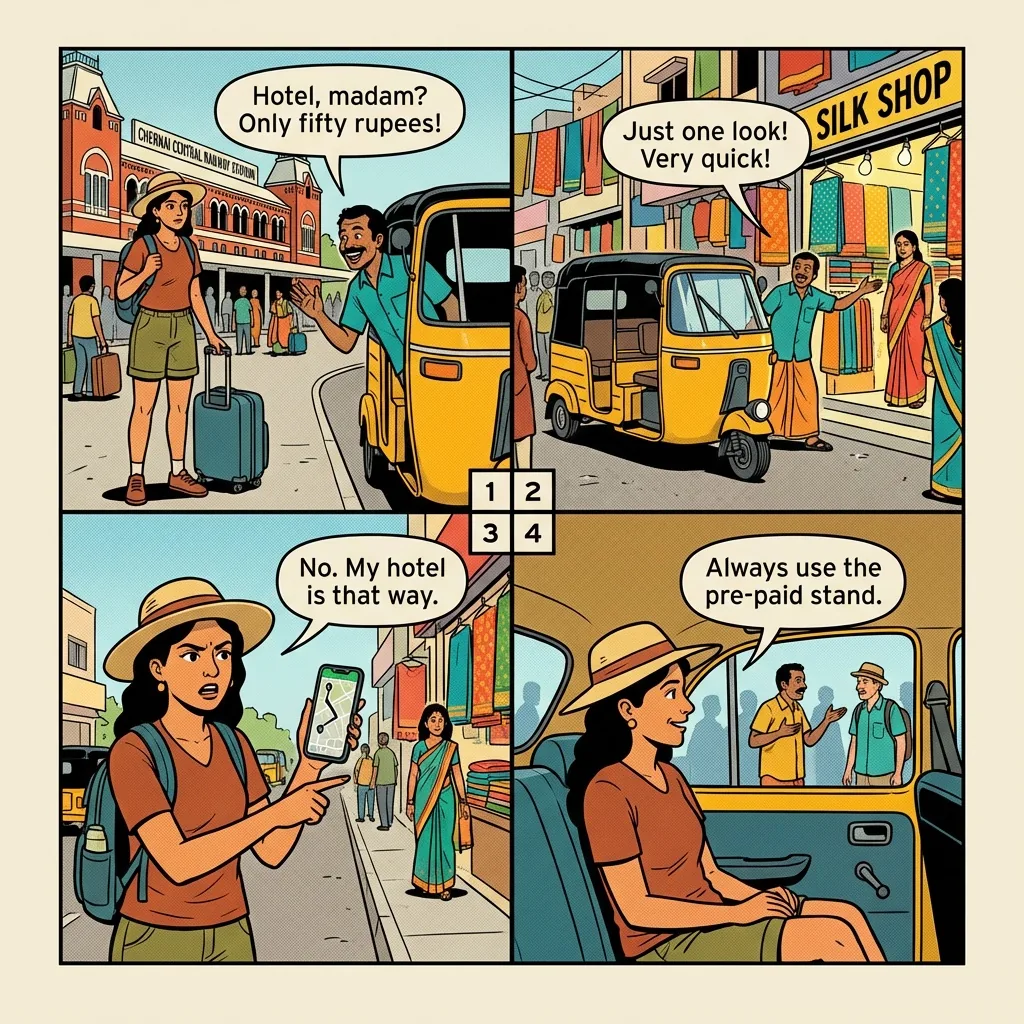
An auto driver outside Chennai Central quotes ₹50 to your hotel — suspiciously cheap — then loops you through silk showrooms for two hours and demands ₹500 for the 'extended' ride.
You step out of Chennai Central station, bags in hand, and an auto-rickshaw driver quotes you ₹50 to your hotel. The number is suspiciously low — a real meter ride would be at least ₹150 — but you are tired and the price is right. You hop in.
Instead of heading to your destination, he begins the loop. The first stop is a silk showroom in T. Nagar where staff insist you 'just have a look,' the second is a jewelry shop, the third is a 'cooperative.' Each visit will 'only take five minutes' and stretches to twenty. The driver collects a commission at every door whether you buy or not, and two hours later you are nowhere near your hotel.
The hook is a below-meter quote that buys him your time — by the time you push back, you are stranded somewhere unfamiliar and he reopens the fare to ₹500 for the 'extended' ride. The defensive move is to skip the auto-rickshaw queue at Chennai Central entirely and book Ola Auto or Uber Auto from inside the station's free WiFi, with a fixed in-app fare and no permission for unscheduled stops.
Red Flags
- An auto driver quotes a fare far below what ride-hailing apps show
- The driver insists on showing you 'the best shop' for silk or souvenirs
- Your route includes unexplained stops at stores you never requested
- The driver claims your hotel is closed, demolished, or 'too far' and suggests alternatives
- The final fare is dramatically higher than the original quote
How to Avoid
- Use Ola or Uber for transparent pricing and GPS-tracked routes.
- If taking an auto, negotiate the fare upfront and insist the driver use the meter.
- Track your route on Google Maps and speak up immediately if the driver deviates.
- Never accept unsolicited shop recommendations from your driver.
- Pre-book airport transfers through your hotel for arrival peace of mind.
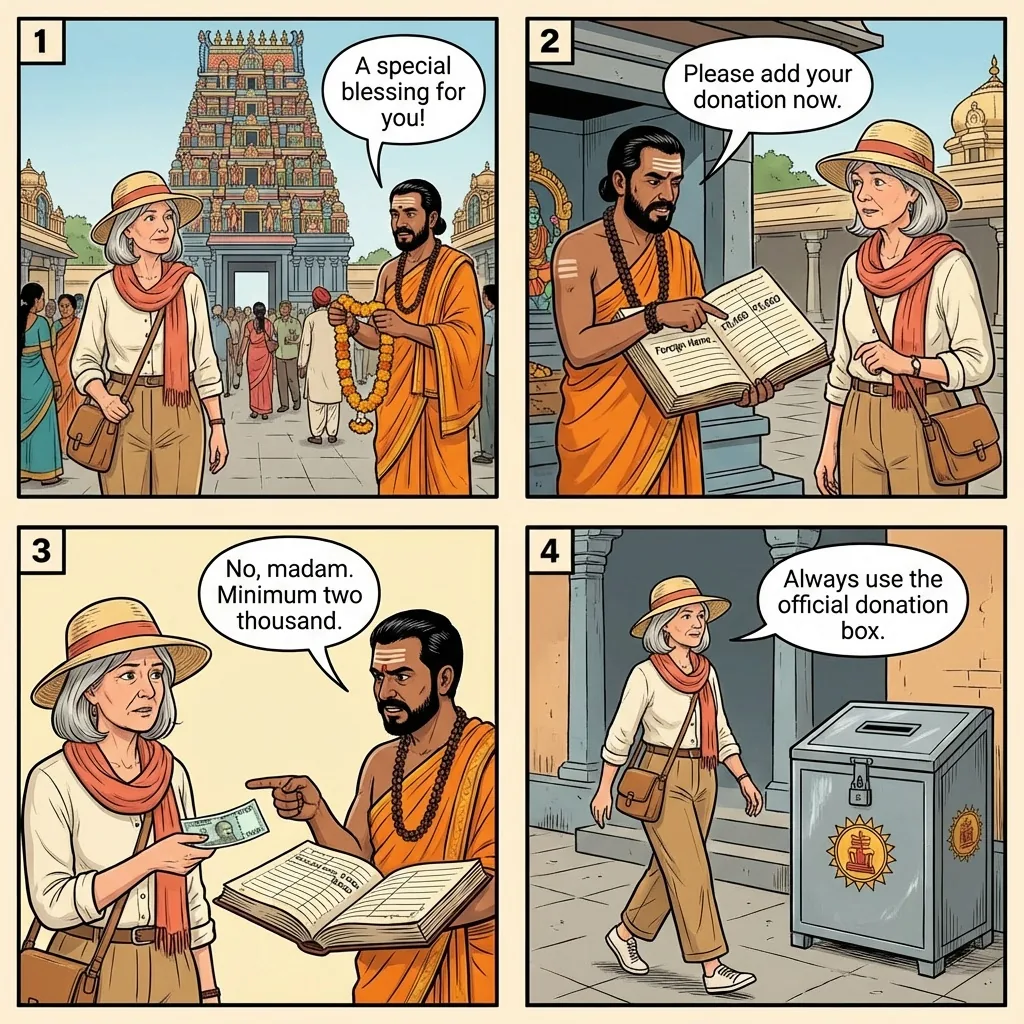
A man in priestly garments at Kapaleeshwarar Temple drapes a flower garland over you, leads you to a side shrine, then opens a 'donation book' showing ₹2,000 to ₹5,000 entries from earlier visitors and demands you match them.
You are admiring the gopuram at Kapaleeshwarar Temple in Mylapore when a man in priestly garments approaches. Before you can react he places a garland of fragrant flowers around your neck and dabs a tilak on your forehead. He leads you to a side shrine, chants a quick blessing, and the moment lands as warm and unfamiliar at the same time.
The pivot is the donation book. He produces a worn notebook with entries of ₹2,000 and ₹5,000 from previous visitors — the names are international, the handwriting is identical — and waits expectantly for you to add yours. When you offer ₹100, his demeanor shifts and he demands thousands for the 'special puja' he has just performed.
The hook is religious cover plus an act that lands before any price is named — refusing in a temple feels disrespectful, and the donation book reframes 'no' as ungenerous. The defensive move is to keep your hands at your sides outside the main sanctum, decline garlands and tilak before they touch you, and ask at the temple office for the official rate card if you want a real puja.
Red Flags
- An unofficial-looking priest approaches you unsolicited outside the main sanctum
- Flowers or sacred items are placed on you without your consent
- A donation book is produced showing suspiciously large amounts from other tourists
- The priest becomes aggressive or guilt-trips you when offered a small donation
- You are led to a side shrine away from other worshippers
How to Avoid
- Politely decline any unsolicited blessings or garlands by keeping your hands by your sides.
- Official temple priests never chase tourists outside the sanctum -- approach them yourself if interested.
- If you want a puja, ask at the temple office for official rates posted on notice boards.
- Never accept items placed in your hands or around your neck without agreeing first.
- Carry small bills so you can offer a modest donation and walk away confidently.
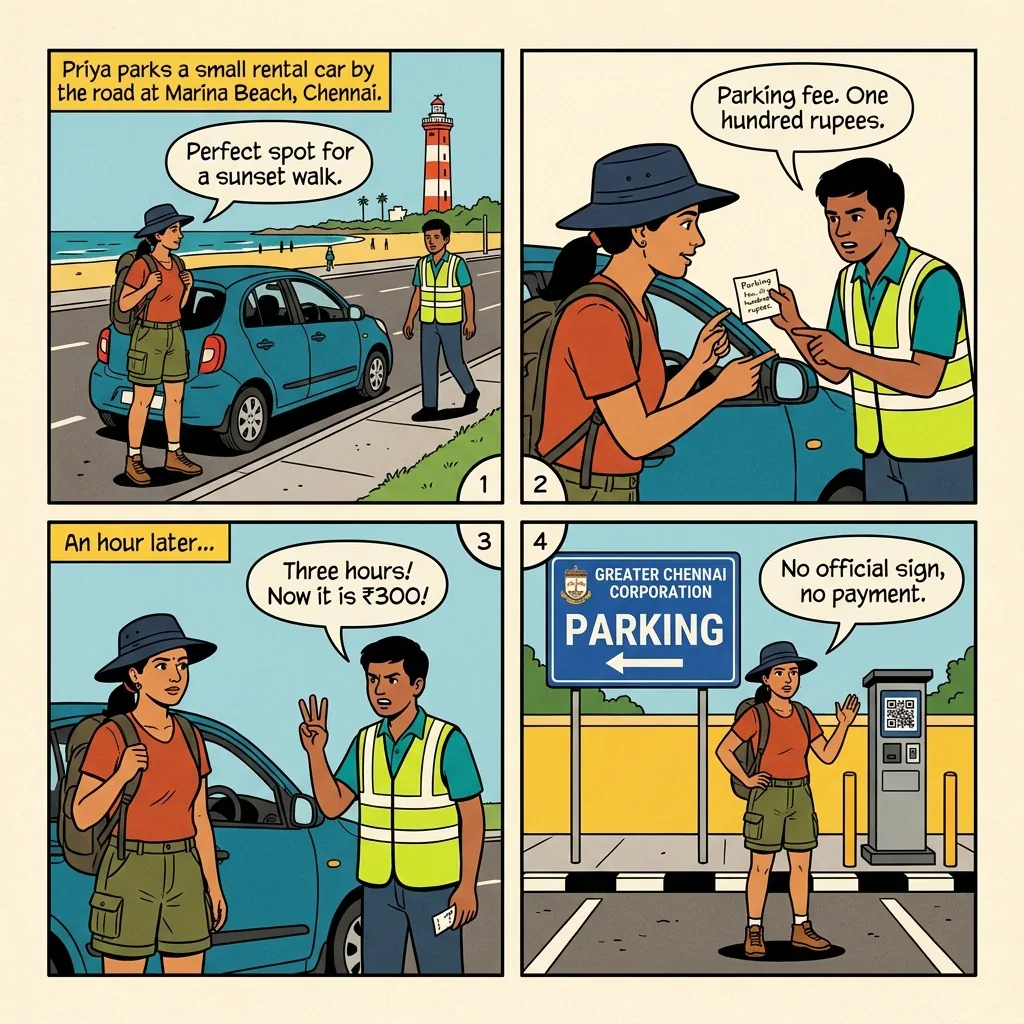
A young man in a fluorescent vest slaps a handwritten 'parking ticket' on your windshield at Marina Beach for ₹100, then a 'three-hour minimum' ₹300 charge appears the moment you return — no badge, no rate card, no city authority behind any of it.
You park along the strip near Marina Beach for a sunset walk. As you step away from the car, a young man in a fluorescent vest appears from nowhere, slaps a handwritten 'ticket' on your windshield, and demands ₹100 for parking. He has no badge, no rate card, and no connection to any city authority — but in the moment it is easier to pay than argue.
The escalation comes on your return. He is waiting at your car with a 'three-hour minimum' charge of ₹300 and threatens to block you in. Local Tamil-language journalists have documented this racket extensively: young men in their twenties collect fees in public spaces without any valid contract, and Chennai residents have posted confrontation videos showing the same vests at the same stretches week after week.
The hook is a uniform suggestion of authority plus the cost of arguing in a city you don't know — the vest is enough to make compliance feel safer than refusal. The defensive move is to use the official Chennai Smart City parking app, demand a printed municipal rate card and a serial-numbered receipt before paying, and offer to call the Chennai traffic police helpline (103) on the spot if pressed.
Red Flags
- Parking attendant has no official badge, printed rate card, or uniform beyond a random vest
- You are charged for a multi-hour minimum regardless of actual time parked
- The attendant cannot produce a proper receipt with a serial number
- Multiple 'attendants' operate in the same stretch without clear territorial logic
- They become confrontational when you question the fee or ask for credentials
How to Avoid
- Use the official Chennai Smart City parking app or look for metered spots.
- Ask to see an official ID and printed municipal rate card before paying.
- Take a photo of the attendant and their 'ticket' as documentation.
- If pressured, offer to call the Chennai traffic police helpline (103) on the spot.
- Park in established lots at malls or hotels nearby and walk to the beach.
Like what you're reading? Get a full Chennai itinerary with safety tips built in.
Browse travel-safety books →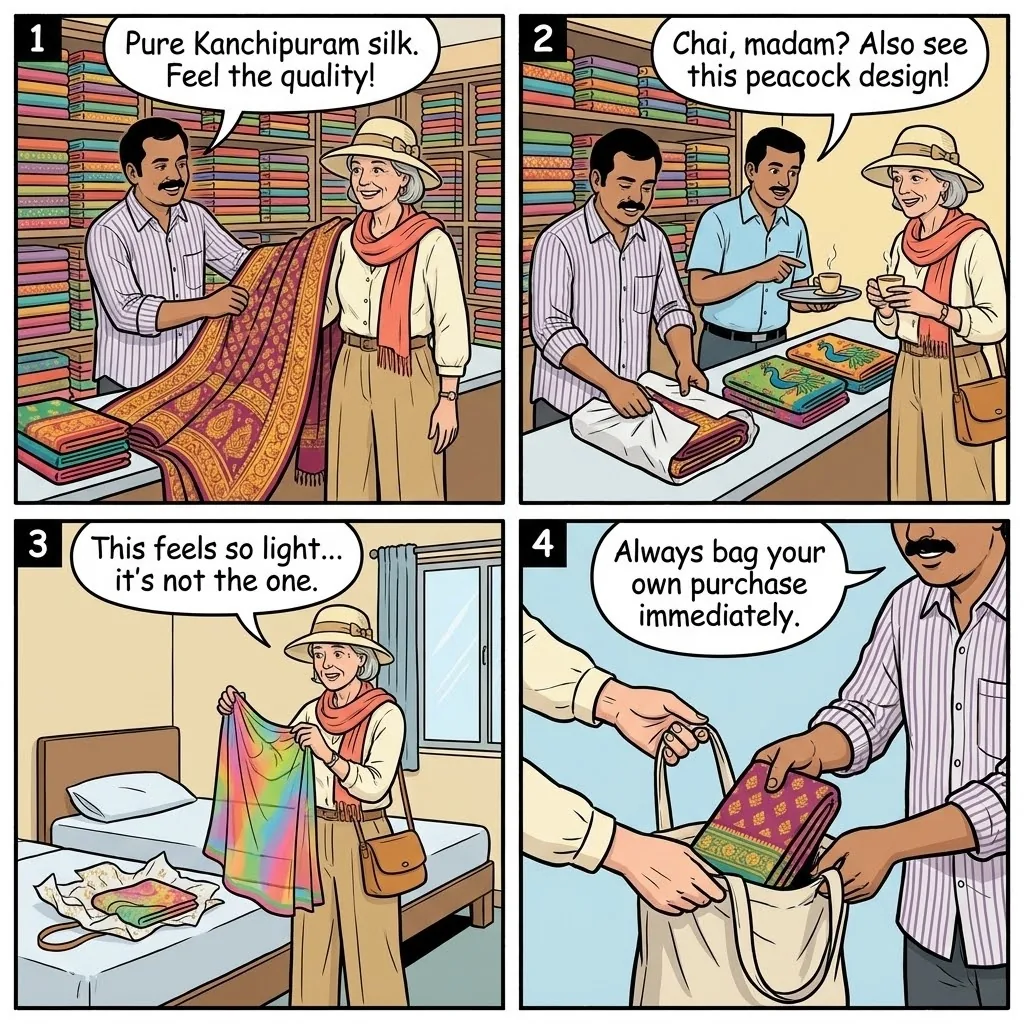
A T. Nagar shopkeeper shows you a gorgeous Kanchipuram silk saree, you agree on the price, and during the elaborate tissue-paper wrap he swaps in a lighter polyester piece — the real silk you touched never left the counter.
You are shopping for silk sarees in T. Nagar — one of Chennai's most famous textile districts — and a shopkeeper unfolds a gorgeous Kanchipuram silk across the counter. He hands it to you to feel: the weight, the sheen, the slight crispness that distinguishes real Kanchipuram from anything synthetic. You agree on a price, he begins to wrap it in tissue paper while another staff member appears with chai and three more sarees to consider.
The swap happens in the wrap. By the time you leave the shop with the carefully tied bundle, you are not carrying the silk you touched. Back at your hotel you unwrap a lighter, machine-made polyester piece that looks similar at a glance and feels obviously wrong the second you handle it. The real Kanchipuram never left the counter.
The hook is distraction at the moment of greatest trust — the bait-and-switch happens after the price is agreed and before the bundle leaves the shop. The defensive move is to do the silk burn-test on a thread before paying (real silk smells like burnt hair, synthetic smells like plastic), watch the packaging without looking away, and shop at government-certified emporia like Co-optex or VTB Silks where the silk is sealed in plastic before it reaches you.
Red Flags
- The shopkeeper insists on wrapping the saree himself in an elaborate, time-consuming process
- You are distracted during packaging by another staff member offering tea or showing more items
- The price seems surprisingly low for genuine Kanchipuram silk
- The shop has no return or exchange policy posted visibly
- Aggressive touts outside steer you toward a specific shop over others
How to Avoid
- Do the burn test: real silk smells like burnt hair, synthetic smells like plastic -- ask to test a thread.
- Rub the fabric between your fingers -- genuine silk warms up, synthetic stays cool.
- Watch the packaging process closely and inspect the saree again before final payment.
- Shop at established government emporiums like Co-optex or VTB Silks with official certifications.
- Pay by card for a transaction trail and potential chargeback protection.
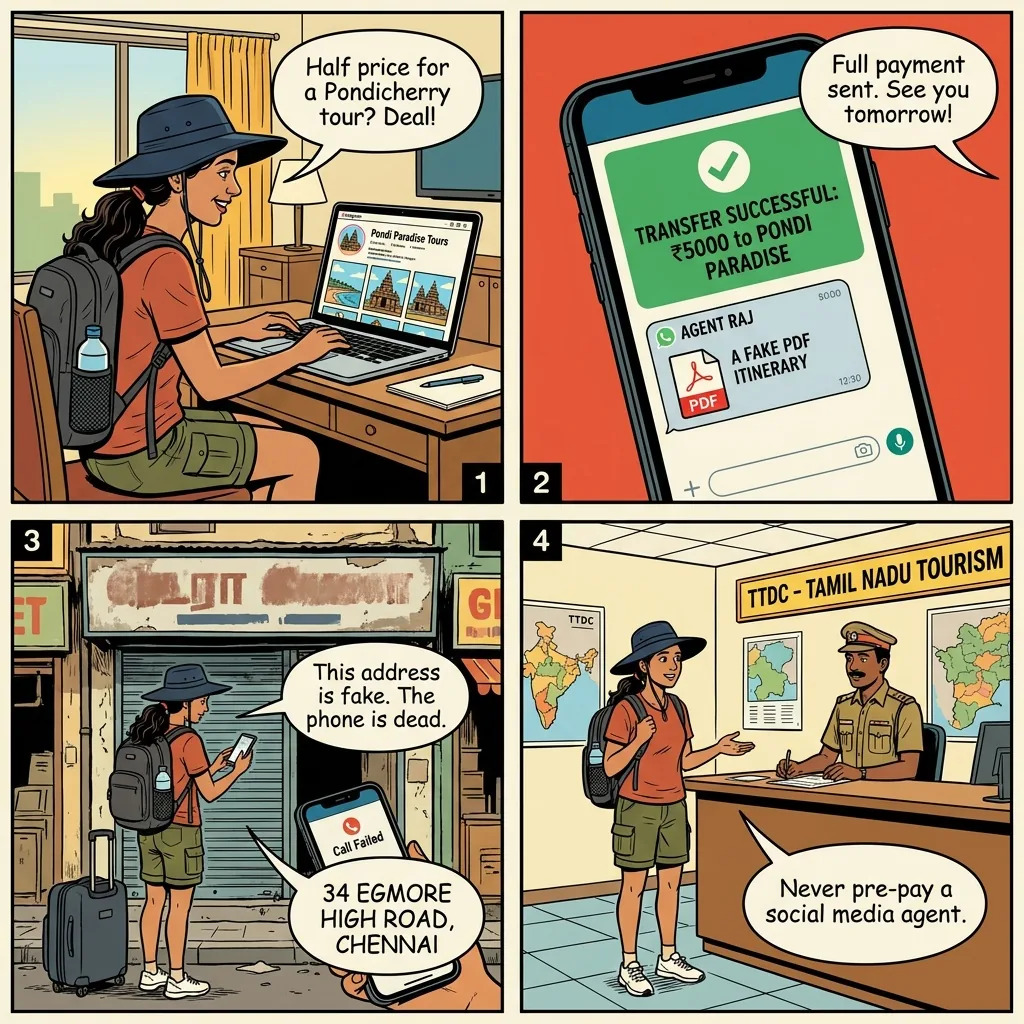
A travel agent on social media offers a multi-day Mahabalipuram and Pondicherry tour at half the going rate, you transfer the full amount, and on the morning of departure the phone is dead and the office address does not exist.
You find a travel agent on social media who offers a multi-day tour package to Mahabalipuram and Pondicherry at an incredible rate — air-conditioned car, hotel, guide, all for half the price of established agencies. The Instagram page is professional, the messages are quick, and the WhatsApp confirmation looks legitimate. He asks for full payment by bank transfer to lock in the rate.
The disappearance is total. On the morning of your trip the agent's phone is switched off, the office address you were sent does not exist, and the hotel where you supposedly have a reservation has never heard the name. Tripadvisor's India forum and Tamil Nadu consumer-affairs reports have documented Chennai-based 'agents' who collect payment, send fake confirmation documents, then vanish entirely — sometimes leaving tourists stranded at the airport with luggage and no itinerary.
The hook is price-undercut plus social-media polish — the deal looks too good and the design is good enough to overpower the doubt. The defensive move is to book only through Ministry of Tourism-registered operators (verify the registration number before paying), pay partial deposits never the full amount upfront, and use a credit card so a chargeback path exists if the service is never delivered.
Red Flags
- Prices significantly undercut all competitors for comparable services
- The agent insists on full payment via bank transfer or cash upfront
- No verifiable physical office address or established web presence
- The agent found you through social media DMs or unsolicited WhatsApp messages
- Confirmation documents look unprofessional or contain generic template text
How to Avoid
- Book through established platforms like MakeMyTrip, verified TripAdvisor-listed operators, or your hotel.
- Never pay full amount upfront -- legitimate agencies accept partial deposits.
- Verify the agency has a valid Ministry of Tourism approval number.
- Search the agency name plus 'scam' or 'review' before booking.
- Pay by credit card for chargeback protection if the service is never delivered.
🆘 What to Do If You Get Scammed
📋 File a Police Report
Go to the nearest Indian Police station. Call 100 (Police) or 112 (Emergency). Get an official crime report — you'll need this for insurance claims. You can also report online at citizenservices.gov.in.
💳 Cancel Your Cards
Call your bank immediately. Most have 24/7 numbers on the back of the card (keep a photo saved separately). Block any suspicious transactions before the thieves use your details.
🛂 Lost Passport?
Contact your nearest embassy or consulate. The US Embassy in New Delhi is at Shantipath, Chanakyapuri, New Delhi 110021. For emergencies: +91 11-2419-8000.
📱 Track Your Device
If your phone was stolen, use Find My (iPhone) or Find My Device (Android) from another device. Don't confront thieves yourself — share the location with police instead.
Frequently Asked Questions

You just read 5 scams in Chennai. The book has 60 across 12 Indian cities.
Delhi’s Paharganj “India Tourism” rebooking trap. Jaipur’s Hawa Mahal rickshaw textile detour. Mumbai’s ₹61,000 dating-app pub bill. The Lake Pichola sunset-photo extortion. The Bengaluru Silk Board meter manipulation. Every documented India scam — with the exact scripts, red flags, and Hindi phrases that shut each one down. Drawn from Reddit, the Times of India, News18, Telangana Today, and embassy advisories.
- 60 documented scams across Delhi, Mumbai, Jaipur, Agra & 8 more cities
- A Hindi exit-phrase card (Devanagari + Latin) you can screenshot to your phone
- Updated annually — buy once, re-download future editions free
- Readable in one flight — $4.99, coming soon on Amazon Kindle