
Key Takeaways
- The #1 reported scam is the Guangzhou Taxi Overcharge & Meter Tampering (Nation's Worst).
- 3 of 6 scams are rated high risk.
- Use app-based ride services or official metered taxis — avoid unmarked vehicles near tourist areas.
- Never accept unsolicited offers from strangers near tourist sites in Guangzhou.
⚡ Quick Safety Tips
- Guangzhou has China's most-complained-about taxi-scam density — use Metro Line 3 from CAN airport (¥6–¥8, 60 min) or DiDi at the official rideshare zone.
- At Canton Fair / business dinners, Don't let a contact or stranger choose the venue — insist on hotel restaurant or Dianping-verified 4.5+ venue; Traveler reports document ¥300+ beer scams.
- Walk past any stranger at Huacheng Plaza, Shamian Island, or Canton Tower inviting you to tea or art places tea-house scam alongside taxi scams as Guangzhou's top two.
- For shopping, treat Beijing Road and Shangxiajiu as window-shopping only; for genuine brands visit IFC Mall, Grandview Mall, or TaiKoo Hui.
- Examine ¥100 notes for watermark + color-shifting ink + raised-texture portrait; Don't accept 'replacement' for a bill you handed over — counterfeit-bill substitution is Guangzhou's signature scam.
Jump to a Scam
- High Guangzhou Taxi Overcharge & Meter Tampering (Nation's Worst)
- High Canton Fair & Trade Expo Hostess-Bar / Contract-Dinner Scams
- High Huacheng Plaza Tea House & Art Student Scam
- Medium Beijing Road & Shangxiajiu Fake-Goods Shopping
- Medium Taxi & Vendor ¥100 Note Swap
- Medium Dim Sum Tourist Restaurants & Shamian Island Menu Overcharge
The 6 Scams
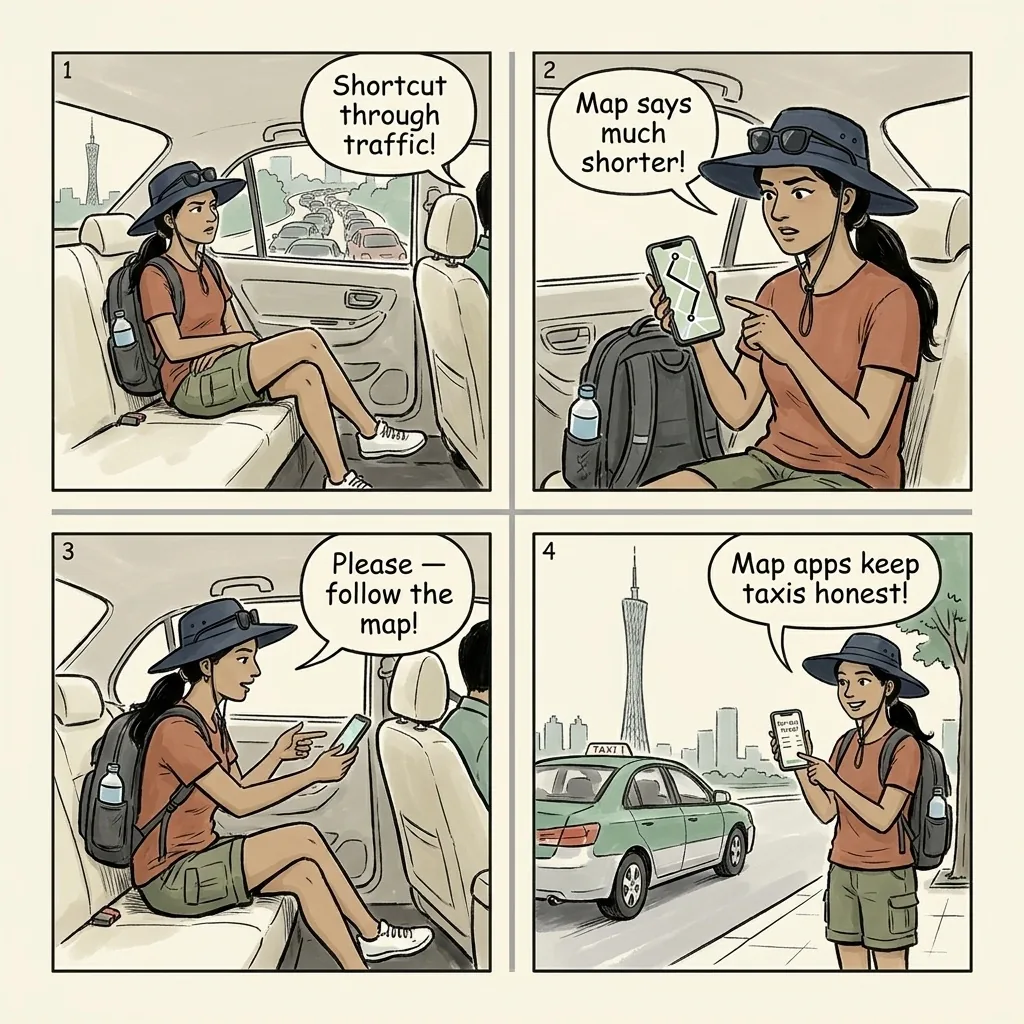
Guangzhou has China's most-complained-about taxi-scam density per traveler reports.
One traveler wrote: '99% of the time I don't get scammed in Shenzhen taxis. 99% of the time I DO get scammed in Guangzhou taxis.' The patterns: (1) CAN airport drivers refuse meter and quote ¥300–¥500 'fixed price' when legitimate meter is ¥140–¥180 to central Guangzhou; (2) meter tampering — running at 2–3x speed; (3) 'bad bill' scam where driver claims a ¥100 note you handed over is counterfeit and returns a 'replacement' that's actually counterfeit. One traveler wrote: 'Taxi scam is by far the most prevalent. Either not running the meter, or slipping you bad bills. Avoid black t' axis entirely.
The Canton Fair (Guangzhou's twice-yearly trade expo) is a scam-density peak — visiting business travelers and tourists are the target. The same rule applies at CAN as well. DiDi operates reliably with English-interface app-regulated fares; Guangzhou Metro Line 3 (CAN airport to Tiyu Xilu in city center ¥6–¥8, 60 min) is the scam-proof option.
For older travelers arriving in Guangzhou, the practical playbook: (1) Metro Line 3 from CAN to central Guangzhou — ¥6–¥8, 60 min, scam-free; (2) install DiDi before flying for app-regulated fares at the official rideshare pickup zone; (3) if licensed taxi, 'da biao' (打表) and expect ¥140–¥180 CAN-to-center; (4) if you receive a ¥100 note you suspect might be counterfeit, Don't hand it back to the driver for 'replacement' — keep it, note the driver's license plate, and exchange at a bank; (5) photograph the taxi plate from rear windscreen before boarding.
Red Flags
- Driver approaches inside CAN arrivals or at Guangzhou South Railway Station
- 'Fixed price' ¥300+ quoted to central Guangzhou (legitimate meter ¥140–¥180)
- Driver refuses 'da biao' or claims meter 'broken'
- Meter visibly runs 2–3x faster than reasonable for distance
- Driver claims a ¥100 note you handed over is 'counterfeit' and offers to 'replace' it
How to Avoid
- Metro Line 3 from CAN to central Guangzhou: ¥6–¥8, 60 min.
- DiDi with international-number sign-up at official rideshare pickup zone.
- Licensed taxi with 'da biao'; expect ¥140–¥180 CAN-to-center.
- Don't hand back a 'counterfeit' bill for replacement — keep it, note driver's plate, verify at a bank.
- Photograph taxi plate from rear windscreen before boarding.

Guangzhou hosts the Canton Fair — China's largest trade expo — twice a year (April–May and October–November).
Thousands of foreign buyers visit; a predatory ecosystem around them has matured. Common scam vectors: (1) 'potential supplier' invites the Canton Fair buyer to a hostess bar or private restaurant room where drinks are ¥800–¥2,000 each and the bill arrives at ¥10,000–¥50,000; (2) 'contract celebration dinner' with a Chinese 'business partner' at a venue they chose; no English menu, 'VIP pricing' applied after the meal; (3) 'factory tour + dinner' packages that include commission-driven kickback shopping stops at jade or TCM 'museums.' documents the 2025 Qingdao-beer anchor that also applies at Canton Fair venues: tourists charged ¥300+ for what should be ¥15.
The mechanic that traps Western buyers is the after-hours "client dinner." A Canton Fair host suggests dinner to "celebrate the deal," and the party arrives at a restaurant that flips into a hostess venue once seated — bottle service at ¥3,000–¥8,000 per bottle, "companion fees" added line-item, table charges that weren't mentioned. Bills land at ¥10,000–¥50,000. Refusal triggers business-relationship pressure: the host suggests the deal is contingent on "paying your share," and disputes get framed as Western tourists not understanding Chinese hospitality. Reddit threads document the same script running at venues clustered around Pazhou and Liwan during fair seasons every spring and fall.
For older business travelers or tourists in Guangzhou during Canton Fair or off-season, the playbook: (1) Don't let a business contact or stranger choose the venue — insist on a hotel restaurant or a Dianping-verified 4.5+ venue; (2) look up expected prices before going (residential beer ¥15–¥30; hotel bar beer ¥40–¥80; above ¥150 signals tourist-pricing scam venue); (3) set a spending limit before any business dinner; (4) pay with credit card for chargeback leverage; (5) if trapped with a ¥10,000+ bill, refuse to pay more than reasonable consumption and call 110 — Guangzhou police have become more responsive to Canton Fair fraud complaints in 2024–2025.
Red Flags
- Business contact or 'supplier' insists on a specific bar or restaurant venue
- Venue has no visible menu or pricing; drinks priced ¥500+ per glass
- 'Hostess' or 'entertainment staff' order for the group; bill assembled without disclosure
- Venue located in a basement, unmarked upper floor, or outside main commercial districts
- Staff block exit or produce large bouncer when the bill arrives
How to Avoid
- Don't let a business contact or stranger choose the venue — use a hotel restaurant or Dianping 4.5+ venue.
- Look up expected prices before going; reject venues without posted menus.
- Set a spending limit before any business dinner.
- Pay with credit card for chargeback leverage.
- If trapped, refuse excessive amounts and call 110; Guangzhou police are responsive to fraud complaints.

The nationwide tea-house and art-student scam ring extends to Guangzhou's Huacheng Plaza and Shamian Island tourist zones. Script: fluent-English strangers approach claiming to be students at Sun Yat-sen University or Guangdong University of Foreign Studies, invite tourists to 'traditional Cantonese tea culture' or 'student art exhibition' at a nearby venue. Bill: ¥2,500–¥7,000 per person. Traveler reports place the tea-house scam alongside taxi scams as Guangzhou's top two.
Shamian Island specifically (the former European concession island) is a scam-density zone because of its tourist appeal: documents the cross-city consistency. The 'art student' variant at Canton Tower and Huacheng Plaza pitches 'student calligraphy exhibition' leading to ¥500–¥3,000 scroll purchases.
For older travelers in Guangzhou, the rule is absolute: ANY English-speaking stranger at Huacheng Plaza, Shamian Island, Canton Tower, or the Sun Yat-sen Memorial with tea or cultural invitations is running the scam. For genuine Cantonese tea culture, visit Lin Heung Tea House (Guangzhou branch — the Hong Kong brand with Guangzhou locations) or Tao Heung with posted pricing. For art, Guangdong Museum of Art (free entry) and Redtory Art + Design Factory are legitimate venues.
Red Flags
- English-speaking 'students' at Huacheng Plaza, Shamian Island, or Canton Tower invite you to tea or art
- Venue is side street or upper floor near the main attraction
- No menu or prices displayed before serving
- Pressure to buy 'student calligraphy' or 'traditional Cantonese tea' at ¥500+
- Staff block exit or produce bouncer at bill time
How to Avoid
- Walk past any stranger at Huacheng Plaza, Shamian Island, or Canton Tower offering tea or art.
- For Cantonese tea, visit Lin Heung Tea House (Guangzhou branch) or Tao Heung with posted pricing.
- Guangdong Museum of Art (free entry) and Redtory Art + Design Factory for legitimate art.
- Pay with credit card for chargeback leverage if trapped.
- Call 12315 (English consumer line) and 110 (police).
Like what you're reading? Get a full Guangzhou itinerary with safety tips built in.
Browse travel-safety books →
Beijing Road and Shangxiajiu Pedestrian Street — are full of counterfeit luxury goods, fake electronics, and bait-and-switch vendors.
Beijing Road and Shangxiajiu Pedestrian Street — are full of counterfeit luxury goods, fake electronics, and bait-and-switch vendors. Common patterns: (1) 'Apple AirPods' at ¥120–¥200 that are clone Bluetooth earbuds with no Apple chip; (2) 'Louis Vuitton' bags and 'Rolex' watches at 1–3% of genuine prices (all counterfeit); (3) bait-and-switch where the examined item is swapped during wrapping.
The customs risk for foreign travelers is significant: counterfeit LV, Rolex, Apple, and Sony goods are illegal to import into the US, UK, EU, Canada, and Australia — customs routinely confiscate at arrival with fines of $500–$10,000 depending on quantity — and Guangzhou's counterfeit-market ecosystem is large enough that this risk is non-trivial for any tourist who buys.
For older travelers considering Beijing Road or Shangxiajiu as curiosity visits, the rules: (1) treat as window-shopping only — assume everything branded is counterfeit; (2) never pay more than ¥30–¥80 total for novelty items (phone cases, cables, fan merchandise); (3) examine the exact item you'll take home BEFORE paying, refuse 'wrap in back' offers; (4) for genuine shopping in Guangzhou, visit IFC Mall (Zhujiang New Town), Grandview Mall (Tianhe), or TaiKoo Hui (Tianhe Road) — all stock genuine brands with posted pricing and returns; (5) understand home-country customs rules — do not attempt to bring counterfeit goods home.
Red Flags
- 'Apple AirPods' at ¥120–¥200 or branded luxury goods at 1–3% of genuine prices
- Vendor offers multiple 'grades' of the same branded product
- Vendor wraps item 'in the back' before handing over
- No warranty cards or authorized-retailer signage
- Pressure to pay in cash or Alipay without inspection time
How to Avoid
- Treat Beijing Road and Shangxiajiu as window-shopping only.
- Never pay more than ¥30–¥80 total for novelty items.
- For genuine brands: IFC Mall (Zhujiang New Town), Grandview Mall, TaiKoo Hui.
- Examine exact item you'll take home BEFORE paying; refuse 'wrap in back.'
- Understand home-country customs rules — counterfeits risk confiscation and fines.

Guangzhou has a documented counterfeit-bill scam ecosystem targeting both tourists and locals.
Travelers are blunt: 'Taxi scam is by far the most prevalent. Either not running the meter, or slipping you bad bills.' The scam: you hand a ¥100 note to a driver, vendor, or market stall; the recipient says 'this is fake' and offers to 'replace it' or hand it back — the note you receive back is a counterfeit that was substituted during the handling.
The scam density is higher in Guangzhou than in most other first-tier cities because the Canton Fair and Pearl River Delta trading volume creates a natural counterfeit-currency ecosystem.
For older travelers in Guangzhou, the defensive playbook: (1) pay by Alipay or WeChat Pay where possible (the QR-code payment era has reduced counterfeit-bill exposure significantly); (2) if paying in cash, examine each ¥100 note for watermark, color-shifting ink on the '100', and the raised-ink texture of Mao Zedong's portrait BEFORE handing over; (3) Don't accept a 'replacement' for a note you just handed over — if the recipient says it's fake, keep it and take to a Bank of China branch for verification; (4) if you receive suspicious change, check it immediately before walking away; (5) use ATMs at major Chinese banks (ICBC, Bank of China, China Construction Bank, ABC) for cash withdrawal — no counterfeit bills from bank machines.
Red Flags
- Taxi driver, vendor, or market stall claims a ¥100 note you handed over is 'counterfeit'
- Offer to 'replace' or 'hand back' a note after brief handling
- ¥100 notes with missing watermark, non-shifting ink, or flat portrait texture
- Market stall insists on cash-only for purchase
- Receiving suspiciously crisp or suspiciously worn ¥100 notes in change
How to Avoid
- Pay by Alipay or WeChat Pay to avoid cash-counterfeit exposure.
- Examine ¥100 notes for watermark + color-shifting ink + raised-texture portrait BEFORE handing over.
- Don't accept a 'replacement' note — keep yours and verify at Bank of China.
- Check change immediately before walking away.
- Withdraw cash only at ATMs of ICBC, Bank of China, China Construction Bank, ABC.

Guangzhou is the birthplace of dim sum, and authentic ¥80–¥150 per-person dim sum experiences are abundant at Cantonese community venues. The tourist-strip parallel on Shamian Island and Beijing Road charges ¥200–¥450 per person for the same items at 2–3x pricing with laminated English-photo menus. Common overcharges: shumai ¥60+ per basket (residential ¥15–¥25), har gow ¥70+ (residential ¥20–¥35), char siu bao ¥50+ (residential ¥15–¥25).
For older travelers seeking authentic Cantonese dim sum, the community-vetted names: (1) Lin Heung Tea House (Guangzhou branch — 1889 Hong Kong brand with Guangzhou locations, dim sum ¥15–¥35 per basket); (2) Tao Heung (chain with multiple Guangzhou branches — consistent ¥80–¥120 per person); (3) Dim Sum Icon (modern upscale, ¥150–¥200 per person, still fair for quality); (4) Panxi Restaurant (classic Guangzhou institution at Liwan Park — ¥120–¥250 per person, legitimate tourist-worthy); (5) Banxi Restaurant (historical venue with posted prices). Book via Dianping (Chinese Yelp, 4.5+ ratings reliable) or hotel concierge at residential venues.
For dim sum that locals actually eat, three names recur in Reddit threads. Tao Tao Ju (陶陶居) on Dishifu Road is a 1880-founded institution with posted English-Chinese menus and ¥80–¥150 per person; Pan Xi (泮溪酒家) at Liwan Lake offers dim sum in a classical garden setting at ¥100–¥180; Bing Sheng Mansion (炳胜) is the contemporary Cantonese standard with three locations, ¥150–¥250. All take Dianping reservations and avoid the Shamian Island and tourist-strip markups by an order of magnitude on dishes like har gow, char siu bao, and lo bak go. The defensive rule for Guangzhou dim sum: posted prices, English-Chinese menu, full of locals — anything else is the markup.
Red Flags
- Tout outside Shamian Island or Beijing Road restaurant calls out in English
- Laminated English-photo menu with no Chinese specials board
- Shumai ¥60+, har gow ¥70+, char siu bao ¥50+ per basket
- 'Dim sum buffet' ¥300+ per person (legitimate buffets at quality venues ¥150–¥220)
- Mandatory 'service charge' or 'tea fee' added to bill
How to Avoid
- Community favorites: Lin Heung Tea House (¥15–¥35 per basket), Tao Heung (¥80–¥120 per person).
- Panxi Restaurant (Liwan Park institution, ¥120–¥250), Dim Sum Icon (¥150–¥200).
- Skip Shamian Island and Beijing Road tourist-strip dim sum.
- Book via Dianping (4.5+ ratings reliable).
- Check menu prices in Chinese (not English-only) before ordering.
🆘 What to Do If You Get Scammed
📋 File a Police Report
Go to the nearest Chinese Police (公安局) station. Call 110 (Police) or 120 (Ambulance). Get an official crime report — you'll need this for insurance claims. You can also report online at mps.gov.cn.
💳 Cancel Your Cards
Call your bank immediately. Most have 24/7 numbers on the back of the card (keep a photo saved separately). Block any suspicious transactions before the thieves use your details.
🛂 Lost Passport?
Contact your nearest embassy or consulate. The US Embassy in Beijing is at No. 55 An Jia Lou Road, Chaoyang District, Beijing 100600. For emergencies: +86 10-8531-3000.
📱 Track Your Device
If your phone was stolen, use Find My (iPhone) or Find My Device (Android) from another device. Don't confront thieves yourself — share the location with police instead.
Frequently Asked Questions
You just read 6 scams in Guangzhou. The full Travel Safety Series has 780+ more across 20+ countries.
Tokyo's Kabukichō ¥130,000 bar trap. Rome's gladiator photo extortion. Paris's gold-ring trick. Bali's ATM skimmer scams. Bangkok's grand-palace closure ruse. Every documented scam across 20+ destinations — with the exact scripts, red flags, and local-language phrases that shut each one down. Drawn from Reddit traveler reports, embassy advisories, and consumer-protection cases.
- 780+ documented scams across Tokyo, Rome, Paris, Bali, Bangkok, Rio & 100+ more cities
- 20+ countries covered, with country-by-country phrase cards for every destination
- Updated annually — buy once, re-download future editions free
- All titles $4.99 each on Amazon Kindle