
Key Takeaways
- The #1 reported scam is the Airport Visa Counter Scam.
- 2 of 7 scams are rated high risk.
- Use app-based ride services (Uber, Bolt) instead of unmarked taxis — always confirm the fare before departure.
- Never accept unsolicited offers from strangers near tourist sites in Hurghada.
⚡ Quick Safety Tips
- Stay within resort areas and the well-patrolled Hurghada Marina for evening entertainment; avoid walking alone in El Dahar old town after dark.
- Always agree on prices before any transaction including taxi rides, camel rides, tours, and restaurant orders; get agreements in writing when possible.
- Purchase your Egyptian visa at the official bank counter inside the airport for exactly $25 and ignore anyone offering to help in the arrivals hall.
- Carry small bills in Egyptian pounds for daily transactions and keep larger amounts in a hotel safe; avoid displaying large amounts of cash in shops or markets.
Jump to a Scam
The 7 Scams

A man with a clipboard and a tour-company lanyard intercepts you between Hurghada Airport passport control and baggage claim, claims to be your Coral Travel or Alltours rep, and processes your visa for $35 — the official price at the bank counter is $25.
Walk out of passport control at Hurghada International Arrivals and a man in a navy polo with a printed Coral Travel or Alltours lanyard steps into your path, waving a clipboard with a list of names. "I'm your tour rep — let me handle the visa, you must be tired." He's friendly and confident, and the names on his clipboard look authentic enough that you don't notice yours isn't on it. He waves you toward a side desk before the official immigration counter.
The desk takes $35 in cash — $10 above the $25 official rate — and hands you the same visa sticker the bank counter would have given you. The lanyard is a print-shop fake; the man works for nobody. The actual government visa counter is a pair of glass windows past the side desk, easily missed if someone steps in front of you the moment you clear passport control. A second variant runs near the restrooms: a man in a vest who isn't a cleaner demanding tip-money to use the toilet.
The con works on every flight because it executes inside the 90-second window between deplaning and the immigration line, when nobody has Wi-Fi and nobody has slept. Reddit and Reddit threads document the visa-desk and the restroom variants both running at Terminal 1 arrivals. The defensive move is to walk past anyone with a clipboard until you see the row of bank-counter windows marked "Egyptian Tourist Visa" — pay exactly $25 in cash there, then proceed to immigration. Restrooms inside the airport are free.
Red Flags
- Someone in the arrivals hall approaches you offering to help with your visa before you reach the official counter
- The person claims to represent your tour operator but you did not arrange airport assistance
- The visa price quoted is anything other than the official $25 for a single-entry visa
- The person directs you away from the main immigration area to a side desk or table
- Someone near the restrooms demands payment for entry to the facilities
How to Avoid
- Purchase your Egyptian visa only at the official bank counter window before passport control, which charges exactly $25 for a single-entry visa.
- Ignore anyone who approaches you in the arrivals hall claiming to represent your tour company unless you specifically arranged airport meet-and-greet service.
- Research the visa process before arrival: you need $25 in cash (USD or EUR), paid at the bank window before the immigration desks.
- Do not pay anyone for restroom access at the airport; public restrooms are free to use.
- If in doubt, ask uniformed airport security officers (not random people in the hall) for directions to the official visa counter.

An agent on the Hurghada Marina or the Sekalla strip sells you a "luxury yacht" snorkeling trip for $20 per person — the boat that arrives is a crowded fishing vessel with no life jackets, no certified guide, and a cascade of last-minute extras at the dock.
An agent at a kiosk along El Mamsha promenade or just inside the Hurghada Marina entrance pitches a snorkeling day trip at $15 to $25 per person. He shows you a brochure photo of a clean catamaran, names a reef stop, throws in "free lunch" and "free pickup." The booking takes 30 seconds; you pay in cash because the credit-card machine is "broken today."
At the dock the next morning, the boat is not the catamaran. It's an older fishing boat without enough life jackets, the "guide" can't produce a PADI card, and the lunch is a single boxed sandwich each. As you board, the captain casually mentions that hotel pickup costs $5 extra, snorkel gear is $10, underwater photos taken by a crew member are $20 each, and there's an "environmental fee" of $5 collected before departure. None of that was on the brochure.
The bait-and-switch runs because by the time you see the actual boat you've already paid in cash, lost the agent's phone number, and are committed to the day. Reddit and Reddit threads document the same kiosk pattern at the Hurghada Marina entrance, the Sekalla tourist strip, and at hotel-lobby tour desks running offshore operators. The defensive move is to book Red Sea snorkeling and dive trips through GetYourGuide, Viator, or your hotel's own dive desk — pay by credit card on a platform that supports refunds, and never hand over cash to a kiosk agent without a printed receipt naming the boat and license number.
Red Flags
- The price seems too good to be true compared to other operators offering similar trips
- The agent cannot show you the actual boat or provide the name and registration number of the vessel
- Extra charges for pickup, equipment, or photos are mentioned only after you have paid the base price
- The agent insists on cash payment with no receipt or booking confirmation document
- The dive guide or snorkeling instructor cannot produce PADI or equivalent certification when asked
How to Avoid
- Book excursions through your hotel concierge or verified platforms like GetYourGuide and Viator with transparent pricing and cancellation policies.
- Ask if the trip includes transport, equipment, lunch, and insurance before paying, and get a written confirmation listing all inclusions.
- For diving, verify the center is PADI or SSI certified and ask to see the instructor's license before boarding.
- Inspect the boat for life jackets, first aid kits, and a working radio before departure; refuse to board an unsafe vessel.
- Pay by credit card through a booking platform when possible; if paying cash, get a receipt with the operator's name, phone number, and license number.

A handler on the El Mamsha promenade or a desert-tour stop offers a "$10 quick ride" on a camel, leads you 300 meters from the start, then demands $30 more before he'll help you dismount.
A handler on the El Mamsha beach promenade or at a Bedouin desert-camp stop on a quad-bike tour offers a quick camel ride for $10. He helps you onto the saddle while you're still working out whether that's a fair price, then leads the camel toward a photogenic dune line a couple hundred meters away. The first photo is great. So is the second.
When you ask to head back, the handler stops walking. "You must pay more — twenty dollars for the return, or thirty if you want me to help you down." The camel won't kneel without his cooperation, and a tall camel is genuinely difficult to dismount alone. If you're traveling with kids or older parents, the math gets worse fast. Some handlers add a phone-photo wrinkle: they ask to hold your phone for the picture, then refuse to return it until the upcharge is settled.
The con works on physical asymmetry — once you're four feet up, the handler holds the only safe way down. Reddit and Reddit threads document the El Mamsha stretch and the desert-tour camel stops as the most-cited venues. The defensive move is to type the all-in price ("ride + return + dismount, no extras") on your phone before mounting, have the handler photograph it back, and never hand over your phone or wallet for "photo help."
Red Flags
- The handler offers an unusually cheap ride price to get you onto the animal quickly
- No clear agreement is made about the total cost, duration, and route before you mount
- The handler leads the animal far from the starting point and other tourists
- The handler asks to hold your phone or camera for photos during the ride
- The handler demands additional money for the return trip or for helping you dismount
How to Avoid
- Agree on an all-inclusive price before mounting that explicitly covers the ride, return, and dismount assistance; write it down and show the handler.
- Never hand over your phone, camera, or wallet to the handler during the ride.
- Book camel or horse rides only through your hotel or a reputable tour operator rather than accepting offers from handlers on the beach.
- Bring the exact amount of the agreed price in small bills, and keep larger bills hidden in a money belt.
- Go with a group or tour guide who can negotiate on your behalf and ensure the handler follows through on the agreed terms.

A shop owner along El Mamsha promenade clocks your all-inclusive wristband, claims to work at your hotel's reception, and offers a "guest-only" deal that costs $50 to $150 for inflated goods or unbookable tours.
You step out of your all-inclusive resort and a shop owner along El Mamsha promenade catches your eye and waves you over. He greets you by your hotel's name — "Welcome, Sunrise Garden, you stay there?" — and gestures at his colored wristband as if comparing notes. He introduces himself as someone from the front desk, says he recognized your wristband color from across the street.
With the rapport built, the offer comes: a "guest-only" perfume bottle, papyrus print, or boat-trip booking, normally $300 but for you $80 because of your hotel deal. The math is fiction. Wristband colors are publicly observable — every shopkeeper along the strip can read which resort you came from and rehearses the same opener with the same hotel names. The "perfume" is mass-produced fragrance, the papyrus is banana leaf, the boat trip is a phone number that rings to nobody.
The hustle works because all-inclusive guests trust hotel staff by default and don't expect to be reverse-engineered by a shop two blocks away. Reddit threads document the wristband-recognition pattern running daily along El Mamsha, around Hurghada Marina, and in the Sekalla tourist strip. The defensive move is to call your real hotel reception from your room phone before agreeing to any "hotel guest" deal — every legitimate hotel partnership routes through your front desk and gets charged to your room, never paid in cash to a shop.
Red Flags
- A shop owner specifically mentions your hotel by name and claims to work there
- The person references your wristband color as proof of their connection to your resort
- Special 'hotel guest only' deals are offered that are not available through the actual hotel reception
- The shop is located outside the resort perimeter and you have no way to verify the person's employment claims
- The deals require immediate cash payment rather than charging to your room
How to Avoid
- Verify any offers by calling your hotel reception directly; real hotel partnerships will be confirmed by actual staff at the front desk.
- Never assume someone is hotel staff just because they know your wristband color or hotel name; this is publicly observable information.
- Book all excursions and services through your hotel's official tour desk or reception, not through street-level shops claiming hotel affiliations.
- If offered a deal outside the hotel, ask for the person's employee ID and the hotel department they work in, then verify at reception.
- Be especially skeptical of offers that seem too good to be true or require immediate cash payment.

A "government-certified" perfume or papyrus factory in El Dahar (or a "free stop" on a Luxor day trip) walks you through a 30-minute demonstration, then sells $5 banana-leaf prints for $50 and pours $3 fragrance oil into vials priced at $80.
Your Luxor day-trip driver pulls into a low building on the way out of Hurghada, or a tuk-tuk drops you in El Dahar near a shop with a polished sign reading "Government-Certified Papyrus Institute." Inside, a salesman invites you to a back room, offers tea, and runs a 20-to-40-minute demonstration of how papyrus is pressed or how perfume oil is blended. The story is genuinely interesting — Cleopatra, ancient Egypt, the family workshop.
Then the price ladder appears. Small papyrus prints are $30 each, framed pieces $80, the "museum-grade" Cleopatra scroll $150. Perfume oil vials run $50 to $100 for an amount that costs $3 to $5 at a Luxor town pharmacy. The "government-certified" label is paint on a sign — there is no certifying body. Most of the papyrus is banana leaf, dye-printed; some perfume bottles get swapped or short-measured during the pour. Your driver waits patiently outside and earns 30 to 50 percent on whatever you spend.
The con runs on rapport — by the time the prices land you've spent half an hour drinking tea and watching a craft demo, and walking out feels rude. Reddit threads document the same demonstration script at El Dahar shops and at the standard "free stop" on Hurghada-to-Luxor day trips. The defensive move is to tell your driver before departure: "No shopping stops, direct to the site only" — and if you genuinely want papyrus or fragrance oil, buy from a Luxor town pharmacy or the Egyptian Museum gift shop after comparing prices.
Red Flags
- A tour guide or driver insists on stopping at a 'government-certified' factory as part of your day trip
- The demonstration is free but leads directly into a high-pressure sales room with no clear exit
- Claims that products are 'certified' or 'government-approved' cannot be independently verified
- Prices are not displayed and are only revealed after the lengthy demonstration
- The salesperson becomes noticeably cold or aggressive if you decline to purchase after the demonstration
How to Avoid
- Tell your tour guide or driver firmly that you do not want to stop at any shops; reputable guides will respect this.
- If you do visit, set a firm spending limit before entering and do not feel obligated to buy after accepting tea or a demonstration.
- Real papyrus is slightly translucent when held to light and does not crack when bent; banana leaf fakes will crack and crumble.
- Compare prices at multiple shops before buying anything; genuine perfume oils are widely available in Egyptian markets at much lower prices.
- Book tours through platforms like GetYourGuide that specify 'no shopping stops' in their itinerary.

A shop worker, hotel cleaner, or street money changer in El Dahar offers you a favorable swap on "leftover" British pounds — the notes are counterfeit or the count is short, and look-alike Moroccan dirham coins replace pound coins in the change.
A hotel cleaner, taxi driver, or shop worker in El Dahar mentions they have a stack of British pound notes a previous guest left behind that they "cannot exchange locally." Would you swap at a friendly rate? The framing is helpful, almost casual. The notes look real at a glance — same color family, similar size — and the exchange rate they offer looks better than the bank window you passed yesterday.
The notes are counterfeit, or genuine but short by one. Some swaps use sleight-of-hand: the changer counts twenty notes into your hand, then "double-checks" and pulls back five before sealing the envelope. A separate pattern slips Moroccan dirham coins (similar size to British one-pound coins) into your change at a souk shop. The 50 piastre note and the 50 EGP note also look alike when you're tired — vendors exploit the resemblance to short you on change.
Street-rate exchange is illegal in Egypt and the entire ecosystem trades on tourists who don't know the local note designs. Reddit threads name El Dahar's older market stalls and the area around the Hurghada Marina taxi pull as the most-cited zones. The defensive move is to exchange currency only at a CIB, QNB, or Banque Misr branch (not at a hotel or street stall), and to count change in front of the cashier before stepping away. Familiarize yourself with the EGP note colors before you arrive — the 50 piastre is brown, the 10 EGP is bright red, the 50 is purple.
Red Flags
- A hotel worker or shop employee asks you to exchange their foreign currency as a personal favor
- A money changer offers a rate significantly better than the banks and official exchange offices
- The person counts money very quickly and becomes agitated if you ask to recount
- Prices are quoted without specifying the currency, creating ambiguity between Egyptian pounds and dollars or euros
- You receive change that includes unfamiliar coins or notes from other countries mixed in with Egyptian currency
How to Avoid
- Exchange money only at official bank branches or licensed exchange offices; never use street money changers or accept exchange offers from strangers.
- Learn to distinguish Egyptian pound notes by denomination: familiarize yourself with the colors and designs of 50 piastre, 10, 50, 100, and 200 pound notes.
- Always clarify whether a price is in Egyptian pounds (EGP) or US dollars (USD) before agreeing; get the amount confirmed in writing if possible.
- Count your change carefully in front of the cashier and do not leave until you are satisfied the amount is correct.
- Use ATMs at reputable banks like CIB, QNB, or Banque Misr for the best exchange rates and avoid carrying large amounts of cash.

An on-site resort doctor in Hurghada diagnoses a serious condition from a routine stomach bug or sunburn, dispenses medication at inflated prices, and presents a £1,000–£1,500 bill (roughly $1,250 to $1,900) before you've seen any treatment plan in writing.
You feel off after a Red Sea boat day — sunburn, mild stomach bug, the standard kit. Your all-inclusive resort offers an on-site doctor as a perk, so you call. The doctor arrives quickly, takes vitals, and within five minutes is describing a more serious diagnosis than you expected — a stomach infection requiring multiple medications, or a sun condition needing a "specialist treatment package."
He dispenses the medications himself, not via prescription to a pharmacy. The bill arrives all at once — sometimes in cash, sometimes in pounds sterling because much of Hurghada's clientele is British — and lands at £1,000 to £1,500 (roughly $1,250 to $1,900). UK travelers later reported to the NHS that the medications dispensed didn't match their actual conditions. A separate pattern dresses up spa or salon services as "medical treatments" and refuses to release patients until they pay.
The conflict of interest is structural — resort doctors are usually independent contractors who pay the hotel a commission for access to guests, so their income scales with how aggressively they over-diagnose and over-prescribe. Reddit and Reddit (where most affected travelers post afterward) document the same overcharging pattern at multiple Hurghada resorts. The defensive move is to buy comprehensive travel insurance with direct-billing partners before your trip, ask for an itemized treatment plan and price quote in writing before any non-emergency treatment, and for routine ailments use a public Hurghada hospital or a Sekalla-strip pharmacy instead of the resort doctor.
Red Flags
- The doctor diagnoses a serious condition from brief or minor symptoms and recommends expensive treatment immediately
- Medication is dispensed directly by the doctor at inflated prices rather than prescribed for purchase at a pharmacy
- The doctor insists on cash payment before treatment or refuses to provide an itemized receipt
- The treatment cost seems dramatically out of proportion to the complaint, especially for common travel ailments like stomach bugs or sunburn
- The doctor discourages you from seeking a second opinion or contacting your home country's health advisory line
How to Avoid
- Purchase comprehensive travel insurance before your trip that covers medical expenses and evacuation, so you can seek treatment at a proper hospital rather than relying on resort doctors.
- For minor ailments, contact your travel insurance helpline for advice before agreeing to any resort medical treatment.
- If you need a doctor, ask the resort for a referral to Hurghada General Hospital or a reputable private clinic rather than using the on-site doctor.
- Always request an itemized bill and compare drug names with online resources before paying for prescribed medications.
- Bring a basic first aid and medicine kit from home covering common travel ailments like upset stomach, sunburn, and minor infections.
🆘 What to Do If You Get Scammed
📋 File a Police Report
Go to the nearest Egyptian Tourist Police station. Call 126. Get an official crime report — you'll need this for insurance claims. You can also report online at Egypt Tourism Authority.
💳 Cancel Your Cards
Call your bank immediately. Most have 24/7 numbers on the back of the card (keep a photo saved separately). Block any suspicious transactions before the thieves use your details.
🛂 Lost Passport?
Contact your country's embassy or consulate in Cairo; the nearest consulates for most countries are in Cairo. File a police report at the local Tourist Police station in Hurghada and bring a photocopy of your passport for faster processing.
📱 Track Your Device
If your phone was stolen, use Find My (iPhone) or Find My Device (Android) from another device. Don't confront thieves yourself — share the location with police instead.
Sources & further reading
Every scam here is cross-checked against official government advisories, police bulletins, and established reporting. Confirm current details with the primary sources below before you travel.
-
UK Foreign, Commonwealth & Development Office (GOV.UK) — Safety and security - Egypt travel advice
Government advisory
“Be cautious in tourist areas, where scammers and touts sometimes target foreign nationals.”
-
UK Foreign, Commonwealth & Development Office (GOV.UK) — Entry requirements - Egypt travel advice
Government advisory
“You do not need to buy a visa from an agent.”
-
U.S. Department of State — Egypt Travel Advisory (Level 2: Exercise Increased Caution)
Government advisory
“Tourists should beware of overcharging and scams in tourist areas.”
-
ADAC SE (Allgemeiner Deutscher Automobil-Club) — Krank in Ägypten: So vermeiden Sie überhöhte Kosten beim Hotelarzt
Travel-safety guide
“Die Behandlungskosten können sehr hoch ausfallen, insbesondere in privaten Einrichtungen.”
-
20 Minuten (Switzerland, TX Group) — Ägypten: 10'000 Euro für unnötige OP in Hurghada verlangt
News report
“Die Spitäler wüssten genau, dass sie von ahnungslosen Touristen und ihren Versicherungen zu viel verlangen könnten.”
Frequently Asked Questions
You just read 7 scams in Hurghada. The book has 36 more across 7 Egyptian destinations.
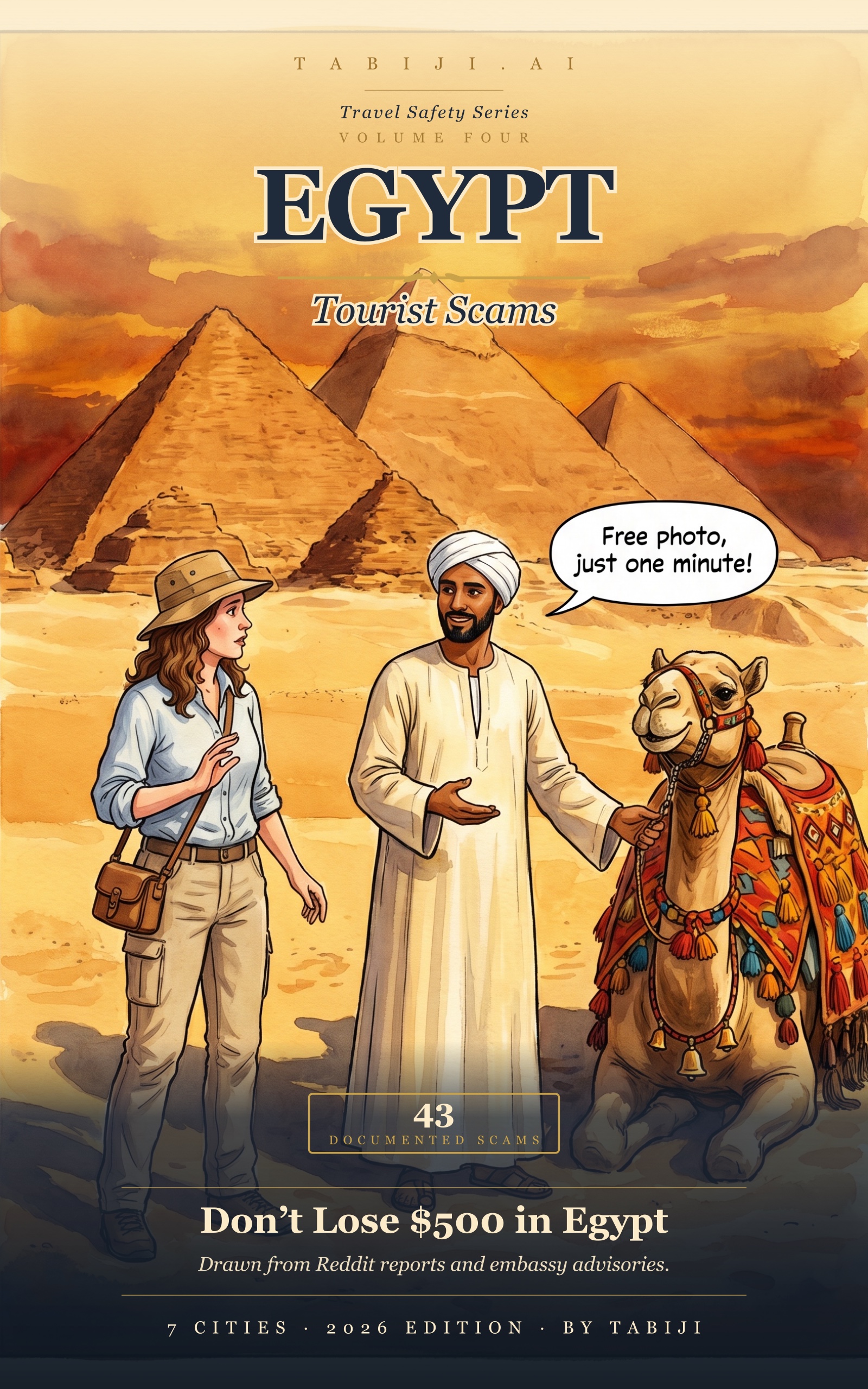
Giza pyramid camel-tout “free photo, just one minute” hostage shakedowns. Khan el-Khalili papyrus “school” markups (plant fiber sold as art). Luxor Valley of the Kings fake-guide tomb lock-ins. CAI airport “official taxi” USD overcharges. Aswan felucca captain price-doubling. Every documented Egypt scam — with the exact scripts, red flags, and Arabic phrases that shut each one down. Drawn from Reddit (Reddit, Reddit), U.S./UK/Canadian Embassy advisories, and Egyptian Tourism & Antiquities Police reports.
- 43 documented scams across Cairo, Luxor, Aswan, Hurghada & 3 more destinations
- An Arabic exit-phrase card you can screenshot to your phone
- Updated annually — buy once, re-download future editions free
- Readable in one flight — $4.99 on Amazon Kindle