
Key Takeaways
- The #1 reported scam is the Howrah Station Ticket Trap.
- 2 of 7 scams are rated high risk.
- Use app-based ride services (Uber, Ola) instead of street taxis — always confirm the fare before departure.
- Never accept unsolicited offers from strangers near tourist sites in Kolkata.
⚡ Quick Safety Tips
- Keep phones and valuables in secure pockets when in crowded areas.
- Use only licensed taxis or app-based ride services.
- Book tours and tickets through verified operators with online reviews.
- Keep a copy of your passport separate from the original.
Jump to a Scam
- High The Howrah Station Ticket Trap
- Medium The Kalighat Temple Donation Scam
- Medium The New Market Commission Guide
- High The CCU Airport Prepaid-Taxi Hotel Diversion
- Medium The Sudder Street Pickpocket Ring
- Low The Victoria Memorial Rickshaw Fare Explosion
- Medium The Kolkata Driver Currency-Note Swap
The 7 Scams
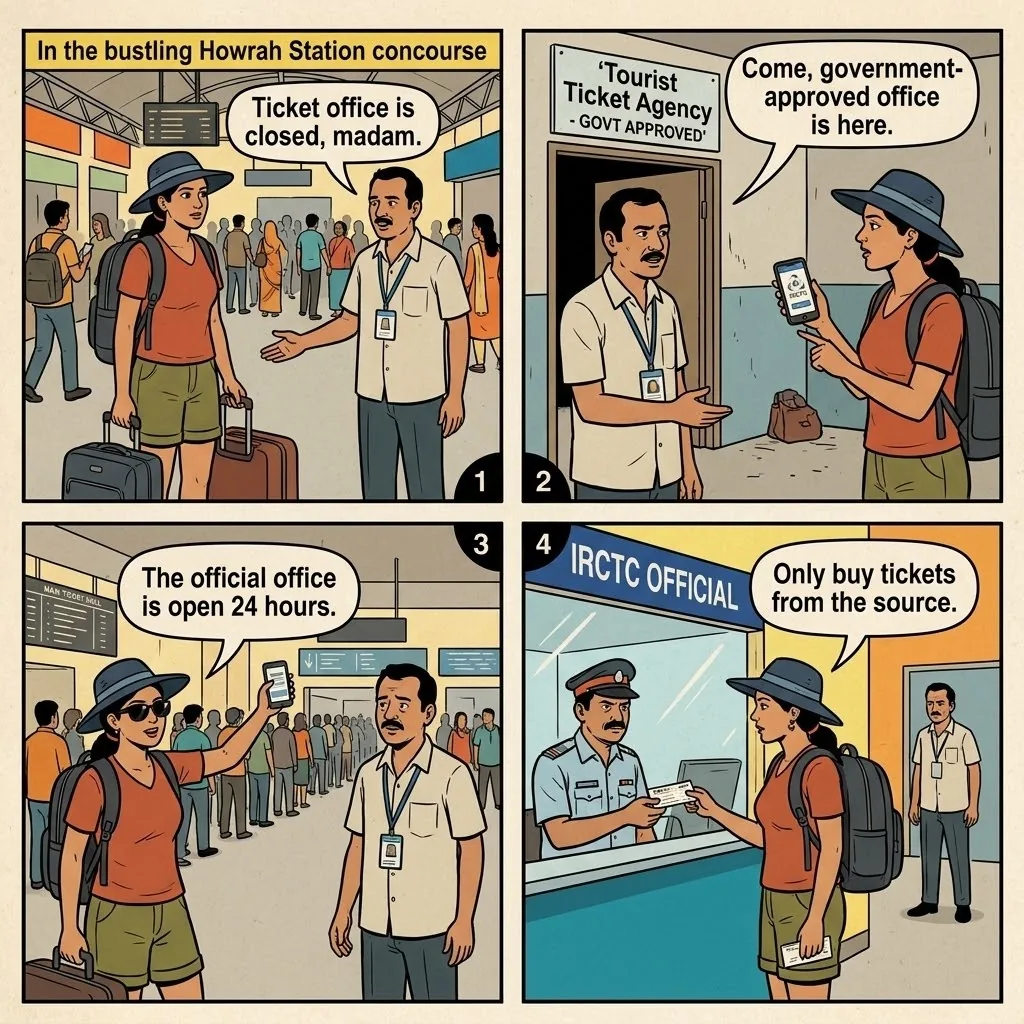
A man in a quasi-official shirt at Howrah Station tells you the official ticket office is closed and your train is fully booked — he steers you to a 'government-approved' agency nearby that charges three times the IRCTC rate plus a hefty 'service charge.'
You step off a train at Howrah Station, India's busiest railway hub, dragging your backpack through the chaos. Before you even find the exit, a man in a quasi-official looking shirt intercepts you. 'Ticket office is closed, sir. Your train is fully booked anyway. Come to our government-approved agency — I arrange everything.'
He guides you to a small office nearby where tickets cost three times the official rate plus a hefty 'service charge.' The Howrah Station touts are among India's most aggressive, and they prey specifically on disoriented arrivals who do not know the actual ticket office operates around the clock. Some 'agents' sell real tickets at inflated prices; others sell tickets on cancellable quotas that get refunded silently after you leave.
The hook is a 'station closed' lie that nobody in the arrival chaos has time to verify. The defensive move is to walk directly to the official Indian Railways ticket counter inside the station — it is open 24 hours — book in advance through the official IRCTC website or app whenever possible, and ignore anyone who approaches you unsolicited at the station, no matter how official they look. If confused, ask uniformed Railway Police (RPF) for directions, not random civilians.
Red Flags
- Someone approaches you inside or outside the station claiming the ticket office is closed
- They claim your train is canceled or fully booked without showing official evidence
- They steer you toward a 'government-approved' booking office that's actually a private shop
- The office charges significantly more than the official IRCTC rates
- They create urgency: 'Only two seats left, you must book now'
How to Avoid
- Walk directly to the official Indian Railways ticket counter inside the station -- it's always open.
- Book trains in advance through the official IRCTC website or app.
- Ignore anyone who approaches you unsolicited at the station, no matter how official they look.
- Indian Railways ticket offices never close permanently -- verify at the counter yourself.
- If confused, ask uniformed Railway Police (RPF) for directions, not random civilians.
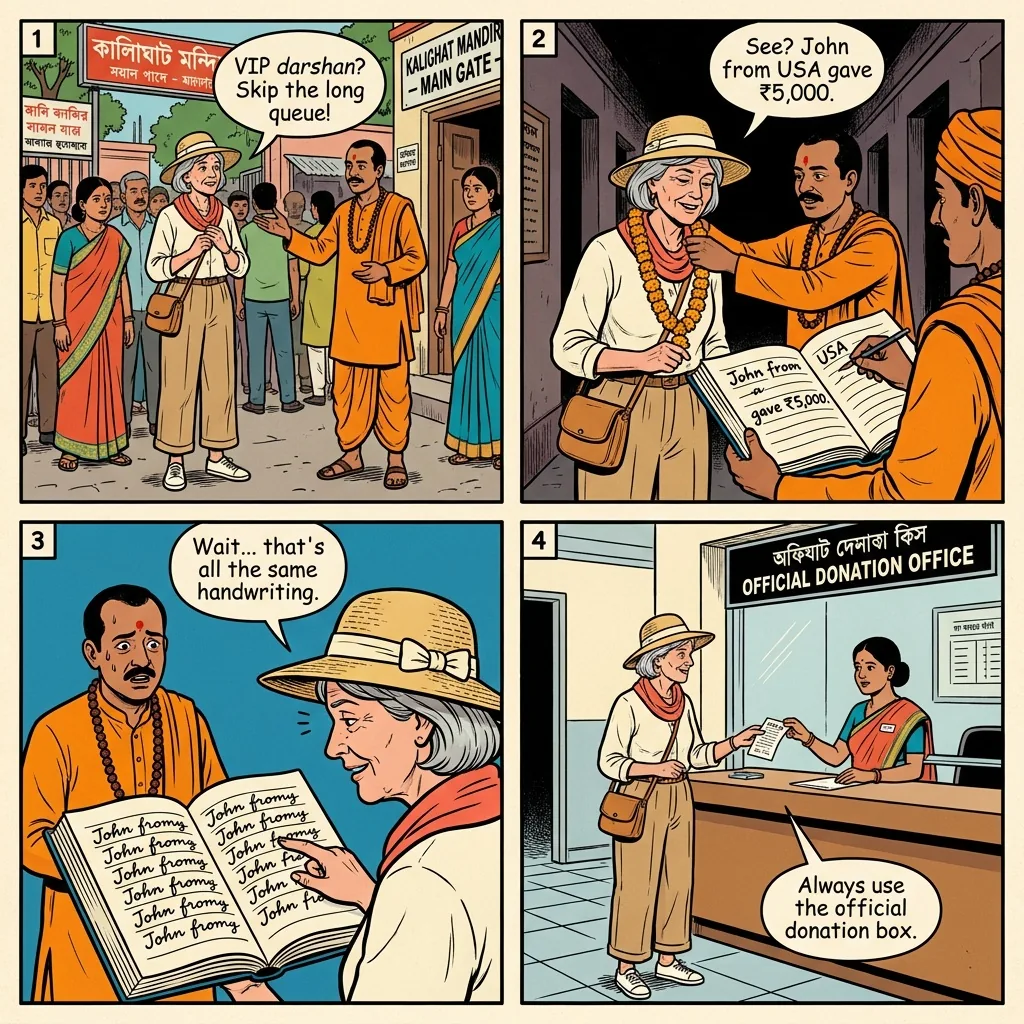
A man in saffron robes outside Kalighat Kali Temple offers 'VIP darshan' to skip the line, places flowers in your hand and vermillion on your forehead, then opens a donation book showing ₹3,000 to ₹5,000 entries from foreign visitors and demands you match them.
You arrive at the famous Kalighat Kali Temple, one of Kolkata's holiest sites. Outside Gate 2, a man in saffron robes approaches: 'I am temple Brahmin. Come, I give you VIP darshan — skip the long line.' He guides you through side corridors, placing flowers in your hand, touching your forehead with vermillion. At the sanctum, he produces a worn notebook.
'See, other tourists donated — John from USA, ₹3,000; Mark from France, ₹5,000.' The names are written in the same handwriting. He expects you to match or exceed them. Tripadvisor reviewers of Kalighat note that fake pandits pocket 100 percent of these 'donations' — none of it reaches the temple, and the 'priest' is not actually authorized to enter the sanctum at all.
The hook is religious cover plus an obligation that lands before any price is named. The defensive move is to enter through the official Gate 2 public entrance and stand in the regular darshan line, never accept items placed in your hands by strangers (this creates a felt obligation to pay), and use only the official donation box inside the temple if you want to give. A firm 'Nahi chahiye' (I don't need it) and a steady walk is the cleanest exit.
Red Flags
- Someone outside the temple offers VIP or skip-the-line darshan for a fee
- They show a donation book with suspiciously neat entries and foreign names with large amounts
- They place items in your hands (flowers, offerings) without asking, then demand payment
- The 'priest' is not inside the temple sanctum but operating in corridors and outside gates
- They become aggressive or invoke spiritual consequences if you refuse to donate
How to Avoid
- Enter through the official Gate 2 public entrance and stand in the regular darshan line.
- Buy puja accessories from authorized stalls before entering, not from individuals outside.
- Never accept items placed in your hands by strangers -- this creates an obligation to pay.
- If you want to donate, use only the official donation box inside the temple.
- Say 'Nahi chahiye' (I don't need it) firmly and keep walking.
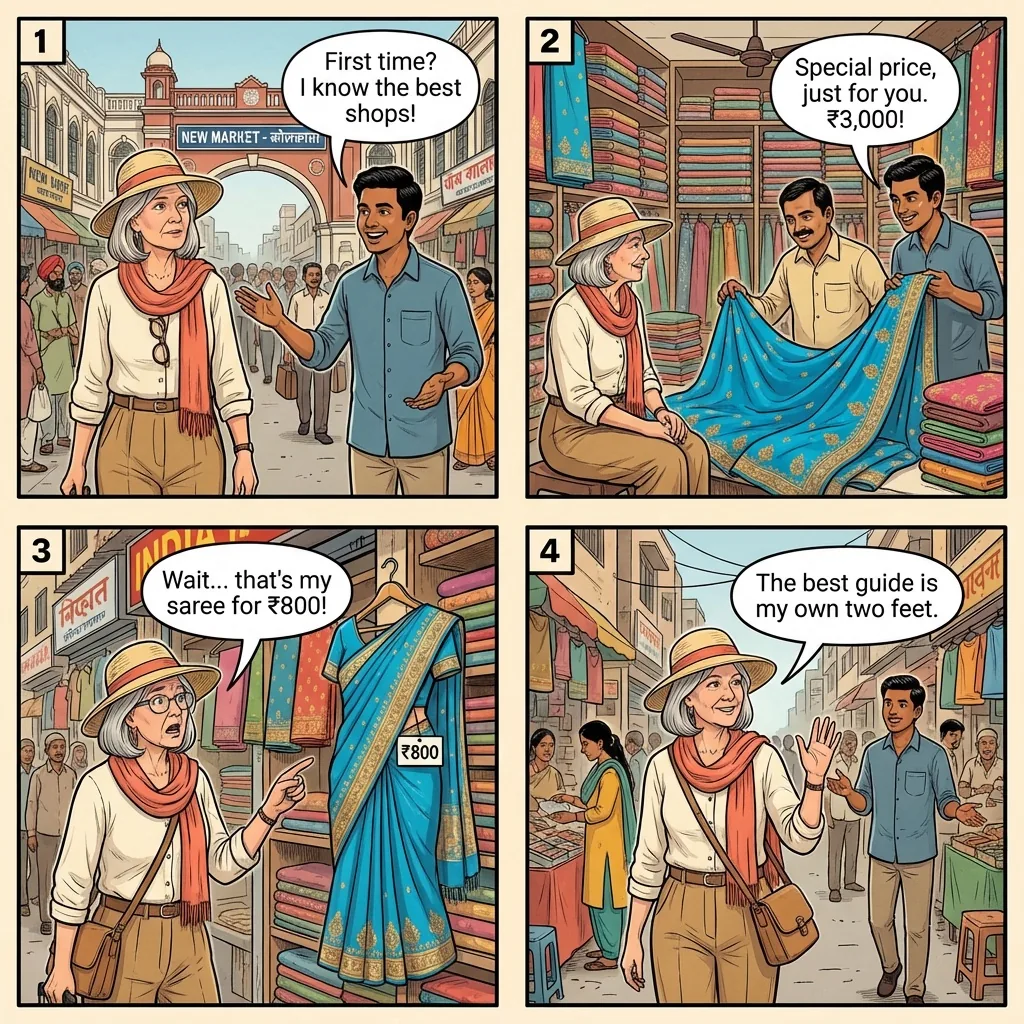
A friendly young man at New Market on Lindsay Street offers to lead you to 'wholesale-price' fabric shops — he earns 30 to 40% commission on everything you buy, and a silk saree he quotes at ₹3,000 has a near-twin three stalls away for ₹800.
You enter New Market — Kolkata's iconic Victorian-era shopping bazaar on Lindsay Street, also known as Hogg Market — looking for Bengali textiles. Almost immediately, a friendly young man appears: 'First time? I know the best shops — wholesale prices, very cheap.' He leads you through the maze of stalls to a fabric shop where the owner greets him like family.
The silk saree the owner quotes at ₹3,000 has a near-twin three stalls away for ₹800. Your 'guide' earns 30 to 40 percent commission on everything you buy, and the price difference is built into every quote. New Market's self-appointed guides are essentially working salesmen who add a 300 to 500 percent markup to every purchase, with the shopkeepers participating fully in the script.
The hook is genuine confusion at a Victorian-era maze plus the relief of a friendly local 'guide'. The defensive move is to firmly decline all unsolicited guides at the entrance ('No guide needed, thank you'), shop independently and compare prices at multiple stalls before buying, and visit fixed-price government emporia like Manjusha or Biswa Bangla for guaranteed fair rates on Bengali textiles.
Red Flags
- An unsolicited guide appears the moment you enter the market
- They claim to know 'wholesale' or 'factory direct' prices at specific shops
- The shops they take you to have no visible price tags on merchandise
- The guide and shopkeeper clearly know each other and communicate in Bengali about pricing
- The guide becomes offended or aggressive if you want to browse independently
How to Avoid
- Firmly decline all unsolicited guides at the market entrance: 'No guide needed, thank you.'
- Shop independently and compare prices at multiple stalls before buying.
- Ask for prices at stalls the guide did NOT suggest to establish a baseline.
- Use Google Maps to pre-identify specific shops with good reviews before visiting.
- Visit the fixed-price government emporium shops (Manjusha, Biswa Bangla) for guaranteed fair rates.
Like what you're reading? Get a full Kolkata itinerary with safety tips built in.
Browse travel-safety books →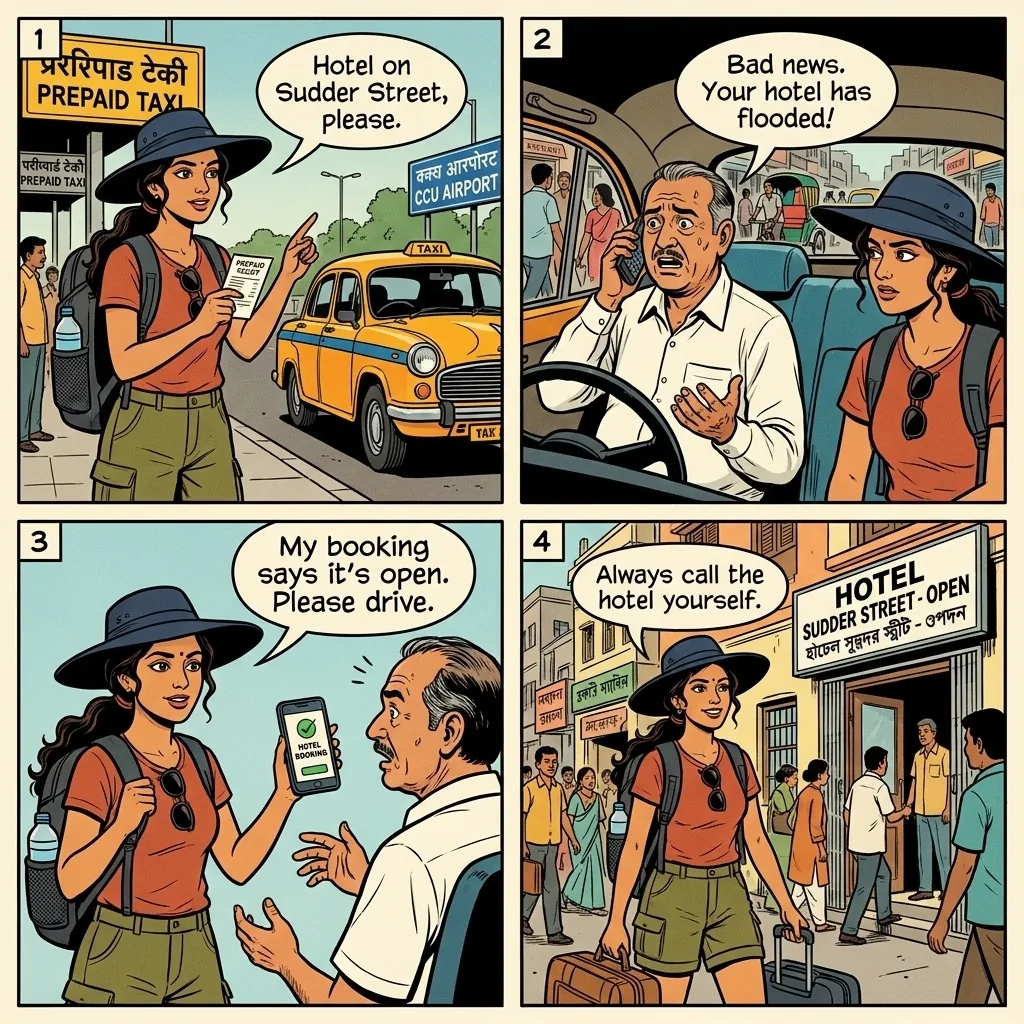
Twenty minutes from Kolkata airport, your prepaid-taxi driver pulls over, fakes a phone call, and announces your hotel has 'flooded' or 'closed' — his brother's place is conveniently nearby and pays him ₹500 to ₹1,000 per delivered tourist.
You land at Netaji Subhas Chandra Bose International Airport (CCU) and take a prepaid taxi to your hotel on Sudder Street. Twenty minutes into the ride, the driver pulls over and makes a phone call in Bengali. He turns to you with rehearsed concern: 'Sir, very bad news. Your hotel has closed down. Water problem, flooding. But don't worry — my brother has a nice guesthouse nearby, very clean.'
You have already paid the prepaid fare, so the driver has no incentive to push the route. The hotel is perfectly fine. The driver's 'brother' pays him ₹500 to ₹1,000 for every tourist delivered, which is significantly more than the prepaid taxi receipts. Tripadvisor's Kolkata forum has documented this play across years of arrival reports, and it is one of India's most common arrival scams.
The hook is arrival exhaustion plus a fabricated emergency you cannot verify from the back seat. The defensive move is to call your hotel before getting in any taxi to confirm the reservation, insist the driver take you to the booked address ('Take me there anyway — I'll check myself'), and use Ola or Uber from CCU for GPS-tracked rides directly to your hotel. Show the driver the booking confirmation address before you set off.
Red Flags
- The driver claims your hotel is closed, flooded, burned down, or overbooked
- He makes a mysterious phone call mid-journey then delivers the bad news
- He has an immediate alternative ready -- always run by his friend, brother, or cousin
- The alternative is conveniently nearby while your actual hotel is 'too far now'
- He refuses to take you to your original hotel to verify the claim yourself
How to Avoid
- Call your hotel before getting in the taxi to confirm your reservation and get their exact address.
- Insist the driver take you to your booked hotel: 'Take me there anyway -- I'll check myself.'
- Use Ola or Uber from the airport for GPS-tracked rides directly to your hotel.
- Have your hotel confirmation with the address saved on your phone to show the driver.
- If the driver refuses to go to your hotel, get out and find another taxi.
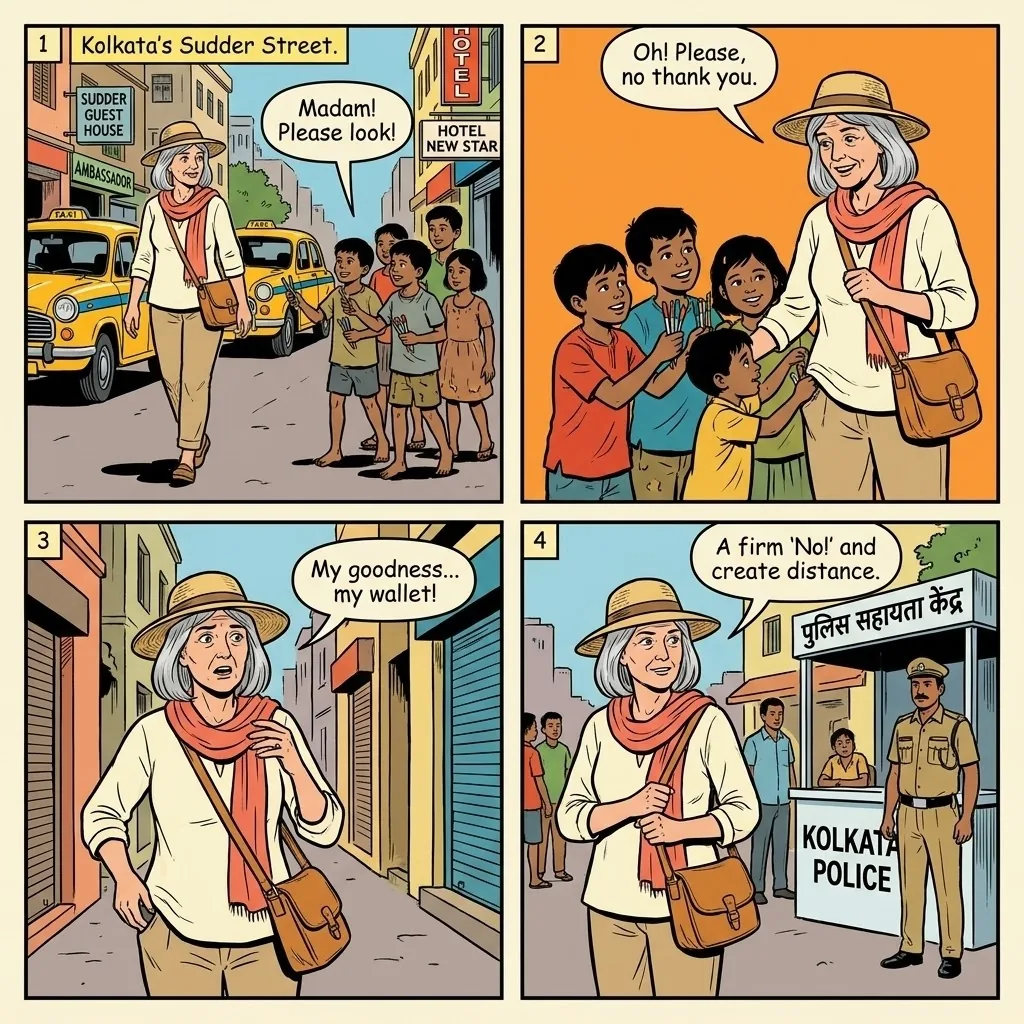
A coordinated cluster of children appears on Sudder Street, tugging at your clothes from all sides while one quietly reaches into your pocket — the youngest does the lift while older 'kids' in the group create the distraction.
You are walking down Sudder Street, Kolkata's famous backpacker hub, checking your phone for restaurant options. A cluster of small children appears, tugging at your sleeves and clothes, showing you trinkets, making noise. They are persistent and surprisingly coordinated, pressing close from all sides. One pulls your arm while another reaches for your pocket.
By the time you have gently pushed through the group, your wallet is gone. Kolkata safety guides have documented organized child pickpocket groups operating specifically along Sudder Street and the lanes between Sudder Street and Park Street. The youngest children do the actual theft because they are smaller and harder to suspect; older children or teenagers create the noise and direct the group from a few meters away.
The hook is a wave of small bodies that converts your instinct toward kindness into a multi-direction distraction. The defensive move is to keep valuables in a money belt or deep front pocket (never in back pockets), carry only the cash you need with the rest in the hotel safe, and when children approach in a group say 'No' firmly and walk away quickly without stopping. A cross-body bag worn in front with the zipper against your body is the simplest physical defense.
Red Flags
- A group of children suddenly surrounds you in an organized manner
- They pull at your clothing, hands, and bags simultaneously from multiple directions
- The children are persistent even when you say no and try to walk away
- An older child or teenager watches from nearby, directing the group
- You feel light touches near your pockets, waistband, or bag zippers
How to Avoid
- Keep valuables in a money belt or deep front pocket, never in back pockets.
- Carry only the cash you need and leave extra money in your hotel safe.
- When children approach in a group, firmly say 'No' and walk away quickly without stopping.
- Avoid walking through Sudder Street's narrow lanes after dark with visible electronics.
- Use a cross-body bag worn in front with the zipper against your body.
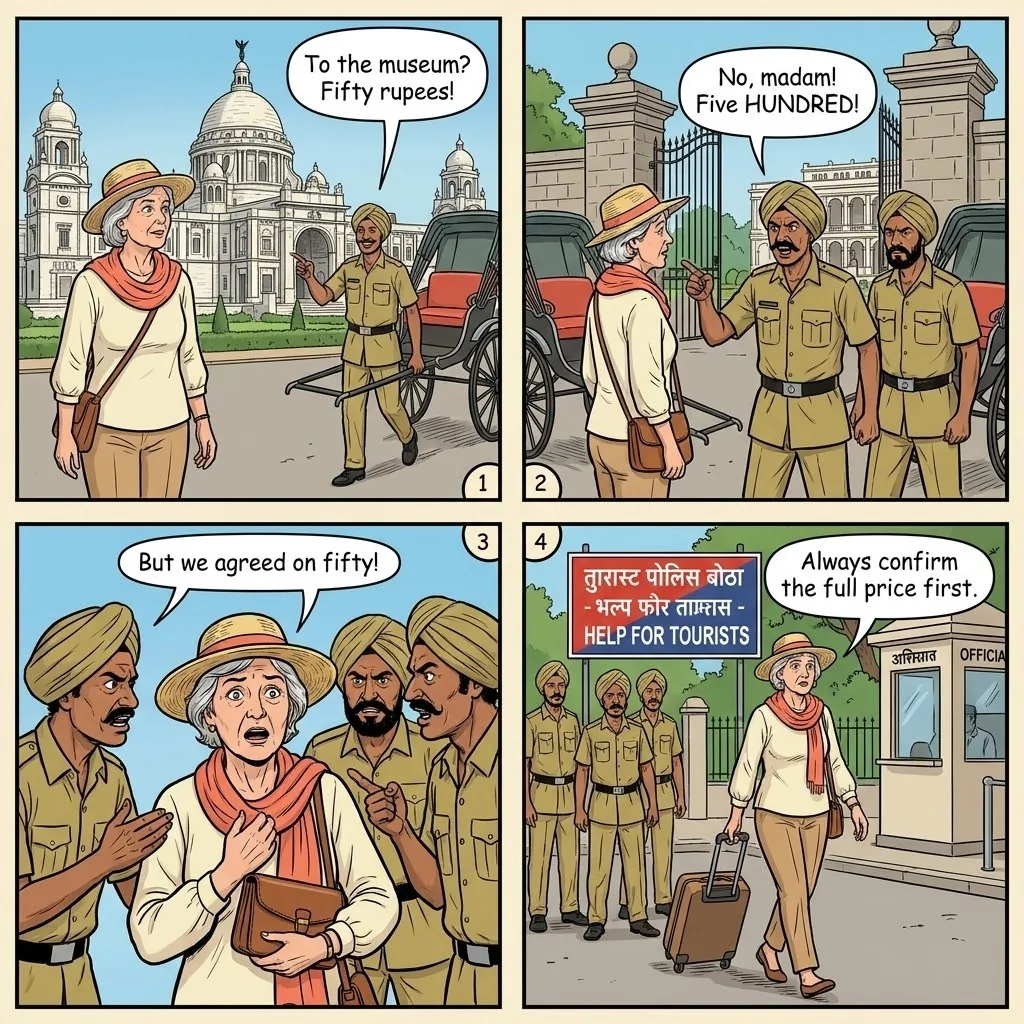
A hand-pulled rickshaw at Victoria Memorial agrees to ₹50 for a short ride to the Indian Museum; at the museum gates the puller demands ₹500, and two backup pullers materialize within seconds to insist that was always the price.
Outside the Victoria Memorial, you hail one of Kolkata's iconic hand-pulled rickshaws for a short ride to the Indian Museum. The puller agrees to ₹50. It is a slow, atmospheric journey through the Maidan's green expanse. At the museum gates, the puller suddenly demands ₹500, gesturing angrily.
Within seconds, two other rickshaw pullers materialize to support his claim, insisting the price was always ₹500. The backup pullers are part of the act — they work the Victoria Memorial area in teams, knowing solo tourists will not risk a confrontation against a group. The hand-pulled rickshaws are charming and historically significant, but the tourist-corridor pullers have built a small economy around the fare-explosion routine.
The hook is an agreed price too good to refuse plus a small crowd at delivery to make refusal feel unsafe. The defensive move is to confirm the fare with both fingers and a phone-screen number that the puller nods to, carry exact change in 10 and 20 rupee notes so you can pay precisely what was agreed, and use Ola or Uber for any longer ride where fare disputes are more likely. If confronted, stay calm, pay the originally agreed amount, and walk toward a busy area or a uniformed officer.
Red Flags
- The rickshaw puller agrees to your price too easily without any counter-offer
- At the destination, the agreed price suddenly multiplies by a factor of ten
- Other rickshaw pullers appear to back up the driver's inflated claim
- The pullers become physically imposing or block your path to pressure payment
- They switch between languages, speaking Bengali among themselves and broken English to you
How to Avoid
- Confirm the fare clearly: hold up fingers showing the number and have the puller nod in agreement.
- Write the agreed price on your phone and show it to the puller before starting.
- Carry exact change in small bills (10 and 20 rupee notes) so you can pay precisely what was agreed.
- Use Ola or Uber for longer rides where fare disputes are more likely.
- If confronted by a group, stay calm, pay the originally agreed amount, and walk toward a busy area or police officer.
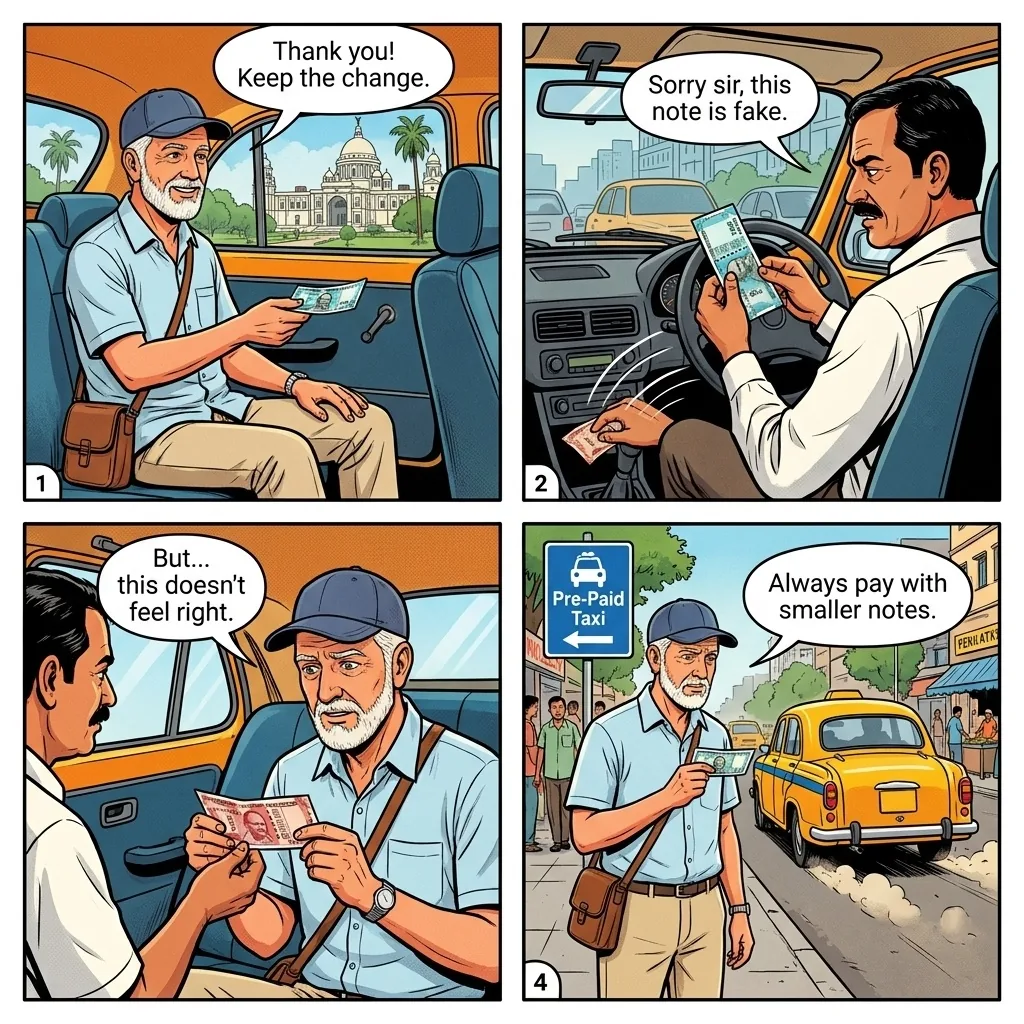
You pay a Kolkata taxi driver with a ₹500 note for a ₹200 fare; he frowns, claims the note is 'fake,' and hands back what looks like the same note — he has just swapped your real ₹500 for a counterfeit through sleight of hand.
You hand a Kolkata taxi driver a ₹500 note for a ₹200 fare. He examines it, frowns, and hands it back: 'Sir, this note is fake. See, the watermark is wrong.' He shows you what appears to be the same note — but it is not. Through sleight of hand, he has swapped your genuine ₹500 note for a counterfeit one. Now you are holding a worthless bill, and he insists on a different note for the fare.
The currency swap is a practiced magic trick that targets tourists unfamiliar with Indian banknote security features. India travel forums and Reddit have documented variations across taxi drivers, street vendors, and small shops in central Kolkata — almost always with ₹500 or ₹2,000 notes, never with small bills. The driver's read of your unfamiliarity with the watermark, security thread, and color-shift ink is what makes the swap work.
The hook is your willingness to accept the driver's authority on what a 'real' Indian note looks like. The defensive move is to photograph or note the serial number of any large bill before handing it over, watch the note at all times and never let it go below a counter or out of your sight, and pay with exact change or small denominations whenever possible. Familiarize yourself with the security features (watermark, security thread, microlettering) of Indian banknotes before your trip.
Red Flags
- A driver or vendor claims your note is fake immediately after you hand it over
- They examine the note below the counter or at an angle where you can't see the swap
- The 'returned' note looks slightly different in color or feel from the one you gave
- They insist on payment with a different note or in smaller denominations
- This happens with a 500 or 2000 rupee note -- never with small bills
How to Avoid
- Before handing over large notes, photograph them or note the serial number.
- Watch the note at all times and never let it go below a counter or out of your sight.
- Pay with exact change or small denominations whenever possible.
- Exchange currency only at banks or authorized exchange counters, not at street stalls.
- Familiarize yourself with Indian banknote security features before your trip.
🆘 What to Do If You Get Scammed
📋 File a Police Report
Go to the nearest Indian Police station. Call 100 (Police) or 112 (Emergency). Get an official crime report — you'll need this for insurance claims. You can also report online at citizenservices.gov.in.
💳 Cancel Your Cards
Call your bank immediately. Most have 24/7 numbers on the back of the card (keep a photo saved separately). Block any suspicious transactions before the thieves use your details.
🛂 Lost Passport?
Contact your nearest embassy or consulate. The US Embassy in New Delhi is at Shantipath, Chanakyapuri, New Delhi 110021. For emergencies: +91 11-2419-8000.
📱 Track Your Device
If your phone was stolen, use Find My (iPhone) or Find My Device (Android) from another device. Don't confront thieves yourself — share the location with police instead.
Frequently Asked Questions
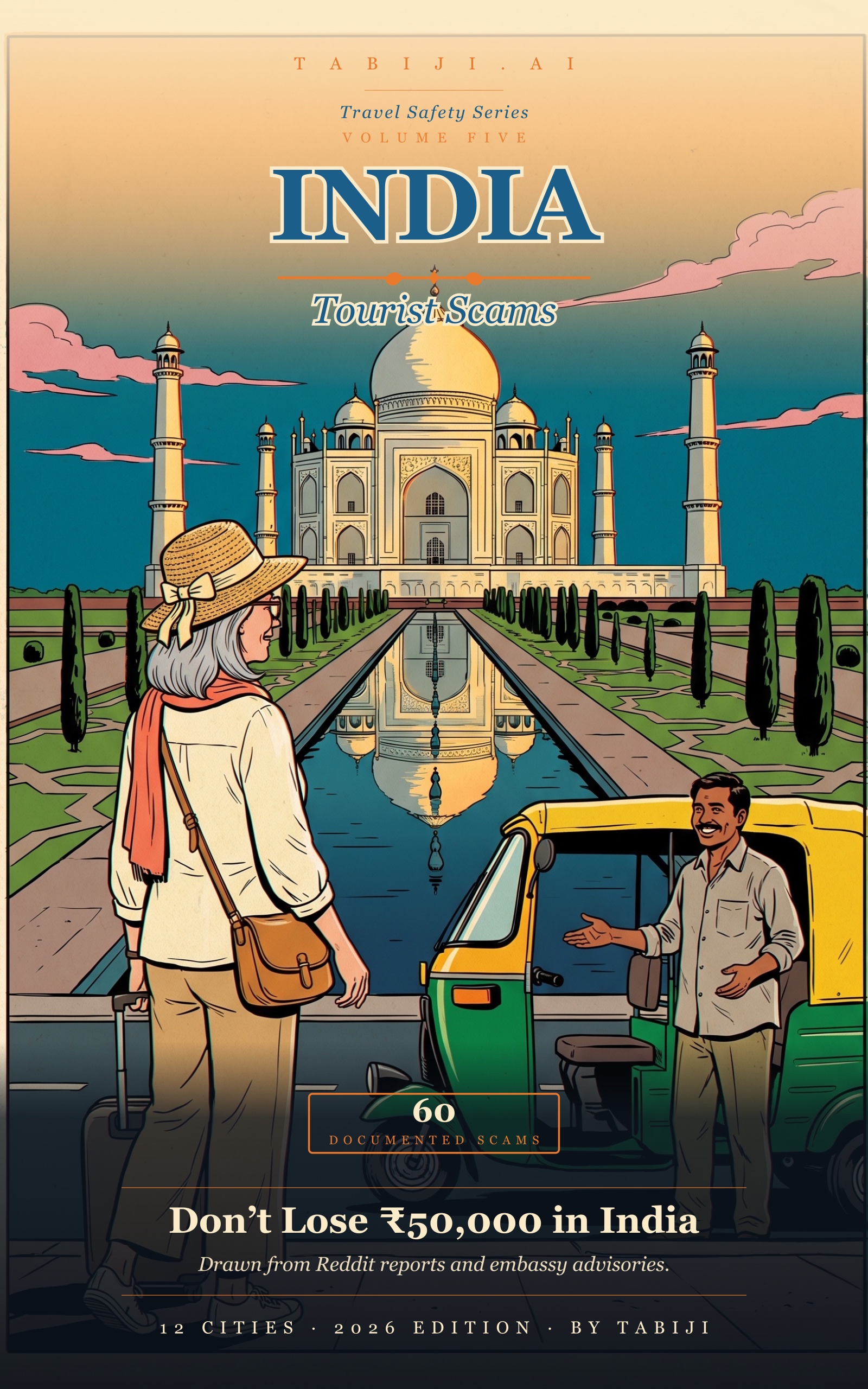
You just read 7 scams in Kolkata. The book has 60 across 12 Indian cities.
Delhi’s Paharganj “India Tourism” rebooking trap. Jaipur’s Hawa Mahal rickshaw textile detour. Mumbai’s ₹61,000 dating-app pub bill. The Lake Pichola sunset-photo extortion. The Bengaluru Silk Board meter manipulation. Every documented India scam — with the exact scripts, red flags, and Hindi phrases that shut each one down. Drawn from Reddit, the Times of India, News18, Telangana Today, and embassy advisories.
- 60 documented scams across Delhi, Mumbai, Jaipur, Agra & 8 more cities
- A Hindi exit-phrase card (Devanagari + Latin) you can screenshot to your phone
- Updated annually — buy once, re-download future editions free
- Readable in one flight — $4.99, coming soon on Amazon Kindle