
Key Takeaways
- The #1 reported scam is the Ganga Offering Shake-Down.
- Most scams in Varanasi are low-to-medium risk.
- Use app-based ride services (Uber, Ola) instead of street taxis — always confirm the fare before departure.
- Never accept unsolicited offers from strangers near tourist sites in Varanasi.
⚡ Quick Safety Tips
- Keep phones and valuables in secure pockets when in crowded areas.
- Use only licensed taxis or app-based ride services.
- Book tours and tickets through verified operators with online reviews.
- Keep a copy of your passport separate from the original.
Jump to a Scam
The 3 Scams
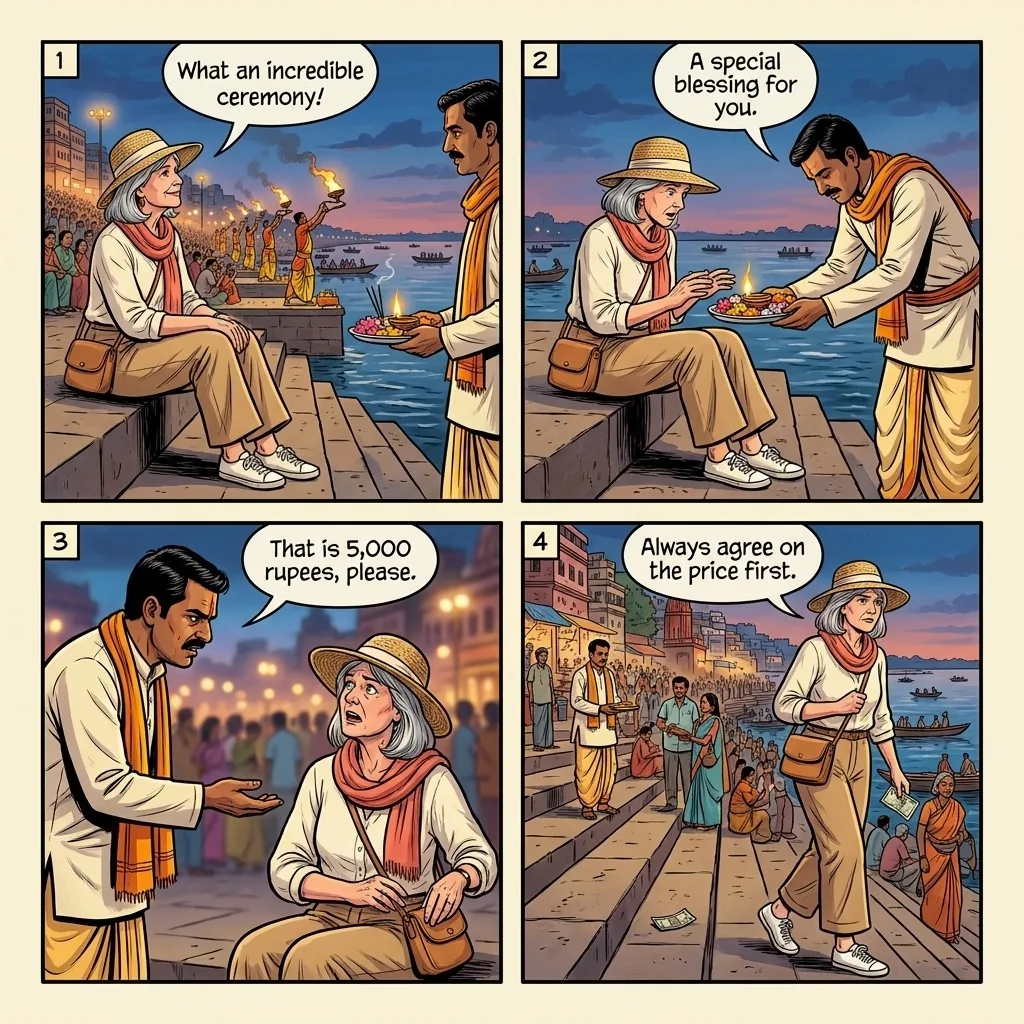
A 'priest' at Dashashwamedh Ghat places an oil lamp and flower offering on your lap during the evening Ganga Aarti, says a quick prayer pushing them toward the river, then demands ₹2,000 to ₹5,000 for the 'ceremony.'
You are watching the evening Ganga Aarti ceremony at Dashashwamedh Ghat — one of Varanasi's defining experiences — when a man in priestly garb places a flower offering and a small oil lamp on your lap. Before you can react, he pushes them toward the river and says a prayer.
Then comes the demand: ₹2,000 to ₹5,000 for the 'ceremony' he just performed. If you have not agreed to a price upfront, you are stuck in an awkward negotiation at a sacred site with crowds watching. The man is rarely affiliated with any of the actual ghat temples — he is freelancing the priestly costume and the timing of the Aarti, when no one wants to make a scene.
The hook is religious cover plus a ritual that lands before any price is named. The defensive move is to never accept items placed in your hands without asking the price first, watch the Ganga Aarti for free from the steps without participating in any unsolicited offering, and if you genuinely want to do a Ganga puja, negotiate the price clearly beforehand (₹100 to ₹200 is fair). Politely say 'Nahi chahiye' (I don't want it) and keep your hands at your sides.
Red Flags
- Items placed in your hands without asking
- No price discussion before the ceremony
- Priestly dress but no affiliation with the main ghat temples
- Emotional pressure using religious significance
How to Avoid
- Never accept items placed in your hands without asking the price first.
- The Ganga Aarti at Dashashwamedh Ghat is free to watch from the steps.
- If you want to do an offering, negotiate the price clearly beforehand (₹100-200 is fair).
- Politely say 'Nahi chahiye' (I don't want it) and keep your hands at your sides.
Like what you're reading? Get a full Varanasi itinerary with safety tips built in.
Browse travel-safety books →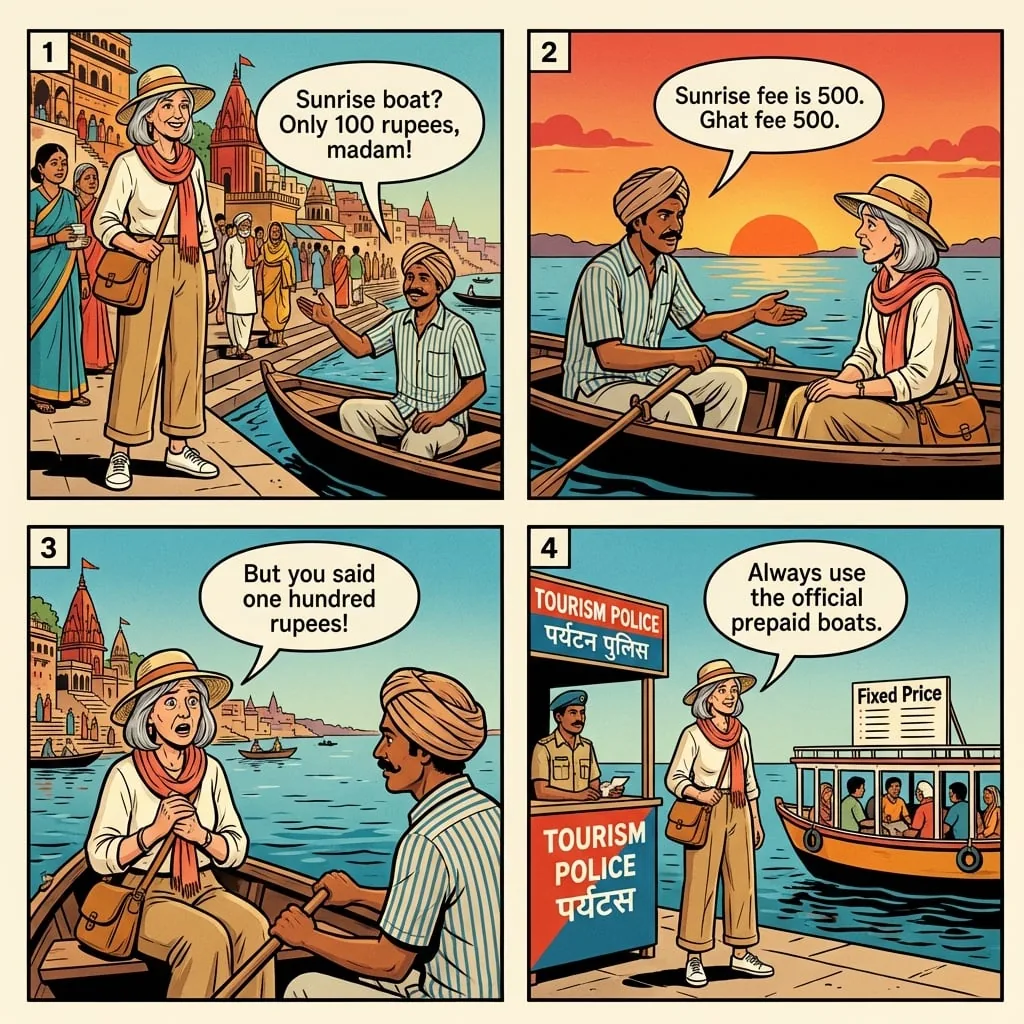
A boatman at the Ganges ghats offers a sunrise ride for ₹100 — halfway through, he announces a 'sunrise viewing fee,' a 'burning-ghat stop fee,' and a 'return surcharge,' turning a ₹100 ride into ₹1,500.
A boatman at the Ganges ghats offers a sunrise ride for ₹100. The price is roughly a third of the going rate, the timing is unbeatable (the sun rising over the river is one of Varanasi's iconic experiences), and you climb in. He pushes off into the current.
Halfway through, the additions begin. The 'sunrise viewing fee' is extra. Stopping at the burning ghat — the sight you came to see — costs more. Returning to your original ghat has a 'surcharge.' Your ₹100 ride becomes ₹1,500. If you refuse, he threatens to leave you at a ghat far from your hotel, in lanes you do not know, and the implicit pressure is that you are alone on a river with a man controlling the route.
The hook is a sub-market quote that buys him your captive position on the water. The defensive move is to agree on the exact total price including all stops and the return ghat before boarding (have the boatman confirm in writing if possible), know that ₹300 to ₹500 per hour is fair for a private boat, and book through your hotel or a verified agency where the price is locked.
Red Flags
- Very low initial quoted price
- No written agreement on what's included
- Extra charges announced mid-ride
How to Avoid
- Agree on exact price, duration, stops, and return point before boarding.
- ₹300-500 per hour is the fair rate for a private boat.
- Book through your hotel or a verified agency.
- Have the boatman confirm the total price — ideally written down.
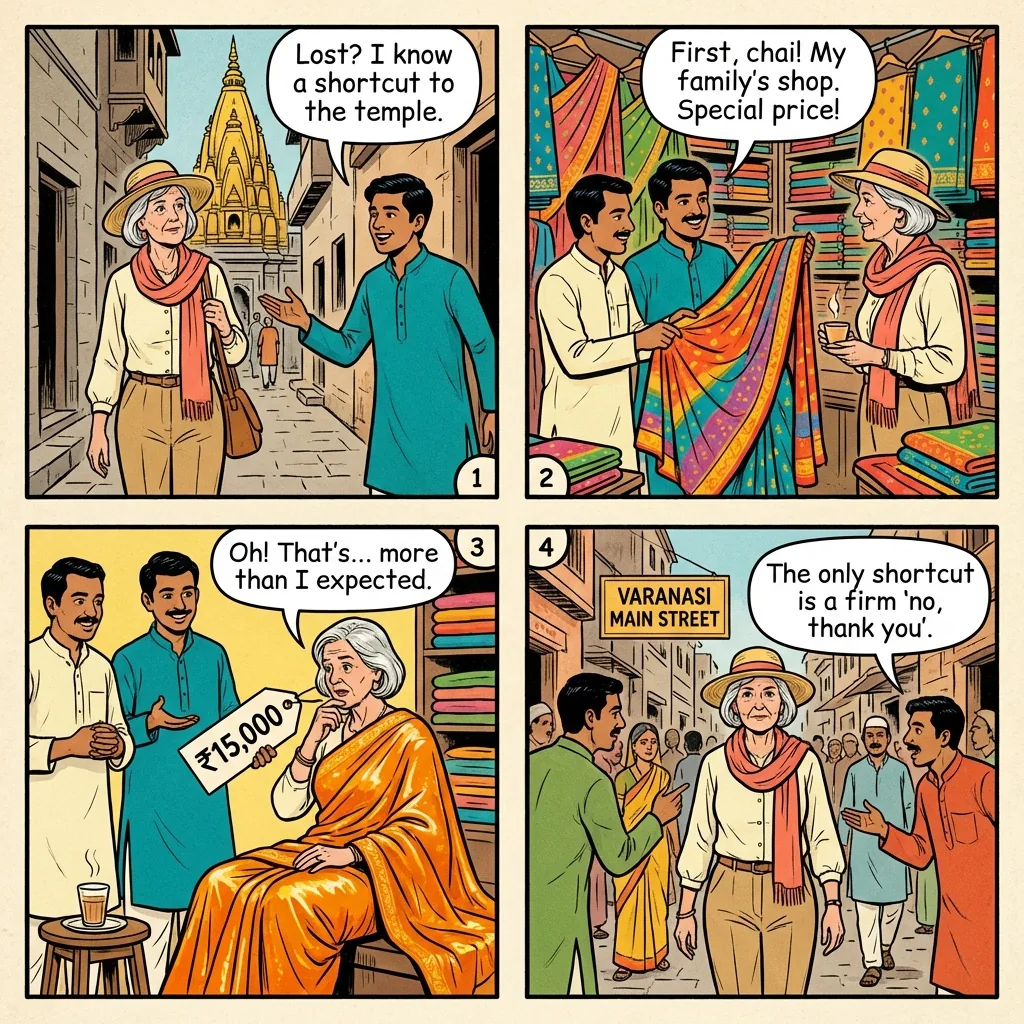
A friendly young man offers a 'shortcut' through the maze-like lanes near Vishwanath Temple — it passes directly through his family's silk shop where 'authentic Banarasi silk' turns out to be machine-made polyester at 10x its value.
A friendly young man near Vishwanath Temple offers to show you a 'shortcut' through the maze-like lanes that surround the temple complex. The lanes are genuinely confusing — they are narrow, unmarked, and unmappable on Google. You accept.
The shortcut happens to pass directly through his family's silk shop. Inside, you are served chai and shown 'authentic Banarasi silk' at 'special prices.' The chai is genuinely good. The silk is often machine-made polyester sold at ten times its value, with the 'government-certified' tag attached to the bolt being either fictional or transferred from a real piece kept in the back. Saying no after accepting hospitality feels rude — which is exactly the plan.
The hook is navigational confusion plus the social weight of accepting chai. The defensive move is to navigate the Vishwanath lanes yourself with Google Maps (the GPS works, just more slowly than usual), decline 'shortcuts' from strangers, and if you want real Banarasi silk, buy from government emporiums like UP Handloom or certified handloom cooperatives where the weave is tagged. It is perfectly acceptable to drink the chai and leave without buying.
Red Flags
- Unsolicited guide through narrow lanes
- Route conveniently passes through a shop
- Free chai and excessive hospitality
- Claims of 'government-certified' silk with no verifiable proof
How to Avoid
- Navigate using Google Maps — don't accept shortcuts from strangers.
- Authentic Banarasi silk has a specific weave pattern and feel — research before buying.
- It's perfectly fine to drink the chai and leave without buying.
- Buy silk from government emporiums like UP Handloom for guaranteed quality.
🆘 What to Do If You Get Scammed
📋 File a Police Report
Go to the nearest Indian Police station. Call 100 (Police) or 112 (Emergency). Get an official crime report — you'll need this for insurance claims. You can also report online at citizenservices.gov.in.
💳 Cancel Your Cards
Call your bank immediately. Most have 24/7 numbers on the back of the card (keep a photo saved separately). Block any suspicious transactions before the thieves use your details.
🛂 Lost Passport?
Contact your nearest embassy or consulate. The US Embassy in New Delhi is at Shantipath, Chanakyapuri, New Delhi 110021. For emergencies: +91 11-2419-8000.
📱 Track Your Device
If your phone was stolen, use Find My (iPhone) or Find My Device (Android) from another device. Don't confront thieves yourself — share the location with police instead.
Frequently Asked Questions

You just read 3 scams in Varanasi. The book has 60 across 12 Indian cities.
Delhi’s Paharganj “India Tourism” rebooking trap. Jaipur’s Hawa Mahal rickshaw textile detour. Mumbai’s ₹61,000 dating-app pub bill. The Lake Pichola sunset-photo extortion. The Bengaluru Silk Board meter manipulation. Every documented India scam — with the exact scripts, red flags, and Hindi phrases that shut each one down. Drawn from Reddit, the Times of India, News18, Telangana Today, and embassy advisories.
- 60 documented scams across Delhi, Mumbai, Jaipur, Agra & 8 more cities
- A Hindi exit-phrase card (Devanagari + Latin) you can screenshot to your phone
- Updated annually — buy once, re-download future editions free
- Readable in one flight — $4.99, coming soon on Amazon Kindle