
Key Takeaways
- The #1 reported scam is the Marble factory commission tour overcharge
- 3 of 5 scams are rated high risk
- Use app-based ride services (Uber, Ola) instead of street taxis — always confirm the fare before departure
- Never accept unsolicited offers from strangers near tourist sites in Agra
⚡ Quick Safety Tips
- Book Taj Mahal tickets only at asi.payumoney.com or the Incredible India tourism portal — the foreigner ticket is ₹1,300 with mausoleum access; lookalike sites like ticketstajmahal.com sold $35 invalid passes that the Times of India covered in April 2026
- Refuse every driver-suggested marble factory, leather workshop, or government emporium detour — these are 30% to 40% commission stops where small inlay bowls run from $400 to $2,500 against ₹3,000 at Sadar Bazaar or Kinari Bazaar
- At Fatehpur Sikri, hire guides only from the Archaeological Survey of India counter inside the monument and remember the Agra Development Authority cap that no chadar at the Sheikh Salim Chishti dargah may cost more than ₹500
- On Delhi-Agra Uber Intercity rides, real Yamuna Expressway and city tolls run roughly ₹800 to ₹1,000 — pay only at the toll plaza booth and message Uber Support inside the ride if a driver demands ₹2,500 or more in cash
- Save the Agra Tourist Police hotline +91 9454402764 and the all-India emergency 112 in your phone before you arrive; the tourist police email [email protected] handles complaints from foreign visitors
Jump to a Scam
The 5 Scams
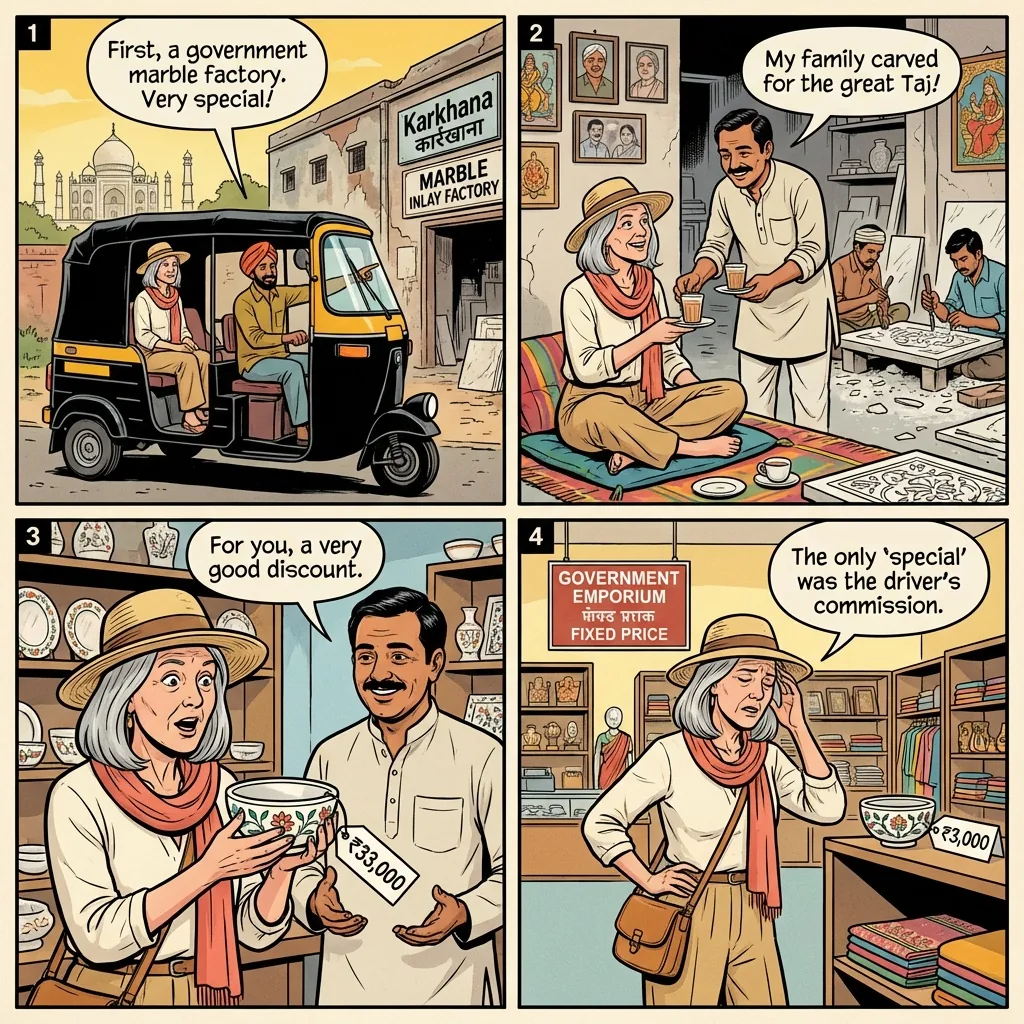
A driver routes your sightseeing day to a 'marble factory' near the Taj where staff push $400 to $2,500 inlay bowls that retail elsewhere for ₹3,000.
The pitch is theater. A polite owner walks you past artisans tapping pietra dura into white Makrana marble, claims his family carved for the original Taj craftsmen, and serves chai. The driver waits outside on commission. By the time you sit down on the showroom cushions, refusing to buy feels rude.
Then the price tags arrive. A small lotus bowl is offered at ₹33,000, a coaster set at $400, a single inlay piece at $2,500. When you flinch, a discount appears, then another, until you settle around ₹30,000 thinking you negotiated well. In November 2025, News18 documented an American tourist who paid ₹37,000 for a bag in a Taj-area shop. In February 2026, the Times of India covered a traveler who paid $2,500 for a single small piece and asked Reddit if he had been scammed.
The hook is manufactured authenticity plus driver-bundled trust — the man at the wheel becomes your local fixer, and his cut on every sale is invisible to you. Travelers have repeatedly documented the same showroom playbook running daily out of Tajganj. The defensive move is to buy marble only at hotel-vetted Sadar Bazaar or Kinari Bazaar shops where a comparable inlay bowl runs ₹2,500 to ₹4,000.
Red Flags
- driver volunteers a 'marble factory' or 'government emporium' detour you did not request
- owner claims direct lineage from the artisans who built the Taj Mahal
- no marked prices anywhere in the showroom and rapid-fire 'special discount' offers
- starting quotes in US dollars when the real local price is in low ₹thousands
- staff blocks the door with chai refills while one person fills out a hand-written invoice
How to Avoid
- REFUSE every driver-suggested shop detour and stick to the Taj Mahal, Agra Fort, and your hotel.
- BUY marble inlay only at Sadar Bazaar or Kinari Bazaar after comparing three vendors.
- ASK your hotel concierge for a written cab itinerary that lists no shopping stops.
- PAY by card, never cash, so you can chargeback through your bank if the price was inflated.
- REPORT overcharging to the Agra Tourist Police on +91 9454402764 before you leave the city.
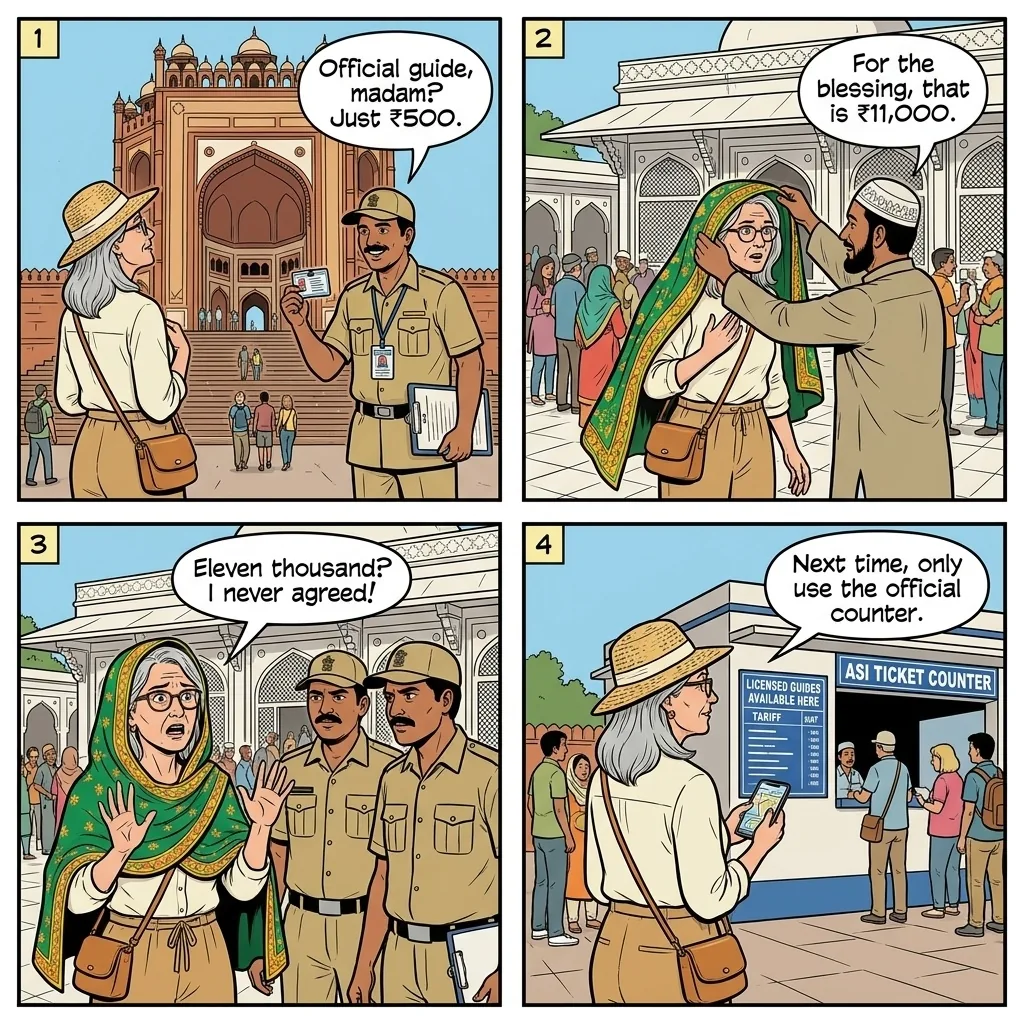
A self-styled 'ASI-licensed' guide at Buland Darwaza walks you to the Sheikh Salim Chishti dargah, where chadar walas demand ₹1,100 to ₹15,000 for a cloth offering you never agreed to.
The opener is calm. He flashes a laminated badge, names a tour fee around ₹500 to ₹2,000, and promises history. He delays the palace stops so you reach the dargah after the crowd thins, when refusing in front of religious staff feels harder.
Inside, the script flips. A man performs a brief ritual with the chadar before any price is named, then announces a 'donation' of ₹1,100, ₹15,000, or even ₹90,000 for a 'large family chadar.' Couples are split and quoted different rates so neither can sanity-check the other. The Times of India reported in November 2024 that a Bulandshahr couple was charged ₹1,100 for a chadar after the guide also claimed Akbar's palace was in ruins to keep them out of the main complex.
The hook is religious cover plus deliberate isolation — the dargah's solemnity makes haggling feel disrespectful, and the cloth ritual lands before the cost does. The Agra Development Authority and Agra Police installed signboards in 2023 stating that no chadar should cost more than ₹500. The defensive move is to hire guides only at the official Archaeological Survey of India counter inside the monument and to refuse any chadar offering before a price is written down in front of you.
Red Flags
- men outside Buland Darwaza pitching tours before you reach the ASI ticket counter
- guide rushes the palace and lingers at the dargah past dusk
- ritual or chadar offering begins before any cost is named
- couples or groups are split up so each gets a different quoted price
- demands in five-figure rupee amounts for a single ceremonial cloth
How to Avoid
- BOOK guides only at the Archaeological Survey of India counter, never from men loitering outside the gate.
- REFUSE any chadar or ritual offering until the exact rupee price is written and signed.
- REMEMBER the official Agra Development Authority cap of ₹500 for any chadar at the dargah.
- STAY together as a couple or group so chadar walas cannot quote split prices.
- CALL the Agra Tourist Police on +91 9454402764 the moment a guide pressures you for cash.
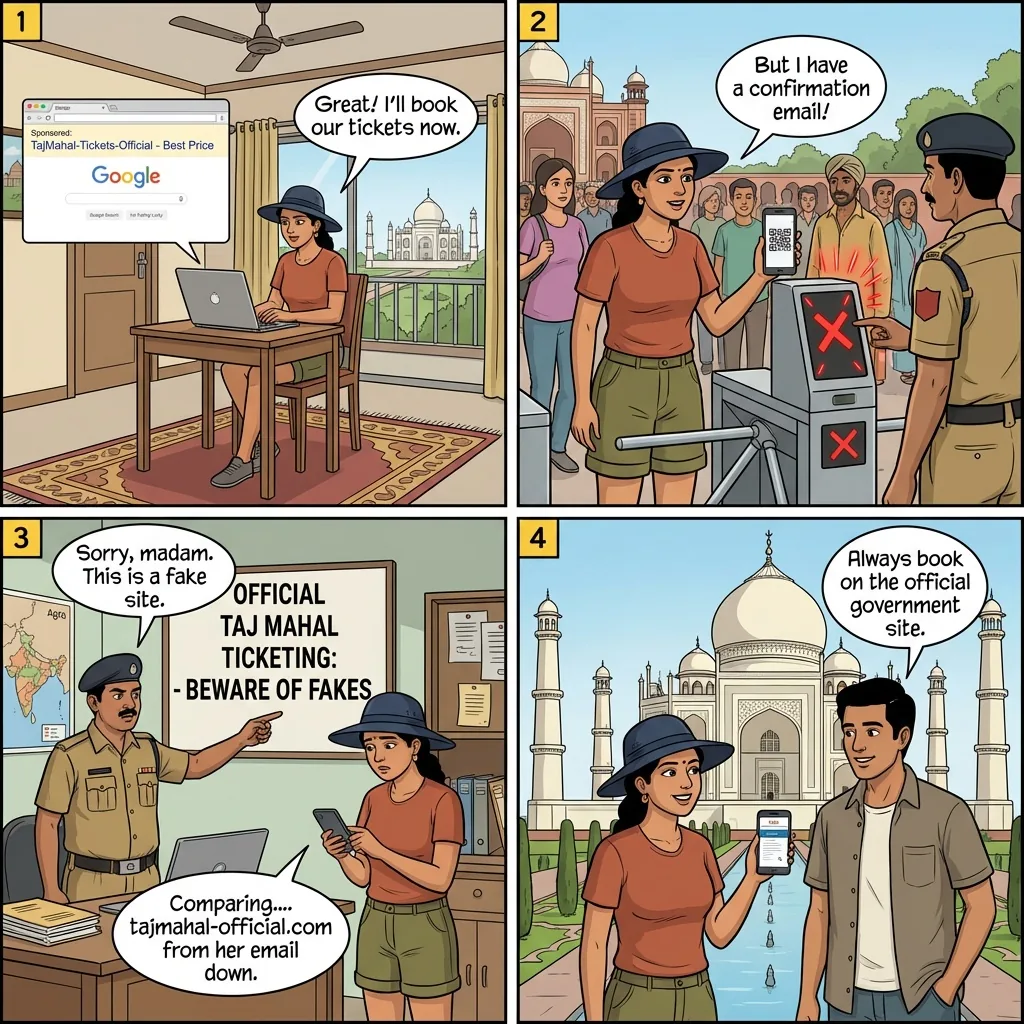
A lookalike site like ticketstajmahal.com sells you a $35 'Taj Mahal pass' that ASI staff scan as invalid at the gate, forcing you to rebuy at the ₹1,300 official rate.
The trap starts on Google. Sponsored results and lookalike domains float above the official Archaeological Survey of India booking page, often using names, logos, and even copies of the ASI seal. The checkout looks legitimate, complete with seat selection and a confirmation email.
The rejection happens at the entry queue. Your QR code throws an error, an ASI conservation assistant pulls you aside, and the staff explain the ticket was never issued by the monument. In April 2026, the Times of India reported that three foreign tourists were duped of $105 through tickets purchased on ticketstajmahal.com, with one paying $35 against the official ₹1,300 foreigner rate. Agra cybercrime police filed a First Information Report under Bharatiya Nyaya Sanhita sections 318 and 319 plus Information Technology Act provisions.
The hook is paid-search domain spoofing plus pre-trip planning panic — visitors book weeks ahead from abroad and trust the first polished site they find. ASI says only two platforms are authorized for online tickets. The defensive move is to book exclusively at asi.payumoney.com or asi.nic.in and to verify the URL bar reads asi.nic.in or asi.payumoney.com before entering any card detail.
Red Flags
- ticket site pays for the top Google ad slot instead of ranking organically
- domain ends in -tickets.com.info.org, or otherwise is not asi.nic.in
- foreigner ticket priced above ₹1,500 or in US dollars without a clear breakdown
- no Indian tax invoice or GST number anywhere on the confirmation
- site claims 'skip-the-line', 'VIP entry', or 'guaranteed entry' as a paid upsell
How to Avoid
- BOOK Taj Mahal tickets only on asi.payumoney.com or the Incredible India tourism portal.
- VERIFY the URL bar reads asi before entering card details, every single time.
- PHOTOGRAPH the QR code and the official ₹1,300 foreigner price before leaving home.
- SAVE the merchant name on your card statement and dispute any non-asi charge immediately.
- ASK your hotel front desk to print and verify your booking the day before your visit.
Like what you're reading? Get a full Agra itinerary with safety tips built in.
Browse travel-safety books →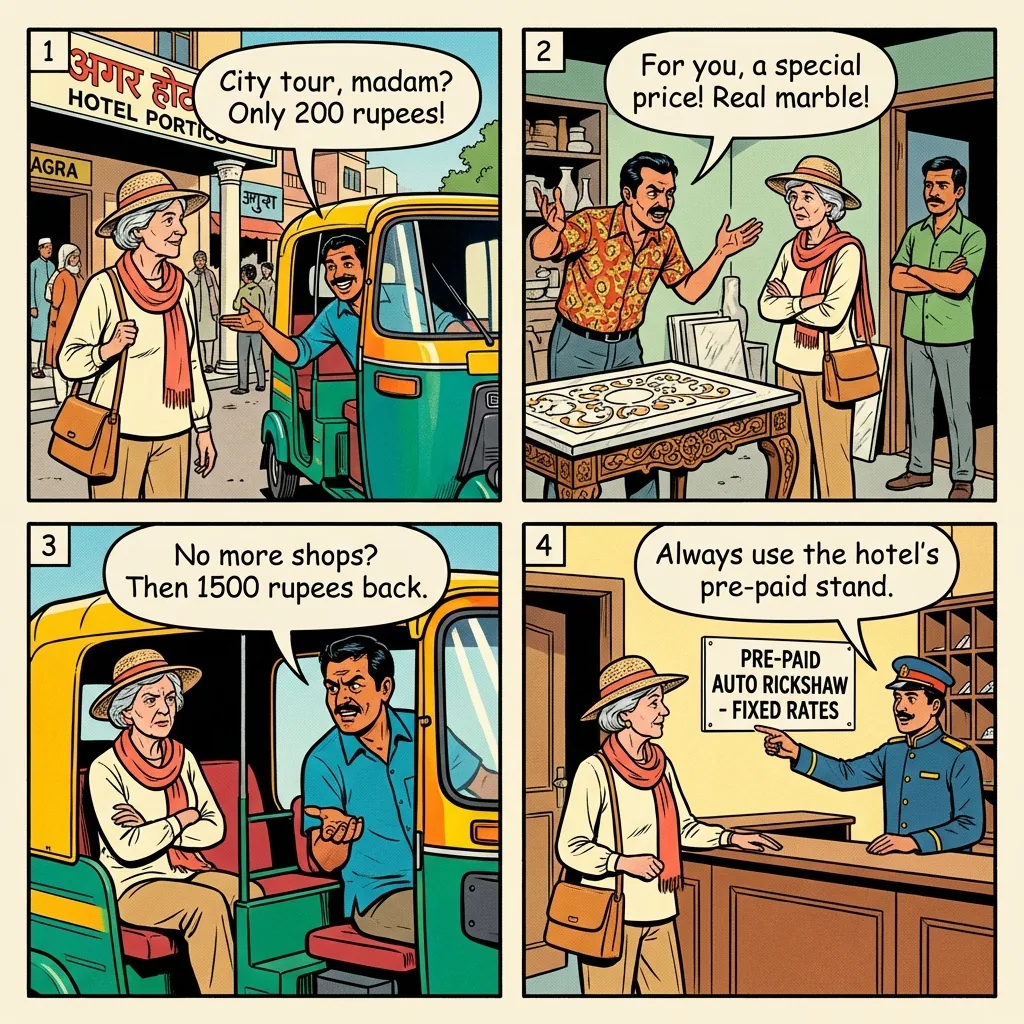
An autorickshaw driver offers a ₹200 'free city tour' that turns into a route through commission shops where staff hard-sell marble, leather, and silk.
The pitch sounds generous. He waves you over outside your hotel, says he is heading that way anyway, and quotes a price low enough to feel like a gift. He may even add 'no shopping, only sightseeing' to defuse your guard. On the road, the itinerary quietly drifts.
The first stop is a marble showroom; the second is a leather workshop; the third is a 'cooperative' selling pashmina and silk. Each stop costs you twenty to forty minutes of hard-sell while the driver collects a 30 percent to 40 percent commission on whatever you buy. Refuse to buy and the driver becomes irritable, drives further from your hotel, and reopens the fare to demand ₹800 to ₹1,500 to take you back. Travelers documented the playbook in a 2026 'Tuktuk scam?' Reddit thread that drew dozens of warnings.
The hook is sunk-cost stranding plus manufactured rapport — by the third shop you have already invested an hour, and the driver controls the route home. The defensive move is to ride only Uber Auto or Ola Auto booked from your hotel WiFi, with a fixed in-app fare and no permission for unscheduled stops.
Red Flags
- driver greets you outside the hotel before you have asked for a ride
- fare quoted is suspiciously low for the distance, often ₹200 or less
- promise of 'sightseeing only, no shopping' that quietly adds shop stops
- driver suggests one more place after every stop, never circling back
- demand for higher return fare appears only when you refuse to shop
How to Avoid
- BOOK every ride through the Uber Auto or Ola Auto app from inside your hotel WiFi.
- DECLINE all street-corner autorickshaw offers, especially those described as free or sightseeing.
- WRITE a no-stops itinerary on paper and show it to the driver before you set off.
- SAVE the Agra Tourist Police number +91 9454402764 in your phone before the trip.
- EXIT the auto immediately at the first unsolicited shop stop and rebook in the app.
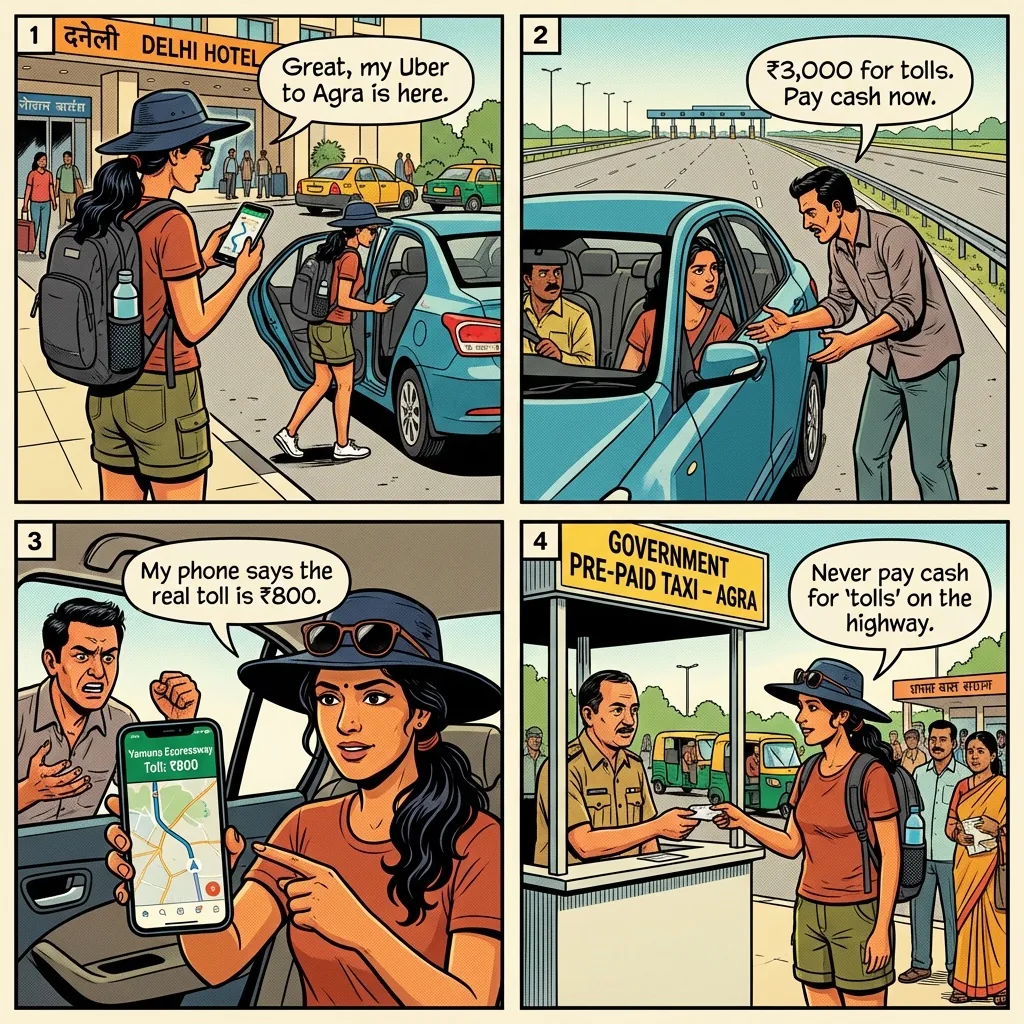
Your Uber Intercity driver stops on the Yamuna Expressway and a man at the window demands ₹2,500 to ₹4,000 in 'toll and state tax' on top of the app fare.
The booking looked clean. The Delhi to Agra ride quoted around ₹3,500 in the app, with a banner noting that tolls and state taxes are paid separately. You climb in. Forty minutes down the highway, the driver pulls over, calls a colleague, and a second man approaches.
The demand lands in cash. He claims the actual tolls and Uttar Pradesh state tax are ₹2,500, ₹3,000, even ₹4,000, and refuses to drive on until paid. A solo American traveler reported in early 2026 that she paid ₹2,500 extra on a ₹3,500 ride after being driven onto the highway shoulder. A separate Delhi rider was quoted ₹4,000 on a Delhi-to-Hanumangarh leg the same season. The real total of Yamuna Expressway and city tolls for a private car is closer to ₹800 to ₹1,000.
The hook is a real Uber policy weaponized into a roadside shakedown — the app does require passengers to pay actual tolls, so the demand sounds plausible. The defensive move is to insist on paying tolls only at the toll plaza counter, photograph every receipt, and contact Uber Support in the app for a refund the moment you reach Agra.
Red Flags
- driver pulls over on the highway shoulder before reaching the first toll plaza
- second man appears at the window to deliver the surcharge demand
- amount demanded is over ₹1,500 for a Delhi to Agra leg
- driver refuses to take cash receipts from the actual toll booth
- request to send the surcharge by UPI rather than the in-app fare
How to Avoid
- PAY tolls only at the toll plaza booth and keep every paper receipt.
- USE the in-app fare estimate plus around ₹1,000 in cash as your full toll budget.
- MESSAGE Uber Support inside the ride to flag any extra cash demand in real time.
- SCREENSHOT the booking confirmation that lists tolls as separate before you leave Delhi.
- BOOK a hotel-arranged car at a fixed quote if you are traveling solo with luggage.
🆘 What to Do If You Get Scammed
📋 File a Police Report
Go to the nearest Indian Police station. Call 100 (Police) or 112 (Emergency). Get an official crime report — you'll need this for insurance claims. You can also report online at citizenservices.gov.in.
💳 Cancel Your Cards
Call your bank immediately. Most have 24/7 numbers on the back of the card (keep a photo saved separately). Block any suspicious transactions before the thieves use your details.
🛂 Lost Passport?
Contact your nearest embassy or consulate. The US Embassy in New Delhi is at Shantipath, Chanakyapuri, New Delhi 110021. For emergencies: +91 11-2419-8000.
📱 Track Your Device
If your phone was stolen, use Find My (iPhone) or Find My Device (Android) from another device. Don't confront thieves yourself — share the location with police instead.
Frequently Asked Questions
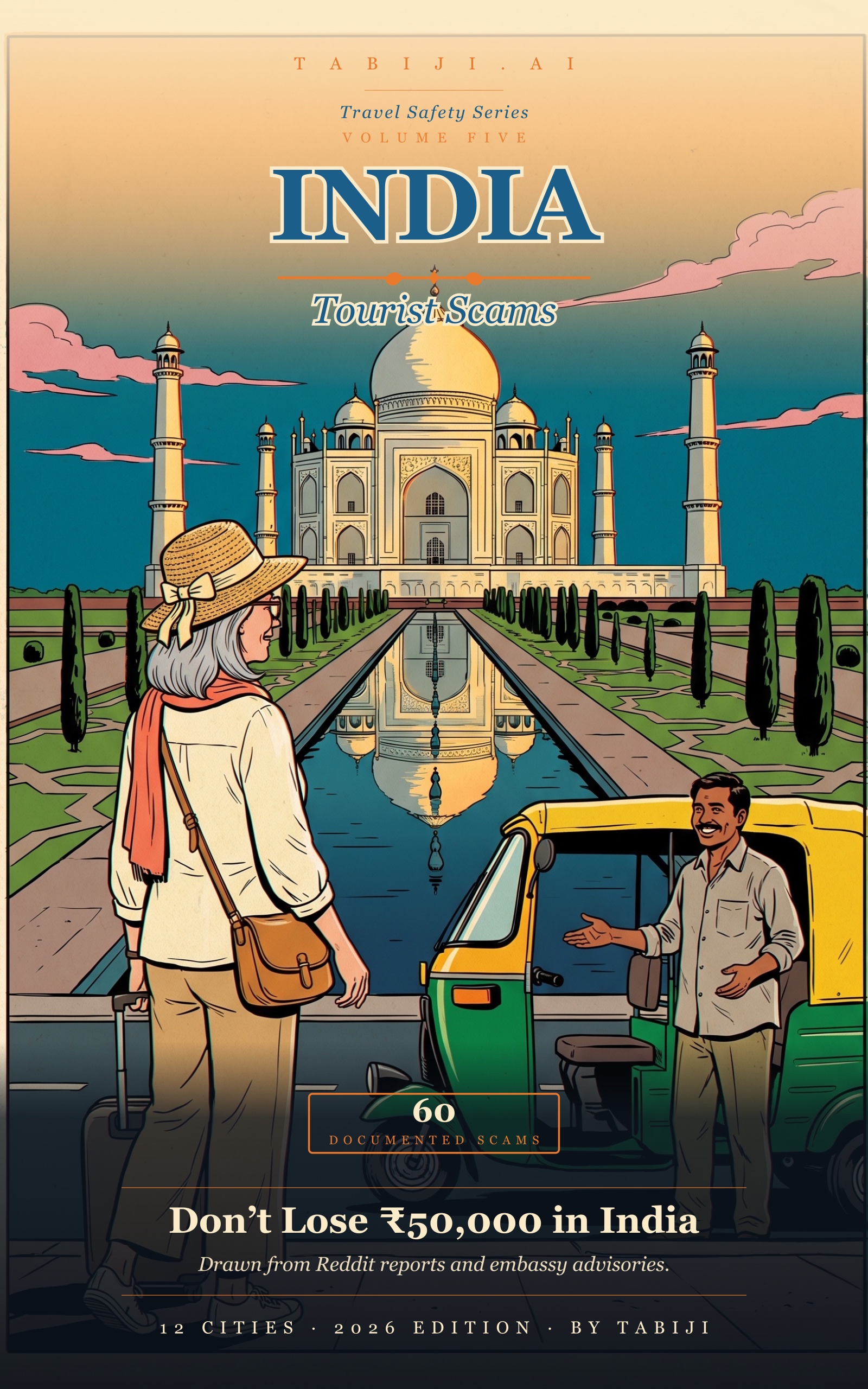
You just read 5 scams in Agra. The book has 60 across 12 Indian cities.
Delhi’s Paharganj “India Tourism” rebooking trap. Jaipur’s Hawa Mahal rickshaw textile detour. Mumbai’s ₹61,000 dating-app pub bill. The Lake Pichola sunset-photo extortion. The Bengaluru Silk Board meter manipulation. Every documented India scam — with the exact scripts, red flags, and Hindi phrases that shut each one down. Drawn from Reddit, the Times of India, News18, Telangana Today, and embassy advisories.
- 60 documented scams across Delhi, Mumbai, Jaipur, Agra & 8 more cities
- A Hindi exit-phrase card (Devanagari + Latin) you can screenshot to your phone
- Updated annually — buy once, re-download future editions free
- Readable in one flight — $4.99, coming soon on Amazon Kindle