Fake monk donation, four mechanics behind the saffron robes.
A man in saffron robes near Bangkok Wat Pho tying a thread bracelet on your wrist and demanding 200 USD. A grey-robed figure on Hong Kong Nathan Road offering a "lucky number" reading then demanding 800 USD. A Singapore Chinatown street offering a "private temple tour with special prayer" for 100 USD. A group of three at the Po Lin Buddha steps converging simultaneously. Four mechanics across 5 East and Southeast Asian countries, defeated by the same five-second rule: real Buddhist monks do not approach tourists for cash.


Fake monk donation scams run four mechanics across 5 East and Southeast Asian countries: bracelet-blessing approach (most common, with 100-500 USD demand after wrist-tying), temple-tour fee (offer of "private tour with special prayer" at gates), fortune-card extraction (Hong Kong / Singapore variant), and group-surround at temple gates. The universal defense is one five-second rule: real Buddhist monks do not approach tourists for cash. The Theravada vinaya and Mahayana pratimoksha both prohibit cash solicitation. The defense in depth is walking past at normal pace, refusing bracelet and fortune-card offers, declining temple-tour offers from individuals at gates, and donating only via the temple's official offering box.
"Bracelet for blessing, sir, just one minute, please give your wrist."
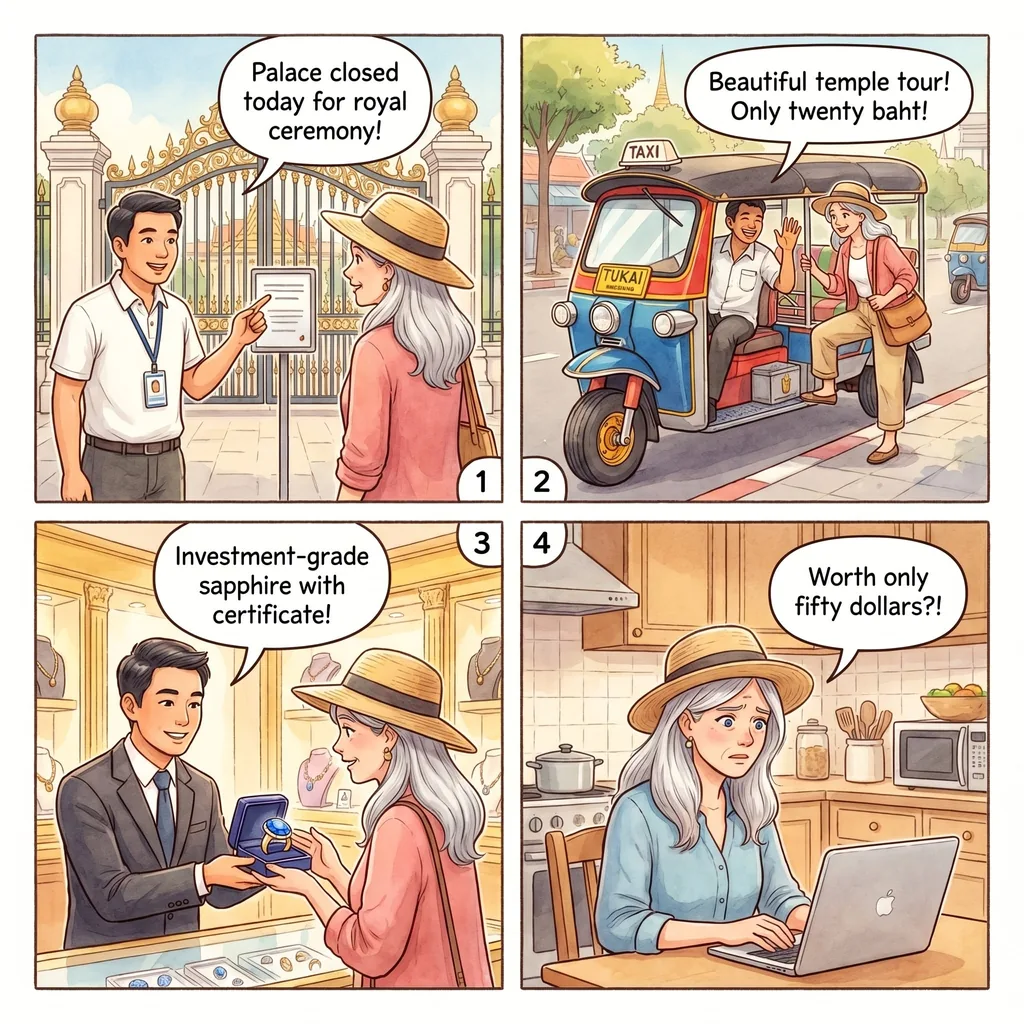
You walk to Wat Pho temple in Bangkok at 10am on a Saturday. The temple complex (home to the Reclining Buddha) is a major Theravada Buddhist site; the gate area on Maha Rat Road is busy with tour groups, locals, and street vendors. As you approach the official ticket office to buy entry, a man in saffron-orange robes steps out from a small group of street vendors. His robes look authentic; he carries a small bowl. He smiles, says in clear English: "Sir, sir, please, bracelet for blessing, very lucky for your family, come, give me your wrist, just one minute, no problem."
You stop. He extends a small woven thread bracelet (red and yellow). His other hand is open, fingers wiggling, gesturing for your wrist. You hesitate; the man chants briefly in what sounds like Pali, ties the bracelet on your wrist, makes a small bow with hands together. Then opens his hand: "Now donation, sir, 500 baht please, for the temple, for blessing." 500 THB is about 15 USD. You pull out a 100 THB note and offer it. He shakes his head: "No no, 500 baht minimum, this is for blessing, very important, you must respect."
What just happened: real Theravada Thai Buddhist monks (phra) follow vinaya rules that prohibit them from soliciting cash. They receive almsgiving (food, robes, basic supplies) from laypeople during formal alms rounds at dawn (typically 6:00-7:30am). They walk silently with their alms bowl; laypeople approach them with food offerings; the monks accept silently and continue walking. They do not stand at temple gates, do not engage tourists in English, do not give bracelets, and do not demand cash.
The man at the Wat Pho gate is not a real monk. He is wearing approximate saffron robes (the actual color and stitching pattern are off if you look closely) and exploiting tourist unfamiliarity with the vinaya code. The Bangkok Tourist Authority of Thailand (TAT) and the Thai Sangha Council both issue annual advisories about fake-monk operators around major Buddhist temples; the Thai Tourist Police 1155 (English-speaking dispatch) accepts complaints. The variant has been documented continuously since at least the 1990s; the Wat Pho temple administration has installed signage at the gate warning tourists not to give cash to individuals in robes.
You take ninety seconds. You hand back the bracelet (politely, no eye contact). You say "mai aw, kop khun krap" (don't want, thanks) and walk to the official ticket office. The man tries one more "sir, sir, just 200 baht then" but moves on to the next tourist within 10 seconds. You buy your Wat Pho entry ticket (200 THB), walk through the gate, see the actual Reclining Buddha. On your way out, you drop a 50 THB note in the official Wat Pho offering box near the main hall — the offering goes to the actual temple, recorded in the temple's accounting.
That is the canonical bracelet-blessing variant of the fake-monk-donation family, executed at one of the most-documented locations in Asia. The rest of this page is the four-mechanic playbook, the four other places where it runs in different forms (Hong Kong, Singapore, Shanghai, Hanoi), and the walk-past rule that defeats every variant.
Read the full Bangkok scam guide →Key Takeaways
The walk-past rule
Fake monk donation depends on you stopping to engage with someone in robes. Real Buddhist monks do not approach tourists; they receive almsgiving silently during formal dawn rounds. The defensive routine is one trained habit: walk past at normal pace, no eye contact. The play falls apart instantly because the operator cannot work a moving target.
- Real Buddhist monks do not approach tourists for cash. Theravada vinaya and Mahayana pratimoksha both prohibit cash solicitation from laypeople. Anyone in monastic robes approaching you on the street, in a shopping mall, or at a temple gate asking for cash is not following the monastic code.
- Refuse the bracelet-blessing approach. A person in saffron or grey robes hands you a thread or beaded bracelet, ties it on your wrist, then demands cash. Walk past at normal pace. Do not extend your wrist. Do not accept the bracelet.
- Refuse temple-tour offers from individuals at temple gates. "Private temple tour with special prayer" for 50-200 USD is the variant. Real temple tours are booked through licensed agencies; real temples have ticketed entry.
- Decline "fortune card" or "lucky number" offers. The free fortune is the lure; the cash demand is the actual ask. Walk away; the variant cannot work against a moving target.
- If you want to donate, donate at the temple's official offering box. Every functioning Buddhist temple has an official offering box near the main hall. Individual robed monks soliciting outside the temple do not represent the temple's accounting.
The four mechanics
Different cities and operator networks lean on different mechanics within the same family. Here are the four sub-variants documented across East and Southeast Asia. Each has a recognition tell, a primary geography, and the routine step that defeats it.
1. Bracelet-Blessing Approach
The most-documented variant globally. A person in saffron or grey robes hands you a small thread or beaded bracelet, sometimes ties it on your wrist while making a chanting sound and gesturing as if blessing. Then demands a "donation" of 100-500 USD equivalent. Real monks do not give bracelets to non-Buddhists, do not chant blessings to strangers in shopping malls, and do not demand cash.
Defense: walk past at normal pace. Do not extend your wrist. Same family as Friendship Bracelet (Vol 17) but with religious framing. Most reported in: Bangkok Wat Pho, Wat Arun gates and Khaosan Road approach; Chiang Mai Wat Phra Singh; Phuket Patong Beach approach; Hanoi Temple of Literature; Shanghai Bund.
2. Temple-Tour Fee
A person in robes (or quasi-monastic dress) approaches at the gate of Wat Pho, Wat Arun, Po Lin Buddha (Lantau), Buddha Tooth Relic Temple, or Beijing's Lama Temple offering "a private temple tour with special prayer for your family" for 50-200 USD. The tour is a 15-minute walk through the public temple grounds with vague Buddhist commentary. Real tours are booked through licensed tour agencies.
Defense: walk past gate-side offers. Real temples have ticketed entry. Most reported in: Bangkok Wat Pho, Wat Arun, Wat Saket; Hong Kong Po Lin Buddha and Tian Tan steps; Singapore Buddha Tooth Relic Temple gate; Beijing Lama Temple, Yonghe Temple; Shanghai Jing'an Temple.
3. Fortune-Card / Lucky-Number Extraction
Documented heavily in Hong Kong Mong Kok, Tsim Sha Tsui, and Singapore Chinatown. A robed person offers a "fortune card" or "lucky number reading" or "palmistry" for free, hands the tourist a small printed card or recites a brief reading. After the reading, demands payment of 200-1,500 USD claiming the fortune is now "spiritually contracted" and not paying brings bad luck. The cash demand exploits post-commitment psychology and superstition.
Defense: refuse the fortune card or lucky number from the start. Most reported in: Hong Kong Mong Kok Nathan Road, Tsim Sha Tsui Promenade, Causeway Bay; Singapore Chinatown shopping streets, Orchard Road tourist zones, Marina Bay Sands; Macau Senado Square.
4. Group-Surround at Temple Gates
Most common at the Po Lin Buddha steps (Lantau Hong Kong), Wat Pho gate (Bangkok), and Buddha Tooth Relic Temple gate (Singapore). Two or three robed operators converge on the tourist simultaneously: one offers a bracelet, another offers a fortune card, the third offers a temple tour. The compounding pressure makes refusal feel rude in a religious-monumental setting. The variant runs at the same gate locations as the standard variants but at higher operator density during peak hours.
Defense: when you see two or three robed operators converging at a temple gate, change direction immediately. Most reported in: Hong Kong Po Lin Buddha approach (Ngong Ping cable car arrival); Bangkok Wat Pho gate; Singapore Buddha Tooth Relic Temple gate; Beijing Lama Temple west gate.
Where it runs
Fake monk donation concentrates at major Buddhist temple gates and high-tourist-density shopping districts in East and Southeast Asia. The five countries below cover the bulk of global tourist exposure.
| Country | Documented variants | Iconic location pattern |
|---|---|---|
| 🇹🇭 Thailand | 4 | Bangkok Wat Pho, Wat Arun, Wat Saket gates and Khaosan Road approach; Chiang Mai Wat Phra Singh; Phuket Patong Beach |
| 🇭🇰 Hong Kong | 4 | Mong Kok Nathan Road; Tsim Sha Tsui Promenade; Causeway Bay; Po Lin Buddha approach (Lantau) |
| 🇸🇬 Singapore | 3 | Chinatown shopping streets and Buddha Tooth Relic Temple gate; Orchard Road; Marina Bay Sands |
| 🇨🇳 China | 2 | Shanghai Bund and Nanjing Road; Beijing Wangfujing and Lama Temple approach; Xi'an Bell Tower |
| 🇻🇳 Vietnam | 1 | Hanoi Old Quarter near Temple of Literature; Ho Chi Minh City Notre-Dame; Hue Imperial City |
Bar width is data-bound at 35 pixels per documented variant. Thailand and Hong Kong together account for 60% of global exposure, driven by Bangkok temple-gate concentration and Hong Kong shopping-district density.
Four more places, four more monk variants
The Bangkok Wat Pho bracelet-blessing scene above showed the canonical Thai variant. Here are four more places where different sub-variants dominate. Each links to the full city scam guide.
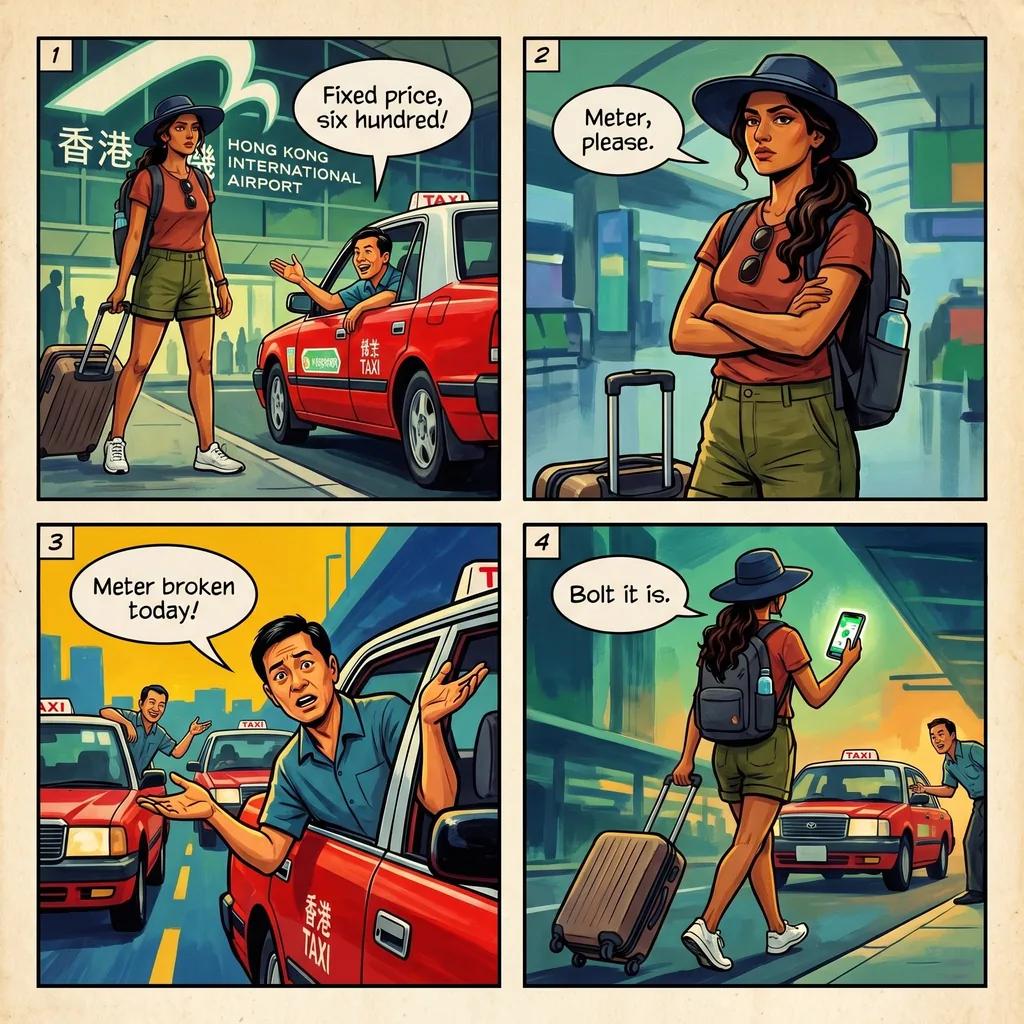
You walk along Nathan Road in Mong Kok at 4pm on a Friday. The neon-signed shopping street is dense with tourists; the Goldfish Market and Ladies' Market are both nearby. A figure in grey robes (Mahayana style; not Theravada saffron) approaches with a small printed card: "Sir, very lucky to meet, please, fortune reading for you, free, just one minute." You hesitate; he hands you the card (Chinese characters with red printing). He chants briefly, takes back the card, points to a Chinese character on it: "This is your lucky number, your lucky color is red, you will receive money in three months." He then opens his hand: "Now donation for the temple, 1000 USD, this is the fortune contract, must be paid for the blessing to take effect." 1000 USD is more than 7,800 HKD. The Hong Kong Police 999 / Hong Kong Tourism Board crime advisories list this variant continuously. The Mong Kok Police Station accepts walk-in reports. Defense: at Mong Kok / Tsim Sha Tsui / Causeway Bay, refuse fortune card or lucky number offers from the start. Real Mahayana monks in Hong Kong are based at Po Lin (Lantau) and Diamond Hill temples; they do not approach tourists in shopping streets.
Read the full Hong Kong scam guide →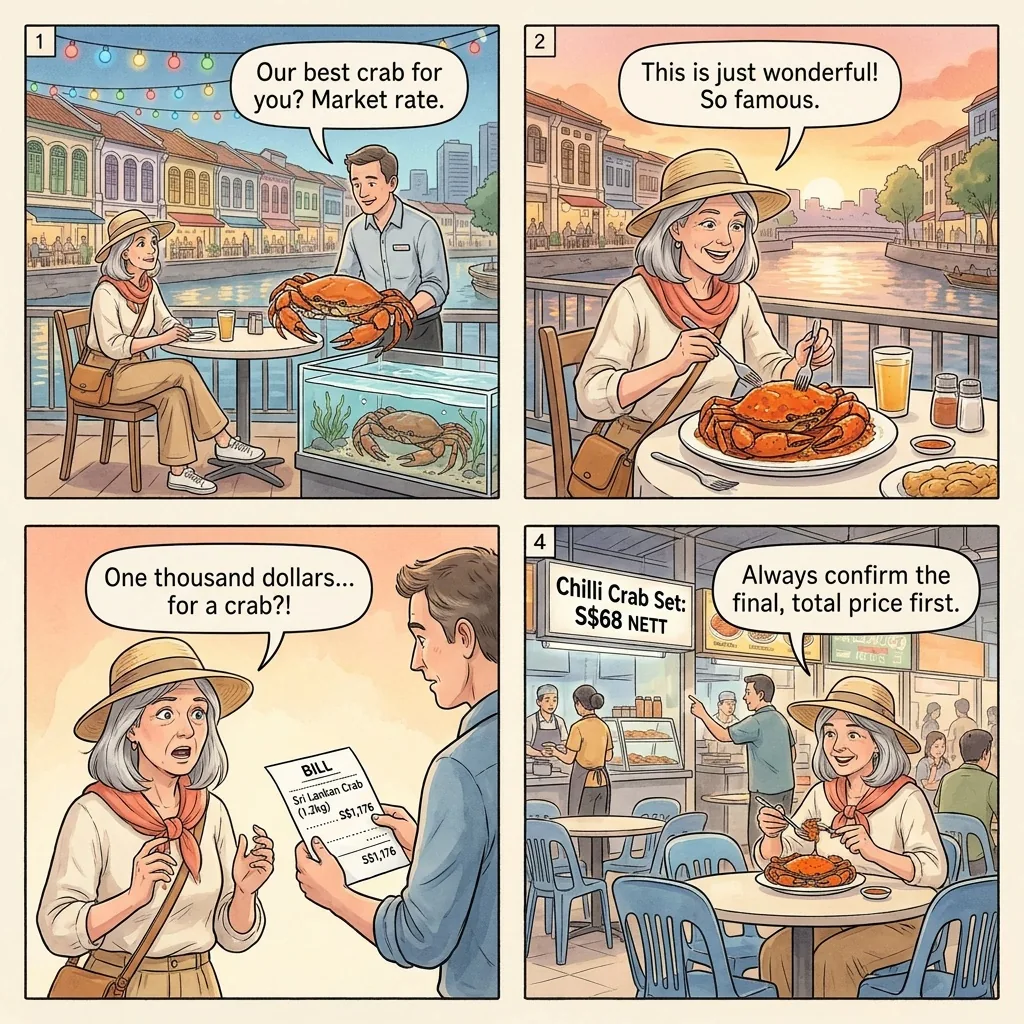
You walk to the Buddha Tooth Relic Temple in Singapore Chinatown at 11am on a Sunday. The temple is one of the city's most-visited Buddhist sites; the entrance is on South Bridge Road. As you approach the gate, a person in grey robes steps out from the small group of tourists at the entrance: "Sir, very nice to meet, please, I am a monk, I can give you a private temple tour with special prayer for your family, only 100 dollars Singapore, you and your wife, half hour." 100 SGD is about 75 USD. The Buddha Tooth Relic Temple has free entry (donations welcome at the official offering box); private tours are not offered by individual monks at the gate. The Singapore Police Force has issued advisories about Chinatown fake-monk variants; the Singapore Tourism Board has installed signage at major temple gates warning tourists. Defense: at Buddha Tooth Relic Temple and other Singapore temples, walk past gate-side offers. Real temple tours in Singapore are booked through Singapore Tourism Board's official website or Get Your Guide.
Read the full Singapore scam guide →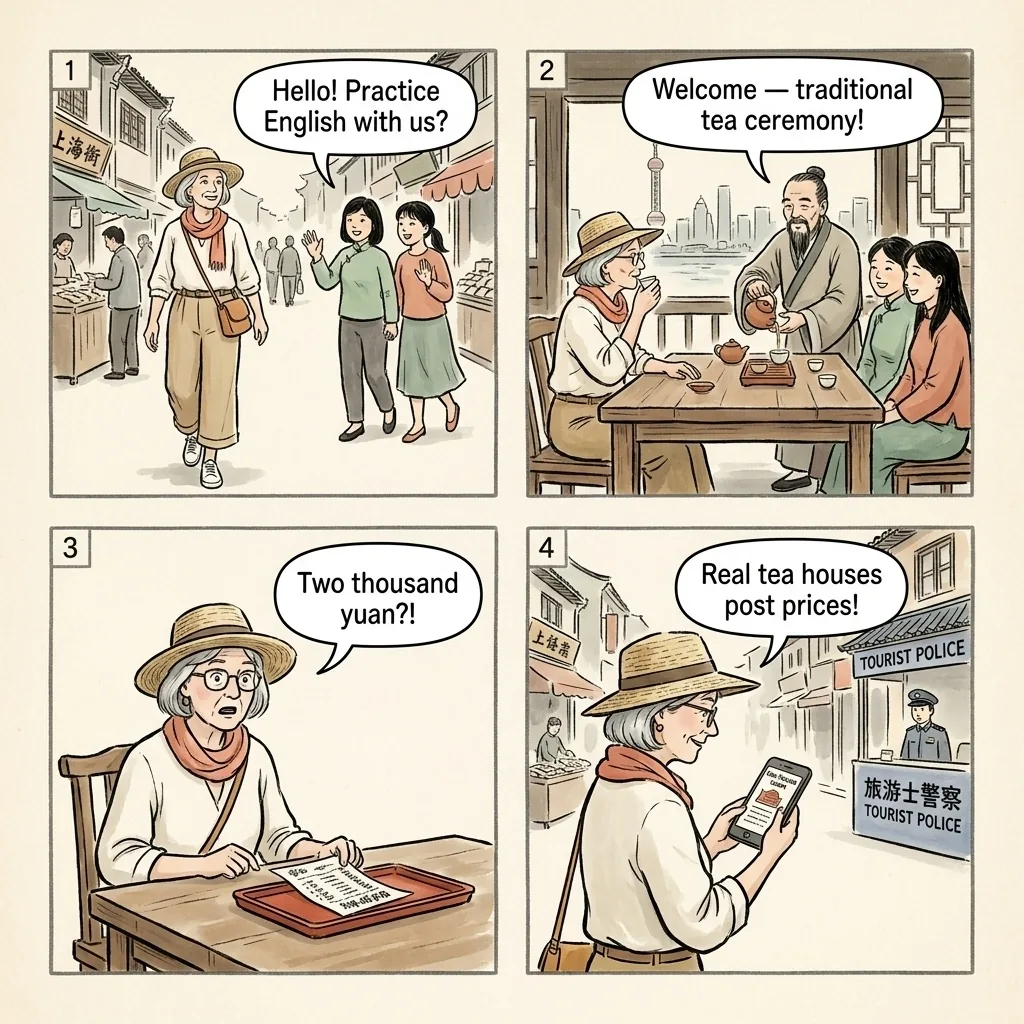
You walk along the Shanghai Bund at 6pm on a Saturday. The Pudong skyline glows across the Huangpu River; the Bund promenade is packed with tourists and locals. A figure in saffron-orange robes (Theravada style; rare in mainland China) approaches with a beaded bracelet: "Hello, sir, bracelet for blessing, your family will be lucky, very simple." The Theravada style is the tell — Chinese Buddhism is Mahayana; saffron robes belong to Thai / Cambodian / Lao / Myanmar / Sri Lankan monks who would not be on the Shanghai Bund. The man's accent is also off (suggesting he is Chinese mainland, not a Theravada monk from a different country). The Shanghai Police 110 accepts complaints; the Shanghai Tourism Bureau has issued bilingual advisories about Bund-area scam variants. Defense: the Shanghai Bund and Nanjing Road are tourist-heavy zones; refuse all "monk" approaches regardless of robe color. Real Mahayana Chinese monks are based at temples (Jing'an Temple, Longhua Temple) and rarely engage with tourists in shopping streets.
Read the full Shanghai scam guide →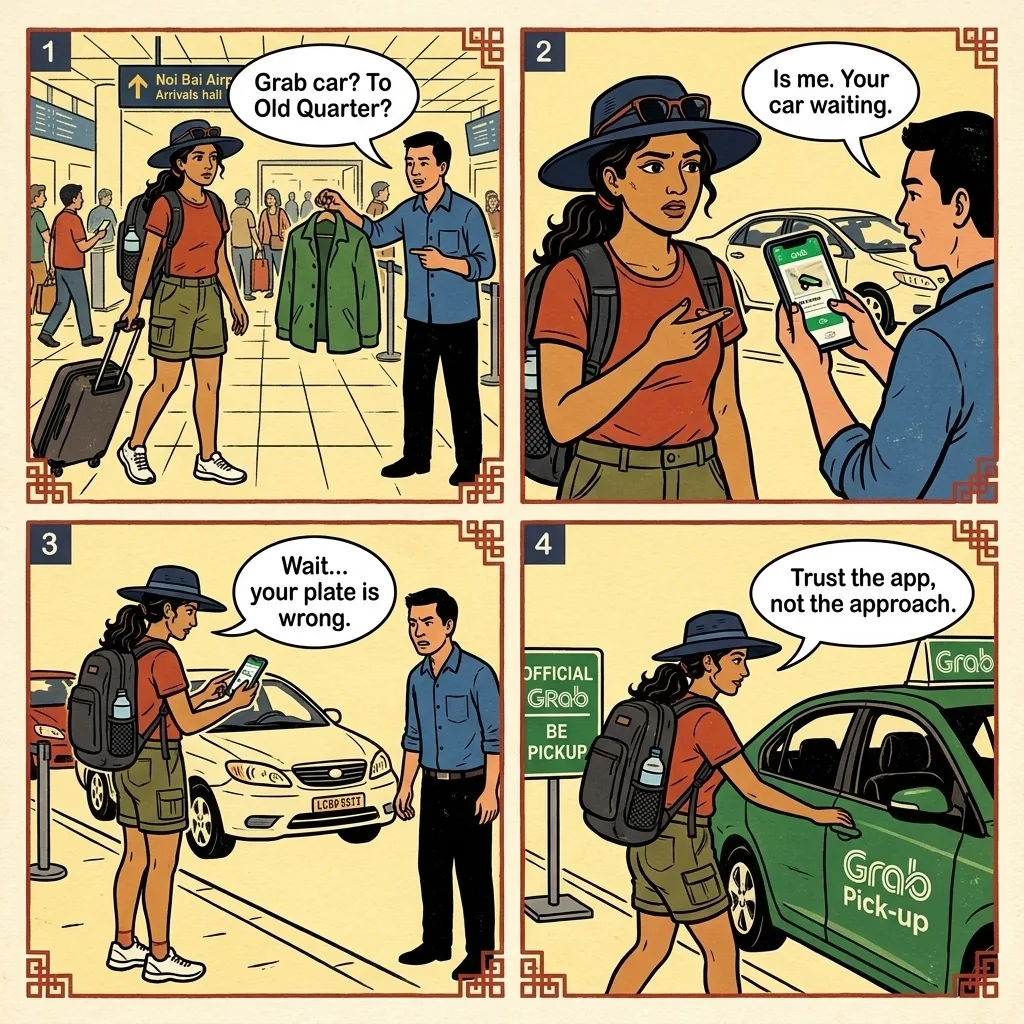
You walk to the Temple of Literature in Hanoi at 11am on a Tuesday. The temple (Van Mieu - Quoc Tu Giam) is one of Vietnam's most important Confucian-Buddhist sites and a major tourist destination; the entrance on Quoc Tu Giam street is busy with tour groups. As you approach the gate, three figures in grey robes (Mahayana Vietnamese style) converge on you simultaneously: one extends a bracelet, the second holds out a fortune card, the third gestures inside saying "private tour, 50 dollars." The compounding pressure makes refusal feel rude in the temple-gate setting. You take a deep breath, say "khong, cam on" (no thanks) firmly, and walk past all three at normal pace. They peel off after 5 seconds. The Vietnam Tourist Police 080-71-080 accepts complaints; the Vietnam Buddhist Sangha has issued statements clarifying that real monks do not solicit at temple gates. Defense: at major Vietnamese temples (Temple of Literature Hanoi, Notre-Dame Cathedral HCMC, Hue Imperial City), walk past gate-side robed approaches at normal pace. The group-surround variant cannot work against a moving target.
Read the full Hanoi scam guide →Red flags
If two or more of these signals fire when you encounter a person in monastic robes, walk past at normal pace. The compounding rule: a single signal might be a coincidence; two signals are a script.
- A person in monastic robes approaches you on a street or in a shopping mall
- The robe color is wrong for the country (saffron in China, grey in Thailand)
- The "monk" speaks fluent English / Mandarin / Cantonese to engage tourists
- The "monk" extends a bracelet, fortune card, or tour brochure
- The "monk" demands cash within 30 seconds of contact
- You are at a major temple gate, shopping street, or tourist promenade
- Two or three "monks" converge on you simultaneously
- The "monk" claims the bracelet/fortune/tour is "spiritually contracted"
- The cash amount demanded is 100-1500 USD (real almsgiving is small food/items)
- The "monk" uses superstition framing: "bad luck if not paid"
The phrases that shut it down
Refusing the fake monk works when you signal you don't want what they're offering. The phrase pattern is the same in every Asian language: don't want, thanks.
If you got hit
You paid 200 USD to a "monk" for a bracelet blessing or fortune card. Fake-monk-donation losses are rarely recoverable. Cash payments to individuals on the street have no transaction record; the operator and the cash leave the location within minutes. The actionable response is preventive for the next encounter, not recovery for this one.
Within 30 minutes: report to the local tourist police. Bangkok Tourist Police 1155 (English-speaking), Hong Kong Police 999, Singapore Police Force, Shanghai Police 110, Vietnam Tourist Police 080-71-080. The report number is required for travel-insurance claims, even when recovery rates are near-zero. The complaint helps the local authority track operator concentrations.
Within 24 hours: report to the country's tourism authority for advisory updates. TAT Thailand, Hong Kong Tourism Board, Singapore Tourism Board, Shanghai Tourism Bureau, Vietnam National Administration of Tourism all maintain advisories about fake-monk variants and accept English-language complaints.
If the variant included a bracelet that you cannot remove cleanly: cut it off with scissors or a small pocket knife. The bracelet has no value beyond the social pressure of the moment. The "spiritual contract" framing has no theological basis in either Theravada or Mahayana Buddhism.
- Bangkok: Tourist Police 1155 (24/7, English); TAT (Tourism Authority of Thailand) for advisories.
- Chiang Mai: Tourist Police via 1155; Wat Phra Singh administration for temple-area complaints.
- Hong Kong: Hong Kong Police 999; HK Tourism Board for advisories.
- Singapore: Singapore Police Force 999; Singapore Tourism Board complaint form.
- Shanghai: Shanghai Police 110; Shanghai Tourism Bureau for Bund-area complaints.
- Beijing: Beijing Police 110; Beijing Cultural Bureau for Lama Temple complaints.
- Hanoi: Vietnam Tourist Police 080-71-080; Vietnam National Administration of Tourism.
- If passport-related concern: embassy emergency line for travel-document support.
Recovery rates: cash 0% recoverable. The actionable response is preventive: walk past robed approaches at normal pace; refuse bracelet, fortune-card, and tour offers; donate at temple offering boxes only. The 5-second walk-past defeats every variant in advance.
Related atlas entries
Sister entries in the Scam Atlas. Fake monk donation overlaps with the Friendship Bracelet Trap (bracelet-blessing variant) and the Fake Charity Petition (donation-extraction variant); the temple-tour-fee variant connects to Fake Tour Guide.
Sources
- Tourism Authority of Thailand (TAT), Bangkok Wat Pho and Wat Arun fake-monk advisories (Thailand, ongoing).
- Thai Sangha Council (Mahatherasamakhom), official statements on lay solicitation by individuals in monastic robes (Thailand, multi-decade).
- Hong Kong Tourism Board, Mong Kok and Tsim Sha Tsui fake-monk fortune-card advisories (Hong Kong, ongoing).
- Singapore Police Force and Singapore Tourism Board, Chinatown and Orchard Road advisory (Singapore, ongoing).
- Shanghai Tourism Bureau, Bund-area scam variant bilingual advisories (China, ongoing).
- Vietnam Buddhist Sangha, statements on fake monks at Temple of Literature and HCMC Notre-Dame (Vietnam, ongoing).
- Bangkok Post, Wat Pho fake-monk investigative coverage (Thailand, 2018-2025).
- South China Morning Post, Mong Kok and Po Lin Buddha fake-monk reporting (Hong Kong, 2019-2025).
- r/travel, r/Thailand, r/HongKong, r/Singapore, r/China, r/Vietnam continuing thread monitoring 2018-2026.
Get the full fake-monk-donation playbook for your destination.
Each Travel Safety atlas covers every documented temple, monk, and donation scam in one country, plus the country's full scam catalog: pickpocket, taxi, ATM, restaurant, fake authority. Buy once, lifetime updates as scams evolve. $4.99 on Kindle.