Motorcycle phone snatch, two seconds and gone.
A drive-by hand-grab on Bui Vien at midnight. A bag-strap cut on Spaccanapoli at noon. A wrist-tethered phone yanked into traffic on Carrera 7. The drive-by phone-snatch and the bag-strap cut, documented across 11 countries — defeated by the same sidewalk-side rule.

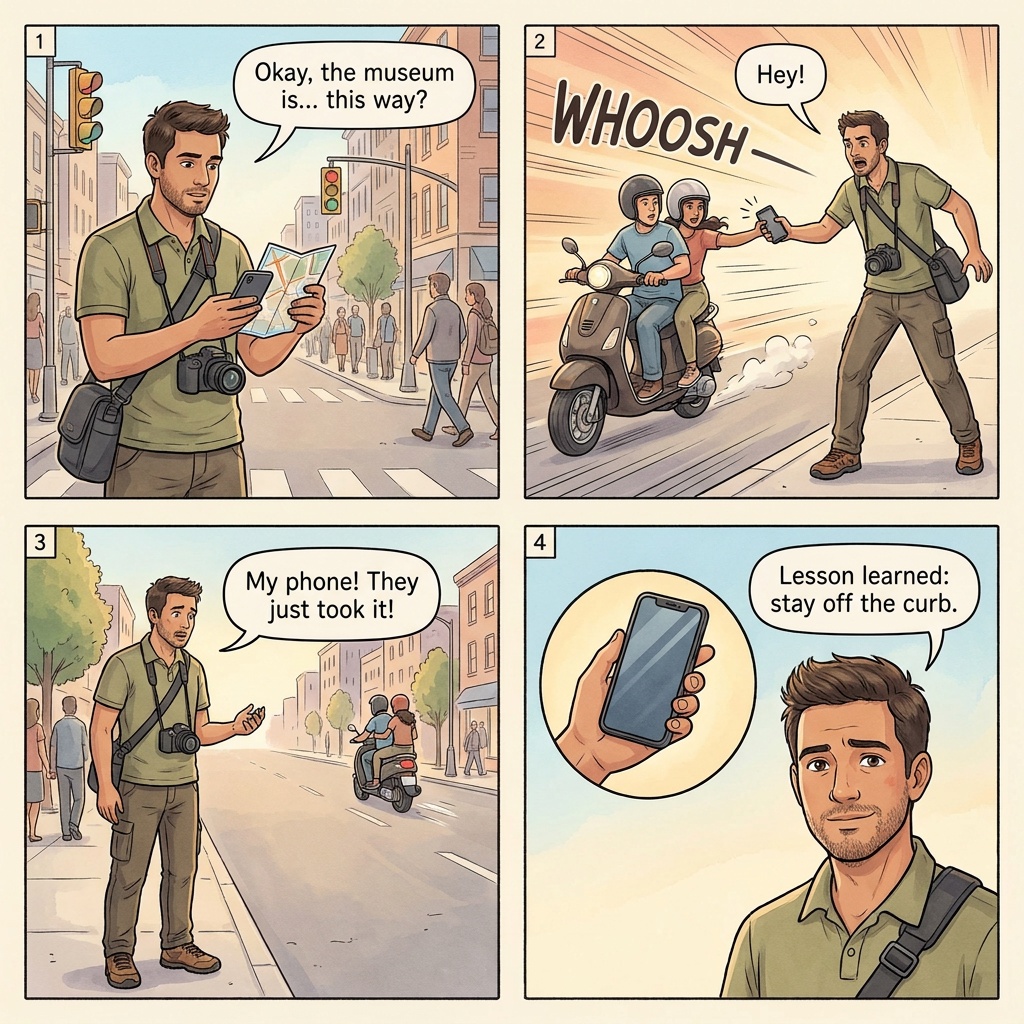
Motorcycle phone snatch runs two mechanics across 11 countries: drive-by phone-snatch (the rider grabs your phone in motion) and bag-strap cut (a passenger slices a single-shoulder bag strap as the bike accelerates past). The universal defense is sidewalk geometry. Walk inside the sidewalk away from the curb. Phone in deep front pocket; out only when stationary. Cross-body bag on the building-wall side. Treat any approaching engine as the cue to step inward and turn to face the road. The rider has to commit before the snatch; eye contact and a turn signal that you have seen them is enough to abort most attempts.
The phone went over your shoulder before you heard the engine.
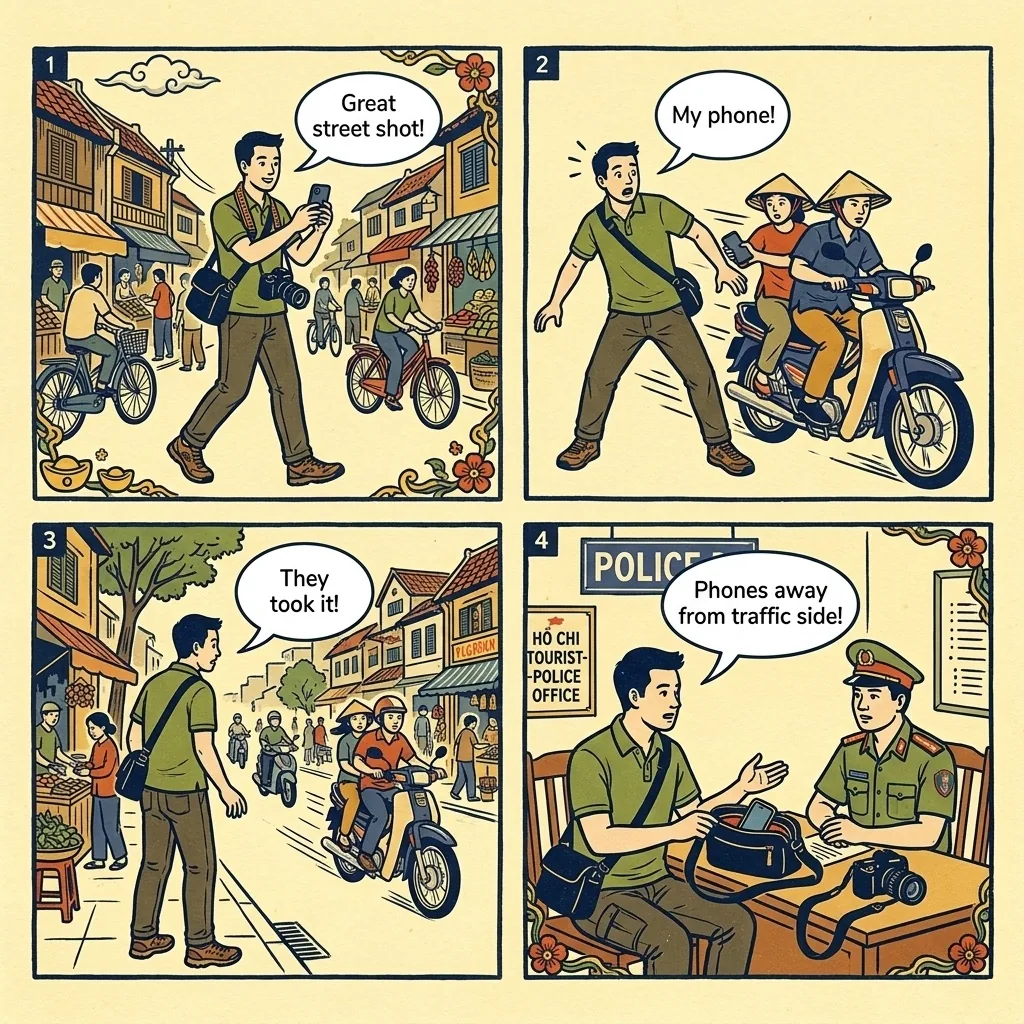
You walk down Bui Vien Walking Street at 11pm on a Friday in District 1. The street is full: backpacker bars, neon signs, the buzz of two-stroke engines from Tran Hung Dao. You hold your phone up to look at the Grab map for the next bar. A motorbike approaches from behind, the engine pitch rises slightly, then the rider on the back leans across and the phone is gone in one fluid motion. The bike accelerates into the cross-street and disappears.
Total elapsed time: about two seconds. Your phone is twelve thousand dong of fuel and two minutes of riding away.
You walk to the Tourist Information Center the next morning. The officer nods immediately when you describe the geometry. The Saigon variant is one of the most-documented drive-by snatches in the world; VnExpress publishes monthly arrest counts of the District 1 moto-snatch crews, the United States Embassy in Hanoi has issued specific phone-on-the-sidewalk warnings, and r/Vietnam threads run a continuous catalog of incidents. Most operators are 18-25 year-old males working in pairs (driver + grabber); the bikes are typically Honda Wave or Yamaha Sirius, the cheapest and most-anonymous models on Saigon roads.
The pattern is geometric. Bui Vien sidewalks are narrow. Phones come out when tourists check Grab. Bikes ride within arm's reach. Eye contact is rare because tourists are looking at their phones. The grabber does not need stealth; they need confidence and a fast bike.
The rest of this page is the two-mechanic playbook, the four other cities where the moto-snatch runs (Bogota, Medellin, Naples, Bali), and the sidewalk-side rule that kills 90% of the geometry without changing anything else about how you travel.
Read the full Ho Chi Minh City scam guide →Key Takeaways
The sidewalk-side rule
Motorcycle snatches depend on geometry: the rider needs your phone or bag within arm's reach of the road. The snatch itself is fast (under two seconds) but the setup is everything: which side of the sidewalk you walk, where your phone is, where your bag is. The defensive routine is one rule about position and one rule about device placement, repeated for every walk.
- Walk inside the sidewalk away from the curb. The drive-by needs the rider's hand to reach you. Walking on the building-wall side puts three feet of clearance between you and the road, eliminating roughly 90% of attempts before they start. Always pick the inside half of any sidewalk in Saigon, Bogota, Medellin, Naples, or Bali. Single most effective preventive move at zero cost.
- Phone in deep front pocket; out only when stationary. Never walk while looking at your phone in a high-snatch zone. If you need to navigate, step into a doorway, cafe, or shop, get your bearings, then pocket the phone before continuing. Phones in hand are the entire target signal; the rider scans for one and rides away if they don't see one.
- Bag-strap across your body, on the building-wall side. A single shoulder strap is the textbook bag-strap-cut target. Cross-body straps with the bag on the building side make the angle of attack impossible. For camera bags or laptops, add an anti-slash steel-cable lining (Pacsafe, Travelon, Bobby). Geometry beats the blade.
- Treat any approaching motorbike as the cue to step inward. If you hear an engine on your shoulder, step toward the wall and turn to face the road. The rider has to commit before the snatch. Eye contact and a turn signal that you have seen them is enough to abort most attempts. The grabber needs the angle of surprise; eye contact takes that away.
- Set up Find My iPhone or Find My Device before you leave home. If your phone is taken, you have minutes before the SIM is pulled. Have remote-wipe configured. Within five minutes of the snatch, mark as lost; within thirty minutes, remote-wipe. The wipe is the entire goal of the response; the phone itself is rarely recovered.
The two mechanics
The same drive-by motorcycle play splits into two operator preferences depending on what target you present. Both run identical geometry; both are defeated by the same sidewalk-side rule.
1. Drive-By Phone-Snatch
The rider on the back of a passing motorcycle reaches out and grabs your phone in one motion as the bike accelerates past. The grabber needs the phone in your hand or back pocket; phones in front pocket make the snatch geometrically impossible. The variant runs in any city with two-lane motorbike traffic adjacent to narrow sidewalks. Most documented in Saigon, Bogota, Medellin, Bali, Hanoi.
What it feels like: the engine sound rising slightly, then a tug, then the bike already in cross-traffic. Defense: phone in deep front pocket; only out when stationary.
2. Bag-Strap Cut
A passenger on the back of a passing motorcycle uses a small concealed blade (often a craft knife or razor) to slice through a single-shoulder bag strap as the bike accelerates past. The cut is so clean that you may not realize the bag is gone until you reach for it. In worst-case scenarios the rider grabs the bag mid-cut and is twenty meters away before you turn. Naples, Palermo, and parts of Mexico City run this variant most consistently.
What it feels like: a brief pressure on the strap, then the strap goes slack and the bag is gone. Defense: cross-body strap on the building-wall side; anti-slash lining for camera bags.
Where it runs
Motorcycle phone snatch concentrates where two conditions overlap: dense motorbike traffic and narrow sidewalks adjacent to that traffic. SE Asia and Latin America account for most documented variants; southern Italy is the European outlier.
| Country | Documented variants | Iconic location pattern |
|---|---|---|
| 🇻🇳 Vietnam | 5 | Saigon District 1 (Bui Vien, Dong Khoi) · Hanoi Old Quarter · Da Nang beach road |
| 🇨🇴 Colombia | 4 | Bogota La Candelaria and Carrera 7 · Medellin El Poblado · Cartagena historic center |
| 🇮🇹 Italy | 3 | Naples Spaccanapoli · Quartieri Spagnoli · Palermo Vucciria · Lungomare Caracciolo |
| 🇮🇩 Indonesia | 2 | Bali Kuta and Seminyak · Ubud monkey-forest perimeter · Canggu beach road |
| 🇲🇽 Mexico | 1 | Mexico City Roma · Condesa late-night corridors |
| 🇧🇷 Brazil | 1 | Rio Copacabana and Ipanema · Sao Paulo Paulista corridor |
| 🇰🇭 Cambodia | 1 | Phnom Penh riverside · Sisowath Quay |
| 🇵🇭 Philippines | 1 | Manila Makati · Boracay Station 2 |
Bar width is data-bound at 10 pixels per documented variant. The eight countries above account for 17 of 18 total variants, or 94% of the global atlas.
Four more cities, four more snatches
The Bui Vien scene above showed the drive-by phone-snatch variant. Here are four more cities where the same play runs the same way on different streets. Each links to the full city scam guide.
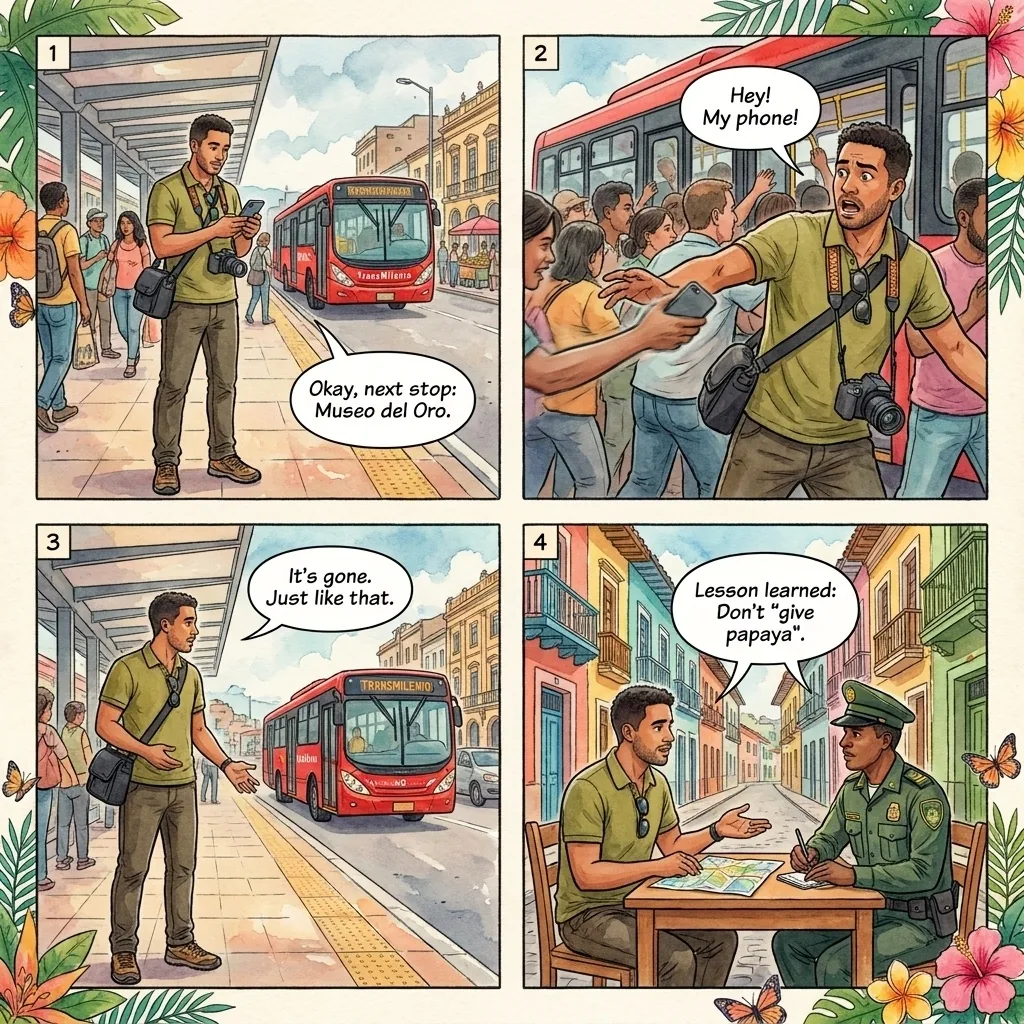
You walk down Carrera 7 from Plaza Bolivar to the gold museum at noon. Bogota traffic on Carrera 7 is heavy and motorbikes weave through the cars. You stop on the corner near La Candelaria's pedestrian crossing and pull out your phone to check Google Maps. A bike rolls past at walking pace; the passenger reaches across and the phone is gone in one motion. The Policia Nacional in Bogota issues quarterly tourist-safety bulletins specifically about the Carrera 7 and La Candelaria moto-snatch crews; the U.S. Embassy in Bogota's "Crime and Safety Report" runs the same warning every year. Daytime activity is high because phones-out behavior peaks during sightseeing hours. The Centro de Atencion al Turista at Calle 19 #4-71 accepts English-language reports. Defense: walk on the building-wall side of Carrera 7. Phone in front pocket. Pull it out only when stepping into a cafe or doorway with three feet of clearance from the curb. Bogota's TransMilenio bus system has phone-snatch issues at platform edges as well.
Read the full Bogota scam guide →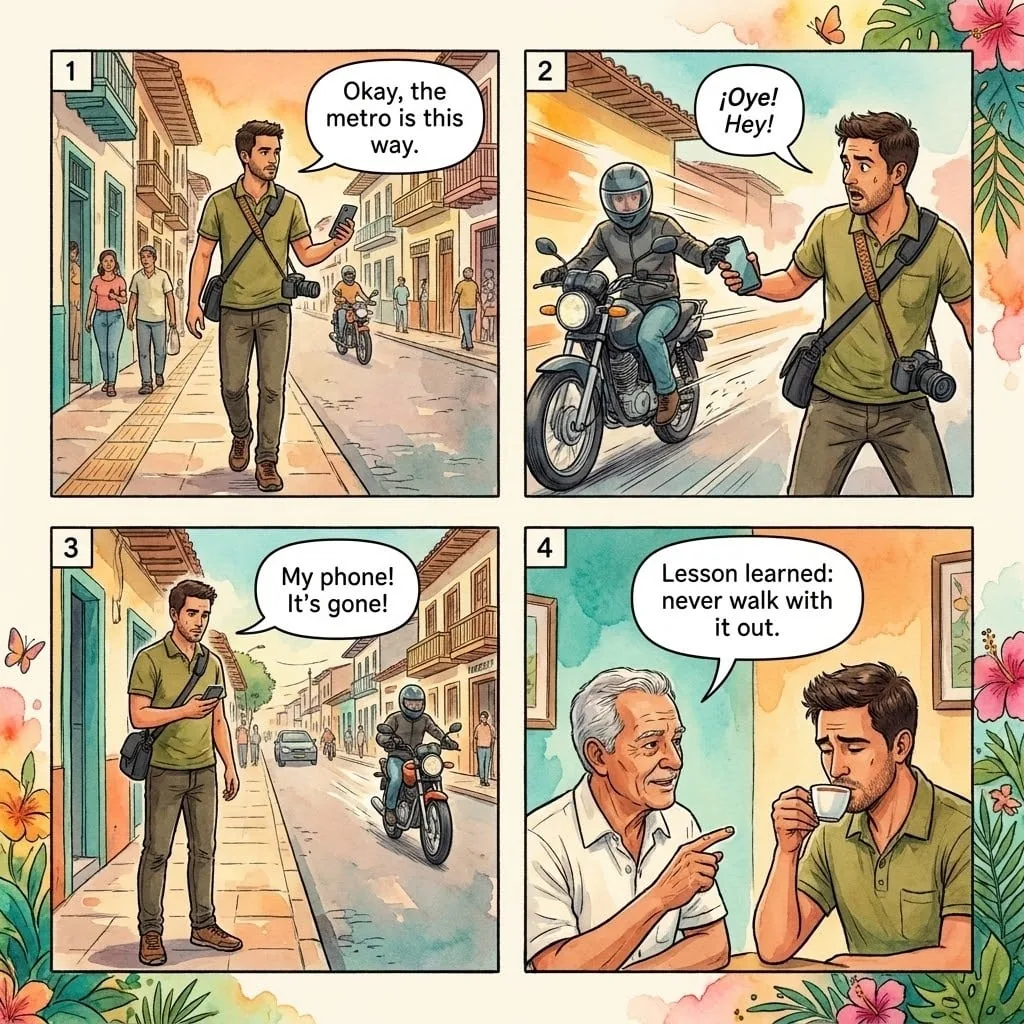
You walk from a rooftop bar in Parque Lleras back to your Airbnb in El Poblado at 1am. Calle 10 is the main artery; bikes pass continuously. You hold up your phone to call an Uber. A bike rises in pitch behind you, the passenger leans across, and the phone is gone. Medellin has more reported moto-snatch incidents than any other Colombian city; the Policia Metropolitana del Valle de Aburra publishes monthly stats. Night-time El Poblado runs a hybrid pattern: the rider grabs phones from people calling Ubers (a known high-value target signal). r/medellin advice is consistent: do not call Ubers from the sidewalk; step into the bar lobby or hotel doorway, complete the booking, then exit when the car is at the curb. Defense in Medellin: phone never out on Calle 10 or the surrounding El Poblado nightlife streets. The Tourist Police at Calle 10 #43E-56 accept English-language reports.
Read the full Medellin scam guide →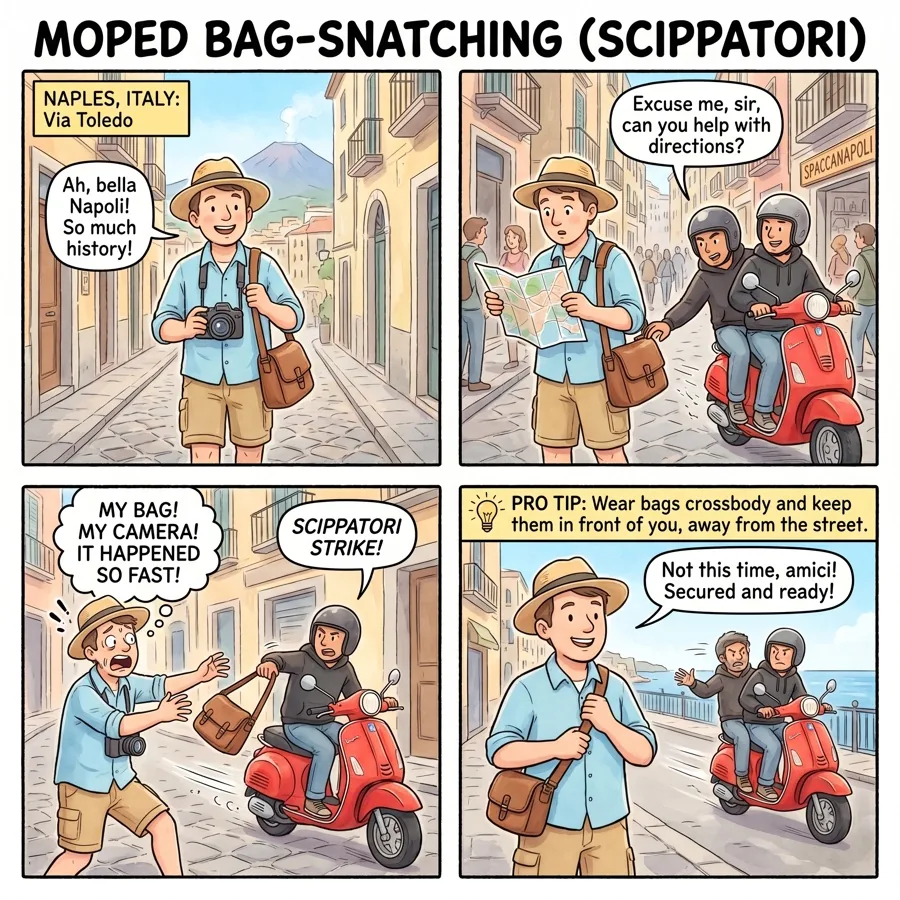
You walk down Spaccanapoli (the Roman-era straight street that bisects Naples Centro Storico) at 11am with a single-shoulder camera bag on your right side, road side. A Vespa passes at walking pace; the passenger leans toward you, and the bag is gone in one motion: a brief pressure on the strap, the strap goes slack, and the bike is twenty meters down the street before you turn. The Naples variant is called scippo (snatching) and is one of the most-documented bag-snatch patterns in Europe. The Polizia Municipale di Napoli runs continuous anti-scippo patrols on Spaccanapoli, Via dei Tribunali, and the Quartieri Spagnoli; Il Mattino publishes weekly arrest counts; the Comune di Napoli has posted multilingual signs in tourist-zone Centro Storico explicitly warning of the variant. Tipo Vespa or Honda Sh125 are the typical bikes; pairs work morning and afternoon shifts. Defense: cross-body bag on the building-wall side of every Centro Storico street. Anti-slash steel-cable lining for camera bags. The Polizia Municipale tourist help desk at Via Toledo accepts English-language reports.
Read the full Naples scam guide →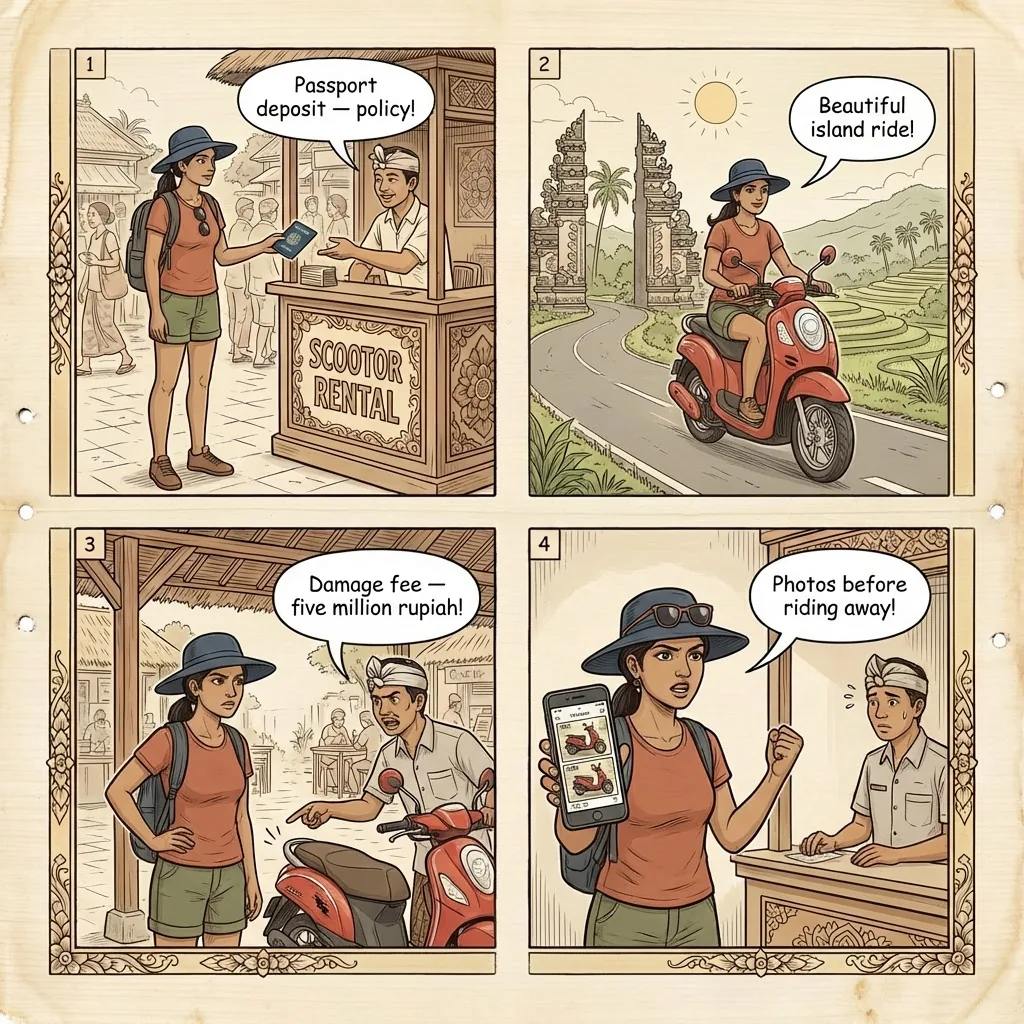
You walk from your Kuta hotel to a beachfront bar at sunset on Jalan Pantai Kuta. The street is one-way and narrow; scooters and Honda BeAT bikes weave through the foot traffic on both sides. You pull out your phone to check the bar's Maps location. A scooter passes at low speed, the passenger reaches across, and the phone is gone before you process the engine sound. Kuta and Seminyak run the moto-snatch variant continuously through high season (June-October and December-January); the Polisi Bali tourist police office in Denpasar issues quarterly bulletins. Ubud's Monkey Forest perimeter (Jalan Monkey Forest) and Ubud Centre run the same variant on tourists pausing to navigate to the Sacred Monkey Forest Sanctuary. The U.S. Embassy in Jakarta lists Bali phone-snatch as a top-three tourist-crime category. Defense: phone in deep front pocket on every Bali tourist road. Kuta-Seminyak-Ubud sidewalks (where they exist) are too narrow for the inside-side rule, so the only working defense is phone-not-out. Tourist police line: 110 (Polri); local English-speaking dispatch via Bali Tourist Police on Jalan Sumba.
Read the full Bali scam guide →Red flags
If two or more of these signals fire while you walk a tourist-zone street with motorbike traffic, immediately pocket the phone and shift to the building-wall side. The compounding rule: a single signal might be a coincidence; two signals are the geometry of a snatch.
- You are walking with phone visible in your hand
- Single-shoulder bag on your road side, not building side
- You are on a narrow sidewalk adjacent to two-lane motorbike traffic
- An approaching engine pitch rises slightly as it nears you
- Two riders on one motorbike (driver + passenger), passenger looking at you
- The bike is a small commuter model (Honda Wave, Yamaha Sirius, Vespa, Honda BeAT)
- You are stopped on a corner pulling out your phone in a tourist zone
- Late night or early morning when foot traffic is thinner
- Calling an Uber or Grab from the sidewalk in El Poblado, Bui Vien, or Ubud
- You feel the engine sound on your shoulder, not the road
The phrases that shut it down
Motorcycle snatches do not respond to verbal refusal because the snatch is over before words leave your mouth. The verbal phrases that matter are the ones you shout AFTER the snatch to alert witnesses for CCTV review and police response.
If you got hit
Your phone went over your shoulder, or your bag-strap is slack and the bag is gone. The first thirty minutes matter most: SIM-pull risk, account-access risk, CCTV review window. The phone itself is rarely recovered; the goal of the response is account safety and the police-report number for your travel-insurance claim.
Within five minutes: open Find My iPhone or Find My Device on a friend's phone, hotel computer, or Apple/Google watch if you wear one. Mark the device as lost (this displays a contact number on the lock screen and prevents new account additions). Note the last-seen location for the police report.
Within thirty minutes: remote-wipe the device. The wipe is irreversible but protects your accounts. Most operators sell to known fences within hours; the SIM is pulled within 30 minutes; the device is reset and resold by the next morning. Any chance of recovery is gone in that window.
Within one hour: file a police report with the local tourist-police line:
- Ho Chi Minh City: Tourist Information Center +84 28 3823 2436; Vietnam Tourist Police 113.
- Bogota: Centro de Atencion al Turista, Calle 19 #4-71; Policia Nacional 123.
- Medellin: Tourist Police, Calle 10 #43E-56 (El Poblado); Policia Metropolitana 123.
- Naples: Polizia Municipale tourist help desk on Via Toledo; Carabinieri 112.
- Bali (Denpasar): Bali Tourist Police on Jalan Sumba; Polri 110.
- Hanoi: Tourist Information Center +84 24 3826 5077.
For travel-insurance claims, the police-report number plus your phone's serial/IMEI is sufficient documentation. Most premium-tier travel cards (Amex Platinum, Chase Sapphire Reserve, Capital One Venture X) include lost-device coverage up to $500-$1,000 with the police report. Replacing a phone abroad is straightforward in major cities; iPhone availability is good in Saigon (FPT Shop, TopZone), Bogota (Falabella, Alkosto), Bali (iBox at Beachwalk Kuta), and Naples (TIM, Vodafone main stores). Carry a spare unlocked phone in your hotel safe so you have immediate replacement capacity.
Related atlas entries
Sister entries in the Scam Atlas. Motorcycle phone-snatch is a sub-pattern of the broader pickpocketing family but distinct enough in geometry and recovery to warrant its own playbook.
Sources
- VnExpress, monthly arrest counts of Saigon District 1 moto-snatch crews (Vietnam, 2018–2025).
- U.S. Embassy Hanoi tourist-safety bulletins on phone-on-the-sidewalk warnings (2023–2025).
- El Tiempo and El Espectador, Bogota Carrera 7 and La Candelaria moto-snatch coverage (Colombia, 2020–2025).
- Policia Metropolitana del Valle de Aburra monthly tourist-crime statistics (Medellin, 2022–2025).
- Il Mattino, Naples Spaccanapoli scippo arrest weekly summaries (Italy, ongoing).
- Comune di Napoli anti-scippo signage and Polizia Municipale Centro Storico patrol records.
- U.S. Embassy Jakarta Bali tourist-crime category reports (Indonesia, 2024–2025).
- r/travel, r/Vietnam, r/Colombia, r/medellin, r/naples, r/bali continuing thread monitoring 2018–2026.
Get the full snatch-defense playbook for your destination.
Each Travel Safety atlas covers every documented motorcycle-snatch variant in one country, plus the country's full scam catalog: pickpocket, taxi, ATM, restaurant, distraction. Buy once, lifetime updates as scams evolve. $4.99 on Kindle.